
Life, 1923-04-19 · page 29 of 36
Life — April 19, 1923 — page 29: what you’re looking at
What you’re looking at
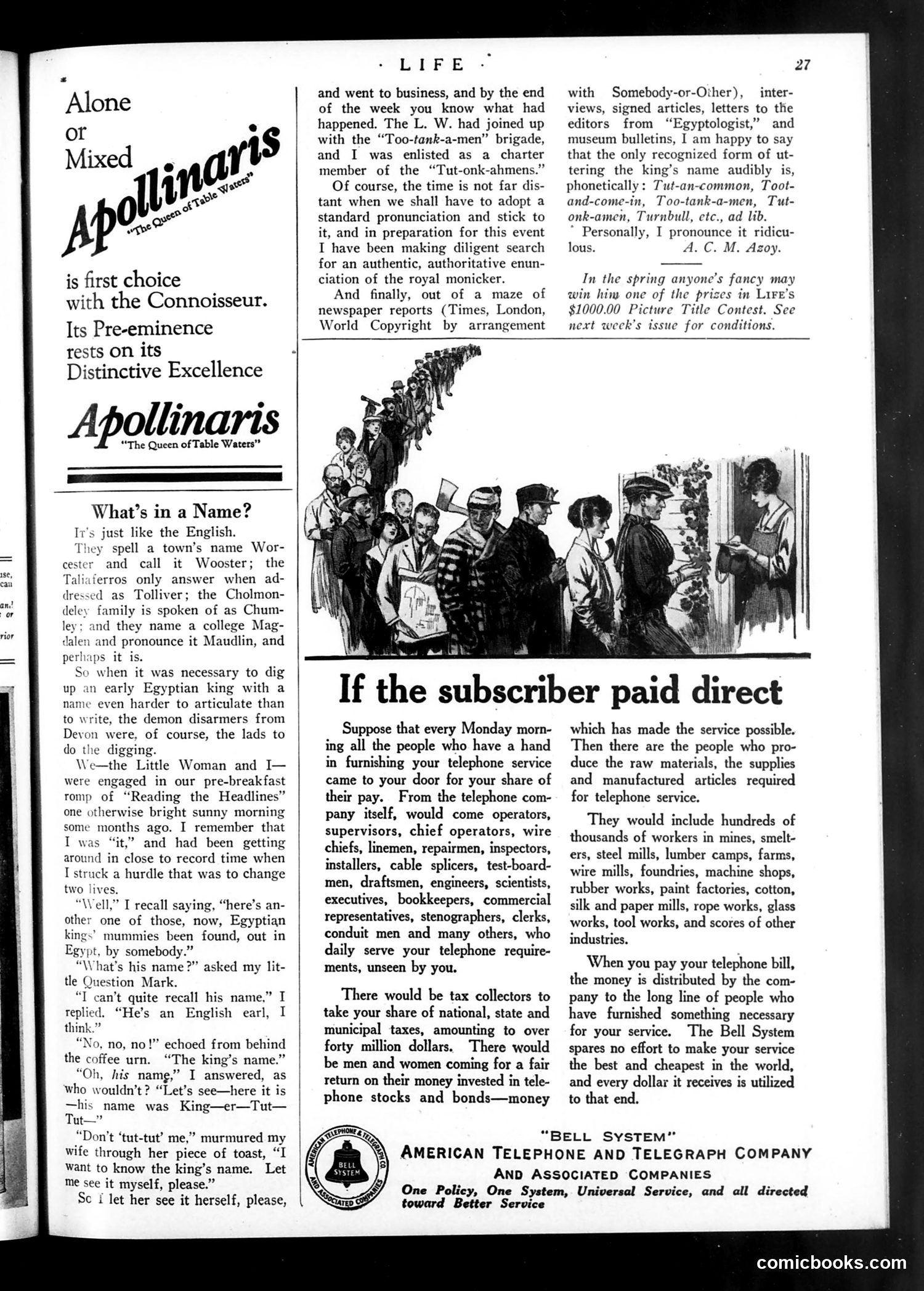
This page contains two distinct elements: a humorous essay about Egyptian King Tutankhamun's pronunciation, and a Bell Telephone advertisement. ## The Tutankhamun Essay The comic piece satirizes the difficulty English speakers had pronouncing "Tutankhamun" following the 1922 discovery of his tomb. The author describes how his family couldn't settle on the correct pronunciation, listing various competing versions ("Tut-an-common," "Too-tank-a-men," etc.). He notes that English people notoriously mispronounce their own place names and titles, making them the "lads" naturally suited to bungle an Egyptian pharaoh's name. The humor lies in the widespread confusion and the absurdity of having multiple "correct" pronunciations in newspapers and museums. ## The Bell Telephone Advertisement The ad argues for the centralized Bell System by illustrating that direct payment would require subscribers to individually pay hundreds of workers, tax collectors, and supply industries. It justifies the consolidated telephone bill as an efficient distribution system.
📄 Transcribed text from this page (OCR, searchable)
Machine-transcribed from the original scan — historical spelling and the odd misread are preserved.
is first choice with the Connoisseur. Its Preeeminence rests on its Distinctive Excellence A poli Queen of Table Waters” LIFE and went to business, and by the end of the week you know what had happened. The L. W. had joined up with the “Too-tank-a-men” brigade, and I was enlisted as a charter member of the “Tut-onk-ahmens.” Of course, the time is not far dis- tant when we shall have to adopt a standard pronunciation and stick to it, and in preparation for this event I have been making diligent search for an authentic, authoritative enun- ciation of the royal monicker. And finally, out of a maze of newspaper reports (Times, London, World Copyright by arrangement with Somebody-or-Other), inter- views, signed articles, letters to the editors from “Egyptologist,” and museum bulletins, I am happy to say that the only recognized form of ut- tering the king’s name audibly is, phonetically : Tut-an-common, Toot- and-come-in, Too-tank-a-men, Tut- onk-amen, Turnbull, etc., ad lib. * Personally, I pronounce it ridicu- lous. A. C. M. Azoy. In the spring anyone's fancy may win him one of the prises in LiFe’s $1000.00 Picture Title Contest. See next week's issue for conditions. What’s in a Name? Ir’s just like the English. They spell a town’s name Wor- cester and call it Wooster; the Taliaferros only answer when ad- dressed as Tolliver; the Cholmon- deley family is spoken of as Chum- ley; and they name a college Mag- and pronounce it Maudlin, and s it is. ) when it was necessary to dig up an early Egyptian king with a name even harder to articulate than to write, the demon disarmers from Devon were, of course, the lads to do the digging. We—the Little Woman and I— were engaged in our pre-breakfast romp of “Reading the Headlines” one otherwise bright sunny morning some months ago. I remember that I was “it,” and had been getting around in close to record time when I struck a hurdle that was to change two lives. “Well,” I recall saying, “here’s an- other one of those, now, Egyptian kings’ mummies been found, out in Egypt, by somebody.” “What's his name?” asked my lit- tle Question Mark. “T can’t quite recall his name,” I replied. “He’s an English earl, I think.” “No, no, no!” echoed from behind the coffee urn. “The king’s name.” “Oh, his name,” I answered, as who wouldn’t? “Let’s see—here it is —his name was King—er—Tut— Tut—” “Don't ‘tut-tut’ me,” murmured my wife through her piece of toast, “I want to know the king’s name. Let me see it myself, please.” Sc i let her see it herself, please, If the subscriber paid direct Suppose that every Monday morn- ing all the people who have a hand in furnishing your telephone service came to your door for your share of their pay. From the telephone com- pany itself, would come operators, supervisors, chief operators, wire chiefs, linemen, repairmen, inspectors, installers, cable splicers, test-board- men, draftsmen, engineers, scientists, executives, bookkeepers, commercial representatives, stenographers, clerks, conduit men and many others, who daily serve your telephone require- ments, unseen by you. There would be tax collectors to take your share of national, state and municipal taxes, amounting to over forty million dollars. There would be men and women coming for a fair return on their money invested in tele- phone stocks and bonds—money which has made the service possible. Then there are the people who pro- duce the raw materials, the supplies and manufactured articles required for telephone service. They would include hundreds of thousands of workers in mines, smelt- ers, steel mills, lumber camps, farms, wire mills, foundries, machine shops, rubber works, paint factories, cotton, silk and paper mills, rope works, glass works, tool works, and scores of other industries. When you pay your telephone bill, the money is distributed by the com- pany to the long line of people who have furnished something necessary for your service. The Bell System spares no effort to make your service the best and cheapest in the world, and every dollar it receives is utilized to that end. “BELL SYSTEM” AMERICAN TELEPHONE AND TELEGRAPH COMPANY AND ASSOCIATED COMPANIES One Policy, One System, Universal Service, and all directed toward Better Service comicbooks.com