
A complete issue · 40 pages · 1923
Life — April 12, 1923
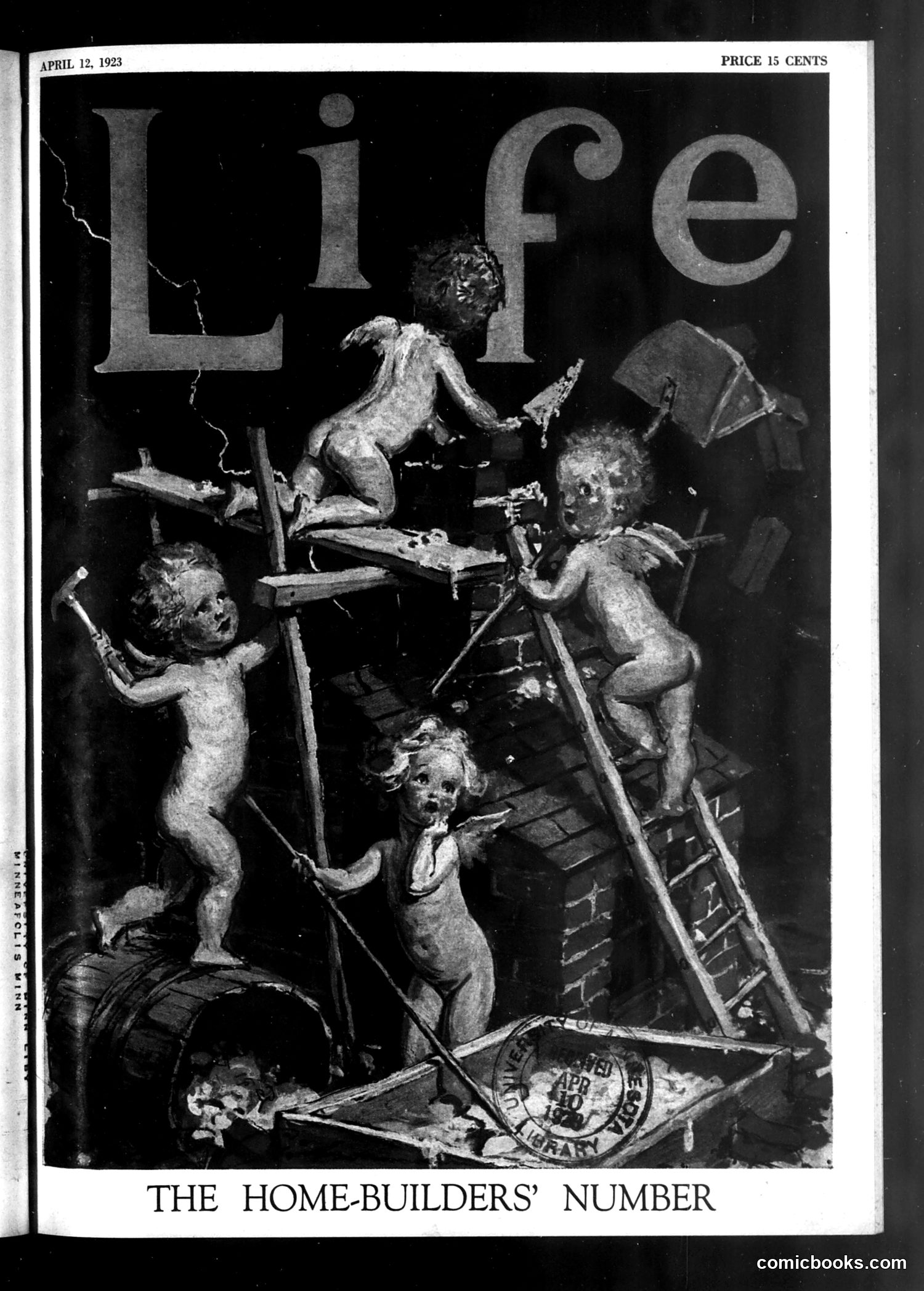
This is the cover of Life magazine's "Home-Builders' Number." The illustration depicts cherubs (baby angels) engaged in construction work, using hammers, saws, ladders, and other tools to build a house frame. The satire appears to play on the post-World War I American housing boom of the early 1920s—a period of significant residential construction and real estate development. By portraying construction workers as innocent cherubs rather than adult laborers, the image humorously suggests the almost magical or fantastical nature of the building boom. The cherubs' playful industriousness satirizes either the optimism surrounding housing development or perhaps the somewhat naive enthusiasm for this economic sector during this prosperous era. The "Home-Builders' Number" subtitle confirms this is a special issue devoted to construction and housing topics.
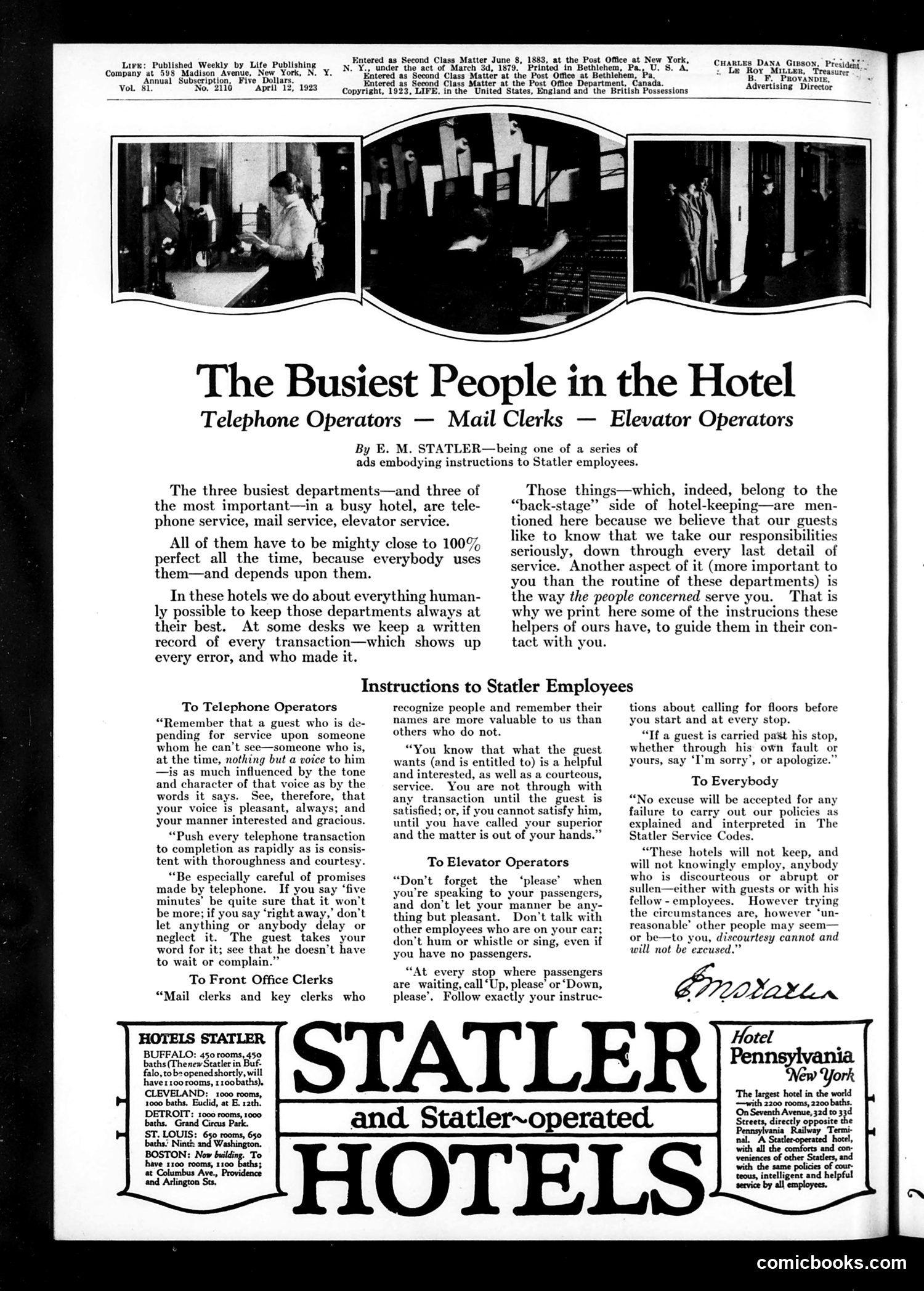
This page is **primarily an advertisement**, not satire or political commentary. It's a 1923 Statler Hotels ad disguised as an instructional article by E.M. Statler (the hotel chain's founder). The three photographs show hotel staff—telephone operators, mail clerks, and elevator operators—performing their duties. The accompanying "Instructions to Statler Employees" is essentially advertiser-written content promoting the chain's customer service philosophy. The article frames these "busiest people in the hotel" as exemplars of professionalism, emphasizing courtesy, accuracy, and attentiveness to guest needs. Rather than satirizing these workers, the piece presents them as models worthy of emulation. This represents early 20th-century corporate self-promotion dressed as editorial content—a forerunner of modern advertorials.
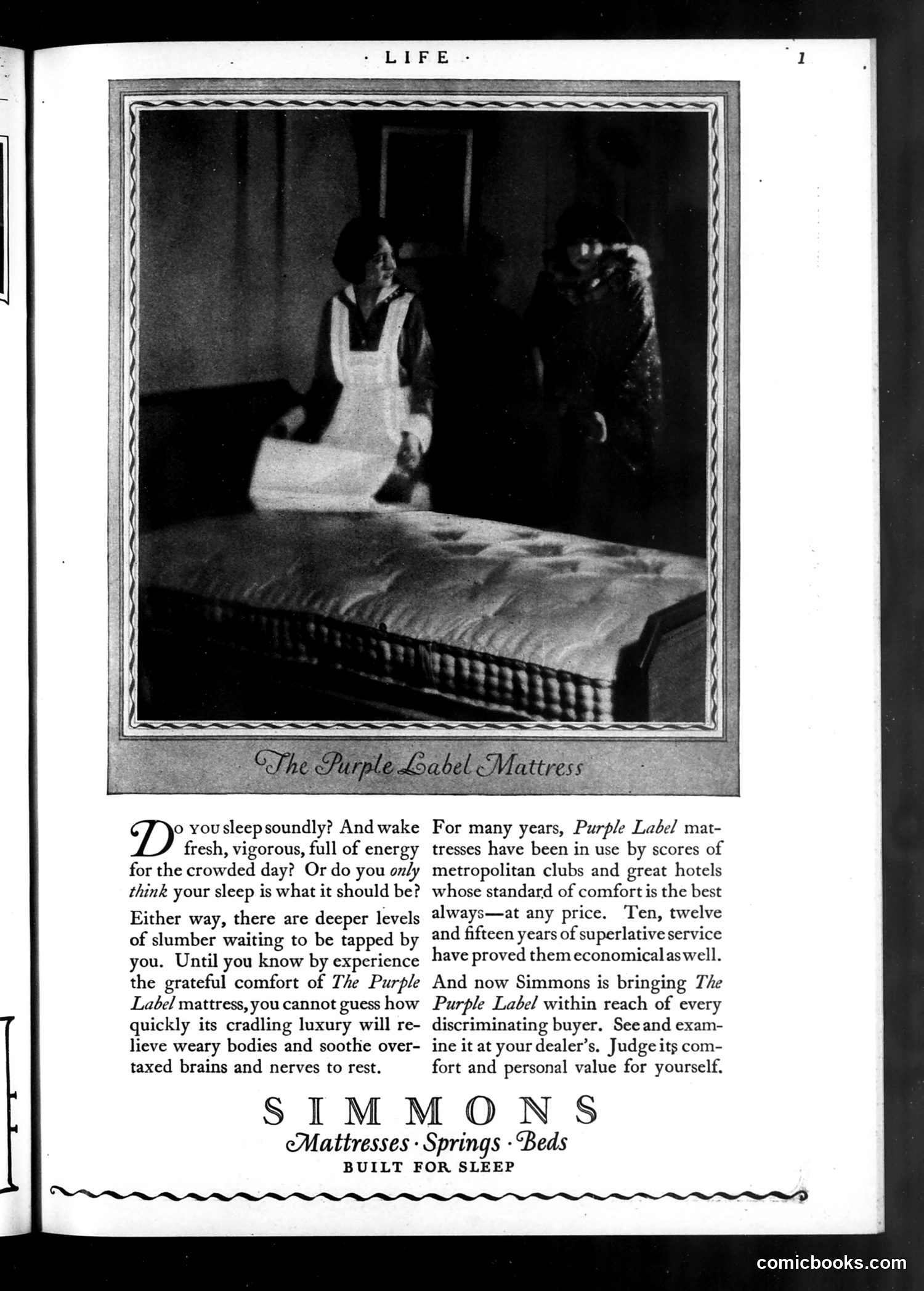
This page is primarily **advertising, not satire or political commentary**. It's a Simmons mattress advertisement from *Life* magazine promoting "The Purple Label Mattress." The image shows two figures in a bedroom—apparently a maid or servant and a woman—examining a mattress. The ad copy emphasizes comfort and quality, claiming Purple Label mattresses have been used for "fifteen years" in metropolitan clubs and hotels as the "standard of comfort." There is no political cartoon or satirical content here. The "joke" (if any) is gentle advertising humor about sleep quality and comfort. The only potential social commentary is implicit in the class dynamics shown—the servant/maid figure suggesting this is aspirational luxury furniture for wealthy households—but this appears incidental to the product promotion rather than intentional satire.
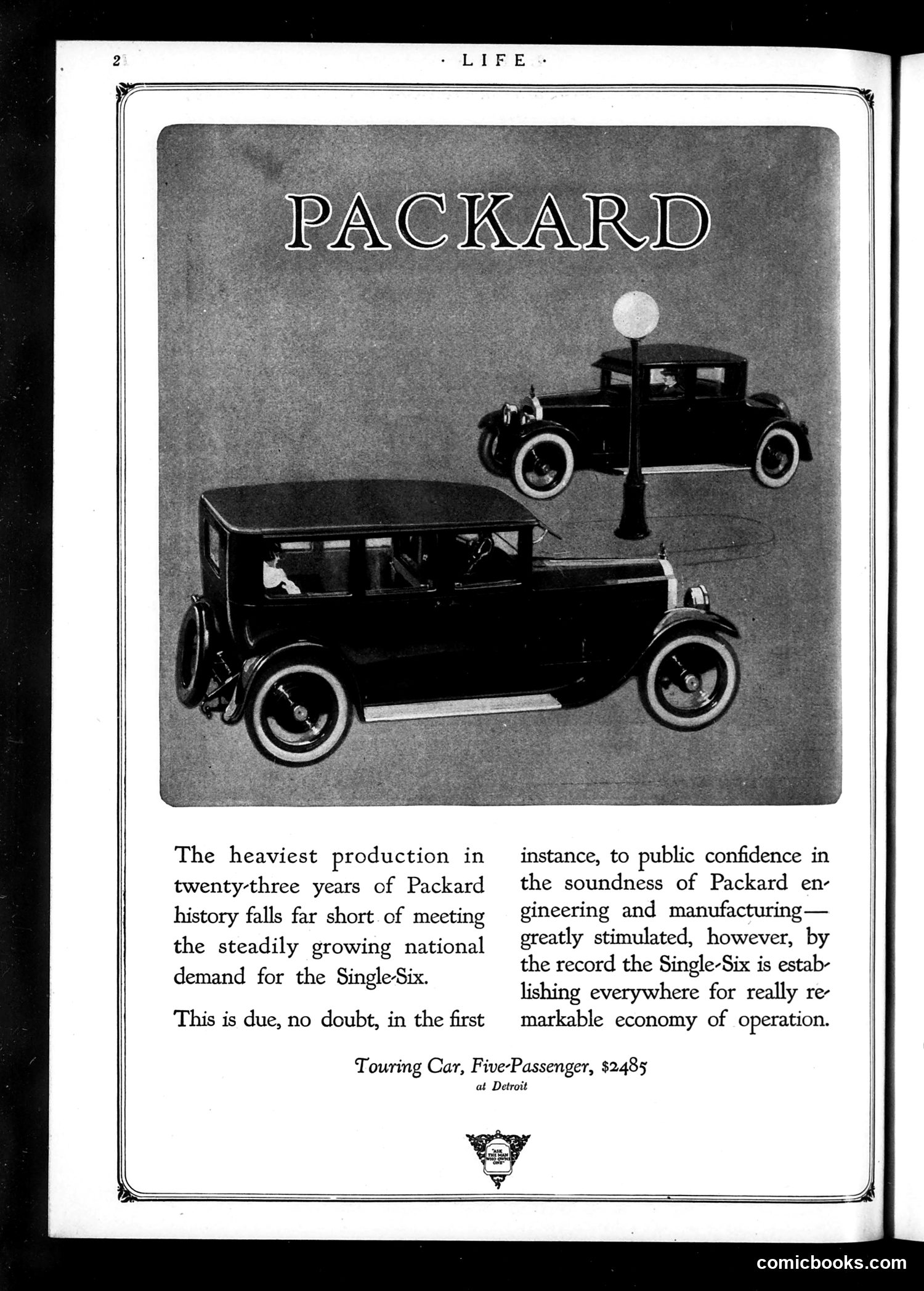
This is a **Packard automobile advertisement**, not political satire. It appears in *Life* magazine (page 2) and promotes Packard's "Single-Six" model. The ad features two cars—a touring car prominently displayed and another model visible in the background near a street lamp. The text emphasizes that Packard's production of the Single-Six cannot keep pace with national demand, attributing this to public confidence in the brand's "engineering and manufacturing" and notably its "economy of operation." The specific model advertised is a **Five-Passenger Touring Car priced at $2,485** in Detroit. This is a straightforward luxury car advertisement highlighting market success and reliability rather than containing satirical commentary.
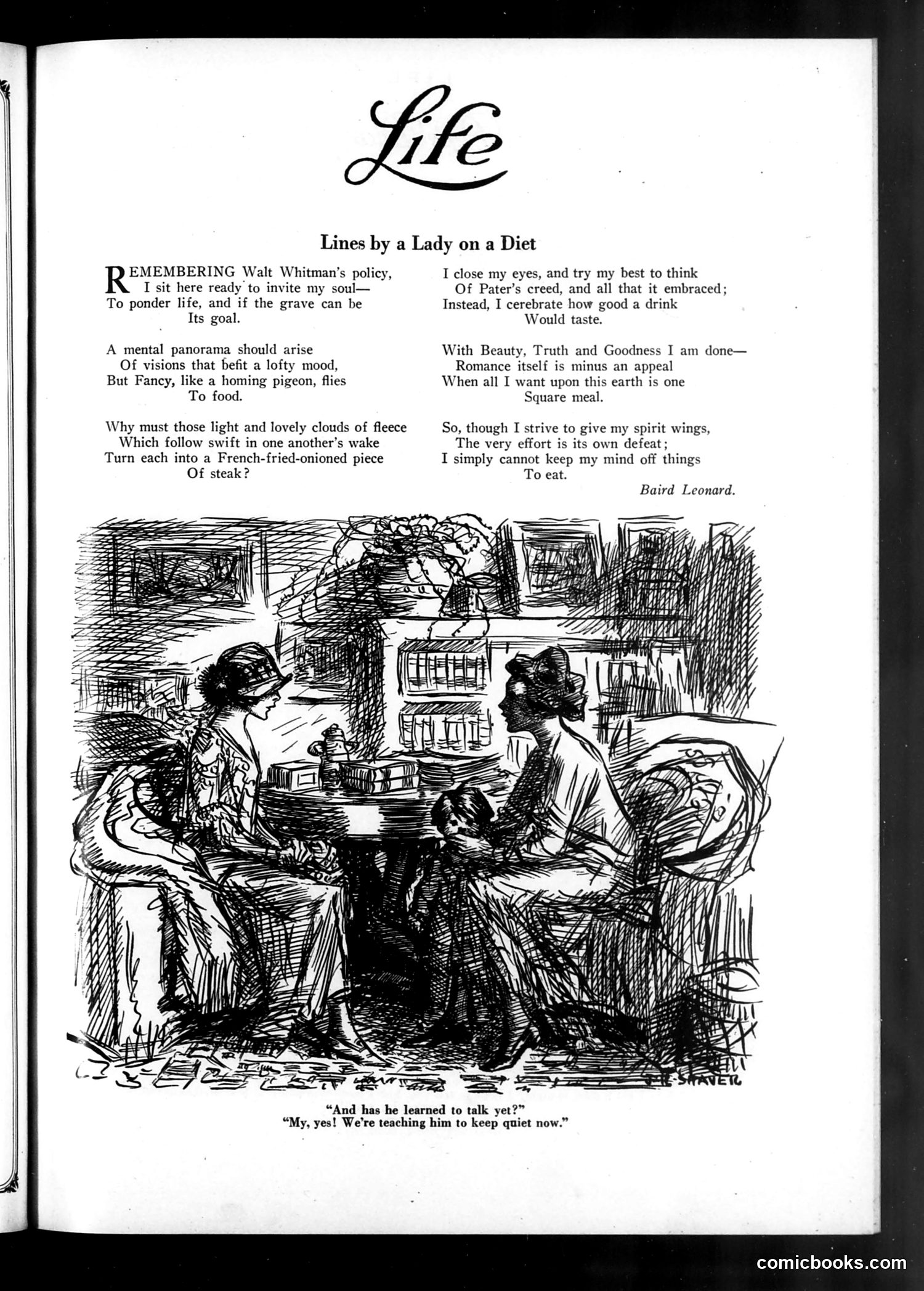
This page satirizes the experience of dieting through both poem and cartoon. The poem, attributed to Baird Leonard, humorously contrasts the philosophical aspirations a dieter should pursue (mental improvement, spiritual elevation) with the actual preoccupation: food. References to "Walt Whitman's policy" and "Pater's creed" invoke serious intellectual traditions that the dieter supposedly wants to embrace, but instead finds themselves obsessing over steaks and meals. The cartoon shows two women with a child, with the caption's joke about teaching a child "to keep quiet now"—likely implying that women on restrictive diets become irritable or withdrawn due to hunger. The satire targets the social pressure on women to diet while acknowledging the psychological toll this takes.
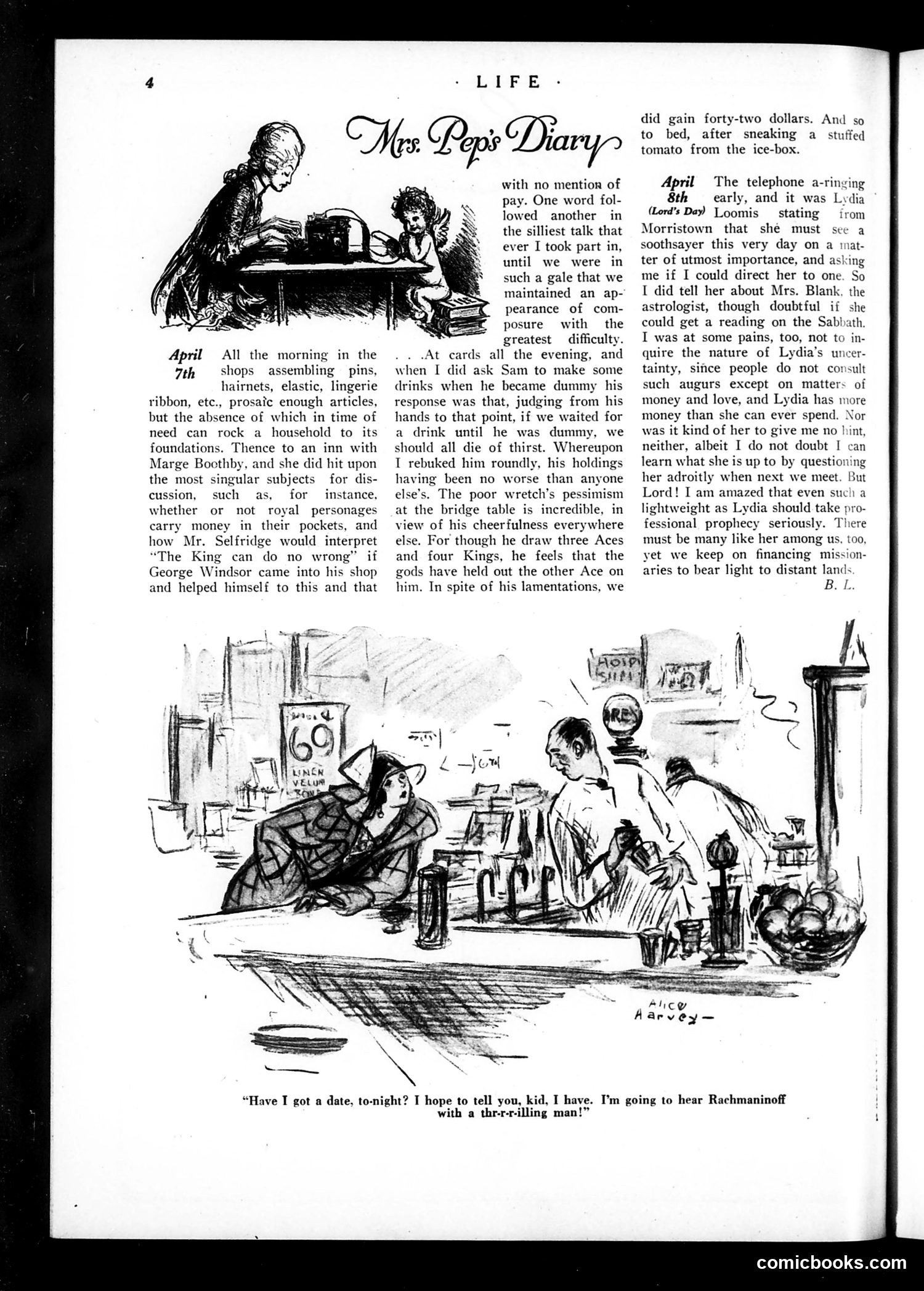
This page from *Life* magazine presents a satirical diary entry mocking domestic life and social pretension. The April 7th entry humorously catalogs the "singular subjects" a wife must discuss with her husband—pins, hairnets, elastic, lingerie ribbons—items essential to household management but trivial to male ears. The diary notes how even these mundane discussions become "gales" requiring marital diplomacy. The April 8th entry satirizes the author's eagerness to consult an astrologer (Mrs. Blank) about her marriage prospects, while also mocking Lydia Loomis, a fortune-teller figure promising financial success to "distant lands." The cartoon below depicts a woman at a vanity, boasting to a child about attending a concert featuring Rachmaninoff, suggesting vanity and social climbing despite domestic ordinariness. The satire targets middle-class aspirations and gender roles of the era.
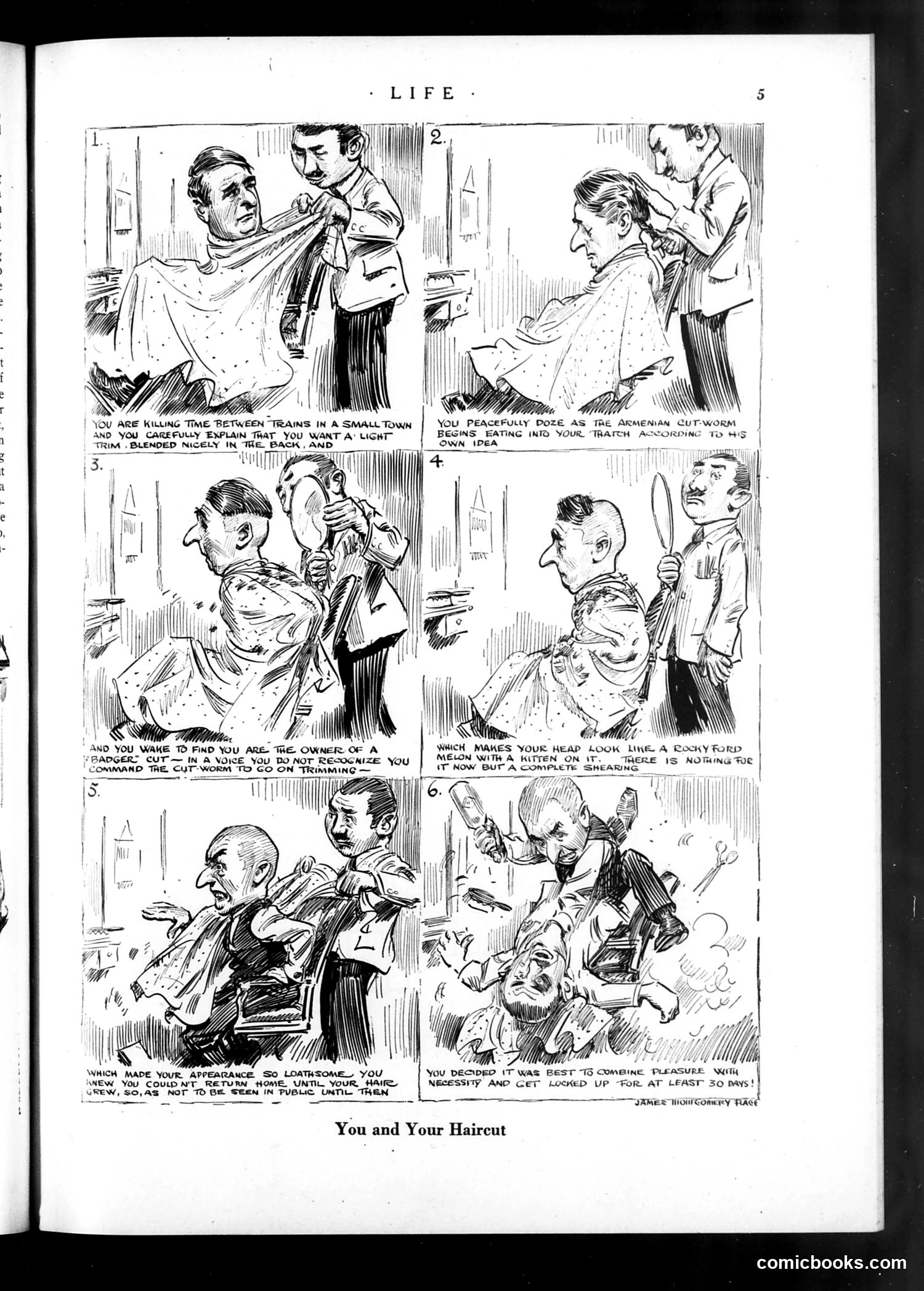
This six-panel comic by James Montgomery Flagg satirizes the frustrations of getting a haircut during wartime shortages (likely WWI era, given the references). The humor centers on absurd situations a man encounters: 1. A barber cuts hair in a moving train 2. A customer endures an "Achenian cut-worm" eating into his head 3. Finding a badger has created the haircut 4. A kookaburra's bite explains the result 5. The man's disheveled appearance makes him unrecognizable 6. He's locked out of his own home for 30 days due to his appearance The satire mocks wartime inconveniences and the difficulty of obtaining basic services, presenting increasingly absurd explanations for poor haircuts as comic commentary on scarcity and everyday frustrations.
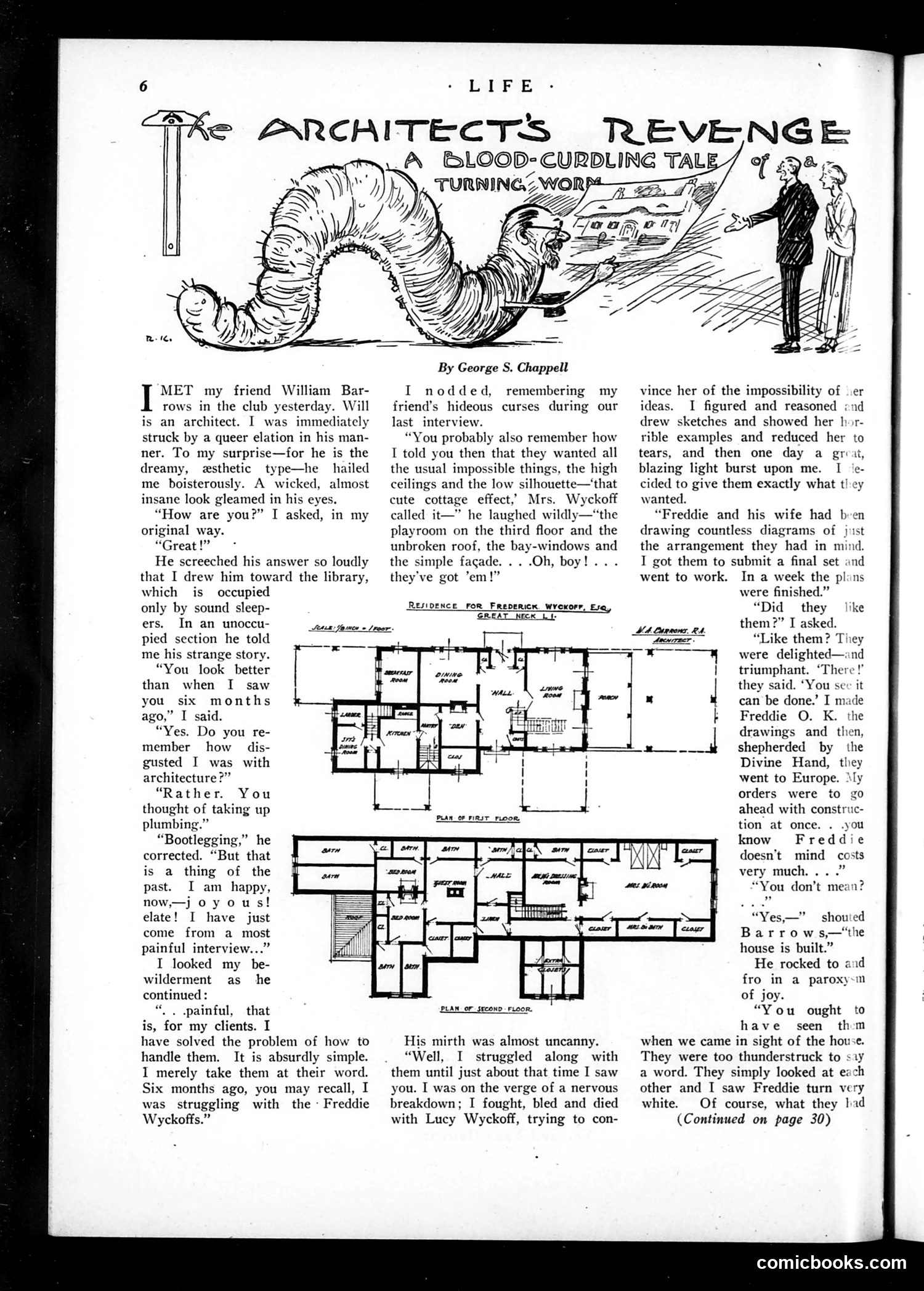
This is a humorous short story by George S. Chappell about an architect named William Barrows who becomes frustrated with a client couple (the Wyckoffs) who repeatedly reject his building designs as impractical. The narrative mocks architectural pretension—the Wyckoffs keep requesting impossible features like high ceilings in low spaces and elaborate cottage aesthetics. The accompanying floor plans illustrate the house design discussed in the story. The "revenge" appears to involve the architect eventually proving his design's merit, though the text cuts off before the resolution. The satire targets both difficult clients and architects' egos during this period.
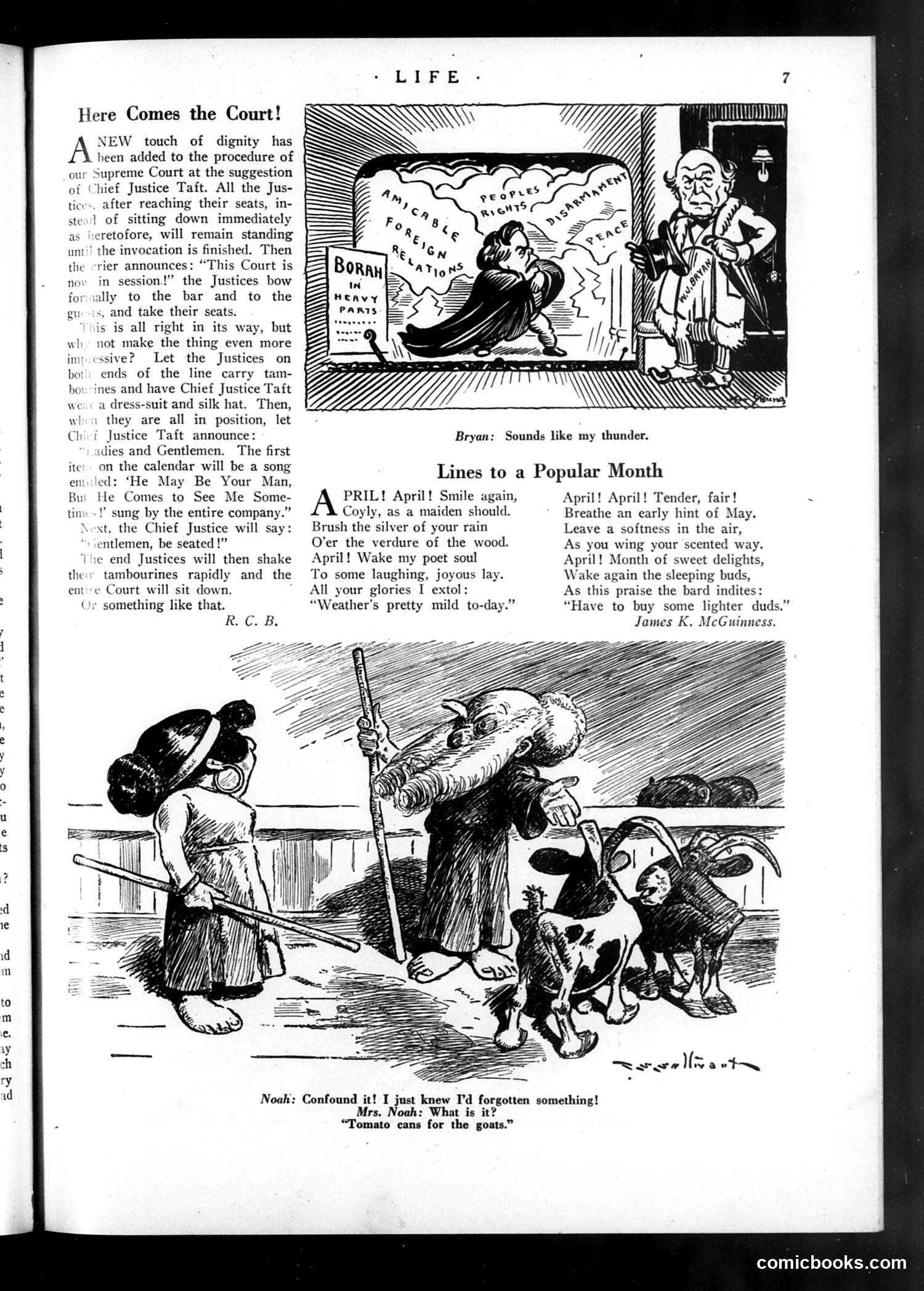
**Top Cartoon ("Here Comes the Court!"):** This satirizes Supreme Court procedure under Chief Justice Taft. The cartoon depicts the Court's new formal entrance ritual—Justices now stand until the Chief Justice invocation is finished, then announce "This Court is now in session" before taking seats. The satire suggests this added "dignity" is excessive formality. The figure appears to be Taft himself, depicted as authoritarian or pompous in enforcing these theatrical procedures. **Bottom Cartoon:** A domestic humor piece showing Noah, his wife, and animals. Noah has forgotten something; his wife reminds him it's "tomato cans for the goats"—likely a joke about modern domesticity intruding on the biblical flood narrative. **"Lines to a Popular Month":** Poetry celebrating April, credited to James K. McGuinness.
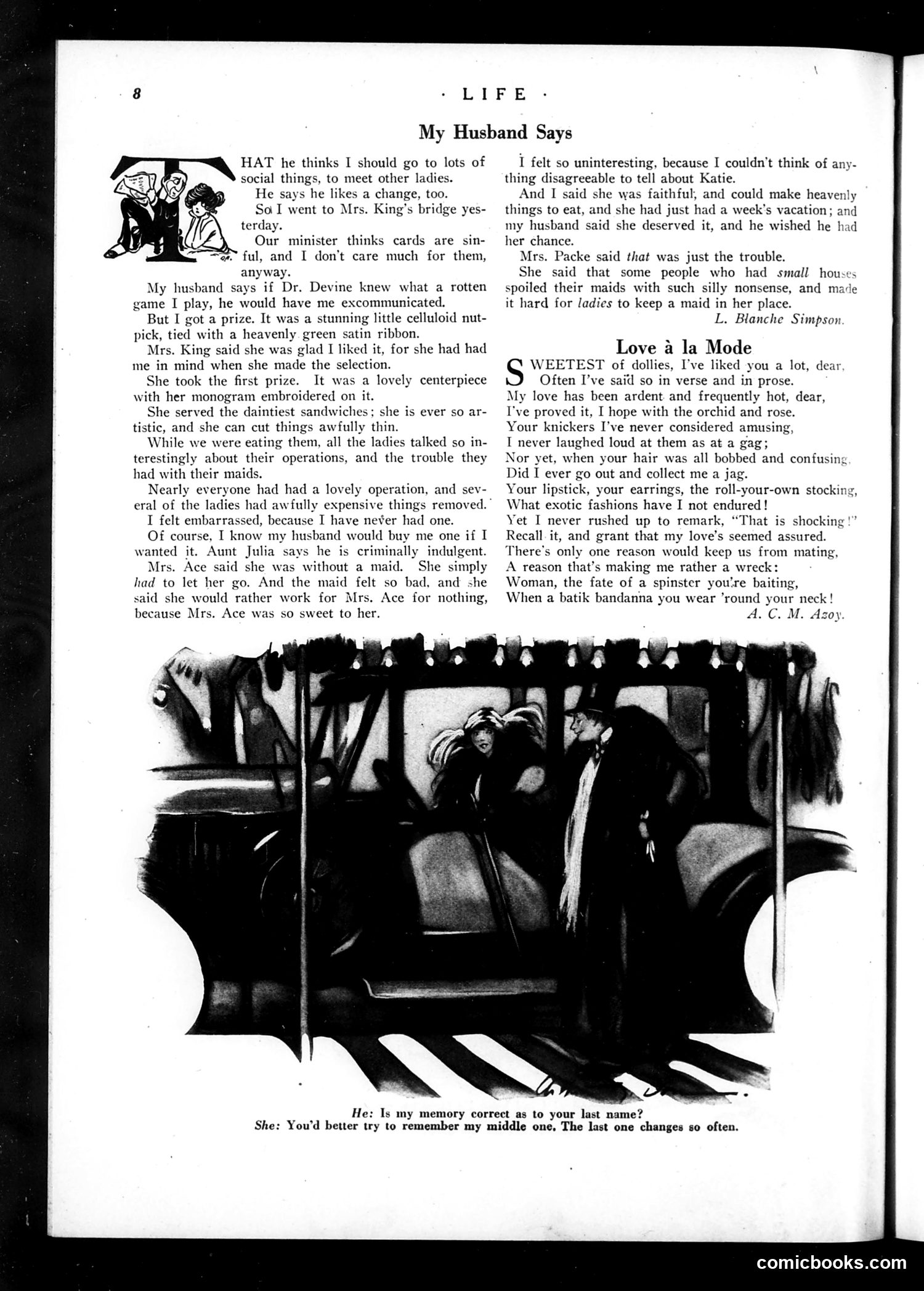
This page contains two separate humor pieces satirizing marriage and social customs of the era (appears to be early 20th century): **"My Husband Says"** mocks the narrator's husband's social expectations and her frustration with them. The satire targets how husbands control wives' social participation and judge their appearance and behavior. References to card games, medical operations, and domestic staff suggest upper-middle-class concerns. **"Love à la Mode"** is a poem critiquing romantic sentimentality in popular literature, suggesting lovers exchange clichéd compliments rather than genuine emotion. The bottom cartoon depicts a man asking a woman's name at what appears to be a social event (possibly a car), with her witty response about her middle name changing frequently—likely a joke about married women losing their identity or frequently marrying.
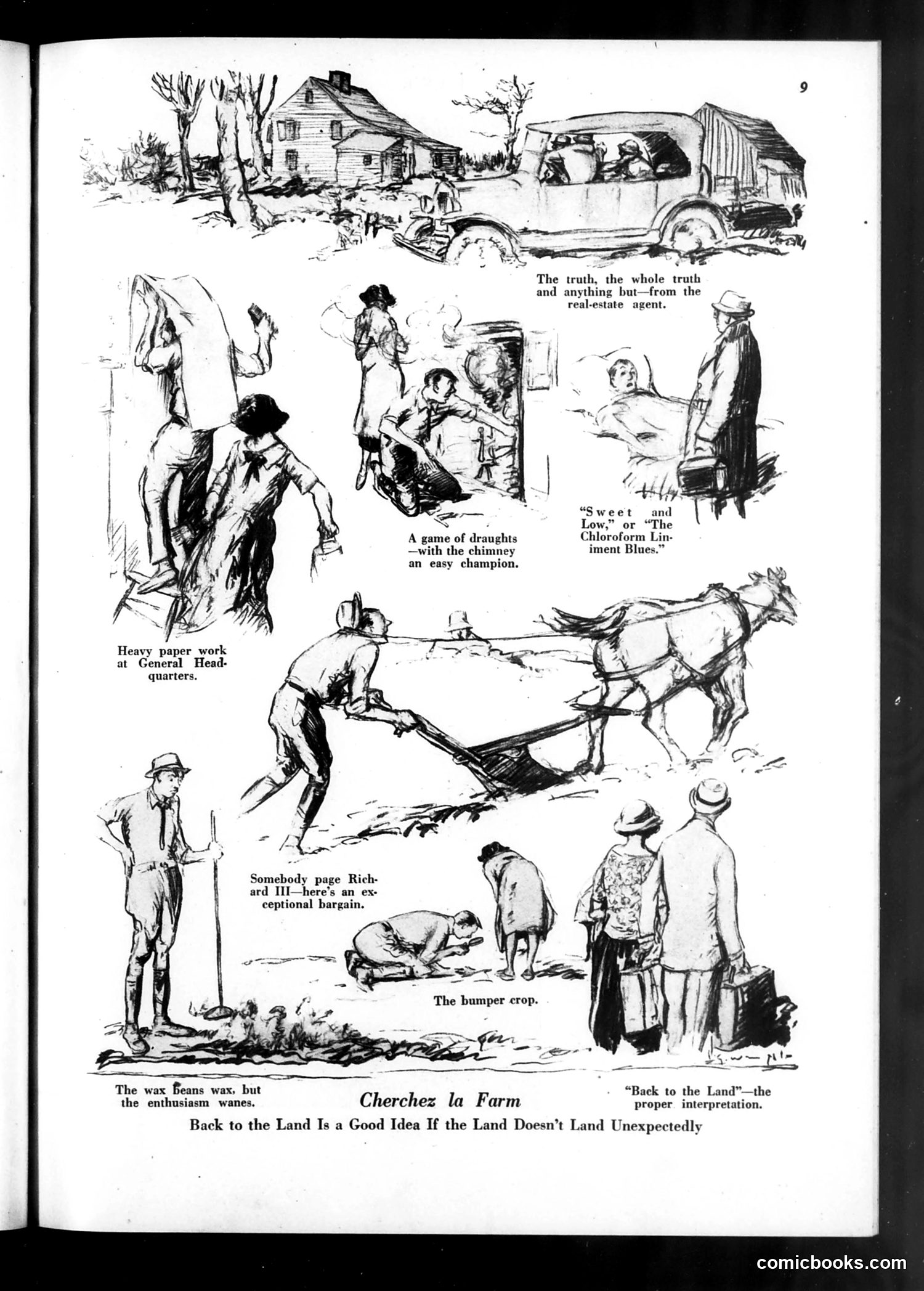
This page satirizes the early 20th-century "back to the land" movement—a romantic ideal promoted by urban enthusiasts who believed farming was a profitable, wholesome alternative to city life. The cartoon's vignettes mock this ideology by showing reality: failed real-estate schemes ("Heavy paper work at General Headquarters"), people playing games instead of working ("A game of draughts—with the chimney an easy champion"), failed crops ("The bumper crop" showing minimal harvest), and physical hardship. The repeated caption—"Back to the Land Is a Good Idea If the Land Doesn't Land Unexpectedly"—undercuts the movement's optimism. The satire suggests that actual farming involves bureaucracy, disappointment, and financial loss rather than the promised pastoral simplicity.
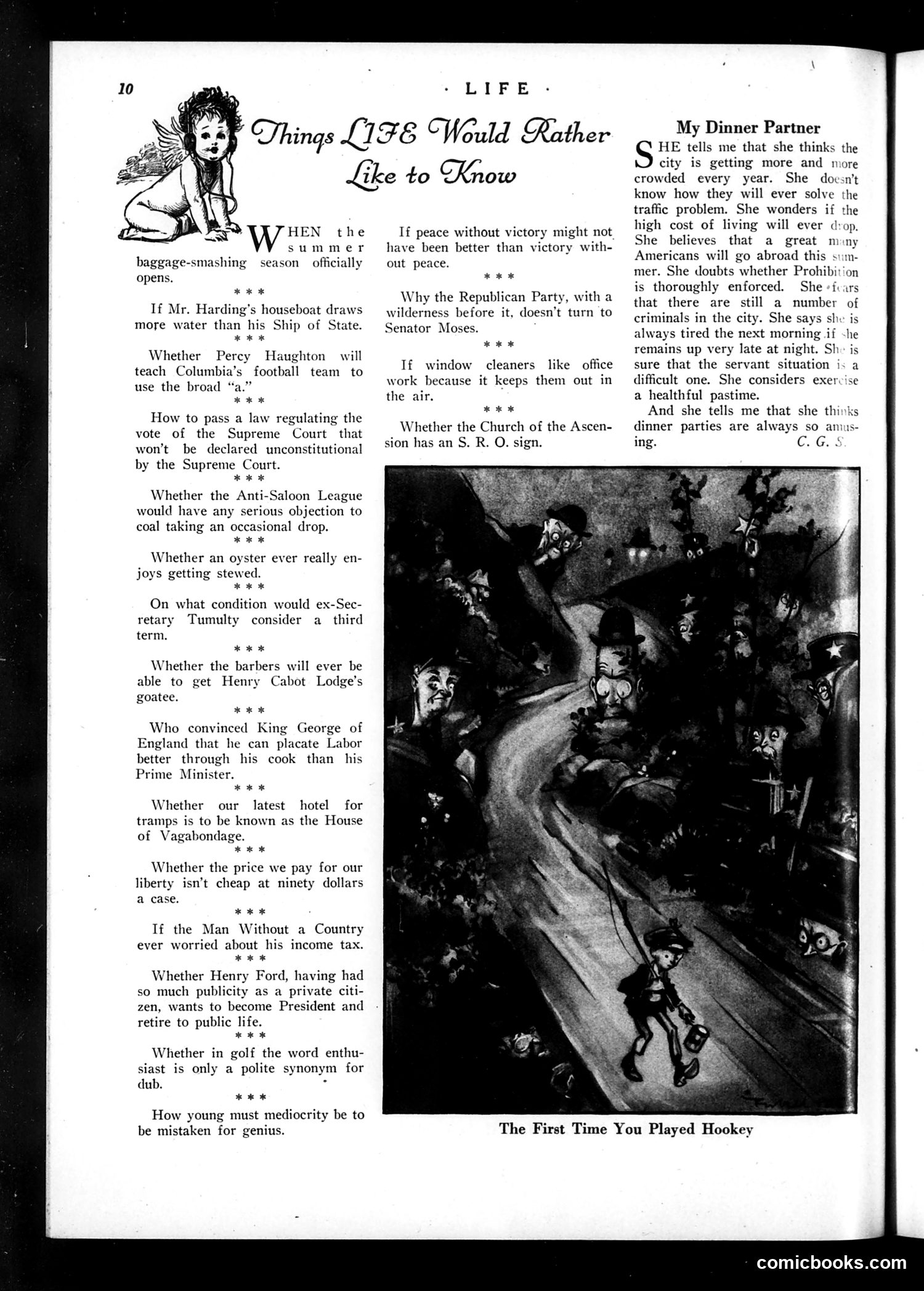
This page presents satirical questions about contemporary political and social issues. The left column lists rhetorical queries—a signature Life magazine format for social commentary. The topics reference: - **Harding's presidency** (water from the "Ship of State") - **Republican Party leadership** and Senator Moses - **The Anti-Saloon League** (Prohibition enforcement) - **King George of England** and his cook (likely a jab at British monarchy) - **Henry Ford** and his public/private role The right section, "My Dinner Partner," humorously catalogs trivial urban complaints—traffic congestion, servant shortages, dinner party tedium. The photograph captioned "The First Time You Played Hockey" shows children playing in what appears to be a cramped urban alley, sardonically illustrating limited recreational space for city youth. Together, the page critiques both major political issues and the petty anxieties of the affluent.
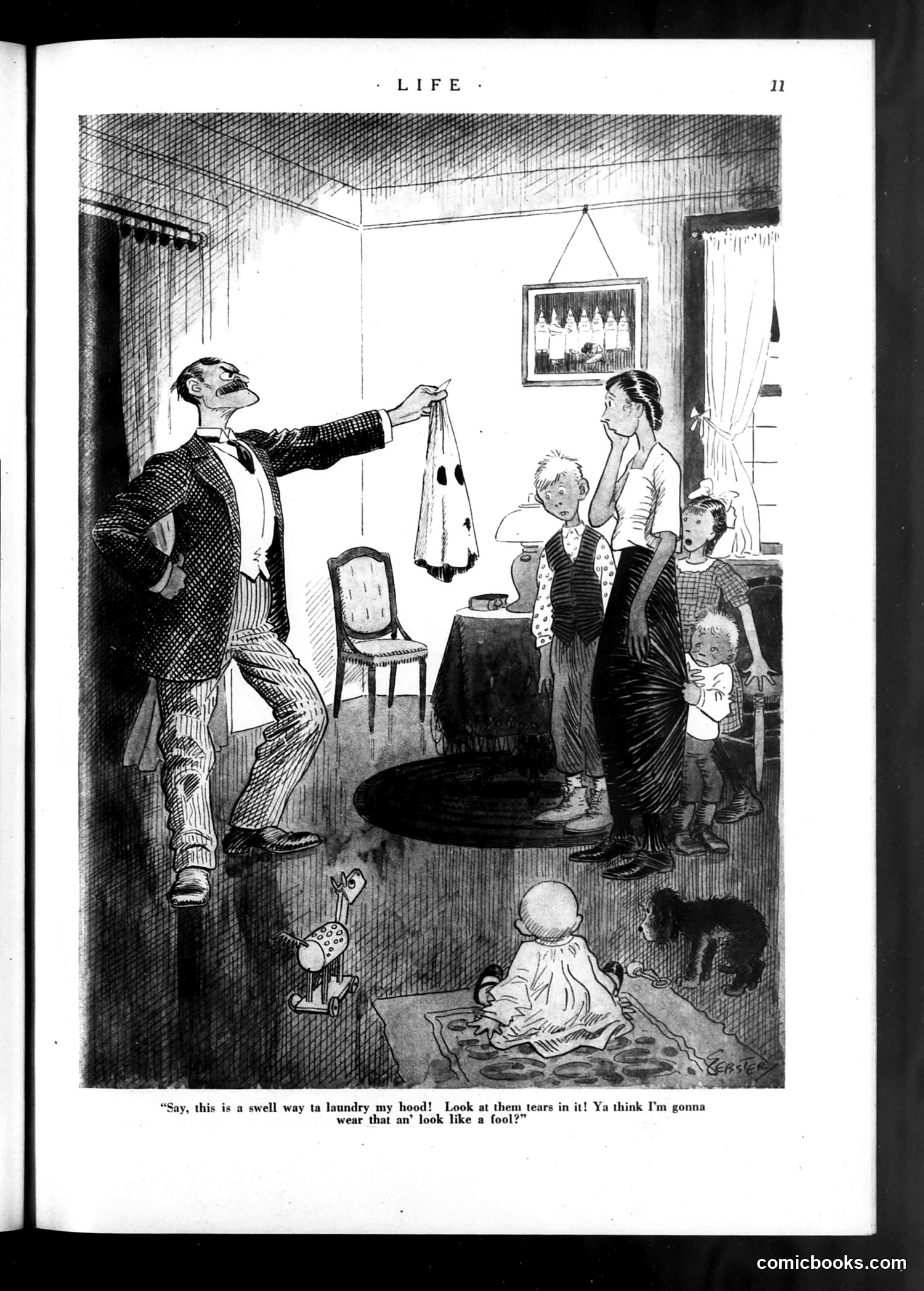
This is a single-panel cartoon satirizing domestic life and masculinity. A well-dressed man holds up a torn garment, presenting it as evidence to his wife and children. His caption boasts sarcastically about his laundry method—tearing holes in the fabric—claiming this makes the clothing look fashionable rather than foolish. The joke targets male incompetence at housework. The man is attempting to present obvious damage as intentional style, trying to justify his failure to properly launder clothes. His exaggerated pose and pompous demeanor suggest he's overcompensating for domestic inadequacy with bluster. The cartoon reflects early-20th-century humor about gender roles: men who venture into "women's work" predictably bungle the task, yet refuse to admit fault. The satire gently mocks both masculine pride and the domestic sphere's gendered expectations.
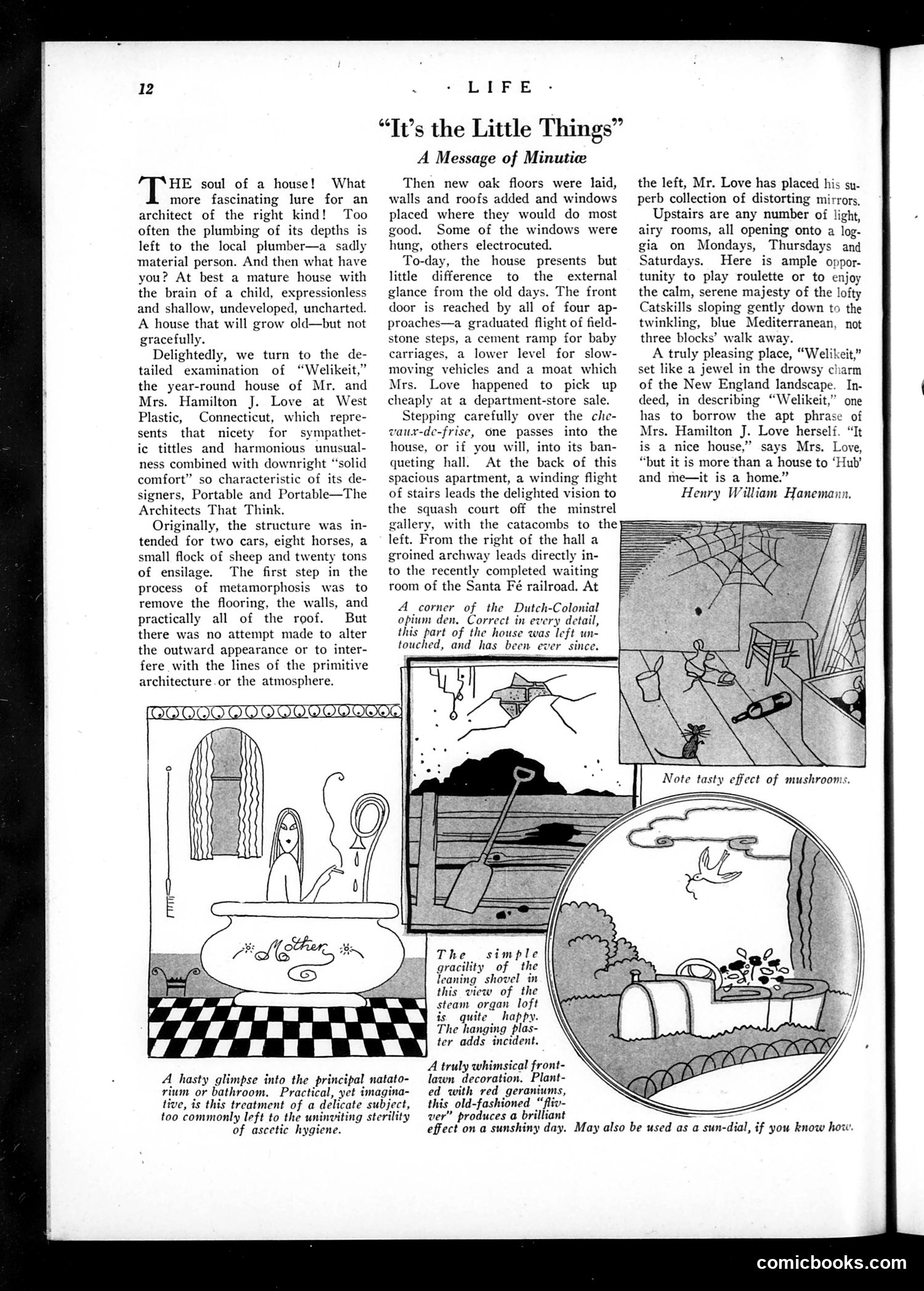
This page satirizes American interior design and home decoration of the early 20th century. The article describes the renovation of "Welikeit," the country house of Mr. and Mrs. Hamilton J. Love in Connecticut. The accompanying illustrations mock pretentious home décor through exaggerated examples: an absurdly ornate bathroom with fussy furnishings, whimsical front-lawn decorations (including what appears to be a sundial disguised as a mushroom), and impractical architectural details. The satire targets the nouveau riche tendency toward ostentatious, poorly-conceived design choices—accumulating decorative "little things" without taste or coherent vision. The captions drily comment on each ridiculous element, suggesting that authentic sophistication lies in restraint rather than excessive ornamentation.
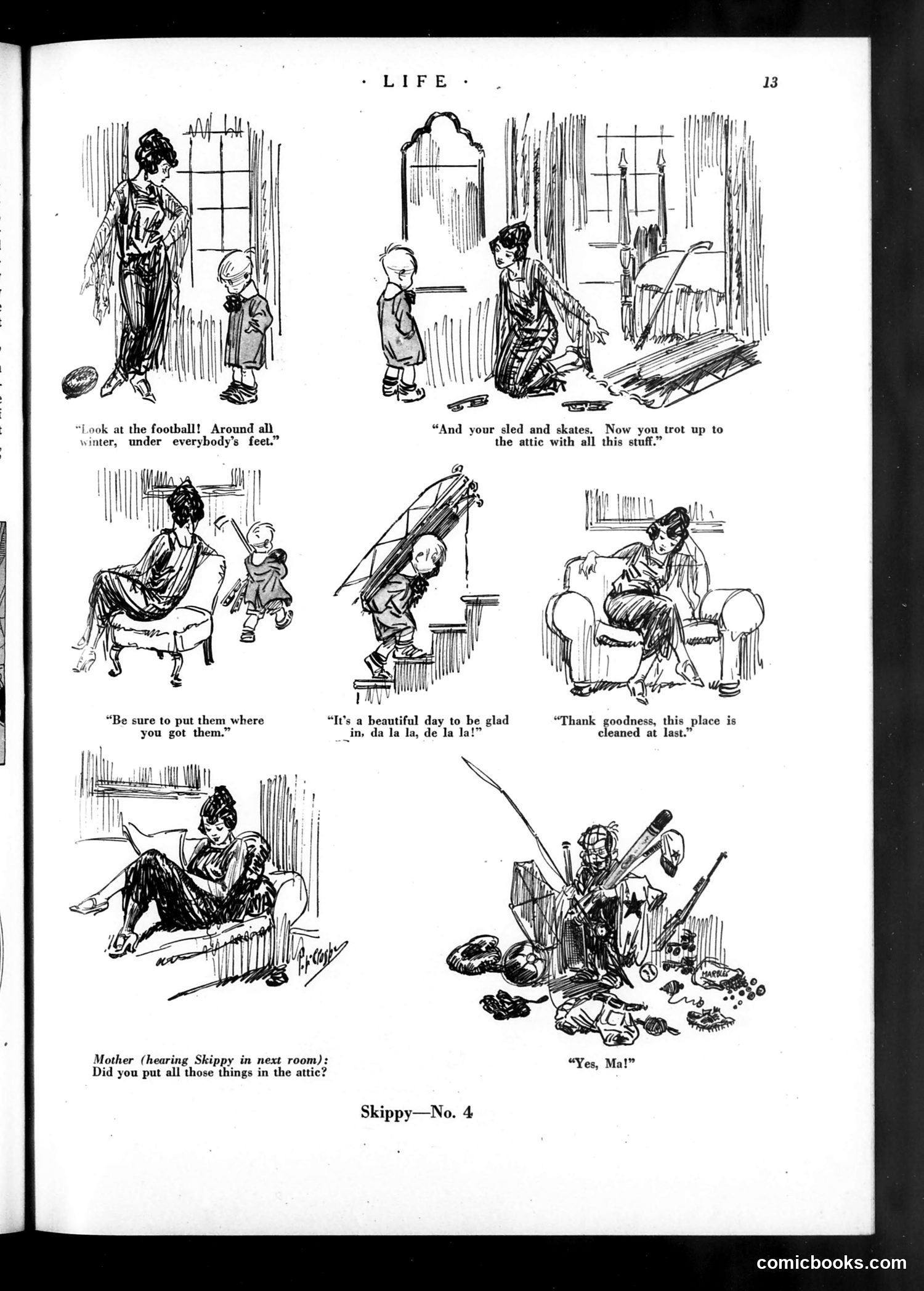
This is a humorous comic strip about a mischievous child named Skippy and his interaction with his mother. The narrative follows a classic domestic scenario: A mother discovers that Skippy has stored winter items (football, sled, skates) in the attic as instructed. However, the final panel reveals the ironic consequence: the attic has become chaotic and cluttered with all these items scattered about in disarray. The satire mocks both childhood literal-mindedness and parental frustration—the child obeys instructions precisely but without understanding the intended outcome. The mother's exasperated "Yes, Ma!" response captures the comedy of this generational disconnect. This reflects early 20th-century domestic humor, where children's antics provided entertainment for adult readers.
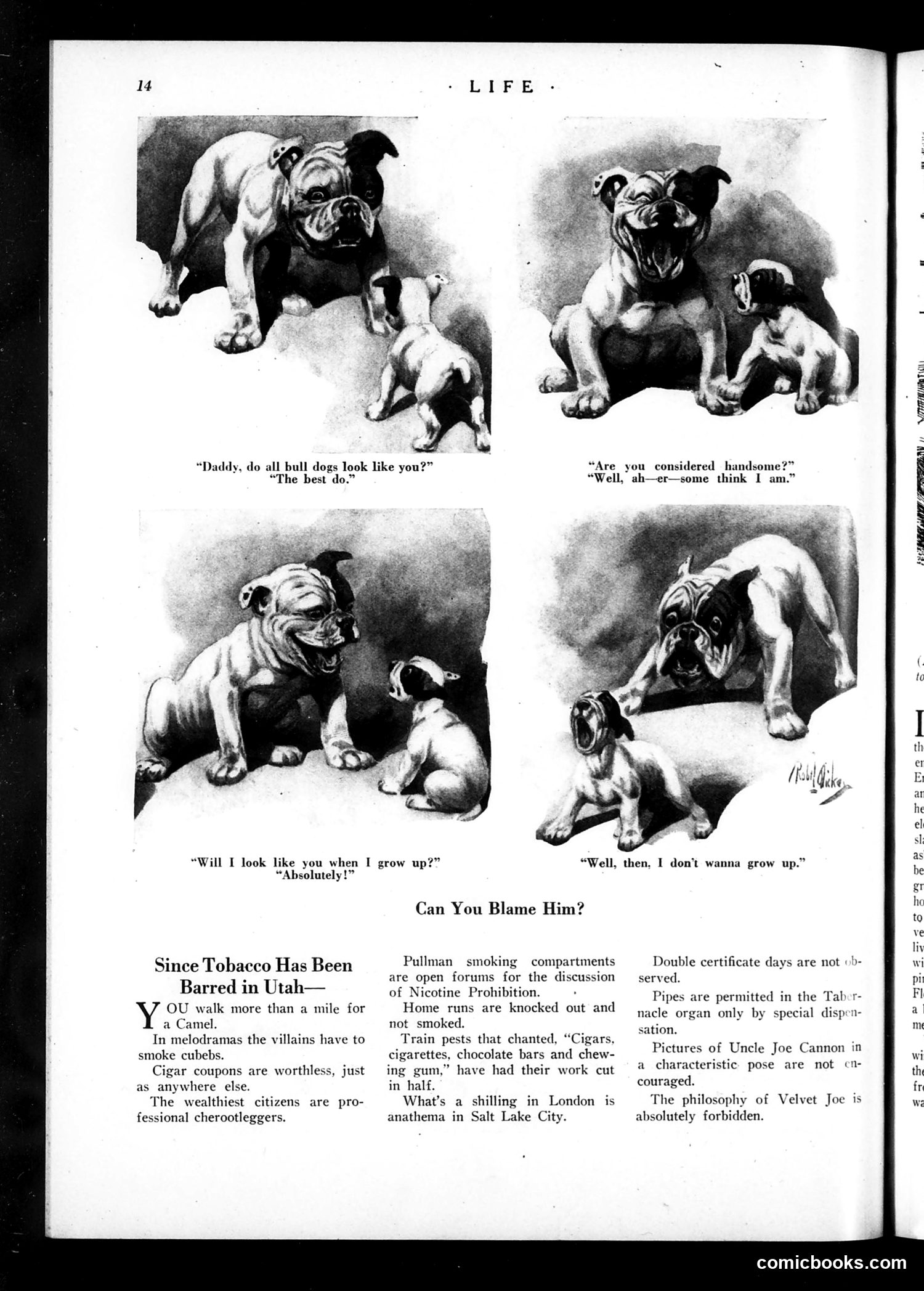
The page features a charming four-panel cartoon about bulldogs titled "Can You Blame Him?" The panels show a large adult bulldog and smaller puppy in humorous exchanges about appearance and growing up—the punchline being the puppy's refusal to mature into the father's wrinkled, stern visage. Below this is a satirical article titled "Since Tobacco Has Been Barred in Utah—" The text mocks Utah's tobacco prohibition by claiming that without cigarettes, villains now smoke cubeb cigars, train passengers chant instead of smoking, and London finds this anathema. It appears to satirize Prohibition-era regulations and their unintended consequences, suggesting the ban merely shifts behaviors rather than eliminating them. The cartoons and article reflect early 20th-century American attitudes toward smoking restrictions and social regulation.
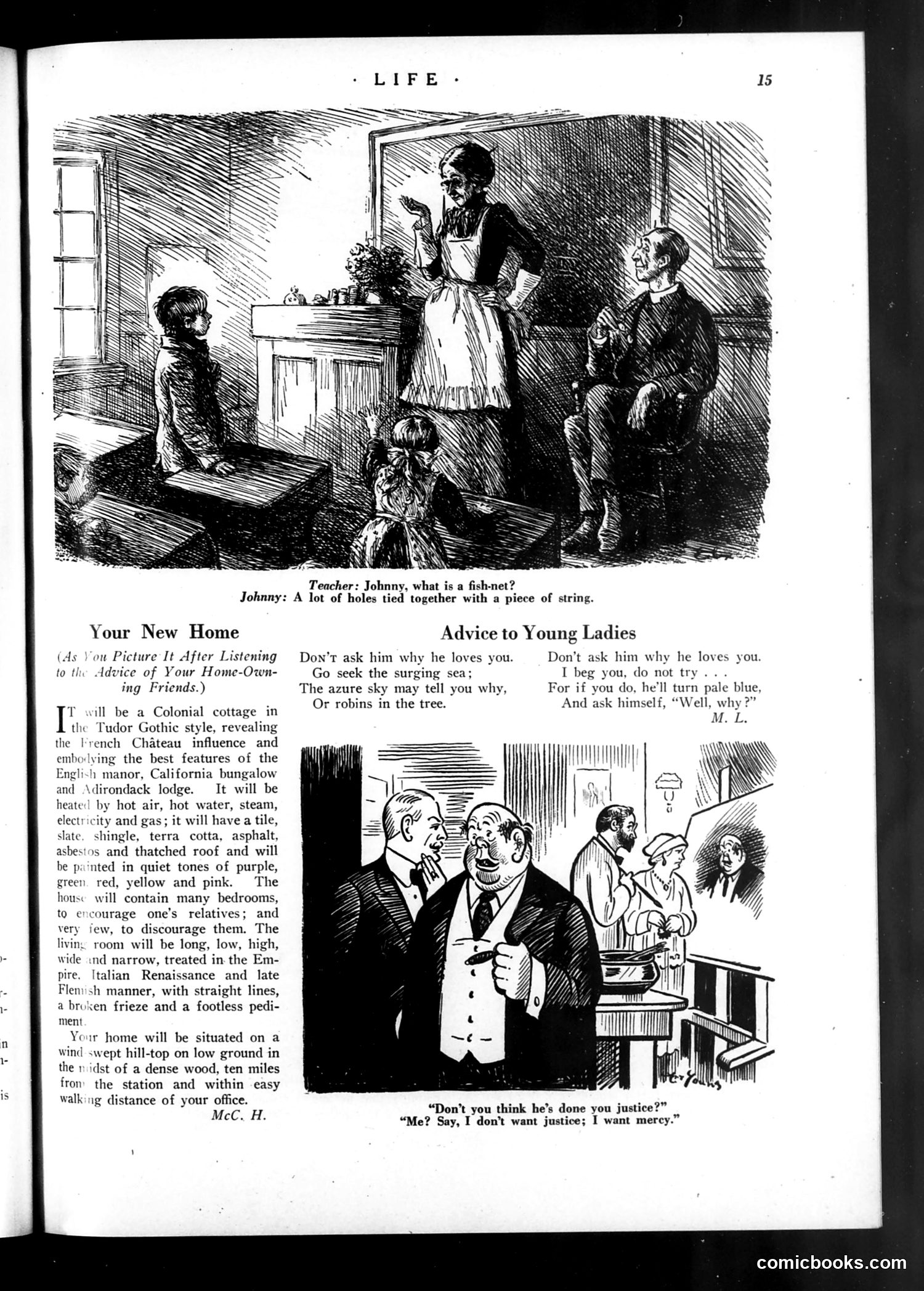
This page from *Life* contains three separate satirical pieces: 1. **Top cartoon**: A teacher asks student Johnny to define "fish-net." His answer—"holes tied together with string"—is a classic children's joke playing on literal versus practical definitions. 2. **"Your New Home"**: This satirizes the contradictory advice given to young couples buying homes. It mocks the impossibility of combining incompatible architectural styles (Colonial, Tudor Gothic, French Chateau, California bungalow, Adirondack) and having mutually exclusive features (many bedrooms *and* few bedrooms; long rooms that are also narrow). The joke targets both pretentious home-buying culture and the absurdity of following too much conflicting advice. 3. **"Advice to Young Ladies"**: A romantic poem advises women not to question their suitors' love. The bottom cartoon shows a man charged with wrongdoing; when asked if justice was done, he replies he wants "mercy" instead—suggesting he's guilty but hoping for leniency rather than fair treatment. All three pieces employ gentle satire on domestic life, romantic relationships, and social expectations.
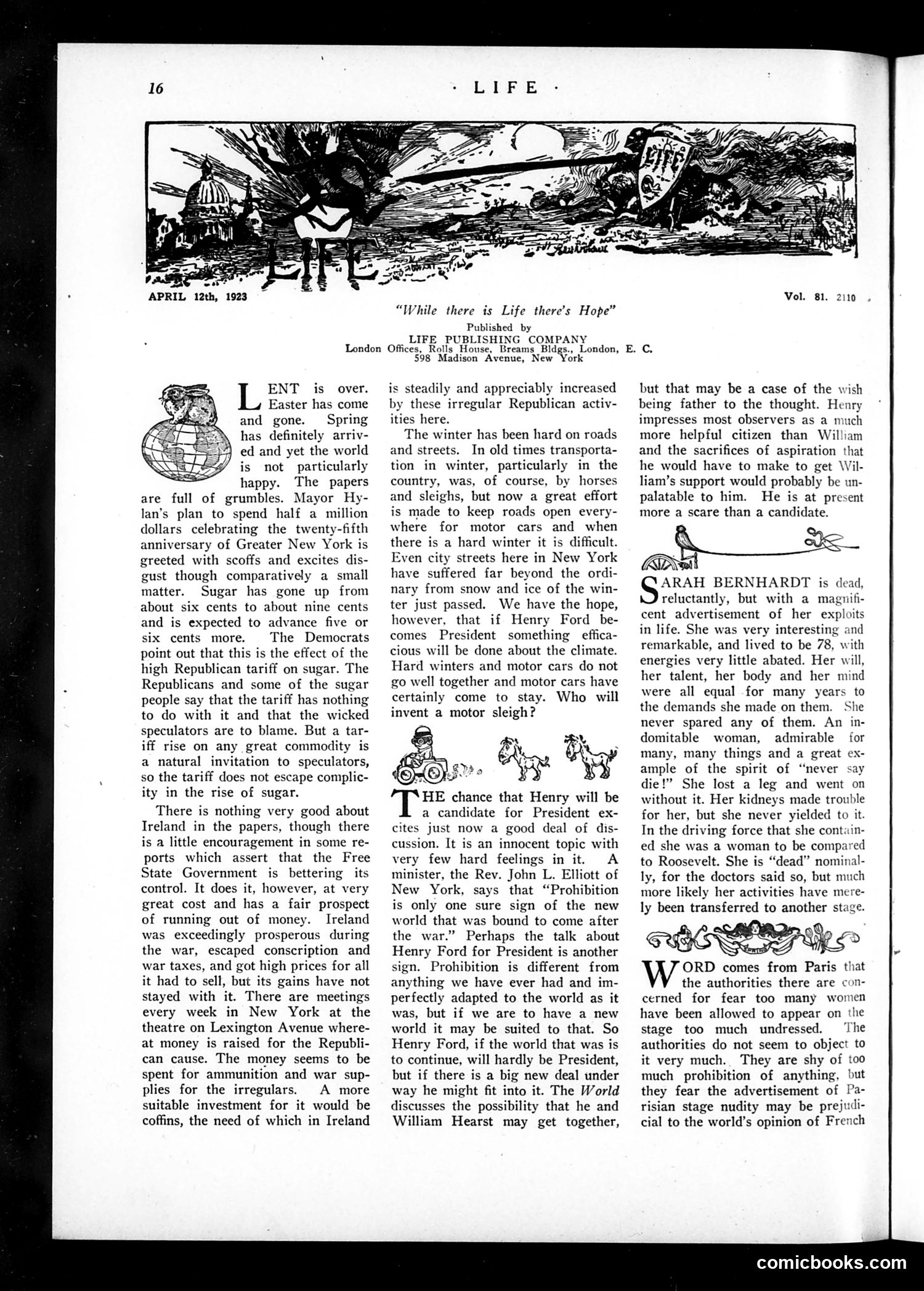
This page contains editorial commentary on current events rather than cartoons. The main satirical points are: **Henry Ford for President**: The article discusses Ford as a potential presidential candidate, noting the irony that if there's a "new world" emerging post-WWI, Ford might fit it—but if the old world continues, he wouldn't. The satire suggests Ford's mechanistic worldview might suit radical change but not stability. **Irish Republican fundraising**: The author sarcastically remarks that money raised in New York for Irish Republican "irregulars" would be better spent on coffins, given the violence of the Irish Civil War (1922-1923). **Sugar tariffs and speculation**: Democrats blame Republican tariffs for sugar price increases; Republicans blame speculators. The author notes tariffs naturally invite speculation—a commentary on market manipulation. **Winter and motor cars**: A humorous aside suggesting someone should invent a "motor sleigh" since cars and hard winters don't coexist well. The overall tone is skeptical of political claims and amused by post-war American contradictions.
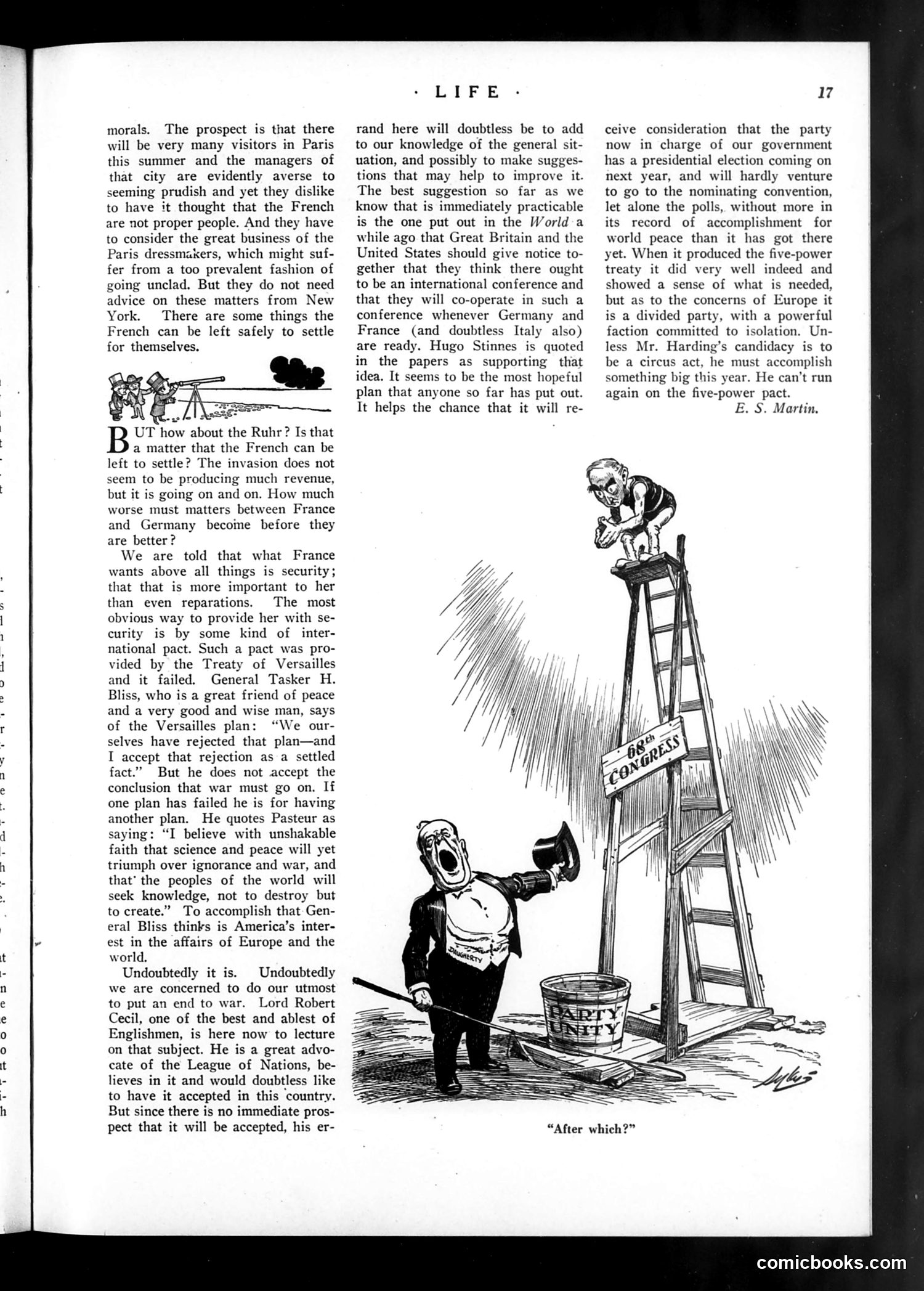
This Life magazine page discusses post-WWI peace efforts, featuring a cartoon titled "After which?" that satirizes American political posturing on European security. **The Cartoon's Meaning:** The illustration shows a man (likely representing a U.S. politician or President Harding) standing on a ladder labeled "Congress," holding a megaphone and gesturing at a bucket labeled "Party" below. The caption "After which?" suggests that once American political theater concludes, what actually comes next regarding genuine peace efforts? **The Satire's Point:** The text reveals the joke: Harding's administration will pursue peace initiatives primarily to boost its record before the upcoming presidential election, not from genuine commitment. The divided Republican party is split between internationalists and isolationists. The author (E.S. Martin) cynically suggests Harding must accomplish something "big this year" to avoid his candidacy appearing as mere "circus act"—implying hollow political performance rather than substantive peace work. The cartoon visualizes this criticism: America's leadership grandstanding from a precarious political perch, disconnected from actual European security concerns.
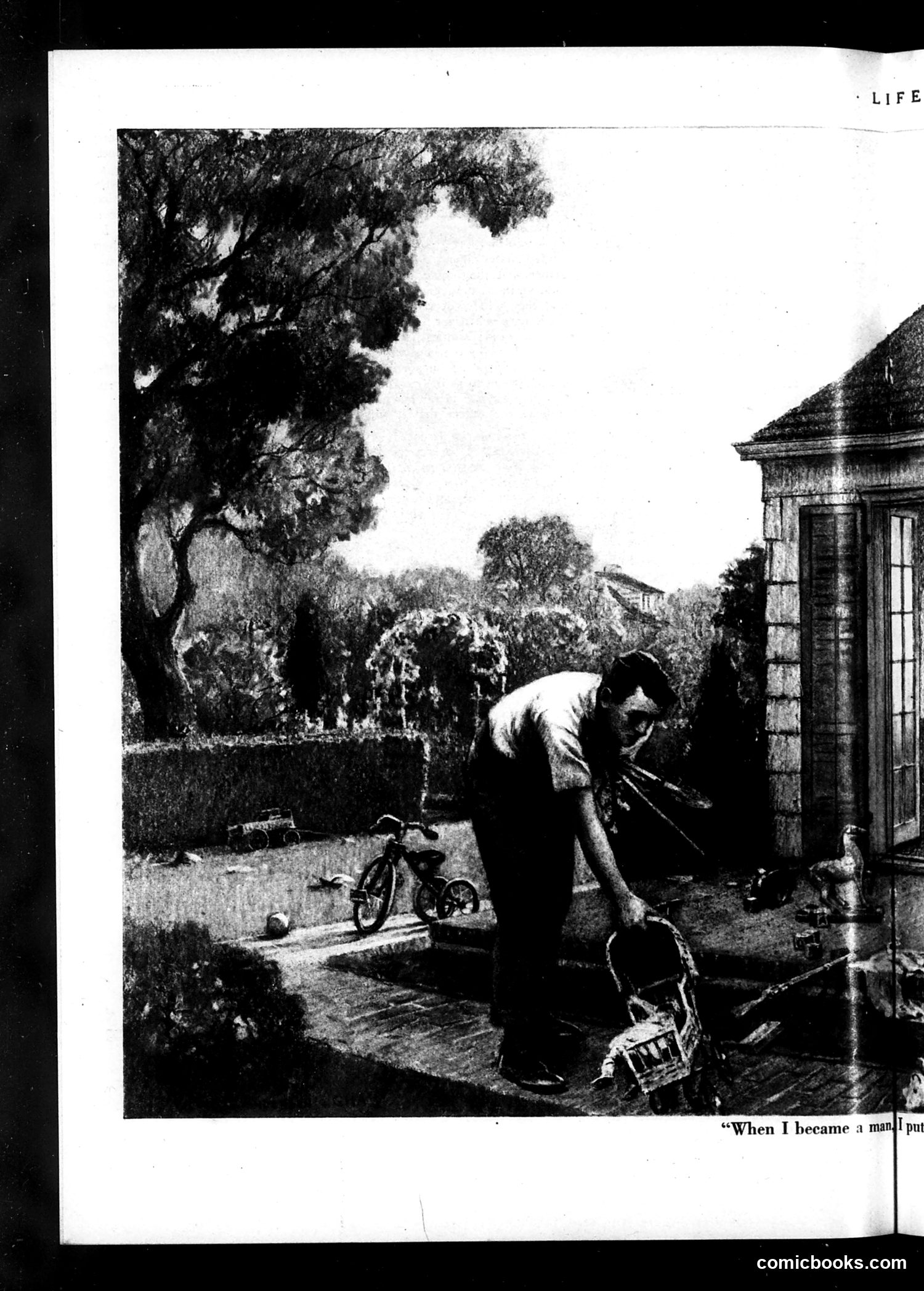
This page shows a black and white photograph rather than a cartoon. It depicts a man bending over to repair or work on a bicycle in a garden setting, with a large tree, hedges, and a stone building visible. A child's bicycle sits nearby. The partial caption reads "When I became a man," which appears to reference the biblical passage (1 Corinthians 13:11): "When I became a man, I put away childish things." The juxtaposition of the adult man working on a child's bicycle suggests satirical commentary on nostalgia, lost youth, or the persistence of childish pursuits into adulthood. Without the complete caption, the exact satirical point remains unclear, but the image likely comments on adult regression or sentimental attachment to childhood.
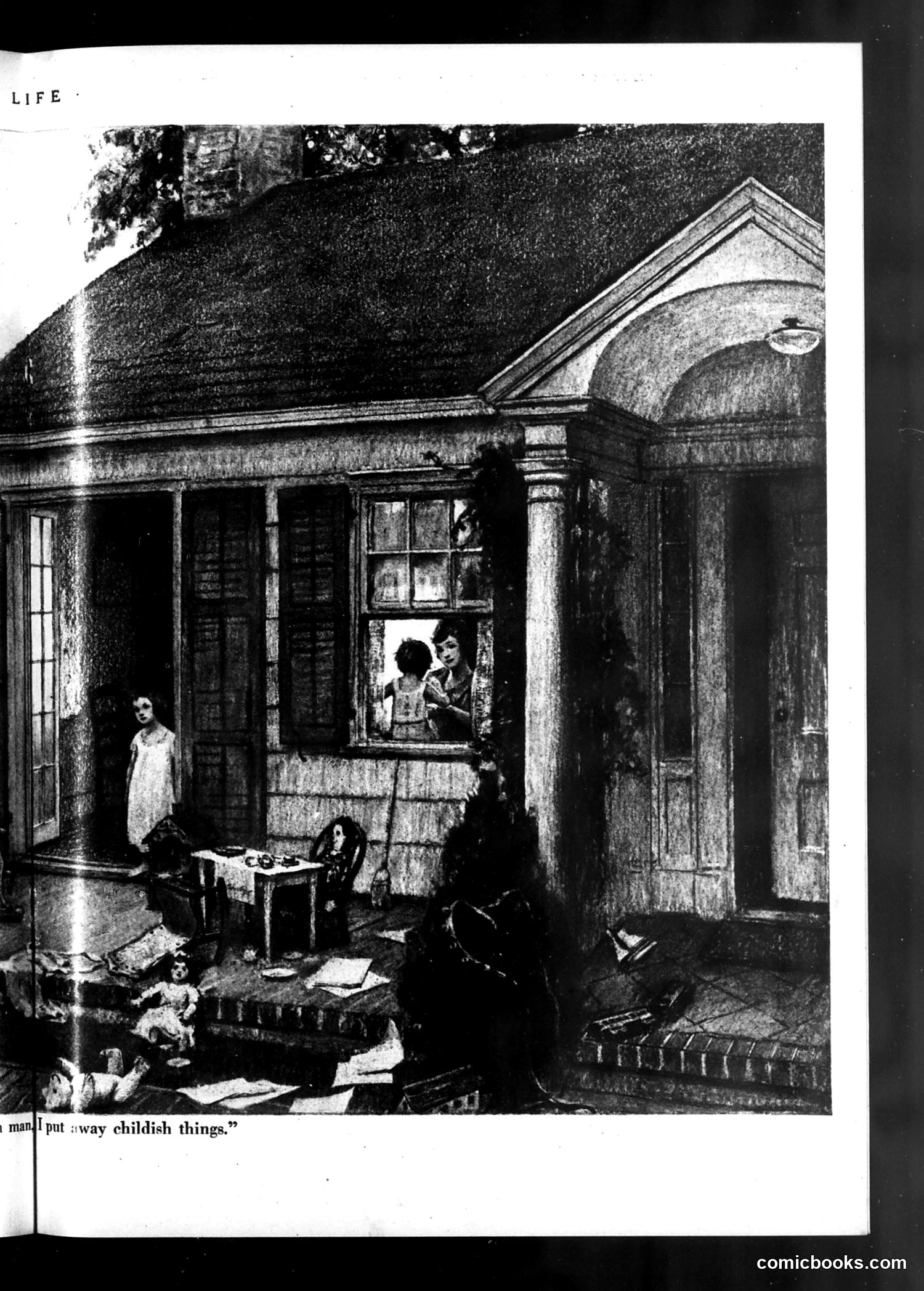
This appears to be a scene from a domestic interior, likely illustrating a narrative or satirical comment on family life or social manners. The image shows multiple figures in what seems to be an early-to-mid 20th century setting, with period furnishings and architecture. The partial caption visible reads "man put away childish things," which references the biblical phrase "when I became a man, I put away childish things" (1 Corinthians 13:11). This suggests the cartoon comments on maturation, responsibility, or the contrast between childhood behavior and adult expectations. However, without the complete caption and full context of the article or cartoon, I cannot definitively identify the specific figures, the precise social commentary intended, or the historical moment being satirized. The domestic scene appears to critique some aspect of contemporary behavior or social convention, but determining the exact target requires more textual information.
This 1920s *Life* magazine article satirizes wealthy amateur investors who fund Broadway musicals. The author mocks the ease with which producers solicit money from "little men with wide baby-blue eyes" willing to back any show with minimal artistic merit. The piece compares two actual Broadway productions: "Jack and Jill" (expensive but tedious, redeemed only by dancer Ann Pennington's "dimpled stimuli") and "Go-Go" (cheap, burlesque-like, yet vital and entertaining). The satire's point: don't judge a show by its budget. "Jack and Jill" squanders money on elaborate scenery while lacking life; "Go-Go" succeeds through authentic comic talent like Don Barclay's performances. The financial advice is ironic—if you must lose money on theater, choose the cheaper show that at least has "vigorous authority" rather than expensively boring spectacle.
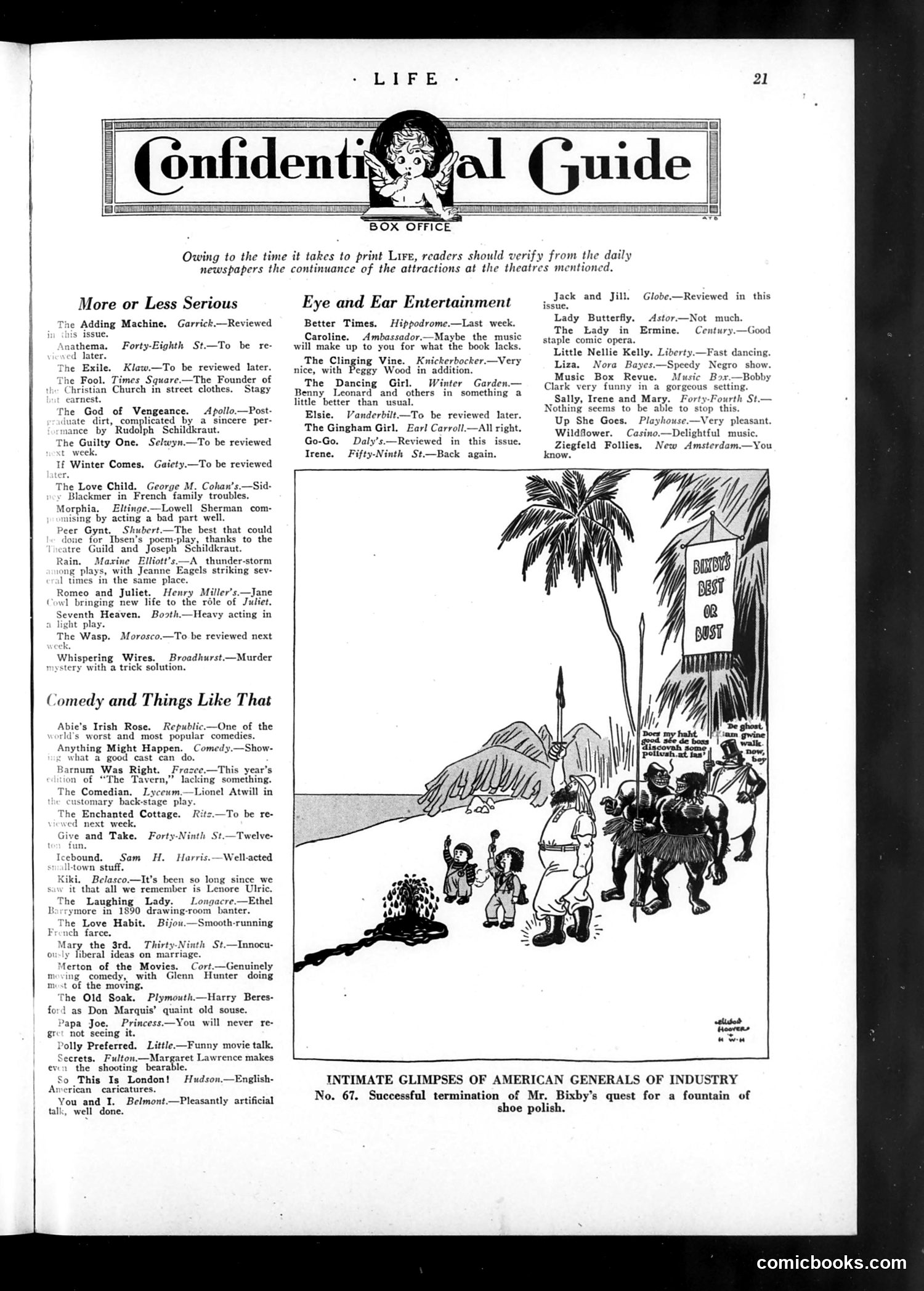
This is a theater review page from Life magazine's "Confidential Guide" to Broadway productions. The left column lists plays categorized as "More or Less Serious" and "Comedy and Things Like That," with brief critical assessments. The cartoon below depicts an absurdist scenario captioned "Intimate Glimpses of American Generals of Industry, No. 67: Successful termination of Mr. Bixby's quest for a fountain of shoe polish." It shows a figure discovering a natural spring in a desert landscape, apparently having mistaken it for shoe polish—a satirical jab at American industrial entrepreneurs pursuing frivolous or misguided commercial ventures. The humor relies on the series title "Generals of Industry," mock-elevating businessmen as military figures while depicting them engaged in ridiculous quests, reflecting early 20th-century skepticism toward corporate ambitions and commercialism.
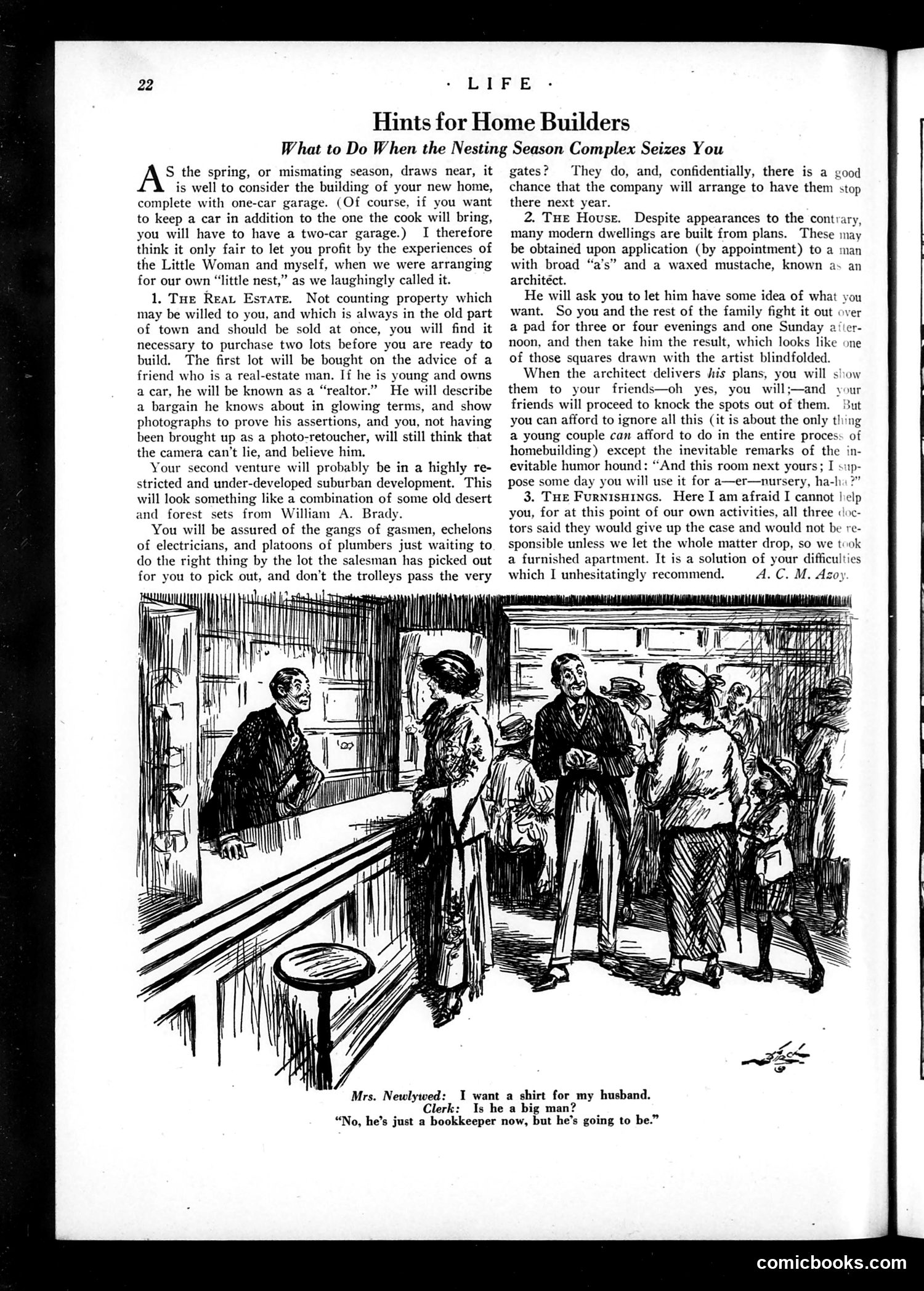
This page satirizes the middle-class aspiration to homeownership during the early 20th century. The article humorously walks readers through purchasing property and building a new suburban house, mocking the pretensions and pitfalls involved. Key targets include: **Real estate salesmen**: Dismissed as deceptive "realtors" who use photos and smooth talk to sell poor properties. **Architects**: Portrayed as pompous (note the affected accent: "architéct") and dismissive of clients' input. **Social climbing**: The piece ridicules newlyweds' enthusiasm and their vulnerability to friends' criticism. The bottom cartoon depicts a clerk fitting a shirt for a bookkeeper's wife. Her boast that her husband will "be" a big man (implying future success) undercuts the modest reality—he's currently just a bookkeeper. This reflects period anxieties about class mobility and domestic aspirations. Overall, the satire deflates homeownership fantasies while gently mocking middle-class social pretensions.
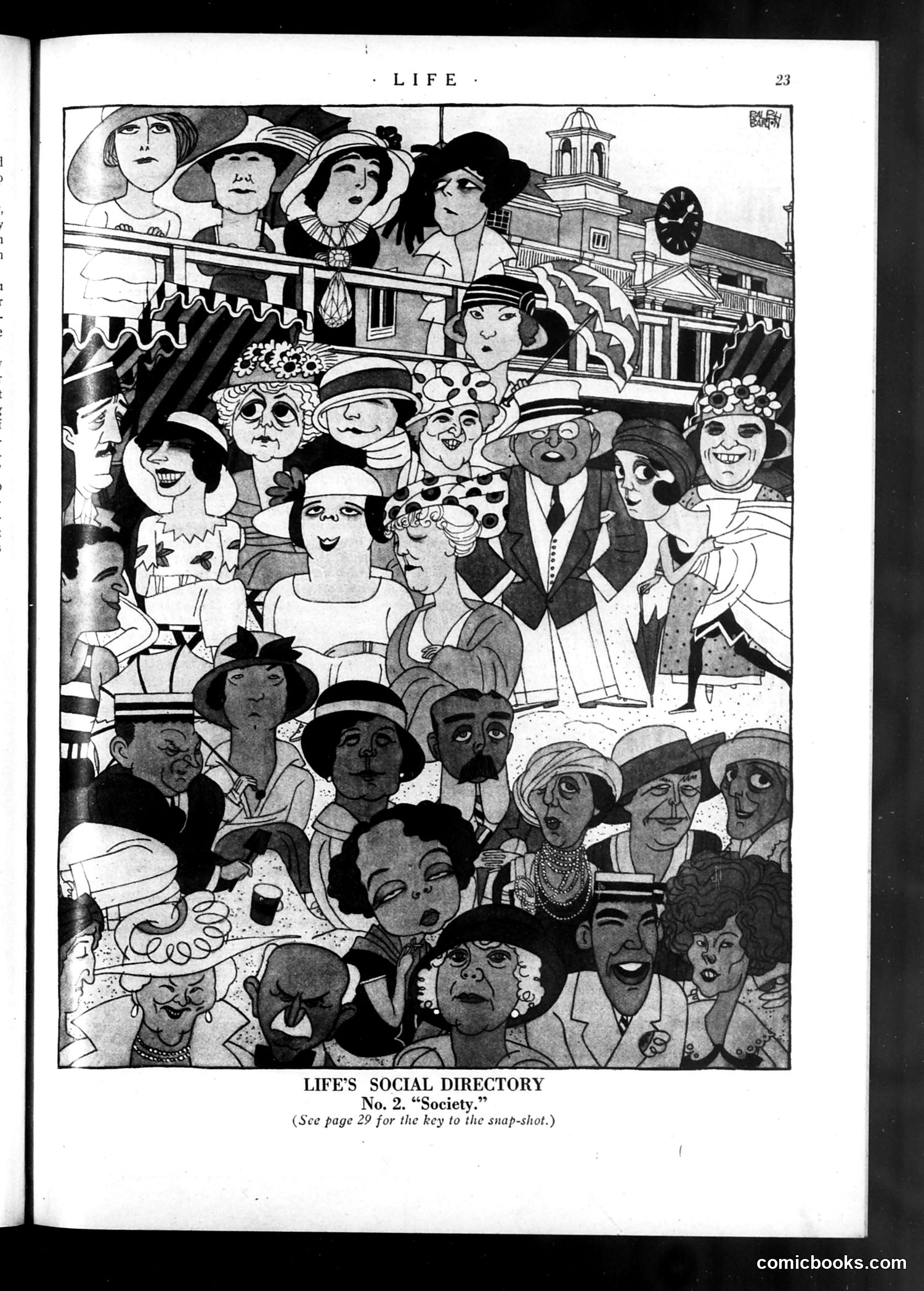
This is a satirical illustration titled "Life's Social Directory No. 2: 'Society.'" It's a densely packed crowd scene caricaturing high-society figures of the era, rendered in an exaggerated, comic style typical of early 20th-century Life magazine satire. The cartoon mocks fashionable society people through unflattering physical caricatures—exaggerated facial features, prominent noses, and affected expressions. The figures wear elaborate hats, jewelry, and formal attire, suggesting wealth and pretension. A building with a clock tower appears in the background, possibly indicating a specific social venue. The satire targets the vanity and superficiality of the upper class. The reference to page 29 indicates the magazine provided a "key" identifying specific individuals being lampooned—a common Life magazine feature that made the satire pointed and personal for contemporary readers who would recognize the society figures depicted.
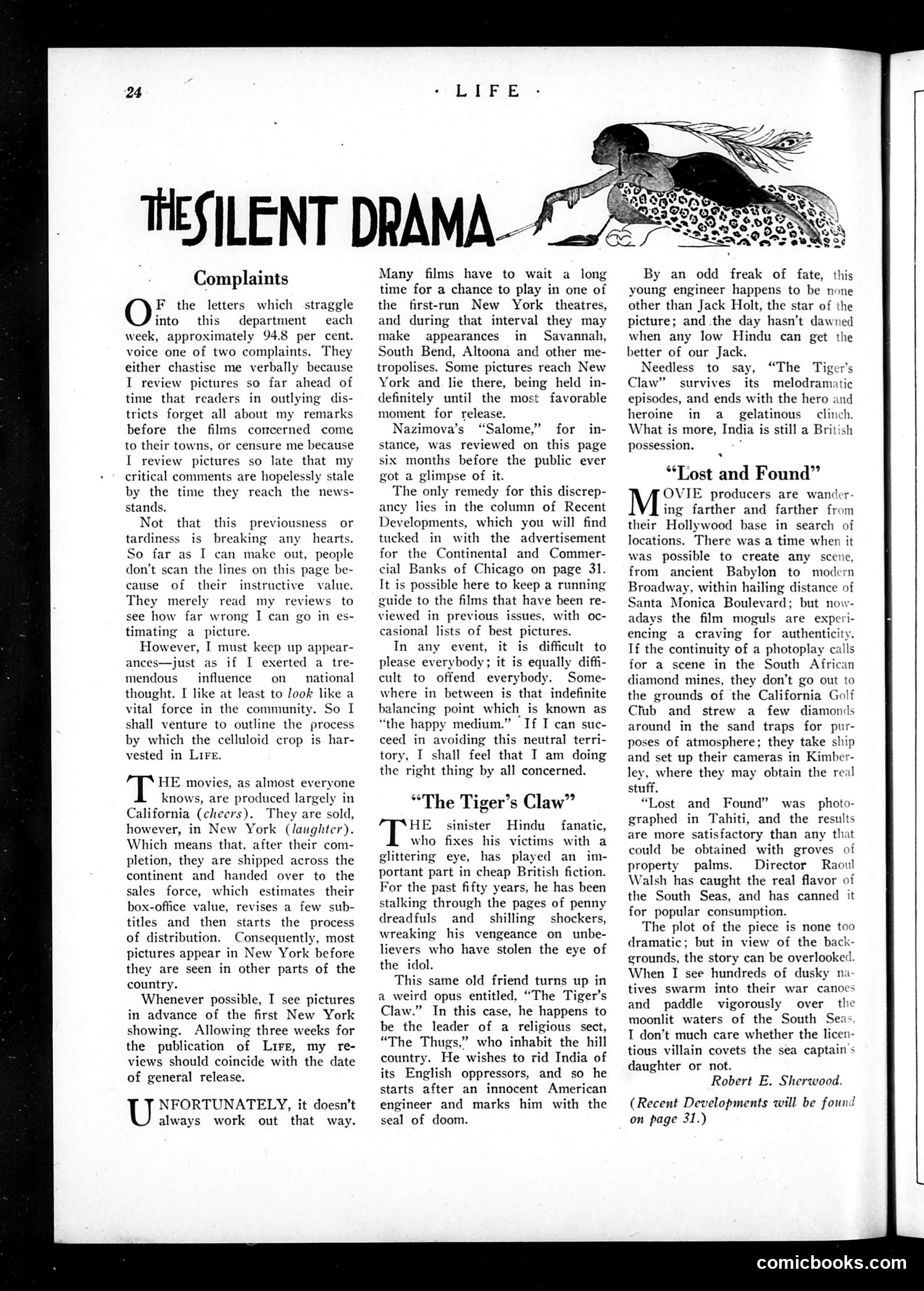
This page contains a film critic's column explaining the logistical challenges of movie reviewing. The critic addresses reader complaints about timing: reviews either appear months before films reach smaller cities, or arrive too late to matter. He describes how Hollywood operates—films are produced in California but distributed from New York, creating unpredictable delays before regional release. The column reviews "The Tiger's Claw," a melodrama featuring a stock character from British pulp fiction: a "sinister Hindu fanatic" seeking vengeance. The critic notes this villain type has haunted "penny dreadfuls and shilling shockers" for fifty years. Here, the character leads a religious sect opposing English rule in India, targeting an American engineer. The casual, somewhat dismissive tone toward both the review-timing problem and the film's orientalist stereotyping reflects early 1920s attitudes—the exotic "Hindu fanatic" villain was considered routine entertainment fodder.
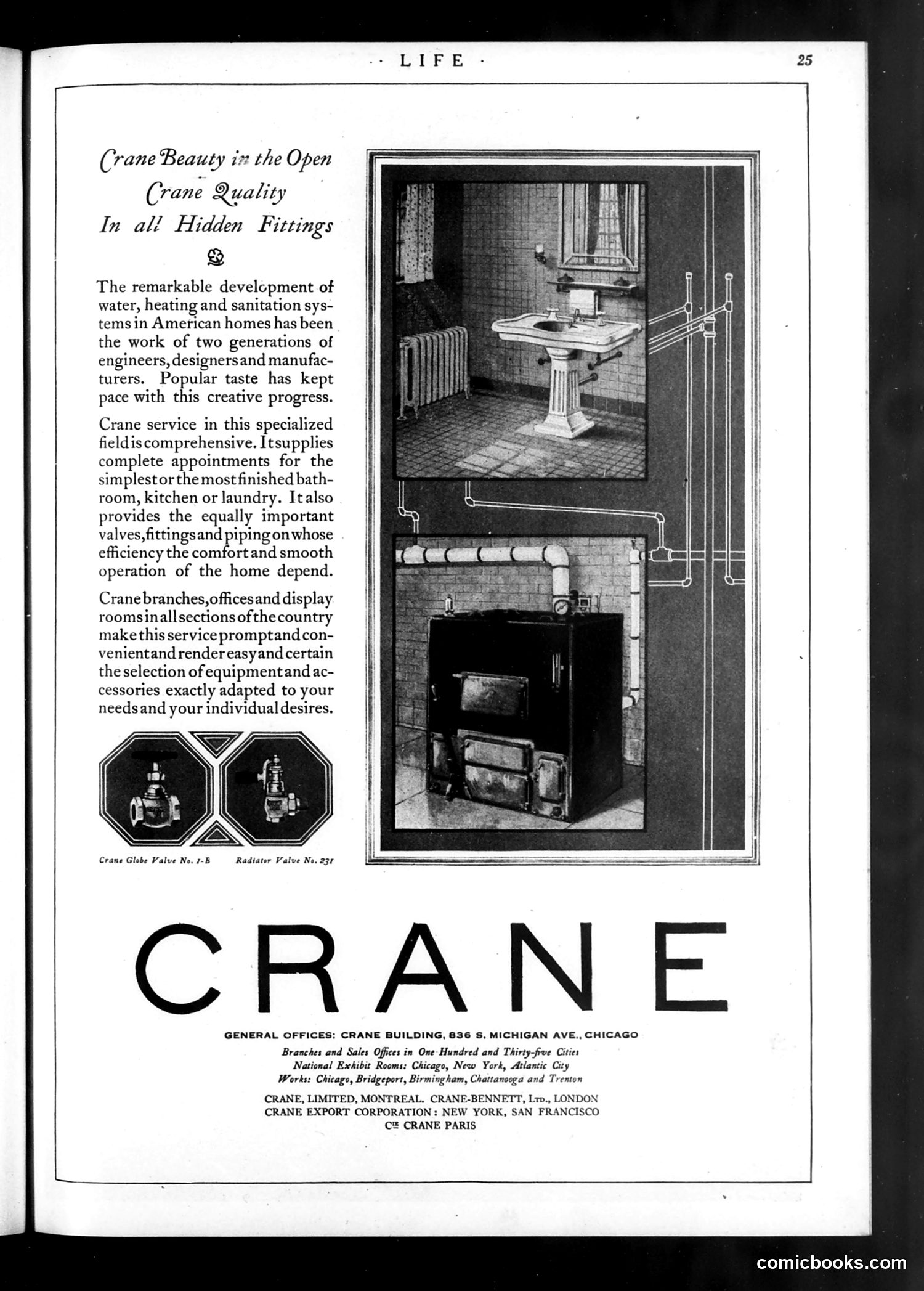
This is a **full-page advertisement**, not a cartoon or satire. It promotes Crane, a major plumbing fixtures and heating systems manufacturer based in Chicago. The ad emphasizes Crane's comprehensive range of bathroom, kitchen, and laundry products—from visible fixtures to hidden valves and piping. The accompanying photograph shows a complete bathroom installation (sink, radiator, toilet) alongside what appears to be a heating stove, illustrating the "quality in hidden fittings" slogan. The text argues that Crane has kept pace with Americans' rising expectations for modern home comfort through two generations of engineering innovation. The ad concludes with Crane's extensive network of branches across 135+ cities and international operations. This represents typical 1920s advertising strategy: positioning industrial manufacturers as drivers of modern domestic progress and convenience.
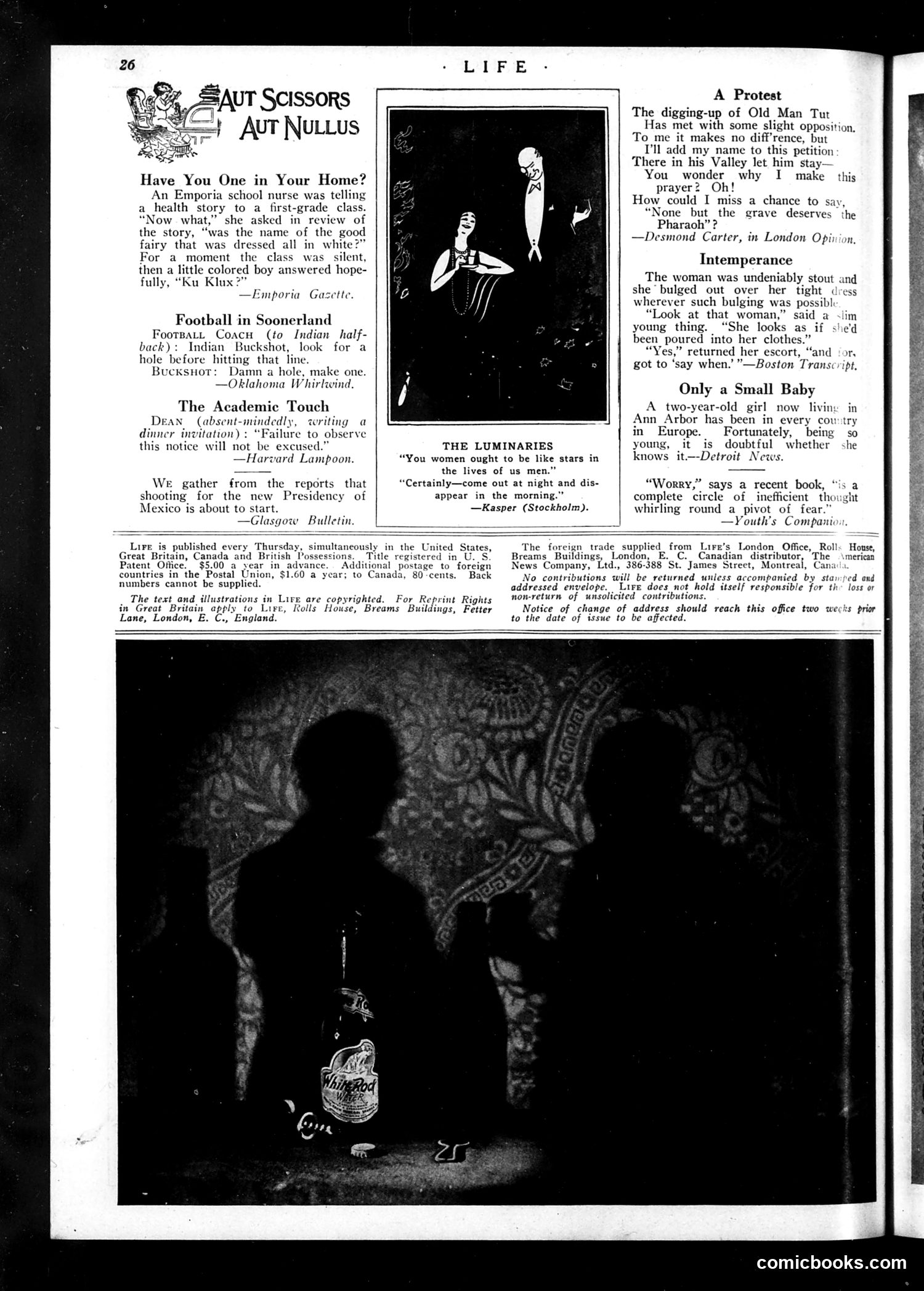
This page from *Life* magazine contains several brief satirical items typical of the publication's humor section: **"Have You One in Your Home?"** mocks the Ku Klux Klan by reporting a first-grader's innocent confusion—a school nurse telling a fairy tale about someone "dressed all in white" leads the child to answer "Ku Klux," treating the KKK as casually as a nursery character. The satire exposes how normalized the Klan had become in American consciousness. **"Football in Soonerland"** jokes about Native American athletes, using period stereotypes ("Indian Buckshot," references to holes). **"The Luminaries"** presents a gender-war joke: when a man compares women to stars in men's lives, a woman retorts that stars only appear at night and disappear by morning—a cutting observation about women's limited social roles. The remaining items are brief quips about intemperance, travel, and worry. The central illustration appears to be an art deco-style decorative piece, likely accompanying "The Luminaries."
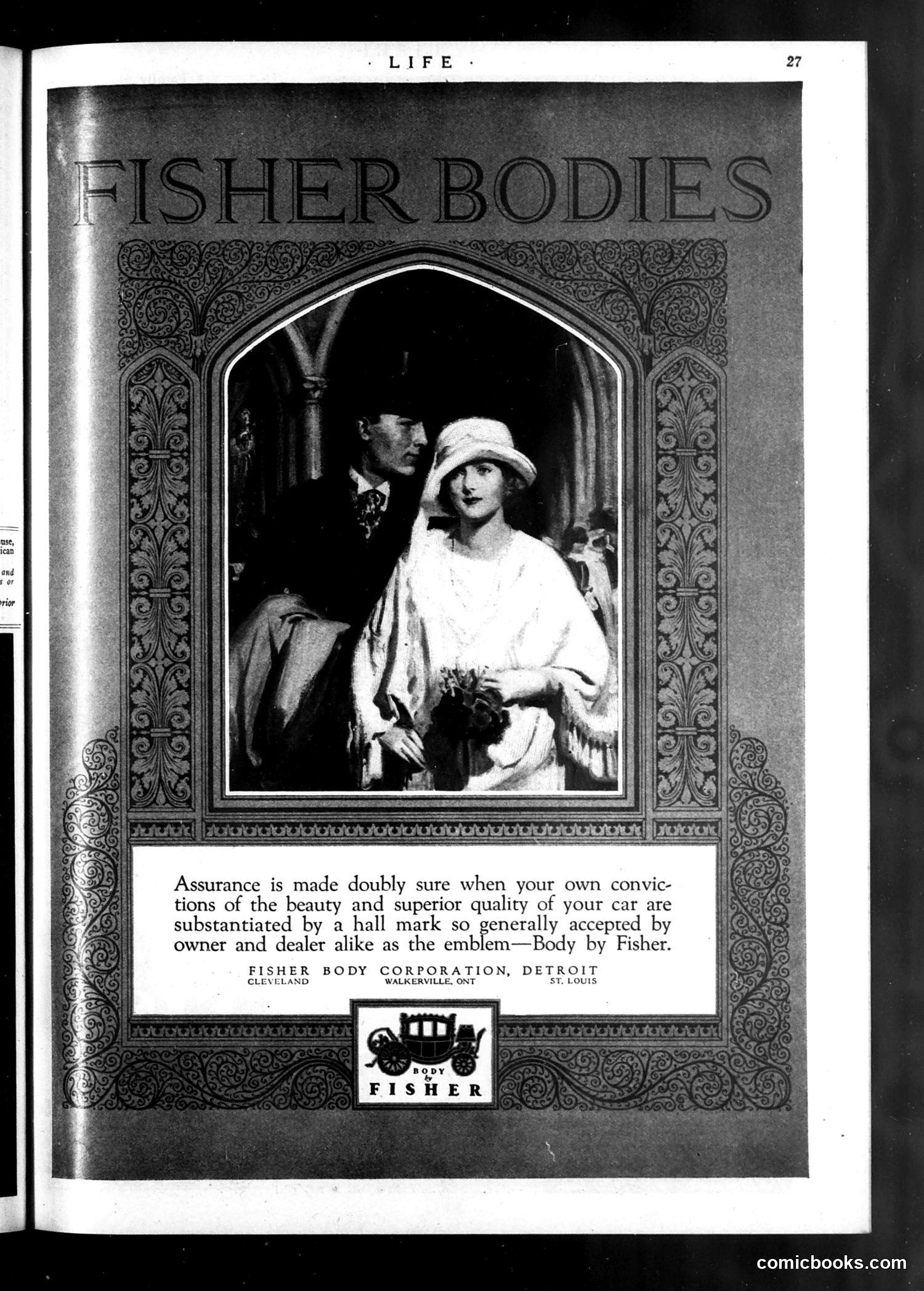
This is a **Fisher Body Corporation advertisement**, not political satire. The page features a photograph of two elegantly dressed figures (a man in a tuxedo and a woman in white clothing and cloche hat, typical 1920s attire) framed in an ornate border. The ad copy uses the couple as aspirational imagery to market automobile bodies. The "hall mark" reference suggests that owning a Fisher Body conveys social status and quality assurance—the implication being that discriminating, well-dressed people choose Fisher. This reflects 1920s advertising strategy: associating products with wealth, sophistication, and refined taste. The Fisher logo and multiple factory locations listed indicate this is a major automotive supplier. There is no political commentary or satire present on this page.
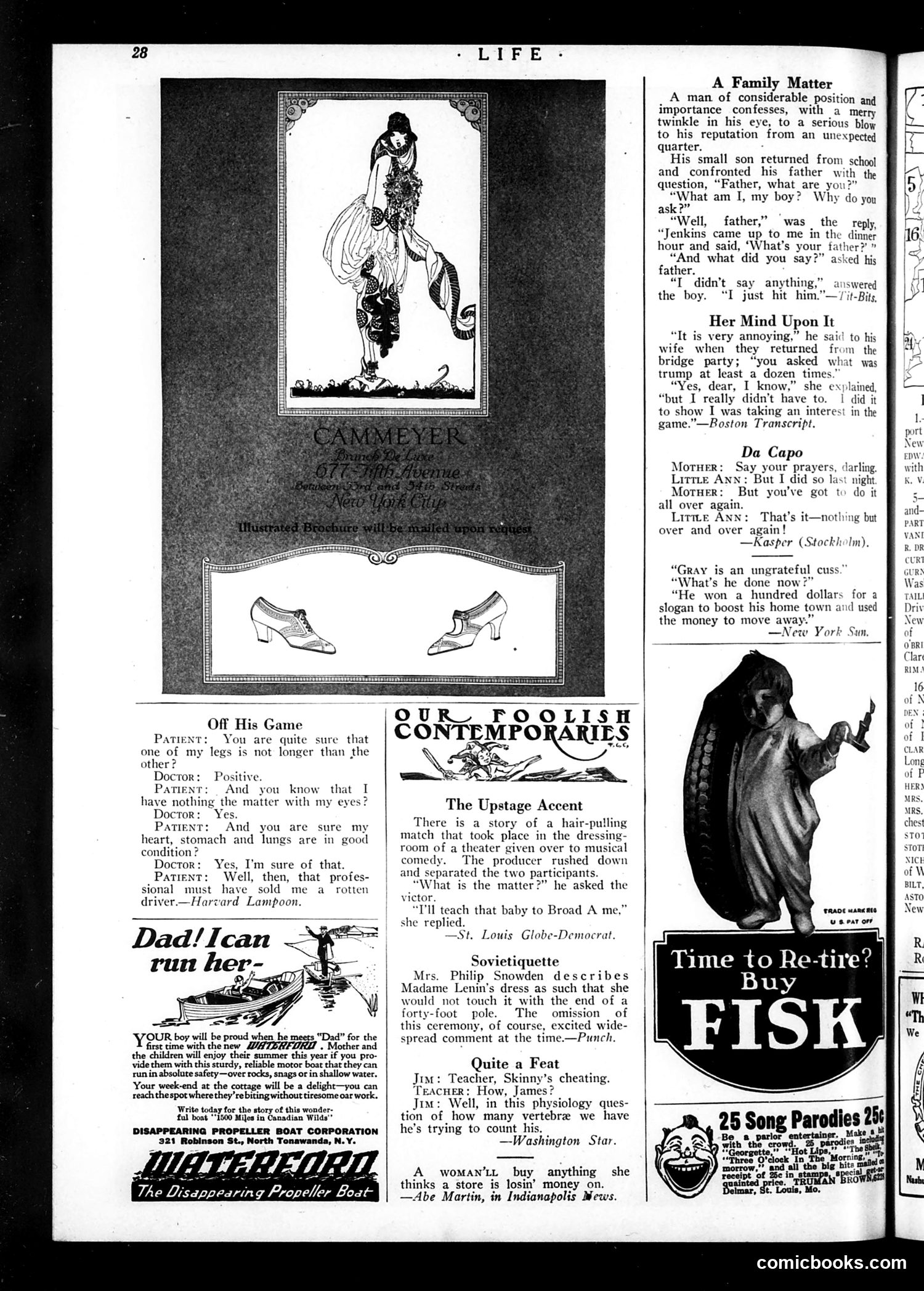
This page contains satirical humor pieces typical of early 20th-century American magazines. The main cartoons and jokes mock everyday situations: **"Off His Game"** jokes about a golfer blaming his poor performance on a faulty golf club rather than his own abilities—despite a doctor confirming his physical health is sound. **"The Upstage Accent"** references theatrical pretension: an actress backstage insists on correcting another performer's pronunciation of "broad A," escalating to a physical fight over theatrical diction standards. **"Sovietiquette"** satirizes post-Soviet Russia through Mrs. Snowden's reported disgust at Madame Lenin's appearance—implying Soviet society lacks refinement. The remaining pieces humorously critique human nature: cheating students, wives distracted at bridge games, and ungrateful townspeople. The advertisements (boat company, Fisk tires) occupy significant space, typical of Life's mixed content model during this era.
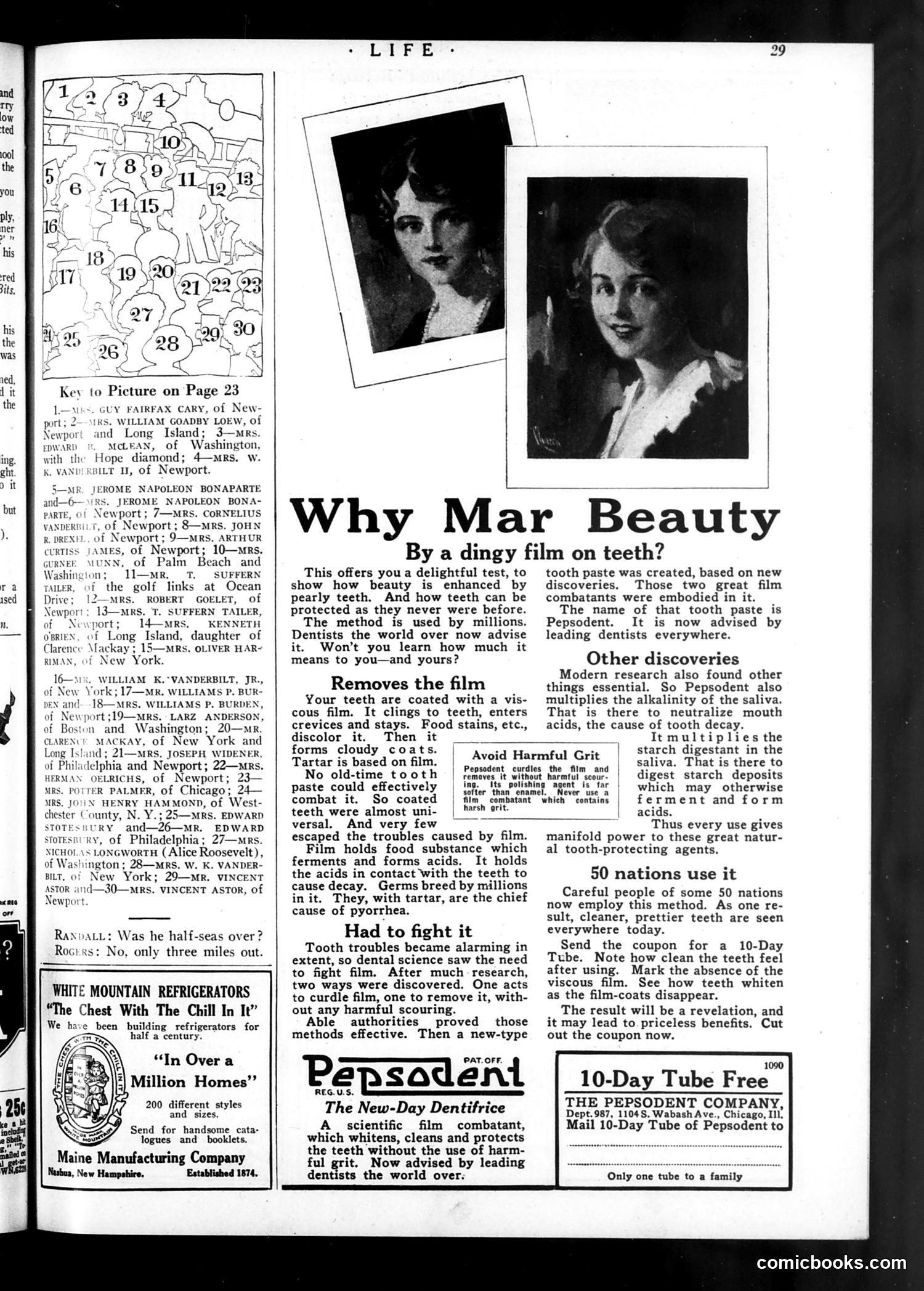
This page is primarily **advertising content**, not political satire. The main feature is a large advertisement for **Pepsodent toothpaste**, which dominates the right side of the page. The left side contains a "Key to Picture on Page 23"—a numbered diagram identifying prominent members of Newport's **high society elite** (the Vanderbilts, Astors, Mackays, and other wealthy families). This appears to reference a society photograph or illustration from the previous page. The Pepsodent ad represents early 20th-century **dental marketing innovation**. It educates readers about a newly-discovered problem: invisible film coating teeth that causes decay and discoloration. The ad emphasizes that Pepsodent uses scientific methods to remove this film without harmful abrasive grit—a major selling point when competitors used harsh scouring powders. The page also includes advertisements for **White Mountain Refrigerators** (positioned as a century-old trusted brand) and a **10-day free trial offer** for Pepsodent. This is a snapshot of consumer advertising and society journalism from the 1920s era.
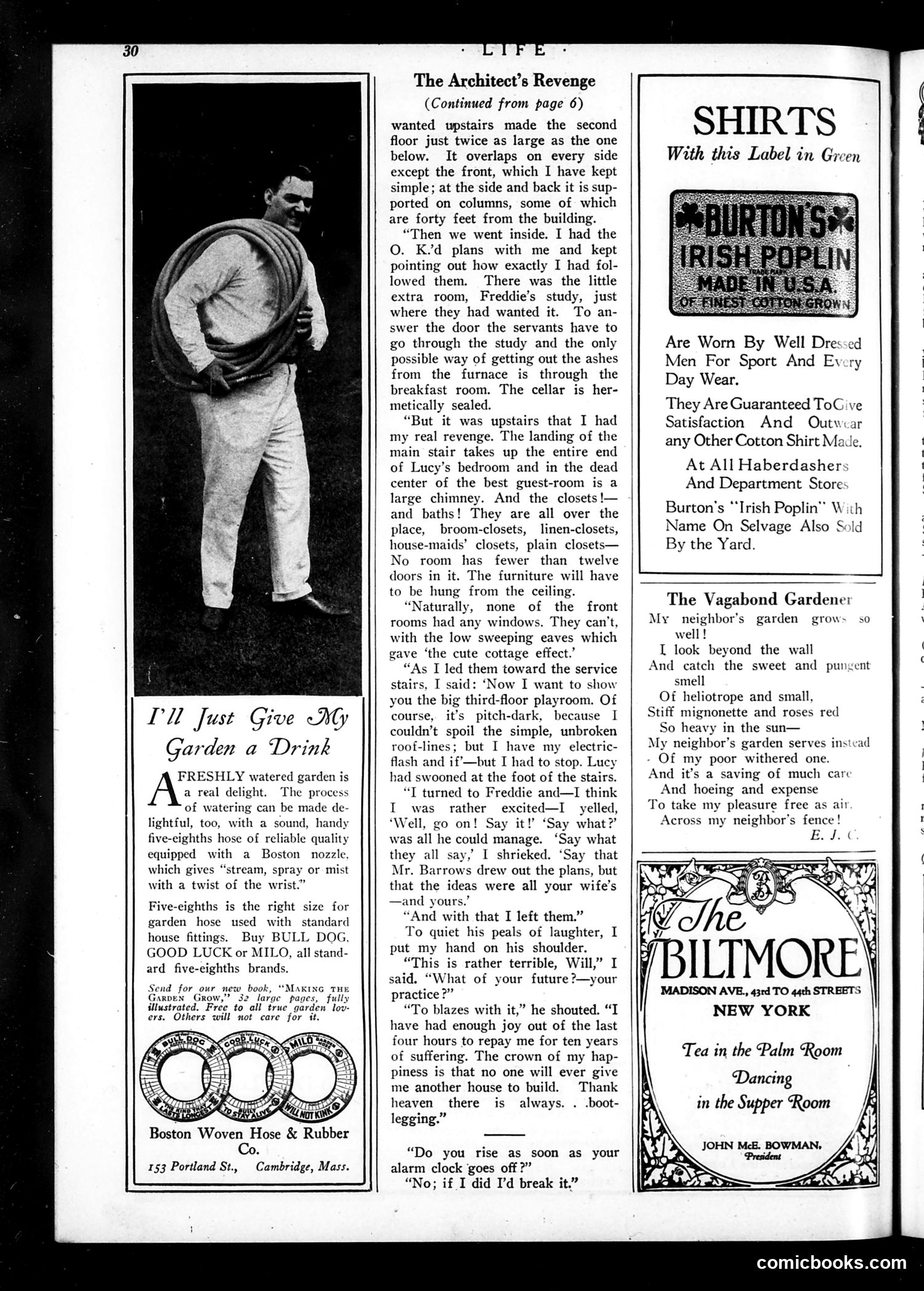
This satirical story depicts an architect's petty revenge against wealthy clients. A couple, Lucy and Freddie, hired the architect (Will) but took credit for the design, claiming his ideas as their own. He responds by deliberately designing their new house with absurd, impractical features: a landing that consumes their bedroom, a massive chimney in the guest room, twelve doors per room, no windows in front rooms, and inaccessible furnace access. The joke is on the clients—they got exactly what they requested in writing, but the architect secretly sabotaged the design to make their house unlivable. His revenge is so successful that when Lucy faints upon realizing their predicament, the architect declares he's so satisfied he's abandoning architecture to become a bootlegger (alluding to Prohibition-era illegal alcohol production). The satire mocks both pretentious clients who steal credit and architects' ability to subtly undermine those who wrong them.
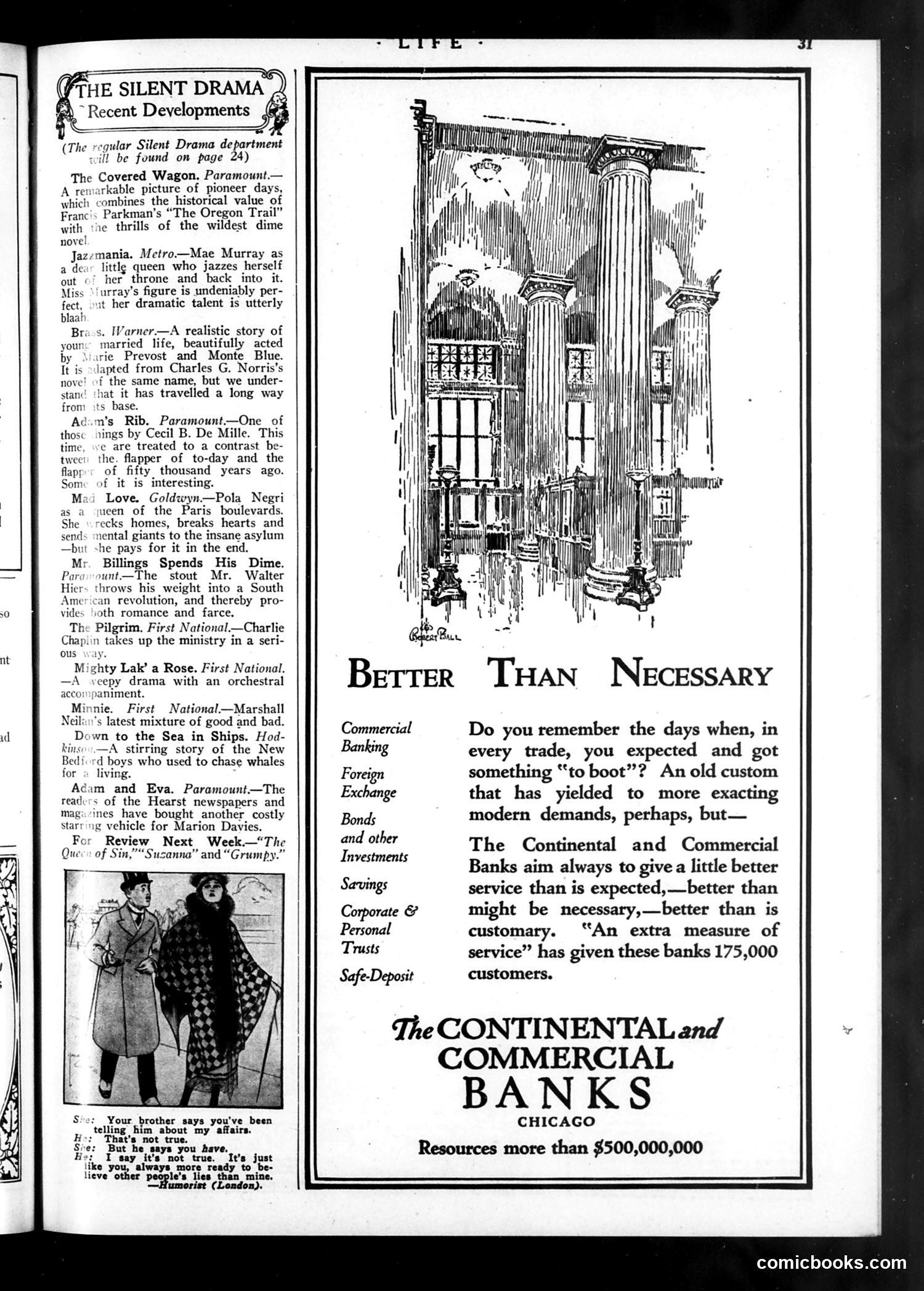
This page combines film reviews with advertising. **Left side**: "The Silent Drama" reviews recent movies, mostly from major studios (Paramount, Metro, First National). The reviews are brief, sometimes witty critiques—Mae Murray's "dramatic talent is utterly blah"; Adam's Rib mixes "the flapper of to-day and the flapper of fifty thousand years ago." **Bottom left**: A small cartoon showing two figures in conversation, with dialogue about affairs and lying—likely satirizing marital infidelity or gossip. **Right side**: A full-page advertisement for Continental and Commercial Banks (Chicago). The architectural sketch and headline "Better Than Necessary" pitch the bank's philosophy of exceeding customer expectations. The copy nostalgically references an older custom of receiving bonus value ("to boot") with purchases, suggesting the bank modernizes this practice through superior service. The appeal targets middle-class depositors seeking trustworthy financial institutions with substantial resources ($500+ million). No political satire appears on this page—it's primarily commercial content aimed at contemporary readers.
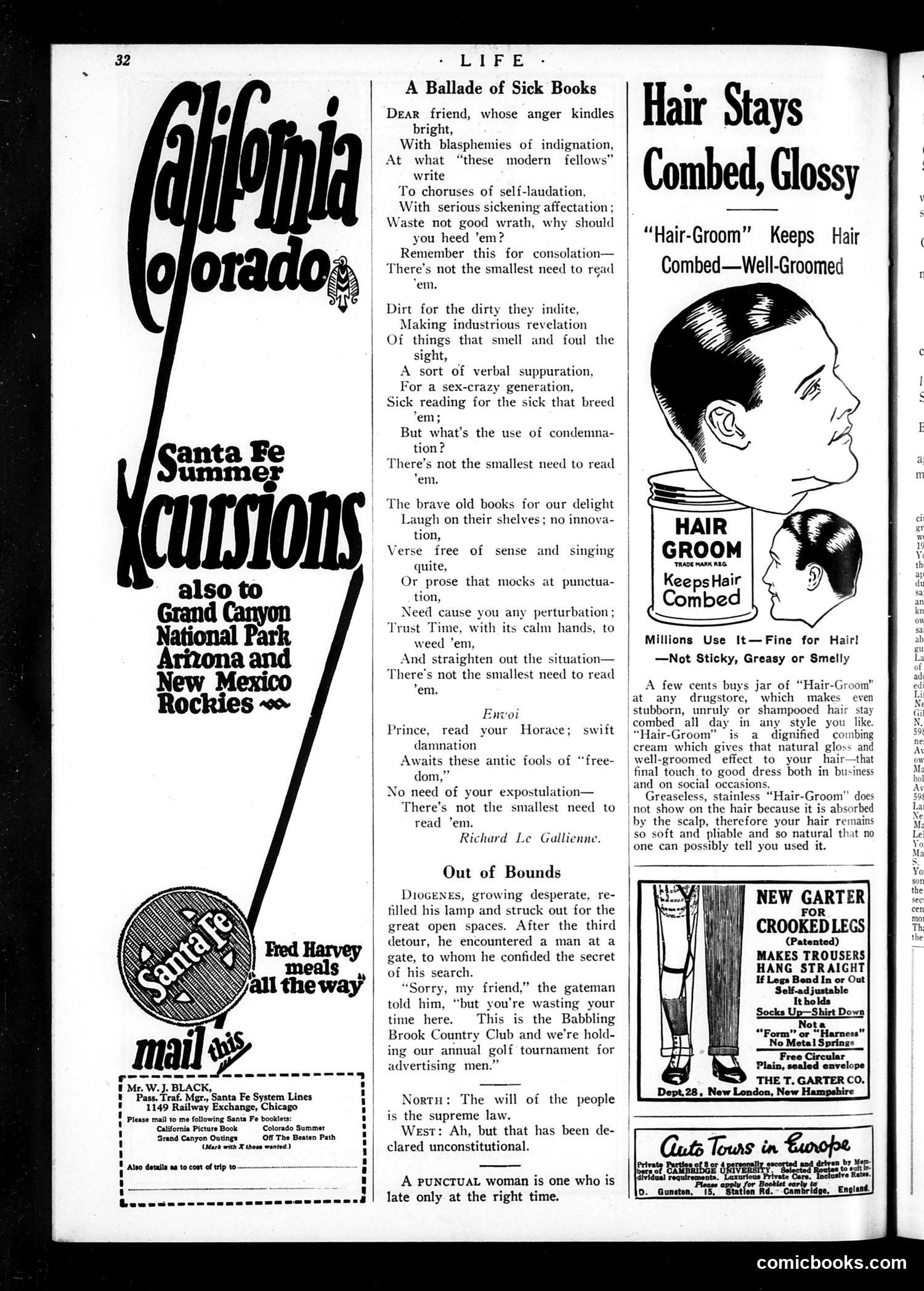
This page contains social and literary satire from the early 20th century. The main text is "A Ballade of Sick Books," a poem by Richard Le Gallienne attacking modern literature. The author condemns contemporary writers for producing vulgar, poorly-written work—"dirt for the dirty"—aimed at what he calls a "sex-crazy generation." He dismisses modernist innovations like free verse and unconventional punctuation as pretentious affectation. The satire targets the cultural anxiety of the era: established literary figures feared that new writing styles (modernism) and frank subject matter represented cultural degradation. The poem's refrain—"There's not the smallest need to read 'em"—dismisses such books through willful ignorance rather than engagement. The "Out of Bounds" joke at page bottom satirizes advertising professionals, depicting Diogenes (the ancient philosopher searching for an honest man) giving up his quest when he discovers a golf tournament for advertisers—implying advertisers represent dishonesty. The page is otherwise dominated by period advertisements for hair products and clothing.
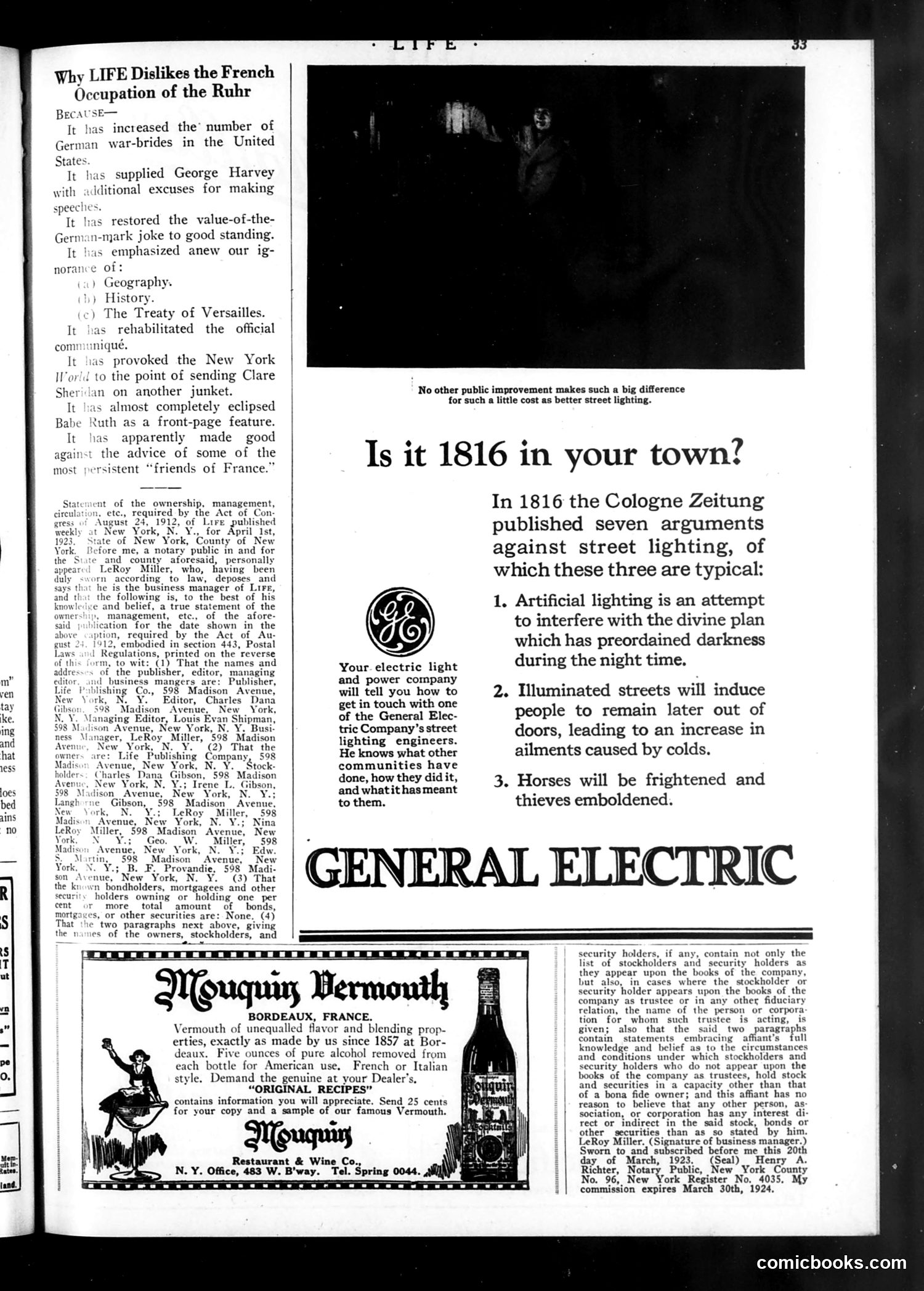
This page from Life (circa 1923) contains satirical commentary on the French occupation of the Ruhr Valley—a post-WWI geopolitical crisis. **The Main Satire ("Why LIFE Dislikes the French Occupation"):** Life uses absurdist humor to mock the occupation's consequences for Americans. The list ranges from the serious (increased German war-brides seeking U.S. entry) to the trivial (providing excuses for diplomat George Harvey's speeches, overshadowing Babe Ruth in the news). The joke is that Life finds the occupation objectionable for petty, self-absorbed American reasons rather than legitimate geopolitical concerns. **The General Electric Advertisement:** A direct response to 1920s anti-modernization sentiment, GE sarcastically presents three ridiculous 1816 German arguments *against* street lighting—claiming it violates divine will, increases immorality, and frightens horses. This mocks contemporary resistance to progress while positioning electrification as inevitable modernity. **Overall Context:** The page reflects 1920s American attitudes: detached bemusement about European affairs, confidence in technological progress, and self-focused humor about how world events affect domestic American life.
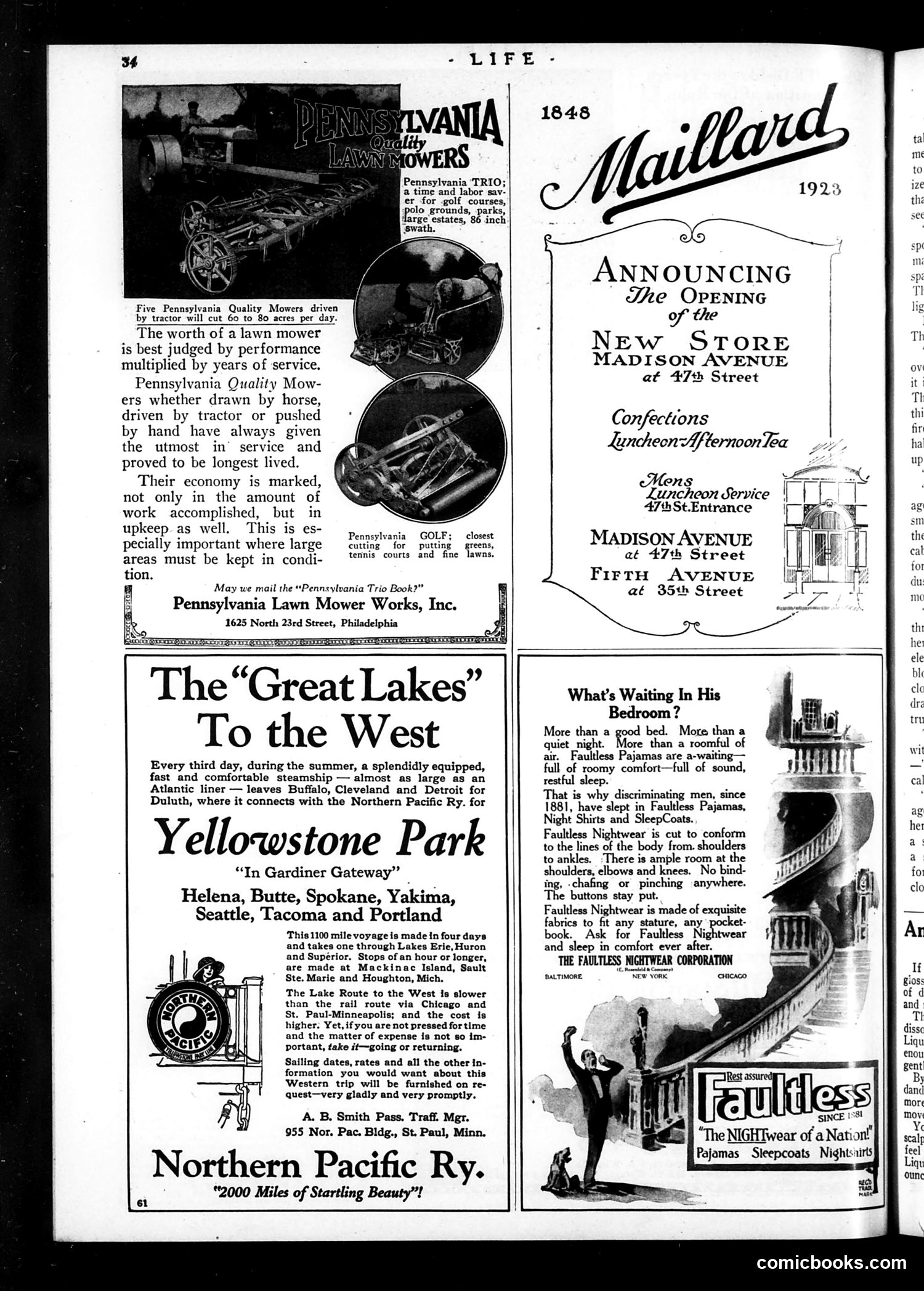
This page is primarily **advertising**, not political satire. It contains six separate commercial advertisements from 1923: 1. **Pennsylvania Quality Mowers** — lawn equipment for estates and golf courses 2. **Maillard** — announcing a new candy/confection store opening on Madison Avenue in New York 3. **Great Lakes/Yellowstone Park** — promoting steamship and rail travel to western destinations 4. **Northern Pacific Railway** — advertising scenic train routes ("2000 Miles of Startling Beauty") 5. **Faultless Nightwear** — pajamas and sleepwear, emphasizing comfort and proper fit for quality sleep The only content with potential social commentary is the **Faultless Nightwear ad**, which appeals to "discriminating men" by emphasizing that quality sleep requires proper clothing—a consumerist pitch targeting middle/upper-class masculinity in the 1920s. No political cartoons or satire appear on this page. It reflects typical 1920s magazine advertising focusing on leisure, travel, and consumer goods.
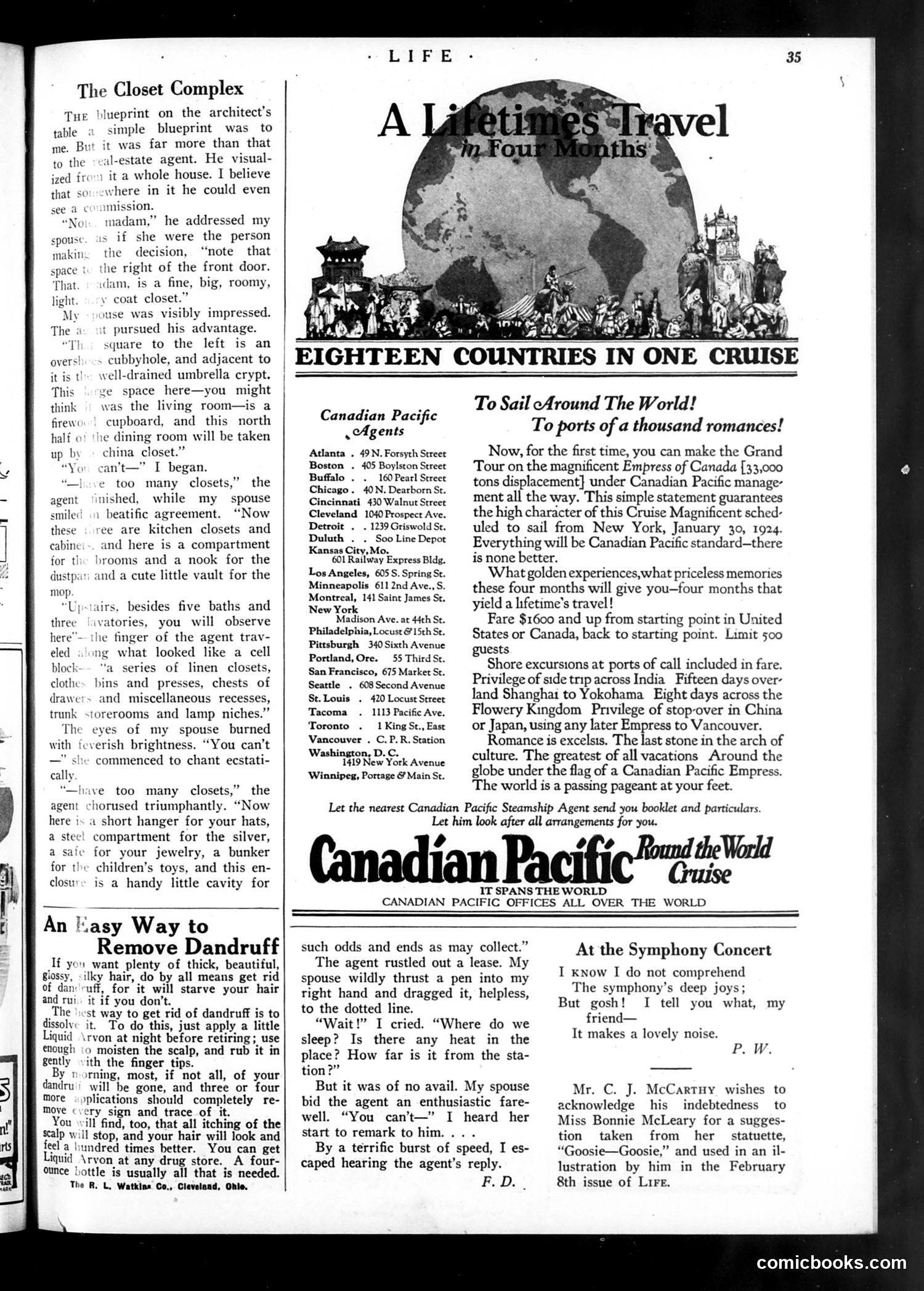
This is a humorous domestic satire about real estate marketing tactics in the 1920s. A real estate agent sells a prospective house to the narrator's wife by obsessively emphasizing its numerous closets and storage spaces—a feature that captivates her far more than the actual living areas. The joke critiques both aggressive sales techniques and changing consumer priorities. The agent deliberately addresses the wife (assuming she makes purchasing decisions) and uses psychological manipulation, repeatedly cataloging closets while the narrator attempts—unsuccessfully—to object. His wife becomes increasingly entranced ("eyes burned with feverish brightness"), repeatedly echoing the agent's refrain: "you can't have too many closets." The satire exposes shallow consumerism: attractive storage features override consideration of the home's actual quality or livability. It also captures gender dynamics of the era, where salesmen assumed wives could be easily swayed by domestic conveniences while husbands seemed powerless to resist their enthusiasm. The accompanying Liquid Arvon dandruff advertisement represents typical 1920s magazine content.
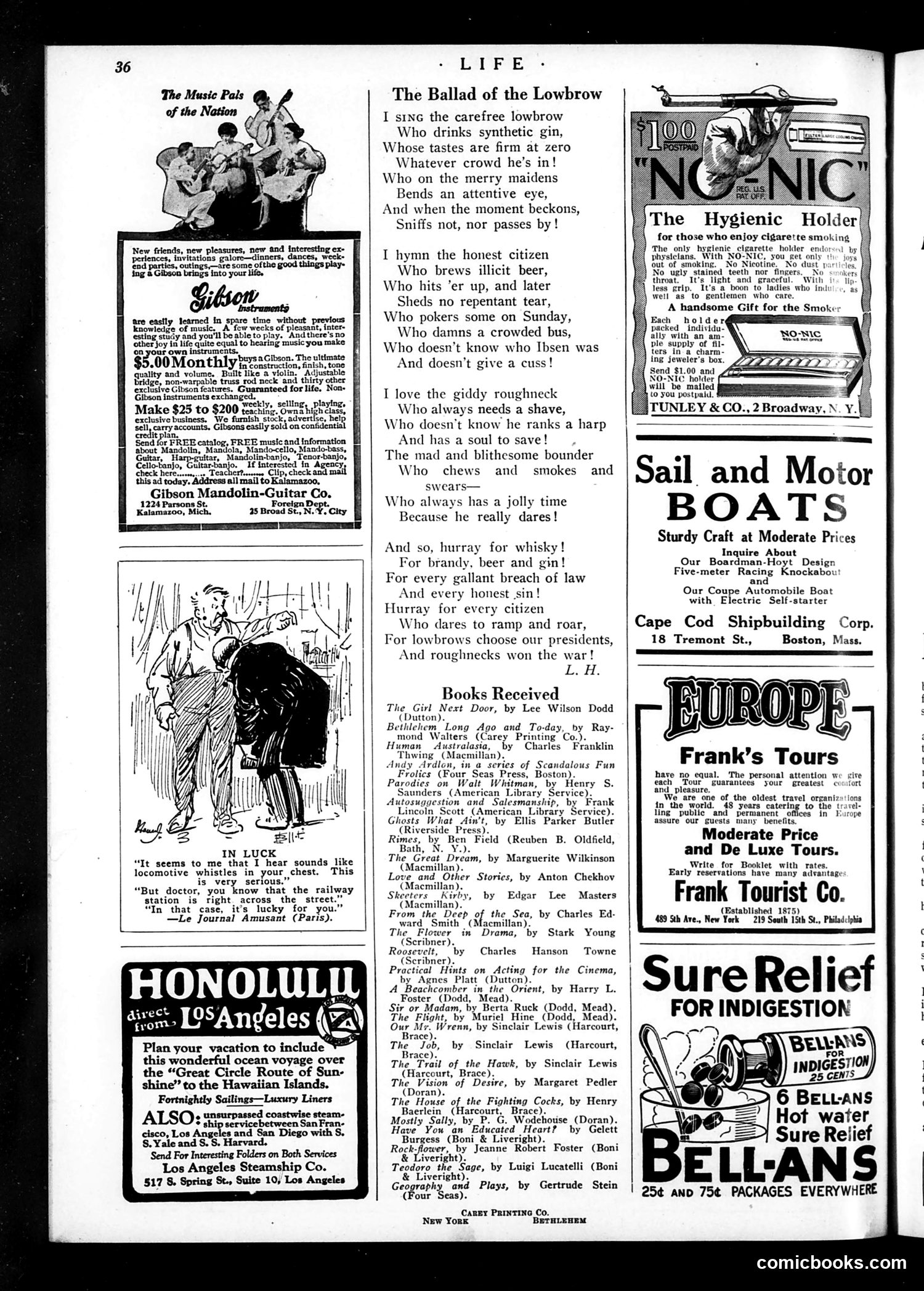
This poem satirizes Prohibition-era hypocrisy and the gap between high society's pretensions and ordinary Americans' actual behavior. Written during or shortly after Prohibition (1920-1933), it celebrates the "lowbrow"—the working-class citizen who drinks illegal alcohol, gambles, curses, and ignores intellectual pursuits like Ibsen's plays. The satire cuts two ways: it mocks the pretentiousness of highbrow culture while also ironically praising rule-breaking and vice as authentically American. The final stanza's claim that "roughnecks won the war" (likely WWI) suggests ordinary people deserve respect despite lacking refined tastes. The accompanying cartoon shows a doctor examining a patient who hears "locomotive whistles" in his chest—a visual joke playing on misdiagnosis and urban noise. Both pieces reflect Life magazine's satirical stance toward American class divisions and cultural standards of the 1920s.
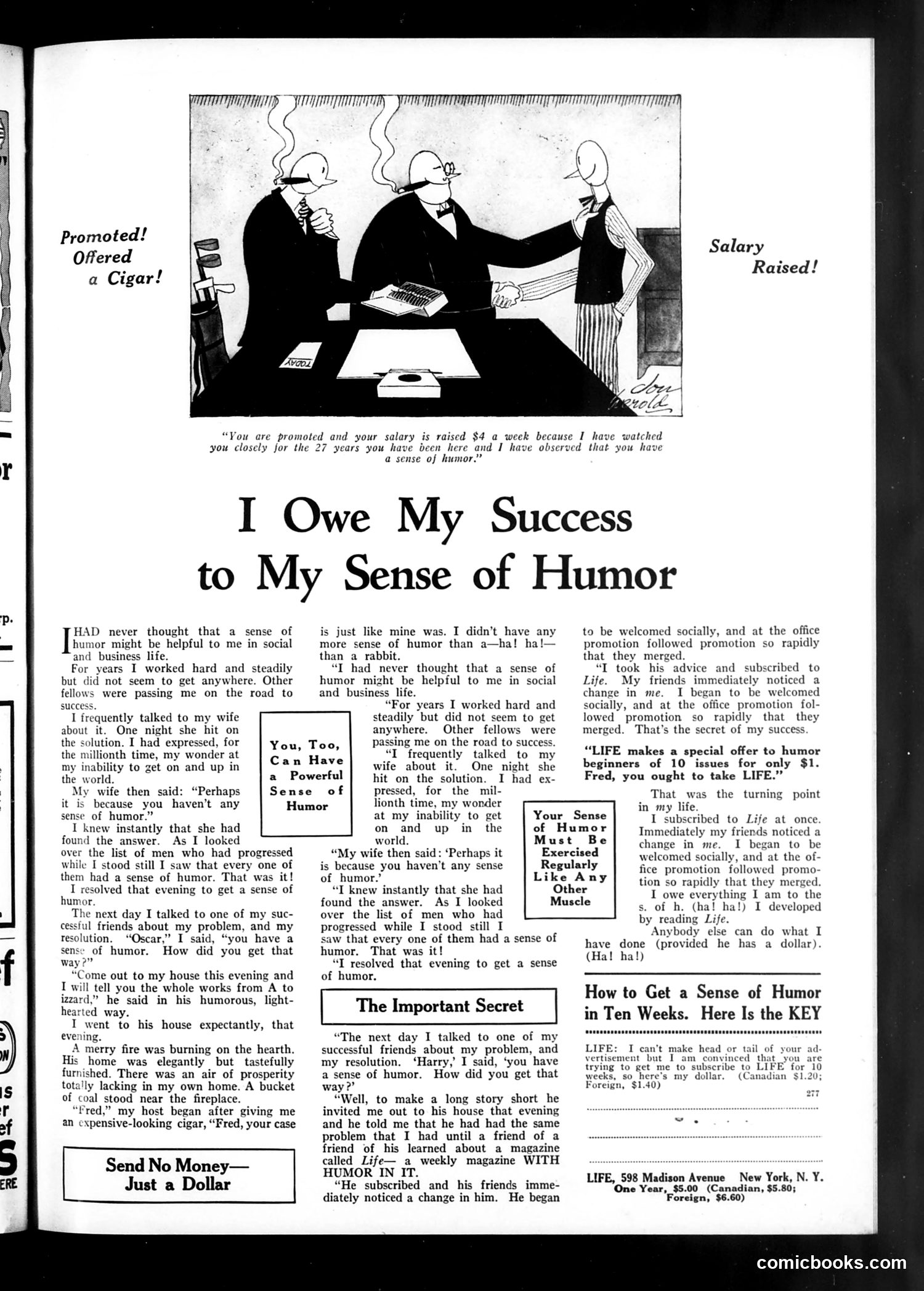
This is primarily **advertising disguised as editorial content**—a common practice in early 20th-century magazines. The cartoon and article form a nested narrative promoting *Life* magazine's subscription. **The Cartoon:** A boss promotes an employee $4 weekly, citing his "sense of humor" observed over 27 years. The visual joke is understated: corporate success supposedly rewarding personality over competence. **The Article's Strategy:** A man lacking professional advancement learns his problem isn't hard work but lacking humor. A successful friend reveals he obtained humor by subscribing to *Life* magazine. Following this advice, the protagonist gains social acceptance and rapid promotions. **The Satire/Sales Pitch:** The piece satirizes American self-help culture and workplace pretense—suggesting employers value likability over merit. Simultaneously, it's a thinly-veiled advertisement claiming *Life*'s humor content can literally improve one's career and social standing. **Modern Context:** This reflects 1920s-era assumptions that personality and charm were learnable commodities valuable for upward mobility, while cynically marketing magazine subscription as the solution.
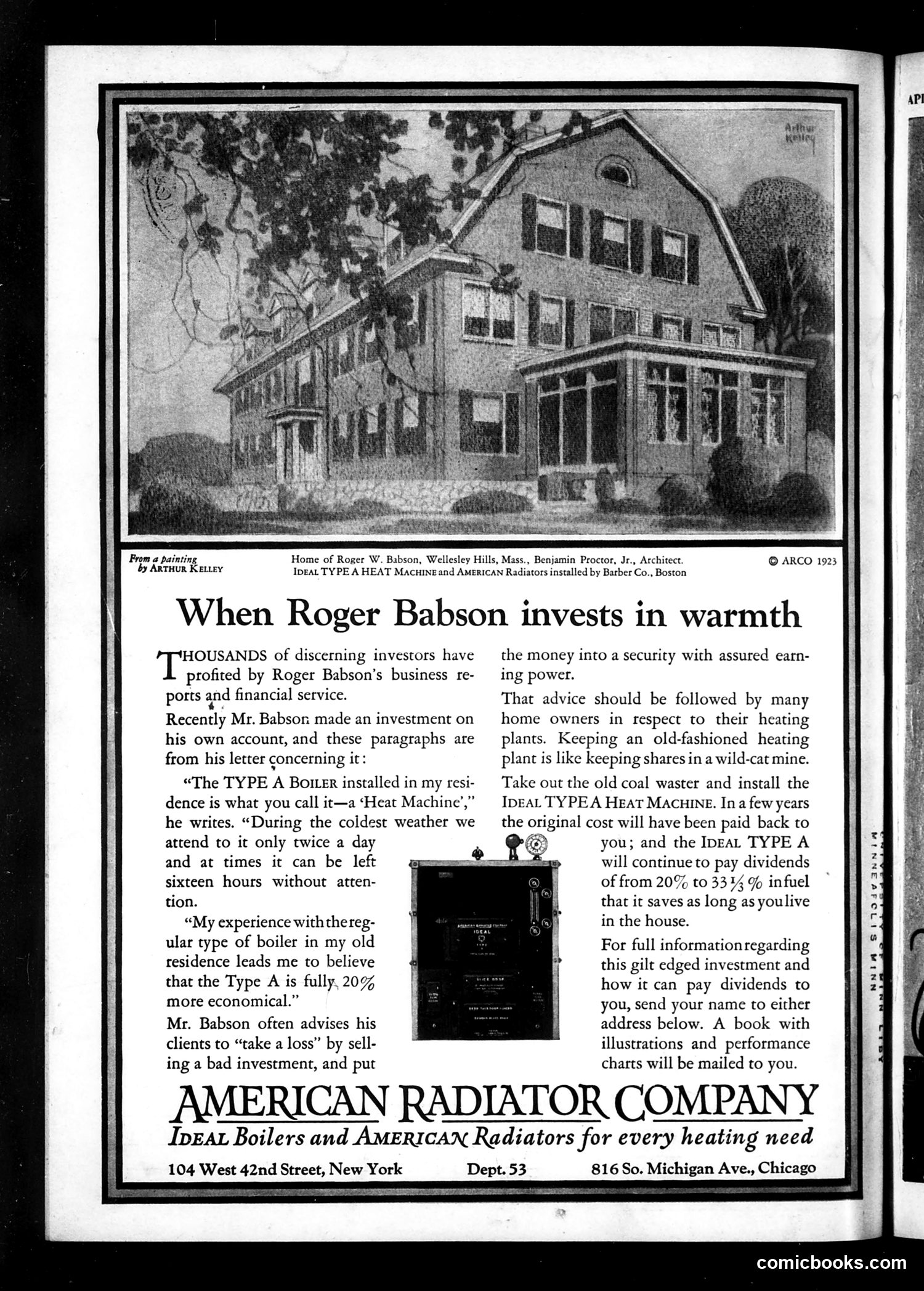
This is primarily an **advertisement**, not satire or editorial content. It features a testimonial from Roger Babson, a real and well-known financial advisor of the 1920s, endorsing the Ideal Type A boiler and radiator system. The ad uses Babson's credibility as an investment expert to pitch heating equipment. The clever angle: it frames upgrading from old coal boilers to modern heating as a financial "investment" that pays dividends through fuel savings (20-33% claimed) over time—language Babson's investment-minded clientele would understand. The painting shows Babson's own Wellesley Hills home with the installed system, providing social proof through his wealth and status. The ad includes Babson's actual quote about the boiler's efficiency and low maintenance. This represents early 20th-century marketing strategy: using a trusted public figure's endorsement to sell consumer goods by reframing them in financial terms. There's no political satire—it's straightforward product promotion.