
Life, 1923-04-12 · page 14 of 40
Life — April 12, 1923 — page 14: what you’re looking at
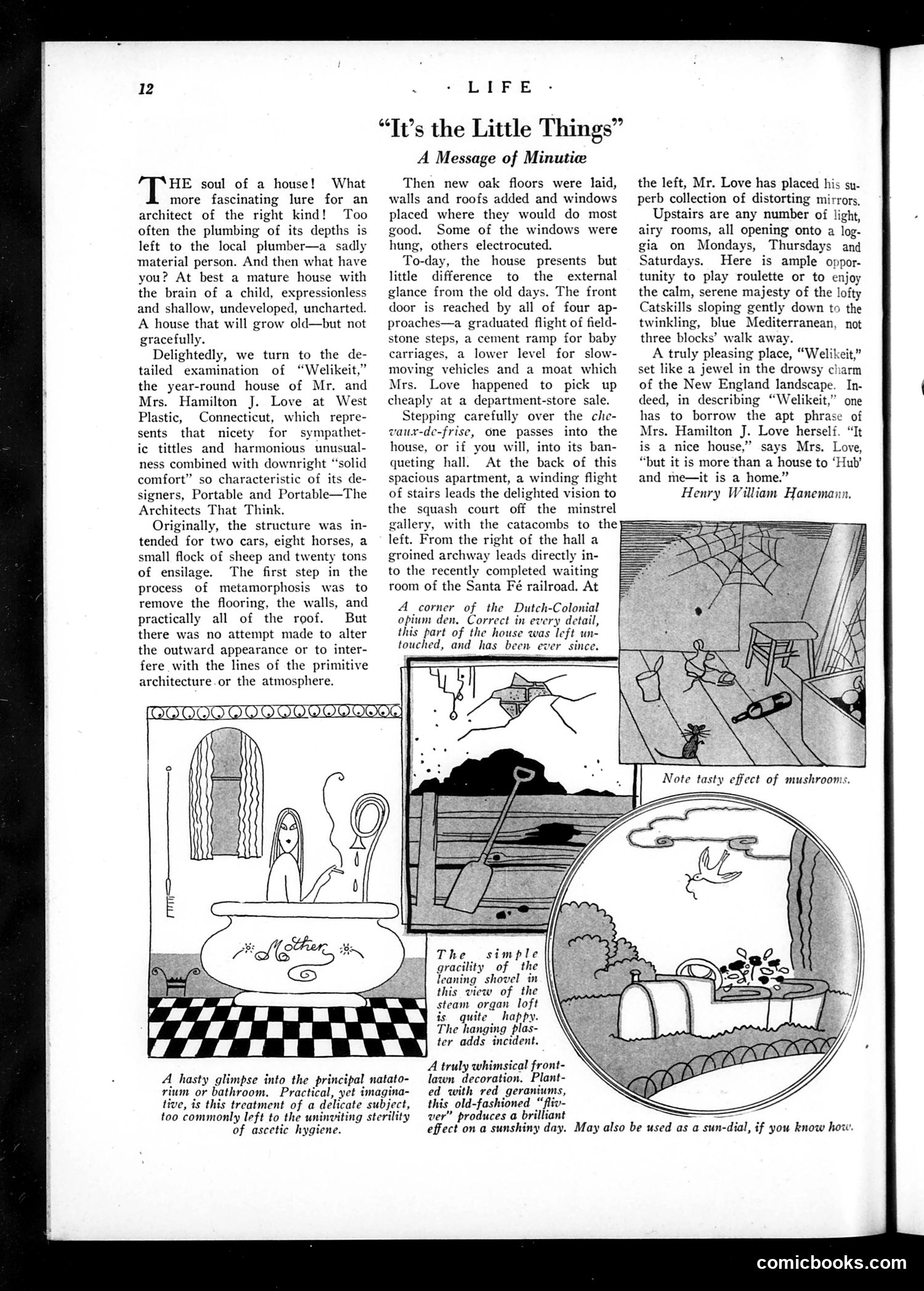
What you’re looking at
This page satirizes American interior design and home decoration of the early 20th century. The article describes the renovation of "Welikeit," the country house of Mr. and Mrs. Hamilton J. Love in Connecticut. The accompanying illustrations mock pretentious home décor through exaggerated examples: an absurdly ornate bathroom with fussy furnishings, whimsical front-lawn decorations (including what appears to be a sundial disguised as a mushroom), and impractical architectural details. The satire targets the nouveau riche tendency toward ostentatious, poorly-conceived design choices—accumulating decorative "little things" without taste or coherent vision. The captions drily comment on each ridiculous element, suggesting that authentic sophistication lies in restraint rather than excessive ornamentation.
📄 Transcribed text from this page (OCR, searchable)
Machine-transcribed from the original scan — historical spelling and the odd misread are preserved.
HE soul of a house! What more fascinating lure for an architect of the right kind! Too often the plumbing of its depths is left to the local plumber—a sadly material person. And then what have you? At best a mature house with the brain of a child, expressionless and shallow, undeveloped, uncharted. A house that will grow old—but not gracefully. Delightedly, we turn to the de- tailed examination of “Welikeit,” the year-round house of Mr. and Mrs. Hamilton J. Love at West Plastic, Connecticut, which repre- sents that nicety for sympathet- ic tittles and harmonious unusual- ness combined with downright “solid comfort” so characteristic of its de- signers, Portable and Portable—The Architects That Think. Originally, the structure was in- tended for two cars, eight horses, a small flock of sheep and twenty tons of ensilage. The first step in the process of metamorphosis was to remove the flooring, the walls, and practically all of the roof. But there was no attempt made to alter the outward appearance or to inter- fere with the lines of the primitive architecture.or the atmosphere. DMOODOOD OOO OOOO OOLLG LIFE “Tt’s the Little Things” A Message of Minutice Then new oak floors were laid, walls and roofs added and windows placed where they would do most good. Some of the windows were hung, others electrocuted. To-day, the house presents but little difference to the external glance from the old days. The front door is reached by all of four ap- proaches—a graduated flight of field- stone steps, a cement ramp for baby carriages, a lower level for slow- moving vehicles and a moat which Mrs. Love happened to pick up cheaply at a department-store sale. Stepping carefully over the che- vaux-de-frise, one passes into the house, or if you will, into its ban- queting hall. At the back of this spacious apartment, a winding flight of stairs leads the delighted vision to the squash court off the minstrel gallery, with the catacombs to the left. From the right of the hall a groined archway leads directly in- to the recently completed waiting room of the Santa Fé railroad. At A corner of the Dutch-Colonial opium den. Correct in every detail, this part of the house was left un- touched, and has been ever since. The simple gracility of the leaning shovel in this view of the steam organ loft is quite happy. The hanging plas- ae ey ter adds incident. A hasty glimpse into the principal natato- rium or bathroom. Practical, yet imagina- tive, is this treatment of a delicate subject, too commonly left to the uninviting sterility of ascetic hygiene. A truly whimsical front- lawn decoration. Plant- ed with red geraniums, this old-fashioned “fliv- ver” produces a brilliant the left, Mr. Love has placed his su. perb collection of distorting mirrors, Upstairs are any number of light, airy rooms, all opening onto a log- gia on Mondays, Thursdays and Saturdays. Here is ample oppor- tunity to play roulette or to enjoy the calm, serene majesty of the lofty Catskills sloping gently down to the twinkling, blue Mediterranean, not three blocks’ walk away. A truly pleasing place, “Welikeit,” set like a jewel in the drowsy charm of the New England landscape. In- deed, in describing “Welikeit,” one has to borrow the apt phrase of Mrs. Hamilton J. Love herself. “It is a nice house,” says Mrs, Love, “but it is more than a house to ‘Hub’ and me—it is a home.” Henry William Hanemann. effect ona sunshiny day. May also be used asa sun-dial, if you know how. comicbooks.com