
Life, 1923-04-12 · page 22 of 40
Life — April 12, 1923 — page 22: what you’re looking at
What you’re looking at
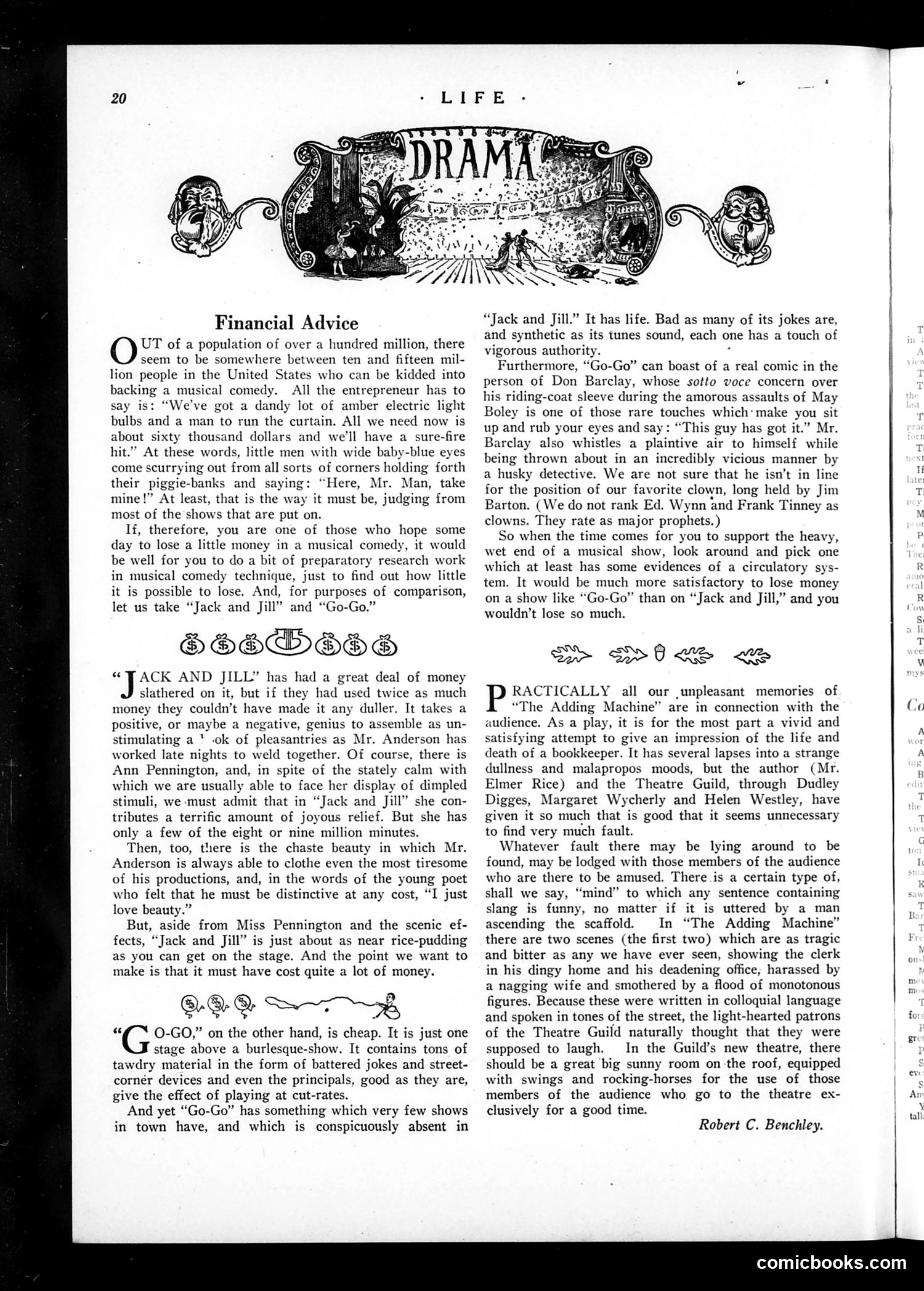
This 1920s *Life* magazine article satirizes wealthy amateur investors who fund Broadway musicals. The author mocks the ease with which producers solicit money from "little men with wide baby-blue eyes" willing to back any show with minimal artistic merit. The piece compares two actual Broadway productions: "Jack and Jill" (expensive but tedious, redeemed only by dancer Ann Pennington's "dimpled stimuli") and "Go-Go" (cheap, burlesque-like, yet vital and entertaining). The satire's point: don't judge a show by its budget. "Jack and Jill" squanders money on elaborate scenery while lacking life; "Go-Go" succeeds through authentic comic talent like Don Barclay's performances. The financial advice is ironic—if you must lose money on theater, choose the cheaper show that at least has "vigorous authority" rather than expensively boring spectacle.
📄 Transcribed text from this page (OCR, searchable)
Machine-transcribed from the original scan — historical spelling and the odd misread are preserved.
Financial Advice O UT of a population of over a hundred million, there seem to be somewhere between ten and fifteen mil- lion people in the United States who can be kidded into backing a musical comedy. All the entrepreneur has to say is: “We've got a dandy lot of amber electric light bulbs and a man to run the curtain. All we need now is about sixty thousand dollars and we'll have a sure-fire hit.” At these words, little men with wide baby-blue eyes come scurrying out from all sorts of corners holding forth their piggie-banks and saying: “Here, Mr. Man, take mine!” At least, that is the way it must be, judging from most of the shows that are put on. If, therefore, you are one of those who hope some day to lose a little money in a musical comedy, it would be well for you to do a bit of preparatory research work in musical comedy technique, just to find out how little it is possible to lose. And, for purposes of comparison, let us take “Jack and Jill” and “Go-Go.” CMONEN@ DENOTE) ‘ae AND JILL” has had a great deal of money slathered on it, but if they had used twice as much money they couldn’t have made it any duller. It takes a positive, or maybe a negative, genius to assemble as un- stimulating a ' .ok of pleasantries as Mr. Anderson has worked late nights to weld together. Of course, there is Ann Pennington, and, in spite of the stately calm with which we are usually able to face her display of dimpled stimuli, we must admit that in “Jack and Jill” she con- tributes a terrific amount of joyous relief. But she has only a few of the eight or nine million minutes. Then, too, there is the chaste beauty in which Mr. Anderson is always able to clothe even the most tiresome of his productions, and, in the words of the young poet who felt that he must be distinctive at any cost, “I just love beauty.” But, aside from Miss Pennington and the scenic ef- fects, “Jack and Jill” is just about as near rice-pudding as you can get on the stage. And the point we want to make is that it must have cost quite a lot of money. “ O-GO,” on the other hand, is cheap. It is just one stage above a burlesque-show. It contains tons of tawdry material in the form of battered jokes and street- cornér devices and even the principals, good as they are, give the effect of playing at cut-rates. And yet “Go-Go” has something which very few shows in town have, and which is conspicuously absent in “Jack and Jill.” It has life. Bad as many of its jokes are, and synthetic as its tunes sound, each one has a touch of vigorous authority. . Furthermore, “Go-Go” can boast of a real comic in the person of Don Barclay, whose sotto voce concern over his riding-coat sleeve during the amorous assaults of May Boley is one of those rare touches which: make you sit up and rub your eyes and say: “This guy has got it.” Mr. Barclay also whistles a plaintive air to himself while being thrown about in an incredibly vicious manner by a husky detective. We are not sure that he isn’t in line for the position of our favorite clown, long held by Jim Barton. (We do not rank Ed. Wynn and Frank Tinney as clowns. They rate as major prophets.) So when the time comes for you to support the heavy, wet end of a musical show, look around and pick one which at least has some evidences of a circulatory sys- tem. It would be much more satisfactory to lose money on a show like “Go-Go” than on “Jack and Jill,” and you wouldn’t lose so much. Sr BOOKS <e RACTICALLY all our ,unpleasant memories of The Adding Machine” are in connection with the audience. As a play, it is for the most part a vivid and satisfying attempt to give an impression of the life and death of a bookkeeper. It has several lapses into a strange dullness and malapropos moods, but the author (Mr. Elmer Rice) and the Theatre Guild, through Dudley Digges, Margaret Wycherly and Helen Westley, have given it so much that is good that it seems unnecessary to find very much fault. Whatever fault there may be lying around to be found, may be lodged with those members of the audience who are there to be amused. There is a certain type of, shall we say, “mind” to which any sentence containing slang is funny, no matter if it is uttered by a man ascending the scaffold. In “The Adding Machine” there are two scenes (the first two) which are as tragic and bitter as any we have ever seen, showing the clerk in his dingy home and his deadening office, harassed by a nagging wife and smothered by a flood of monotonous figures. Because these were written in colloquial language and spoken in tones of the street, the light-hearted patrons of the Theatre Guild naturally thought that they were supposed to laugh. In the Guild’s new theatre, there should be a great big sunny room on-the roof, equipped with swings and rocking-horses for the use of those members of the audience who go to the theatre ex- clusively for a good time. Robert C. Benchley. comicbooks.com