
Life, 1923-04-12 · page 19 of 40
Life — April 12, 1923 — page 19: what you’re looking at
What you’re looking at
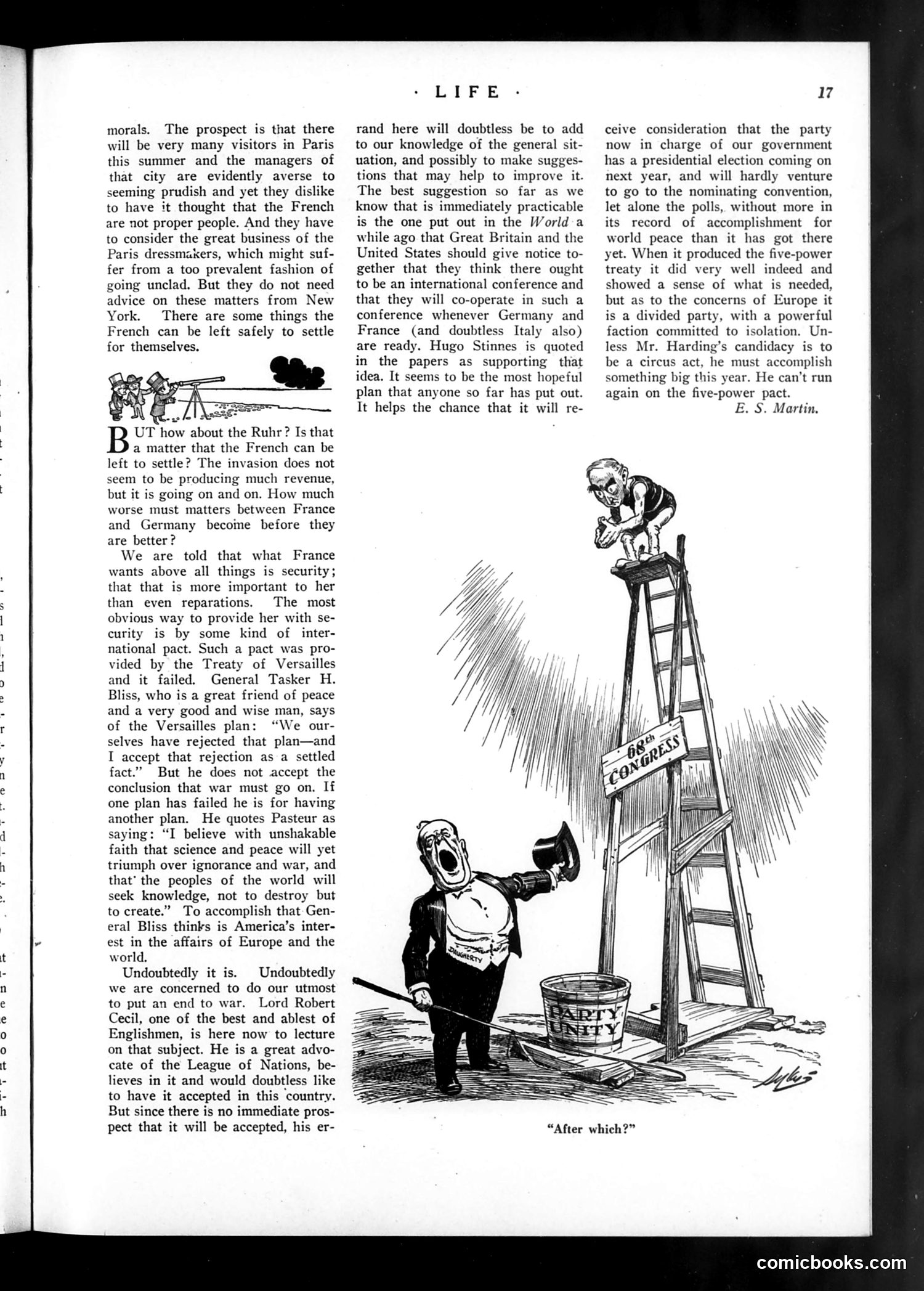
This Life magazine page discusses post-WWI peace efforts, featuring a cartoon titled "After which?" that satirizes American political posturing on European security. **The Cartoon's Meaning:** The illustration shows a man (likely representing a U.S. politician or President Harding) standing on a ladder labeled "Congress," holding a megaphone and gesturing at a bucket labeled "Party" below. The caption "After which?" suggests that once American political theater concludes, what actually comes next regarding genuine peace efforts? **The Satire's Point:** The text reveals the joke: Harding's administration will pursue peace initiatives primarily to boost its record before the upcoming presidential election, not from genuine commitment. The divided Republican party is split between internationalists and isolationists. The author (E.S. Martin) cynically suggests Harding must accomplish something "big this year" to avoid his candidacy appearing as mere "circus act"—implying hollow political performance rather than substantive peace work. The cartoon visualizes this criticism: America's leadership grandstanding from a precarious political perch, disconnected from actual European security concerns.
📄 Transcribed text from this page (OCR, searchable)
Machine-transcribed from the original scan — historical spelling and the odd misread are preserved.
morals. The prospect is that there will be very many visitors in Paris this summer and the managers of that city are evidently averse to seeming prudish and yet they dislike to have it thought that the French are not proper people. And they have to consider the great business of the Paris dressmakers, which might suf- fer from a too prevalent fashion of going unclad. But they do not need advice on these matters from New York. There are some things the French can be left safely to settle for themselves. a matter that the French can be left to settle? The invasion does not seem to be producing much revenue, but it is going on and on. How much worse must matters between France and Germany become before they are better? We are told that what France wants above all things is security; that that is more important to her than even reparations. The most obvious way to provide her with se- curity is by some kind of inter- national pact. Such a pact was pro- vided by the Treaty of Versailles and it failed. General Tasker H. Bliss, who is a great friend of peace and a very good and wise man, says of the Versailles plan: “We our- selves have rejected that plan—and I accept that rejection as a settled fact.” But he does not accept the conclusion that war must go on. If one plan has failed he is for having another plan. He quotes Pasteur as saying: “I believe with unshakable faith that science and peace will yet triumph over ignorance and war, and that’ the peoples of the world will seek knowledge, not to destroy but to create.” To accomplish that Gen- eral Bliss thinks is America’s inter- est in the affairs of Europe and the world. Undoubtedly it is. | Undoubtedly we are concerned to do our utmost to put an end to war. Lord Robert Cecil, one of the best and ablest of Englishmen, is here now to lecture on that subject. He is a great advo- cate of the League of Nations, be- lieves in it and would doubtless like to have it accepted in this ‘country. But since there is no immediate pros- pect that it will be accepted, his er- » LIFE rand here will doubtless be to add to our knowledge of the general sit- uation, and possibly to make sugges- tions that may help to improve it. The best suggestion so far as we know that is immediately practicable is the one put out in the World a while ago that Great Britain and the United States should give notice to- gether that they think there ought to be an international conference and that they will co-operate in such a conference whenever Germany and France (and doubtless Italy also) are ready. Hugo Stinnes is quoted in the papers as supporting that idea. It seems to be the most hopeful plan that anyone so far has put out. It helps the chance that it will re- 17 ceive consideration that the party now in charge of our government has a presidential election coming on next year, and will hardly venture to go to the nominating convention, let alone the polls, without more in its record of accomplishment for world peace than it has got there yet. When it produced the five-power treaty it did very well indeed and showed a sense of what is needed, but as to the concerns of Europe it is a divided party, with a powerful faction committed to isolation. Un- less Mr. Harding’s candidacy is to be a circus act, he must accomplish something big this year. He can’t run again on the five-power pact. E. S. Martin, “After which?” comicbooks.com