
Life, 1923-04-12 · page 26 of 40
Life — April 12, 1923 — page 26: what you’re looking at
What you’re looking at
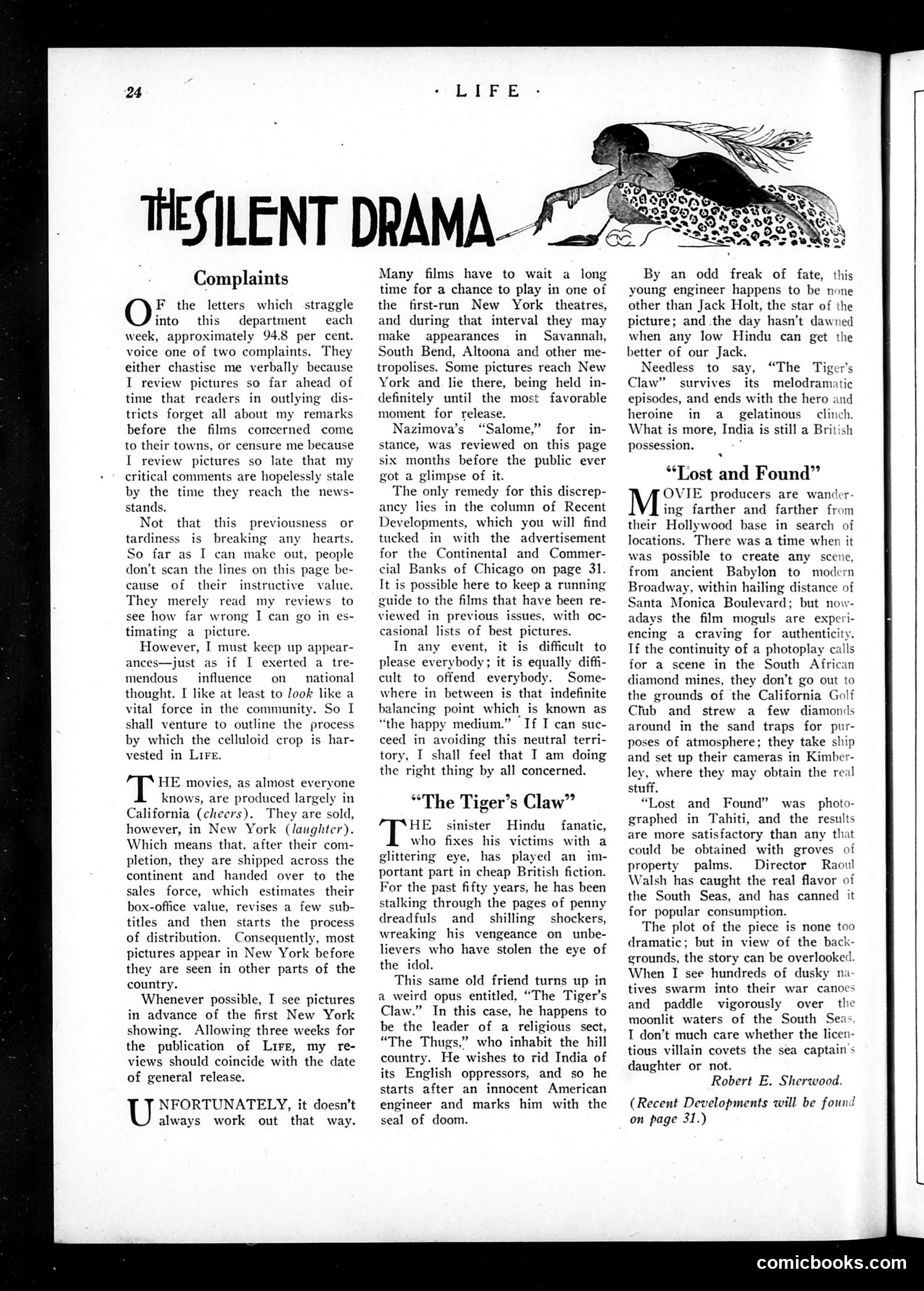
This page contains a film critic's column explaining the logistical challenges of movie reviewing. The critic addresses reader complaints about timing: reviews either appear months before films reach smaller cities, or arrive too late to matter. He describes how Hollywood operates—films are produced in California but distributed from New York, creating unpredictable delays before regional release. The column reviews "The Tiger's Claw," a melodrama featuring a stock character from British pulp fiction: a "sinister Hindu fanatic" seeking vengeance. The critic notes this villain type has haunted "penny dreadfuls and shilling shockers" for fifty years. Here, the character leads a religious sect opposing English rule in India, targeting an American engineer. The casual, somewhat dismissive tone toward both the review-timing problem and the film's orientalist stereotyping reflects early 1920s attitudes—the exotic "Hindu fanatic" villain was considered routine entertainment fodder.
📄 Transcribed text from this page (OCR, searchable)
Machine-transcribed from the original scan — historical spelling and the odd misread are preserved.
THESILENT DRAMA Complaints F the letters which straggle into this department each week, approximately 94.8 per cent. voice one of two complaints. They either chastise me verbally because I review pictures so far ahead of time that readers in outlying dis- tricts forget all about my remarks before the films concerned come to their towns, or censure me because I review pictures so late that my critical comments are hopelessly stale by the time they reach the news- stands. Not that this previousness or tardiness is breaking any hearts. So far as I can make out, people don’t scan the lines on this page be- cause of their instructive value. They merely read my reviews to see how far wrong I can go in es- timating a picture. However, I must keep up appear- ances—just as if I exerted a tre- mendous influence on ___ national thought. I like at least to look like a vital force in the community. So I shall venture to outline the process by which the celluloid crop is har- vested in Lire. HE movies, as almost everyone knows, are produced largely in California (cheers). They are sold, however, in New York (laughter). Which means that, after their com- pletion, they are shipped across the continent and handed over to the sales force, which estimates their box-office value, revises a few sub- titles and then starts the process of distribution. Consequently, most pictures appear in New York before they are seen in other parts of the country. Whenever possible, I see pictures in advance of the first New York showing. Allowing three weeks for the publication of Lire, my re- views should coincide with the date of general release. NFORTUNATELY, it doesn’t always work out that way. Many films have to wait a long time for a chance to play in one of the first-run New York theatres, and during that interval they may make appearances in Savannah, South Bend, Altoona and other me- tropolises. Some pictures reach New York and. lie there, being held in- definitely until the most favorable moment for release. Nazimova’s “Salome,” for in- stance, was reviewed on this page six months before the public ever got a glimpse of it. The only remedy for this discrep- ancy lies in the column of Recent Developments, which you will find tucked in with the advertisement for the Continental and Commer- cial Banks of Chicago on page 31. It is possible here to keep a running guide to the films that have been re- viewed in previous issues, with oc- casional lists of best pictures. In any event, it is difficult to please everybody; it is equally diffi- cult to offend everybody. Some- where in between is that indefinite balancing point which is known as “the happy medium.” If I can suc- ceed in avoiding this neutral terri- tory, I shall feel that I am doing the right thing by all concerned. “The Tiger’s Claw” HE sinister Hindu fanatic, who fixes his victims with a glittering eye, has played an im- portant part in cheap British fiction. For the past fifty years, he has been stalking through the pages of penny dreadfuls and shilling shockers, wreaking his vengeance on unbe- lievers who have stolen the eye of the idol. This same old friend turns up in a weird opus entitled, “The Tiger’s Claw.” In this case, he happens to be the leader of a religious sect, “The Thugs,” who inhabit the hill country. He wishes to rid India of its English oppressors, and so he starts after an innocent American engineer and marks him with the seal of doom. By an odd freak of fate, this young engineer happens to be none other than Jack Holt, the star of the picture; and .the day hasn't dawned when any low Hindu can get the better of our Jack. Needless to say, “The Tiger's Claw” survives its melodramatic episodes, and ends with the hero and heroine in a_ gelatinous clinch. What is more, India is still a British possession. . “Lost and Found” OVIE producers are wander: ing farther and farther from their Hollywood base in search of locations. There was a time when it was possible to create any scene, from ancient Babylon to modern Broadway, within hailing distance of Santa Monica Boulevard; but now- adays the film moguls are experi- encing a craving for authenticity. If the continuity of a photoplay calls for a scene in the South African diamond mines, they don’t go out to the grounds of the California Golf Club and strew a few diamonds around in the sand traps for pur- poses of atmosphere; they take ship and set up their cameras in Kimber- ley, where they may obtain the real stuff. “Lost and Found” was _photo- graphed in Tahiti, and the results are more satisfactory than any that could be obtained with groves of property palms. Director Raoul Walsh has caught the real flavor of the South Seas, and has canned it for popular consumption. The plot of the piece is none too dramatic; but in view of the back- grounds, the story can be overlooked. When I see hundreds of dusky na- tives swarm into their war canoes and paddle vigorously over the moonlit waters of the South Seas I don’t much care whether the licen- tious villain covets the sea captain's daughter or not. Robert E. Sherwood. (Recent Developments will be found on page 31.) comicbooks.com