
Life, 1923-04-12 · page 18 of 40
Life — April 12, 1923 — page 18: what you’re looking at
What you’re looking at
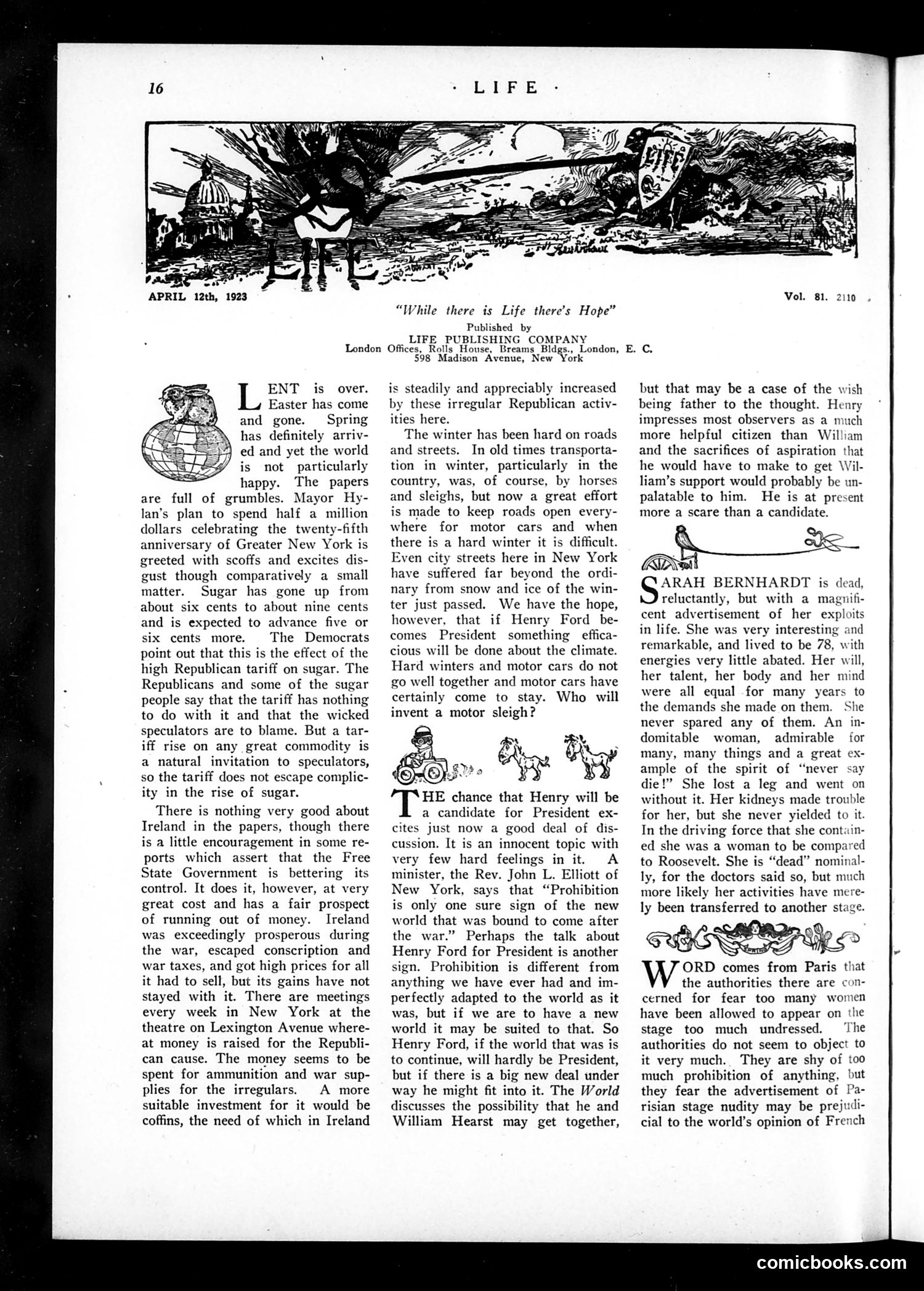
This page contains editorial commentary on current events rather than cartoons. The main satirical points are: **Henry Ford for President**: The article discusses Ford as a potential presidential candidate, noting the irony that if there's a "new world" emerging post-WWI, Ford might fit it—but if the old world continues, he wouldn't. The satire suggests Ford's mechanistic worldview might suit radical change but not stability. **Irish Republican fundraising**: The author sarcastically remarks that money raised in New York for Irish Republican "irregulars" would be better spent on coffins, given the violence of the Irish Civil War (1922-1923). **Sugar tariffs and speculation**: Democrats blame Republican tariffs for sugar price increases; Republicans blame speculators. The author notes tariffs naturally invite speculation—a commentary on market manipulation. **Winter and motor cars**: A humorous aside suggesting someone should invent a "motor sleigh" since cars and hard winters don't coexist well. The overall tone is skeptical of political claims and amused by post-war American contradictions.
📄 Transcribed text from this page (OCR, searchable)
Machine-transcribed from the original scan — historical spelling and the odd misread are preserved.
APRIL 12th, 1923 ENT is over. Easter has come and gone. Spring has definitely arriv- ed and yet the world is not particularly happy. The papers are full of grumbles. Mayor Hy- lan’s plan to spend half a million dollars celebrating the twenty-fifth anniversary of Greater New York is greeted with scoffs and excites dis- gust though comparatively a small matter. Sugar has gone up from about six cents to about nine cents and is expected to advance five or six cents more. The Democrats point out that this is the effect of the high Republican tariff on sugar. The Republicans and some of the sugar people say that the tariff has nothing to do with it and that the wicked speculators are to blame. But a tar- iff rise on any great commodity is a natural invitation to speculators, so the tariff does not escape complic- ity in the rise of sugar. There is nothing very good about Ireland in the papers, though there is a little encouragement in some re- ports which assert that the Free State Government is bettering its control. It does it, however, at very great cost and has a fair prospect of running out of money. Ireland was exceedingly prosperous during the war, escaped conscription and war taxes, and got high prices for all it had to sell, but its gains have not stayed with it. There are meetings every week in New York at the theatre on Lexington Avenue where- at money is raised for the Republi- can cause. The money seems to be spent for ammunition and war sup- plies for the irregulars. A more suitable investment for it would be coffins, the need of which in Ireland “While there is Life there’s Hope” Published by _ LIFE PUBLISHING COMPANY London Offices, Rolls House, Breams Bldgs., London, 598 Madison Avenue, New York is steadily and appreciably increased by these irregular Republican activ- ities here. The winter has been hard on roads and streets. In old times transporta- tion in winter, particularly in the country, was, of course, by horses and sleighs, but now a great effort is made to keep roads open every- where for motor cars and when there is a hard winter it is difficult. Even city streets here in New York have suffered far beyond the ordi- nary from snow and ice of the win- ter just passed. We have the hope, however, that if Henry Ford be- comes President something effica- cious will be done about the climate. Hard winters and motor cars do not go well together and motor cars have certainly come to stay. Who will invent a motor sleigh? HE chance that Henry will be a candidate for President ex- cites just now a good deal of dis- cussion. It is an innocent topic with very few hard feelings in it. A minister, the Rev. John L. Elliott of New York, says that “Prohibition is only one sure sign of the new world that was bound to come after the war.” Perhaps the talk about Henry Ford for President is another sign. Prohibition is different from anything we have ever had and im- perfectly adapted to the world as it was, but if we are to have a new world it may be suited to that. So Henry Ford, if the world that was is to continue, will hardly be President, but if there is a big new deal under way he might fit into it. The World discusses the possibility that he and William Hearst may get together, but that may be a case of the wish being father to the thought. Henry impresses most observers as a much more helpful citizen than William and the sacrifices of aspiration that he would have to make to get Wil- liam’s support would probably be un- palatable to him. He is at present more a scare than a candidate. at——*=- ARAH BERNHARDT is dead, reluctantly, but with a magnifi- cent advertisement of her exploits in life. She was very interesting and remarkable, and lived to be 78, with energies very little abated. Her will, her talent, her body and her mind were all equal for many years to the demands she made on them. She never spared any of them. An in- domitable woman, admirable for many, many things and a great ex- ample of the spirit of “never say die!” She lost a leg and went on without it. Her kidneys made trouble for her, but she never yielded to it. In the driving force that she contain- ed she was a woman to be com, to Roosevelt. She is “dead” nominal- ly, for the doctors said so, but much more likely her activities have mere- ly been transferred to another stage. ORD comes from Paris that the authorities there are con- cerned for fear too many women have been allowed to appear on the stage too much undressed. ‘The authorities do not seem to object to it very much. They are shy of too much prohibition of anything, but they fear the advertisement of Pa- risian stage nudity may be prejudi- cial to the world’s opinion of French comicbooks.com