
A complete issue · 36 pages · 1922
Life — July 6, 1922
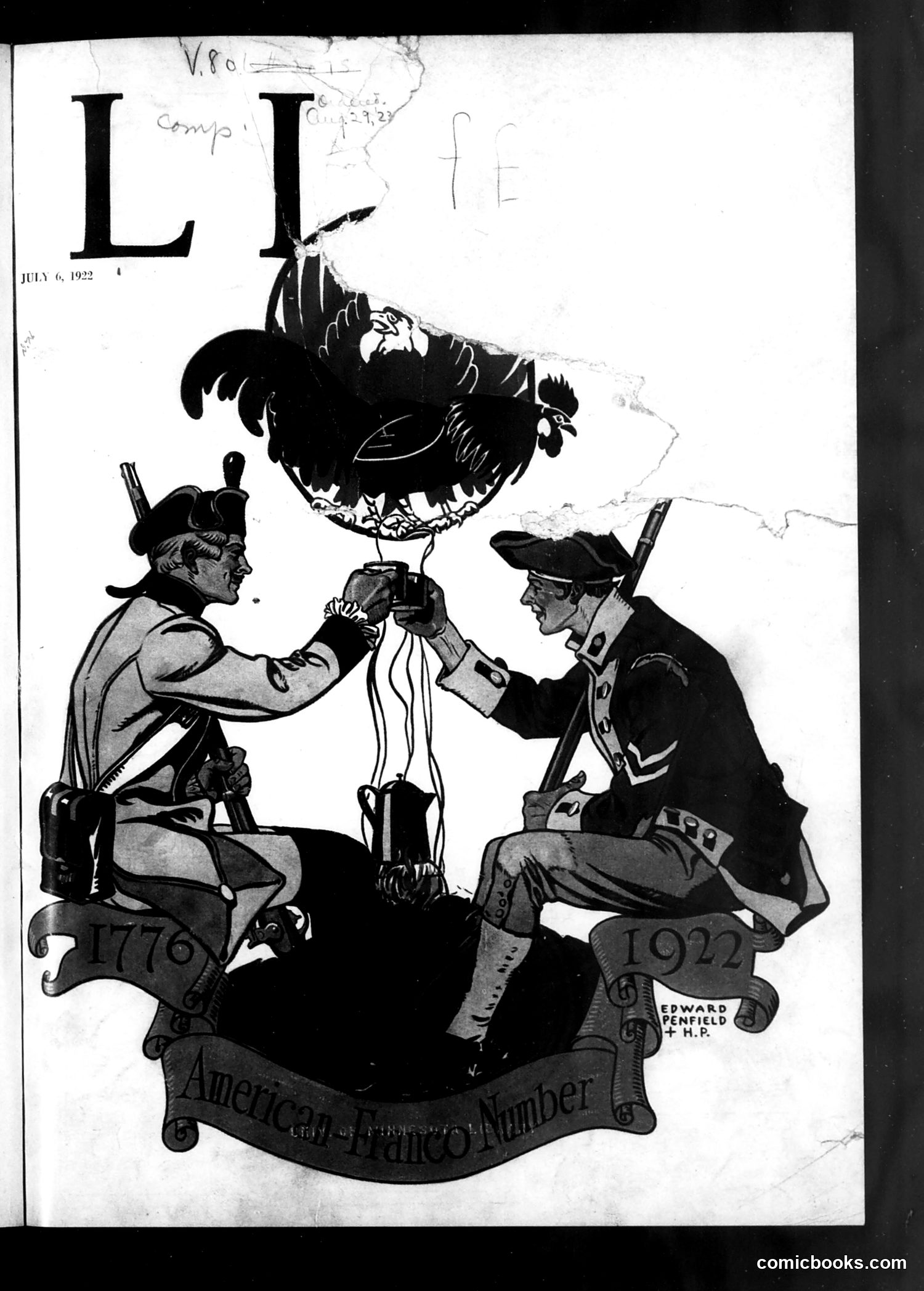
This satirical cover by Edward Penfield depicts two military figures from different eras—one labeled 1776 (American Revolutionary period) and one labeled 1922—jointly roasting a rooster over a fire. The rooster bears the label "American Trades Number," referencing Life's special issue theme. The cartoon appears to satirize the relationship between America's revolutionary past and its 1922 present, using the roasting imagery as dark political humor. The pairing of these historical moments suggests commentary on American labor or trade issues circa 1922, likely connecting historical ideals of American independence to contemporary economic concerns. The specific "trades" reference suggests this relates to labor unions or industrial matters of the period.
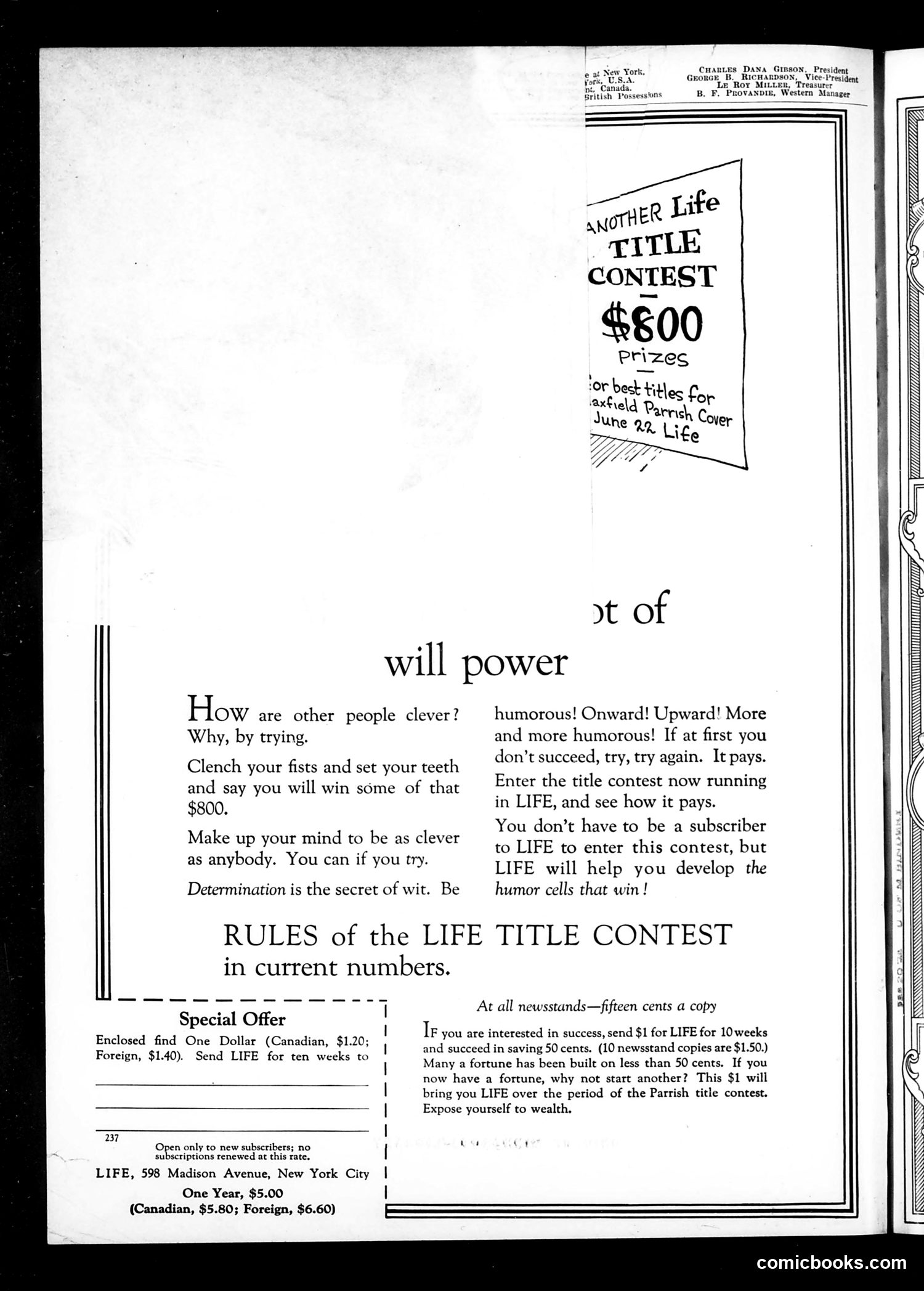
This page is primarily **advertising and promotional content** rather than political satire. It announces a "$600 prize" contest inviting readers to submit humorous titles for an upcoming "Garfield Parrish Cover" in Life's June 22 issue. The motivational text uses playful rhetoric—"Clench your fists and set your teeth and say you will win"—to encourage participation. It emphasizes that cleverness comes from **determination and effort** ("Why, by trying"). The page also includes a **subscription offer**: one dollar (Canadian $1.20) for a ten-week trial subscription to Life magazine, priced at $5.00 yearly ($5.80 Canadian). This reflects Life's early 20th-century business model of using contests and reader engagement to build circulation.
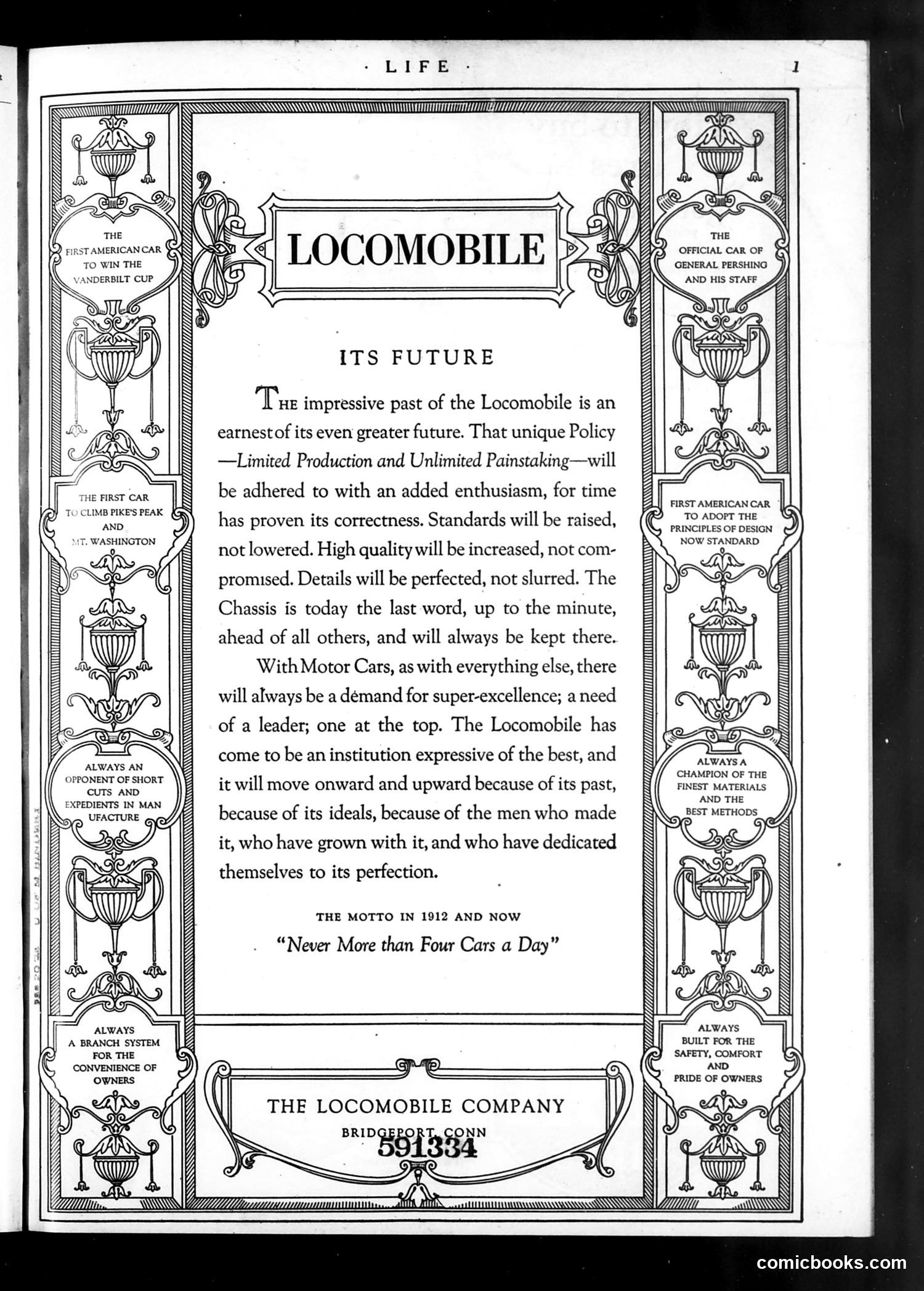
This is **not a cartoon or satire page** — it's a **luxury automobile advertisement** for the Locomobile Company of Bridgeport, Connecticut. The ornate decorative borders frame marketing copy emphasizing the Locomobile's superior craftsmanship and exclusivity. Key claims include: - "Limited Production and Unlimited Paintmaking" (quality over quantity) - The motto "Never More than Four Cars a Day" (exclusivity/luxury positioning) - References to prestigious ownership: "Official Car of General Pershing and His Staff," "First American Car to Adopt the Vanderbilt Cup" standard The page contains no political satire or social commentary. It's a straightforward high-end product advertisement aimed at wealthy readers, leveraging prestige, racing heritage, and military endorsement to justify premium pricing during the early automobile era.
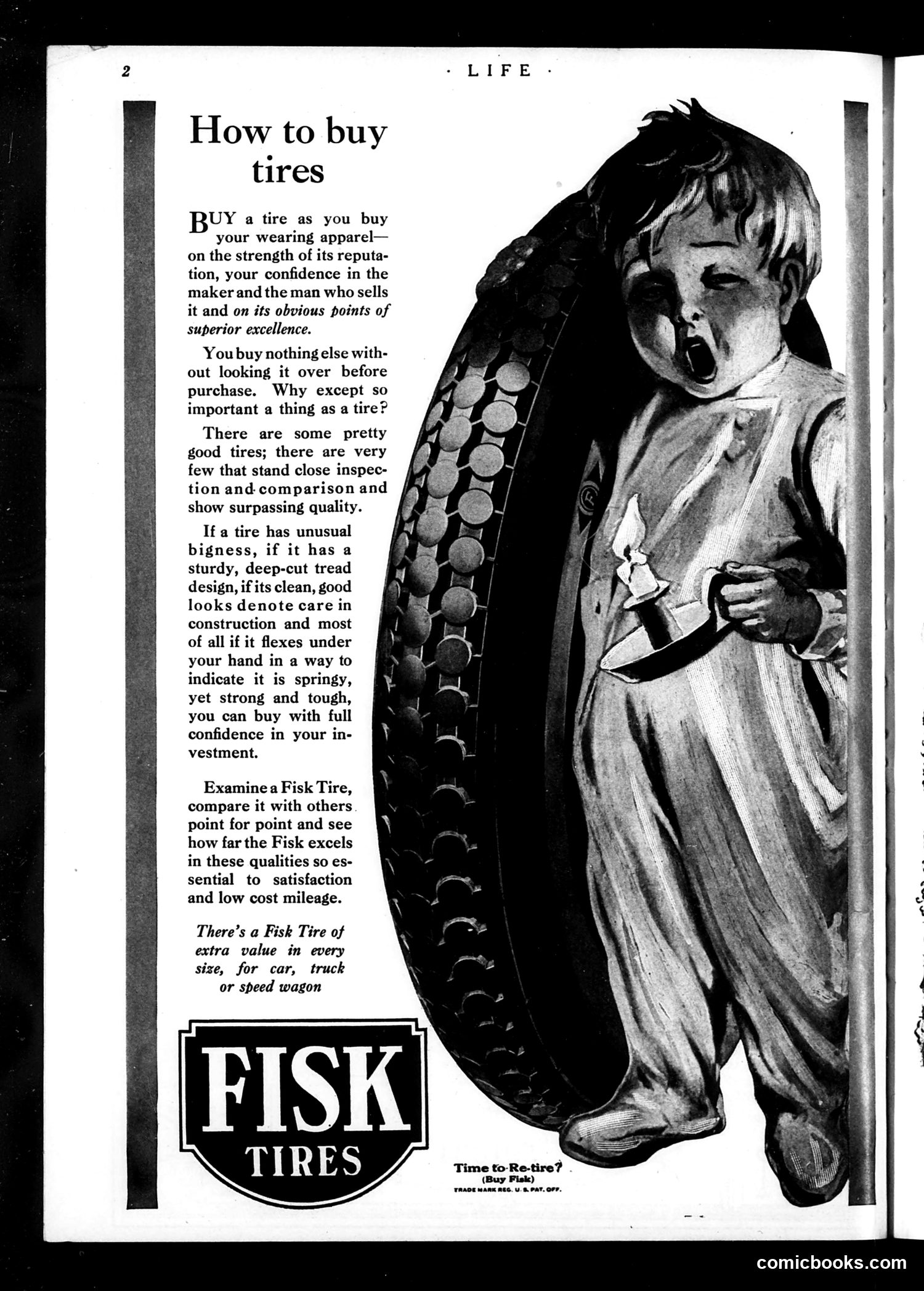
This is primarily a **commercial advertisement**, not satire or political commentary. The page features a product endorsement for Fisk Tires using a memorable mascot: a **drowsy or yawning child in oversized pajamas and slippers**, holding a tire. This figure became iconic in American advertising during the early 20th century, representing the "Fisk boy"—used to suggest drivers should replace worn tires before falling asleep at the wheel. The advertisement uses the child's tired appearance as a visual pun, humorously implying that driving on worn tires is dangerous enough to cause drowsiness. The tagline "Time to Re-Tire? (Buy Fisk)" reinforces this message. The text emphasizes practical buying advice: examine tire quality carefully before purchase, comparing reputation, construction, and visible features. No political or satirical content is present—this is straightforward consumer marketing.
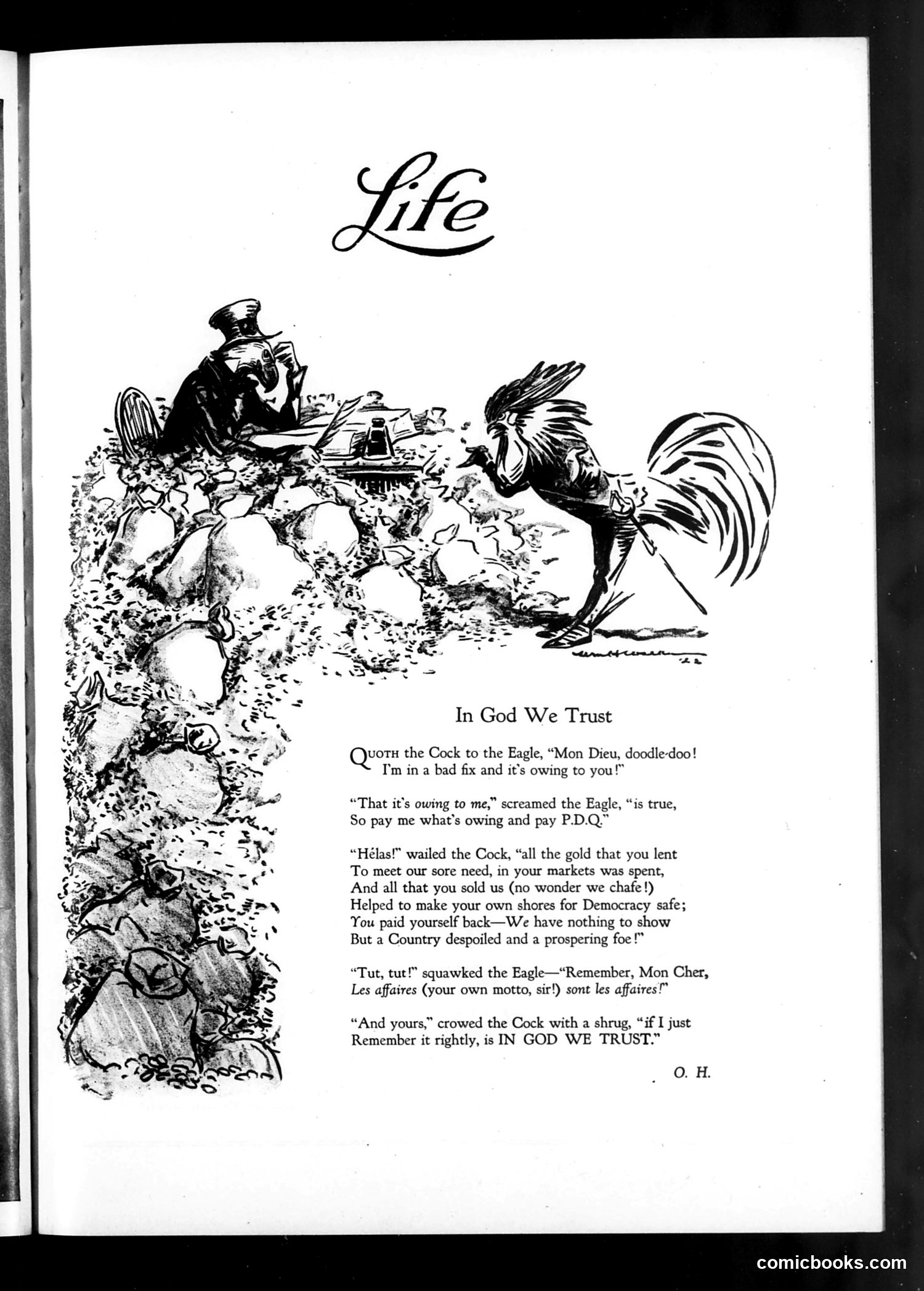
This page satirizes post-WWI financial disputes, likely between France and the United States. The rooster represents France, the eagle represents America. France ("Mon Dieu") complains it's in debt and needs repayment. The eagle responds that France must pay back American loans and invoices ("P.D.Q."—pretty darn quick). The Cock accuses the Eagle of profiting from wartime markets while France suffered invasion and destruction. The Eagle dismisses this with legalistic deflection ("Les affaires sont les affaires"—business is business), asserting that loans must be repaid regardless of circumstances. The joke's ironic conclusion: both nations invoke "In God We Trust" while bickering over money—suggesting cynicism about post-war Allied solidarity and American creditor ruthlessness toward an impoverished France.
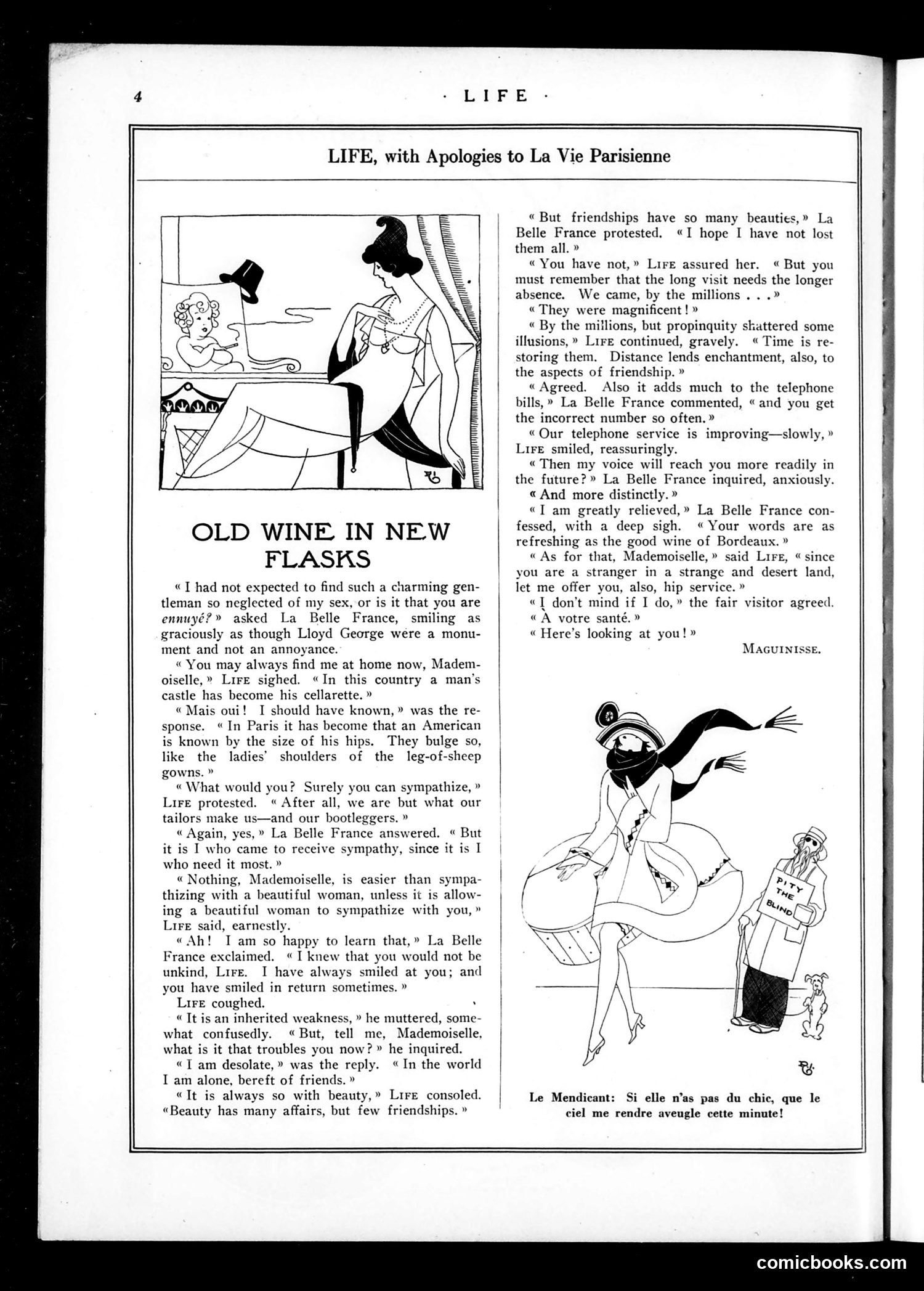
This satirical dialogue between "Life" and "La Belle France" (personified as an elegant woman) concerns Franco-American relations, likely from the early 20th century. The humor relies on contrasting French sophistication with American materialism. Life teases La Belle France about American excess—men's enormous cellars and bulging waistlines. She protests that friendships shouldn't suffer during their long separation ("by the millions"). The title "Old Wine in New Flasks" suggests recycled ideas in modern packaging—possibly referencing diplomatic relations dressed up as something new. The accompanying cartoon shows a woman on a telephone, likely illustrating the communication difficulties between the nations mentioned in the dialogue. The piece gently mocks both cultures' pretensions while maintaining affectionate tone.
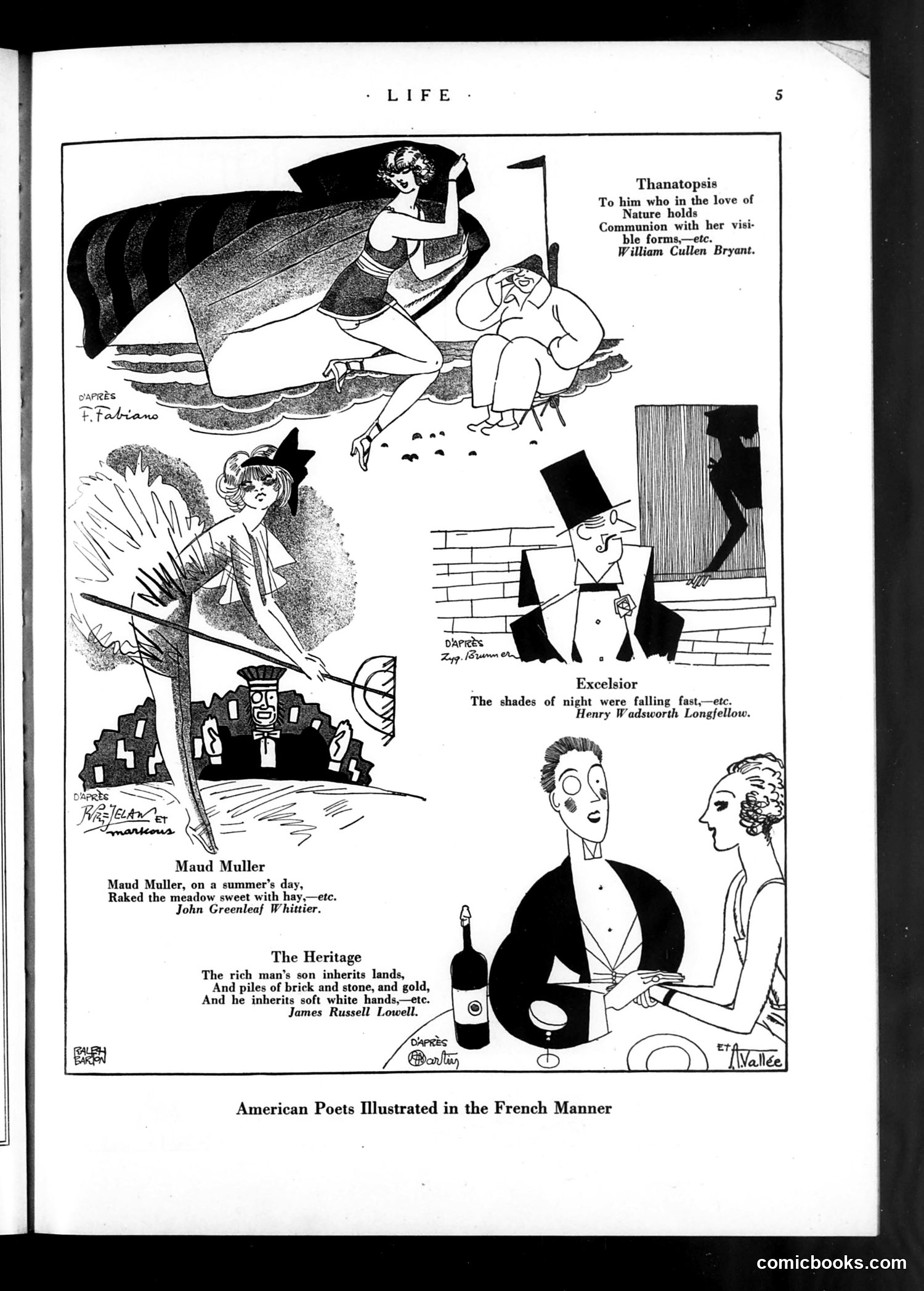
This page presents four illustrated literary quotations in an art nouveau/decorative style. Each pairs a famous American poem with a French-influenced drawing: 1. **"Thanatopsis"** (William Cullen Bryant) — shows a reclining woman communing with nature 2. **"Maud Muller"** (John Greenleaf Whittier) — depicts a woman raking hay in a pastoral scene 3. **"Excelsior"** (Henry Wadsworth Longfellow) — shows a man in evening dress at a doorway 4. **"The Heritage"** (James Russell Lowell) — illustrates two figures at a dining table with wine The satire appears to mock the fashionable adoption of French artistic aesthetics in American culture. By dressing quintessentially American romantic poetry in elaborate, decorative French illustration style, the page humorously comments on American cultural pretension and the era's Francophilia among educated classes.
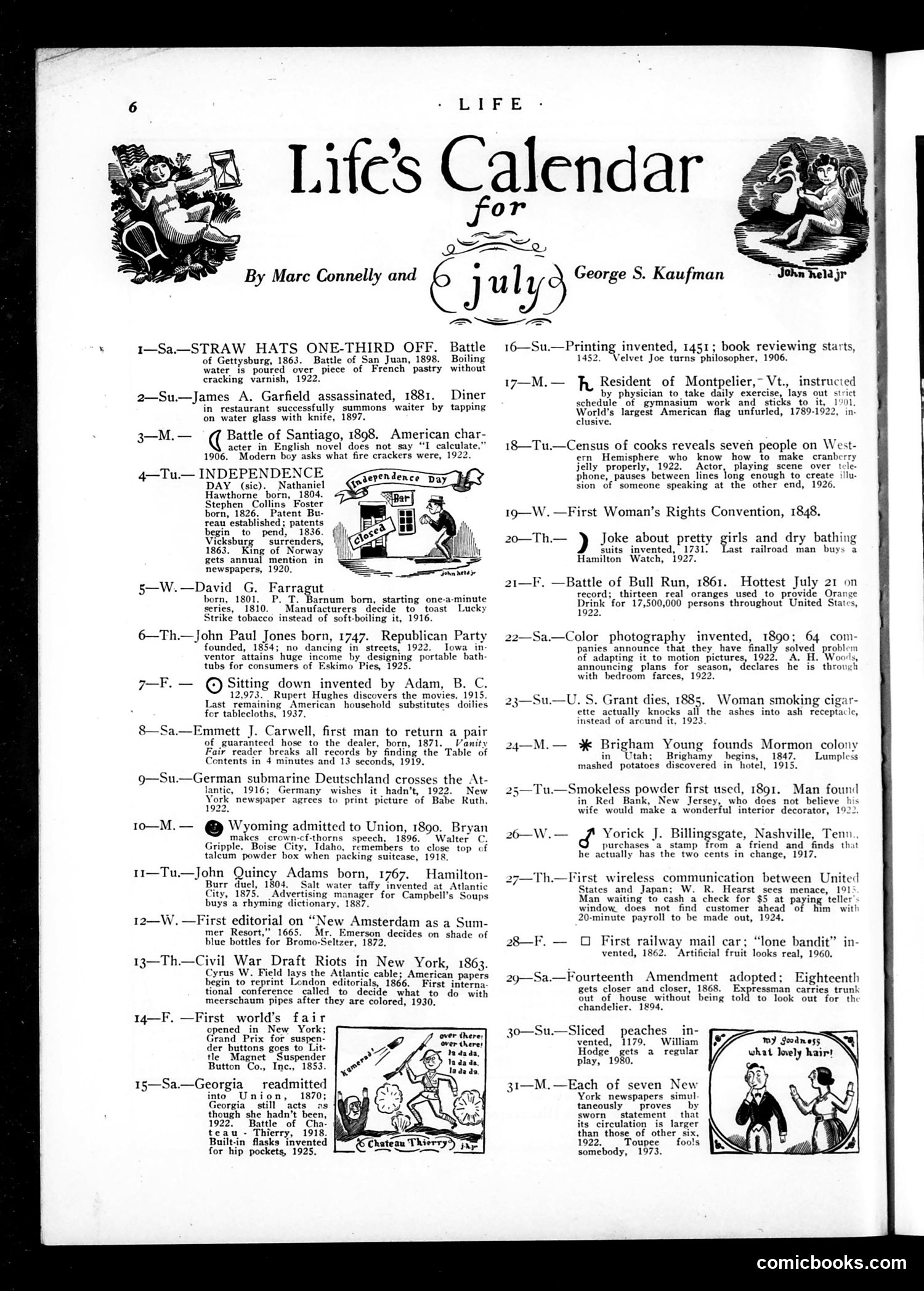
This is "Life's Calendar for July," a page of historical trivia and daily observances by Marc Connelly and George S. Kaufman. Rather than political satire, it presents humorous historical facts paired with small illustrations. Notable entries include: the invention of sitting down (July 7), Wyoming's admission to the Union (July 10), and the First World's Fair in New York (July 14). The page mixes genuine historical events (Civil War Draft Riots, Georgia's readmission to the Union) with absurdist humor claiming mundane activities were "invented" on specific dates. The small cartoons illustrate some entries—one shows a man holding what appears to be a stamp. This appears to be primarily entertainingly-written calendar filler rather than political commentary, typical of Life magazine's lighter content.
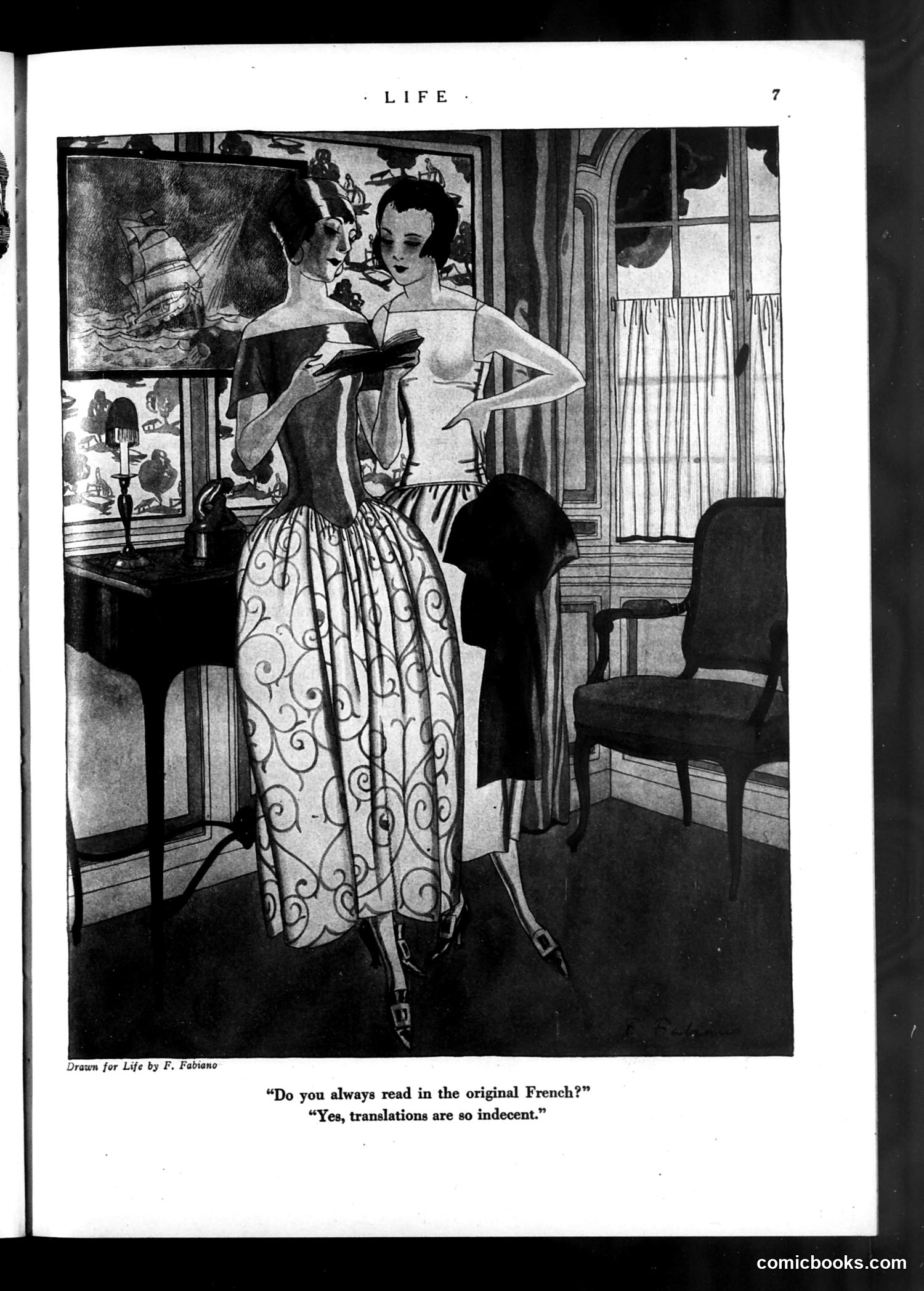
This is a single-panel cartoon by F. Fabiano depicting two women in an elegant bedroom. One woman, dressed in an ornate patterned robe, reads a book while another woman (appearing to be a maid or servant, in darker clothing) attends to her. The caption reads: "Do you always read in the original French?" / "Yes, translations are so indecent." **The satire:** The joke mocks pretentious intellectualism and moral hypocrisy. The wealthy woman claims to read French literature in its original language to avoid "indecent" translations—suggesting she reads risqué French novels but justifies this by claiming the originals are somehow more refined or less improper. The humor lies in the transparent absurdity of this rationalization: the content is identical regardless of language. This satirizes both affected sophistication and the era's anxieties about morality and literature.
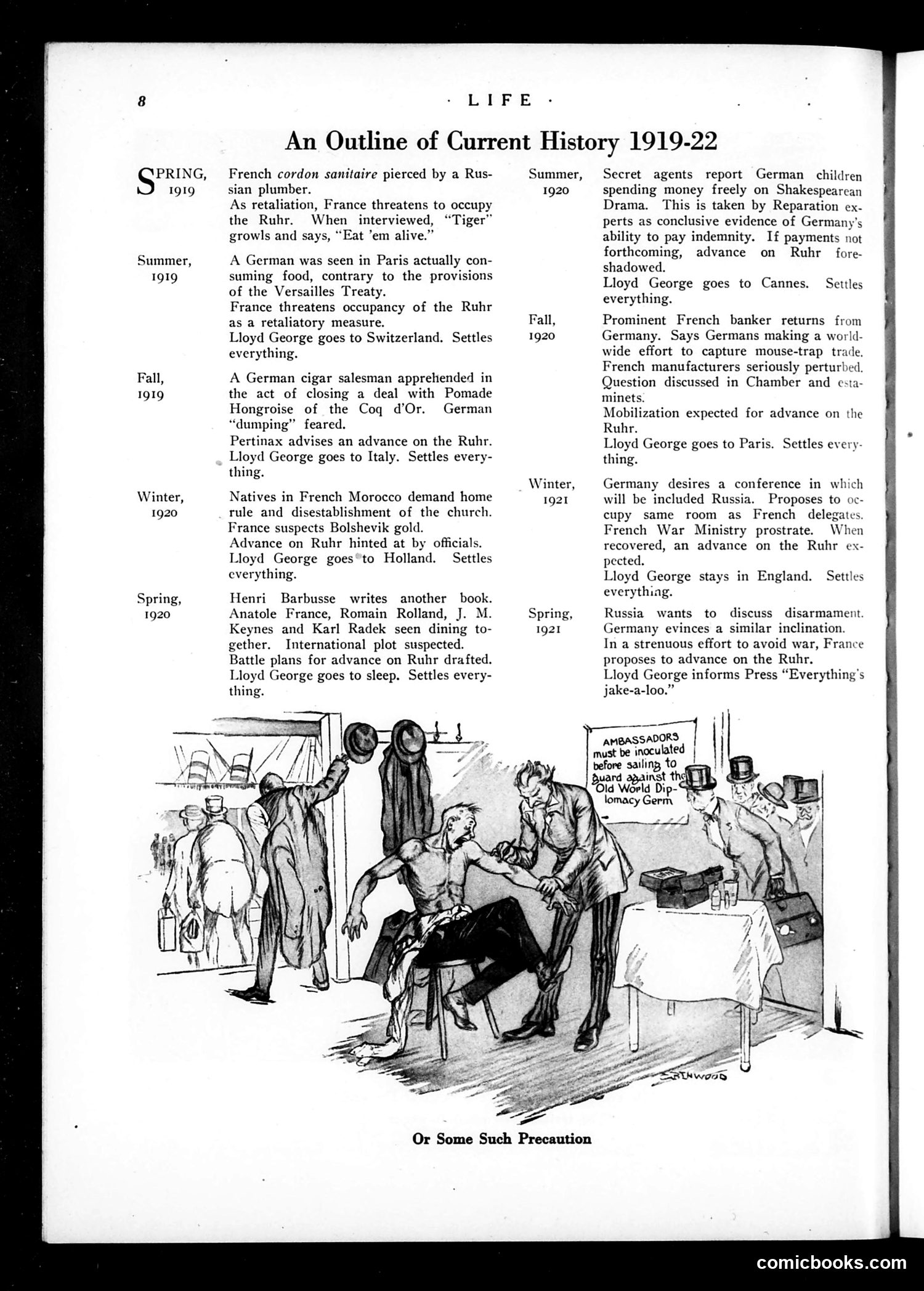
This cartoon satirizes post-WWI diplomatic tensions, specifically the recurring crises over German reparations and French military threats to occupy the Ruhr region. The timeline lists events from 1919-1921 where Lloyd George (British PM) repeatedly "settles everything" through negotiations, yet tensions keep resurging. The cartoon depicts ambassadors being inoculated before sailing to "guard against the Old World Dip-lomacy Germ"—a medical metaphor suggesting diplomatic efforts are treated like vaccinations against recurring disease. The joke: despite repeated settlements and negotiations, European conflicts keep breaking out, so diplomats need preventative treatment before engaging with the same chronic problems.
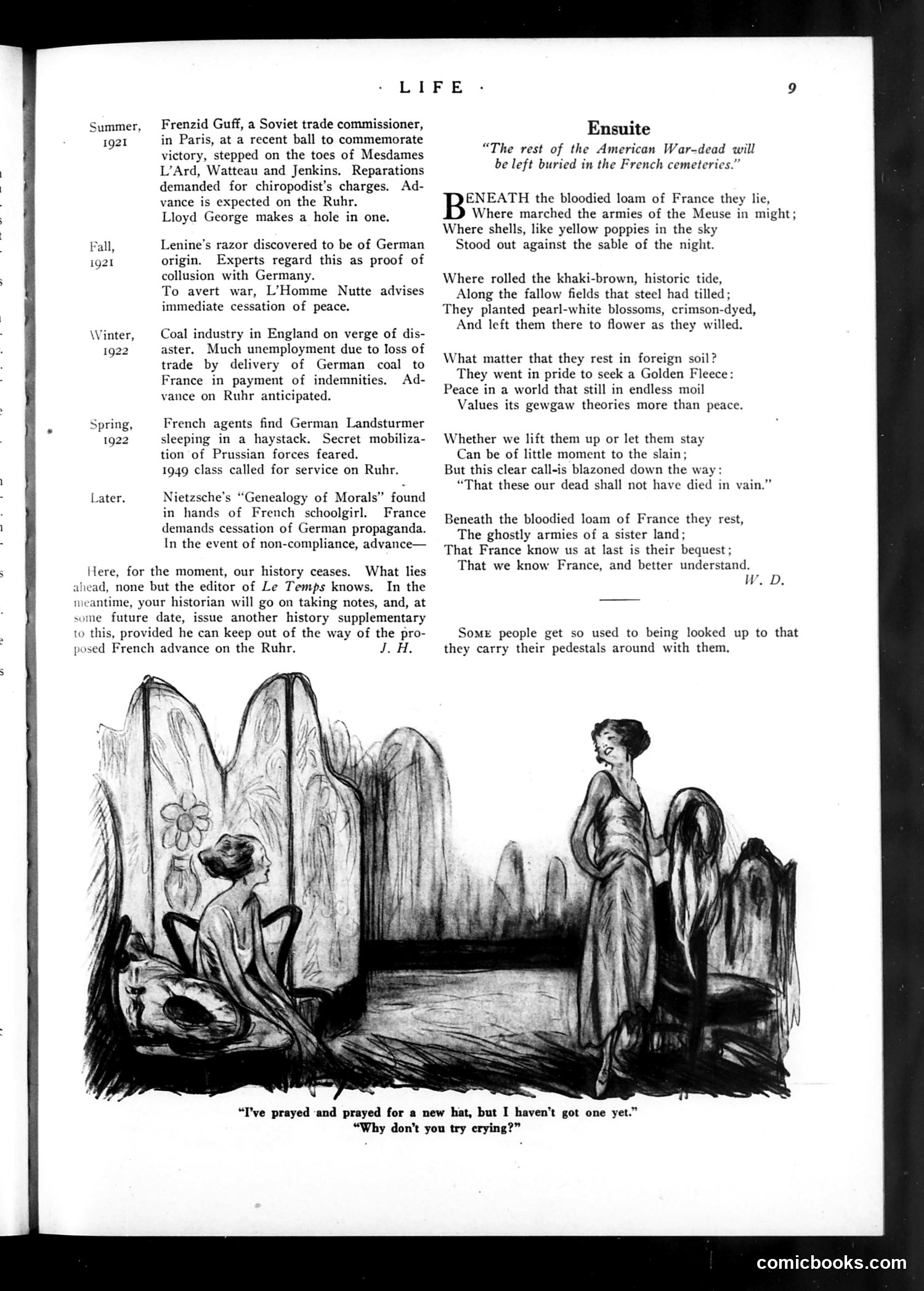
This page contains a poem titled "Ensuite" about American war dead buried in France, followed by a single-panel cartoon below it. **The cartoon** depicts figures in what appears to be an afterlife or cemetery setting. Two women are shown among tall grave markers or monuments. One woman says to another: "I've prayed and prayed for a new hat, but I haven't got one yet." The second responds: "Why don't you try crying?" **The satire** appears to mock materialism and frivolity—specifically, women's obsession with fashion (hats) even in the face of death and mourning. The juxtaposition with the solemn war-dead poem above creates ironic contrast, suggesting the living remain preoccupied with vanity while soldiers lie dead abroad. The joke implies emotional manipulation ("try crying") as a means to obtain worldly goods.
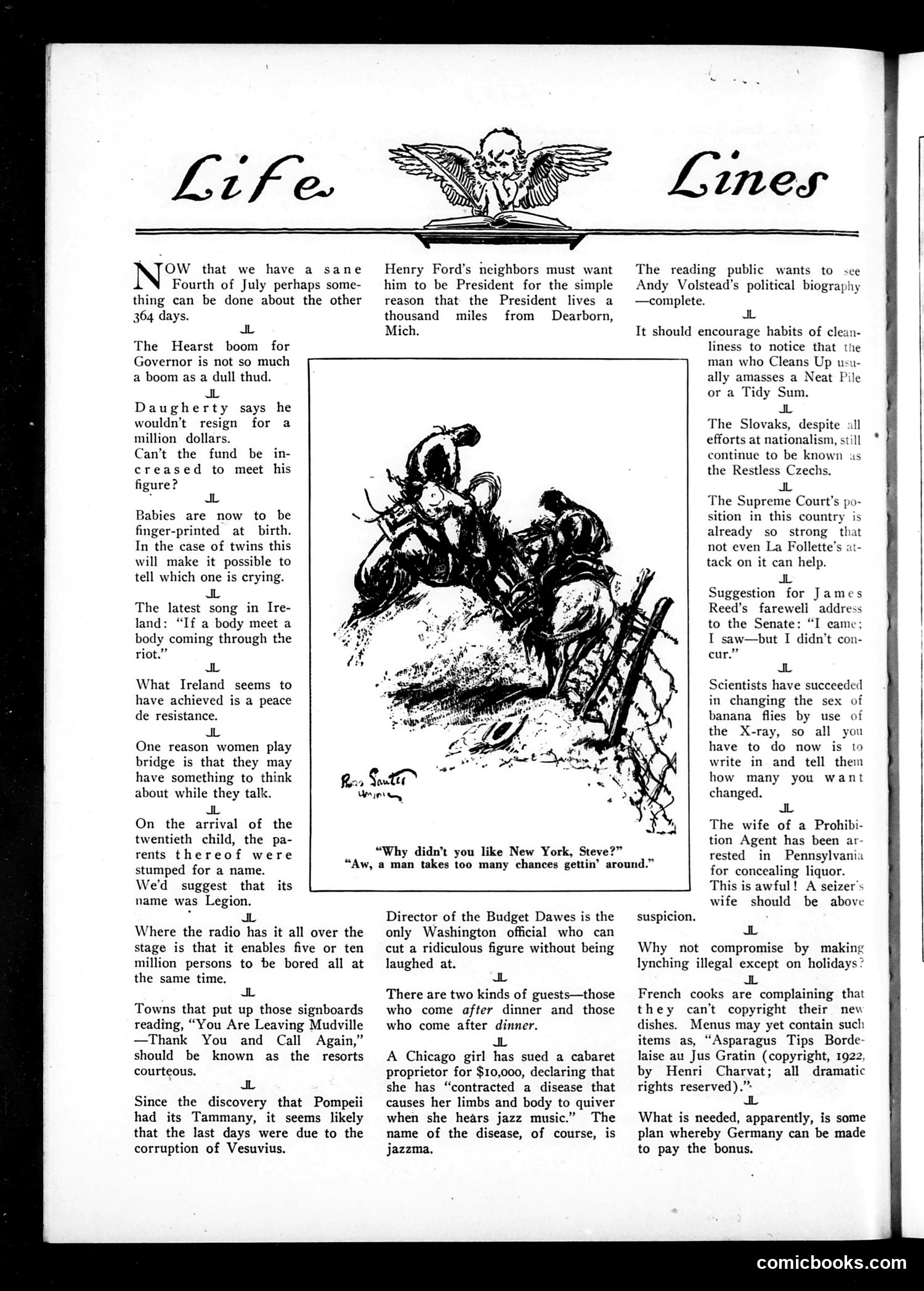
The central cartoon depicts two figures on a motorcycle that has crashed or is careening wildly. The caption reads: **"Why didn't you like New York, Steve?" "Aw, a man takes too many chances gettin' around."** This is a straightforward satirical commentary on the danger and chaos of New York City traffic and urban life in the 1920s. The motorcycle accident serves as visual evidence of the hazards—the joke being that surviving New York requires constant risk-taking. The cartoon mocks the city's notoriously dangerous streets and reckless driving culture of the era, presenting urban transportation as inherently perilous. "Steve" appears to be an everyman character illustrating the common experience of accident-prone city living.
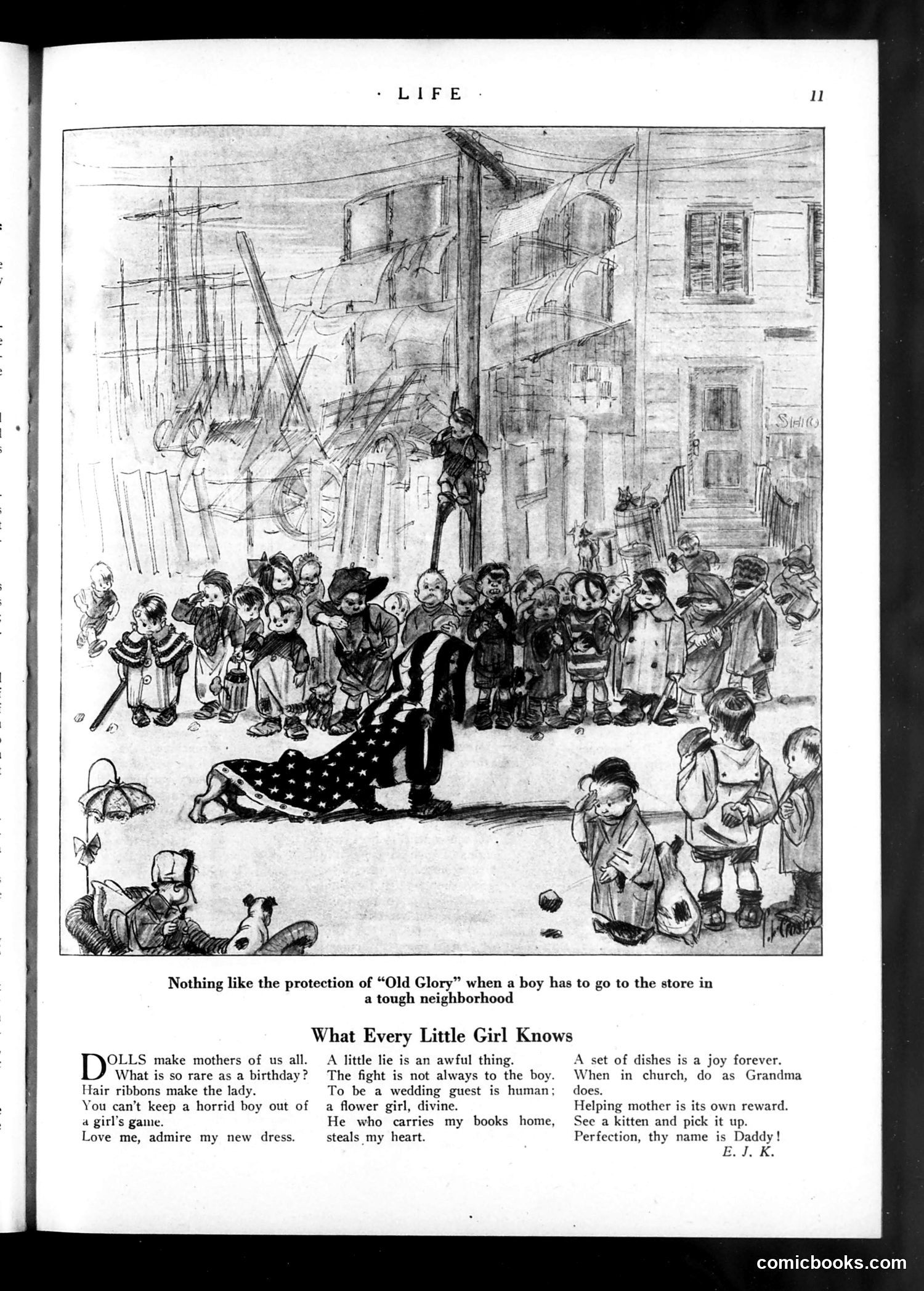
This page contains two distinct pieces: **Top illustration**: A street scene showing a figure being hanged while children and townspeople watch. The caption reads: "Nothing like the protection of 'Old Glory' when a boy has to go to the store in a tough neighborhood." This appears to be **political satire about patriotism and urban safety**—the image suggests that merely wrapping oneself in the American flag ("Old Glory") offers illusory protection in dangerous city streets. The dark humor implies that patriotic symbols cannot substitute for actual safety measures or social reform. **Bottom section**: "What Every Little Girl Knows"—a sentimental poem about childhood lessons (dolls, ribbons, manners, romance). This contrasts sharply with the grim cartoon above, creating **ironic juxtaposition** between innocent childhood ideals and harsh urban realities.
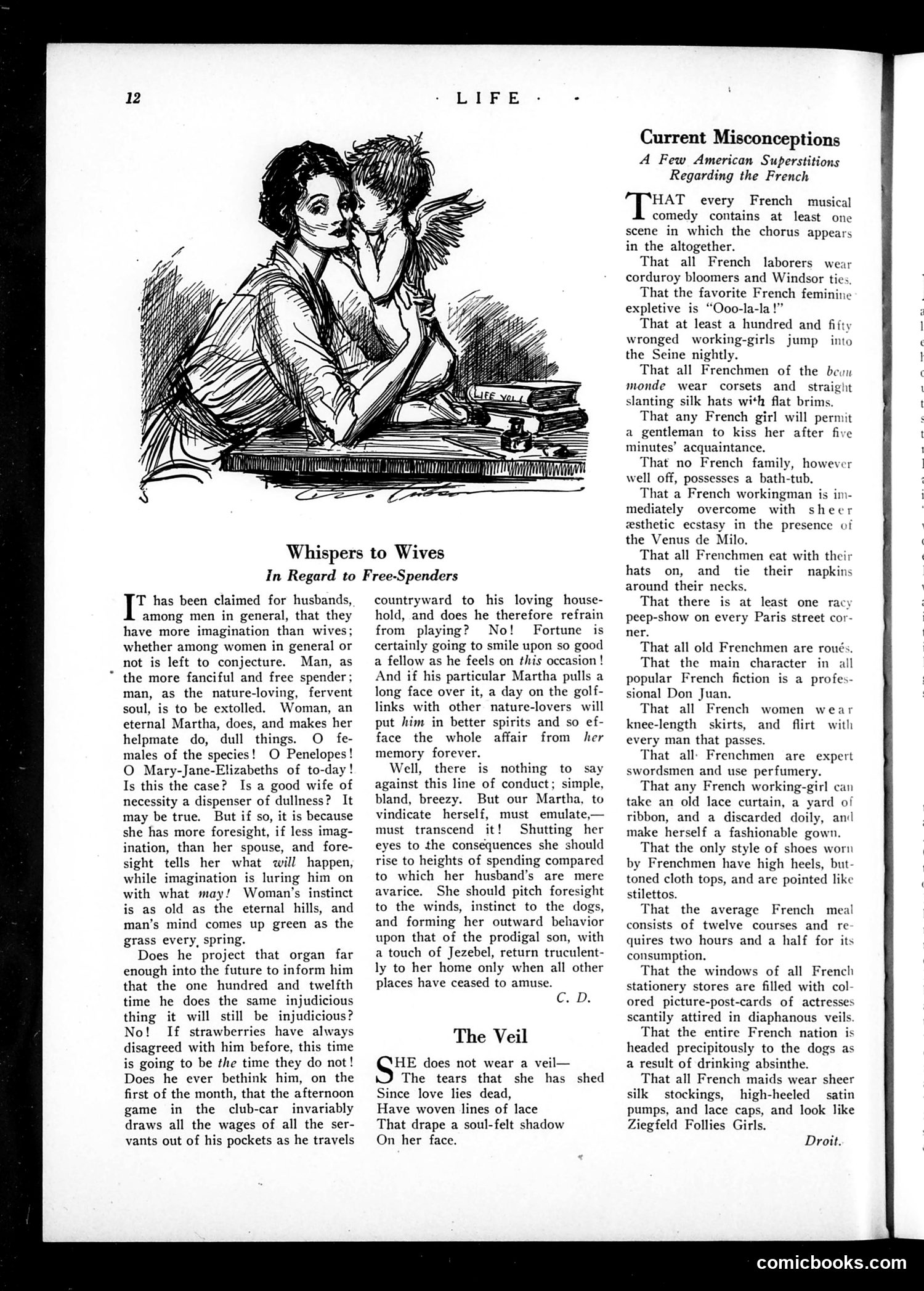
This page satirizes American husbands' anxieties about wives' spending habits. The illustration shows a cherub whispering to a woman at a writing desk—visualizing the "imagination" husbands fear will tempt their wives to spend money. The main article argues husbands exaggerate wives' extravagance. It defends women's right to occasional spending ("free-spender") while mocking men's paranoia about losing household finances. The piece sardonically catalogs husbands' feared scenarios: wives attending golf outings, taking shopping trips, or making "fashionable" purchases. The sidebar "Current Misconceptions" ridicules stereotypical French tropes (chorus girls, corduroy bloomers, perfume use), suggesting American attitudes toward French culture were themselves absurd misconceptions—a meta-satirical commentary.
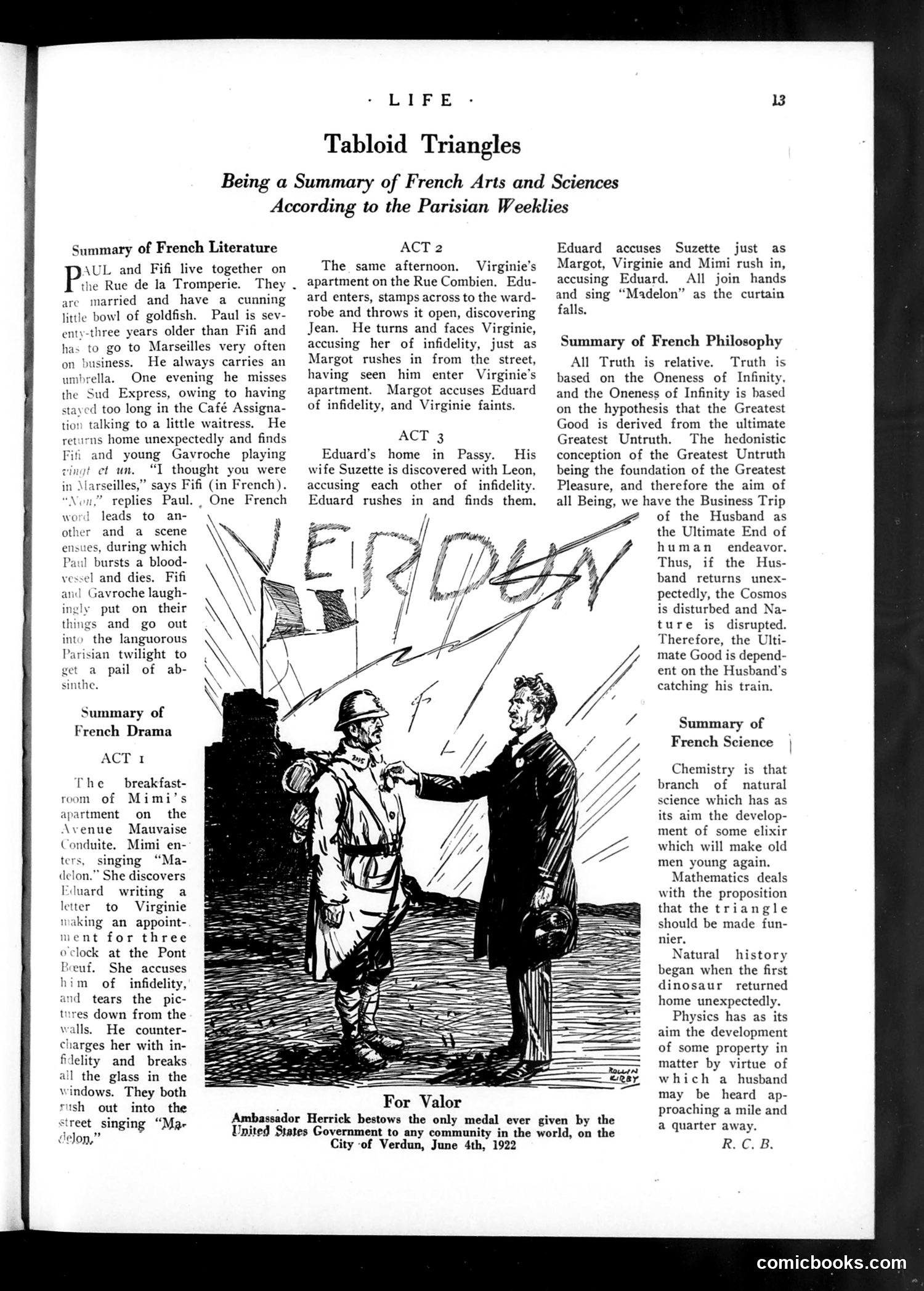
This page from *Life* magazine satirizes contemporary French culture through mock summaries of French literature, drama, philosophy, and science. The central cartoon illustrates "For Valor," depicting Ambassador Herrick bestowing a medal—described as "the only medal ever given by the United States Government to any community in the world" (dated June 4th, 1922, in Verdun). The satire mocks sensationalistic French tabloid plots: infidelity scandals (Eduard, Suzette, Virginie, Mimi), romantic entanglements, and melodramatic confrontations. The French philosophy and science summaries parody pretentious intellectual abstractions—discussing "Truth," "Infinity," "Greatest Untruth," and absurd scientific observations (dinosaurs returning home). The overall effect ridicules both French tabloid sensationalism and intellectual pretension.
This editorial page addresses post-WWI European politics, specifically France's position. The cartoon at top shows a figure in a chair surrounded by chaotic scenes—likely representing France overwhelmed by reconstruction demands. The text discusses France's financial struggles and diplomatic challenges: she demands reparations from Germany, wants security guarantees, and seeks return of Russian property. However, she cannot achieve these goals alone and reluctantly must cooperate with other nations, including Germany itself. The article also mentions American tourists visiting France and domestic U.S. political troubles (coal strikes, the Fordney Tariff, shipping board issues). The satire criticizes France's contradictory position: demanding security while being forced into compromise with former enemies—a realistic assessment of post-war European difficulties.
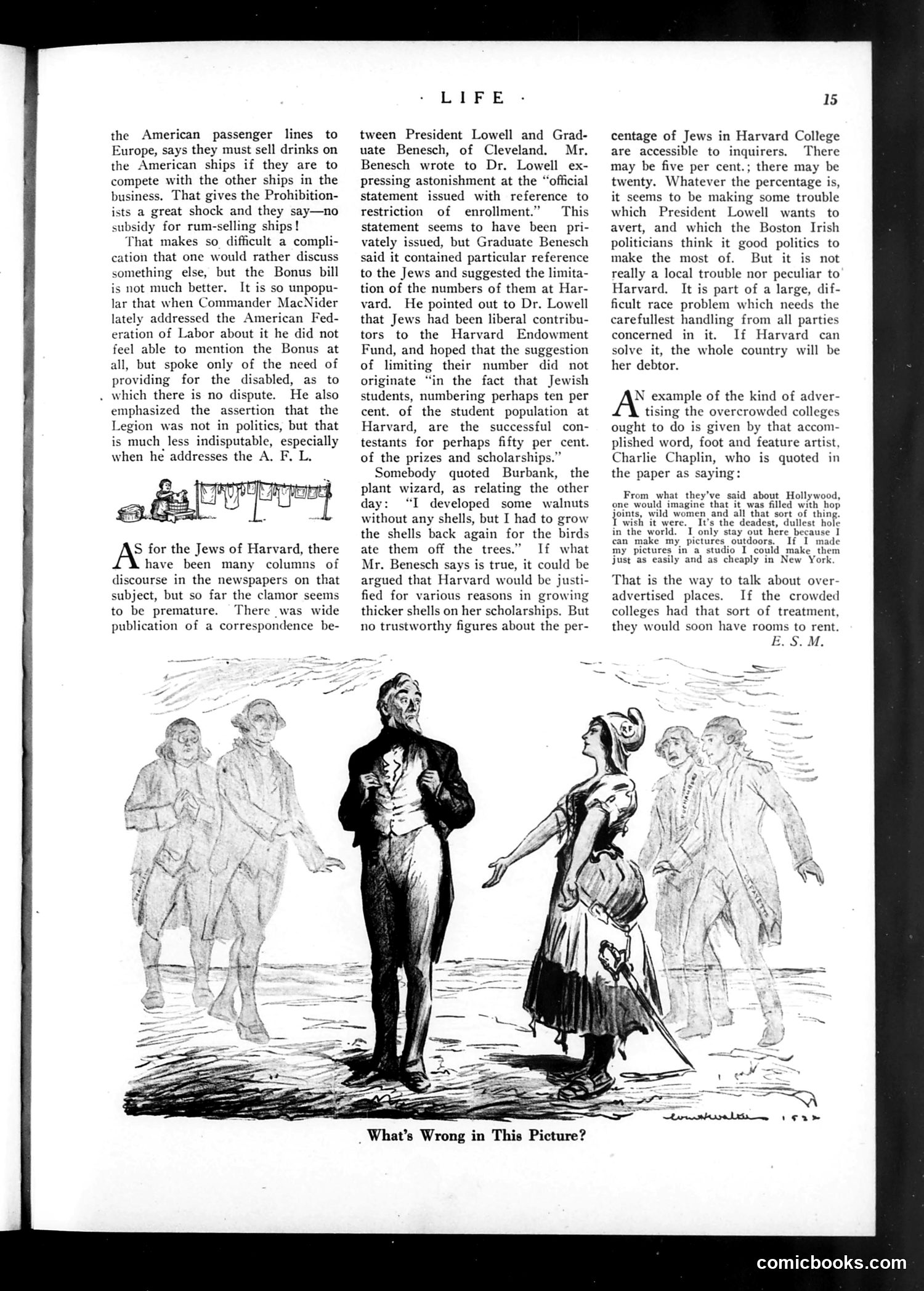
This page addresses several contemporary social controversies circa the 1920s: **The Harvard Jewish Quota Controversy**: The main text discusses President Lowell's alleged restriction on Jewish enrollment at Harvard. Graduate student Benesch challenged Lowell's "official statement" limiting Jewish numbers, noting that Jewish students—comprising roughly 10% of the student body—won approximately 50% of prizes and scholarships. The article acknowledges the sensitive nature of this "race problem" without endorsing discrimination. **The Bonus Bill**: Brief criticism of a veterans' benefits proposal, noting Commander MacNider's reluctance to discuss it publicly. **Prohibition and Shipping**: American passenger lines claim they need to serve alcohol to compete internationally, creating tension with Prohibitionists who oppose subsidizing "rum-selling ships." **The Cartoon**: Titled "What's Wrong in This Picture?" (bottom), it appears to be a visual puzzle, though the specific joke is unclear from the image alone. The page reflects 1920s debates about assimilation, veterans' benefits, and Prohibition enforcement.
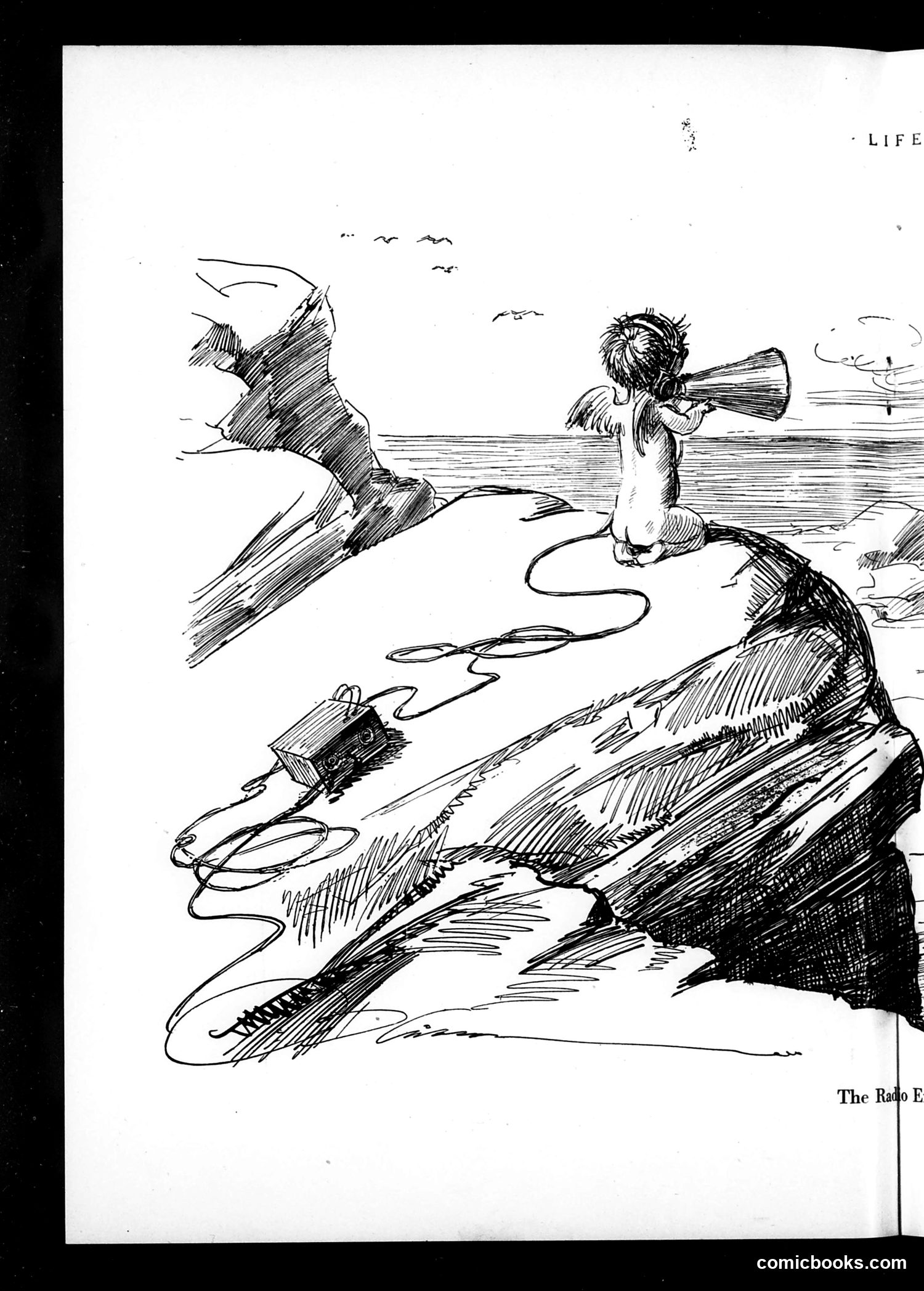
This page appears to show a satirical illustration titled "The Radio E[...]" (text cut off). The sketch depicts a cherubic, naked child figure operating what appears to be early radio broadcasting equipment on a beach or shore setting. The child holds a megaphone or broadcasting horn, while mechanical radio apparatus sits nearby connected by wires. The satire likely mocks the novelty and somewhat chaotic early era of radio broadcasting in the 1920s-30s. The image suggests radio technology was so accessible or poorly regulated that even a child could operate it—a commentary on either the simplicity of the technology or the lack of professional standards in early radio. The exact publication date and specific target remain unclear from the visible text.
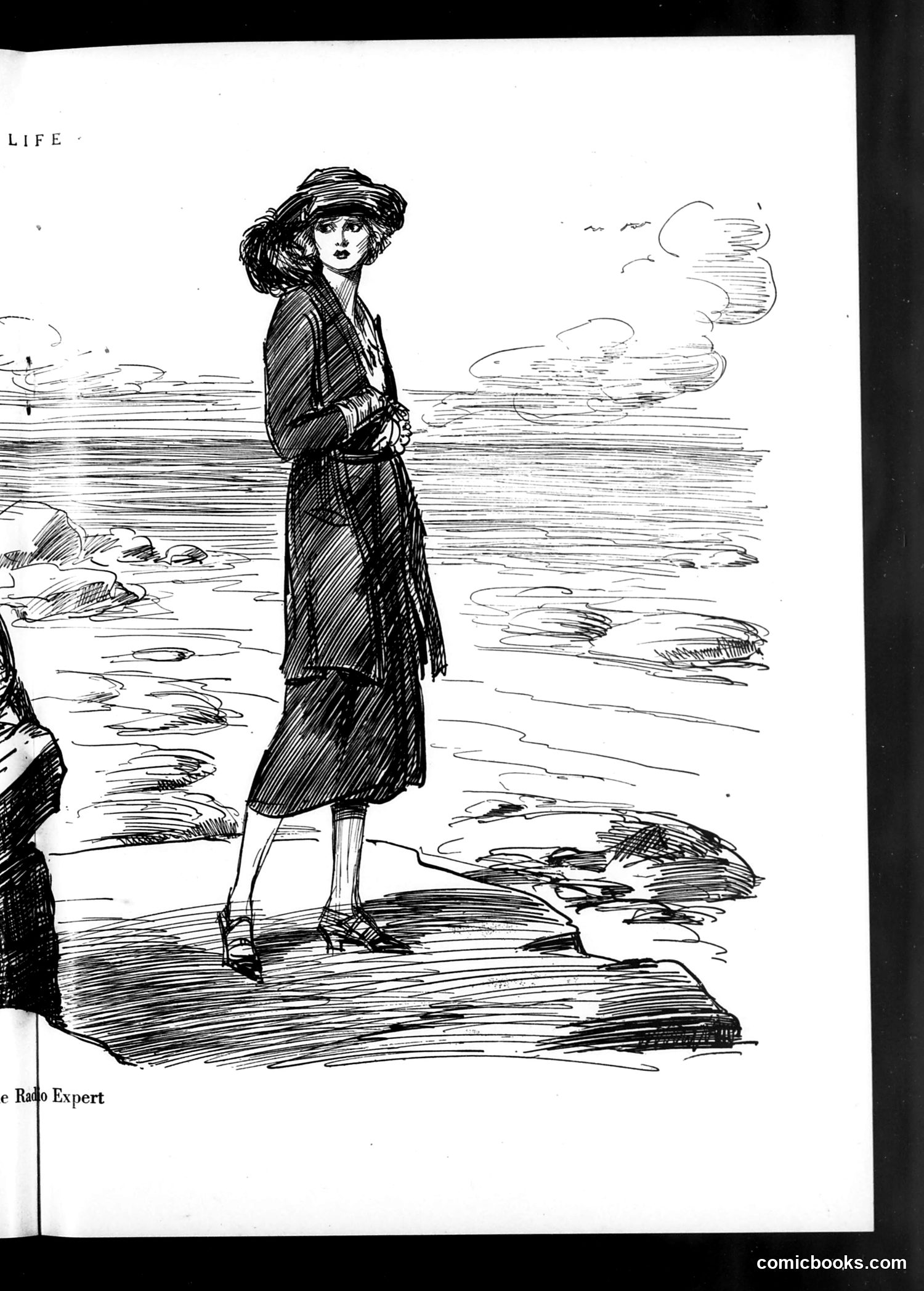
This appears to be a page from *Life* magazine featuring a single illustration titled "The Radio Expert" (visible at bottom left). The drawing shows a woman in 1920s attire—a long dark coat, cloche hat, and heeled shoes—standing on a beach or shoreline, gazing thoughtfully outward. The style is characteristic of early-20th-century satirical illustration. The caption "The Radio Expert" likely contains ironic commentary about early radio technology and knowledge. Given the era and *Life*'s satirical nature, this probably mocks either: someone claiming expertise they lack, or possibly gendered assumptions about women's technical knowledge during radio's emergence. The woman's pensive pose and fashionable appearance suggest the humor relies on visual contrast or social commentary typical of the period's satire.
This is Robert C. Benchley's theater review of the Chauve-Souris, a Russian vaudeville revue at the Century Roof, presented by impresario Balieff. The piece satirizes the pretentious Manhattan audience attending the first program—"hyper-sensitive zealots" who swooned theatrically over the entertainment and ostracized the reviewer for honest criticism, even getting him "thrown into jail as a suspicious character" (hyperbole for social exclusion). Benchley argues the second show was better simply because the ordinary audience enjoyed it without pretension. He acknowledges Balieff as a talented performer and host but dismisses the acts themselves as elementary vaudeville—wooden soldiers' drills, pantomime, Russian folk songs—rejecting claims it represents revolutionary artistry. The satire targets 1920s Manhattan cultural snobbery rather than the show itself.
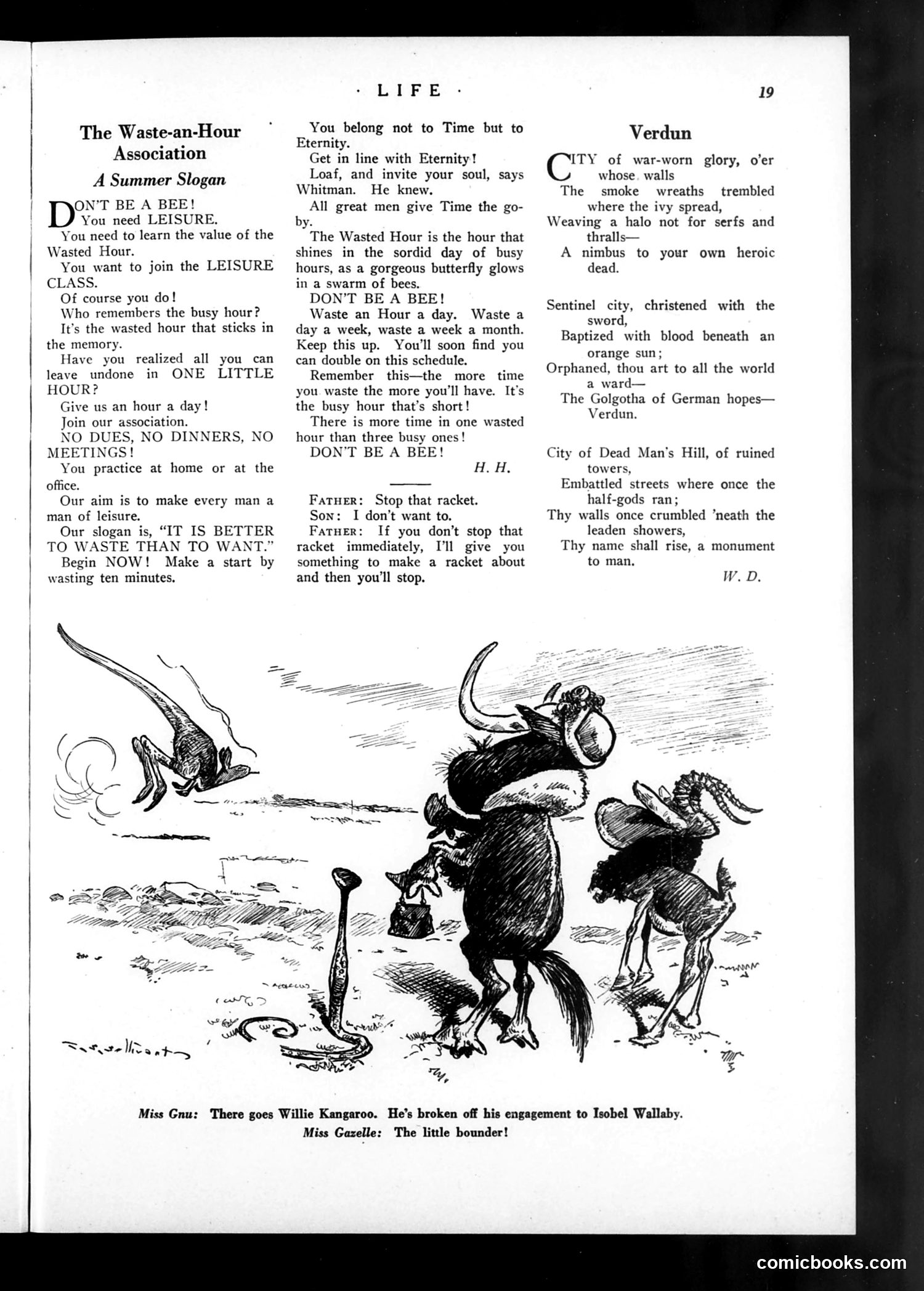
This page satirizes the early 20th-century leisure movement and changing attitudes toward work. The "Waste-an-Hour Association" mock-advertisement ironically promotes idleness as virtue, inverting the Protestant work ethic that dominated American culture. Phrases like "IT IS BETTER TO WASTE THAN TO WANT" and the slogan "DON'T BE A BEE!" (contrasting busy workers with leisured gentlemen) parody both labor reformers advocating shorter hours and wealthy elites celebrating indolence. The humorous father-son dialogue below illustrates generational conflict over discipline and obedience—a common period anxiety. The page also includes a serious WWI poem about Verdun, the devastating French fortress battle (1916), and a cartoon showing animals gossiping—typical filler content mixing satire with whimsy.
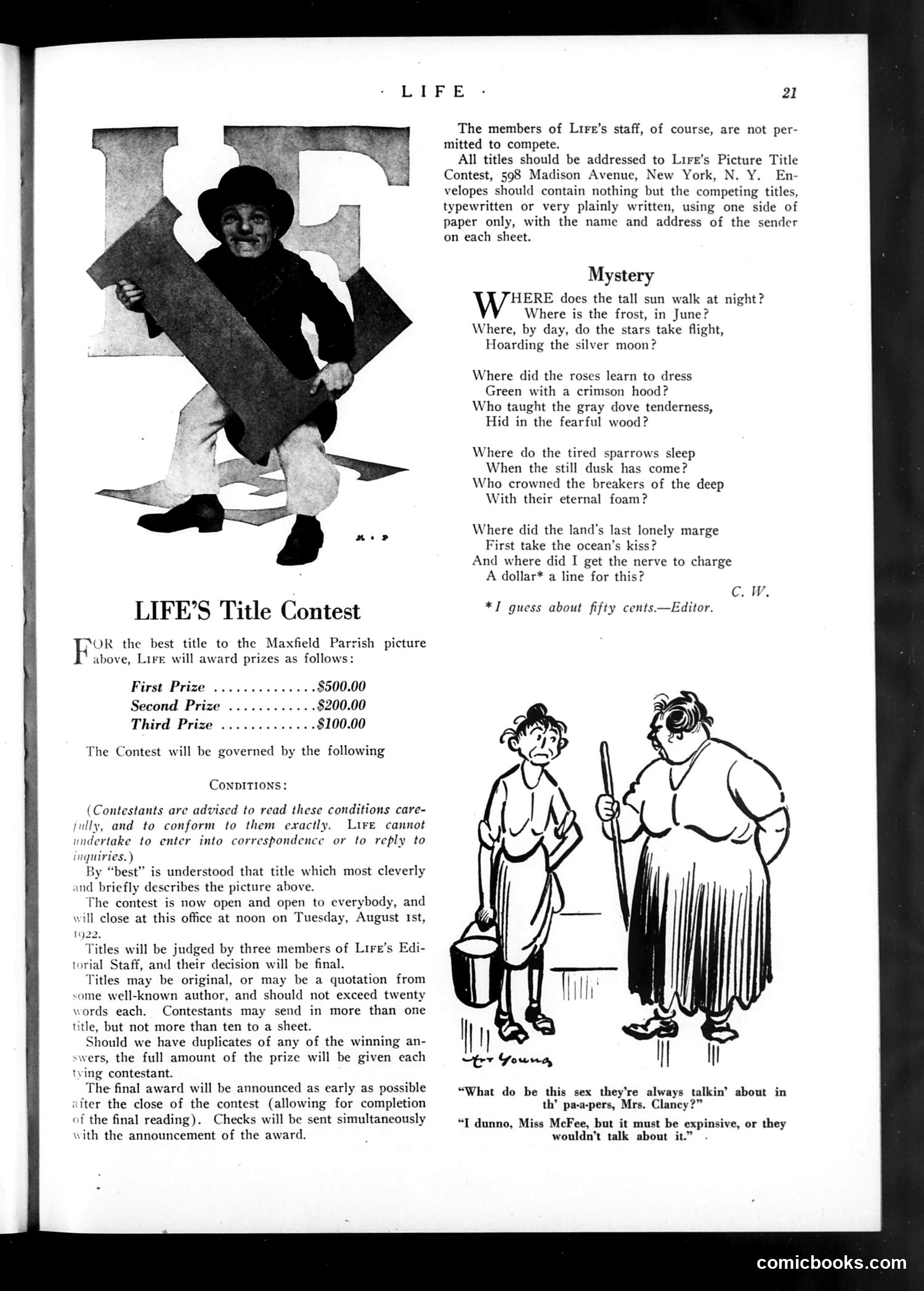
This page contains a **title-writing contest** for a Maxfield Parrish painting (visible at top left—a figure in dark clothing posed dramatically against large letters). Life offered $500-$100 in prizes for the cleverest, briefest titles, with submissions due August 1, 1922. Below is a humorous **poem titled "Mystery"** that poses philosophical questions about nature, concluding with self-deprecating satire: the poet admits charging a dollar per line for verses, then the editor quips it's actually worth fifty cents—mocking overwrought literary pretension. At bottom is a **cartoon joke** featuring two working-class women (likely Irish immigrants, suggested by names "Clancy" and "McFee"). One asks what "sex" means from newspaper discussions; the other replies it must be expensive since people keep talking about it—satirizing both the era's sexual frankness debates and working-class detachment from sophisticated discourse.
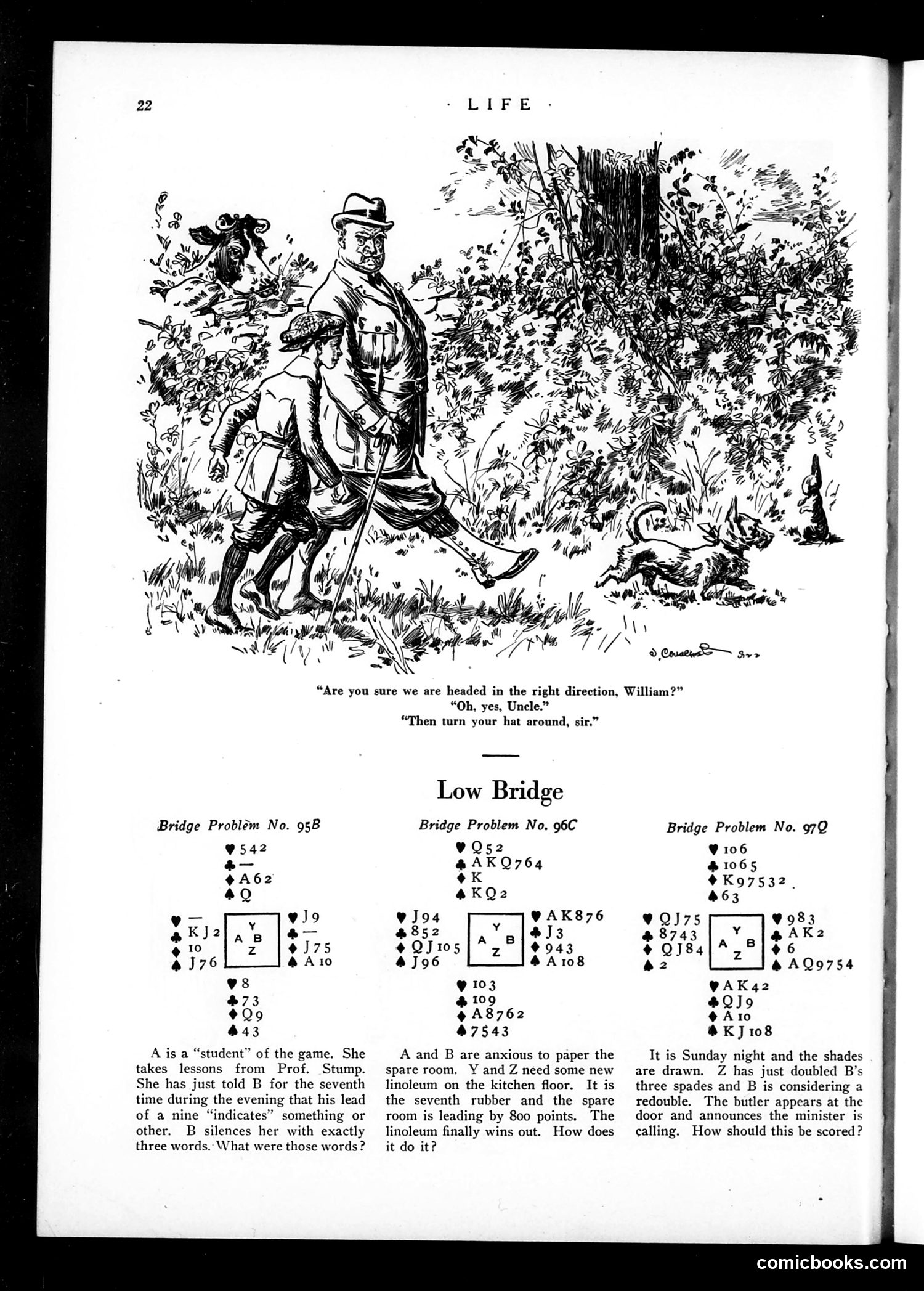
This page from *Life* magazine features a humorous cartoon and three bridge card game problems. **The Cartoon:** A man in a hat and military-style uniform walks through overgrown vegetation with a young boy, asking if they're heading the right direction. The boy replies "Oh, yes, Uncle," then adds "Then turn your hat around, sir"—a witty insult implying the man is going backward or lost. The humor is gentle mockery of an adult's navigation incompetence. **The Bridge Problems:** These are instructional card game puzzles, a common *Life* feature. Each problem presents a scenario mixing bridge strategy with humorous domestic situations—a woman repeatedly offering unsolicited bridge advice, couples competing over home repairs, or a minister's visit interrupting a game. The jokes rely on readers' familiarity with bridge culture and the absurdity of applying game logic to real-life interruptions. The page reflects early-to-mid 20th century upper-middle-class leisure activities—bridge was a popular social pastime requiring intelligence and strategy, making it suitable material for *Life's* educated readership.
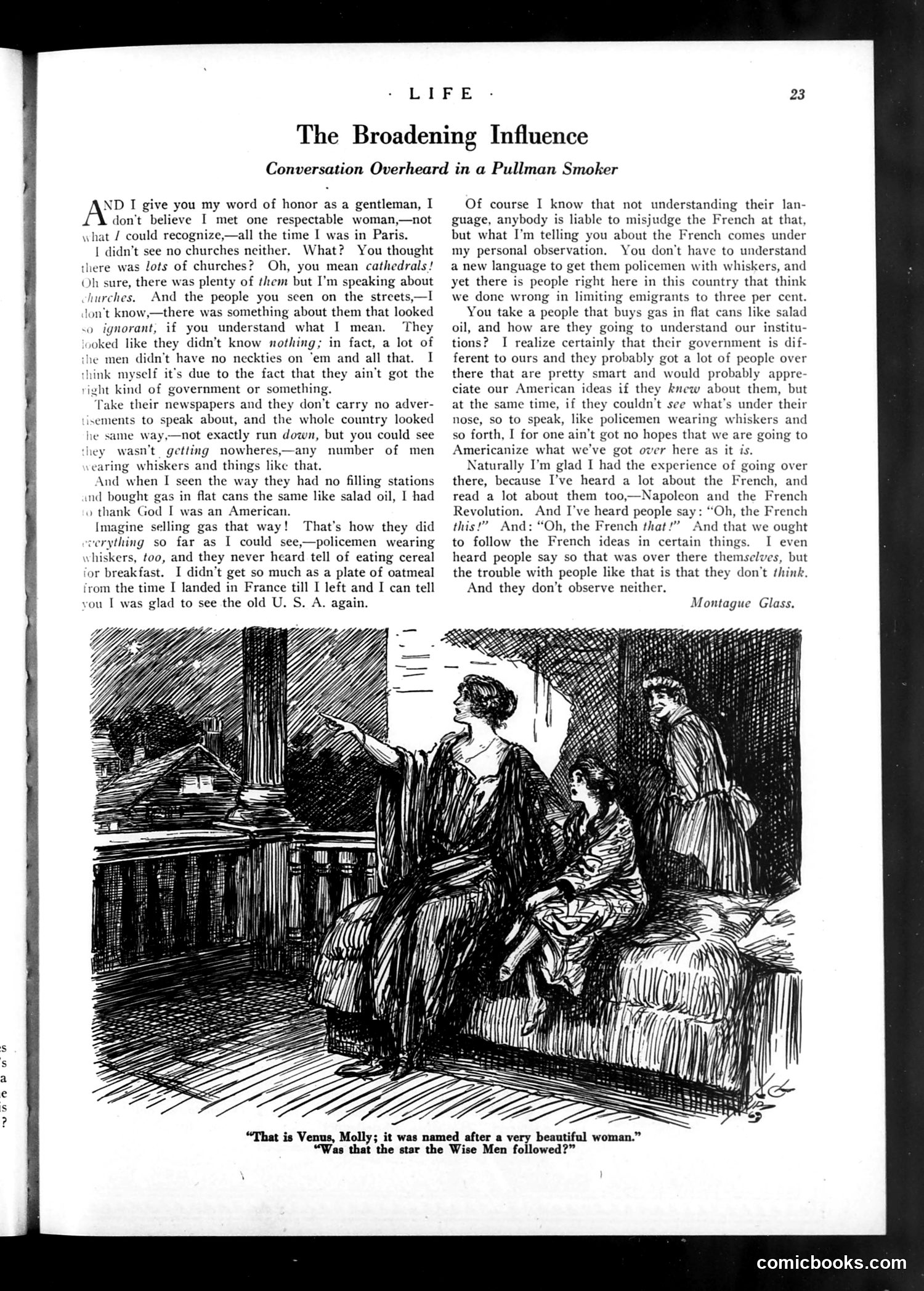
This satirical piece mocks American tourists and xenophobic attitudes of the 1920s. A boastful American businessman in a Pullman train car describes his Paris visit with profound ignorance, complaining about French women's morality, lack of churches (confusing them with cathedrals), Frenchmen's appearance (beards, no neckties), and primitive gas-selling methods using flat cans. The satire targets multiple targets: the speaker's laughable lack of cultural understanding, his assumption that American methods are superior, and his use of trivial observations to justify restrictive immigration policy (the "three per cent" quota). The caption's joke about Venus and the Star of Bethlehem reinforces the theme—depicting Americans as comically uninformed. By having an educated-sounding man express such ignorant views, author Montague Glass exposes the absurdity of nativist sentiment and American cultural smugness in the post-WWI era.
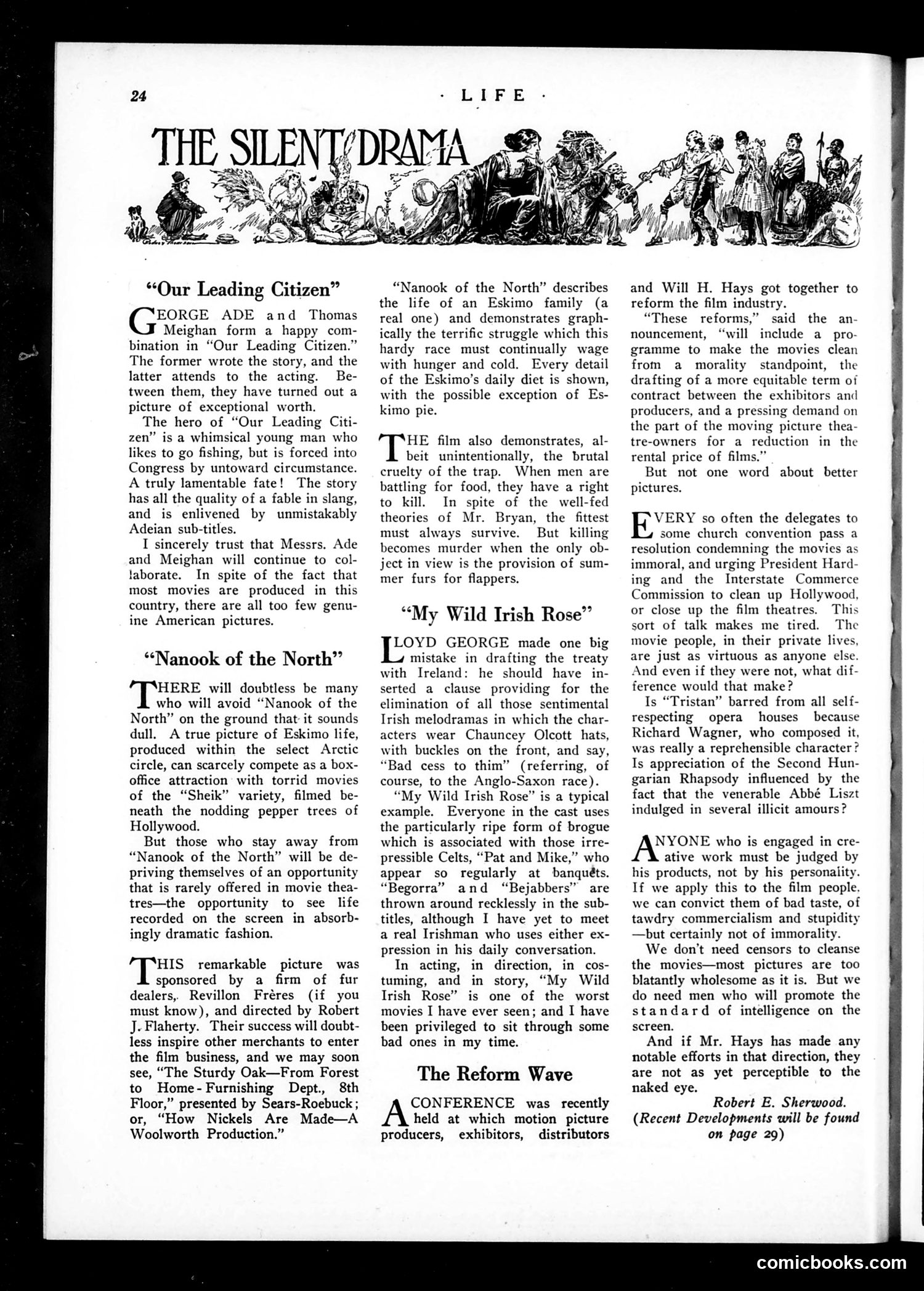
This page contains three film reviews from what appears to be the early 1920s. The satirical content targets Hollywood's output and Irish-American stereotypes: **"Our Leading Citizen"**: Praised as genuinely American entertainment—a rarity in Hollywood at the time. **"Nanook of the North"**: Celebrated as authentic documentary cinema, though the reviewer sarcastically anticipates other corporations will sponsor branded films (Sears-Roebuck, Woolworth). The piece mocks animal trapping for fashion ("summer furs for flappers"). **"My Wild Irish Rose"**: Harshly critiqued as perpetuating tired Irish stereotypes. The reviewer—likely Robert E. Sherwood—attacks the film's reliance on caricatured dialect ("Begorra," "Bejabbers") and characters like "Pat and Mike," claiming no real Irishman speaks this way. This reflects post-1921 Irish independence treaty tensions and satirizes Hollywood's reductive ethnic portrayals. **"The Reform Wave"**: Notes industry attempts at moral cleanup under Will H. Hays, skeptically questioning whether producers genuinely care about quality standards.
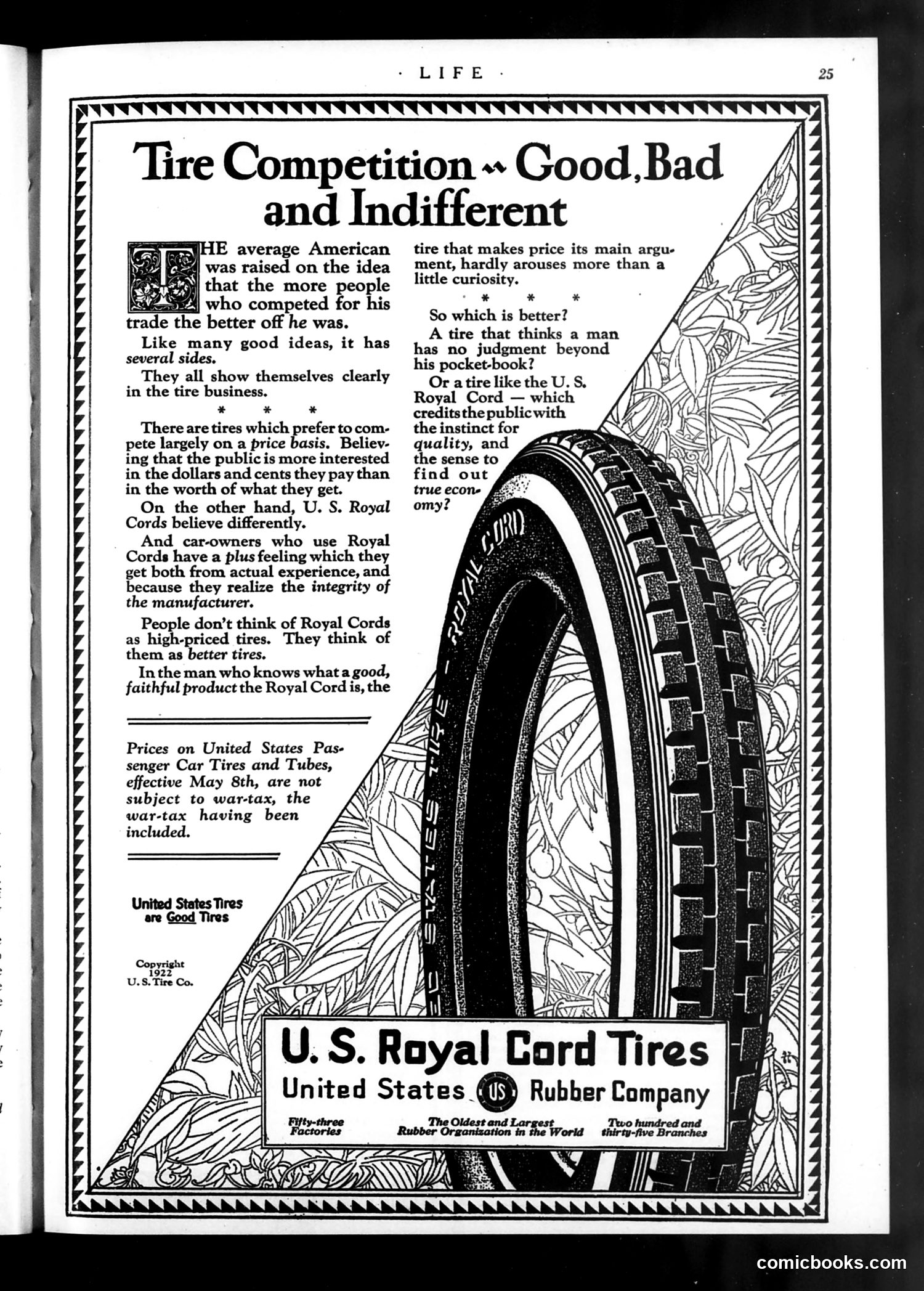
This is primarily **advertising content**, not political satire or a cartoon. It's a full-page advertisement for U.S. Royal Cord Tires from the United States Rubber Company. The ad uses a rhetorical argument rather than caricature or satire. It contrasts two tire-buying philosophies: competitors who compete on price (implying cheap quality), versus U.S. Royal Cord, which assumes consumers value "quality" and "true economy" over mere low cost. The central image shows a large tire with decorative Art Deco-style background. The text appeals to readers' sense of being intelligent consumers who won't be fooled by price-based competition alone. The only topical reference is a note that tire prices (effective May 8th) exclude war-tax, suggesting this was published during or shortly after World War I, when such taxes existed. This represents straightforward early-20th-century brand messaging emphasizing product integrity and consumer intelligence—not social or political commentary.
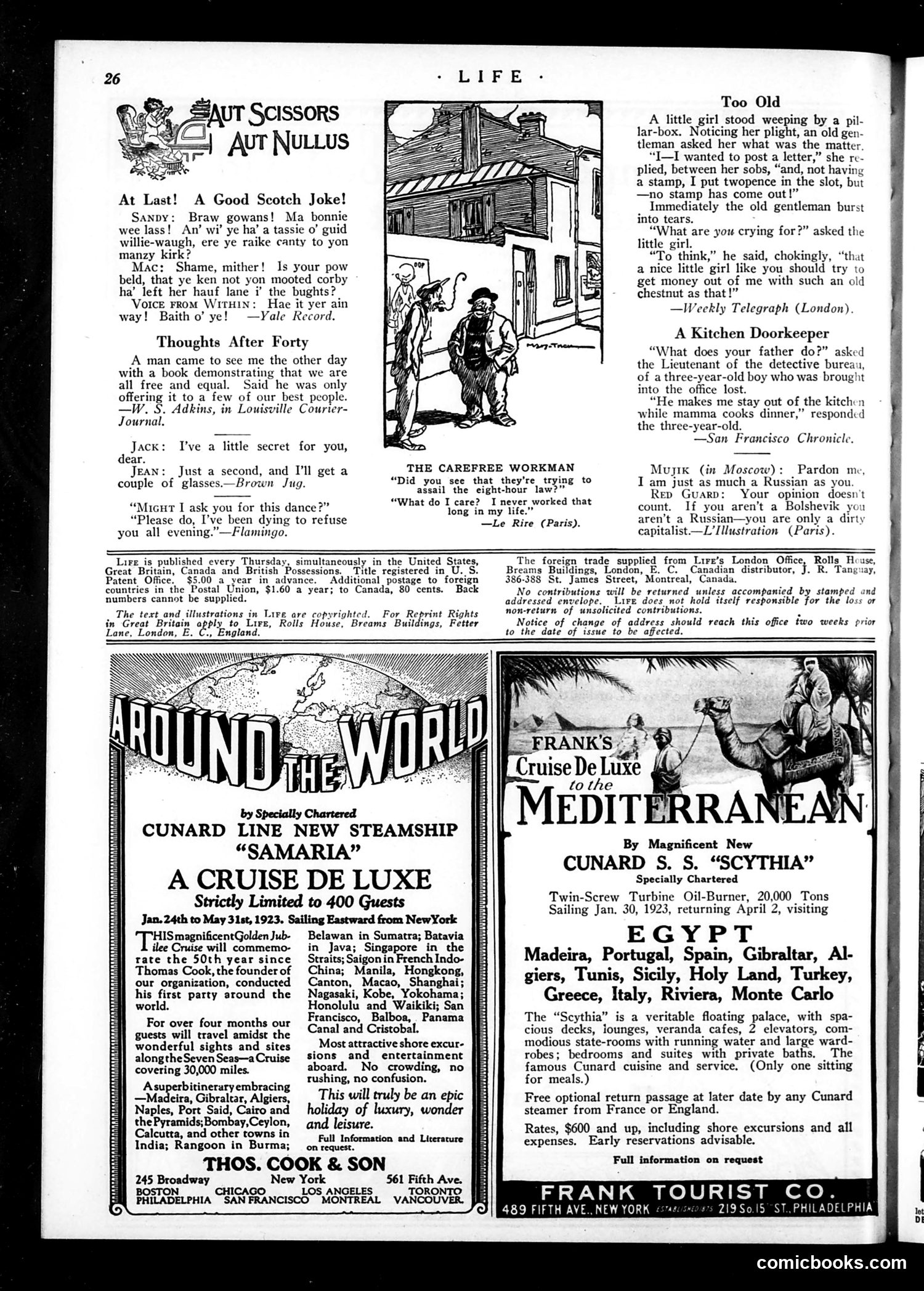
This page from *Life* magazine contains primarily humorous short jokes and advertisements, rather than political cartoons. The jokes mock social pretensions and class anxieties. "Thoughts After Forty" satirizes wealthy people's selective distribution of egalitarian ideas. The "Kitchen Doorkeeper" anecdote plays on a child's innocent misunderstanding of parental authority. The "Too Old" joke humorously depicts an elderly gentleman recognizing an old con ("chestnut"). Most notably, the "Muyik" joke appears to reference post-Bolshevik Revolution tensions (circa 1920s). A Russian peasant's observation that non-Bolsheviks are "dirty capitalists" satirizes the Soviet regime's ideological rigidity and intolerance of dissent. The remaining content consists of cruise ship advertisements from Cunard and Thomas Cook & Son, targeting wealthy travelers seeking luxury Mediterranean and world voyages during the early 1920s.
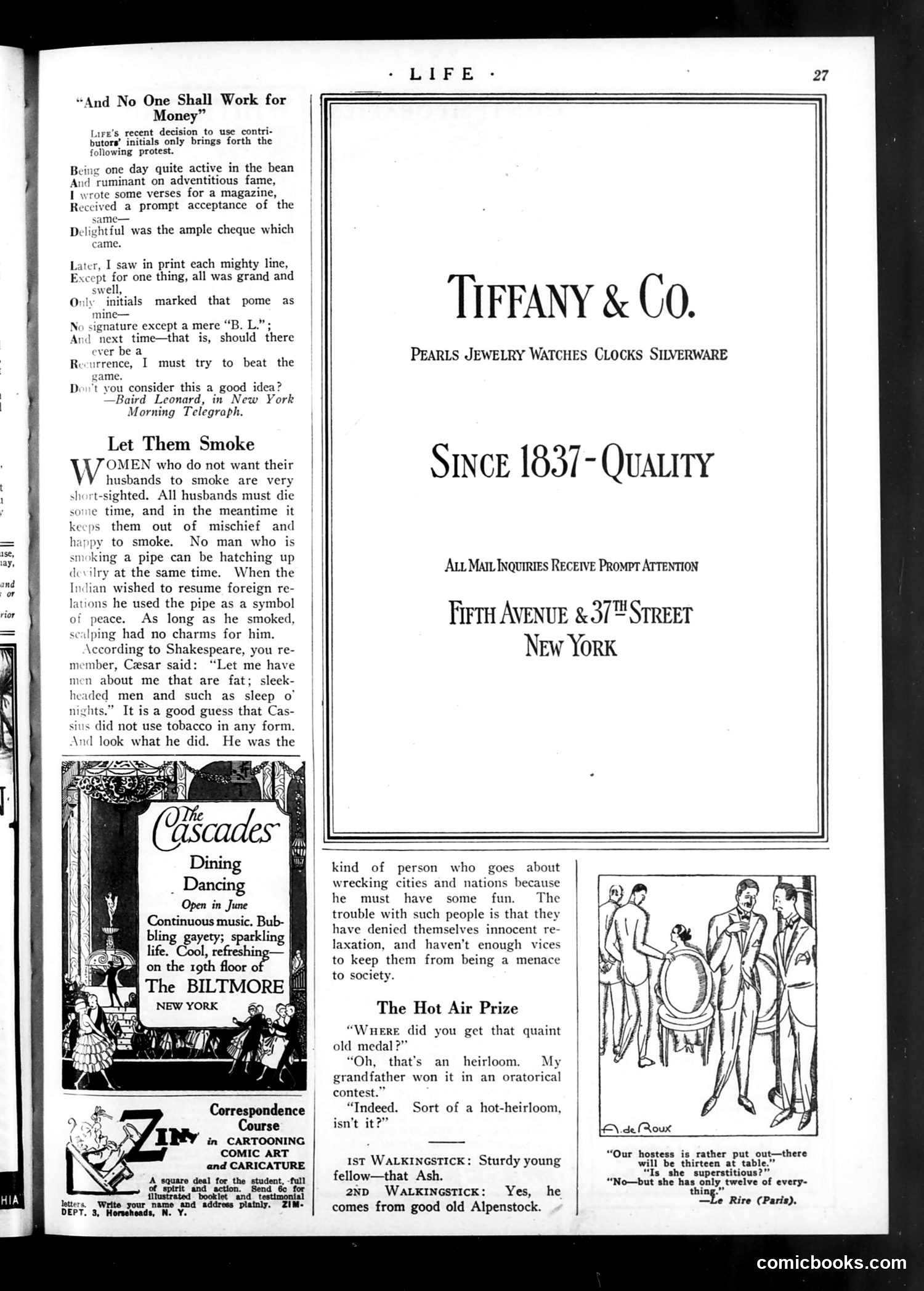
This page contains three distinct pieces of satire: 1. **"And No One Shall Work for Money"**: A protest poem by Baird Leonard criticizing Life's editorial decision to publish contributor bylines using only initials (like "B.L.") rather than full names. The poet sarcastically suggests he'll try to "beat the game" next time—implying the anonymity undermines authorial recognition and pride. 2. **"Let Them Smoke"**: An essay arguing women shouldn't discourage husbands from smoking, as it keeps them occupied and out of trouble. It humorously cites Shakespeare's Caesar and references Native American peace pipes, suggesting smoking prevents men from scheming or causing social chaos. 3. **"The Hot Air Prize"**: A brief joke about an "oratorical contest medal" being a "hot-heirloom"—punning on the phrase "hot air" to mock verbose public speaking. The page also includes a cartoon about table settings and superstition, plus period advertisements for The Biltmore hotel and Tiffany & Co.
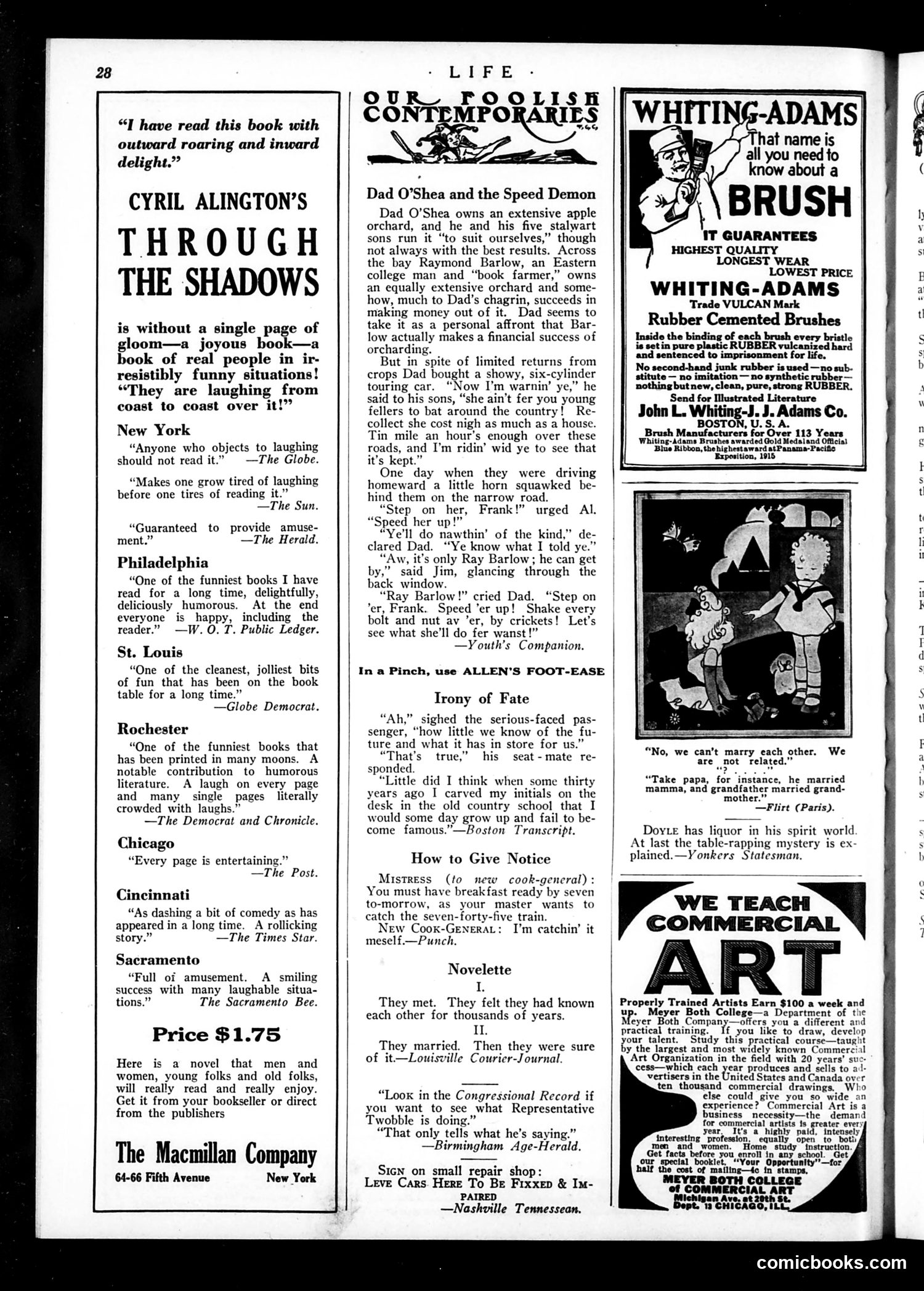
This page is primarily **advertising and book promotion**, not political satire. The dominant content includes: **Main Feature**: A glowing review section for Cyril Alington's novel *Through the Shadows*, compiled from major newspapers praising its humor and wholesomeness. The book costs $1.75. **Side Content**: - A brief humorous story, "Dad O'Shea and the Speed Demon" (from *Youth's Companion*), about an Irish farmer who forbids his sons from speeding in his new car—until their rival, successful businessman Ray Barlow, appears behind them. Dad then demands maximum speed, driven by competitive pride rather than safety sense. The irony is the joke. - Short comic anecdotes about social awkwardness and fate. **Advertisements**: Whiting-Adams brushes, Meyer Both College's commercial art instruction, and Allen's Foot-Ease. The page reflects 1920s American publishing and consumer culture, with no apparent political commentary—just book marketing and light domestic humor typical of the era's *Life* magazine format.
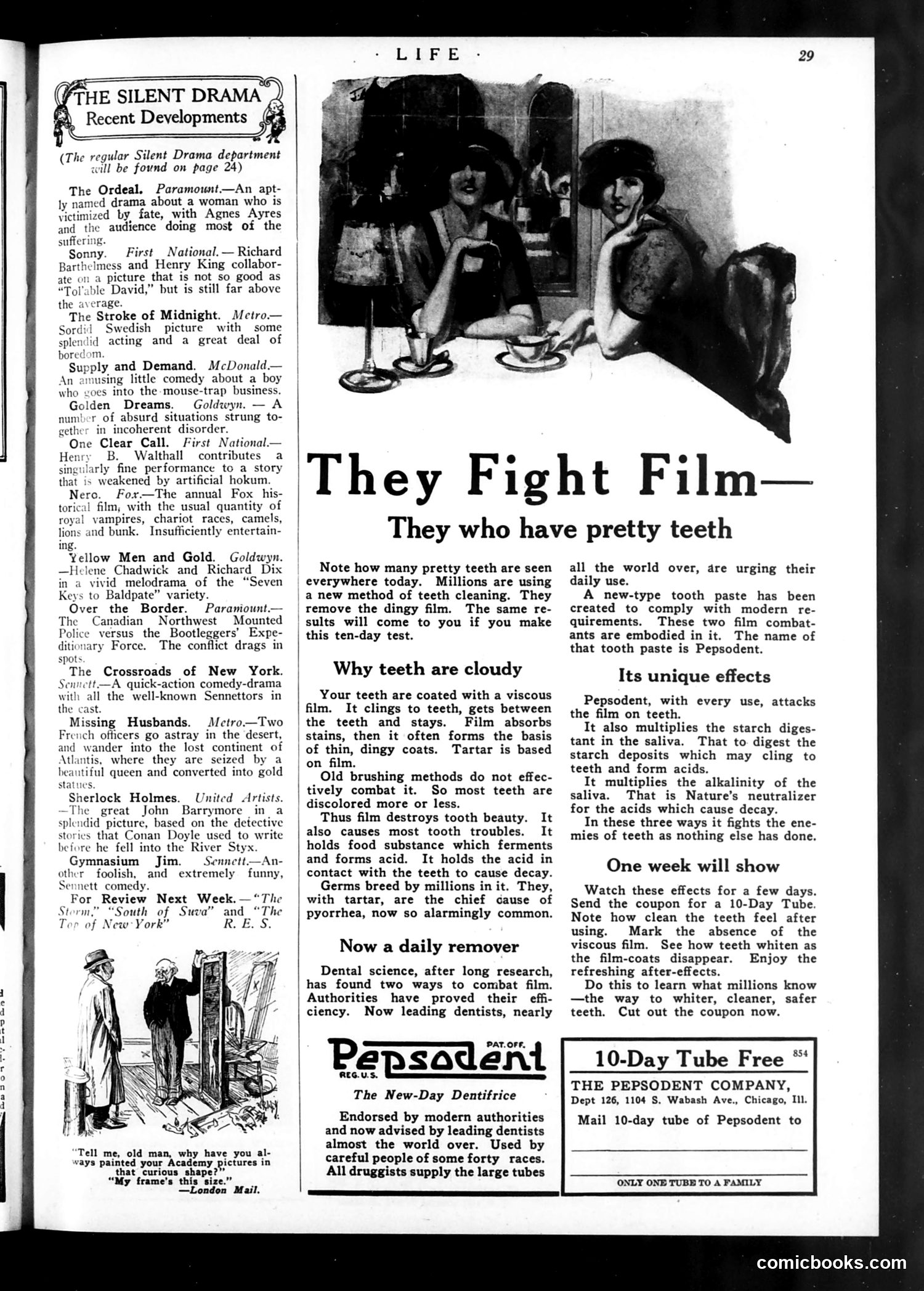
This page mixes entertainment criticism with advertising. The left column contains **film reviews** from Life magazine's "Silent Drama" section, offering brief satirical takes on current movies—judging them harshly ("Insufficiently entertaining," "incoherent disorder"). The tone is witty and dismissive, typical of 1920s film criticism. The right half is a **Pepsodent toothpaste advertisement** disguised as an educational article titled "They Fight Film." It uses pseudo-scientific language to describe a supposed "film" coating teeth, claiming Pepsodent removes it through two special ingredients. The ad addresses a real concern of the era—tooth discoloration—and leverages dentist endorsements to build credibility. The small cartoon at bottom-left is unrelated humor about picture framing. This represents early **advertorial technique**: blending ads into editorial content to appear more authoritative than standalone advertising.
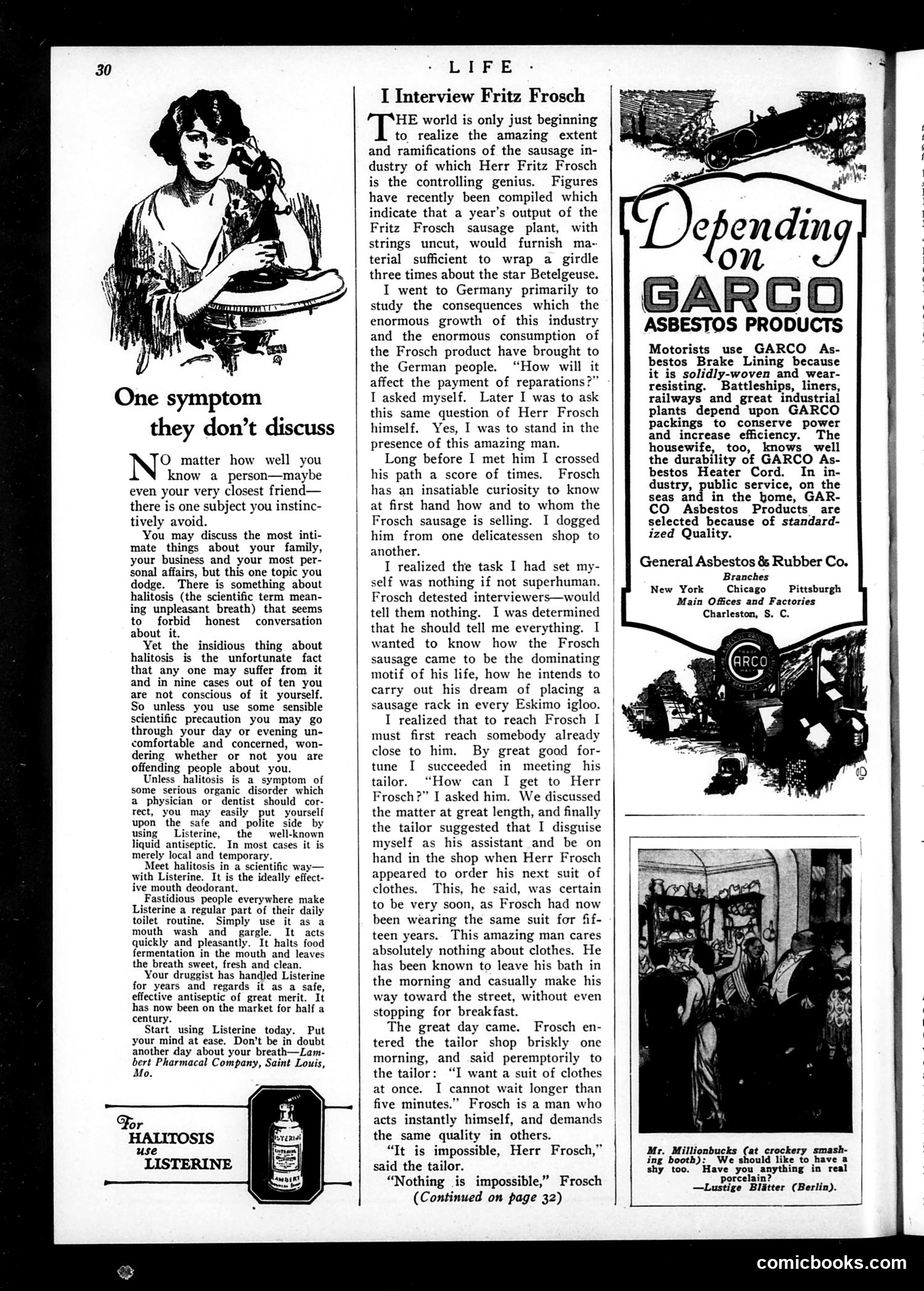
This page contains two distinct pieces: a Listerine advertisement masquerading as health advice (left), and a satirical interview article about a fictional German sausage magnate (right). The **advertisement** uses "halitosis" (bad breath)—a term Listerine's marketing popularized—as a social shame device, implying that unpleasant breath could damage relationships and career prospects. It's early 20th-century fear-based marketing. The **main article** satirizes post-WWI Germany's economic situation. "Fritz Frosch," a sausage industrialist, represents German industry's recovery and aggressive expansion. The joke involves the interviewer's absurd mission to reach Frosch (even planning elaborate disguises), mocking both German industrialists' insularity and American journalists' obsessive celebrity culture. The reference to "reparations" alludes to Germany's post-war financial obligations—suggesting sausage production symbolized economic restoration, however trivial that seems. The satire targets contemporary American fascination with German industrial recovery.
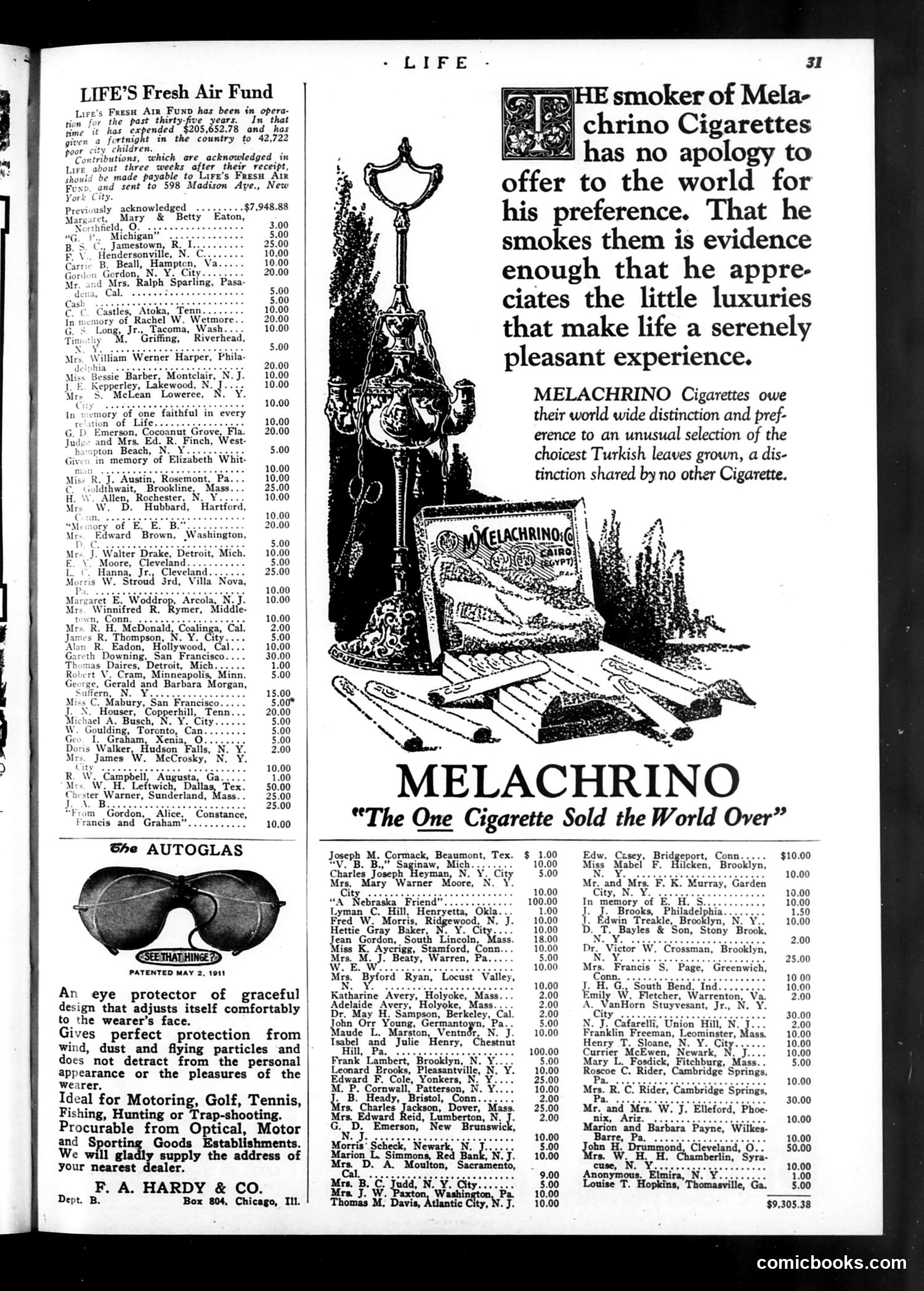
This page contains two distinct elements: a charitable donation list and cigarette advertising. **Left side:** LIFE's Fresh Air Fund donation acknowledgments—a charitable program that has operated 35 years, providing country vacations to urban children. The long list credits donors ranging from $1 to $100. **Right side:** A full-page advertisement for Melachrino Cigarettes. The ad features ornate imagery (an decorative lamp or urn with cypress trees) and claims the brand offers "world wide distinction" due to "choicest Turkish leaves grown." The tagline reads "The One Cigarette Sold the World Over." **The irony for modern readers:** This page juxtaposes charitable work helping disadvantaged children breathe fresh country air with aggressive marketing of a product (cigarettes) now known to harm respiratory health. The ad's emphasis on refined taste and luxury stands uncontested—there's no health warning or acknowledgment of smoking's dangers, reflecting early-20th-century advertising standards before tobacco risks were widely publicized or regulated.
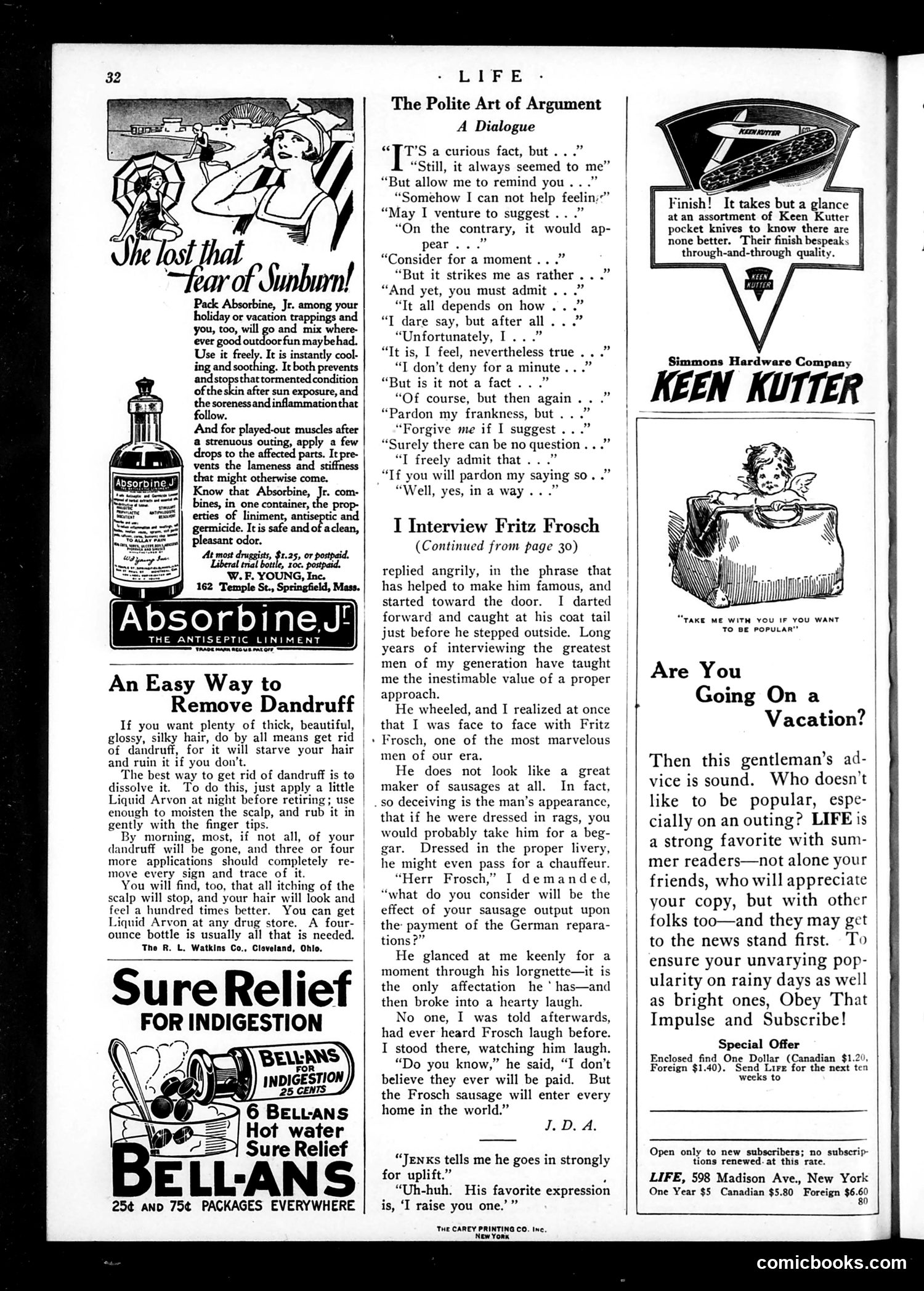
This page satirizes two distinct targets: **"The Polite Art of Argument"** is a humorous dialogue cataloging the evasive phrases people use in debate—endless qualifications ("It's a curious fact, but..."), deflections ("It all depends on how..."), and polite disagreements that avoid actual substance. It mocks how civilized discourse becomes circular verbal dancing. **"I Interview Fritz Frosch"** parodies celebrity journalism and the absurdity of modern interviewing. The unnamed interviewer pursues Frosch (a sausage manufacturer) persistently, then asks him an utterly ridiculous question: what effect will his sausage output have on German war reparations? The text suggests Frosch is treated as some profound figure despite being unremarkable in appearance. The joke—Frosch's unexpected laughter—mocks both the interviewer's pretentious approach and the notion that industrial figures are geniuses worthy of breathless coverage. Both pieces satirize 1920s American manners and media.
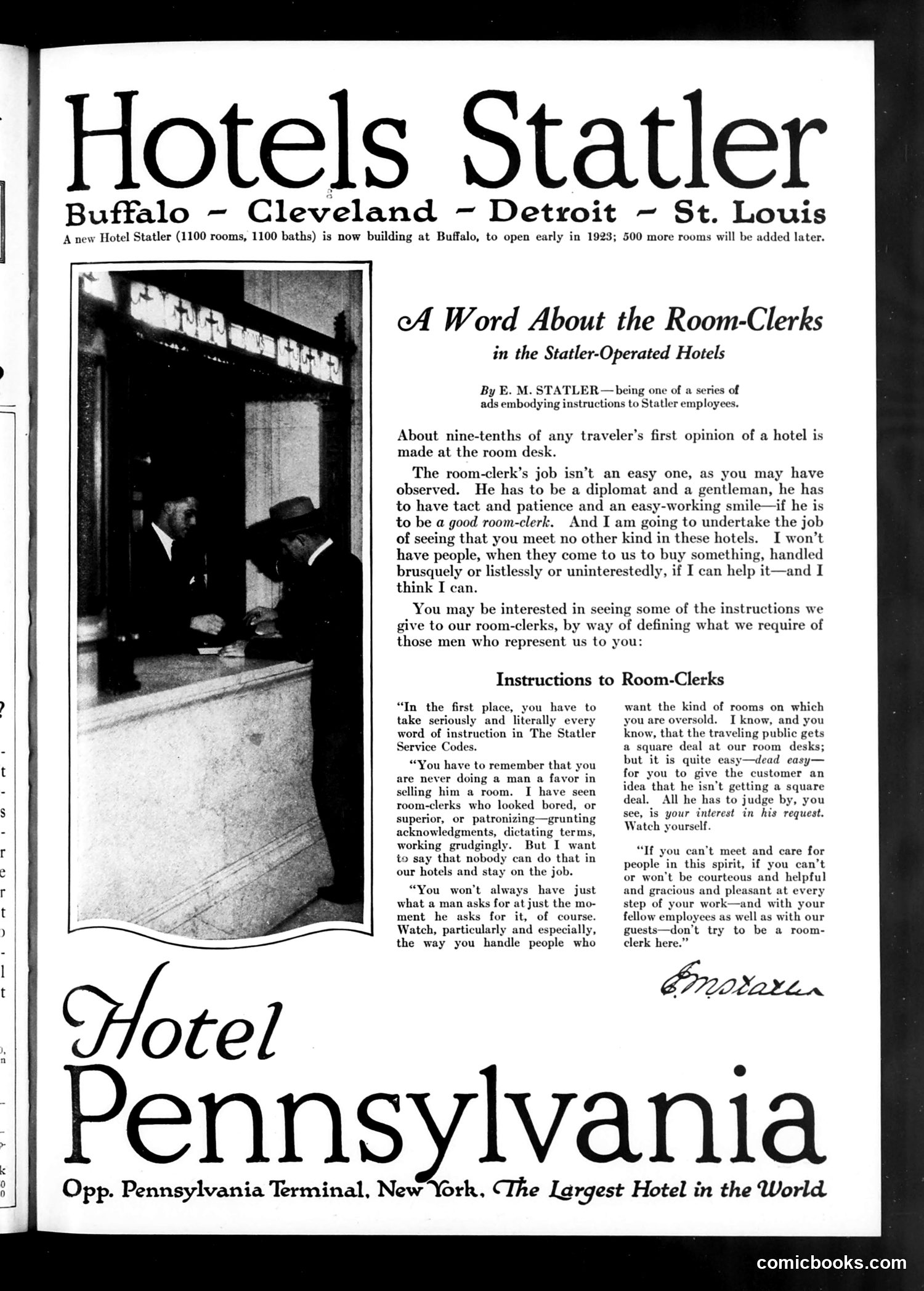
This is primarily **advertising**, not political satire. E.M. Statler uses the page to promote his hotel chain and publicize his management philosophy regarding customer service. The content shows a photograph of a hotel room clerk at a desk and presents Statler's written instructions to his staff. The "message" is straightforward business strategy: Statler emphasizes that guests form their first impression at the front desk, so room clerks must be courteous, attentive, and genuinely interested in guests' needs—never bored, superior, or grudging. Statler presents this as enlightened labor management, claiming he will ensure customers "meet no other kind" of clerk in his hotels. While this reads as standard hospitality advice today, in the 1920s this represented a notable public commitment to consistent service standards. The Hotel Pennsylvania advertisement below claims to be "The Largest Hotel in the World," establishing competitive positioning in the luxury hotel market.
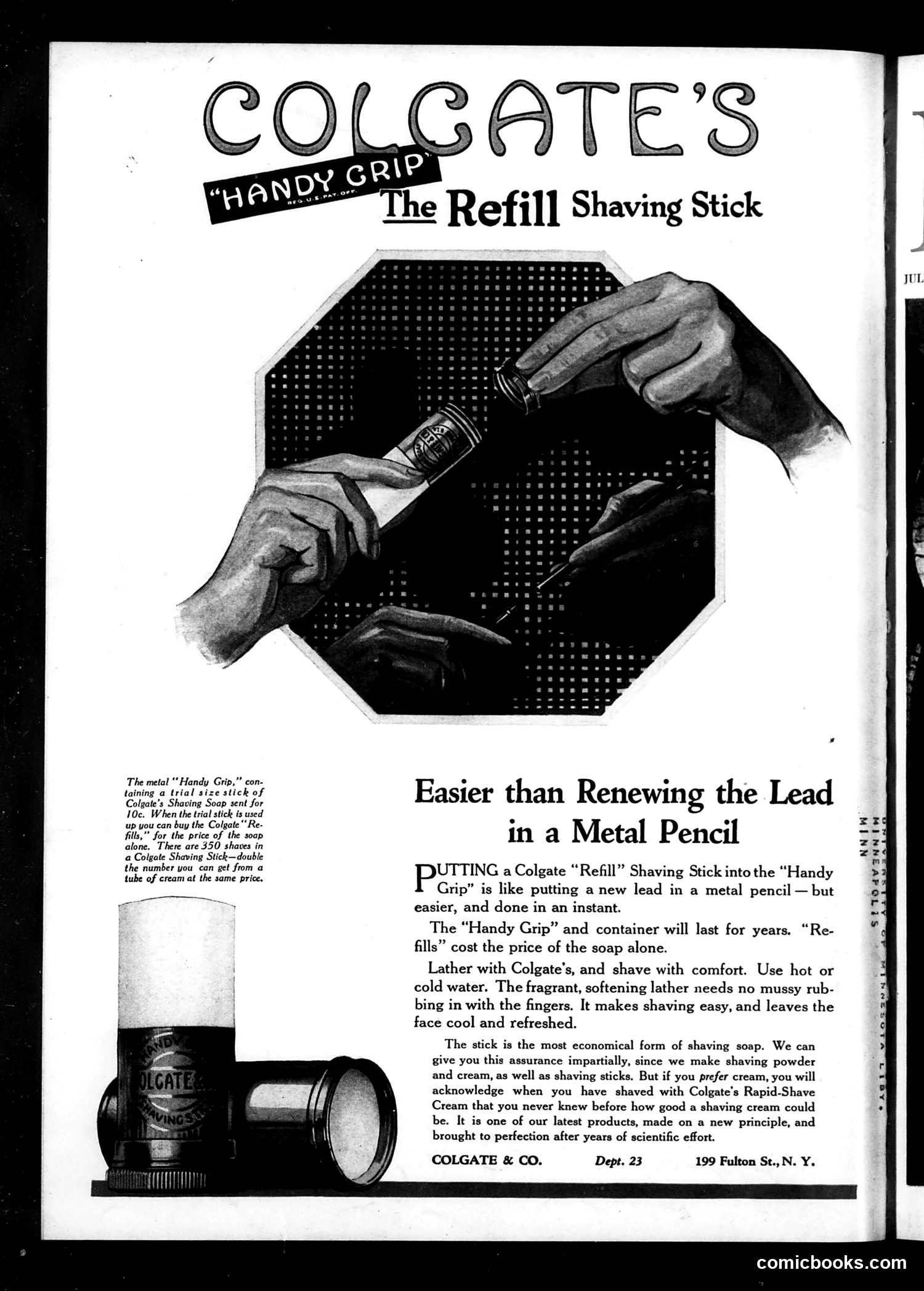
This is not a cartoon or satire—it's a **product advertisement** for Colgate's shaving soap and the "Handy Grip" refillable stick dispenser. The page compares the convenience of replacing a shaving stick to replacing pencil lead, using illustrations of hands demonstrating the refill mechanism. The key sales pitch: the reusable metal grip lasts years while only the soap refills need repurchasing, making it economical (350 shaves per stick versus fewer from cream tubes at the same price). The ad emphasizes ease of use, comfort, and value, claiming superiority over competing shaving products—notably mentioning their own "Rapid-Shave Cream" to appear impartial while promoting the stick form. **This reflects early 20th-century marketing strategies:** comparing new products to familiar ones (the pencil analogy) and using hands-on demonstrations to show practical benefits.