
Life, 1922-07-06 · page 26 of 36
Life — July 6, 1922 — page 26: what you’re looking at
What you’re looking at
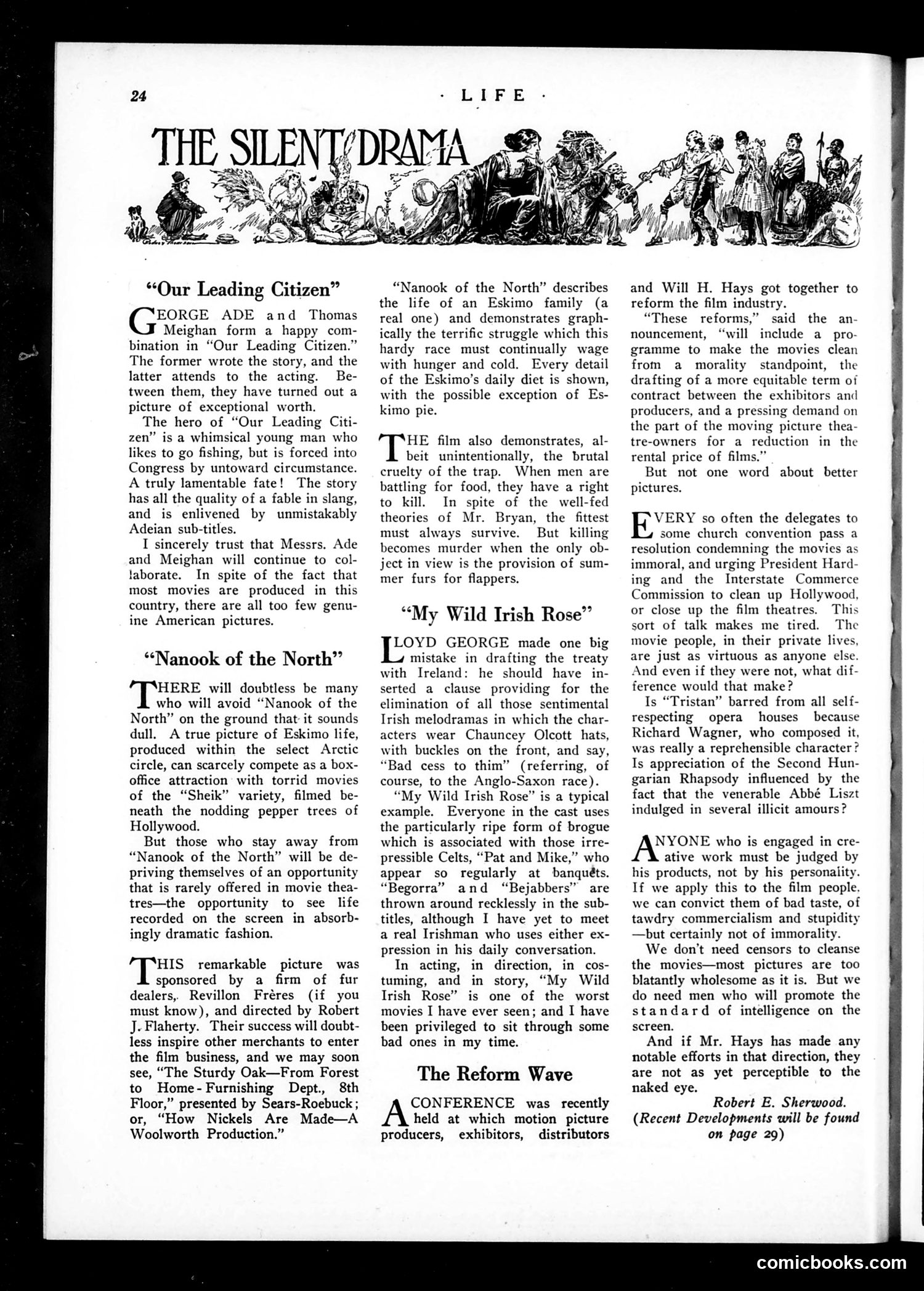
This page contains three film reviews from what appears to be the early 1920s. The satirical content targets Hollywood's output and Irish-American stereotypes: **"Our Leading Citizen"**: Praised as genuinely American entertainment—a rarity in Hollywood at the time. **"Nanook of the North"**: Celebrated as authentic documentary cinema, though the reviewer sarcastically anticipates other corporations will sponsor branded films (Sears-Roebuck, Woolworth). The piece mocks animal trapping for fashion ("summer furs for flappers"). **"My Wild Irish Rose"**: Harshly critiqued as perpetuating tired Irish stereotypes. The reviewer—likely Robert E. Sherwood—attacks the film's reliance on caricatured dialect ("Begorra," "Bejabbers") and characters like "Pat and Mike," claiming no real Irishman speaks this way. This reflects post-1921 Irish independence treaty tensions and satirizes Hollywood's reductive ethnic portrayals. **"The Reform Wave"**: Notes industry attempts at moral cleanup under Will H. Hays, skeptically questioning whether producers genuinely care about quality standards.
📄 Transcribed text from this page (OCR, searchable)
Machine-transcribed from the original scan — historical spelling and the odd misread are preserved.
“Our Leading Citizen” EORGE ADE and Thomas Meighan form a happy com- bination in “Our Leading Citizen.” The former wrote the story, and the latter attends to the acting. Be- tween them, they have turned out a picture of exceptional worth. The hero of “Our Leading Citi- zen” is a whimsical young man who likes to go fishing, but is forced into Congress by untoward circumstance. A truly lamentable fate! The story has all the quality of a fable in slang, and is enlivened by unmistakably Adeian sub-titles. I sincerely trust that Messrs. Ade and Meighan will continue to col- laborate. In spite of the fact that most movies are produced in this country, there are all too few genu- ine American pictures. “Nanook of the North” HERE will doubtless be many who will avoid “Nanook of the North” on the ground that it sounds dull. A true picture of Eskimo life, produced within the select Arctic circle, can scarcely compete as a box- office attraction with torrid movies of the “Sheik” variety, filmed be- neath the nodding pepper trees of Hollywood. But those who stay away from “Nanook of the North” will be de- priving themselves of an opportunity that is rarely offered in movie thea- tres—the opportunity to see life recorded on the screen in absorb- ingly dramatic fashion. HIS remarkable picture was sponsored by a firm of fur dealers, Revillon Fréres (if you must know), and directed by Robert J. Flaherty. Their success will doubt- less inspire other merchants to enter the film business, and we may soon see, “The Sturdy Oak—From Forest to Home-Furnishing Dept., 8th Floor,” presented by Sears-Roebuck ; or, “How Nickels Are Made—A Woolworth Production.” “Nanook of the North” describes the life of an Eskimo family (a real one) and demonstrates graph- ically the terrific struggle which this hardy race must continually wage with hunger and cold. Every detail of the Eskimo’s daily diet is shown, with the possible exception of Es- kimo pie. HE film also demonstrates, al- beit unintentionally, the brutal cruelty of the trap. When men are battling for food, they have a right to kill. In spite of the well-fed theories of Mr. Bryan, the fittest must always survive. But killing becomes murder when the only ob- ject in view is the provision of sum- mer furs for flappers. “My Wild Irish Rose” | eee GEORGE made one big mistake in drafting the treaty with Ireland: he should have in- serted a clause providing for the elimination of all those sentimental Irish melodramas in which the char- acters wear Chauncey Olcott hats, with buckles on the front, and say, “Bad cess to thim” (referring, of course, to the Anglo-Saxon race). “My Wild Irish Rose” is a typical example. Everyone in the cast uses the particularly ripe form of brogue which is associated with those irre- pressible Celts, “Pat and Mike,” who appear so regularly at banquéts. “Begorra” and “Bejabbers” are thrown around recklessly in the sub- titles, although I have yet to meet a real Irishman who uses either ex- pression in his daily conversation. In acting, in direction, in cos- tuming, and in story, “My Wild Irish Rose” is one of the worst movies I have ever seen; and I have been privileged to sit through some bad ones in my time. The Reform Wave CONFERENCE was recently held at which motion picture producers, exhibitors, distributors and Will H. Hays got together to reform the film industry. “These reforms,” said the an- nouncement, “will include a_ pro- gramme to make the movies clean from a morality standpoint, the drafting of a more equitable term of contract between the exhibitors and producers, and a pressing demand on the part of the moving picture thea- tre-owners for a reduction in the rental price of films.” But not one word about better pictures. VERY so often the delegates to some church convention pass a resolution condemning the movies as immoral, and urging President Hard- ing and the Interstate Commerce Commission to clean up Hollywood, or close up the film theatres. This sort of talk makes me tired. The movie people, in their private lives, are just as virtuous as anyone else. And even if they were not, what dif- ference would that make? Is “Tristan” barred from all self- respecting opera houses because Richard Wagner, who composed it, was really a reprehensible character? Is appreciation of the Second Hun- garian Rhapsody influenced by the fact that the venerable Abbé Liszt indulged in several illicit amours? NYONE who is engaged in cre- ative work must be judged by his products, not by his personality. If we apply this to the film people. we can convict them of bad taste, of tawdry commercialism and stupidity —but certainly not of immorality. We don’t need censors to cleanse the movies—most pictures are too blatantly wholesome as it is. But we do need men who will promote the standard of intelligence on the screen. And if Mr. Hays has made any notable efforts in that direction, they are not as yet perceptible to the naked eye. Robert E. Sherwood. (Recent Developments will be found on page 29) comicbooks.com