
Life, 1922-07-06 · page 25 of 36
Life — July 6, 1922 — page 25: what you’re looking at
What you’re looking at
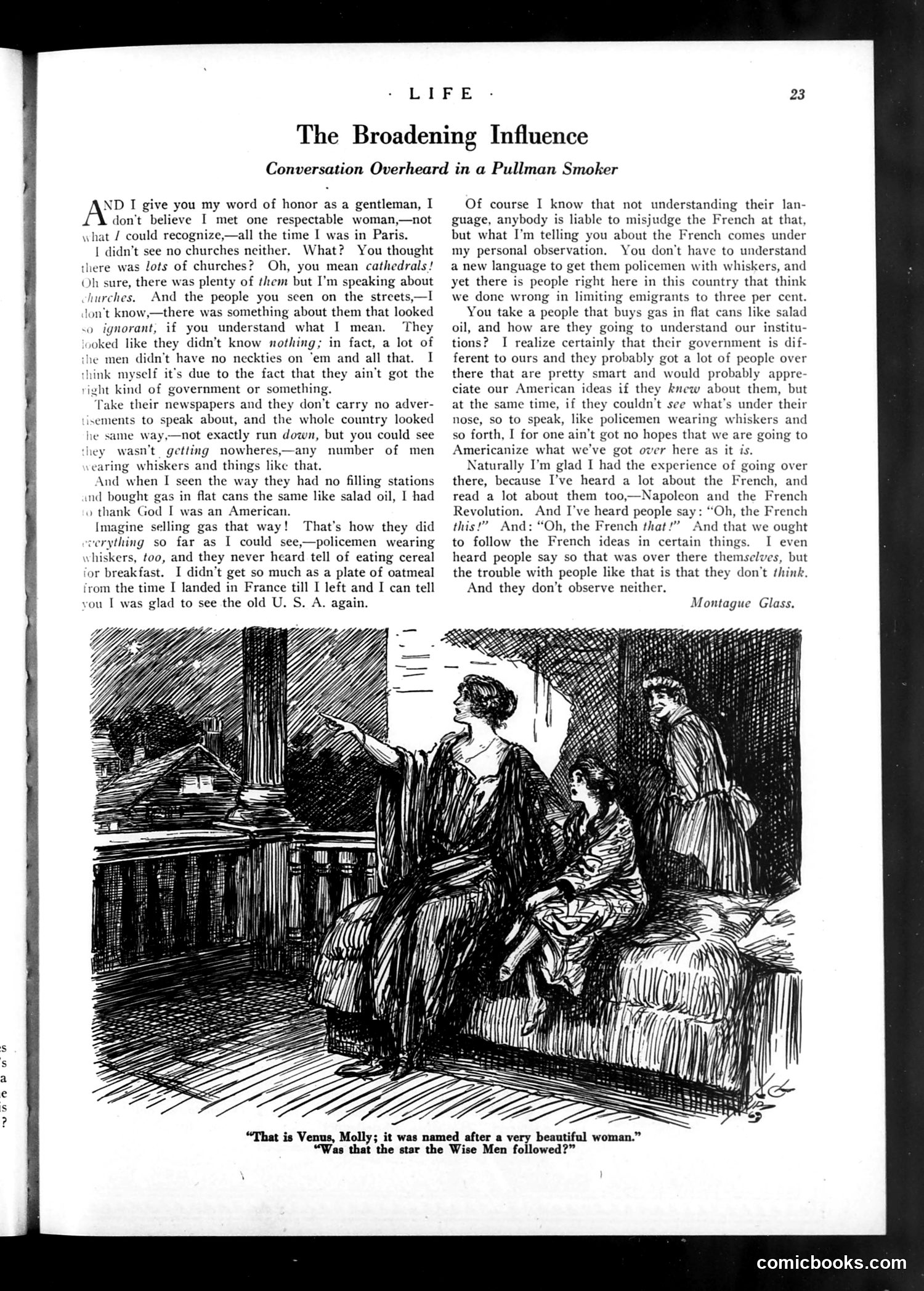
This satirical piece mocks American tourists and xenophobic attitudes of the 1920s. A boastful American businessman in a Pullman train car describes his Paris visit with profound ignorance, complaining about French women's morality, lack of churches (confusing them with cathedrals), Frenchmen's appearance (beards, no neckties), and primitive gas-selling methods using flat cans. The satire targets multiple targets: the speaker's laughable lack of cultural understanding, his assumption that American methods are superior, and his use of trivial observations to justify restrictive immigration policy (the "three per cent" quota). The caption's joke about Venus and the Star of Bethlehem reinforces the theme—depicting Americans as comically uninformed. By having an educated-sounding man express such ignorant views, author Montague Glass exposes the absurdity of nativist sentiment and American cultural smugness in the post-WWI era.
📄 Transcribed text from this page (OCR, searchable)
Machine-transcribed from the original scan — historical spelling and the odd misread are preserved.
LIFE The Broadening Influence Conversation Overheard in a Pullman Smoker ND I give you my word of honor as a gentleman, I don't believe I met one respectable woman,—not what / could recognize,—all the time I was in Paris. | didn’t see no churches neither. What? You thought there was lots of churches? Oh, you mean cathedrals! Oh sure, there was plenty of them but I’m speaking about hurches. And the people you seen on the streets,—I lon't know,—there was something about them that looked so ignorant, if you understand what I mean. They voked like they didn’t know nothing; in fact, a lot of ihe men didn’t have no neckties on ‘em and all that. I hink myself it’s due to the fact that they ain't got the ight kind of government or something. e their newspapers and they don’t carry no adver- isements to speak about, and the whole country looked he same way,—not exactly run down, but you could see wy wasn't getting nowheres,—any number of men earing whiskers and things like that. And when I seen the way they had no filling stations nd bought gas in flat cans the same like salad oil, I had » thank God I was an American. Imagine selling gas that way! That's how they did verything so far as I could see,—policemen wearing whiskers, too, and they never heard tell of eating cereal or breakfast. I didn’t get so much as a plate of oatmeal irom the time I landed in France till I left and I can tell you I was glad to see the old U. S. A. again. Of course I know that not understanding their lan- guage, anybody is liable to misjudge the French at that, but what I’m telling you about the French comes under my personal observation. You don’t have to understand a new language to get them policemen with whiskers, and yet there is people right here in this country that think we done wrong in limiting emigrants to three per cent. You take a people that buys gas in flat cans like salad oil, and how are they going to understand our institu- tions? I realize certainly that their government is dif- ferent to ours and they probably got a lot of people over there that are pretty smart and would probably appre- ciate our American ideas if they knew about them, but at the same time, if they couldn’t see what's under their nose, so to speak, like policemen wearing whiskers and so forth, I for one ain’t got no hopes that we are going to Americanize what we've got over h as it is. Naturally I’m glad I had the experience of going over there, because I’ve heard a lot about the French, and read a lot about them too,—Napoleon and the nch Revolution, And I've heard people s “Oh, the French this!” And: “Oh, the French that!” And that we ought to follow the French ideas in certain thing: I even heard people say so that was over there ther s, but the trouble with people like that is that they don’t think. And they don’t observe neither. Montague Glass. “That is Venus, Molly; it was named after a very beautiful woman.” “Was that the star the Wise Men followed?” comicbooks.com