
Life, 1922-07-06 · page 20 of 36
Life — July 6, 1922 — page 20: what you’re looking at
What you’re looking at
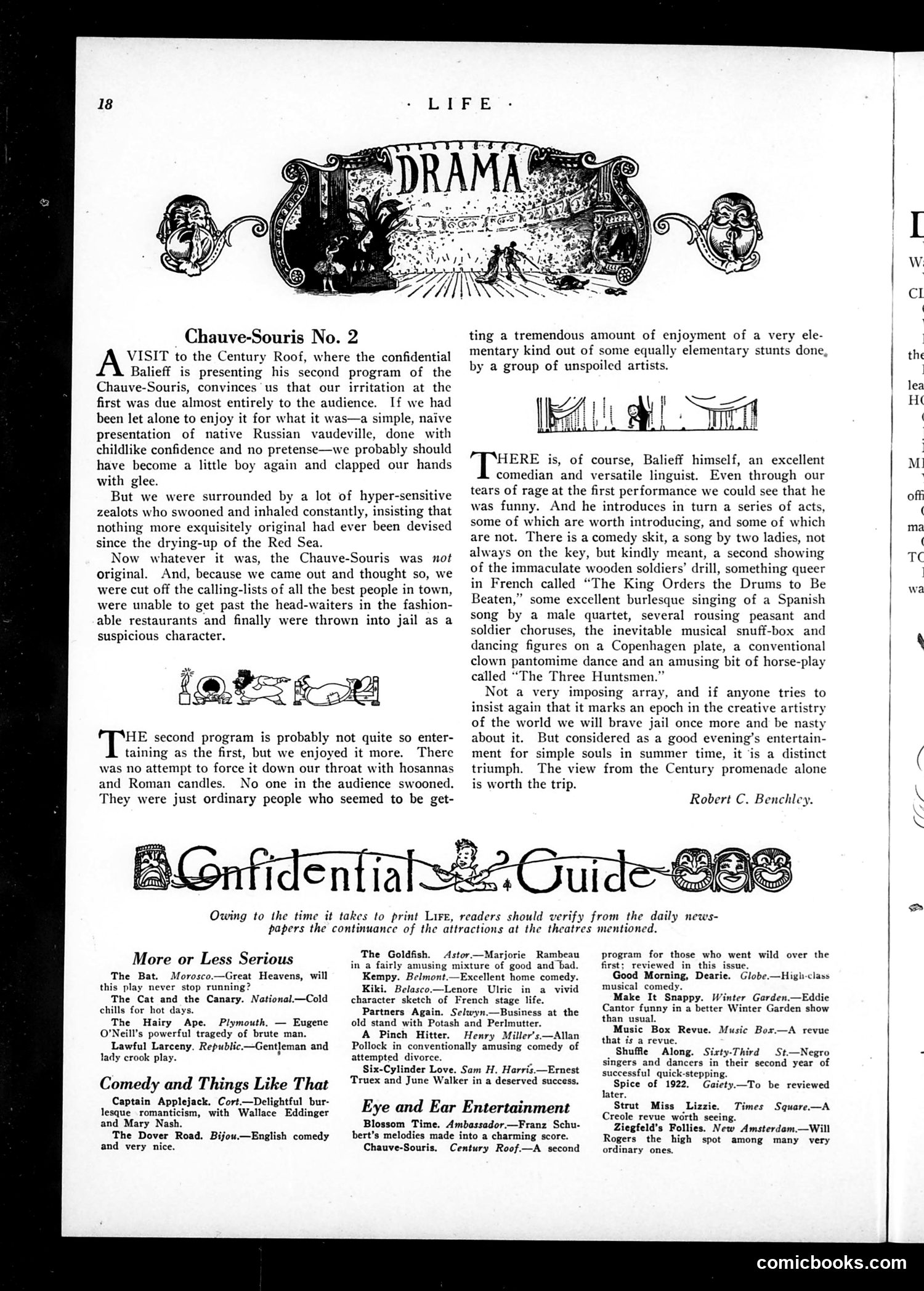
This is Robert C. Benchley's theater review of the Chauve-Souris, a Russian vaudeville revue at the Century Roof, presented by impresario Balieff. The piece satirizes the pretentious Manhattan audience attending the first program—"hyper-sensitive zealots" who swooned theatrically over the entertainment and ostracized the reviewer for honest criticism, even getting him "thrown into jail as a suspicious character" (hyperbole for social exclusion). Benchley argues the second show was better simply because the ordinary audience enjoyed it without pretension. He acknowledges Balieff as a talented performer and host but dismisses the acts themselves as elementary vaudeville—wooden soldiers' drills, pantomime, Russian folk songs—rejecting claims it represents revolutionary artistry. The satire targets 1920s Manhattan cultural snobbery rather than the show itself.
📄 Transcribed text from this page (OCR, searchable)
Machine-transcribed from the original scan — historical spelling and the odd misread are preserved.
Chauve-Souris No. 2 VISIT to the Century Roof, where the confidential Balieff is presenting his second program of the Chauve-Souris, convinces us that our irritation at the first was due almost entirely to the audience. If we had been let alone to enjoy it for what it was—a simple, naive presentation of native Russian vaudeville, done with childlike confidence and no pretense—we probably should have become a little boy again and clapped our hands with glee. But we were surrounded by a lot of hyper-sensitive zealots who swooned and inhaled constantly, insisting that nothing more exquisitely original had ever been devised since the drying-up of the Red Sea. Now whatever it was, the Chauve-Souris was not original. And, because we came out and thought so, we were cut off the calling-lists of all the best people in town, were unable to get past the head-waiters in the fashion- able restaurants and finally were thrown into jail as a suspicious character. ON ced eee | HE second program is probably not quite so enter- taining as the first, but we enjoyed it more. There was no attempt to force it down our throat with hosannas and Roman candles. No one in the audience swooned. They were just ordinary people who seemed to be get- ting a tremendous amount of enjoyment of a very ele- mentary kind out of some equally elementary stunts done, by a group of unspoiled artists. ‘HERE is, of course, Balieff himself, an excellent comedian and versatile linguist. Even through our tears of rage at the first performance we could see that he was funny. And he introduces in turn a series of acts, some of which are worth introducing, and some of which are not. There is a comedy skit, a song by two ladies, not always on the key, but kindly meant, a second showing of the immaculate wooden soldiers’ drill, something queer in French called “The King Orders the Drums to Be Beaten,” some excellent burlesque singing of a Spanish song by a male quartet, several rousing peasant and soldier choruses, the inevitable musical snuff-box and dancing figures on a Copenhagen plate, a conventional clown pantomime dance and an amusing bit of horse-play called “The Three Huntsmen.” Not a very imposing array, and if anyone tries to insist again that it marks an epoch in the creative artistry of the world we will brave jail once more and be nasty about it. But considered as a good evening’s entertain- ment for simple souls in summer time, it ‘is a distinct triumph. The view from the Century promenade alone is worth the trip. Robert C. Benchley. Owing to the time it takes to print Lire, readers should verify from the daily news- papers the continuance of the attractions at the theatres mentioned. More or Less Serious The Bat. Morosco.—Great Heavens, will this play never stop running? The Cat and the Canary. National.—Cold chills for hot days. The Hairy Ape. Plymouth, — Eugene O’Neill’s powerful tragedy of brute man, Lawful Larceny. Republic.—GentJeman and lady crook play. Comedy and Things Like That Captain Applejack. Cort.—Delightful bur- lesque romanticism, with Wallace Eddinger and Mary Nash. The Dover Road. Bijou.—English comedy and very nice. The Goldfish. Astor.—Marjorie Rambeau in a fairly amusing mixture of good and bad. Kempy. Belmont.—Excellent home comedy. Kiki. Belasco.—Lenore Ulric in a vivid character sketch of French stage life. Partners Again. Selwyn.—Business at the old stand with Potash and Perlmutter. A Pinch Hitter. Henry Miller’s—Allan Pollock in conventionally amusing comedy of attempted divorce. Six-Cylinder Love. Sam H. Harris.—Ernest Truex and June Walker in a deserved success. Eye and Ear Entertainment Blossom Time. Ambassador—Franz Schu- bert’s melodies made into a charming score. Chauve-Souris. Century Roof—A second program for those who went wild over the first; reviewed in this issue. Good Morning, Dearie. Globe.—High-class musical comedy. Make It Snappy. Winter Garden.—Eddie Cantor funny in a better Winter Garden show than usual. Music Box Revue. Music Box—A revue that is a revue. Shuffle Along. Sixty-Third St—Negro singers and dancers in their second year of successful quick-stepping. Spice of 1922. Gaiety.—To be reviewed later. Strut Miss Lizzie. Times Square—A Creole revue worth seeing. Ziegfeld’s Follies. New Amsterdam.—Will Rogers the high spot among many very ordinary ones. SSG gee: 9 comicbooks.com