
Life, 1922-07-06 · page 17 of 36
Life — July 6, 1922 — page 17: what you’re looking at
What you’re looking at
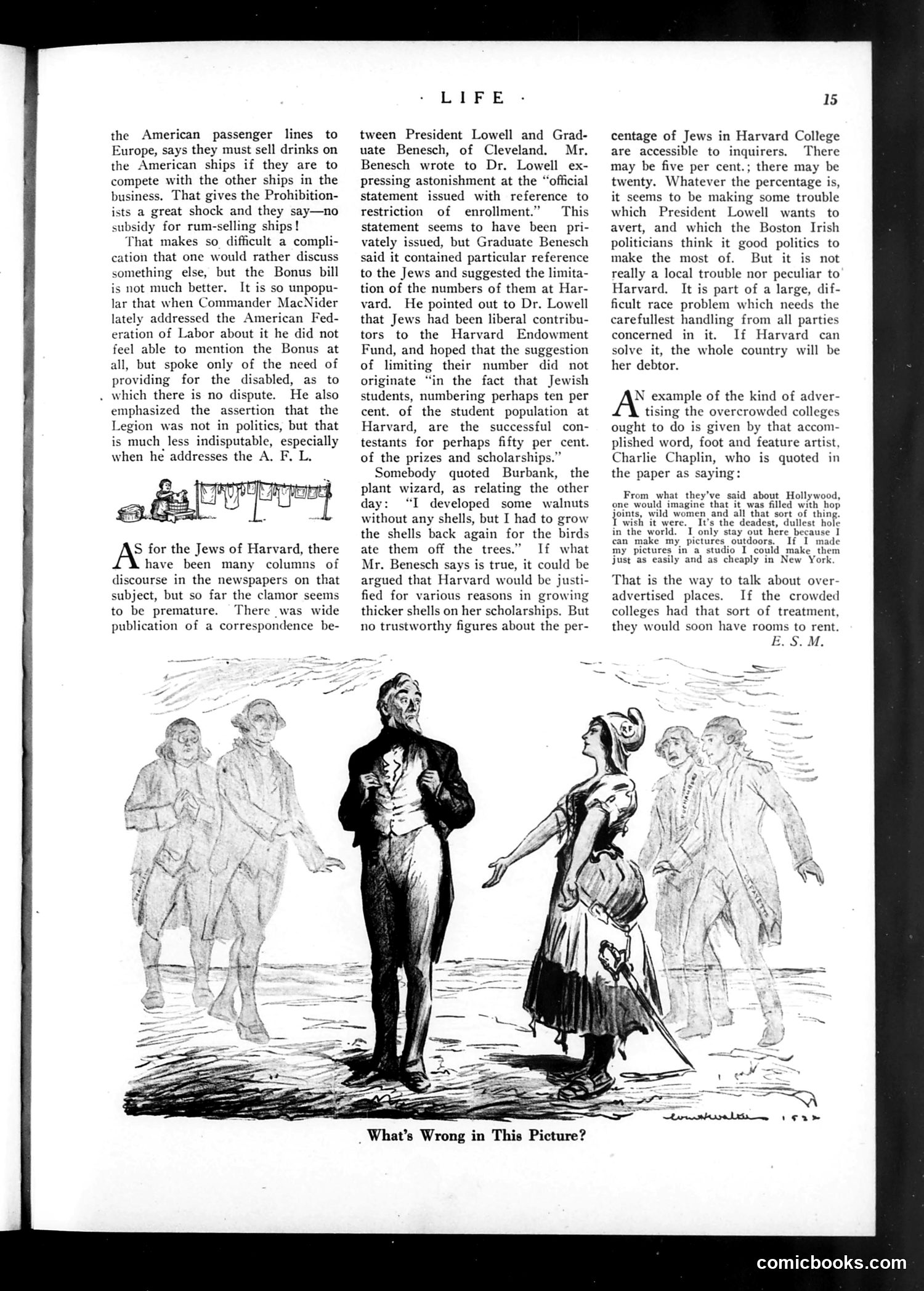
This page addresses several contemporary social controversies circa the 1920s: **The Harvard Jewish Quota Controversy**: The main text discusses President Lowell's alleged restriction on Jewish enrollment at Harvard. Graduate student Benesch challenged Lowell's "official statement" limiting Jewish numbers, noting that Jewish students—comprising roughly 10% of the student body—won approximately 50% of prizes and scholarships. The article acknowledges the sensitive nature of this "race problem" without endorsing discrimination. **The Bonus Bill**: Brief criticism of a veterans' benefits proposal, noting Commander MacNider's reluctance to discuss it publicly. **Prohibition and Shipping**: American passenger lines claim they need to serve alcohol to compete internationally, creating tension with Prohibitionists who oppose subsidizing "rum-selling ships." **The Cartoon**: Titled "What's Wrong in This Picture?" (bottom), it appears to be a visual puzzle, though the specific joke is unclear from the image alone. The page reflects 1920s debates about assimilation, veterans' benefits, and Prohibition enforcement.
📄 Transcribed text from this page (OCR, searchable)
Machine-transcribed from the original scan — historical spelling and the odd misread are preserved.
the American passenger lines to Europe, says they must sell drinks on the American ships if they are to compete with the other ships in the business. That gives the Prohibition- ists a great shock and they say—no subsidy for rum-selling ships! That makes so difficult a compli- cation that one would rather discuss something else, but the Bonus bill is not much better. It is so unpopu- lar that when Commander MacNider lately addressed the American Fed- eration of Labor about it he did not feel able to mention the Bonus at all, but spoke only of the need of providing for the disabled, as to . which there is no dispute. He also emphasized the assertion that the Legion was not in politics, but that is much less indisputable, especially when he addresses the A. F. L. S for the Jews of Harvard, there have been many columns of discourse in the newspapers on that subject, but so far the clamor seems to be premature. There was wide publication of a correspondence be- LIFE tween President Lowell and Grad- uate Benesch, of Cleveland. Mr. Benesch wrote to Dr. Lowell ex- pressing astonishment at the “official statement issued with reference to restriction of enrollment.” This statement seems to have been pri- vately issued, but Graduate Benesch said it contained particular reference to the Jews and suggested the limita- tion of the numbers of them at Har- vard. He pointed out to Dr. Lowell that Jews had been liberal contribu- tors to the Harvard Endowment Fund, and hoped that the suggestion of limiting their number did not originate “in the fact that Jewish students, numbering perhaps ten per cent. of the student population at Harvard, are the successful con- testants for perhaps fifty per cent. of the prizes and scholarships.” Somebody quoted Burbank, the plant wizard, as relating the other day: “I developed some walnuts without any shells, but I had to grow the shells back again for the birds ate them off the trees.” If what Mr. Benesch says is true, it could be argued that Harvard would be justi- fied for various reasons in growing thicker shells on her scholarships. But no trustworthy figures about the per- 15 centage of Jews in Harvard College are accessible to inquirers. There may be five per cent.; there may be twenty. Whatever the percentage is, it seems to be making some trouble which President Lowell wants to avert, and which the Boston Irish politicians think it good politics to make the most of. But it is not really a local trouble nor peculiar to Harvard. It is part of a large, dif- ficult race problem which needs the carefullest handling from all parties concerned in it. If Harvard can solve it, the whole country will be her debtor. N example of the kind of adver- tising the overcrowded colleges ought to do is given by that accom- plished word, foot and feature artist, Charlie Chaplin, who is quoted in the paper as saying: From what they've said about Hollywood, one would imagine that it was filled with hop joints, wild women and all that sort of thing. I wish it were. It’s the deadest, dullest hole in the world. ‘I only stay out here because I can make my pictures outdoors. If I made my pictures in a studio I could make them just as easily and as cheaply in New York. That is the way to talk about over- advertised plac If the crowded colleges had that sort of treatment, they would soon have rooms to rent. comicbooks.com