
A complete issue · 35 pages · 1922
Life — June 29, 1922
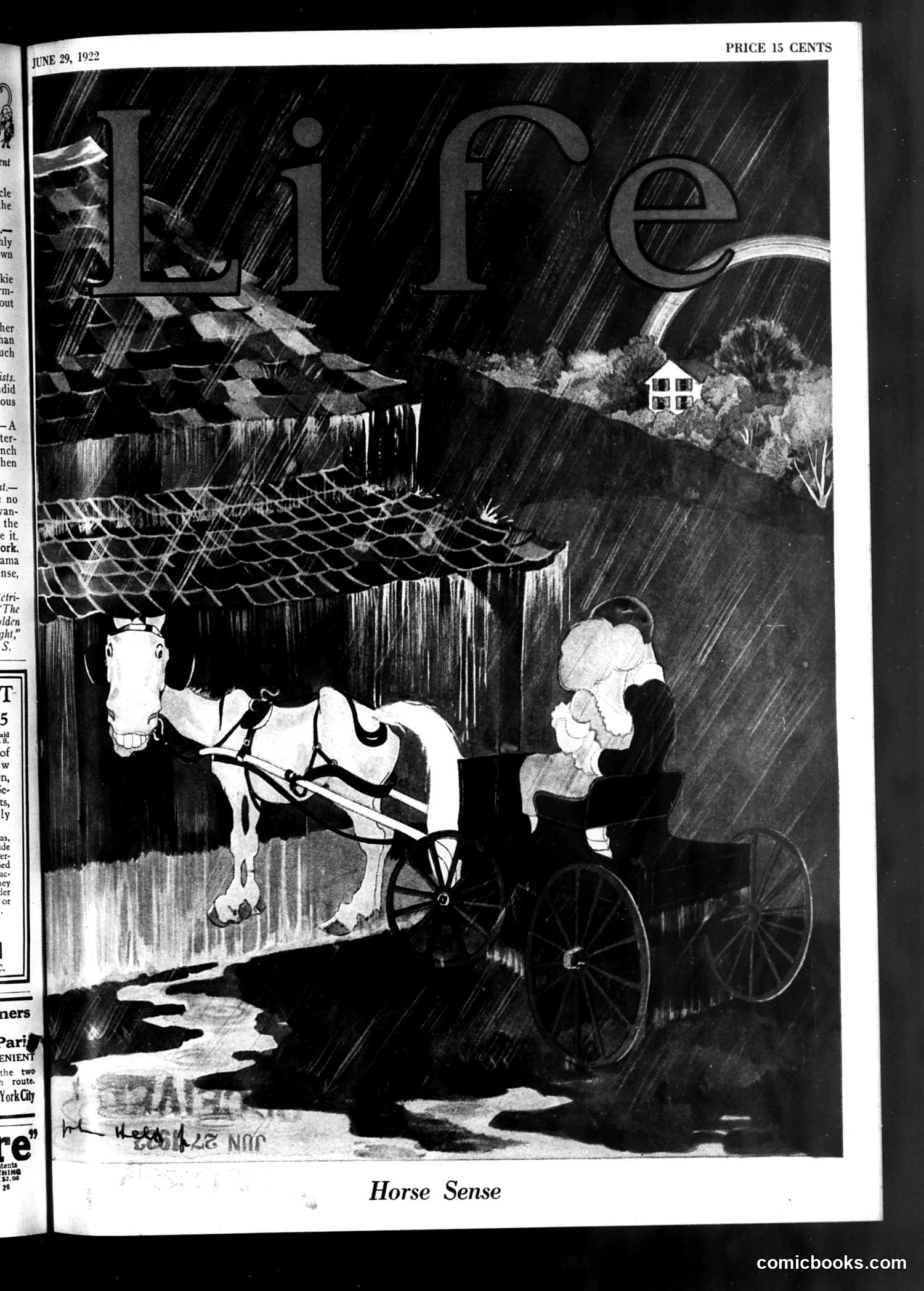
This cartoon satirizes someone's poor judgment during a rainstorm. A figure in a cart is being pulled by a horse toward a distant house, while heavy rain falls. The title "Horse Sense" plays on the idiom meaning practical wisdom—suggesting the person lacks it. The joke appears to be that the passenger trusts the horse to find the way home in terrible weather, implying humans sometimes lack the basic common sense that animals possess. The cartoon likely comments on foolish decision-making or misplaced confidence, though the specific target or incident referenced is unclear without additional context from the magazine's original reporting.
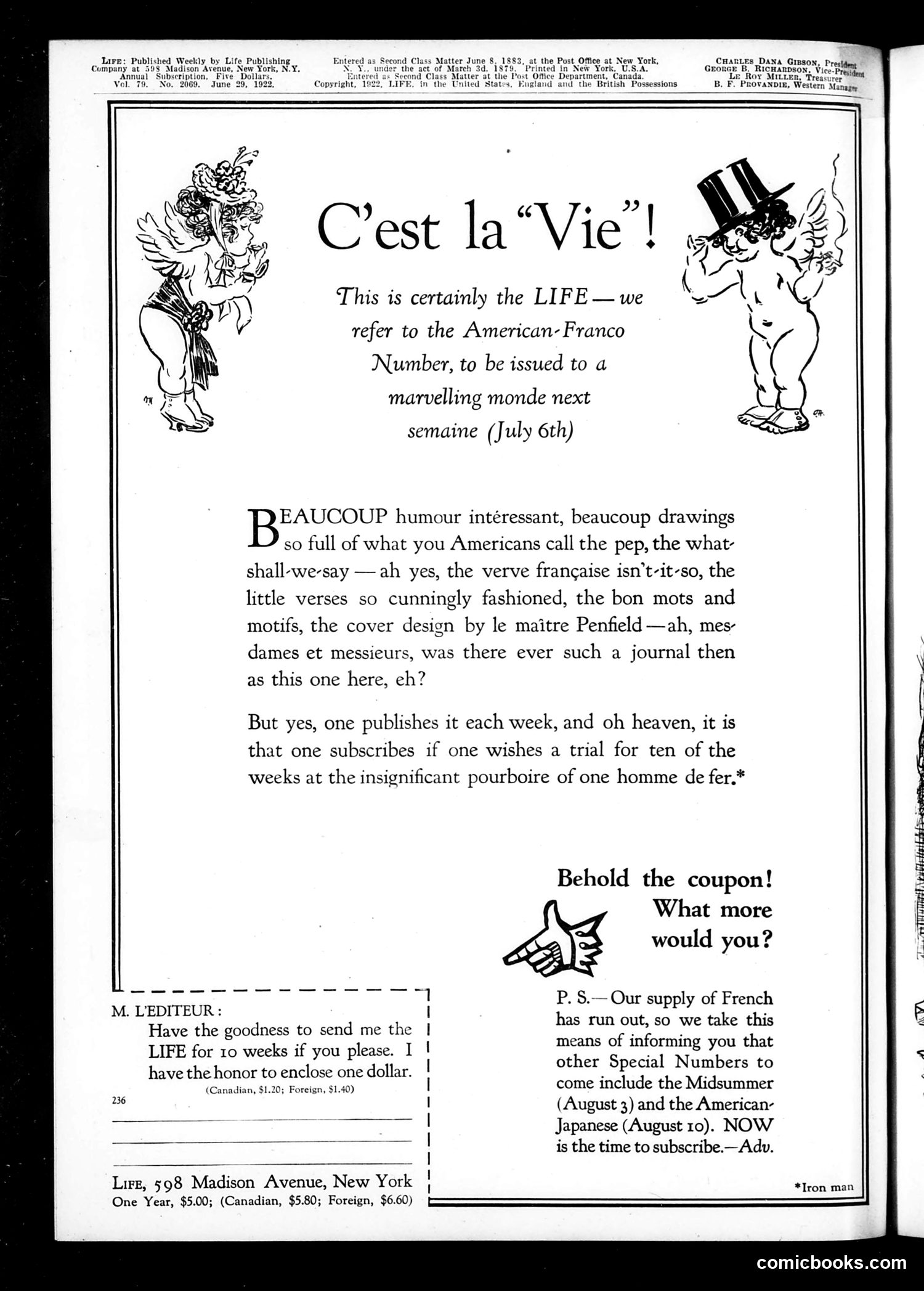
This is primarily a **subscription advertisement** for LIFE magazine's special American-Franco Number (July 6, 1922). The two decorative cherub figures flanking the title are generic ornamental designs, not specific caricatures. The ad emphasizes LIFE's appeal: French humor, drawings, clever verse, and cover design by "le maitre Penfield" (likely Clifford Penfield, a prominent illustrator). It uses playful Franco-American references and affected French phrasing ("mes dames et messieurs") to market the special edition to American readers. The subscription coupon offers one dollar for weeks of LIFE. A postscript notes French supply shortages, promoting upcoming special numbers: Midsummer (August 3) and American-Japanese (August 10). This reflects 1922 American fascination with French culture and Franco-American relations in the post-WWI period.
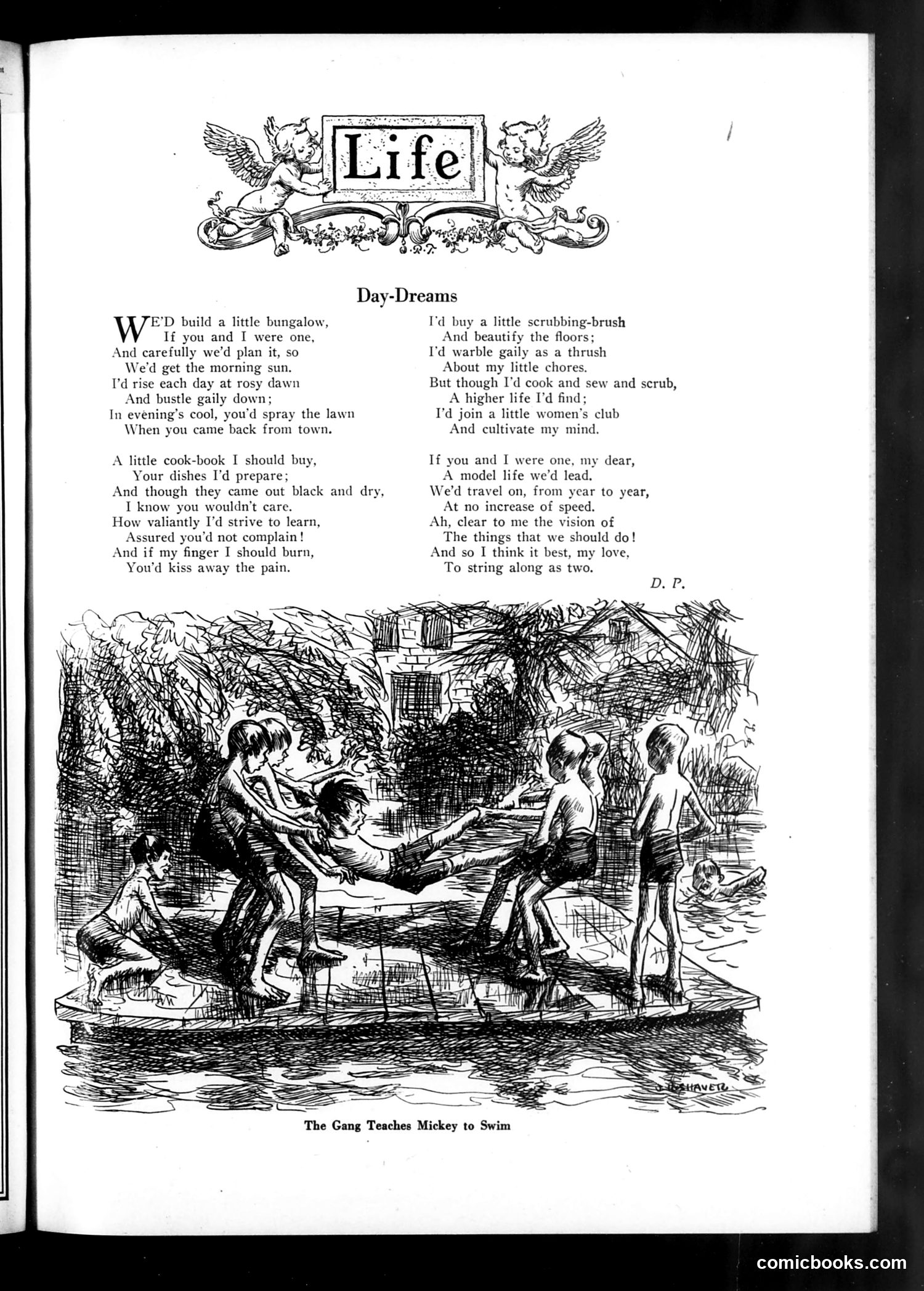
This page contains a poem titled "Day-Dreams" (signed D.P.) depicting domestic fantasies, paired with an illustration captioned "The Gang Teaches Mickey to Swim." The poem presents a woman imagining shared domestic life with a man—building a bungalow, cooking, cleaning, and cultivating intellectual pursuits together. It reflects early 20th-century romantic idealization of companionate marriage and domestic partnership. The illustration shows children teaching a younger boy to swim in water near a building, depicting childhood camaraderie and outdoor recreation. Both works appear to celebrate idealized life scenarios: the poem romanticizes domestic partnership and self-improvement, while the illustration celebrates innocent childhood bonding. The overall page reflects period values around domesticity, education, and wholesome recreation.
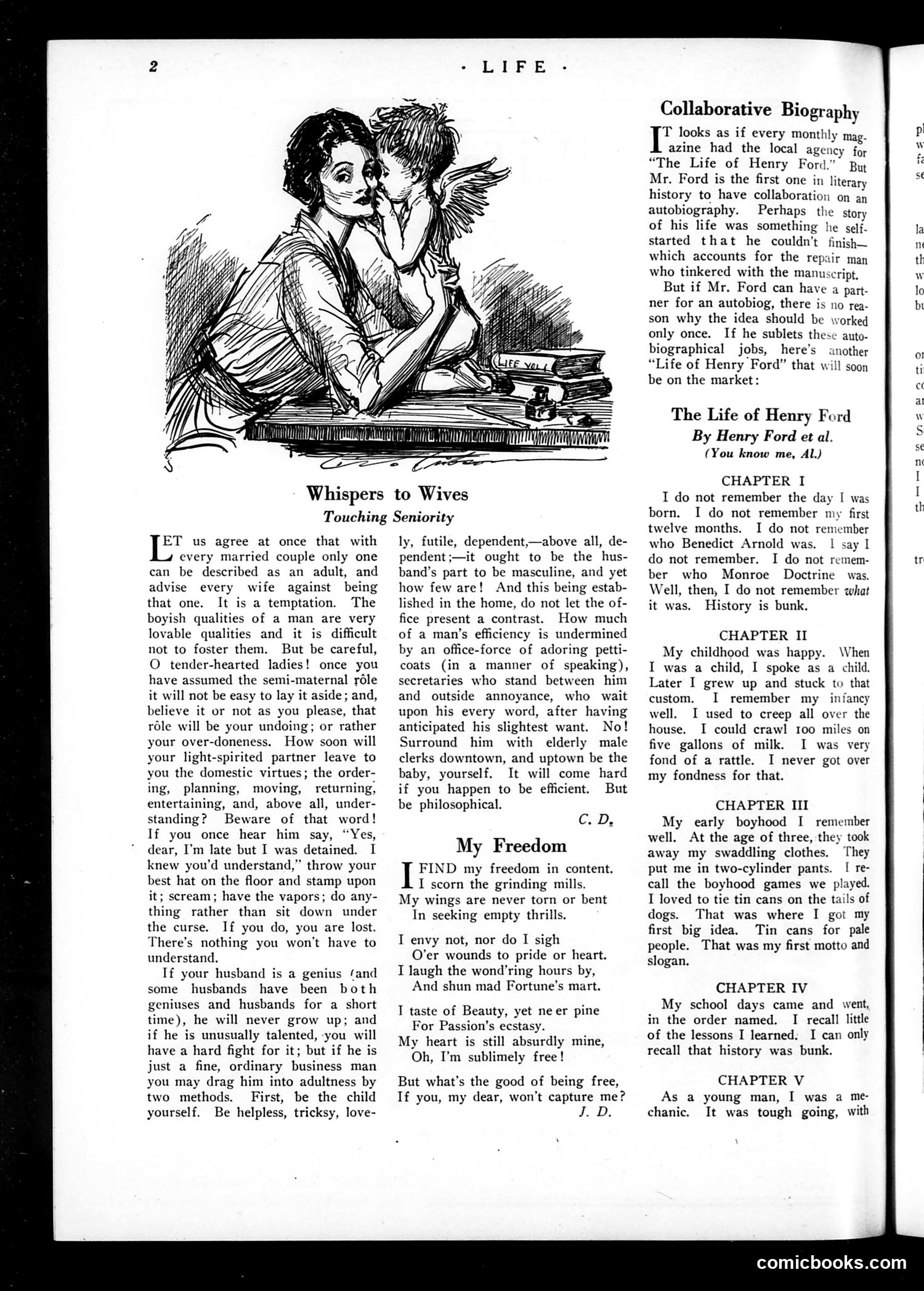
This page contains satirical content from *Life* magazine addressing marriage dynamics and gender roles. The illustration shows a cherub or cupid figure with a woman, accompanying the column "Whispers to Wives: Touching Seniority." The satire targets married women, advising them to avoid becoming "adoring petticoats" who undermine their husbands' efficiency through excessive deference. The author (signed "C.D.") argues that wives should not adopt an entirely submissive domestic role, warning that over-mothering husbands makes them dependent and ineffective. Below this is a poem titled "My Freedom" (signed "J.D.") presenting a contrasting perspective—a man asserting his independence and resistance to romantic capture. The page also begins "The Life of Henry Ford," a collaborative autobiography of the industrialist. The satire's core joke appears to be the ironic tension between advocating for wives' assertiveness while simultaneously publishing Ford's self-aggrandizing life story.
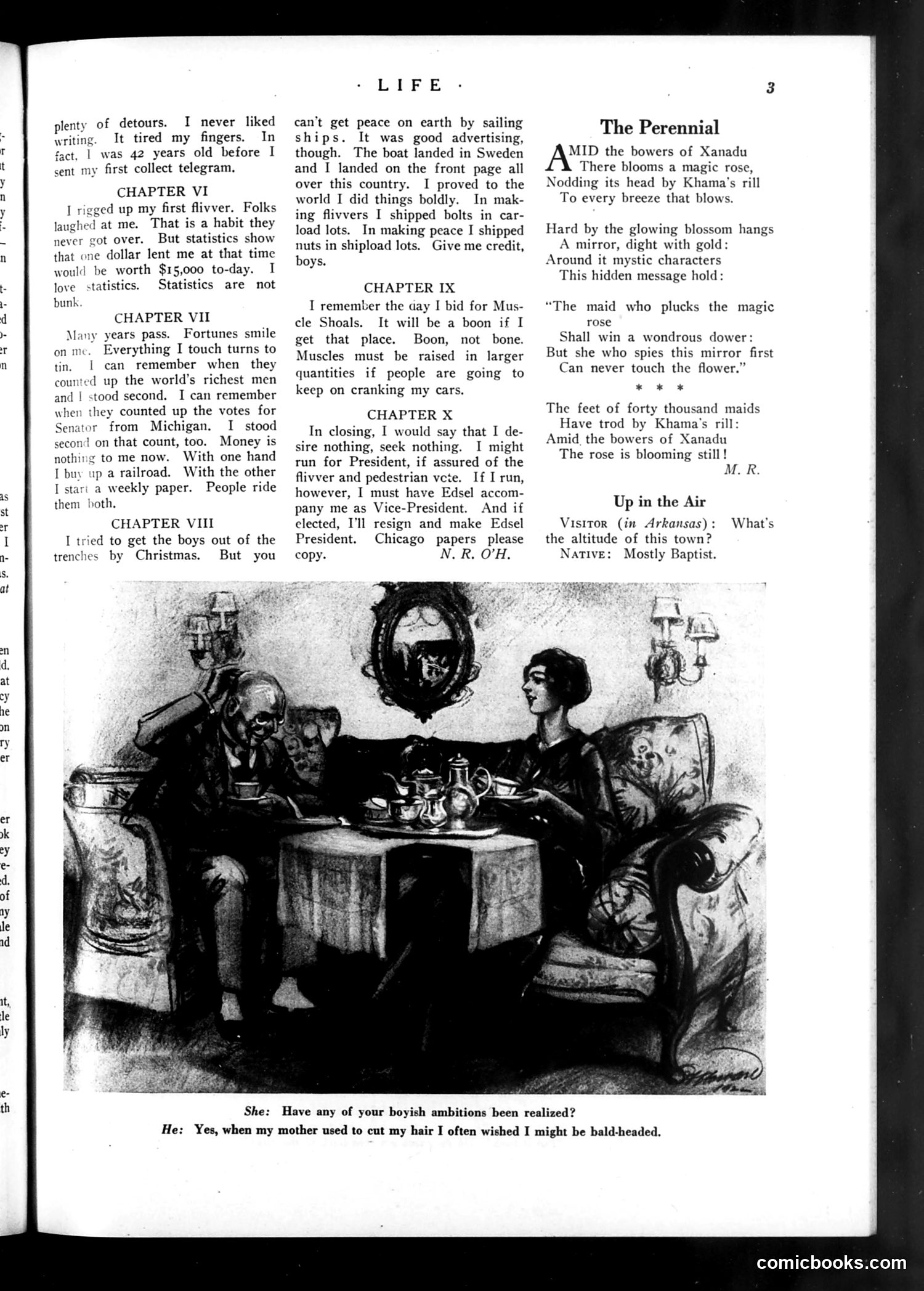
This page contains several sections: memoir chapters about riverboat and railroad experiences, a poem titled "The Perennial" about a magical rose in Xanadu, and a cartoon at the bottom. The cartoon depicts a man and woman in an intimate domestic setting. The caption reads: "She: Have any of your boyish ambitions been realized? He: Yes, when my mother used to cut my hair I often wished I might be bald-headed." This is a humorous domestic joke playing on marital dynamics. The wife asks about his youthful aspirations; the husband's response—that his childhood wish (to be bald, avoiding haircuts) has been "realized" through natural baldness—is self-deprecating comedy about aging and hair loss, common satirical targets in early 20th-century humor magazines.
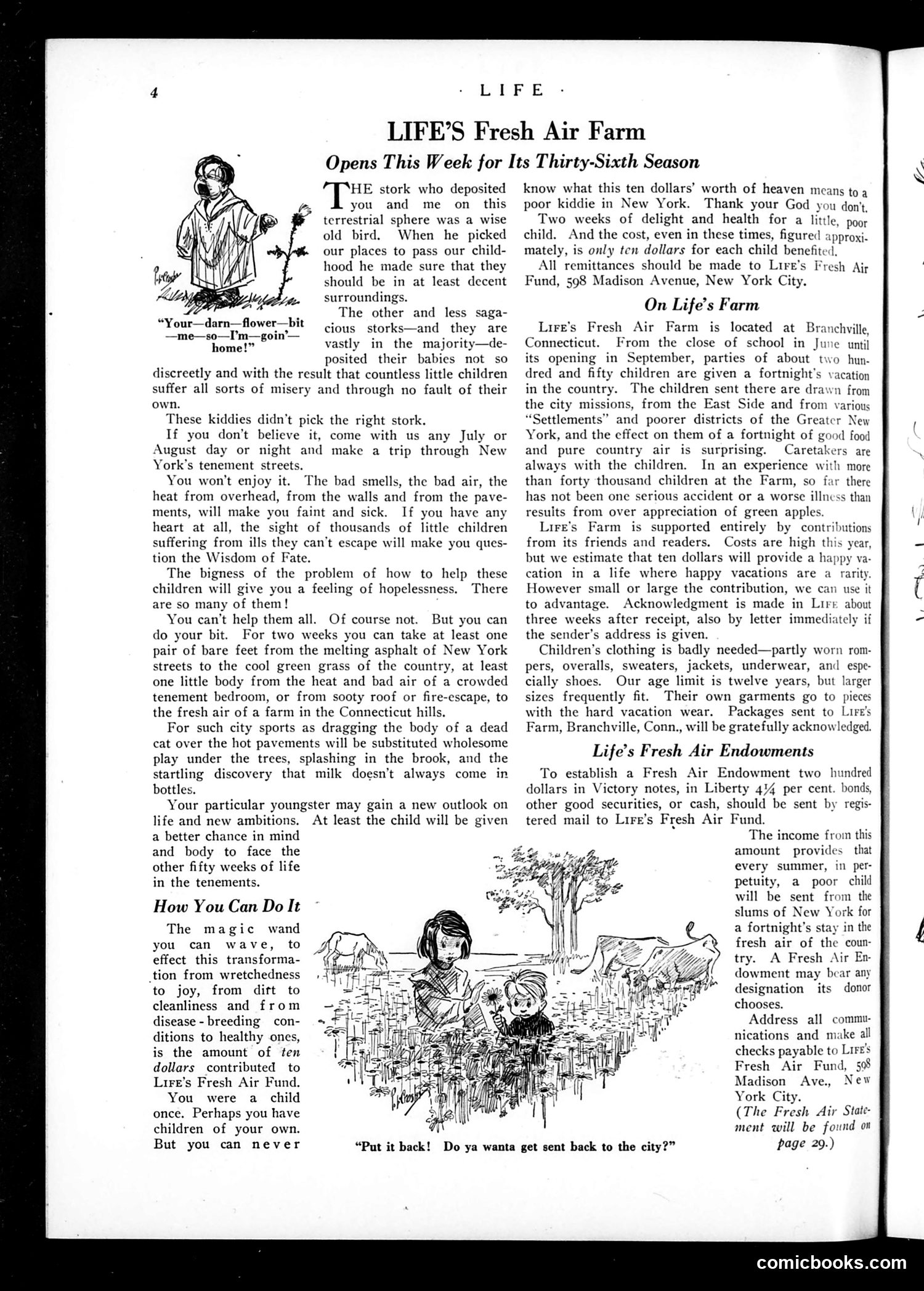
This page promotes **Life's Fresh Air Farm**, a charitable program opening for its thirty-sixth season. The content is informational rather than satirical. The page explains how ten-dollar donations provide poor urban children—primarily from New York's East Side and tenements—with two-week summer vacations at the Connecticut farm. The accompanying illustration shows children in a rural setting, with one child asking "Put it back! Do ya wanna get sent back to the city?" suggesting reluctance to return to urban life. The text emphasizes the program's health benefits, describing how children escape pollution, disease, and overcrowding to experience clean air and countryside. The page also solicits donations for an endowment fund and explains how contributions help provide clothing and supplies. This represents **Progressive Era charitable work** addressing urban poverty and child welfare.
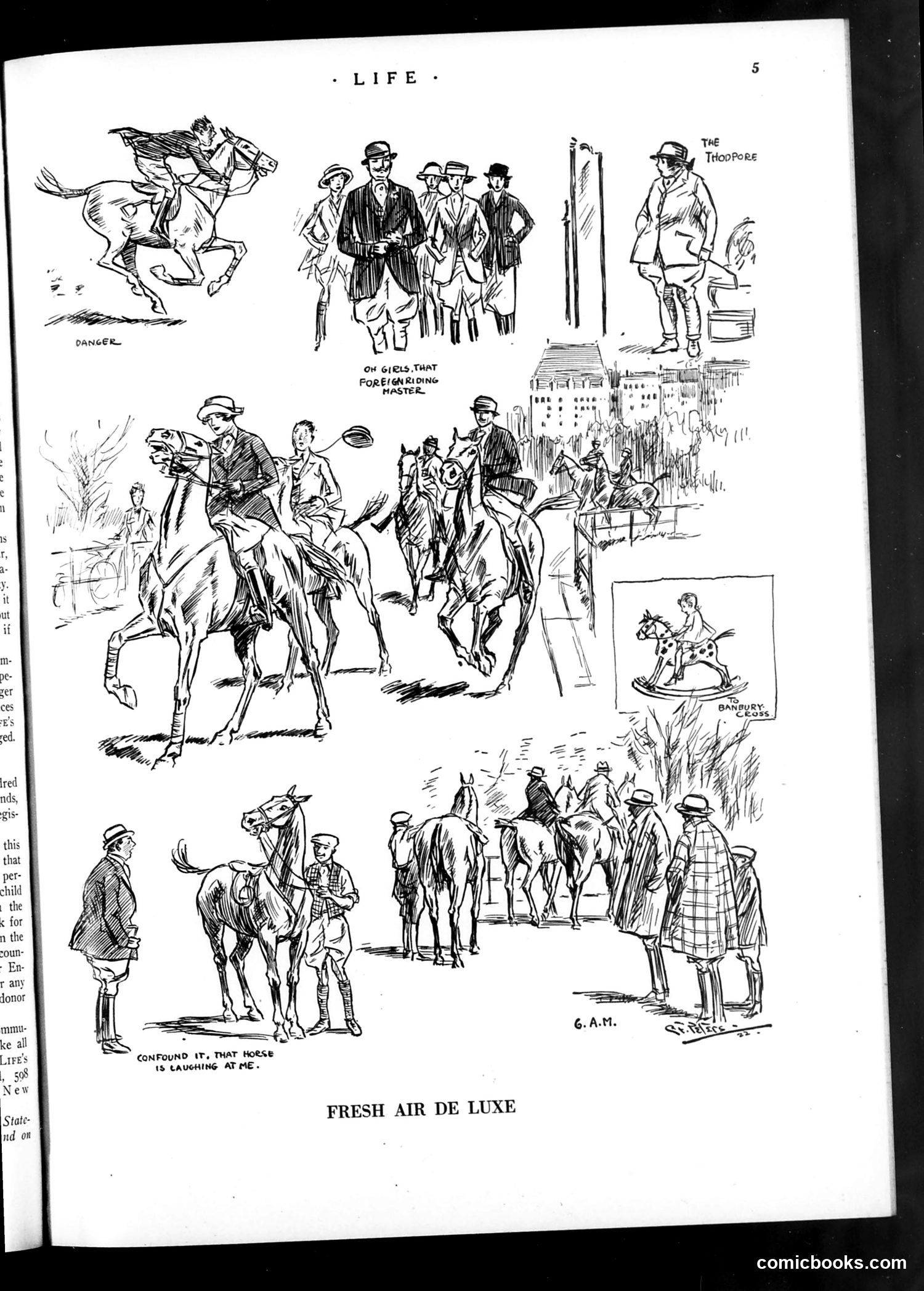
This page satirizes wealthy urbanites' attempts at "roughing it" or acquiring rustic experiences. The title "Fresh Air de Luxe" mocks the contradiction between genuine outdoor recreation and aristocratic pretension. The sketches depict well-dressed city people on horseback and at what appears to be a country gathering (marked "6 A.M."), suggesting they're awkwardly participating in rural activities while maintaining their refined appearance and mannerisms. Key captions include "Oh girls, that foreign riding master" (implying hired instruction for basics), "The Theodore" (likely a character type), and "Confound it, that horse is laughing at me" — indicating the animals recognize their riders' incompetence. The satire targets wealthy people's superficial engagement with country life, treating outdoor pursuits as fashionable poses rather than genuine experiences.
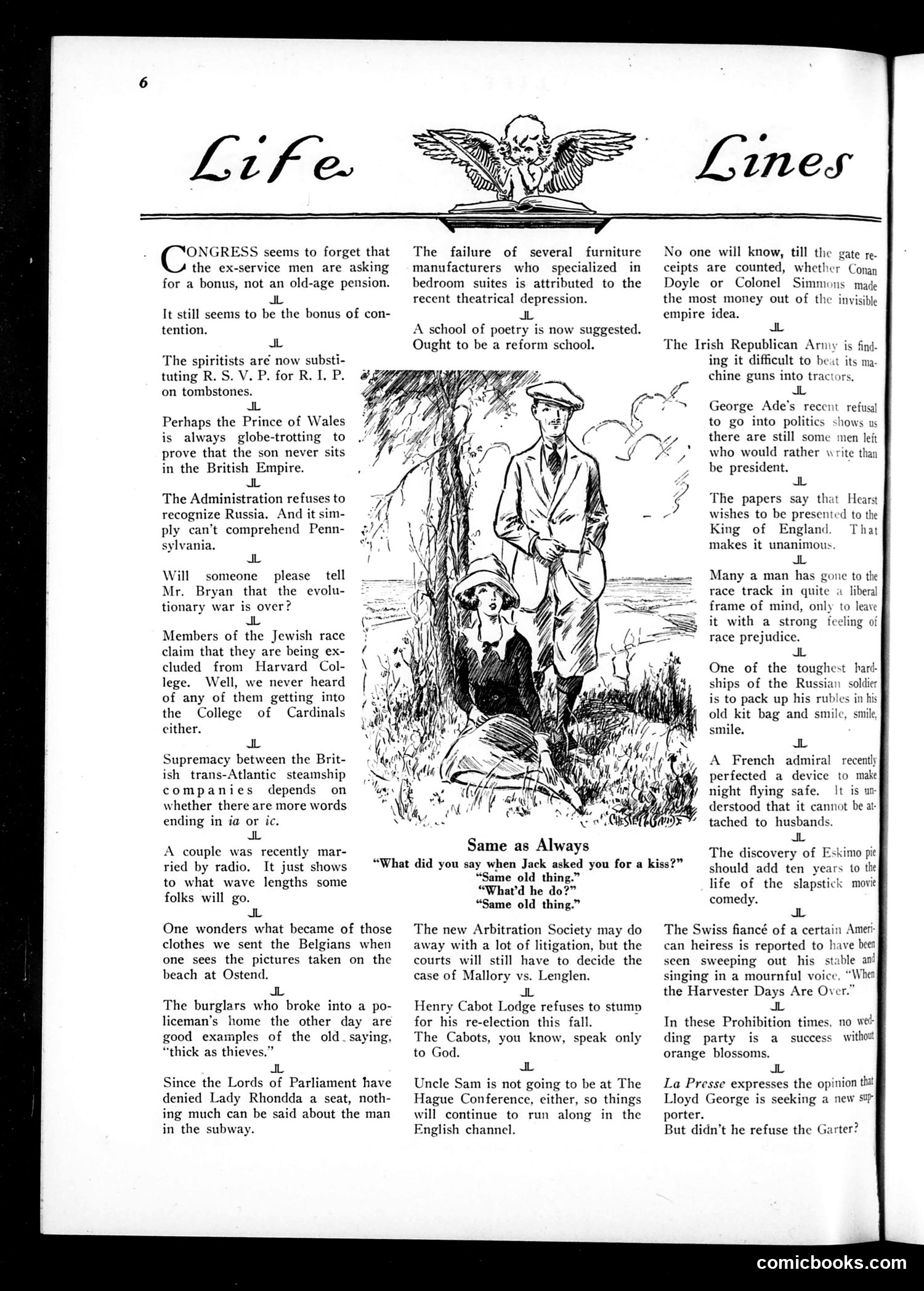
This single-panel cartoon depicts a man proposing to a woman outdoors. The dialogue reveals the satire: when he asks what she said "when Jack asked you for a kiss," she replies "Same old thing." When he asks "What'd he do?" she again says "Same old thing." The joke mocks predictable courtship rituals and male persistence—suggesting women give standard, unchanging responses to romantic advances, implying either resignation or routine rejection. The cartoon satirizes conventional gender dynamics and dating conventions of the era, where men's romantic overtures apparently followed formulaic patterns that women encountered repeatedly. The surrounding "Life Lines" column contains other topical political and social commentary typical of the magazine's satirical voice.
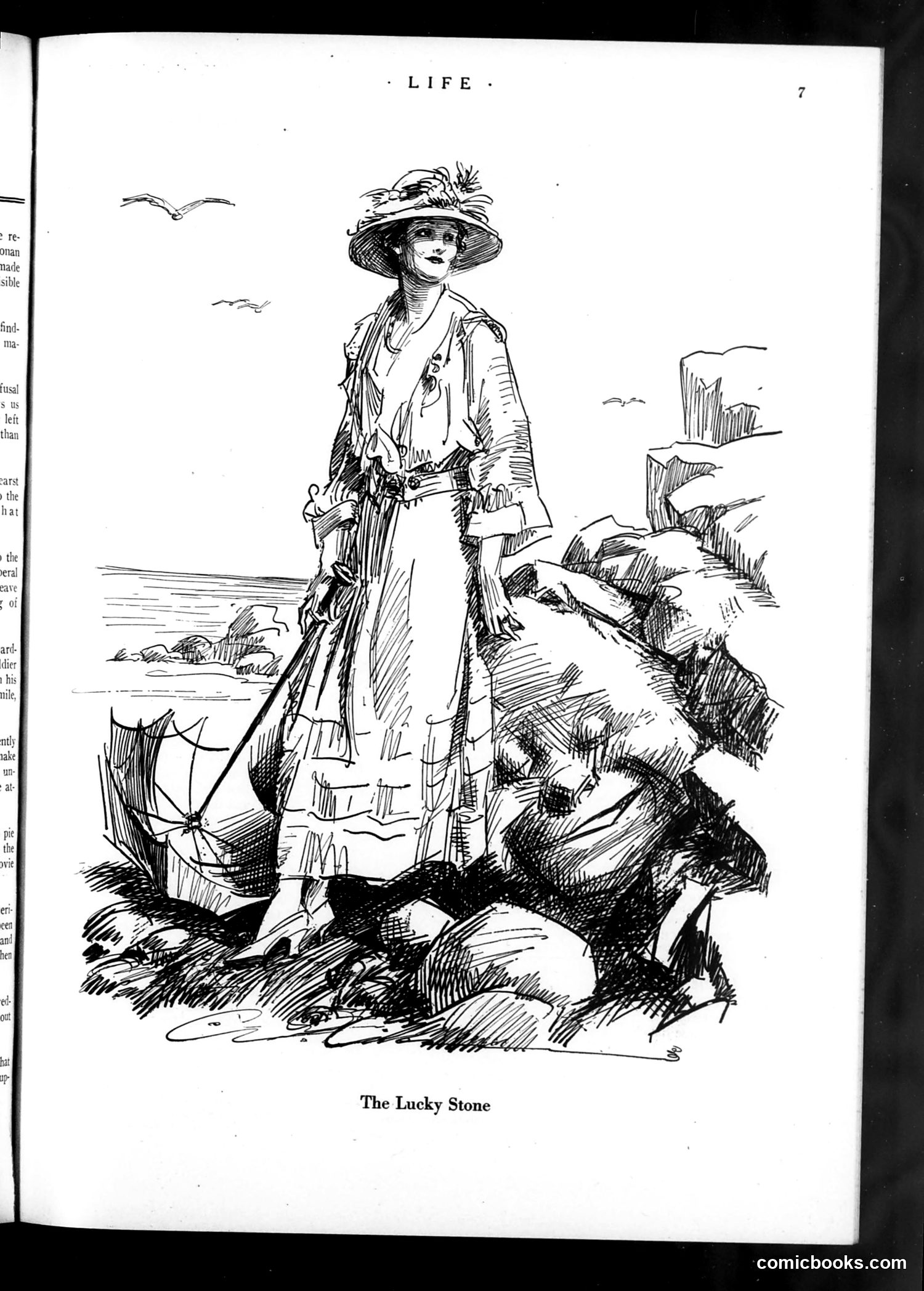
This illustration depicts a fashionably dressed woman in early 20th-century attire, standing confidently on rocky terrain while holding an umbrella. The title "The Lucky Stone" suggests she's found fortune or protection through chance. The cartoon likely satirizes the period's obsession with superstition and good luck charms among the upper classes. The woman's stylish dress, elaborate hat, and composed demeanor contrast with the rough, barren landscape, implying that her "luck" (represented by the stone she's discovered) provides psychological comfort or social advantage despite difficult circumstances. The work appears to mock how wealthy individuals relied on superstitious beliefs rather than practical solutions to life's challenges.
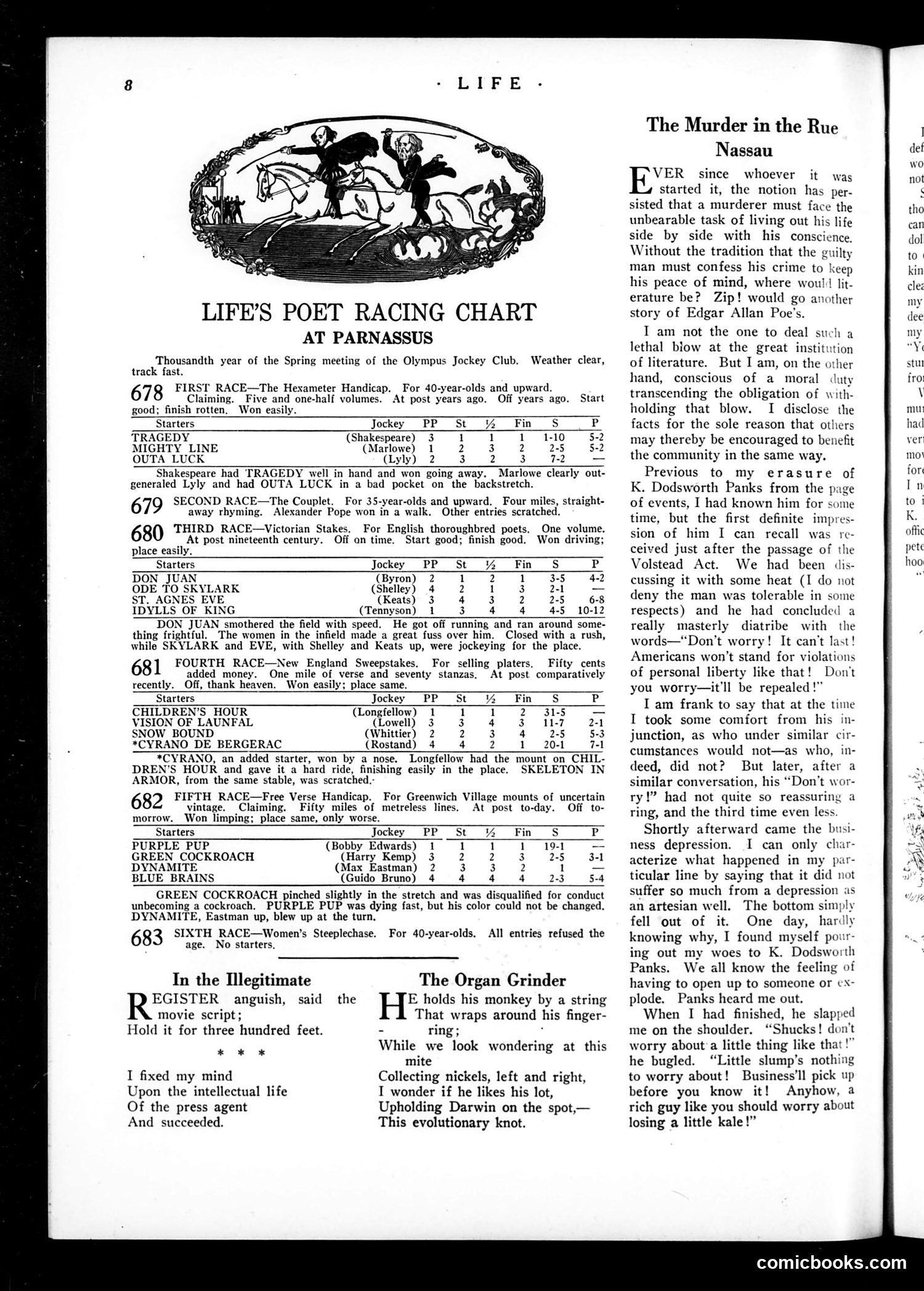
This page contains literary and racing content rather than political cartoons. The main elements are: **"Life's Poet Racing Chart at Parnassus"**: A mock horse-racing chart listing classical and literary references (races numbered 678-683) with whimsical names like "FIRST RACE," "MIGHTY LINE," and "OUTA LUCK." This satirizes the then-popular pastime of horse racing by applying its format to poetry and literature, creating absurdist humor for educated readers familiar with both classical allusions and sporting terminology. **Right column prose**: "The Murder in the Rue Nassau" discusses moral responsibility in literature, referencing Edgar Allan Poe's famous story. It's a serious essay about artistic ethics. **Bottom poems**: "In the Illegitimate," "The Organ Grinder," etc.—light verse on various topics. This reflects *Life* magazine's approach: mixing literary satire, racing humor, and poetry for an educated, urban audience.
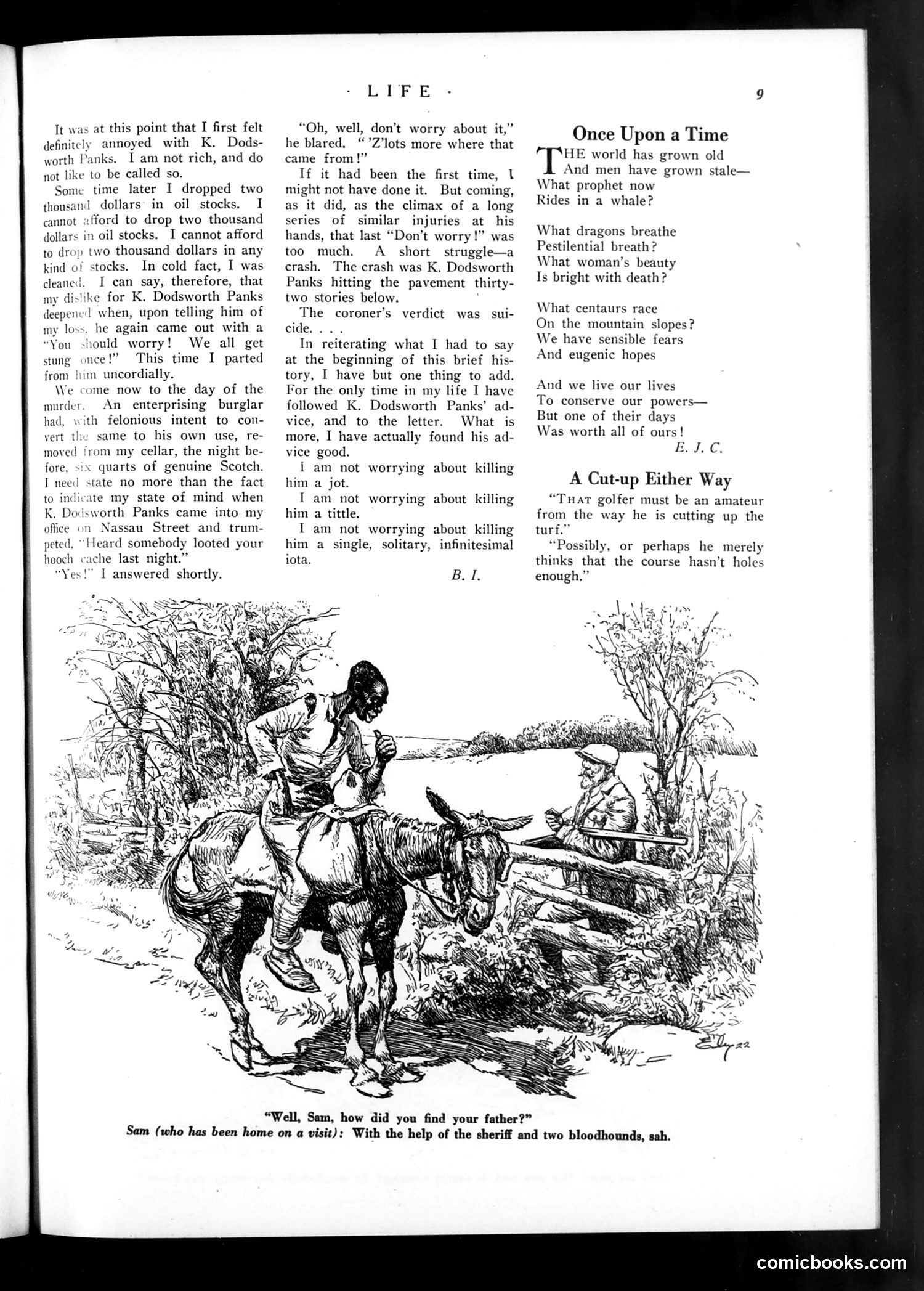
This page contains two distinct pieces: **Upper section:** A personal anecdote about the author's frustration with K. Dodsworth Panks, who repeatedly advised "Don't worry" during financial losses. The narrator eventually tells Panks to stop worrying about him—a sardonic reversal where the anxious advisor becomes the problem rather than the solution. **Lower cartoon:** Depicts a man on horseback speaking with a sheriff and another figure near a rural fence. The caption reads: "Well, Sam, how did you find your father?" with Sam (recently home on a visit) responding: "With the help of the sheriff and two bloodhounds, sah." The joke relies on the implication that locating one's father required law enforcement and tracking dogs—suggesting either the father was lost/hiding or commentary on absent rural/Southern fathers.
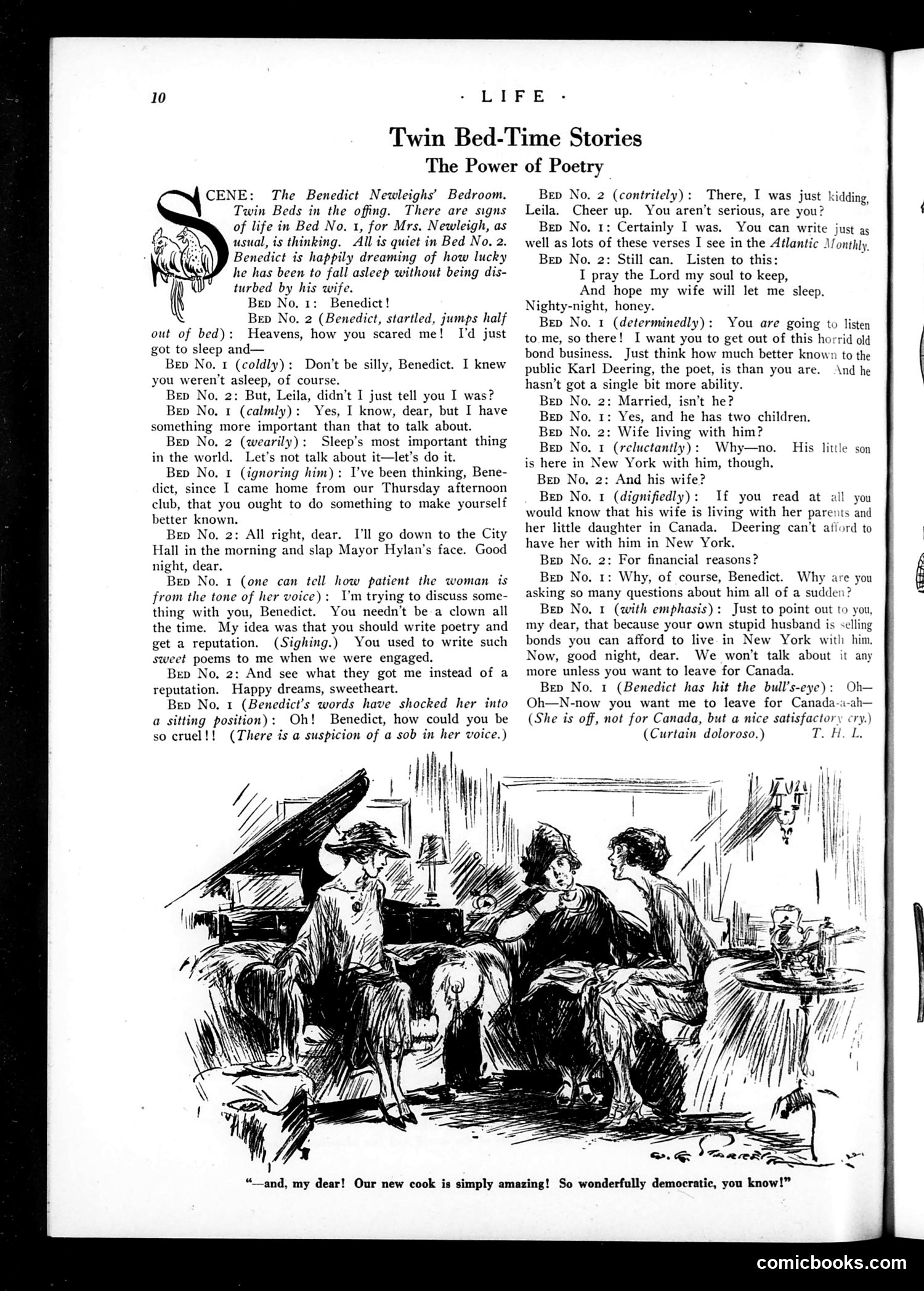
This is a "Twin Bed-Time Stories" sketch titled "The Power of Poetry" from *Life* magazine. The dialogue depicts two married couples in adjacent beds (a common 1920s-30s setup) discussing poetry and marital dynamics. The satire centers on **Benedict**, who allegedly writes poetry to impress his wife. His wife challenges him: poetry didn't help him secure their cook or resolve financial problems with her father Karl Deering. She suggests he's using "the power of poetry" as an excuse for his actual failures as a provider. The cartoon below illustrates the couple with their "wonderfully democratic" new cook, satirizing pretentious social attitudes. The humor targets **masculine vanity**—how men invoke art and culture to compensate for practical inadequacies—and **class anxieties** about domestic staff and financial status.
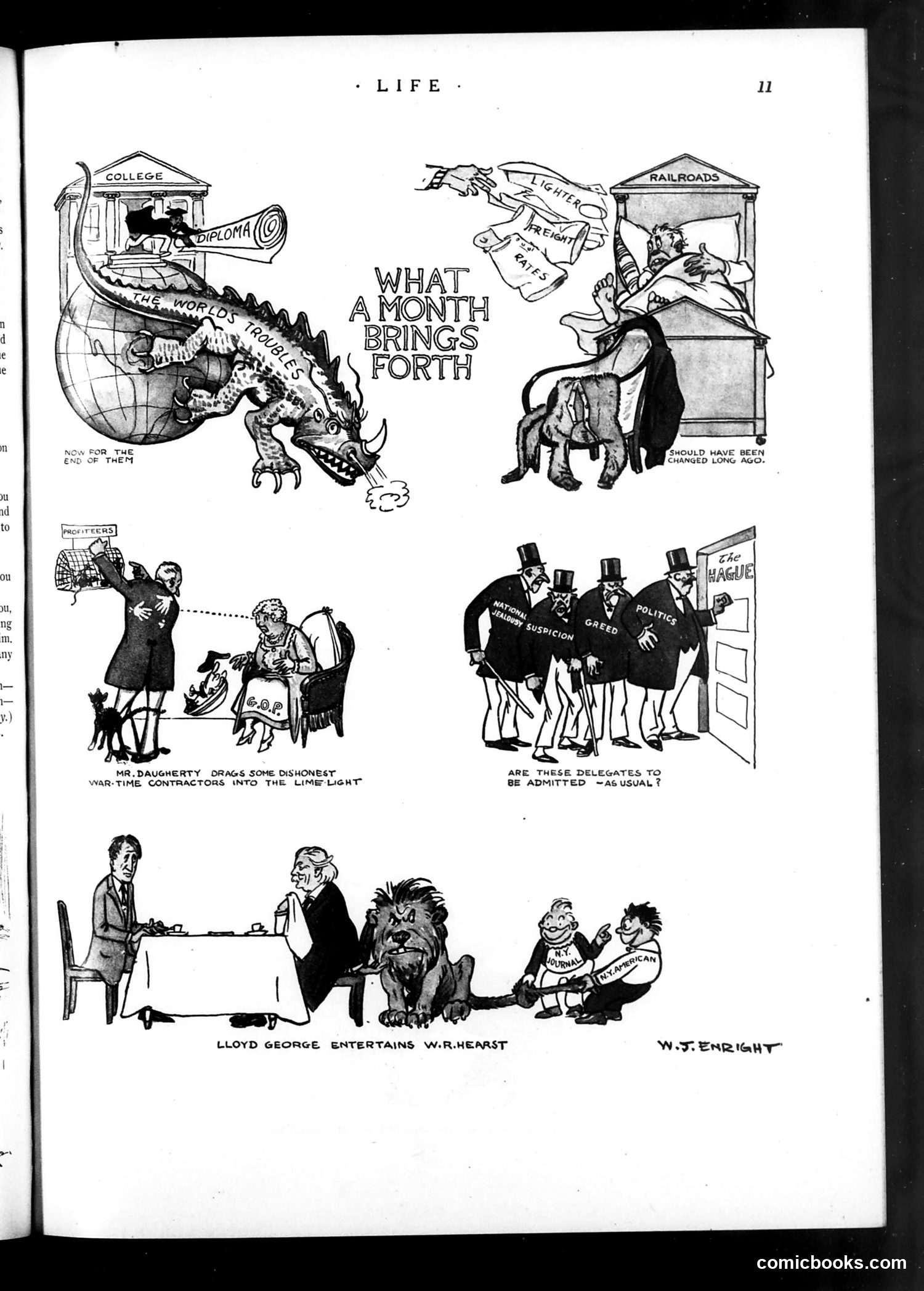
This page from *Life* magazine presents four satirical cartoons criticizing various societal figures and institutions: 1. **Top left**: A dragon labeled with education/diploma credentials devours a globe, captioned "now for the world's travails" — mocking how credentials don't guarantee wisdom. 2. **Top right**: A corrupt railroad official with freight/rate documents; caption suggests he "should have been hanged long ago" — criticizing railroad monopolies and corruption. 3. **Middle**: Mr. Dougherty exposing "war-time contractors" to public scrutiny — likely referencing WWI profiteering scandals. 4. **Bottom right**: Delegates labeled with various corruptions (greed, suspicion, police) entering a building — satirizing political corruption and bribery in government. 5. **Bottom**: Lloyd George entertains W.R. Hearst with animal-headed figures representing "National" and "Pan-American" interests — mocking political theater and foreign relations.
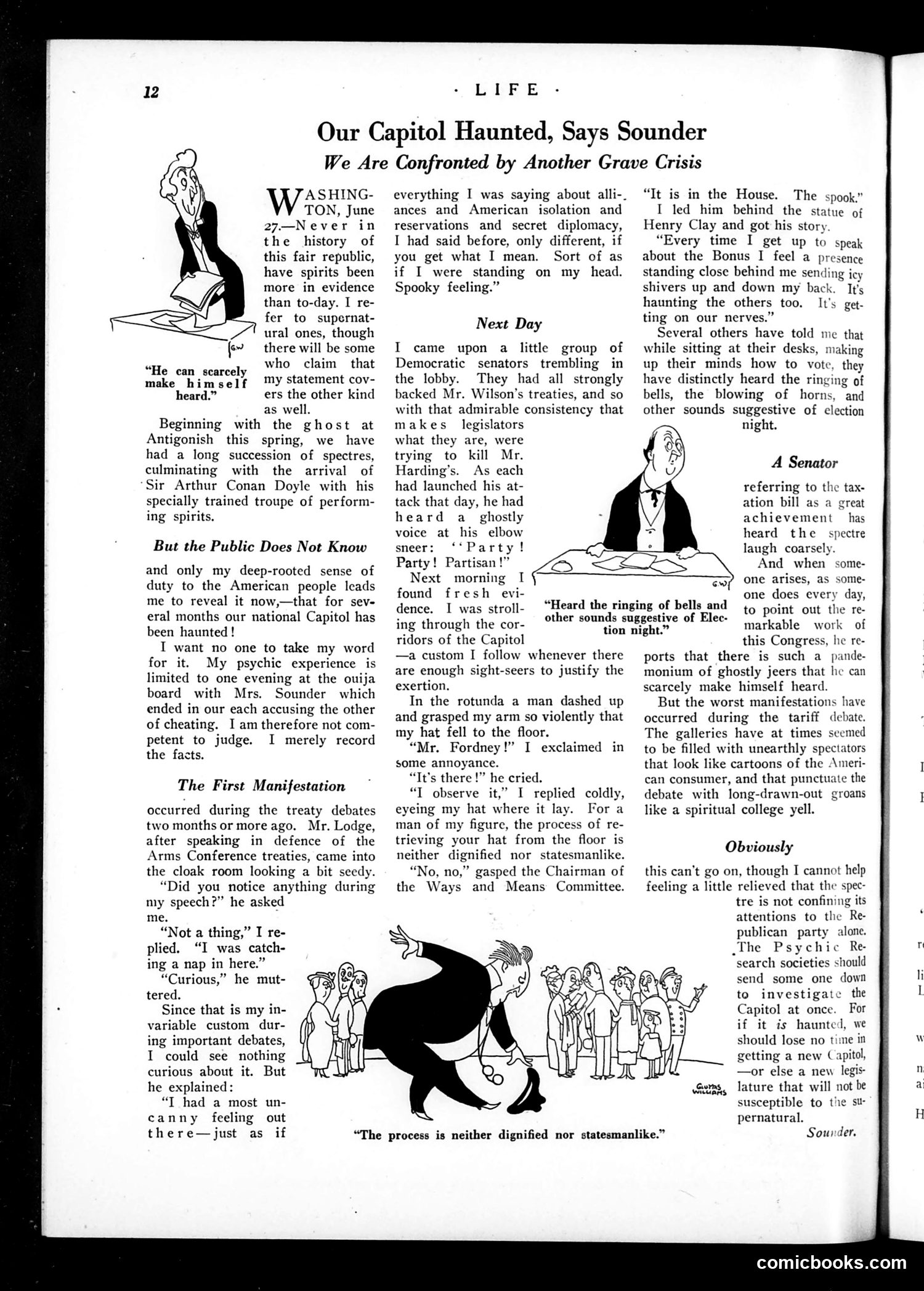
This satirical piece by Sounder describes supernatural disturbances in the U.S. Capitol building. The author claims the "spook" is Henry Clay, whose spirit allegedly haunts legislators during debates—particularly over Wilson's treaties and the taxation bill. The cartoons illustrate the chaos: one shows a senator startled at his desk; another depicts a man being violently thrown down, captioned "The process is neither dignified nor statesmanlike." The satire mocks congressional behavior during contentious debates, suggesting lawmakers are so unruly and emotional they might as well be possessed by ghosts. It's a tongue-in-cheek critique of partisan gridlock and undignified conduct in the House and Senate, using supernatural metaphors to exaggerate real political dysfunction.
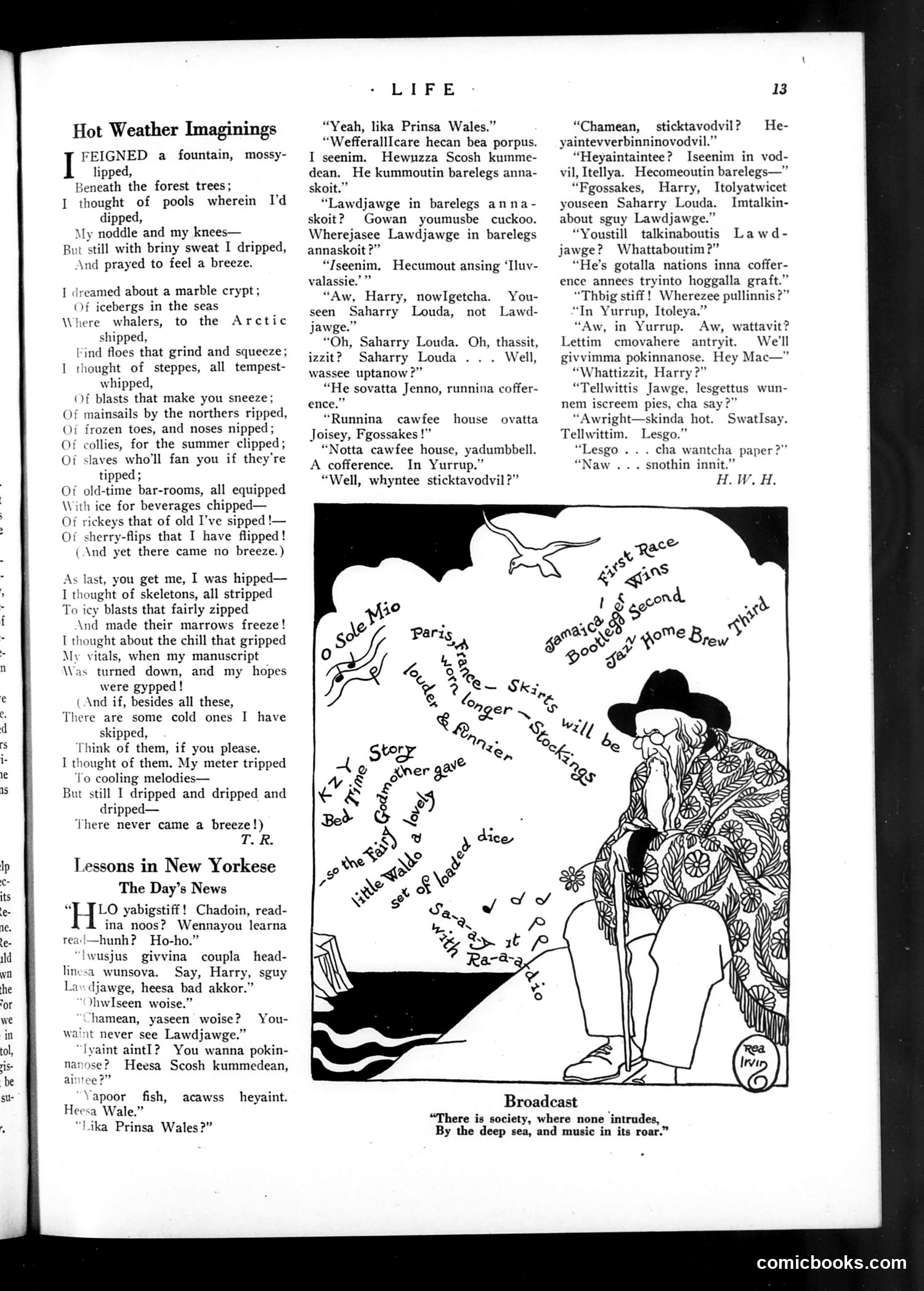
This cartoon depicts an elderly, elaborately dressed figure broadcasting a story into the night. The winding text spiraling outward contains fragmented phrases about racing, Paris, "skirts," and "dice"—suggesting a rambling, disjointed narrative. The caption reads: "There is society, where none intrudes, / By the deep sea, and music in its roar." The satire appears to target verbose or nonsensical public speakers—likely radio broadcasters, a relatively new medium in the 1920s-30s. The elderly figure's ornate clothing and the jumbled, stream-of-consciousness text mock both the pretension of broadcasters and the absurdity of their often rambling content reaching mass audiences indiscriminately. The cartoon satirizes early radio's tendency to transmit whatever speakers offered, without editorial quality control.
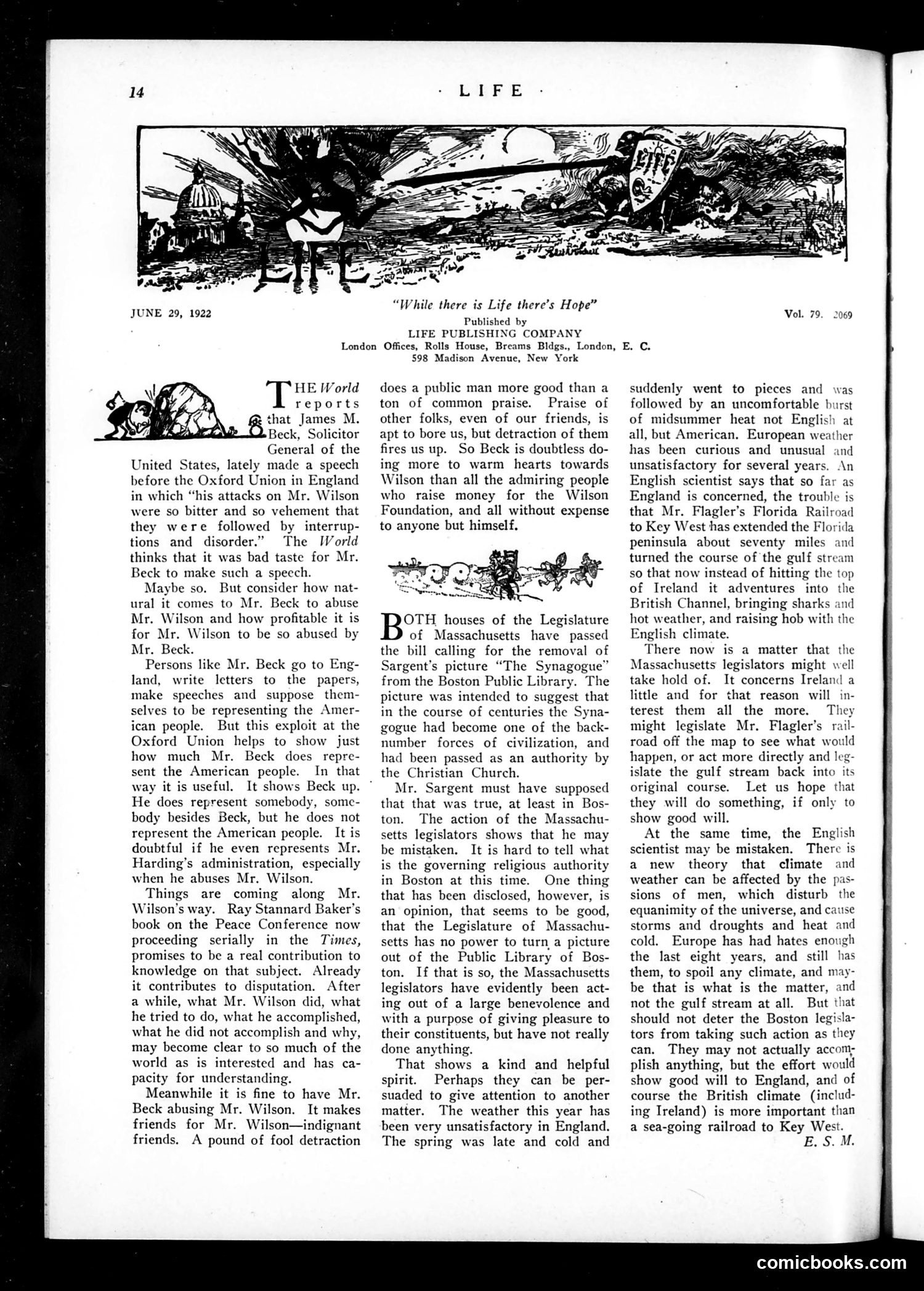
The article critiques James M. Beck, Solicitor General of the United States, for his recent Oxford Union speech attacking President Wilson. The piece argues Beck overstepped by representing American opinion while receiving government salary. The text notes Beck's actions generated significant British backlash, then pivots to discuss two separate Massachusetts legislative matters: removal of John Singer Sargent's painting "The Synagogue" from the Boston Public Library, and a proposed railroad bill affecting Florida's Gulf Stream course. The cartoon at top appears to show a nighttime landscape with moon and dramatic sky—likely illustrating the editorial's broader themes of political upheaval or controversy, though specific symbolic meaning remains unclear without clearer image resolution.
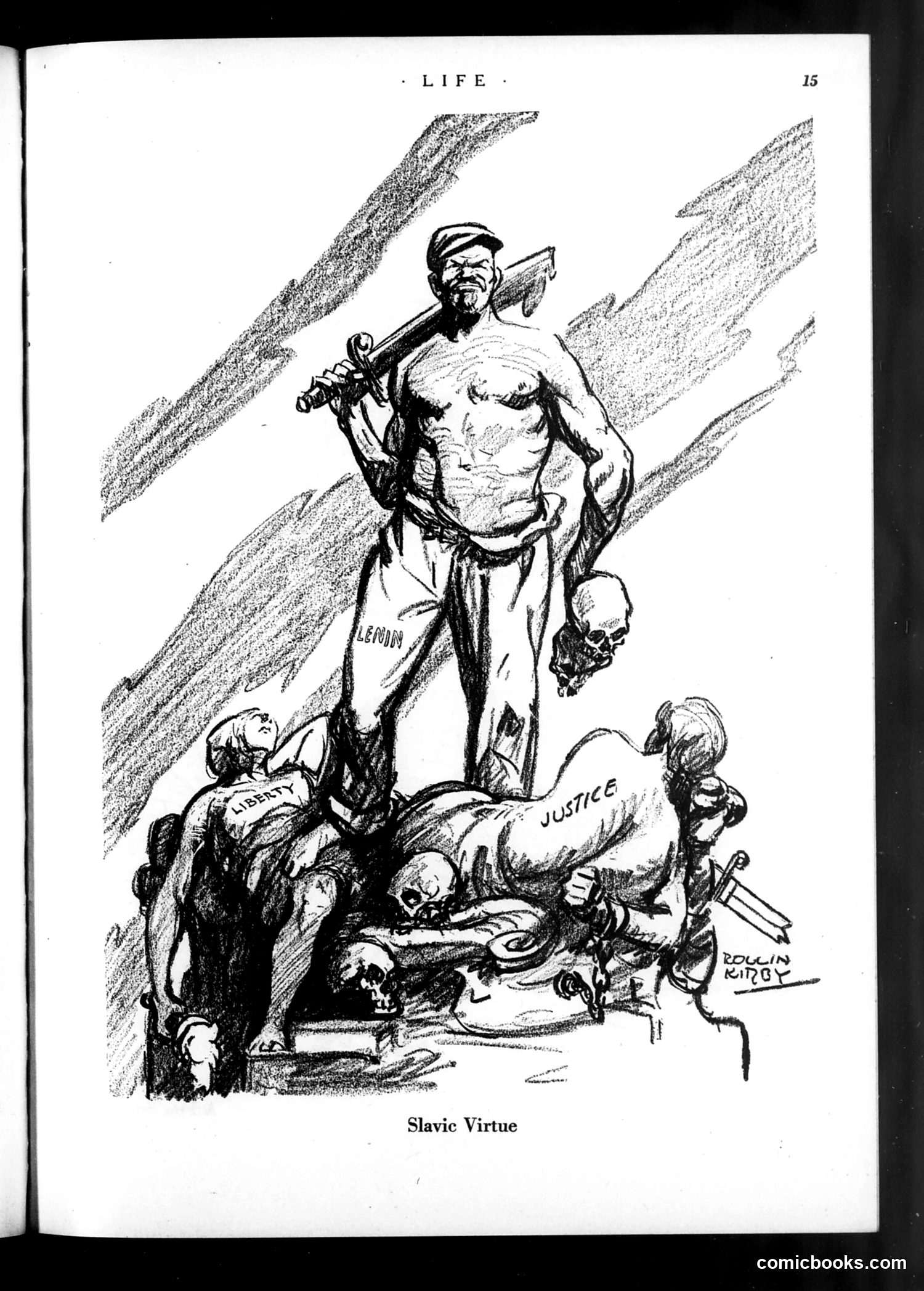
This political cartoon depicts a muscular, bearded figure standing triumphantly over fallen enemies, holding an axe and a severed head. The figure appears to represent Slavic peoples or a Slavic nation. Below are defeated figures labeled "Liberty" and "Justice," along with what appears to be broken symbols of democratic governance. The cartoon's title "Slavic Virtue" is clearly ironic—the satire suggests that Slavic regimes (likely referring to Soviet or Eastern European communist governments) hypocritically claim virtue while actually crushing liberty and justice. The towering warrior figure crushing democratic ideals beneath his feet represents authoritarian oppression. This reflects early-to-mid 20th century American anxieties about communist expansion and anti-democratic regimes in Eastern Europe.
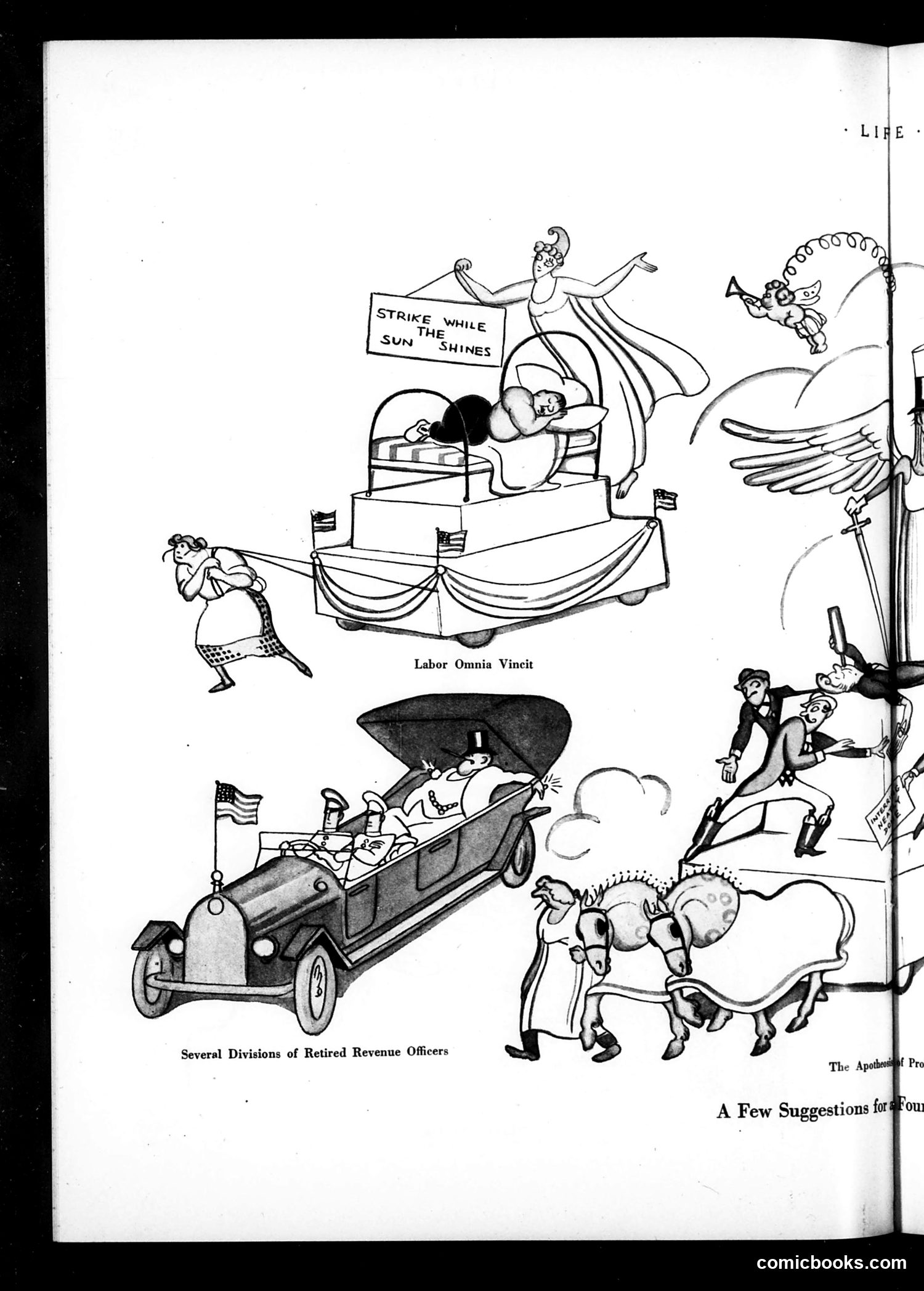
This page contains two satirical cartoons mocking political figures and policies. The upper cartoon, captioned "Labor Omnia Vincit" (Labor Conquers All), depicts a luxurious floating bed with a sleeping figure being fanned by an attendant, while holding a banner reading "Strike While the Sun Shines." This appears to criticize labor strikes or union activism as indulgent laziness. The lower cartoon shows "Several Divisions of Retired Revenue Officers"—men in formal dress riding in an automobile pulled by oxen. This likely satirizes government bureaucrats or tax collectors, suggesting they're outdated, inefficient, or undeserving of their positions. Both cartoons use exaggeration and absurdist imagery to ridicule their targets, typical of Life magazine's political humor from the early 20th century.
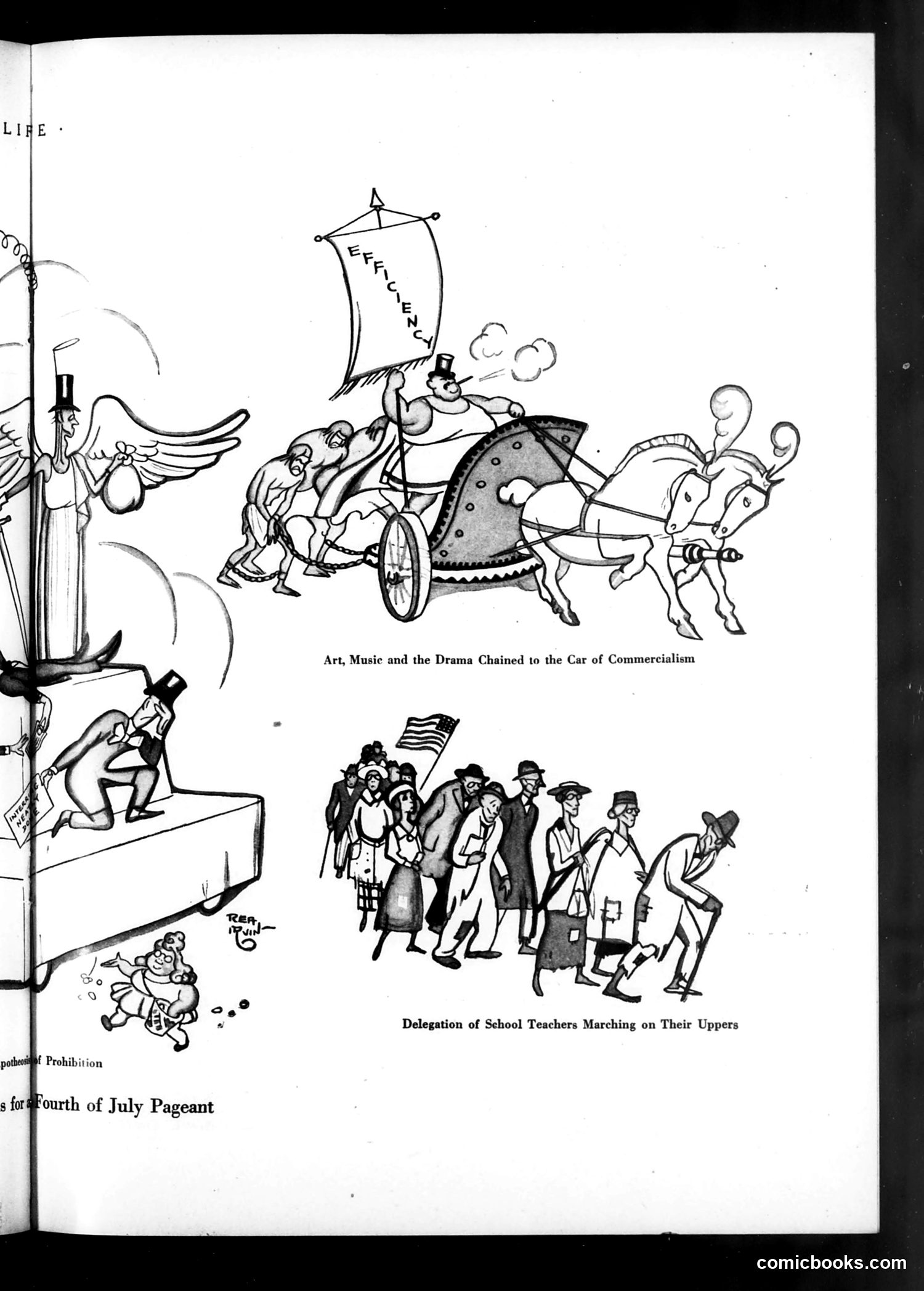
**Top cartoon:** "Art, Music and the Drama Chained to the Car of Commercialism" depicts the arts being enslaved to a commercial vehicle. Figures representing artistic disciplines are literally chained and pulling a cart driven by a fat plutocrat wearing a top hat, with a sail labeled "EFFICIENCY" above. Cherubs or putti on the left appear to represent classical ideals. The satire critiques how commercial interests and profit-seeking have corrupted and enslaved the arts. **Bottom cartoon:** "Delegation of School Teachers Marching on Their Uppers" shows teachers in worn clothing marching with an American flag, appearing downtrodden. "Uppers" refers to the soles of worn shoes—a visual pun suggesting teachers are impoverished or poorly paid. This likely protests inadequate teacher compensation during an earlier period. Both condemn institutional exploitation.
This is a theater review of the Ziegfeld Follies, a famous Broadway revue known for elaborate staging and chorus girls. The critic complains that while the *visual* production (designed by James Reynolds) is beautiful, the *comedy* has declined due to missing star performers. **Key figures mentioned:** - **Fannie Brice and W.C. Fields**: Popular comedians whose absence the critic deeply resents - **Will Rogers**: A beloved performer whose charm can't compensate for the missing stars - **Gallagher and Shean**: A comedy duo whose act the critic finds banal - **"Little, impassive Dooley"**: Appears to be a deceased performer the critic admired **The satire:** The reviewer uses emotional exaggeration—"great sobs shook our frame"—to mock both the show's sentimentality and their own nostalgia. They're essentially saying: the Follies are pretty but empty; without genuinely funny people, it's just expensive spectacle. The critic also admits bias (free tickets compromised their objectivity, as did their fondness for absent comedians).
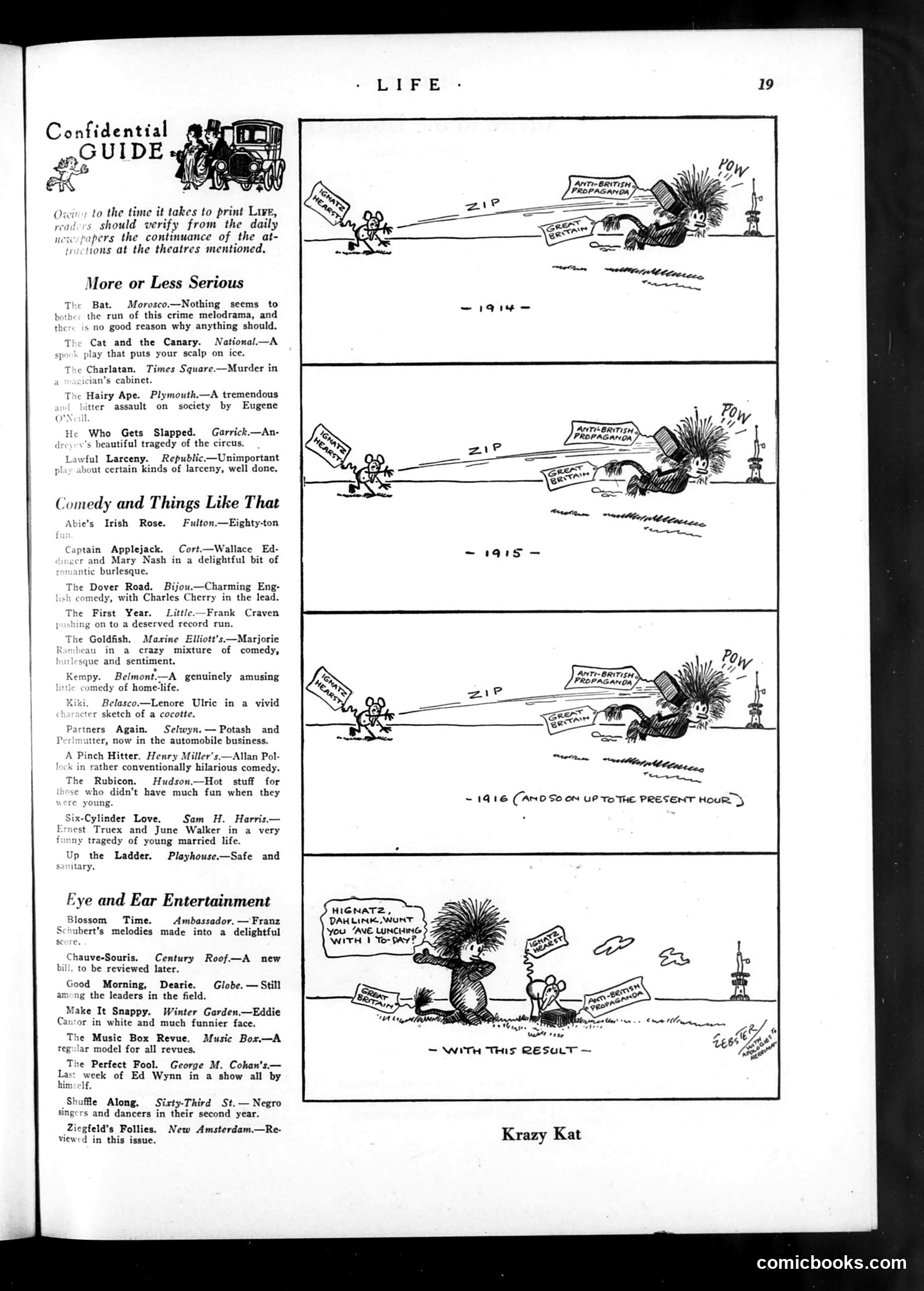
This comic strip satirizes American preparedness anxieties in the immediate post-WWI era (dates shown: 1914-1916). The sequence depicts an escalating cycle: **The figures**: A character labeled "Anti-British Propaganda" pursues what appears to be a figure representing American interests or policy, while "Krazy Kat" (the strip's protagonist) observes from the sidelines. **The satire**: Each panel shows the same chase repeating with intensifying speed and fury, culminating in chaos. The final panel shows the result: apparent diplomatic breakdown or social discord ("with this result"). **The point**: The cartoon mocks how anti-British propaganda campaigns and counter-responses spiral endlessly, escalating tensions without resolution. The repetitive panels suggest futility and self-perpetuation of conflict rhetoric. This reflects 1920s American debates over neutrality, British-American relations, and the lingering effects of World War I propaganda—concerns very much alive in the postwar period depicted here.
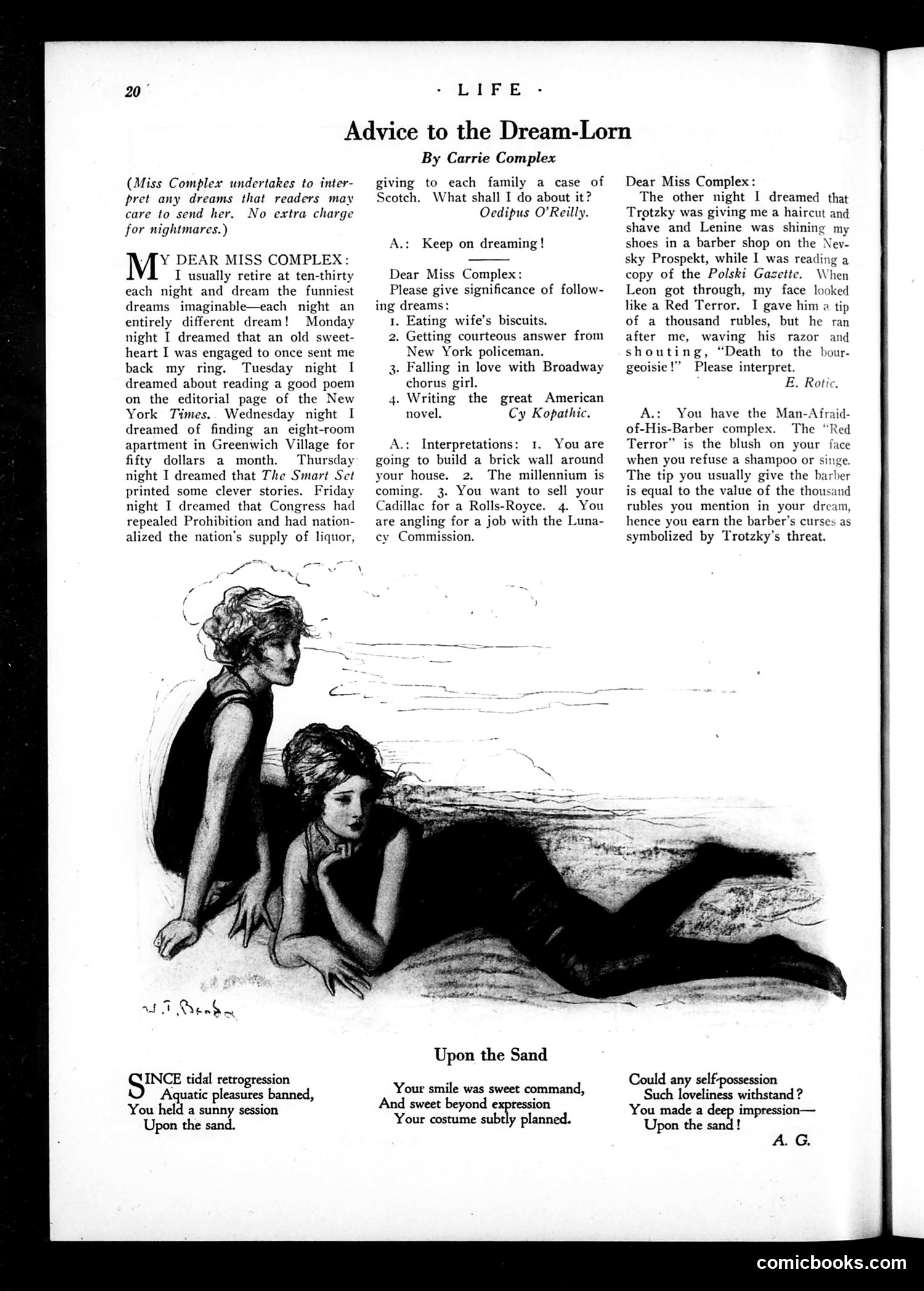
This 1920s *Life* magazine page features a humor column where "Miss Complex" interprets readers' dreams through a satirical lens. The jokes rely on contemporary frustrations: **Dream Interpretations:** - Finding a cheap Greenwich Village apartment = impossible fantasy - Congress repealing Prohibition = wishful thinking (Prohibition was enforced 1920-1933) - Receiving courtesy from a NYC policeman = "the millennium is coming" (implying police were notoriously rude) - Wife's edible biscuits = absurd dream requiring surreal explanation **Political Reference:** One dream mentions Trotsky and Lenin running a barber shop on Nevsky Prospekt (a real St. Petersburg street). This satirizes American anxiety about the 1917 Russian Revolution—representing communist leaders in menial service is mockery of Bolshevism. **Bottom Poem:** "Upon the Sand" appears unrelated romantic verse, standard *Life* filler content. The humor targets 1920s urban life: housing scarcity, Prohibition discontent, and Red Scare anticommunism.
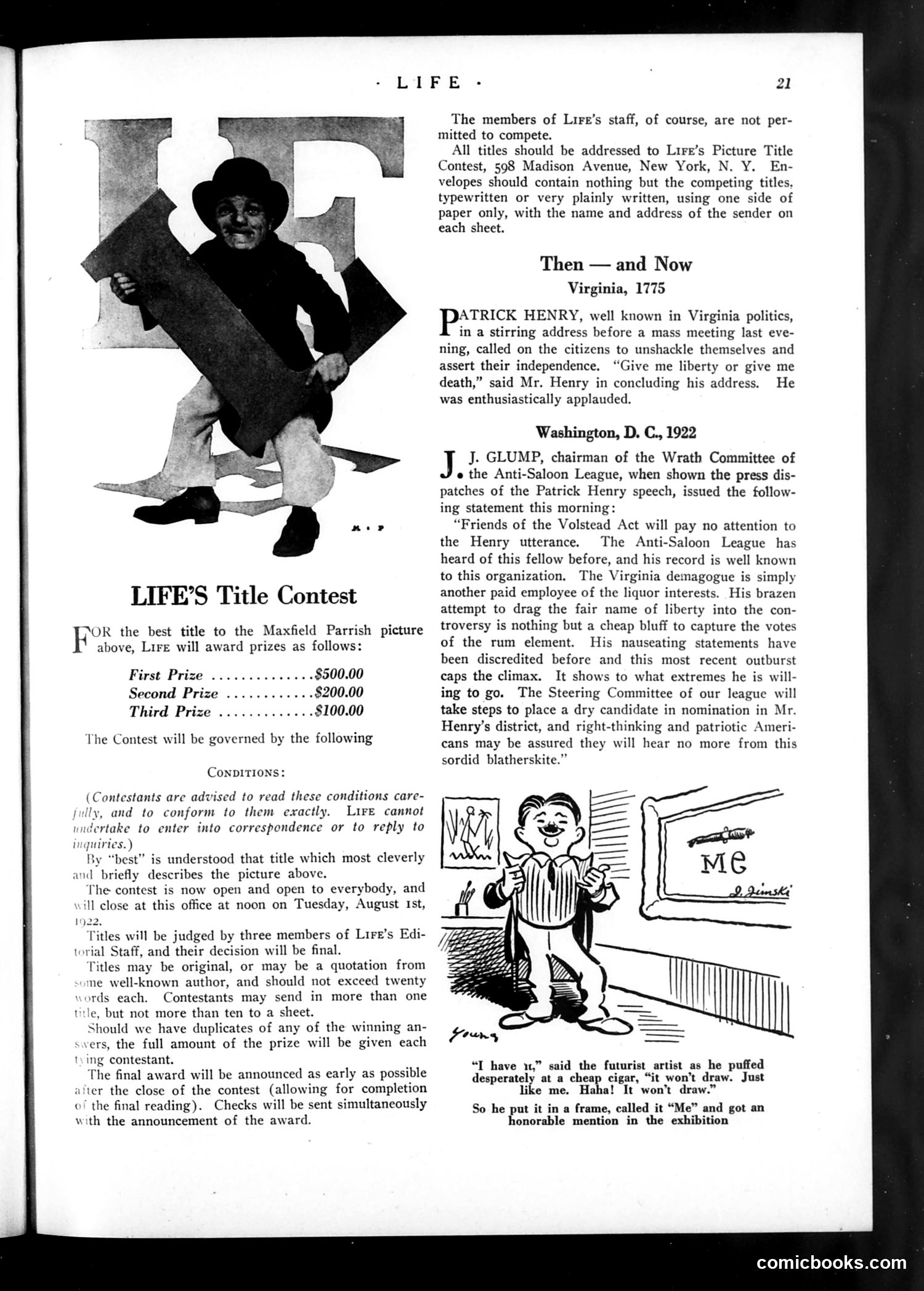
This two-part satire contrasts Patrick Henry's 1775 call for liberty ("Give me liberty or give me death") with a 1922 response from J. Glump of the Anti-Saloon League, who dismisses Henry as a "paid employee of the liquor interests." The joke: The Anti-Prohibition League's leader uses patriotic language to attack someone invoking actual American independence. He frames Henry's liberty speech as a "cheap bluff" to capture "rum element" votes—revealing the absurdity of Prohibition advocates claiming the moral high ground while attacking free speech itself. The cartoon below satirizes modern art pretension: a futurist artist creates a self-portrait ("Me") he admits won't draw well, frames it anyway, and receives an "honorable mention"—mocking how avant-garde work gets praised despite lacking basic competence. Both mock hypocrisy: political zealotry disguised as patriotism, and artistic mediocrity disguised as innovation.
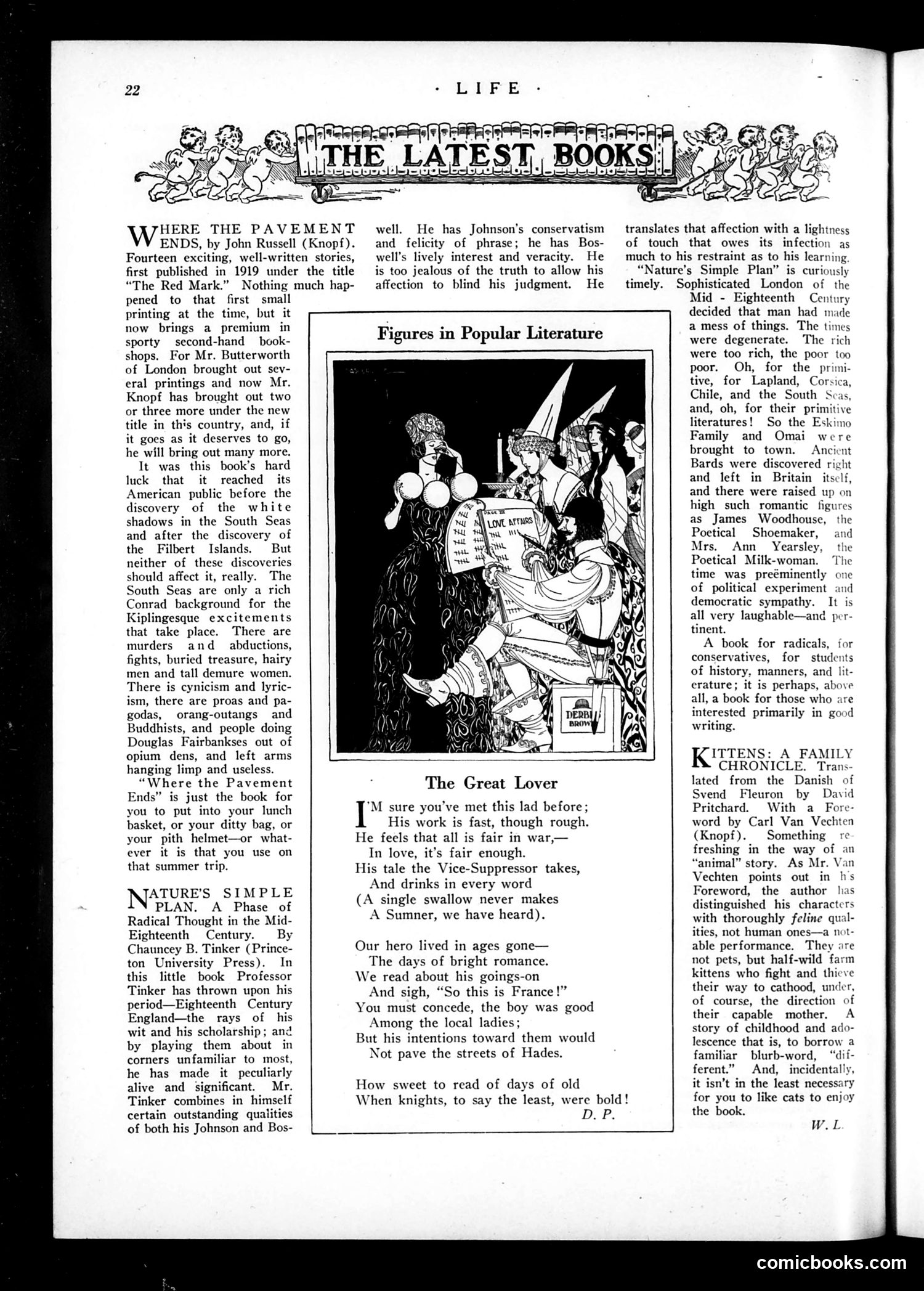
This is a book review section from *Life* magazine featuring three literary notices. The central illustration titled "Figures in Popular Literature" depicts a satirical scene of a young, attractive man being admired by three women—one labeled "Vice-Suppressor" who is reading about his romantic exploits. The accompanying poem "The Great Lover" mocks the romantic hero archetype popular in contemporary fiction: a morally dubious seducer whose behavior the "Vice-Suppressor" (likely a censor or moral crusader) paradoxically consumes eagerly. The satire suggests hypocrisy in moral gatekeeping—those claiming to suppress vice are fascinated by it. The reviews discuss books exploring adventure, romance, and 18th-century radical thought. The overall page satirizes popular literary tastes and the gap between professed moral standards and actual reading interests during this period.
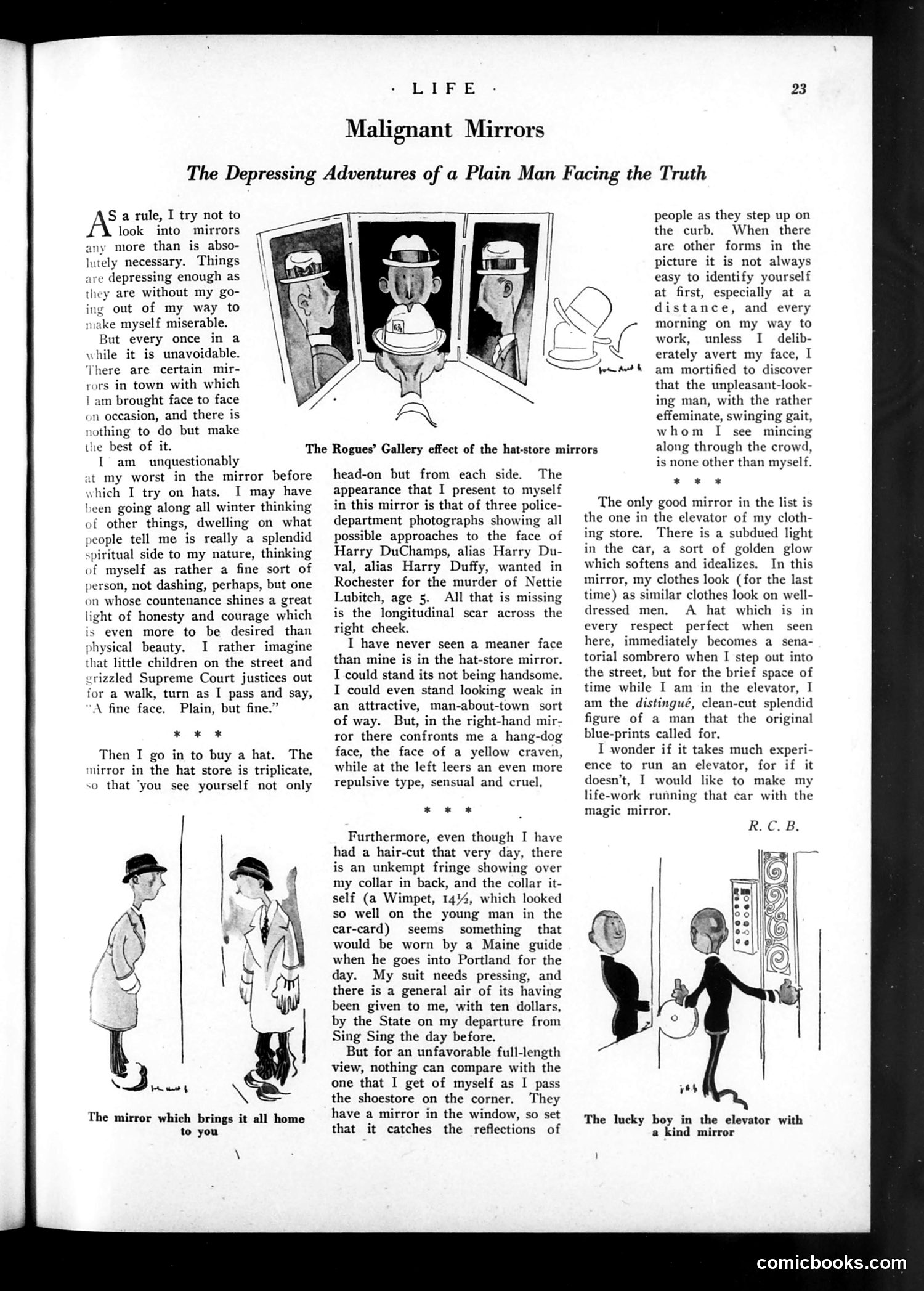
This is a humorous essay about how different mirrors reveal unflattering truths about the author's appearance. The satire works by contrasting his self-image with what mirrors actually show him. **The key references:** The hat-store mirror comparison to "Harry DuChamps, alias Harry Duffy" — a wanted criminal with a "longitudinal scar" — is the central joke. The triple mirror shows the author from multiple angles, making him look like a criminal mugshot (a common comparison in early 20th-century humor). The shoestore window mirror catches him "mincing along through the crowd," suggesting an effeminate gait that embarrasses him. The only flattering mirror is in a clothing-store elevator with "subdued light" and "golden glow" — suggesting that good lighting, not reality, creates a positive self-image. **The point:** The satire mocks how people deceive themselves about their appearance and how context (lighting, mirrors, perspective) shapes perception. It's gentle social commentary on vanity and self-delusion, typical of *Life* magazine's satirical approach to everyday American life.
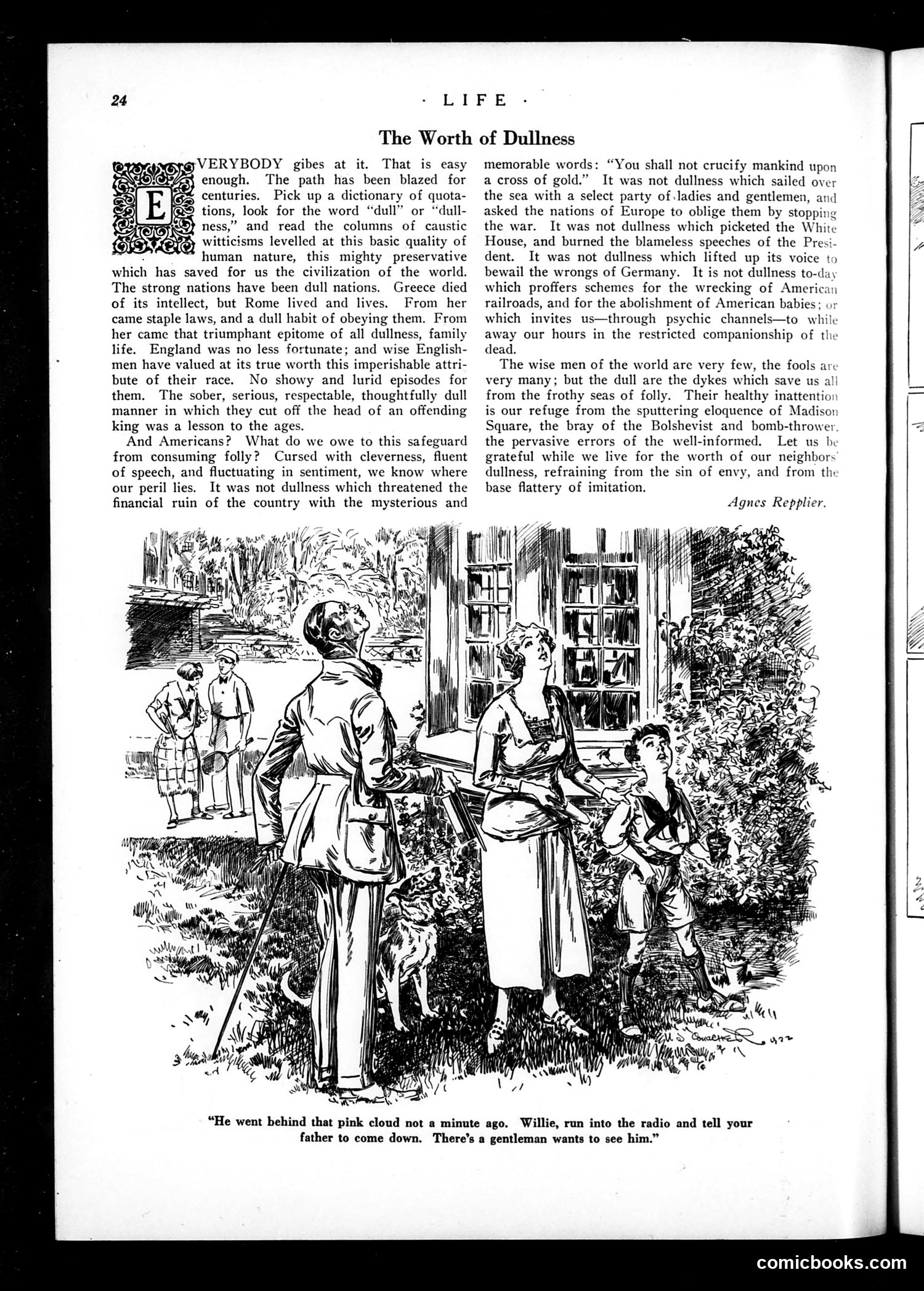
This is an essay by Agnes Repplier defending "dullness" as a stabilizing social force. Written during a turbulent period (references to financial panic, anti-war activism, and Bolshevism suggest early 20th century), Repplier argues that excessive cleverness and rhetoric—not dullness—threatens society. The essay alludes to William Jennings Bryan's 1896 "cross of gold" speech and peace activists who lobbied European nations to stop World War I. It mocks "well-informed" radicals advocating railroad nationalization and birth control, along with spiritualist séances gaining popularity. The cartoon below, captioned about someone disappearing behind a pink cloud while a boy fetches his father via radio, illustrates the essay's point: modish enthusiasms (spiritualism, new technology) distract from sensible domestic life. The joke satirizes how fashionable foolishness disrupts ordinary family routines—exactly the kind of thoughtless "cleverness" Repplier warns against.
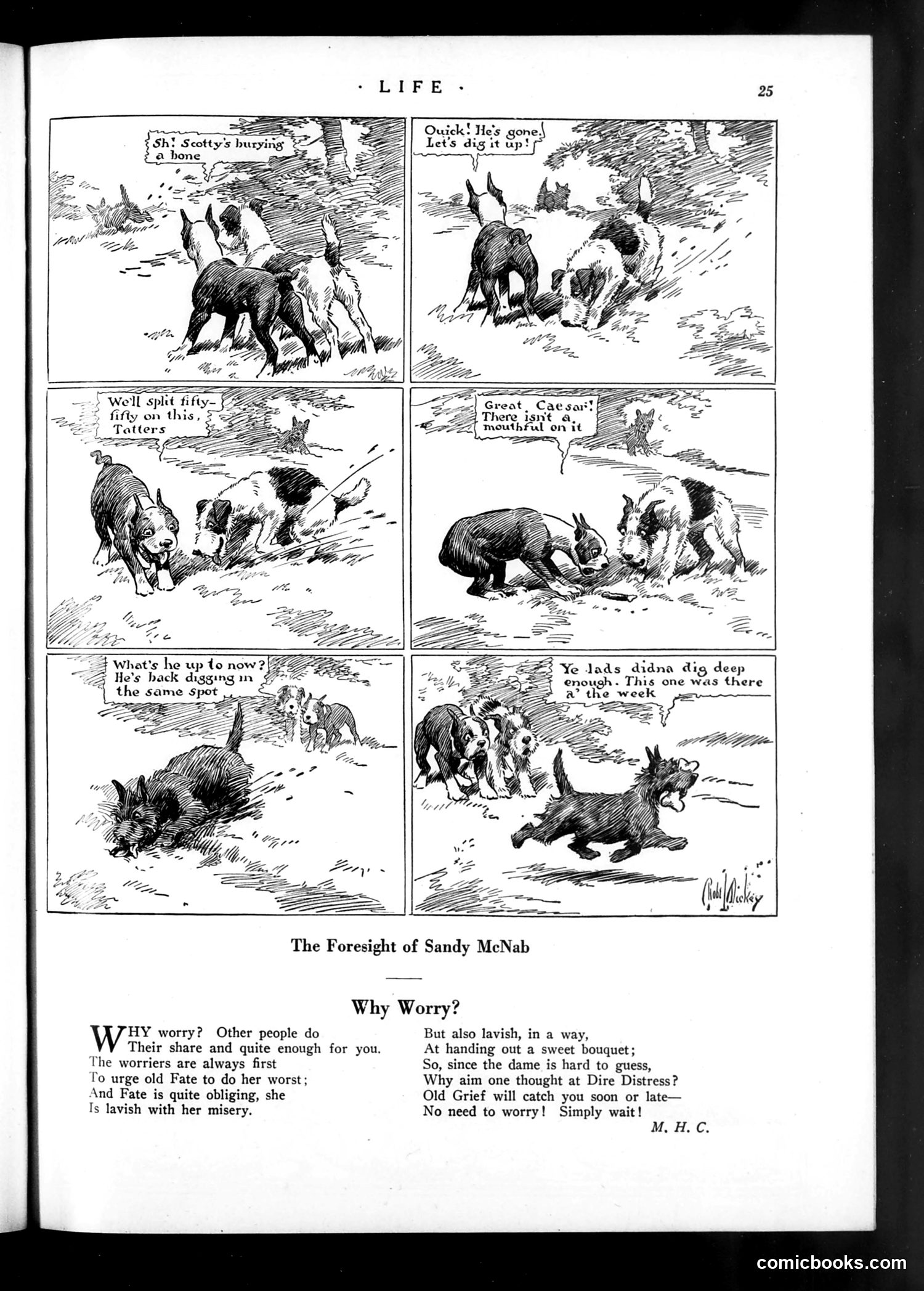
This six-panel comic depicts Scottish terriers (or similar dogs) burying and re-excavating a bone. The humor is situational rather than political: the dogs bury a bone, then one dog reports it's gone; they collectively dig it up, only to find it was buried too shallowly and has decomposed over a week. The Scottish dialect ("Scotty," "Ye lads," "didna") in the speech bubbles establishes the comic's ethnic humor style, common to early 20th-century American magazines. Below the comic, the poem "Why Worry?" (attributed M.H.C.) offers philosophical advice: worry is futile since fate will bring both good and bad regardless. The connection between the comic and poem is thematic—the dogs' futile effort parallels human anxious planning against inevitable misfortune. This represents typical *Life* magazine content: light humor with mild moralizing.
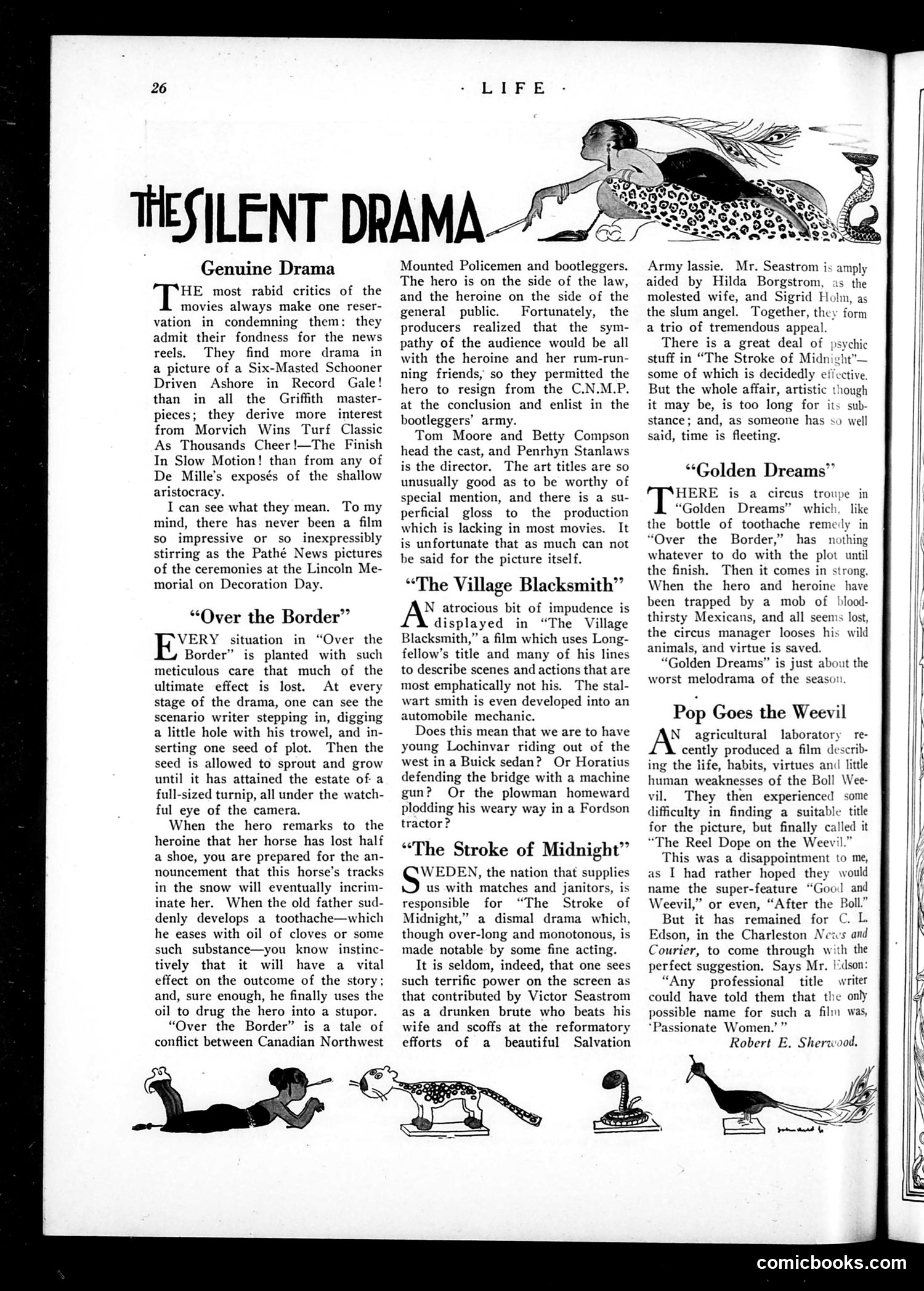
This page contains film criticism from Life's satirical column reviewing recent silent movies. The critic disparages overly-constructed plots in "Over the Border" (a Prohibition-era bootlegging tale), where he observes that every minor detail—a horse's lost shoe, a father's toothache—obviously foreshadows later plot developments, making the screenplay's manipulation transparent. He ridicules "The Village Blacksmith" for appropriating Longfellow's poem while updating it absurdly: the blacksmith becomes an auto mechanic, mocking Hollywood's modernization of classic literature. He praises "The Stroke of Midnight," a Swedish import featuring actor Victor Seastrom's powerful performance as a brutish drunk, finding genuine emotional power in this reformatory drama. The bottom decorative illustrations appear to be period-appropriate comic vignettes. Overall, this represents early 1920s film criticism emphasizing artificiality in American cinema versus authenticity in imported European films.
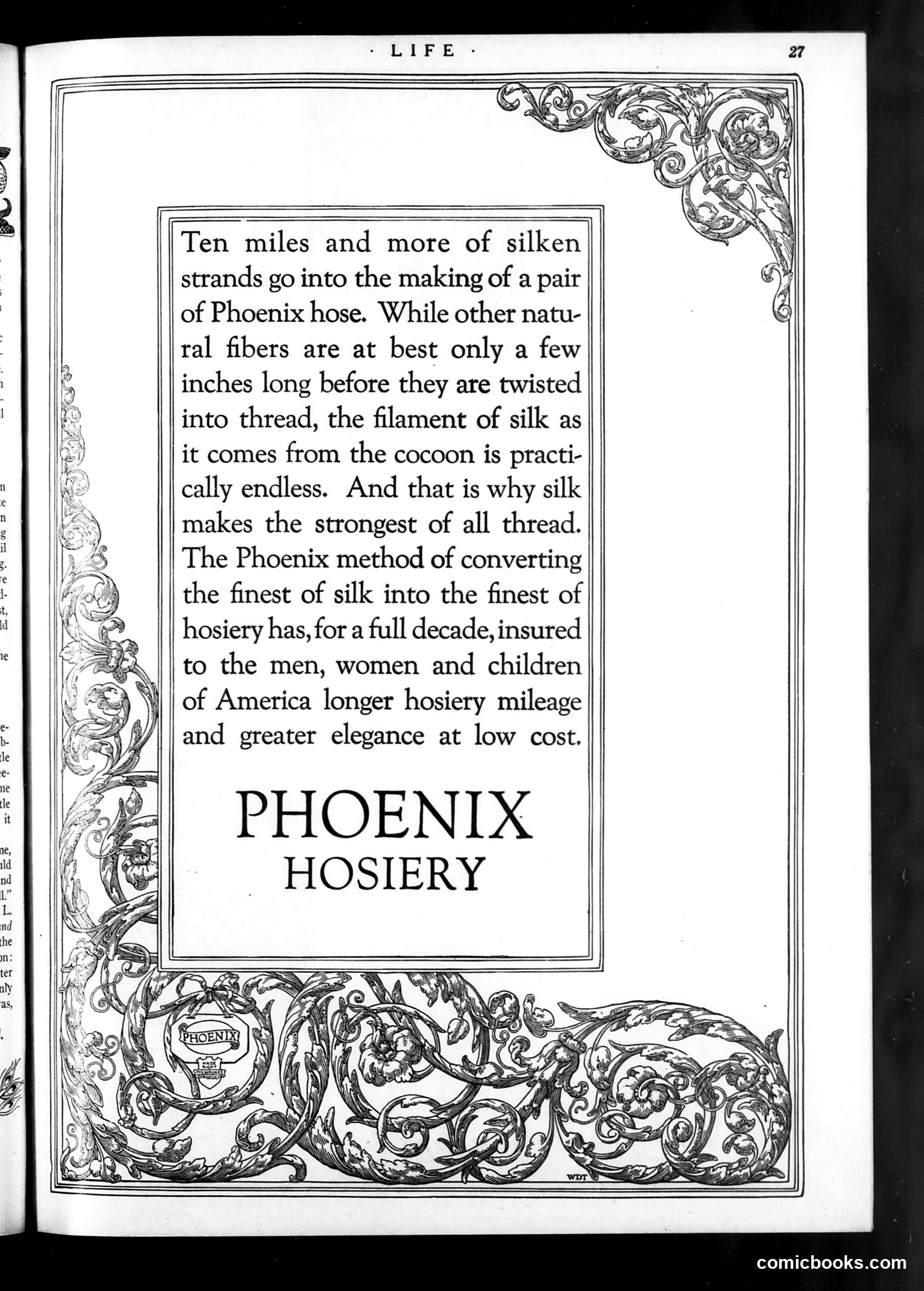
This is a **full-page advertisement**, not a cartoon or satire. It promotes Phoenix Hosiery, a silk stocking brand. The ad explains Phoenix's manufacturing advantage: silk filaments from cocoons are "practically endless," unlike other natural fibers, making silk thread stronger and longer-lasting. The text emphasizes that Phoenix has offered American consumers superior hosiery durability and style "for a full decade" at affordable prices. The ornate decorative borders and prominent branding are typical of early 20th-century advertising design in *Life* magazine. There is no political or satirical content—this is straightforward product marketing emphasizing material quality and value proposition to justify the product's cost to potential customers.
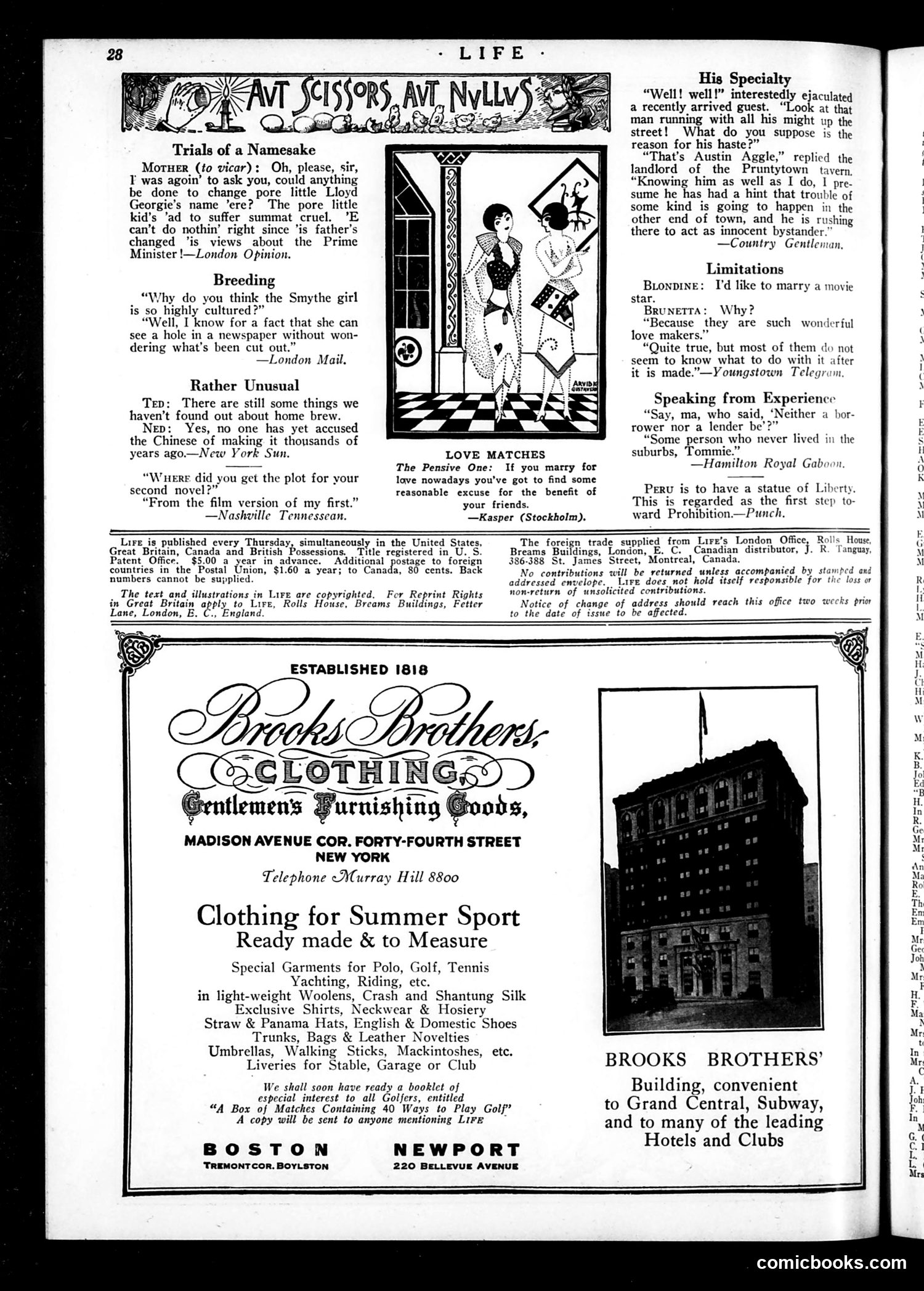
This page contains miscellaneous short humor pieces typical of early 20th-century satirical magazines, plus advertising. **Key humor items:** - **"Trials of a Namesake"**: A working-class mother asks a vicar to change her son's name from Lloyd George because the child suffers ridicule since his father changed political views about the Prime Minister. This references real political controversy surrounding British PM David Lloyd George. - **"Rather Unusual"**: Jokes about home brew and Chinese origins, reflecting Prohibition-era American humor. - **"His Specialty"**: Austin Aggle is portrayed as someone who rushes to scenes of trouble to appear as an "innocent bystander"—satirizing a recognizable character type. - **Other brief jokes** mock movie stars as lovers, suburban borrowing culture, and Peru's planned Liberty statue as a step toward prohibition. The page is primarily filler content between advertisements, including a substantial Brooks Brothers clothing ad featuring their Madison Avenue store building.
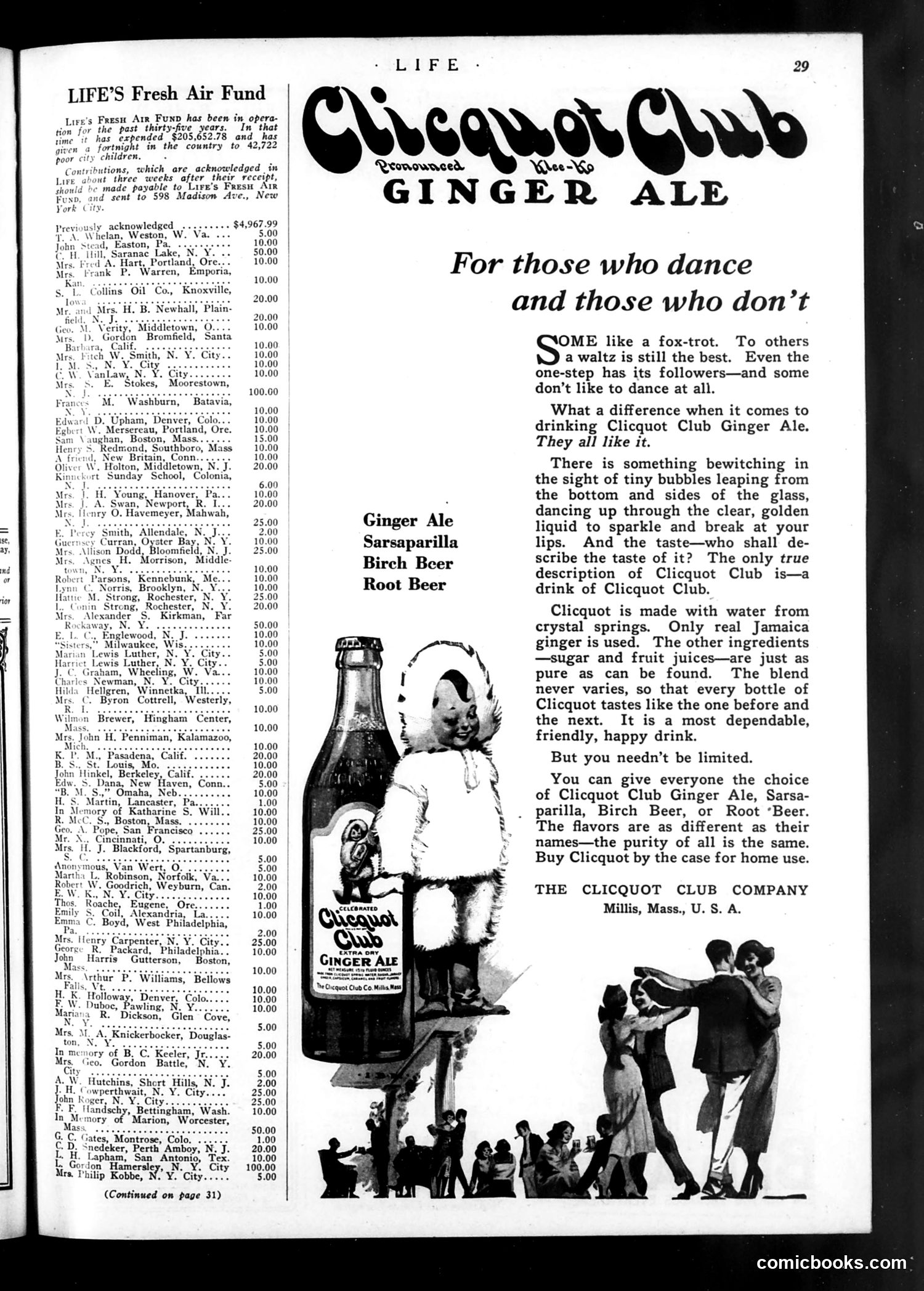
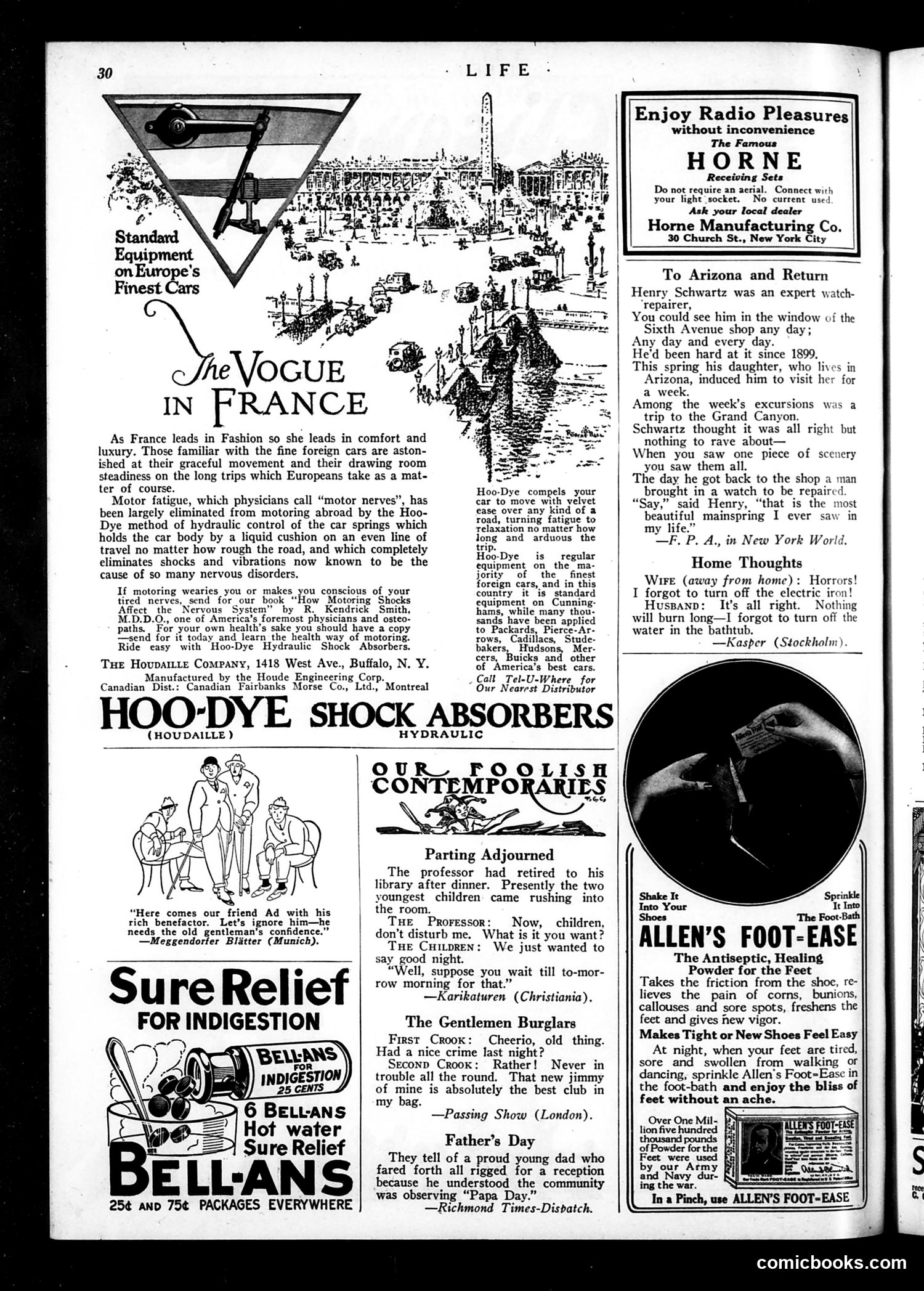
This page is primarily **advertising** for automotive and consumer products, with brief satirical vignettes scattered throughout. The main advertisement promotes **Hoo-Dye Hydraulic Shock Absorbers**, luxury car components that claim to eliminate "motor nerves"—the fatigue and nervous disorders caused by rough roads. The copy appeals to wealthy Americans by emphasizing that these suspensions are "standard equipment" on fine foreign cars and prestigious American models (Packards, Cadillacs, etc.). The small cartoons are typical *Life* humor: - "Sure Relief for Indigestion" satirizes advertising excess through Bellans antacids - "Our Foolish Contemporaries" mocks domestic scenes (a professor annoyed by children wanting to say goodnight; burglars discussing crime casually) - A brief anecdote about Henry Schwartz, a watchmaker unimpressed by the Grand Canyon but moved by a mainspring The page reflects 1920s consumer culture and class anxiety—wealthy motorists worried about health effects of automobiles while aspiring to Continental sophistication.
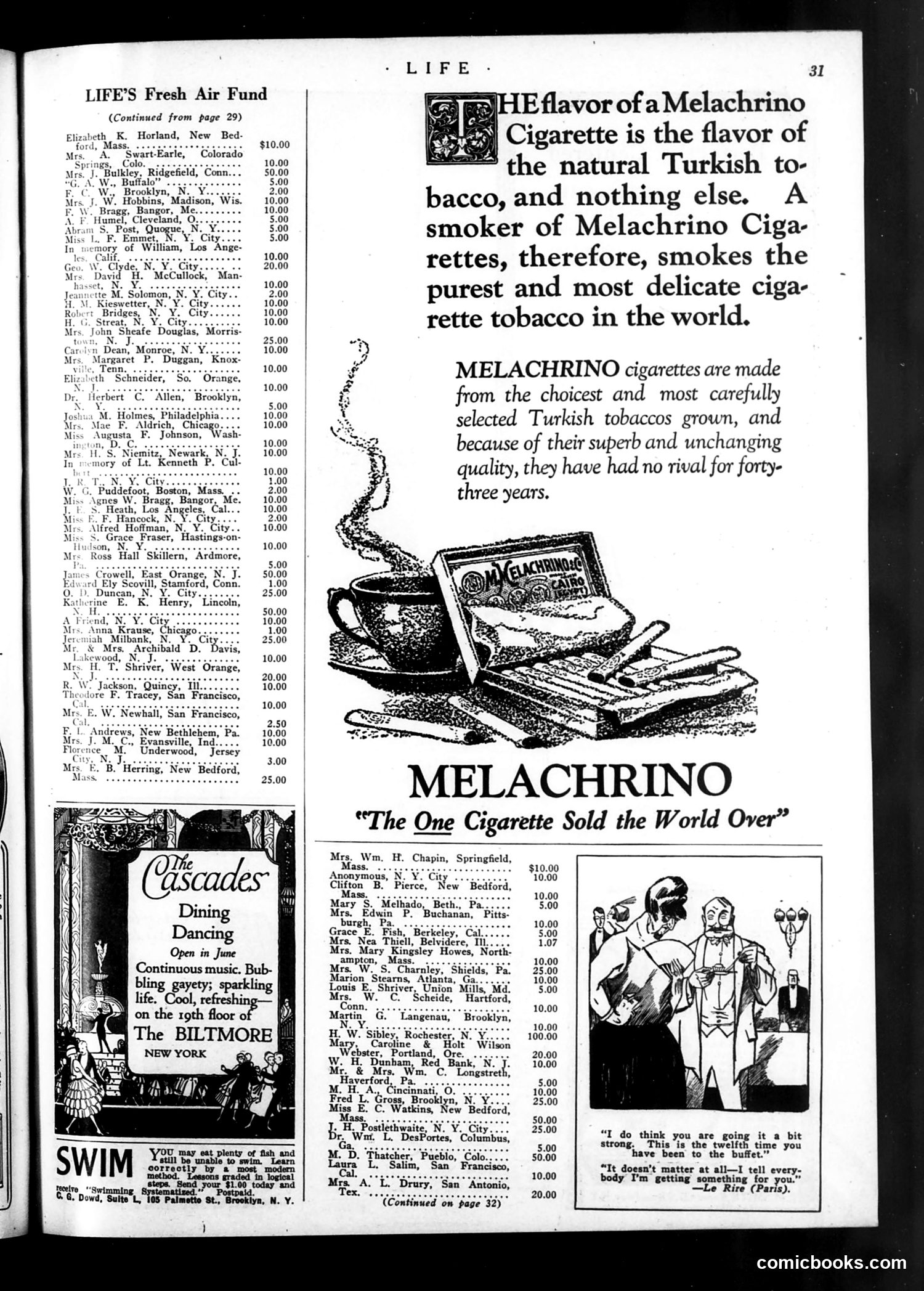
This page is primarily **advertising and a charity fund listing**, not political satire. The dominant content is a **Melachrino cigarette advertisement** claiming the brand uses "the purest and most delicate cigarette tobacco in the world"—specifically natural Turkish tobacco with "no rival for forty-three years." The ad features a decorative illustration of a smoking pipe and cigarettes. The left column contains the continuation of **LIFE's Fresh Air Fund**—a charitable donation list of individuals contributing to send underprivileged children to the countryside. At bottom right is a **small cartoon joke** (attributed to *Le Rire*, a French publication): A woman at a buffet tells a man he's visited twelve times; he responds he's "getting something for you," implying he's taking food home—a mild satire on cheapness or buffet excess. The Cascades nightclub advertisement promotes dining and dancing at the Biltmore in New York. This is representative mid-1920s *Life* content: charity appeals, luxury product advertising, and light humor.
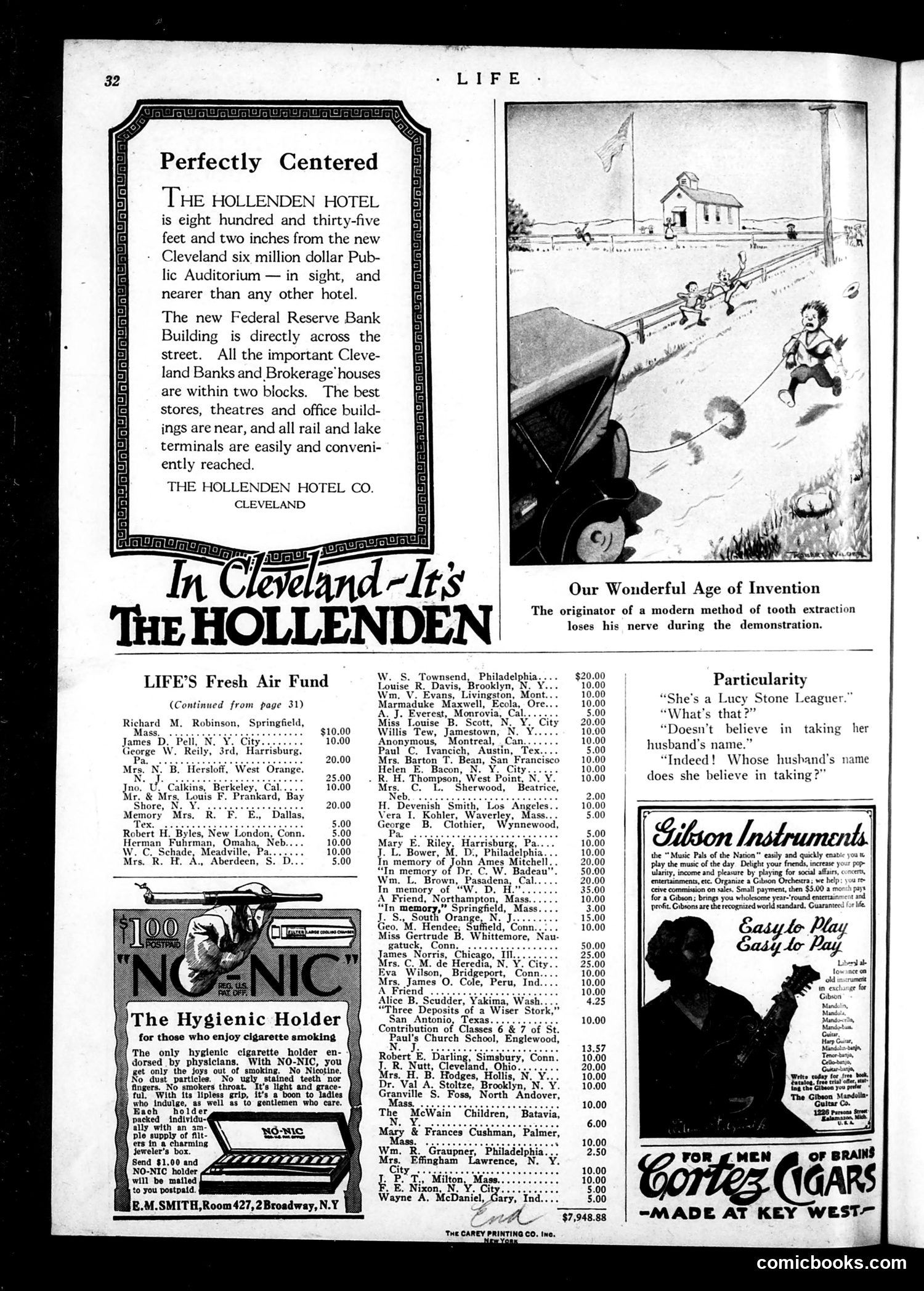
This single-panel cartoon satirizes modern dental technology by depicting a dentist demonstrating an innovative tooth extraction method to an audience. The humor lies in the ironic contrast: despite touting this as a marvel of modern invention, the dentist himself has "lost his nerve during the demonstration"—suggesting the procedure is either gruesome, painful, or otherwise alarming to witness. The cartoon reflects early 20th-century American skepticism toward progress and new inventions, even as they were celebrated. While ads on the page promote hotels, cigarette holders, and musical instruments as "modern methods," this cartoon undercuts such optimism by showing that newfangled devices don't necessarily improve human comfort or confidence. The joke satirizes both inventors' blind faith in technology and the public's anxiety about submitting to novel medical procedures.
I can see this appears to be a mostly blank page from Life magazine with some OCR artifacts and partial text visible along the left margin, but the OCR text provided is essentially unreadable—consisting only of scattered letters and symbols. The actual image shows what appears to be a blank or nearly blank page with some binding marks on the left side and what might be partial text or imagery at the very bottom edge that is too obscured to decipher clearly. Without legible text or visible cartoon content, I cannot identify specific figures, political references, or satirical points. To provide accurate historical context as requested, I would need a clearer image or legible OCR text from the actual article or cartoon on this page.