
Life, 1922-06-29 · page 20 of 35
Life — June 29, 1922 — page 20: what you’re looking at
What you’re looking at
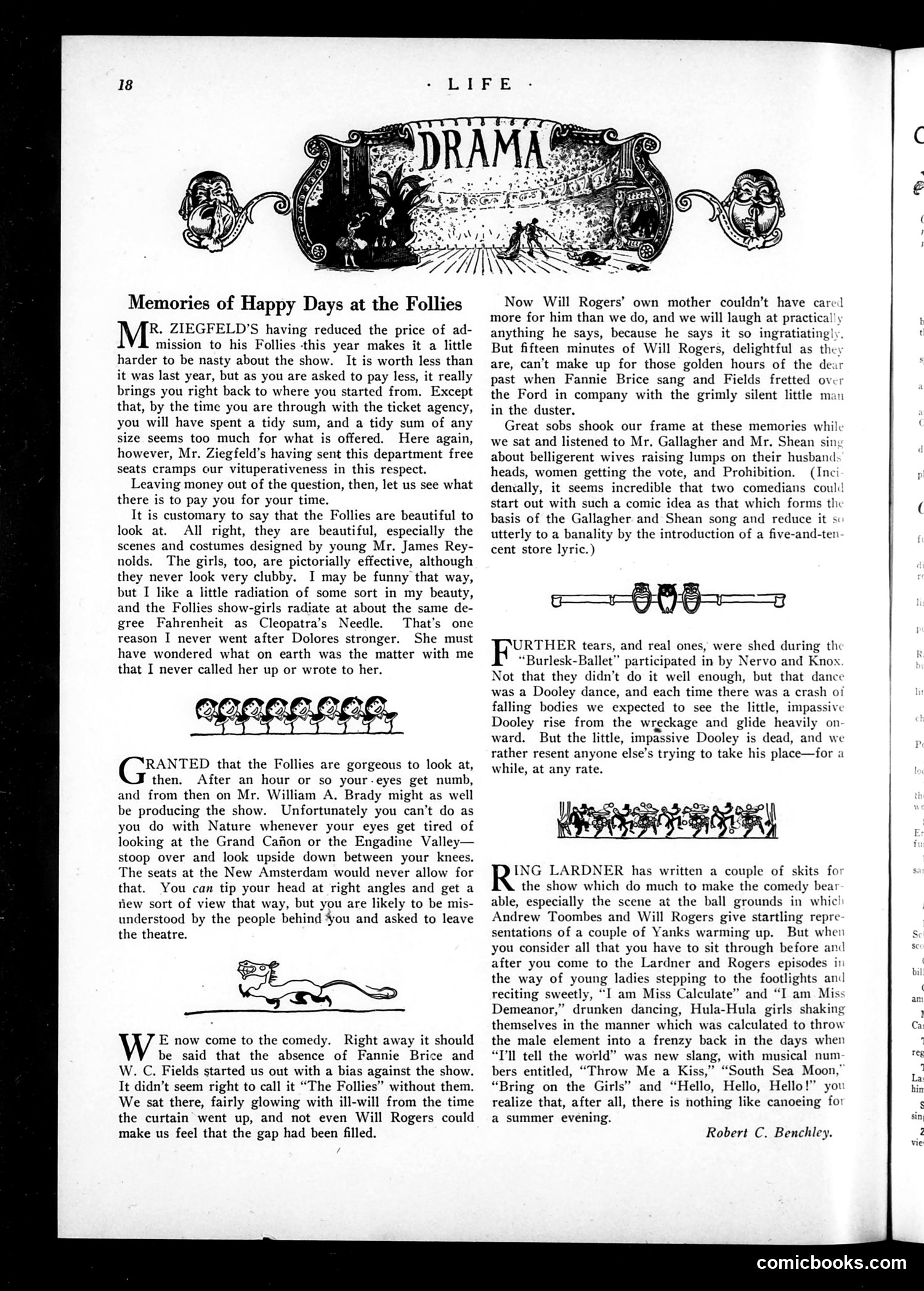
This is a theater review of the Ziegfeld Follies, a famous Broadway revue known for elaborate staging and chorus girls. The critic complains that while the *visual* production (designed by James Reynolds) is beautiful, the *comedy* has declined due to missing star performers. **Key figures mentioned:** - **Fannie Brice and W.C. Fields**: Popular comedians whose absence the critic deeply resents - **Will Rogers**: A beloved performer whose charm can't compensate for the missing stars - **Gallagher and Shean**: A comedy duo whose act the critic finds banal - **"Little, impassive Dooley"**: Appears to be a deceased performer the critic admired **The satire:** The reviewer uses emotional exaggeration—"great sobs shook our frame"—to mock both the show's sentimentality and their own nostalgia. They're essentially saying: the Follies are pretty but empty; without genuinely funny people, it's just expensive spectacle. The critic also admits bias (free tickets compromised their objectivity, as did their fondness for absent comedians).
📄 Transcribed text from this page (OCR, searchable)
Machine-transcribed from the original scan — historical spelling and the odd misread are preserved.
Memories of Happy Days at the Follies R, ZIEGFELD’S having reduced the price of ad- mission to his Follies this year makes it a little harder to be nasty about the show. It is worth less than it was last year, but as you are asked to pay less, it really brings you right back to where you started from. Except that, by the time you are through with the ticket agency, you will have spent a tidy sum, and a tidy sum of any size seems too much for what is offered. Here again, however, Mr. Ziegfeld’s having sent this department free seats cramps our vituperativeness in this respect. Leaving money out of the question, then, let us see what there is to pay you for your time. It is customary to say that the Follies are beautiful to look at. All right, they are beautiful, especially the scenes and costumes designed by young Mr. James Rey- nolds. The girls, too, are pictorially effective, although they never look very clubby. I may be funny that way, but I like a little radiation of some sort in my beauty, and the Follies show-girls radiate at about the same de- gree Fahrenheit as Cleopatra’s Needle. That's one reason I never went after Dolores stronger. She must have wondered what on earth was the matter with me that I never called her up or wrote to her. RANTED that the Follies are gorgeous to look at, then. After an hour or so your-eyes get numb, and from then on Mr. William A. Brady might as well be producing the show. Unfortunately you can’t do as you do with Nature whenever your eyes get tired of looking at the Grand Cafion or the Engadine Valley— stoop over and look upside down between your knees. The seats at the New Amsterdam would never allow for that. You can tip your head at right angles and get a tiew sort of view that way, but you are likely to be mis- understood by the people behind ‘you and asked to leave the theatre. E now come to the comedy. be said that the absence of Fannie Brice and W. C. Fields started us out with a bias against the show. It didn’t seem right to call it “The Follies” without them. We sat there, fairly glowing with ill-will from the time the curtain went up, and not even Will Rogers could make us feel that the gap had been filled. Right away it should Now Will Rogers’ own mother couldn’t have cared more for him than we do, and we will laugh at practical! y anything he says, because he says it so ingratiatingly. But fifteen minutes of Will Rogers, delightful as the) are, can’t make up for those golden hours of the dear past when Fannie Brice sang and Fields fretted ov the Ford in company with the grimly silent little man in the duster. Great sobs shook our frame at these memories while we sat and listened to Mr. Gallagher and Mr. Shean sing about belligerent wives raising lumps on their husband. heads, women getting the vote, and Prohibition. (Inc denvally, it seems incredible that two comedians coul start out with such a comic idea as that which forms th. basis of the Gallagher and Shean song and reduce it sv utterly to a banality by the introduction of a five-and-ten cent store lyric.) ——hG-—a 'URTHER tears, and real ones, were shed during th« “Burlesk-Ballet” participated in by Nervo and Knox Not that they didn’t do it weil enough, but that dance was a Dooley dance, and each time there was a crash of falling bodies we expected to see the little, impassive Dooley rise from the wreckage and glide heavily on ward. But the little, impassive Dooley is dead, and we rather resent anyone else’s trying to take his place—for a while, at any rate. able, especially the scene at the ball grounds in whic Andrew Toombes and Will Rogers give startling repre sentations of a couple of Yanks warming up. But when you consider all that you have to sit through before and after you come to the Lardner and Rogers episodes iti the way of young ladies stepping to the footlights an: reciting sweetly, “I am Miss Calculate” and “I am Miss Demeanor,” drunken dancing, Hula-Hula girls shaking themselves in the manner which was calculated to throw the male element into a frenzy back in the days when “T'll tell the world” was new slang, with musical num bers entitled, “Throw Me a Kiss,” “South Sea Moon, “Bring on the Girls” and “Hello, Hello, Hello!” you realize that, after all, there is nothing like canoeing for a summer evening. Robert C. Benchley. comicbooks.com