
Life, 1922-06-29 · page 24 of 35
Life — June 29, 1922 — page 24: what you’re looking at
What you’re looking at
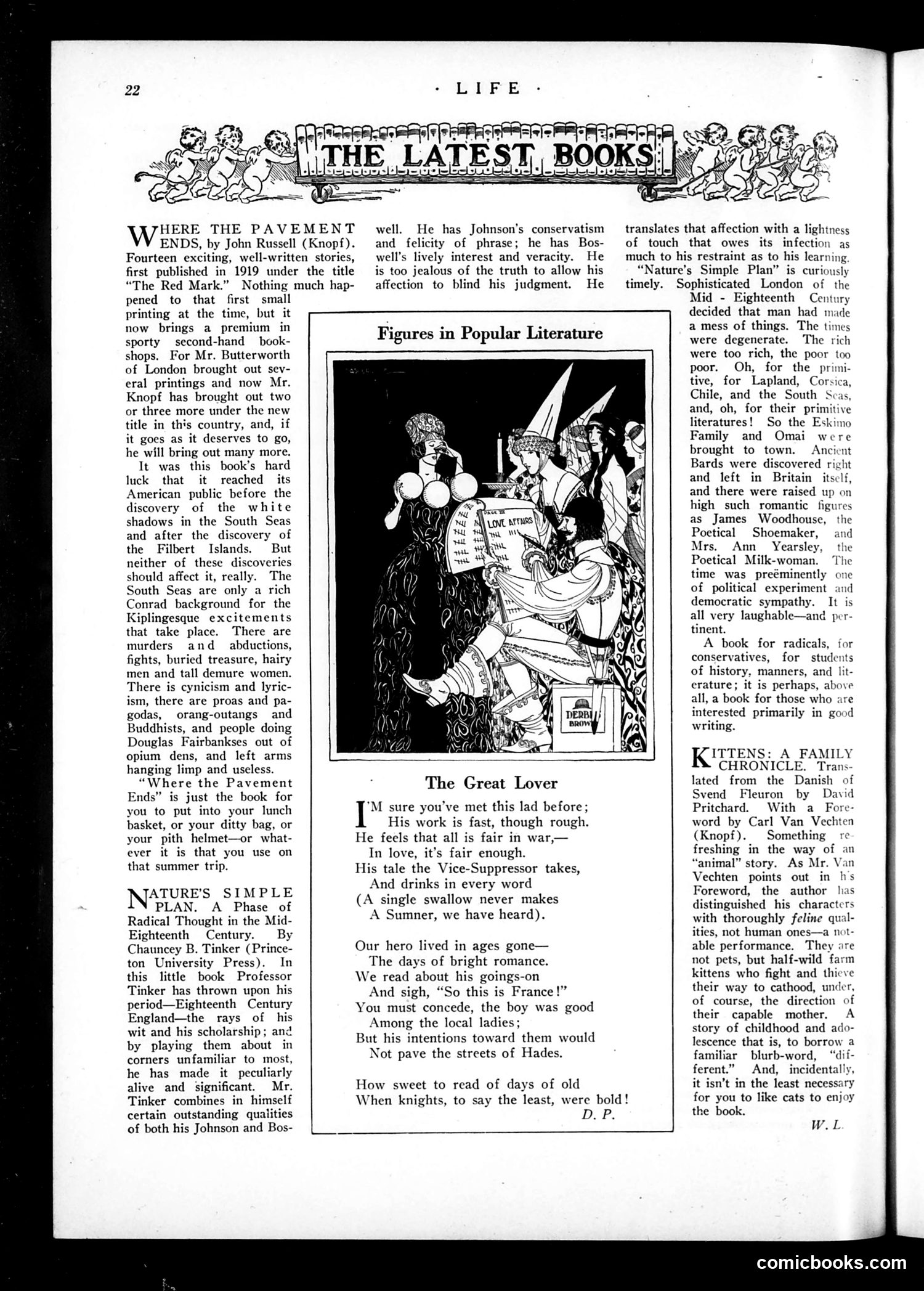
This is a book review section from *Life* magazine featuring three literary notices. The central illustration titled "Figures in Popular Literature" depicts a satirical scene of a young, attractive man being admired by three women—one labeled "Vice-Suppressor" who is reading about his romantic exploits. The accompanying poem "The Great Lover" mocks the romantic hero archetype popular in contemporary fiction: a morally dubious seducer whose behavior the "Vice-Suppressor" (likely a censor or moral crusader) paradoxically consumes eagerly. The satire suggests hypocrisy in moral gatekeeping—those claiming to suppress vice are fascinated by it. The reviews discuss books exploring adventure, romance, and 18th-century radical thought. The overall page satirizes popular literary tastes and the gap between professed moral standards and actual reading interests during this period.
📄 Transcribed text from this page (OCR, searchable)
Machine-transcribed from the original scan — historical spelling and the odd misread are preserved.
HERE THE PAVEMENT well. He has Johnson's conservatism ENDS, by John Russell (Knopf). Fourteen exciting, well-written stories, first published in 1919 under the title “The Red Mark.” Nothing much hap- pened to that first small printing at the time, but it now brings a premium in sporty second-hand book- shops. For Mr. Butterworth of London brought out sev- eral printings and now Mr. Knopf has brought out two or three more under the new title in this country, and, if it goes as it deserves to go, he will bring out many more. It was this book’s hard luck that it reached its American public before the discovery of the white shadows in the South Seas and after the discovery of the Filbert Islands. But neither of these discoveries should affect it, really. The South Seas are only a rich Conrad background for the Kiplingesque excitements that take place. There are murders and abductions, fights, buried treasure, hairy men and tall demure women. There is cynicism and lyric- ism, there are proas and pa- godas, orang-outangs and Buddhists, and people doing Douglas Fairbankses out of opium dens, and left arms hanging limp and useless. “Where the Pavement ds” is just the book for you to put into your lunch basket, or your ditty bag, or your pith helmet—or what- ever it is that you use on that summer trip. ATURE’S SIMPLE PLAN. A Phase of Radical Thought in the Mid- Eighteenth Century. By Chauncey B. Tinker (Prince- ton University Press). In this little book Professor Tinker has thrown upon his period—Eighteenth Century England—the rays of his wit and his scholarship; and by playing them about in corners unfamiliar to most, he has made it peculiarly alive and significant. Mr. Tinker combines in himself certain outstanding qualities of both his Johnson and Bos- and felicity of phrase; he has Bos- well’s lively interest and veracity. He is too jealous of the truth to allow his affection to blind his judgment. He r 3 Figures in Popular Literature The Great Lover "M sure you've met this lad before; His work is fast, though rough. He feels that all is fair in war,— In love, it’s fair enough. His tale the Vice-Suppressor takes, And drinks in every word (A single swallow never makes A Sumner, we have heard). Our hero lived in ages gone— The days of bright romance. We read about his goings-on And sigh, “So this is France!” You must concede, the boy was good Among the local ladies; But his intentions toward them would Not pave the streets of Hades. How sweet to read of days of old When knights, to say the least, were bold! DP: translates that affection with a lightness of touch much to his restraint as to his learning. “Nature’s Simple Plan” is curiously timely. Sophisticated London of the that owes its infection as Mid - Eighteenth Century decided that man had made a mess of things. The times were degenerate. The rich were too rich, the poor too poor. Oh, for the primi- tive, for Lapland, Corsica, Chile, and the South Scas, and, oh, for their primitive literatures! So the Eskimo Family and Omai were brought to town. Ancient Bards were discovered right and left in Britain itself, and there were raised up on high such romantic figures as James Woodhouse, the Poetical Shoemaker, nd Mrs. Ann Yearsley, Poetical Milk-woman. The time was preéminently one of political experiment democratic sympathy. It is all very laughable—and per- tinent. A book for radicals, for conservatives, for students of history, manners, and lit- erature; it is perhaps, above all, a book for those who are interested primarily in good writing. ITTENS: A FAMILY CHRONICLE. Trans- lated from the Danish of Svend Fleuron by David Pritchard. With a Fore- word by Carl Van Vechten (Knopf). Something — re freshing in the way of an “animal” story. As Mr. Van Vechten points out in hs Foreword, the author lias distinguished his characters with thoroughly feline qual- ities, not human ones—a not- able performance. They are not pets, but half-wild farm kittens who fight and thieve their way to cathood, under, of course, the direction of their capable mother, A story of childhood and ado- lescence that is, to borrow a familiar blurb-word, “dif- ferent.” And, incidental! it isn’t in the least neces: for you to like cats to enjoy the book. W.L comicbooks.com