
Life, 1922-06-29 · page 21 of 35
Life — June 29, 1922 — page 21: what you’re looking at
What you’re looking at
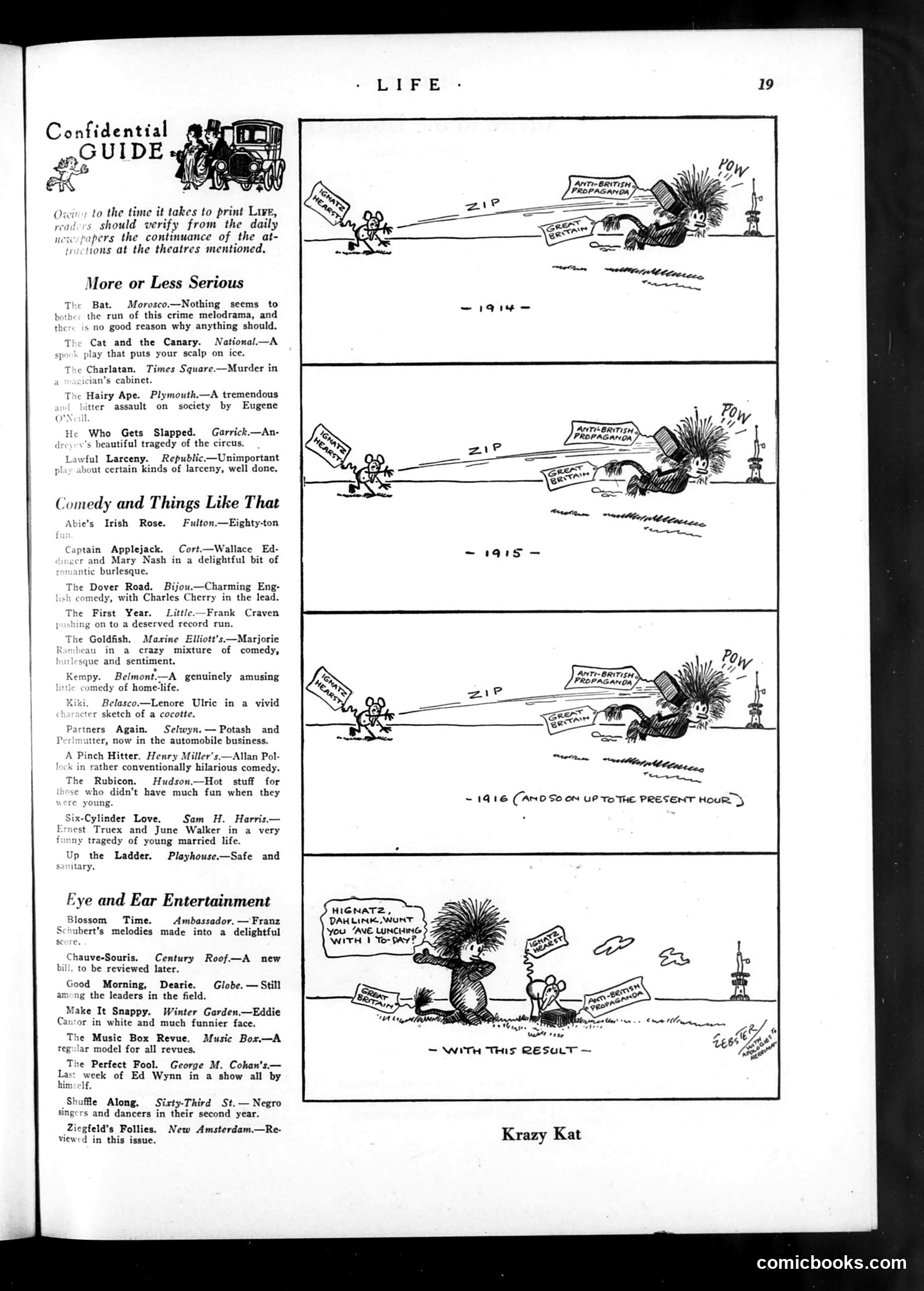
This comic strip satirizes American preparedness anxieties in the immediate post-WWI era (dates shown: 1914-1916). The sequence depicts an escalating cycle: **The figures**: A character labeled "Anti-British Propaganda" pursues what appears to be a figure representing American interests or policy, while "Krazy Kat" (the strip's protagonist) observes from the sidelines. **The satire**: Each panel shows the same chase repeating with intensifying speed and fury, culminating in chaos. The final panel shows the result: apparent diplomatic breakdown or social discord ("with this result"). **The point**: The cartoon mocks how anti-British propaganda campaigns and counter-responses spiral endlessly, escalating tensions without resolution. The repetitive panels suggest futility and self-perpetuation of conflict rhetoric. This reflects 1920s American debates over neutrality, British-American relations, and the lingering effects of World War I propaganda—concerns very much alive in the postwar period depicted here.
📄 Transcribed text from this page (OCR, searchable)
Machine-transcribed from the original scan — historical spelling and the odd misread are preserved.
Confidential ,GUIDE a Owin to the time it takes to print Live, reads should verify from the daily newspapers the continuance of the at- tructions at the theatres mentioned. More or Less Serious The Bat. Morosco.—Nothing seems to bothe: the run of this crime melodrama, and there is no good reason why anything should. The Cat and the Canary. National.—A y that puts your scalp on ice. The Charlatan, Times Square.—Murder in ‘ ian’s cabinet. The Hairy Ape. Plymouth.—A tremendous tter assault on society by Eugene ANTRBRITISH, He Who Gets Slapped. Garrick.—An- eceRerise dvesov's beautiful tragedy of the circus, wful Larceny. Republic—Unimportant bout certain kinds of larceny, well done. Comedy and Things Like That Abie’s Irish Rose. Fulton.—Eighty-ton sptain Applejack. Cort.—Wallace_Ed- ser and Mary Nash in a delightful bit of ntic burlesque. The Dover Road. Bijou.—Charming Eng- comedy, with Charles Cherry in the lead. The First Year. Little.—Frank Craven ng on to a deserved record run. he Goldfish. Maxine Elliott’s.—Marjorie mbeat in a crazy mixture of comedy, | burlesque and sentiment. Kempy. Belmonf.—A genuinely amusing omedy of homellife. Belasco.—Lenore Ulric in a vivid r sketch of a cocotte. Partners Again. Selwyn. — Potash and Perlmutter, now in the automobile business. A Pinch Hitter. Henry Miller’s.—Allan Pol- x in rather conventionally hilarious comedy. The Rubicon. Hudson.—Hot stuff for e who didn’t have much fan when they young. Six-Cylinder Love. Sam H. Harris.— est Truex and June Walker in a very tragedy of young married life. Jp the Ladder. Playhouse—Safe and sanitary, ~ 1416 (AND S0 ON UP TOTHE PRESENT HouR) Eye and Ear Entertainment Blossom Time. Ambassador. Franz bert’s melodies made into a delightful HIGNaAT2, DAH LINK, WUNT You “AVE LUNCHING WITH 1 To: DAY? Chauve-Souris, Century Roof—A new bill, to be reviewed later. Good Morning, Dearie. Globe. — Still among the leaders in the field. ake It Snappy. Winter Garden.—Eddie or in white and much funnier face. The Music Box Revue. Music Bor.—A regular model for all revues. The Perfect Fool. George M. Cohan’s— Las: week of Ed Wynn in a show all by himeelf. Shuffle Along, Sixty-Third St. — Negro singers and dancers in their second year. Ziegfeld’s Follies. New Amsterdam.—Re- viewed in this issue. Krazy Kat Ca — WiTH THis RESULT — comicbooks.com