
Life, 1922-06-29 · page 4 of 35
Life — June 29, 1922 — page 4: what you’re looking at
What you’re looking at
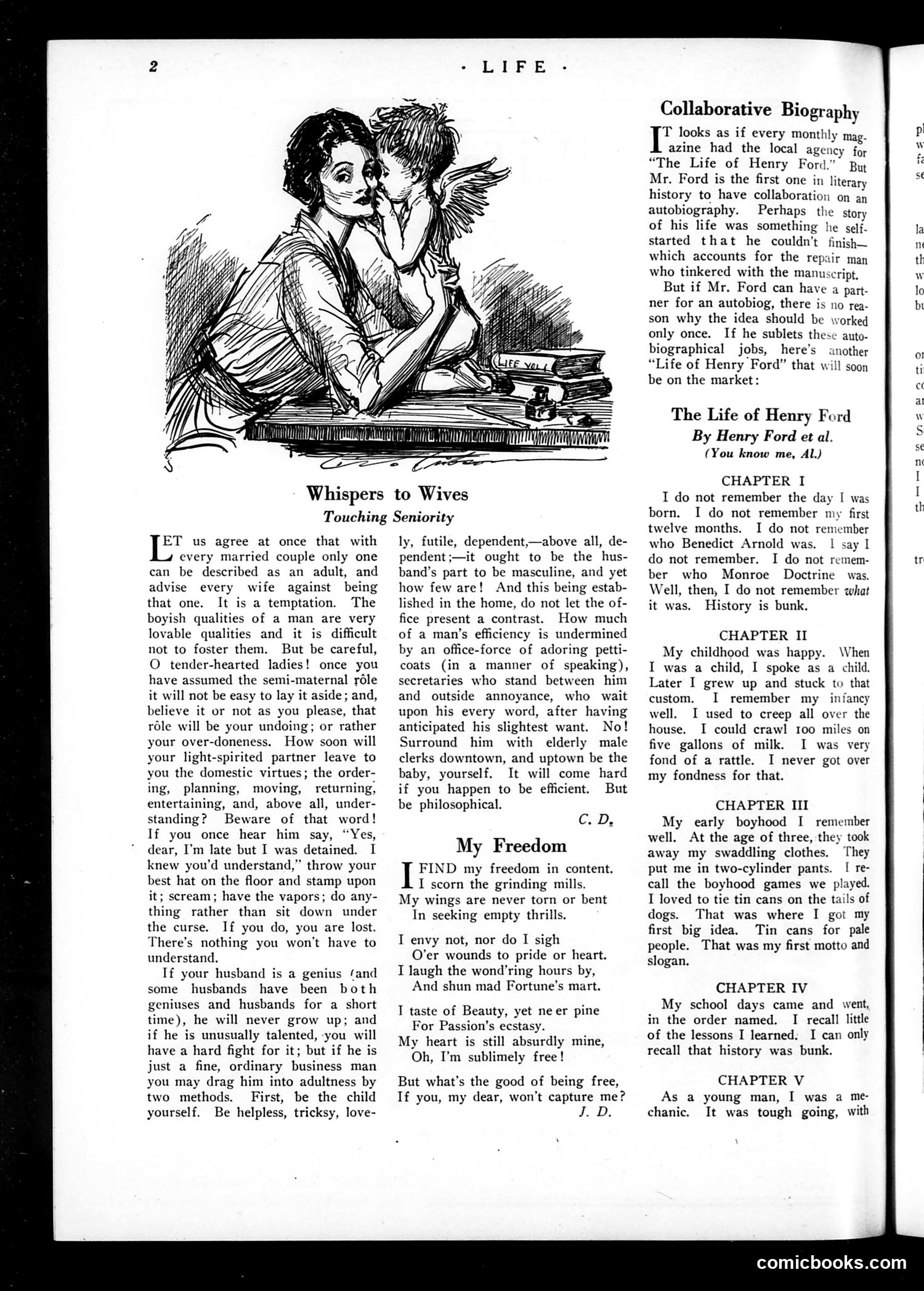
This page contains satirical content from *Life* magazine addressing marriage dynamics and gender roles. The illustration shows a cherub or cupid figure with a woman, accompanying the column "Whispers to Wives: Touching Seniority." The satire targets married women, advising them to avoid becoming "adoring petticoats" who undermine their husbands' efficiency through excessive deference. The author (signed "C.D.") argues that wives should not adopt an entirely submissive domestic role, warning that over-mothering husbands makes them dependent and ineffective. Below this is a poem titled "My Freedom" (signed "J.D.") presenting a contrasting perspective—a man asserting his independence and resistance to romantic capture. The page also begins "The Life of Henry Ford," a collaborative autobiography of the industrialist. The satire's core joke appears to be the ironic tension between advocating for wives' assertiveness while simultaneously publishing Ford's self-aggrandizing life story.
📄 Transcribed text from this page (OCR, searchable)
Machine-transcribed from the original scan — historical spelling and the odd misread are preserved.
Whispers to Wives Touching Seniority ET us agree at once that with every married couple only one can be described as an adult, and advise every wife against being that one. It is a temptation. The boyish qualities of a man are very lovable qualities and it is difficult not to foster them. But be careful, O tender-hearted ladies! once you have assumed the semi-maternal réle it will not be easy to lay it aside; and, believe it or not as you please, that role will be your undoing; or rather your over-doneness. How soon will your light-spirited partner leave to you the domestic virtues; the order- ing, planning, moving, returning, entertaining, and, above all, under- standing? Beware of that word! If you once hear him say, “Yes, dear, I’m late but I was detained. I knew you'd understand,” throw your best hat on the floor and stamp upon it; scream; have the vapors; do any- thing rather than sit down under the curse. If you do, you are lost. There’s nothing you won't have to understand. If your husband is a genius ‘and some husbands have been both geniuses and husbands for a short time), he will never grow up; and if he is unusually talented, -you will have a hard fight for it; but if he is just a fine, ordinary business man you may drag him into adultness by two methods. First, be the child yourself. Be helpless, tricksy, love- ly, futile, dependent,—above all, de- pendent ;—it ought to be the hus- band’s part to be masculine, and yet how few are! And this being estab- lished in the home, do not let the of- fice present a contrast. How much of a man’s efficiency is undermined by an office-force of adoring petti- coats (in a manner of speaking), secretaries who stand between him and outside annoyance, who wait upon his every word, after having anticipated his slightest want. No! Surround him with elderly male clerks downtown, and uptown be the baby, yourself. It will come hard if you happen to be efficient. But be philosophical. C.D, My Freedom FIND my freedom in content. I scorn the grinding mills. My wings are never torn or bent In seeking empty thrills. I envy not, nor do I sigh O’er wounds to pride or heart. I laugh the wond’ring hours by, And shun mad Fortune's mart. I taste of Beauty, yet neer pine For Passion’s ecstasy. My heart is still absurdly mine, Oh, I'm sublimely free! But what's the good of being free, If you, my dear, won't capture me? Ind, Collaborative Biography le looks as if every monthly mag- azine had the local agency for “The Life of Henry Ford.” But Mr. Ford is the first one in literary history to have collaboration on an autobiography. Perhaps the story of his life was something he seli- started that he couldn't finish— which accounts for the repair man who tinkered with the manuscript, But if Mr. Ford can have a part- ner for an autobiog, there is no rea- son why the idea should be worked only once. If he sublets these auto- biographical jobs, here’s another “Life of Henry Ford” that will soon be on the market: The Life of Henry Ford By Henry Ford et al. (You know me, Al.) CHAPTER I I do not remember the day I was born. I do not remember my first twelve months. I do not remember who Benedict Arnold was. | say I do not remember. I do not remem- ber who Monroe Doctrine was. Well, then, I do not remember what it was. History is bunk. CHAPTER II My childhood was happy. When I was a child, I spoke as a child. Later I grew up and stuck to that custom. I remember my _ infancy well. I used to creep all over the house. I could crawl roo miles on five gallons of milk. I was very fond of a rattle. I never got over my fondness for that. CHAPTER III My early boyhood I remember well. At the age of three, they took away my swaddling clothes. They put me in two-cylinder pants. [| re- call the boyhood games we played. I loved to tie tin cans on the tails of dogs. That was where I got my first big idea. Tin cans for pale people. That was my first motto and slogan. CHAPTER IV My school days came and went, in the order named. I recall little of the lessons I learned. I can only recall that history was bunk. CHAPTER V As a young man, I was a me- chanic. It was tough going, with comicbooks.com