
Life, 1922-06-29 · page 28 of 35
Life — June 29, 1922 — page 28: what you’re looking at
What you’re looking at
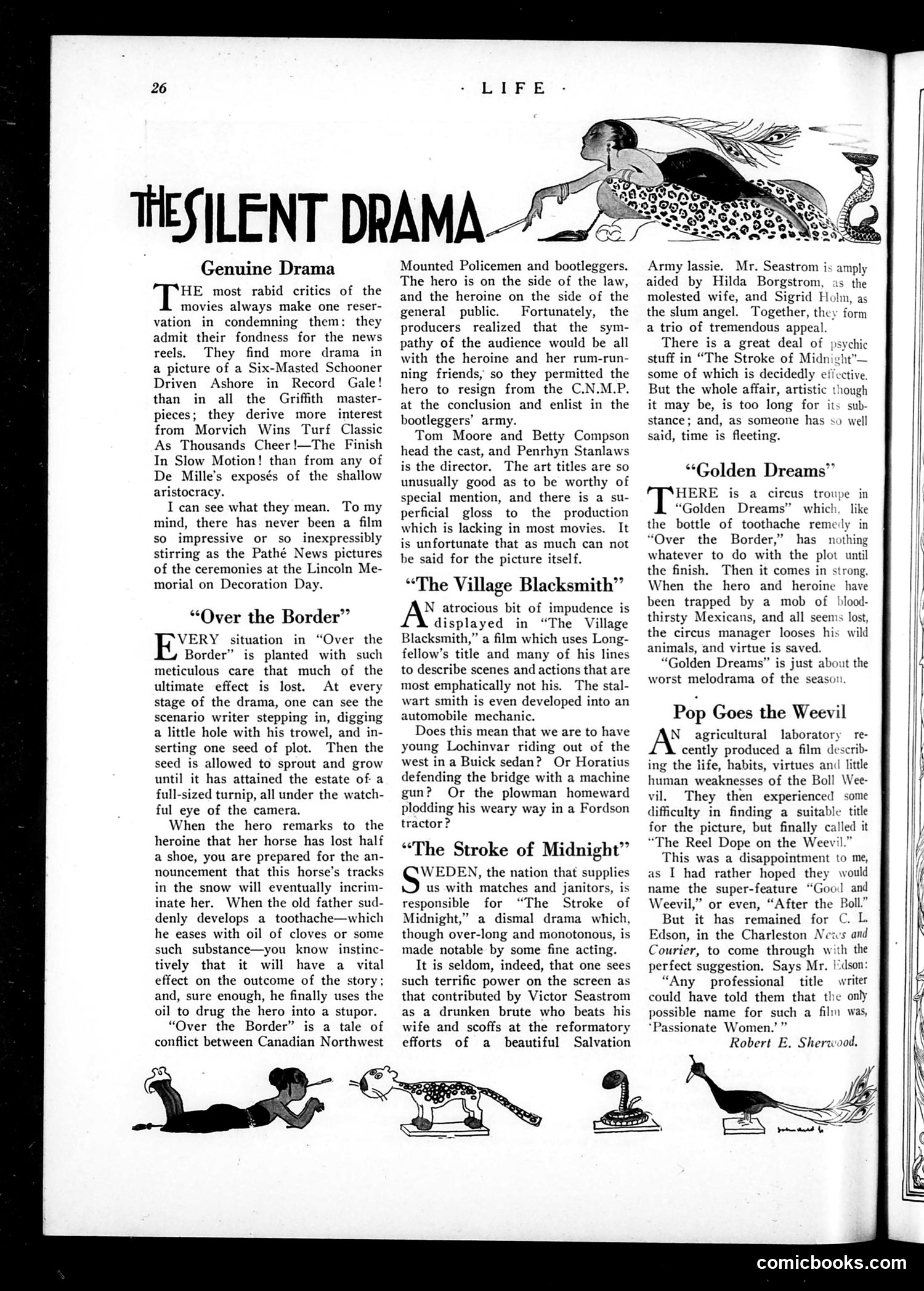
This page contains film criticism from Life's satirical column reviewing recent silent movies. The critic disparages overly-constructed plots in "Over the Border" (a Prohibition-era bootlegging tale), where he observes that every minor detail—a horse's lost shoe, a father's toothache—obviously foreshadows later plot developments, making the screenplay's manipulation transparent. He ridicules "The Village Blacksmith" for appropriating Longfellow's poem while updating it absurdly: the blacksmith becomes an auto mechanic, mocking Hollywood's modernization of classic literature. He praises "The Stroke of Midnight," a Swedish import featuring actor Victor Seastrom's powerful performance as a brutish drunk, finding genuine emotional power in this reformatory drama. The bottom decorative illustrations appear to be period-appropriate comic vignettes. Overall, this represents early 1920s film criticism emphasizing artificiality in American cinema versus authenticity in imported European films.
📄 Transcribed text from this page (OCR, searchable)
Machine-transcribed from the original scan — historical spelling and the odd misread are preserved.
THESILENT DRAMA Genuine Drama HE most rabid critics of the movies always make one reser- vation in condemning them: they admit their fondness for the news reels. They find more drama in a picture of a Six-Masted Schooner Driven Ashore in Record Gale! than in all the Griffith master- pieces; they derive more interest from Morvich Wins Turf Classic As Thousands Cheer!—The Finish In Slow Motion! than from any of De Mille’s exposés of the shallow aristocracy. I can see what they mean. To my mind, there has never been a film so impressive or so inexpressibly stirring as the Pathé News pictures of the ceremonies at the Lincoln Me- morial on Decoration Day. “Over the Border” VERY situation in “Over the Border” is planted with such meticulous care that much of the ultimate effect is lost. At every stage of the drama, one can see the scenario writer stepping in, digging a little hole with his trowel, and in- serting one seed of plot. Then the seed is allowed to sprout and grow until it has attained the estate of a full-sized turnip, all under the watch- ful eye of the camera. When the hero remarks to the heroine that her horse has lost half a shoe, you are prepared for the an- nouncement that this horse’s tracks in the snow will eventually incrim- inate her. When the old father sud- denly develops a toothache—which he eases with oil of cloves or some such substance—you know instinc- tively that it will have a_ vital effect on the outcome of the story; and, sure enough, he finally uses the oil to drug the hero into a stupor. “Over the Border” is a tale of conflict between Canadian Northwest @ Mounted Policemen and bootleggers. The hero is on the side of the law, and the heroine on the side of the general public. Fortunately, the producers realized that the sym- pathy of the audience would be all with the heroine and her rum-run- ning friends, so they permitted the hero to resign from the C.N.M.P. at the conclusion and enlist in the bootleggers’ army. Tom Moore and Betty Compson head the cast, and Penrhyn Stanlaws is the director. The art titles are so unusually good as to be worthy of special mention, and there is a su- perficial gloss to the production which is lacking in most movies. It is unfortunate that as much can not be said for the picture itself. “The Village Blacksmith” N atrocious bit of impudence is displayed in “The Village Blacksmith,” a film which uses Long- fellow’s title and many of his lines to describe scenes and actions that are most emphatically not his. The stal- wart smith is even developed into an automobile mechanic. Does this mean that we are to have young Lochinvar riding out of the west in a Buick sedan? Or Horatius defending the bridge with a machine gun? Or the plowman homeward plodding his weary way in a Fordson tractor? “The Stroke of Midnight” WEDEN, the nation that supplies us with matches and janitors, is responsible for “The Stroke of Midnight,” a dismal drama which, though over-long and monotonous, is made notable by some fine acting. It is seldom, indeed, that one sees such terrific power on the screen as that contributed by Victor Seastrom as a drunken brute who beats his wife and scoffs at the reformatory efforts of a beautiful Salvation Army lassie. Mr. Seastrom is amply aided by Hilda Borgstrom, as the molested wife, and Sigrid Holm, as the slum angel. Together, they form a trio of tremendous appeal. There is a great deal of hic stuff in “The Stroke of Midnight’— some of which is decidedly effective. But the whole affair, artistic though it may be, is too long for its sub- stance; and, as someone has so well said, time is fleeting. “Golden Dreams” HERE is a circus troupe in “Golden Dreams” which, like the bottle of toothache remeiy in “Over the Border,” has nothing whatever to do with the plot until the finish. Then it comes in strong. When the hero and heroine have been trapped by a mob of blood- thirsty Mexicans, and all seems lost, the circus manager looses his wild animals, and virtue is saved. “Golden Dreams” is just about the worst melodrama of the season. Pop Goes the Weevil maN agricultural laboratory re- cently produced a film describ- ing the life, habits, virtues and little human weaknesses of the Boll Wee- vil. They then experienced some difficulty in finding a suitable for the picture, but finally c: “The Reel Dope on the Weev This was a disappointment to me, as I had rather hoped they would name the super-feature “Good and Weevil,” or even, “After the Boll.” But it has remained for C. L Edson, in the Charleston News and Courier, to come through with the perfect suggestion. Says Mr. |dson: “Any professional title writer could have told them that the only possible name for such a film was, ‘Passionate Women.’ ” Robert E. Sherwood. —— Sa comicbooks.com