
A complete issue · 34 pages · 1922
Life — June 1, 1922
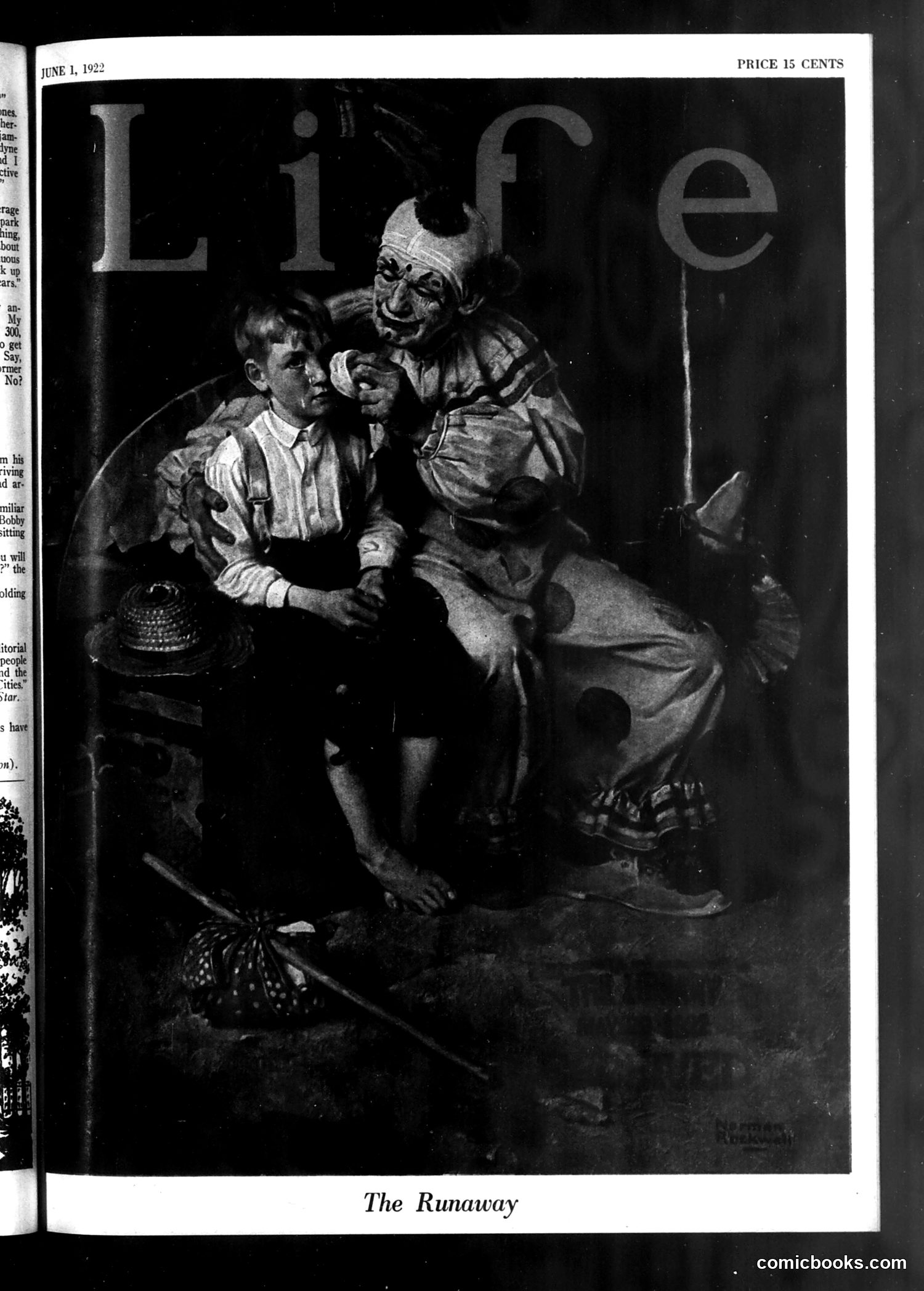
This illustration depicts a scene titled "The Runaway," showing a young boy being caught or confronted by a figure in jester's or clown's costume with an exaggerated grin. The jester holds the child's arm while gesturing expressively. The satire likely comments on childhood mischief or truancy—a "runaway" child being apprehended. The jester costume suggests foolishness or that running away is foolish behavior. The theatrical, menacing quality of the clown's expression contrasts darkly with the innocent child, possibly satirizing how adults (represented by the fool/authority figure) pursue or punish children's minor transgressions. Without additional context from the magazine's editorial content, the precise political or social reference remains unclear, though it appears to comment on youth behavior and adult responses.
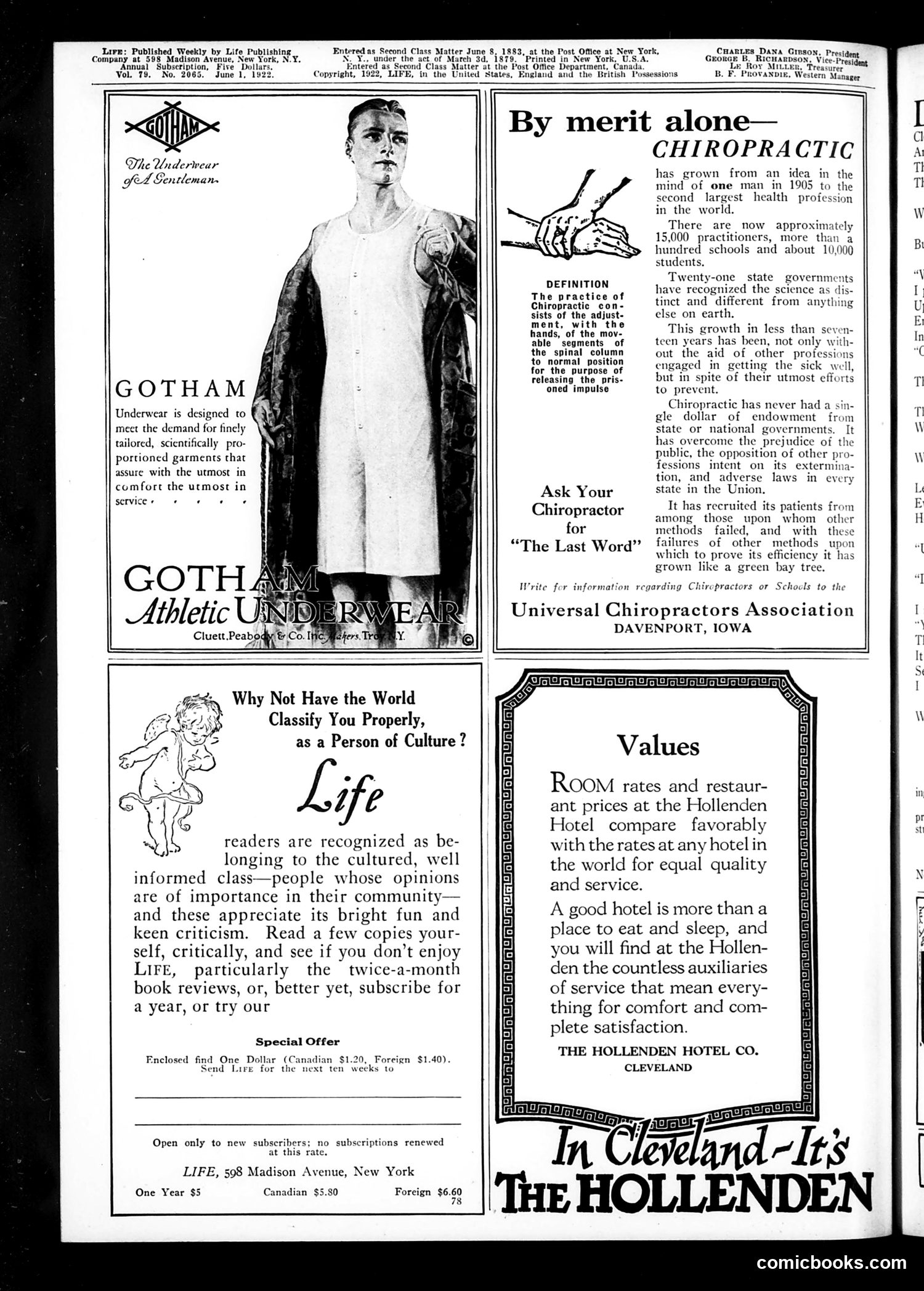
This page is primarily **advertising**, not satire or political commentary. The left side features ads for **Gotham Athletic Underwear** (showing a man in undershirt and long underwear) and a subscription pitch for *Life* magazine itself, emphasizing it as reading for "cultured" people. The right side promotes **chiropractic medicine** as an emerging health profession (approximately 15,000 practitioners by this date), and a hotel advertisement for Cleveland's Hollenden Hotel. The only potentially satirical element is the *Life* magazine ad's claim that readers are "people of culture" whose "opinions are of importance"—a somewhat tongue-in-cheek appeal to vanity aimed at persuading people to subscribe. The magazine positions itself as essential reading for the intellectually refined.
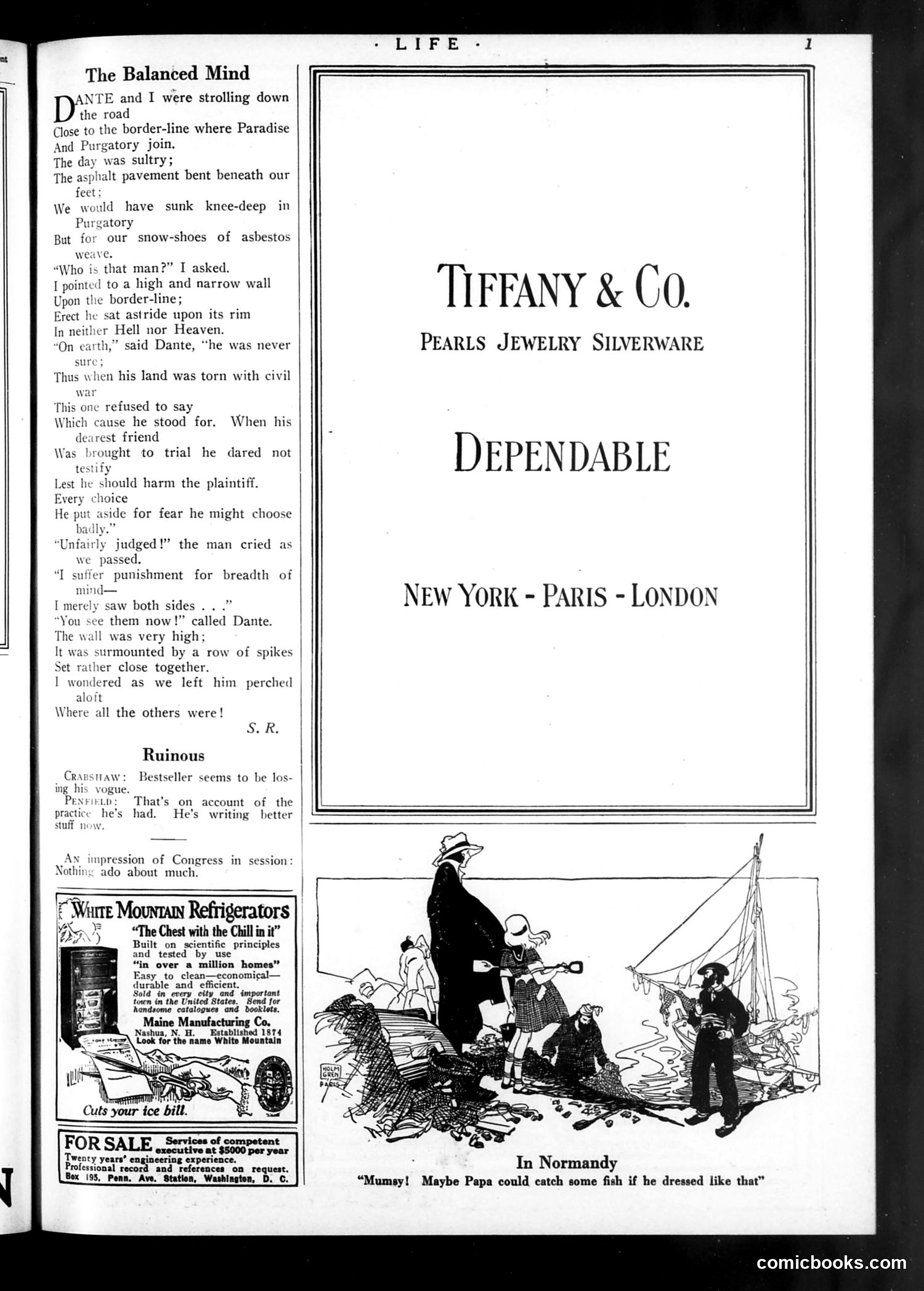
This page contains primarily **advertisements and literary content** rather than political cartoons. The main text feature is "The Balanced Mind," a poem by S.R. referencing Dante's Inferno, contrasting Paradise and Purgatory. Below it is a brief satirical exchange labeled "Ruinous," joking about a bestselling author losing his vogue due to practice. The cartoon at bottom, titled "In Normandy," shows a humorous domestic scene: a woman suggests her husband ("Papa") dress differently to catch fish, implying his formal attire is unsuitable for fishing. This is **gentle social satire** about fashion and gender roles—wives instructing husbands on proper dress. The page is otherwise dominated by **luxury brand advertising** (Tiffany & Co., White Mountain Refrigerators), typical of Life magazine's revenue model during this period.
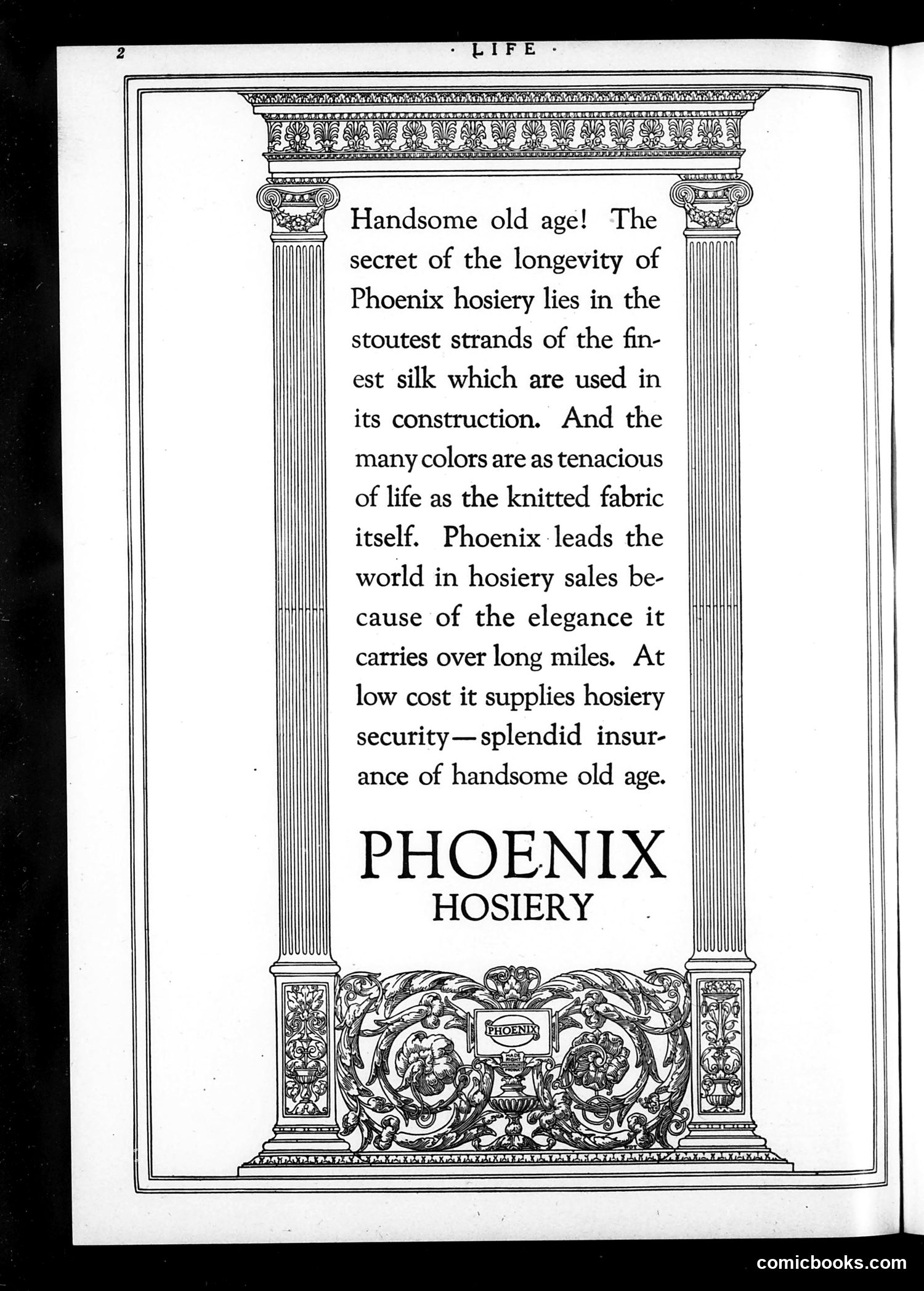
This page is **primarily advertising, not satire or political commentary**. It's a full-page advertisement for Phoenix Hosiery that appeared in *Life* magazine. The ad uses classical architectural imagery (Corinthian columns, ornate base) to convey elegance and timelessness. The copy promotes Phoenix brand stockings by claiming their durability and color-fastness provide "handsome old age"—a metaphor suggesting the hosiery maintains its appearance through extended wear. The advertisement emphasizes that Phoenix "leads the world in hosiery sales" due to quality silk construction and affordable pricing. The elaborate classical framing device is meant to lend prestige and sophistication to a utilitarian consumer product—a common advertising strategy of the early 20th century. There is no political satire present here.
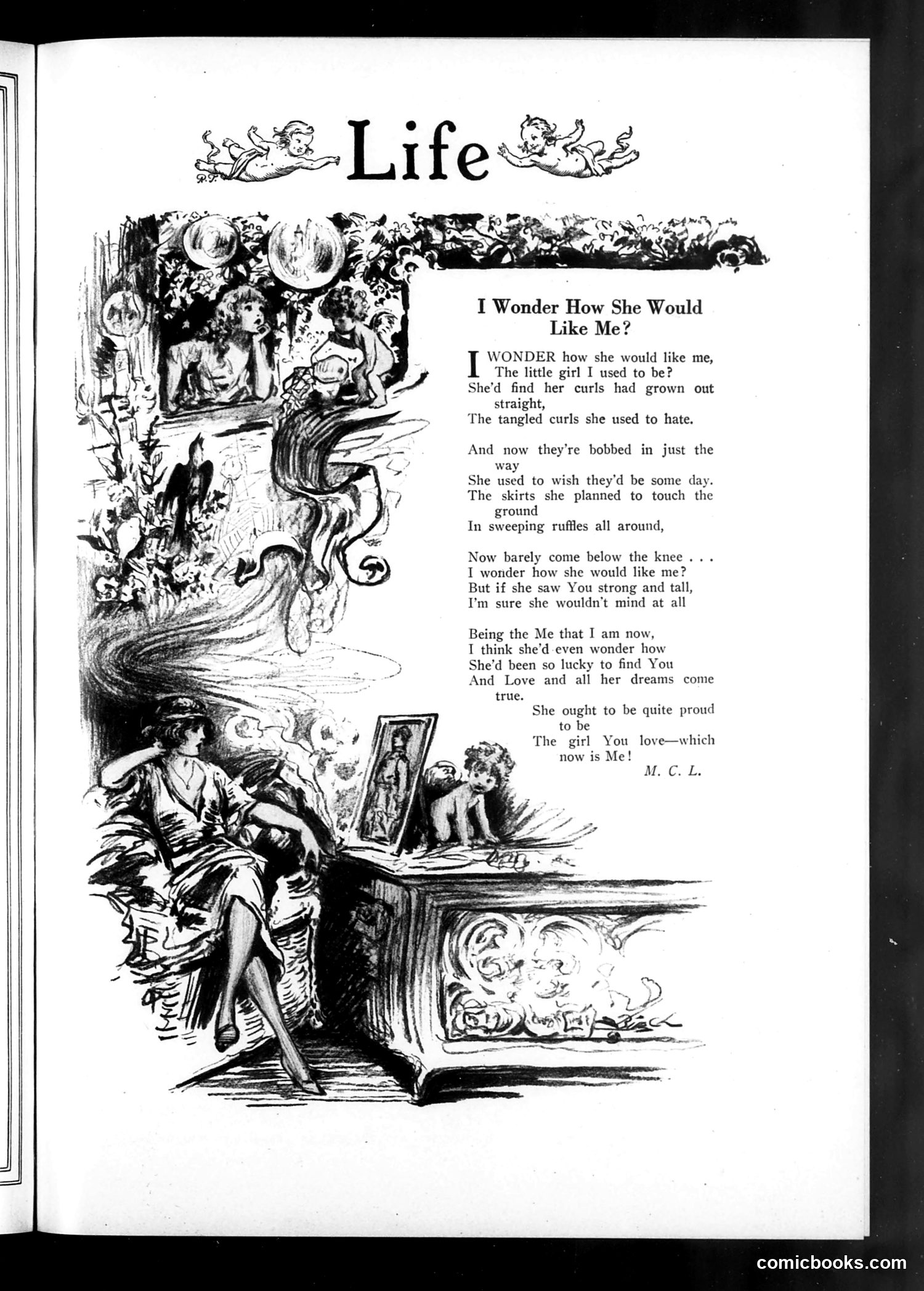
This is a reflective poem by M.C.L. about personal growth and self-perception. The narrator—apparently a woman—wonders how her childhood self would regard her as an adult. The illustrations depict a young girl's fantasies (top panel shows cherubs and whimsical scenes) contrasted with an adult woman at a mirror (bottom panel), suggesting the gap between youthful dreams and adult reality. The poem's central irony: the narrator once envied women with certain fashionable attributes (long curls, long skirts), but now possesses those very qualities as an adult ("the girl You love—which now is Me!"). Rather than political satire, this appears to be sentimental social commentary on how women's desires and self-image evolve from childhood to adulthood, typical of *Life* magazine's lighter literary content.
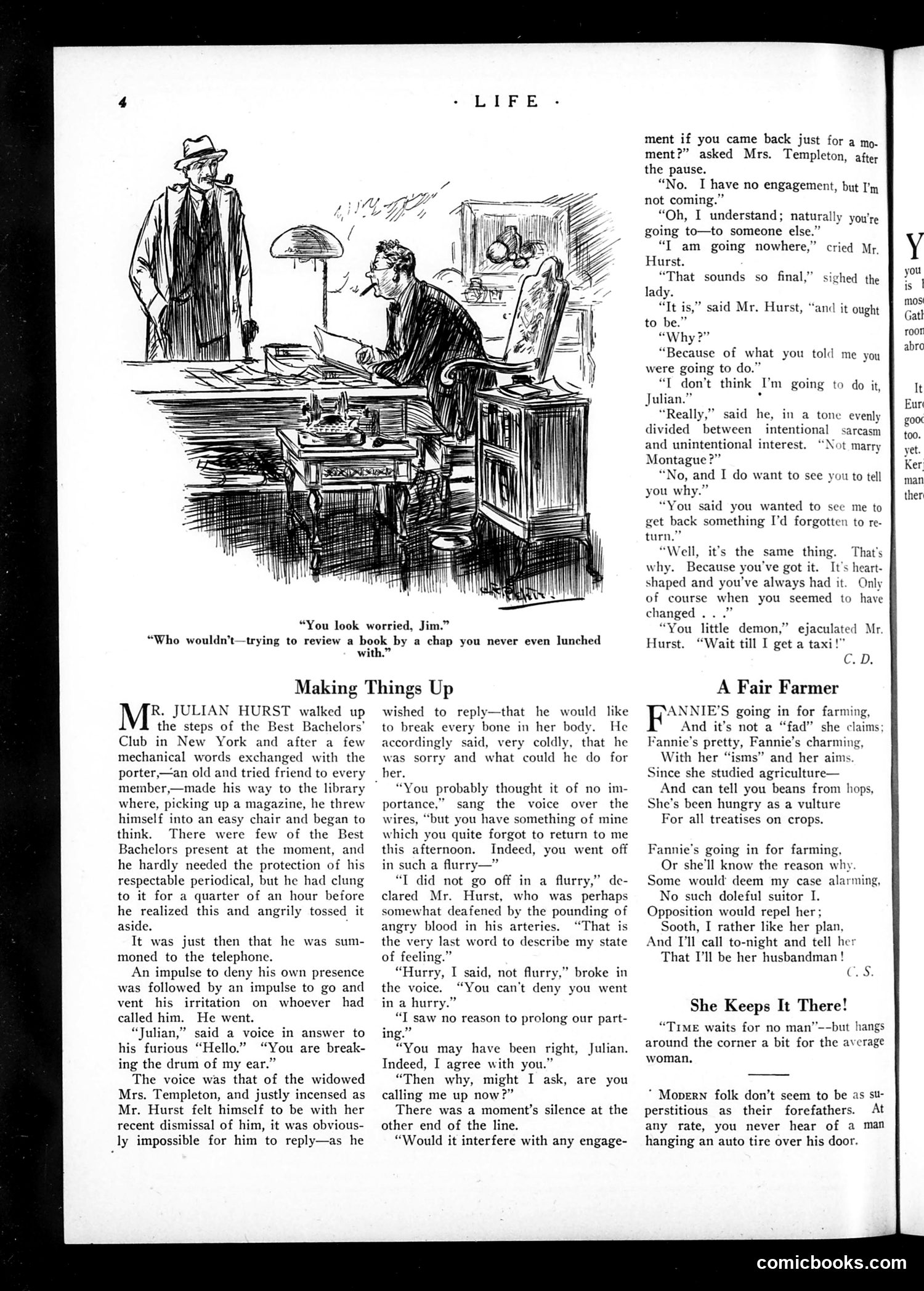
This page contains three separate short stories/humor pieces rather than political cartoons. The main illustration—"Making Things Up"—shows a man at a desk being interrupted by a visitor. The accompanying caption and text describe Mr. Julian Hurst receiving an unwelcome call from Mrs. Templeton regarding a broken engagement. The humor derives from their tense conversation about his refusal to marry her, with Hurst insisting he never promised anything and questioning why she's now contacting him. The other two pieces—"A Fair Farmer" and "She Keeps It There!"—are brief humorous poems about farming and domestic life. This page reflects early-20th-century Life magazine's focus: satirizing courtship conventions, relationship dynamics, and social expectations rather than political commentary. The humor targets romantic misunderstandings and the social pressures surrounding marriage.
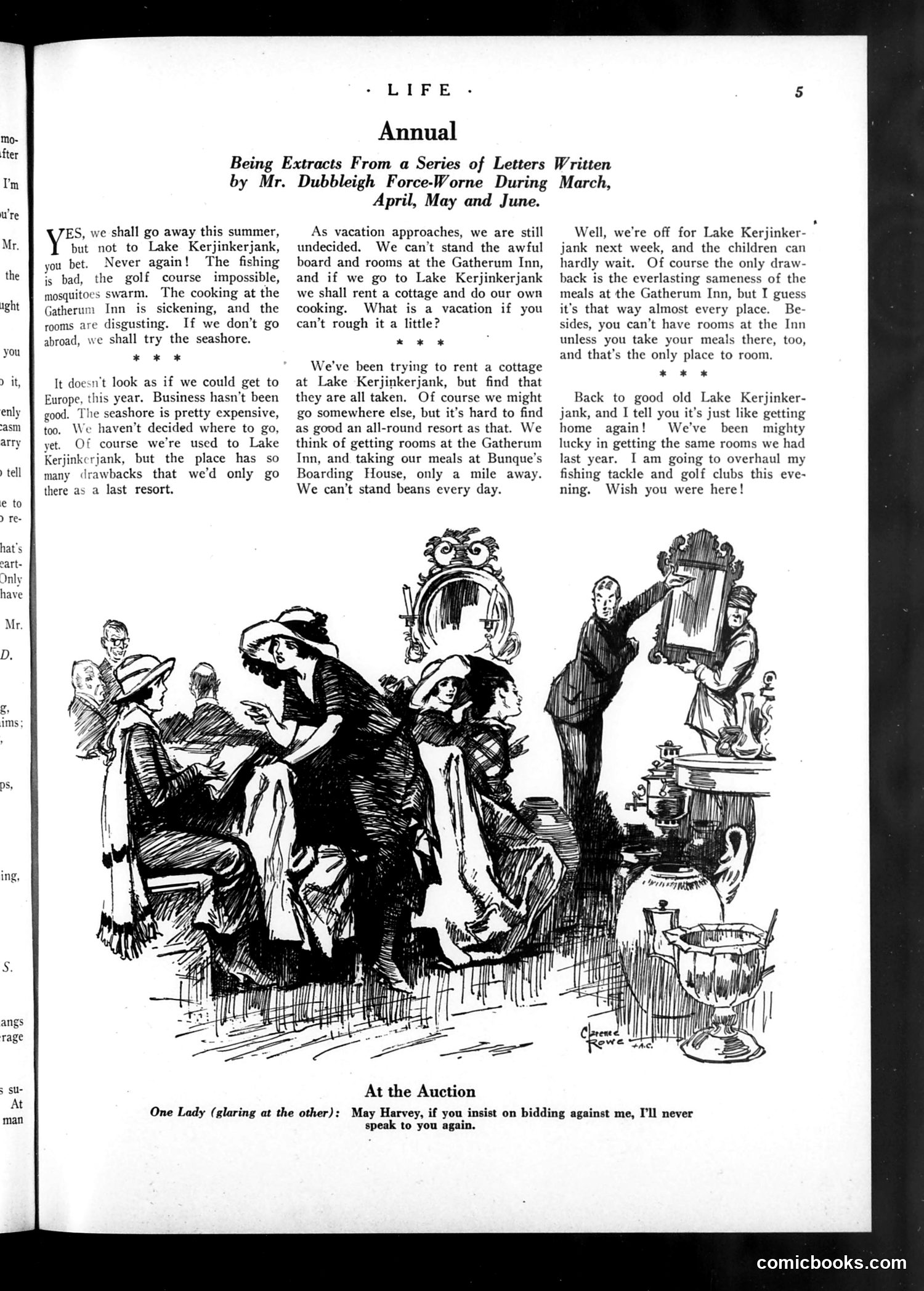
This is a social satire cartoon illustrating a scene at an auction house. The illustration shows well-dressed figures engaged in heated bidding, with one woman (identified in the caption as "One Lady") glaring at another man (identified as "May Harvey"). The joke relies on a common social awkwardness: two people competing fiercely in an auction, driving up prices against each other. The woman's threat—"if you insist on bidding against me, I'll never speak to you again"—satirizes how people can become irrationally competitive and emotionally volatile over acquiring objects at auction, letting social vanity override rational economics. The cartoon mocks upper-class auction culture and the absurdity of interpersonal conflict triggered by acquisition rivalries.
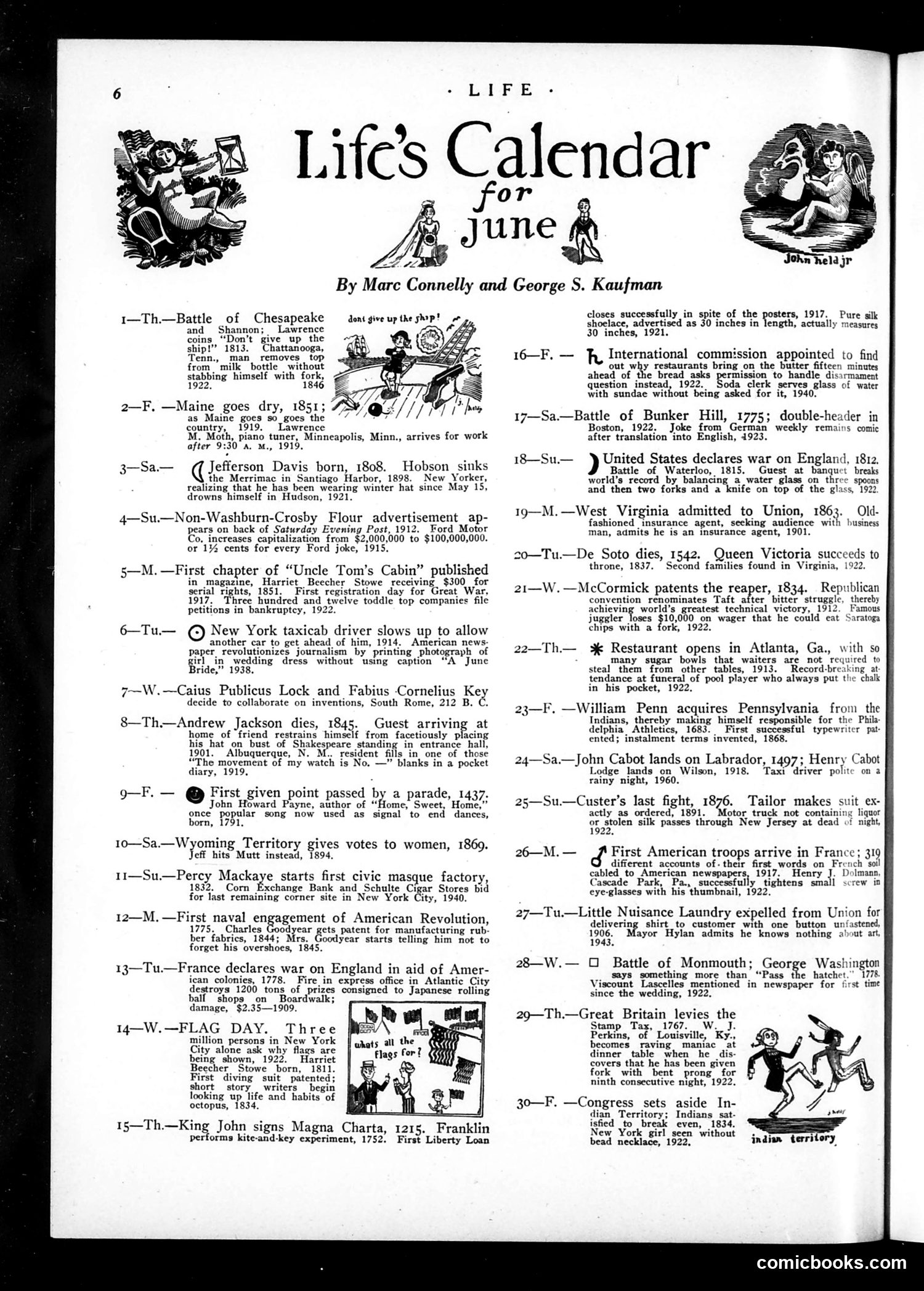
This is an informational calendar page listing historical events for June, created by Marc Connelly and George S. Kaufman. Rather than satire or political cartoons, it presents notable dates in American and world history—ranging from the Battle of Chesapeake (1781) to Congress setting aside Indian Territory (1834). The small decorative illustrations scattered throughout are generic period engravings (showing figures, flags, ships) that simply accompany the historical entries. There are no identifiable caricatures or satirical commentary visible. The page functions as educational content, presenting facts like Jefferson Davis's birth (1808), Wyoming granting women's suffrage (1869), and the sinking of the Merrimac. No specific political satire or joke is apparent—it's straightforward historical reference material typical of Life magazine's informational sections.
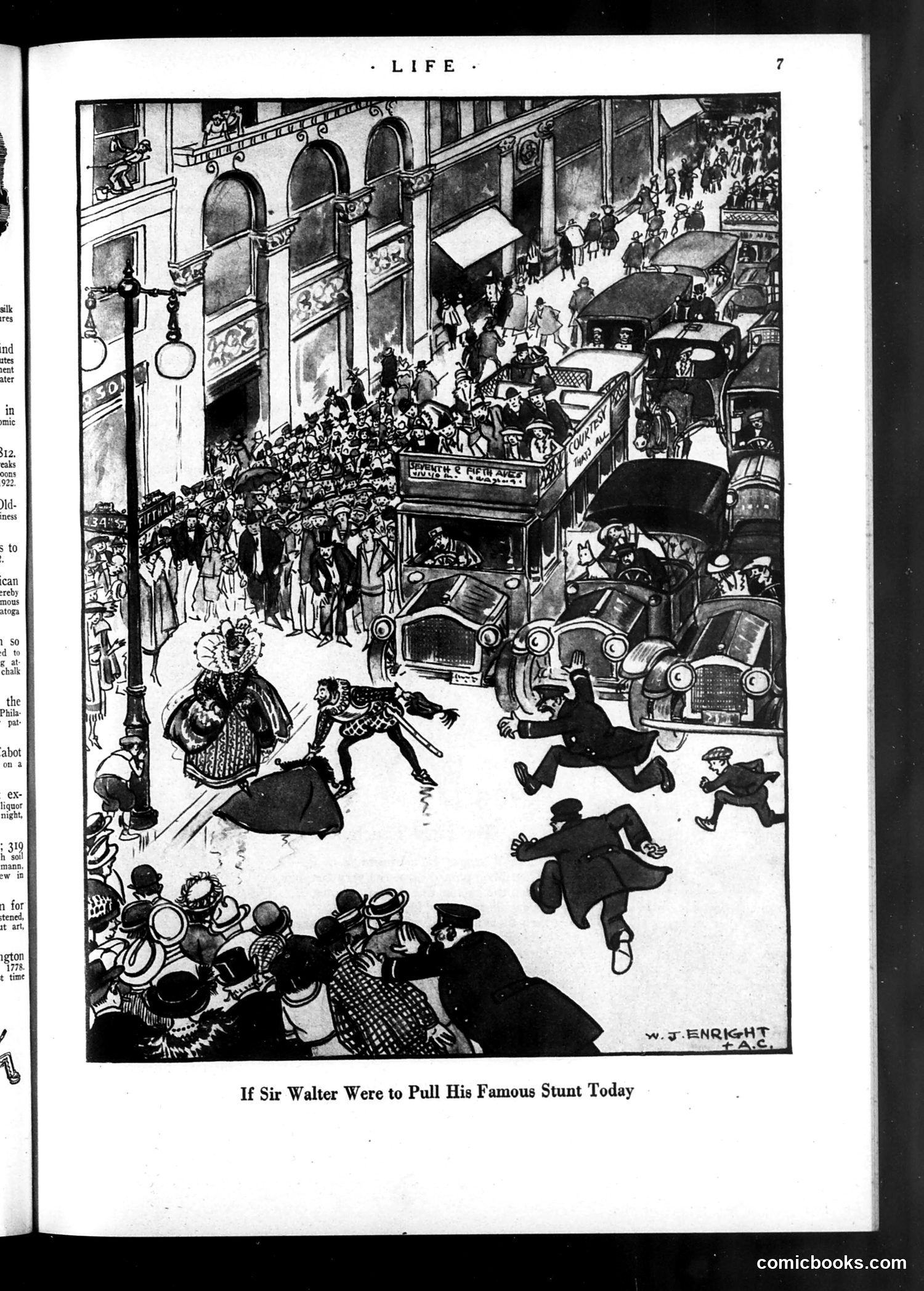
This cartoon by W.J. Enright satirizes modern urban chaos by imagining Sir Walter Raleigh attempting his legendary stunt of laying his cloak over a puddle for Queen Elizabeth I—but in a contemporary bustling city street. The humor contrasts the chivalrous, orderly past with present-day pandemonium: a crowded street filled with automobiles, pedestrians, and general commotion. Multiple figures slip and fall; people scatter chaotically. The implication is that modern city life offers no room for courtly gestures—attempting such a gallant act would be swallowed up in traffic and confusion. The cartoon mocks both modern urban disorder and the impossibility of maintaining historical civility in the contemporary world.
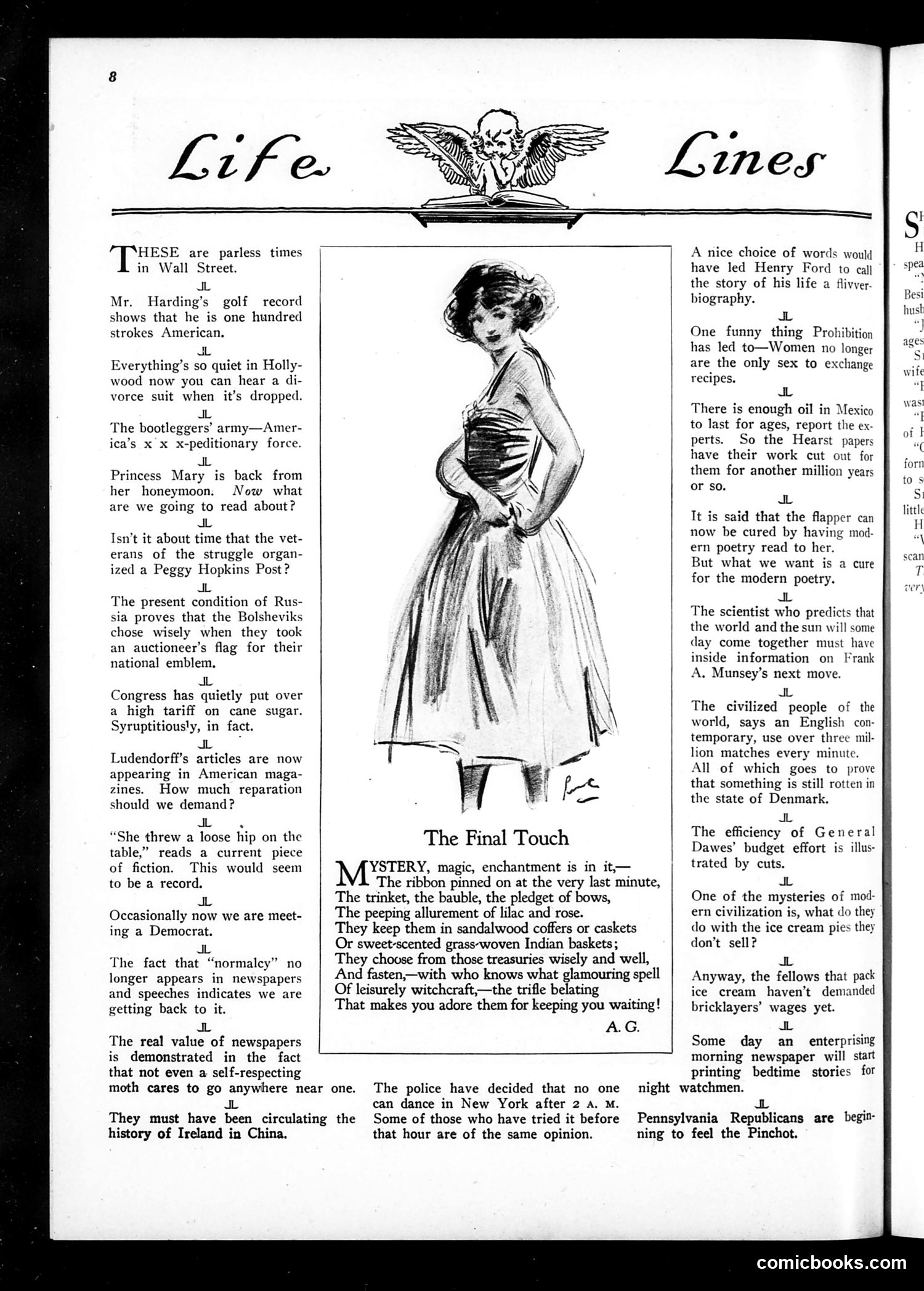
This page contains satirical commentary on contemporary events rather than a formal cartoon. The central illustration, "The Final Touch," depicts a fashionable woman and uses poetic language to celebrate women's fashion accessories and attention to detail in dress. The left column's "Life Lines" contains brief satirical observations on 1920s topics: Mr. Harding's golf obsession, Hollywood quiet films, bootleggers, Princess Mary's honeymoon, Russian Bolsheviks, tariffs, and Ludendorff's reparations demands. The right column continues with observations on Prohibition (the flapper "cure"), oil in Mexico, modern poetry, and ends with a joke about ice cream wages and Pennsylvania Republicans feeling "the Pinchot" (likely referring to political figure Gifford Pinchot). The satire targets contemporary politics, social trends, and cultural absurdities of the post-WWI era.
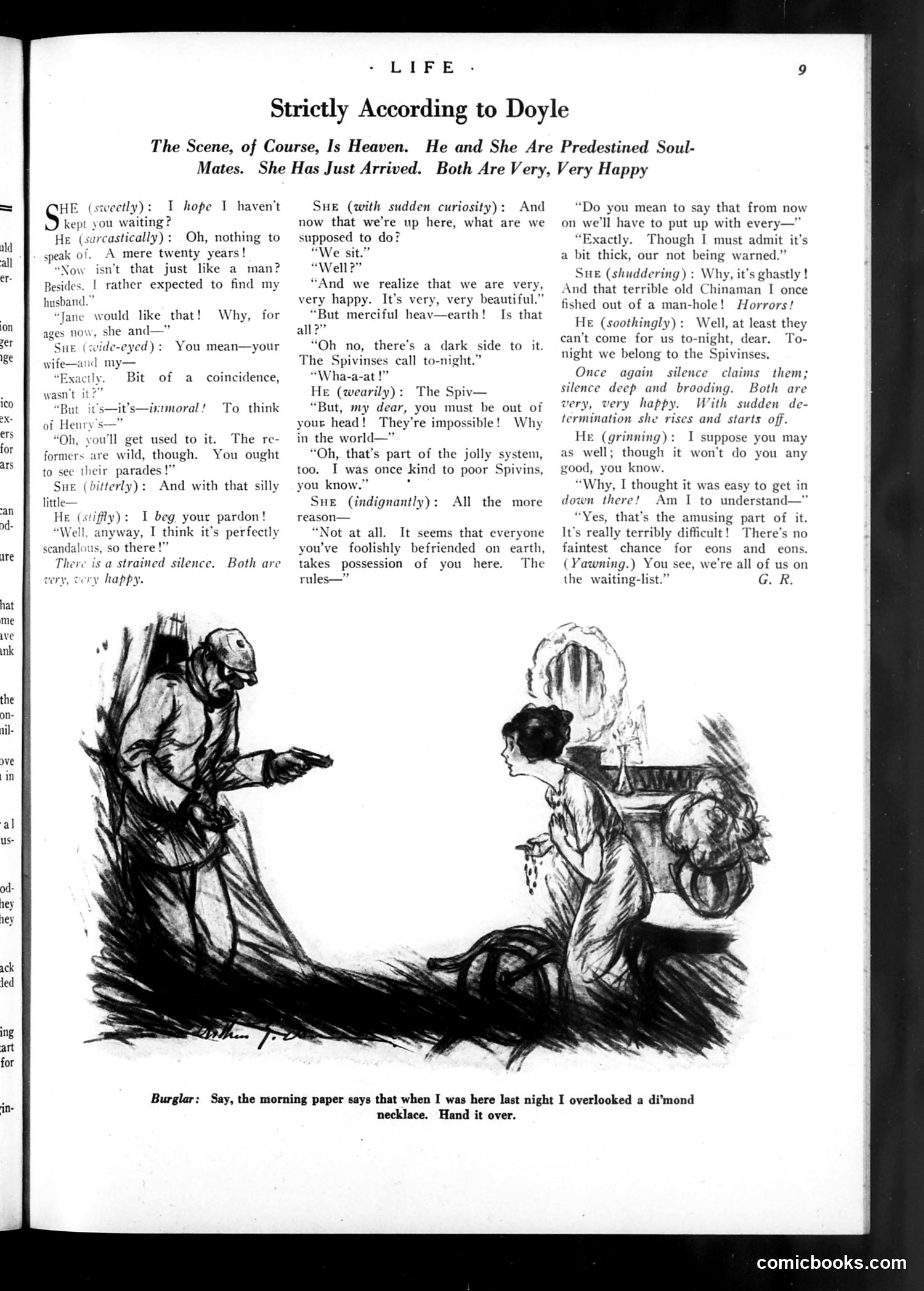
This satirical sketch mocks romantic idealization, specifically referencing Arthur Conan Doyle's sentimental writing style. The scene depicts a couple in "Heaven" as "predestined soul-mates," with dialogue poking fun at saccharine romantic notions popular in early 20th-century literature. The cartoon shows a burglar character interrupting this heavenly reunion, delivering the punchline: he's returning a diamond necklace he stole during his previous night visit. This absurd intrusion deflates the romantic pretension—even in Heaven, earthly crime and materialism intrude. The satire targets both Doyle's melodramatic storytelling conventions and the era's overly sentimental romantic literature, suggesting such idealized scenarios are naive when confronted with reality's mundane complications.
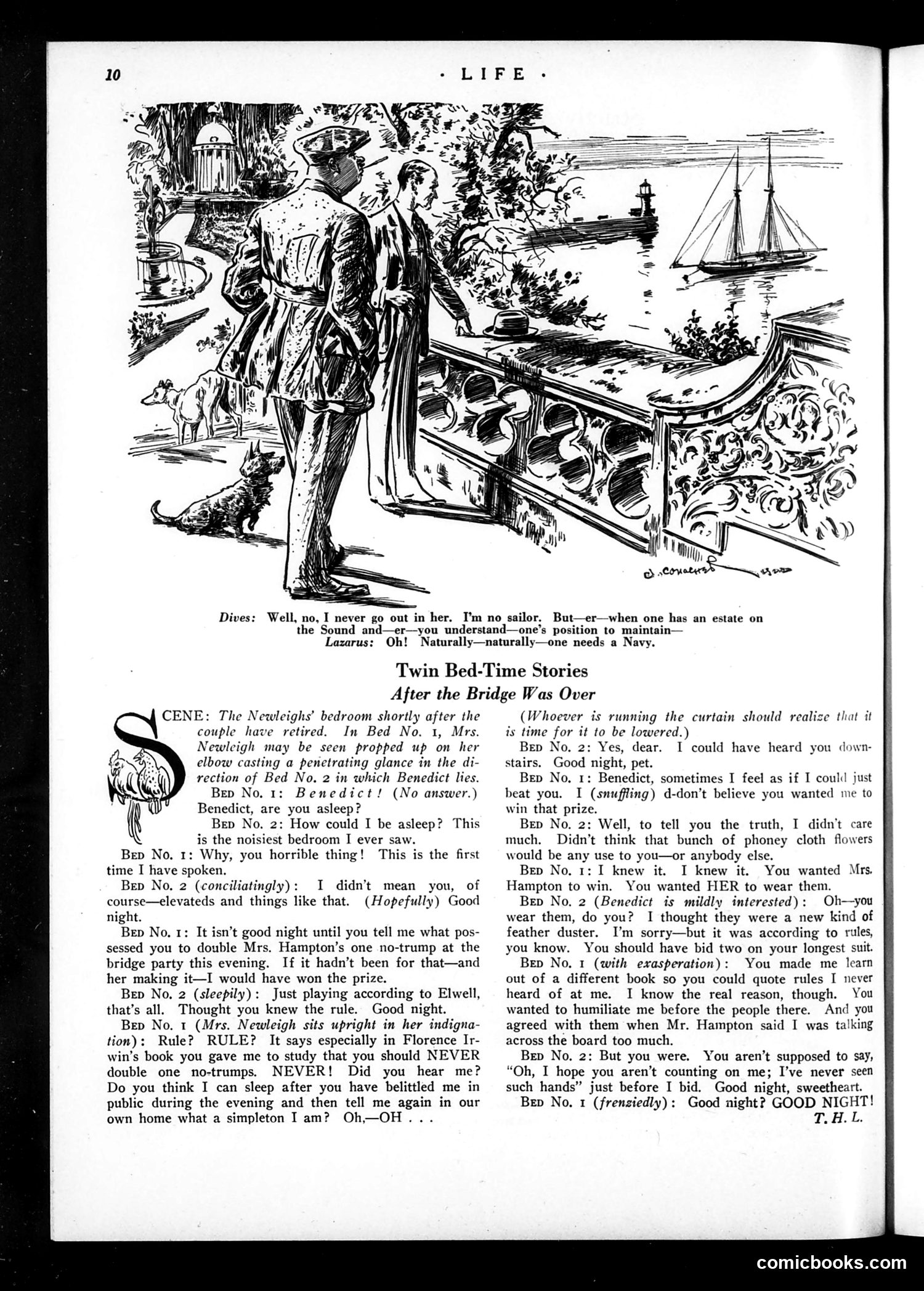
This page contains a humorous sketch and a comic dialogue piece, not political cartoons. The upper illustration shows two well-dressed figures at what appears to be a seaside estate, with a sailor ship visible. The dialogue reveals class anxieties: one character explains he maintains a naval presence on his Sound property to uphold his social position—he's "no sailor" but needs the appearance of wealth and naval connections. Below, "Twin Bed-Time Stories" presents a newlywed couple's bedroom banter after a bridge party. The humor centers on marital conflict: she quotes etiquette rules he violated publicly; he deflects by accusing her of wearing an unflattering feather duster. The satire targets both rigid social conventions and domestic squabbling over propriety and appearance—quintessential early 20th-century middle-class anxieties about maintaining respectability.
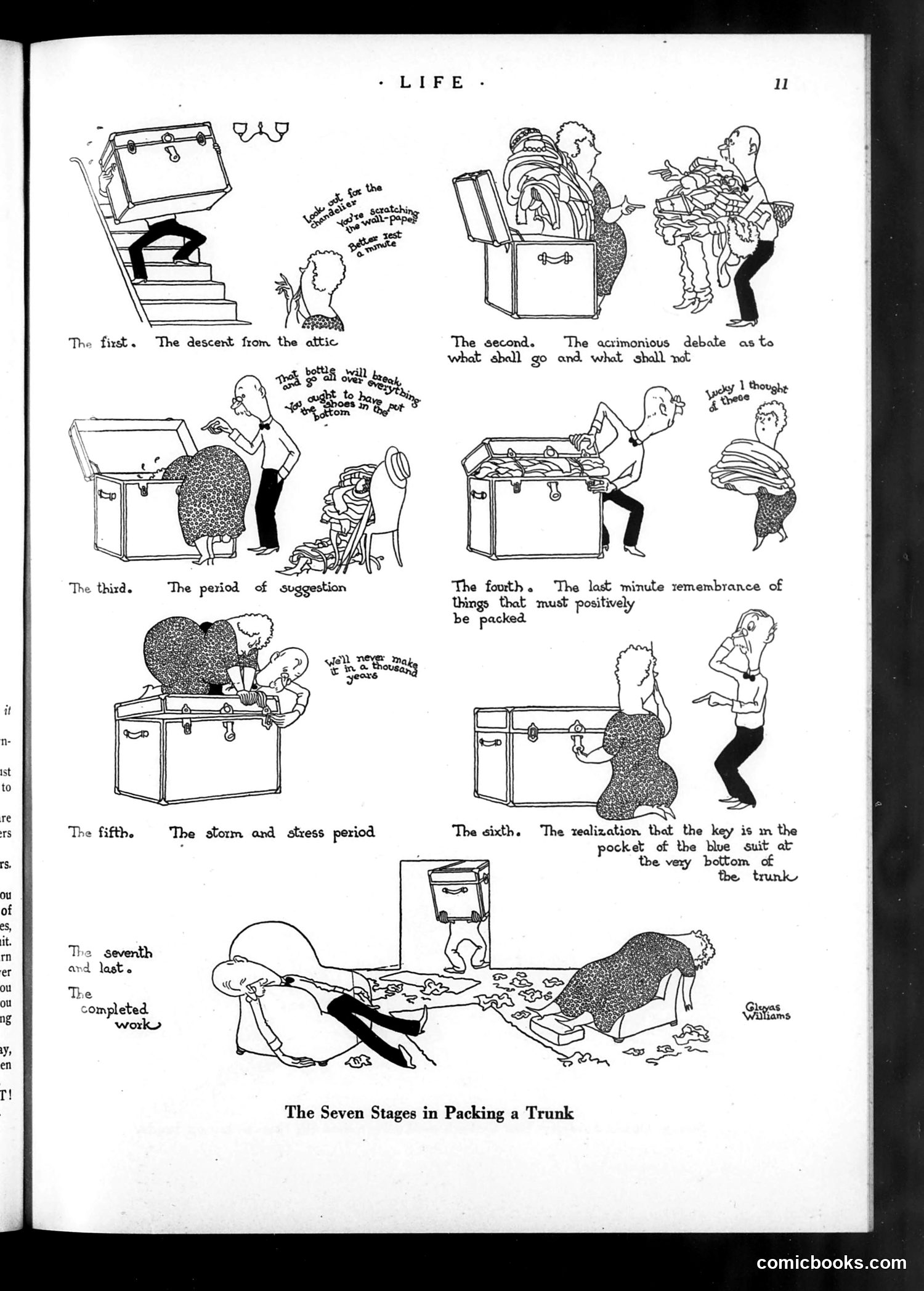
This is a humorous comic strip depicting the universal frustration of packing luggage. It satirizes the emotional journey of trunk-packing through seven exaggerated stages: 1. **The descent** - retrieving the trunk 2. **The acrimonious debate** - deciding what goes where 3. **The period of suggestion** - adding more items 4. **The last-minute remembrance** - frantically adding forgotten things 5. **The storm and stress period** - overwhelming chaos 6. **The realization** - discovering the key is missing 7. **The completed work** - final exhausted acceptance The satire targets the relatable domestic chaos of travel preparation, showing how a simple task devolves into emotional turmoil. The exaggerated facial expressions and physical comedy emphasize the absurdity and frustration anyone experiences when packing.
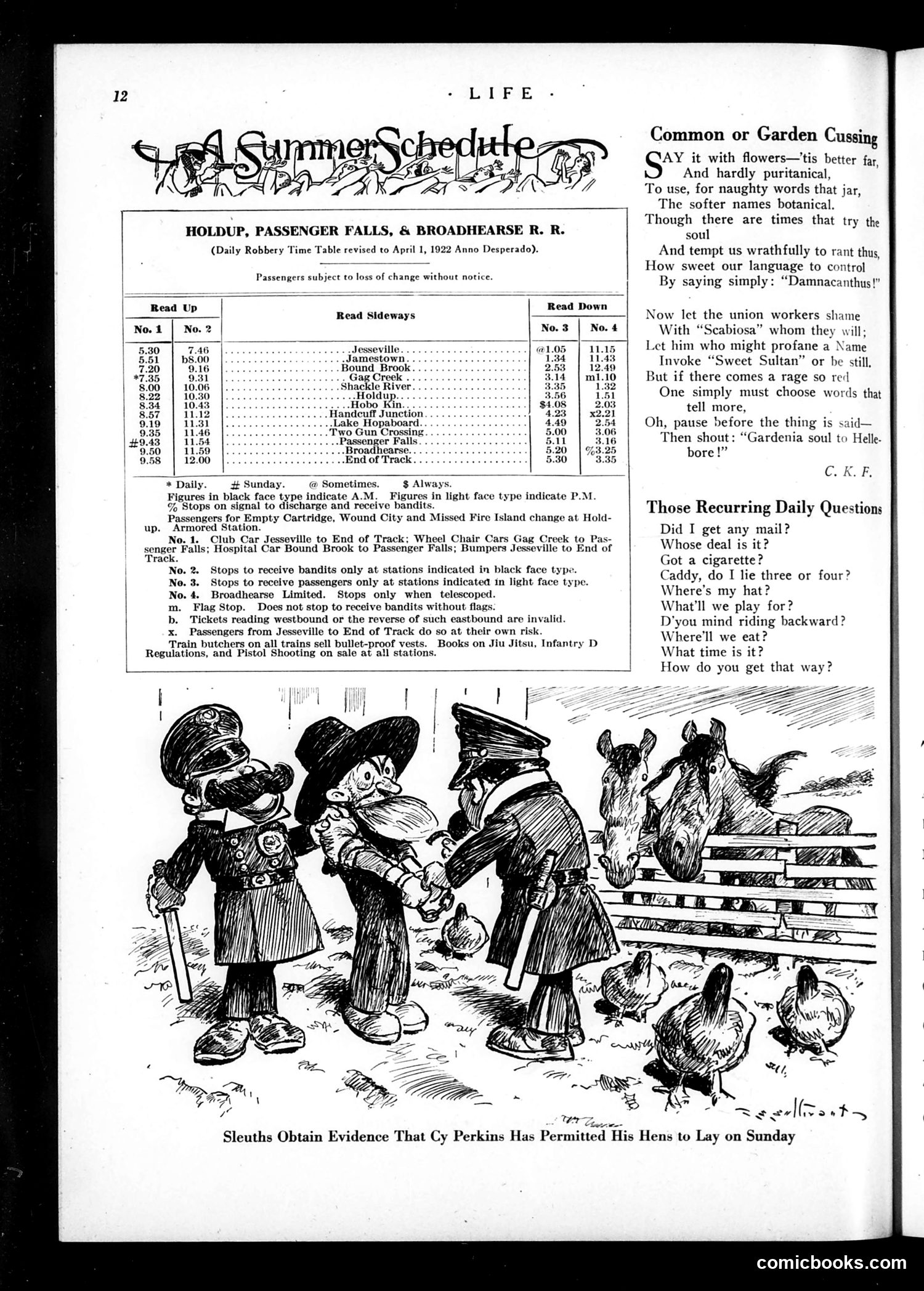
This page from *Life* magazine contains a humorous cartoon about Sunday observance laws. The illustration shows two police detectives ("Sleuths") confronting what appears to be a farmer named Cy Perkins near a fence with hens. The caption reads: "Sleuths Obtain Evidence That Cy Perkins Has Permitted His Hens to Lay on Sunday." The joke satirizes overzealous enforcement of strict Sunday laws—regulations that prohibited various activities on the Sabbath. The absurdity is that police are investigating whether hens have violated these rules by laying eggs on Sunday, an impossible thing to regulate or prevent. It mocks both the ridiculousness of such rigid religious laws and their aggressive enforcement, suggesting authorities have become comically zealous in policing private behavior deemed sinful.
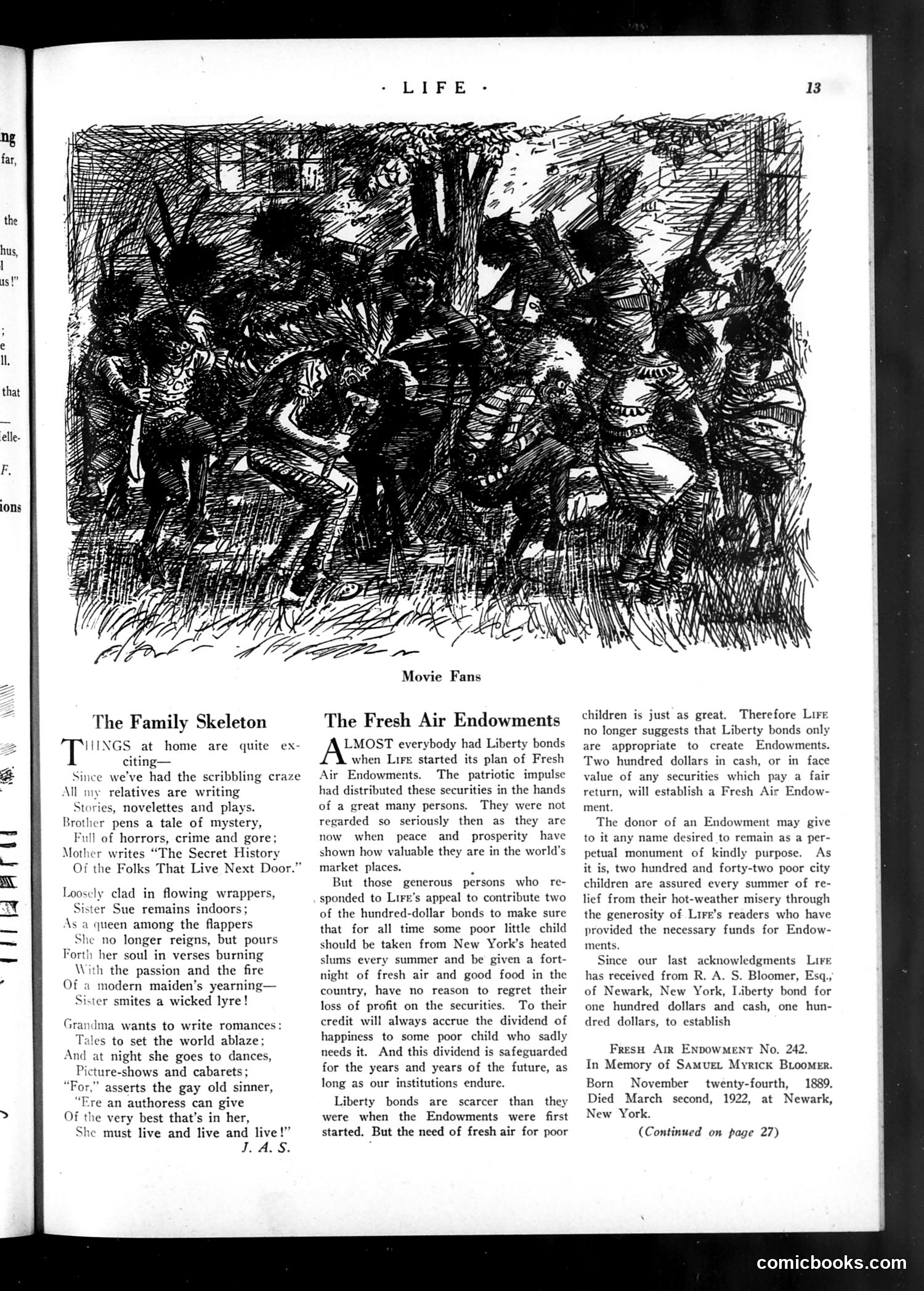
This ink sketch depicts a chaotic group of wildly gesturing figures gathered together—"Movie Fans" according to the caption. The cartoon satirizes the fervent behavior of motion picture enthusiasts, showing them as excitable and dramatically expressive, with exaggerated body language and expressions. The accompanying poem "The Family Skeleton" uses dark humor to mock family members' creative pursuits: relatives writing stories and plays involving "horrors, crime and gore," and a grandmother wanting to "write romances" and "set the world ablaze." The satire suggests that aspiring writers in ordinary households harbor grandiose artistic ambitions. The humor targets both cinema's devoted audience and amateur writers' pretensions during the early film era.
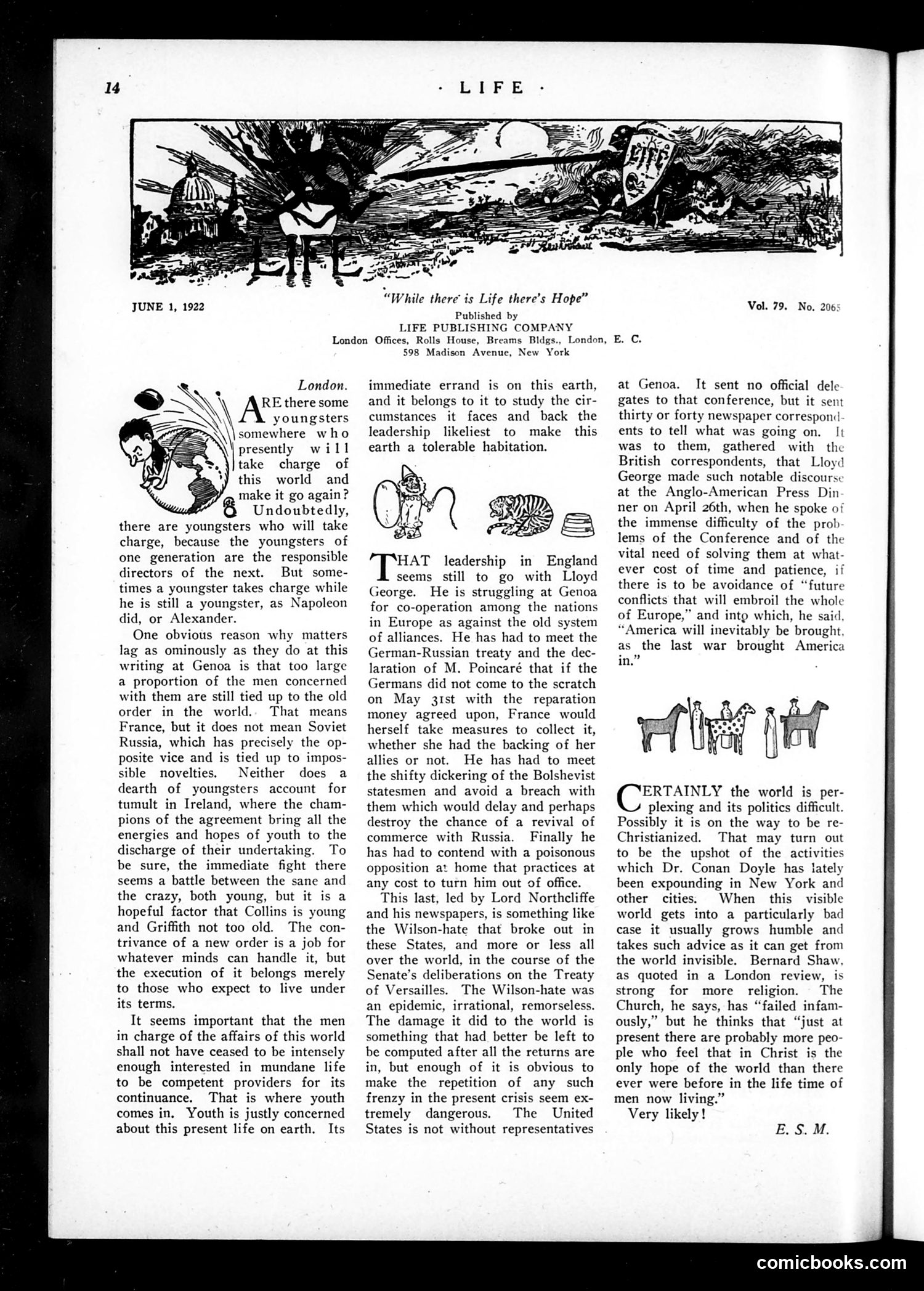
This June 1, 1922 *Life* editorial page addresses post-WWI leadership and youth's role in rebuilding. The central illustration depicts a large figure (appears to be representing a leader or nation) struggling with or carrying an enormous burden—likely symbolizing the weight of post-war reconstruction and treaty obligations. The text discusses Lloyd George's leadership at the Genoa Conference, focusing on international cooperation and preventing future conflicts. The article emphasizes that youth must take charge of world affairs to ensure lasting peace, contrasting idealistic youth leadership with the failures of older statesmen. The satirical point critiques how older generations created the war's problems while expecting youth to solve them—a common post-WWI sentiment. The cartoon visually reinforces this burden being placed on younger shoulders.
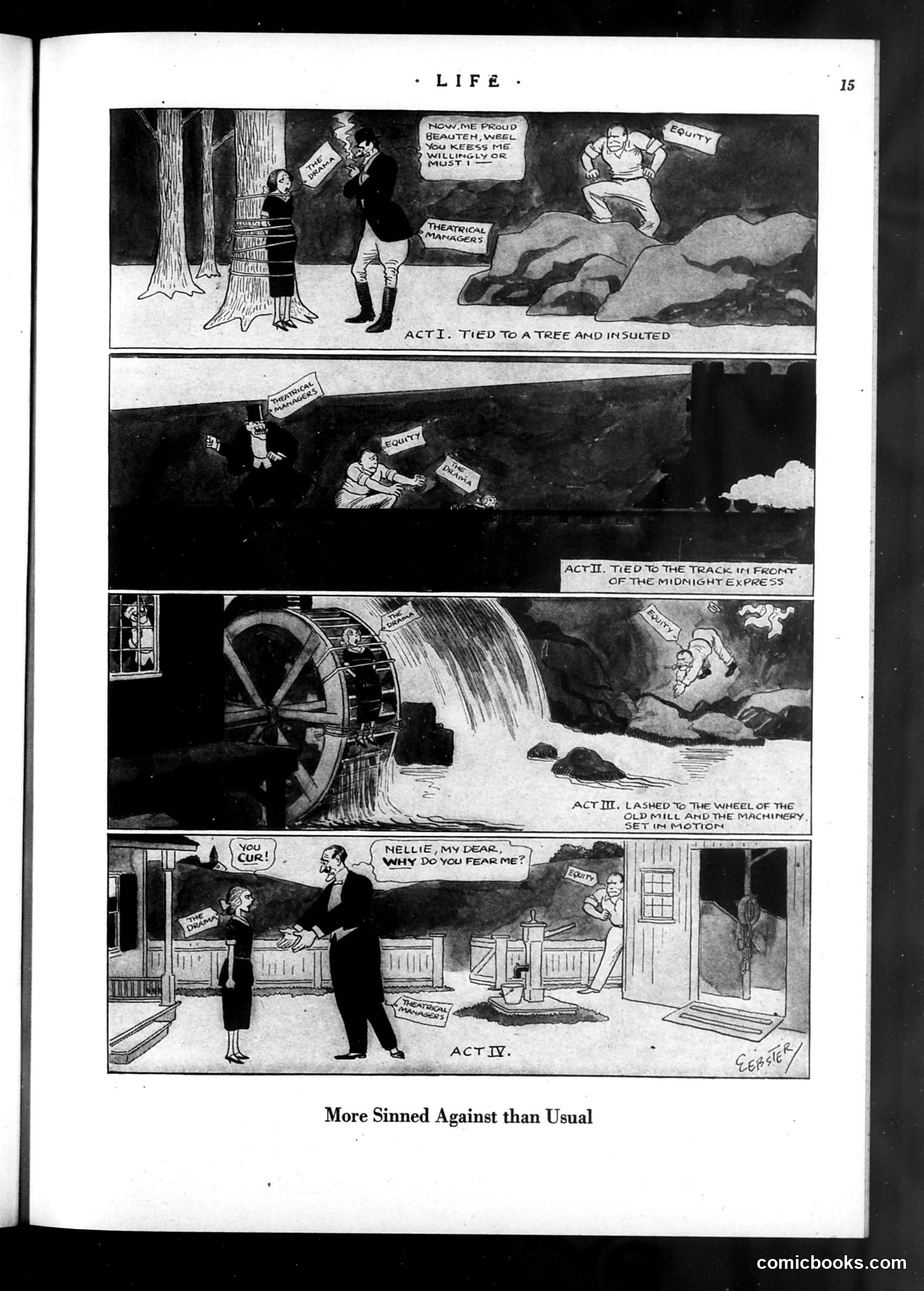
This four-act comic strip satirizes melodramatic theater, particularly the "damsel in distress" genre popular in early 20th-century stage productions. Each act depicts increasingly absurd perils befalling a female character: tied to a tree and insulted, bound to railroad tracks before the Midnight Express, lashed to a mill wheel, and finally confronted indoors by a man asking why she fears him. The title "More Sinned Against than Usual" is a Shakespeare reference (from *King Lear*), mocking how melodramas constantly subject their heroines to exaggerated suffering. The cartoon ridicules both the overwrought plots of theatrical melodrama and the stock "innocent woman tormented" trope. The absurdity escalates with each panel—the piling-on of disasters—to emphasize how formulaic and ridiculous these stage conventions had become to sophisticated readers.
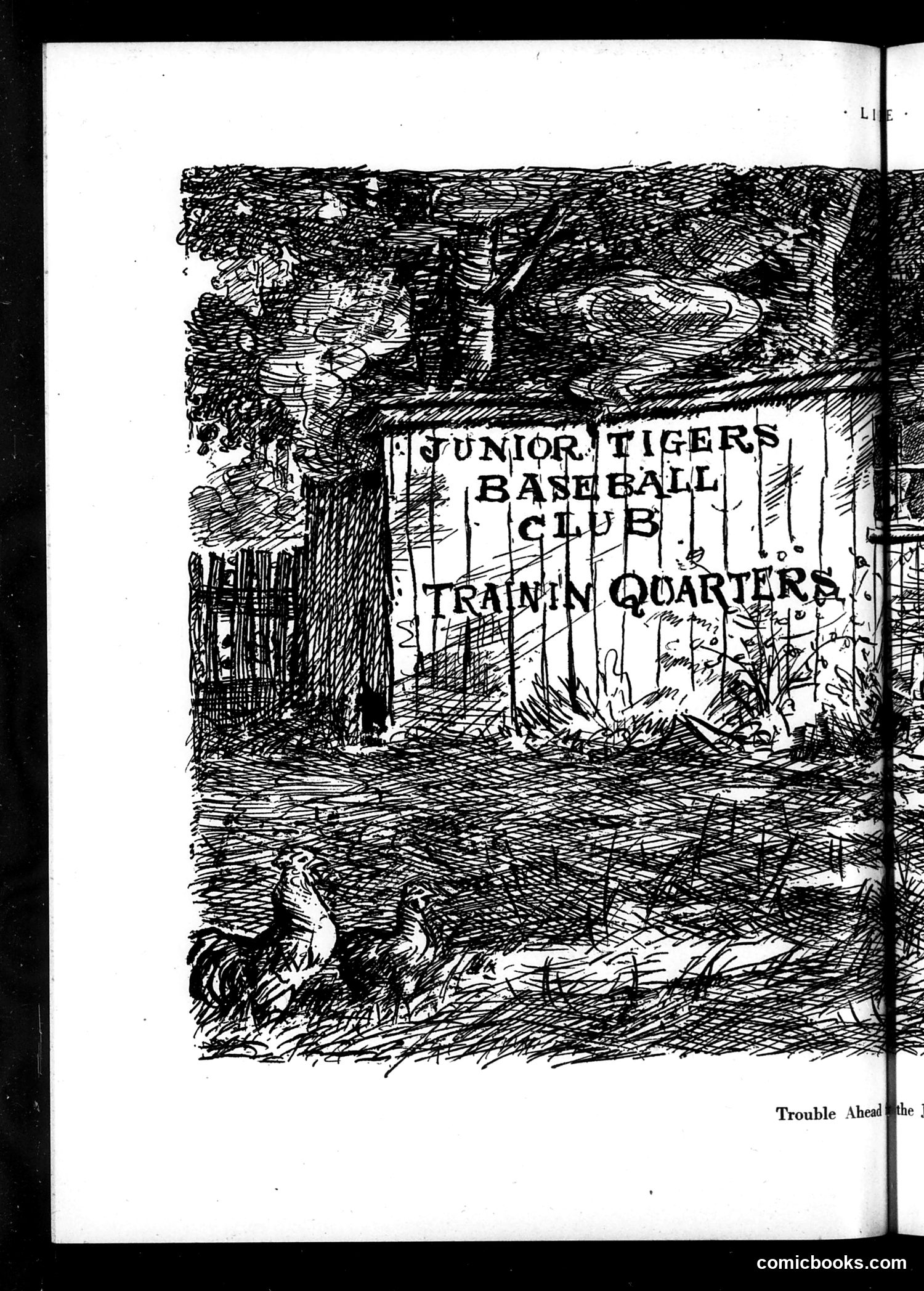
This page shows a pen-and-ink sketch depicting a building with a sign reading "JUNIOR TIGERS BASEBALL CLUB TRAINING QUARTERS." The illustration appears to be satirical commentary on youth baseball organization, though the specific joke or reference remains unclear from the visible image alone. The caption "Trouble Ahead" suggests the cartoon is predicting problems for this junior baseball club, but without additional context about when this was published or what contemporary issues it references, the precise satire is difficult to identify. The OCR text is largely corrupted, providing no help. The cartoon's subject—youth sports organization—indicates it likely satirizes some aspect of American youth culture or recreational institutions of its era, but the specific target cannot be determined from this page alone.
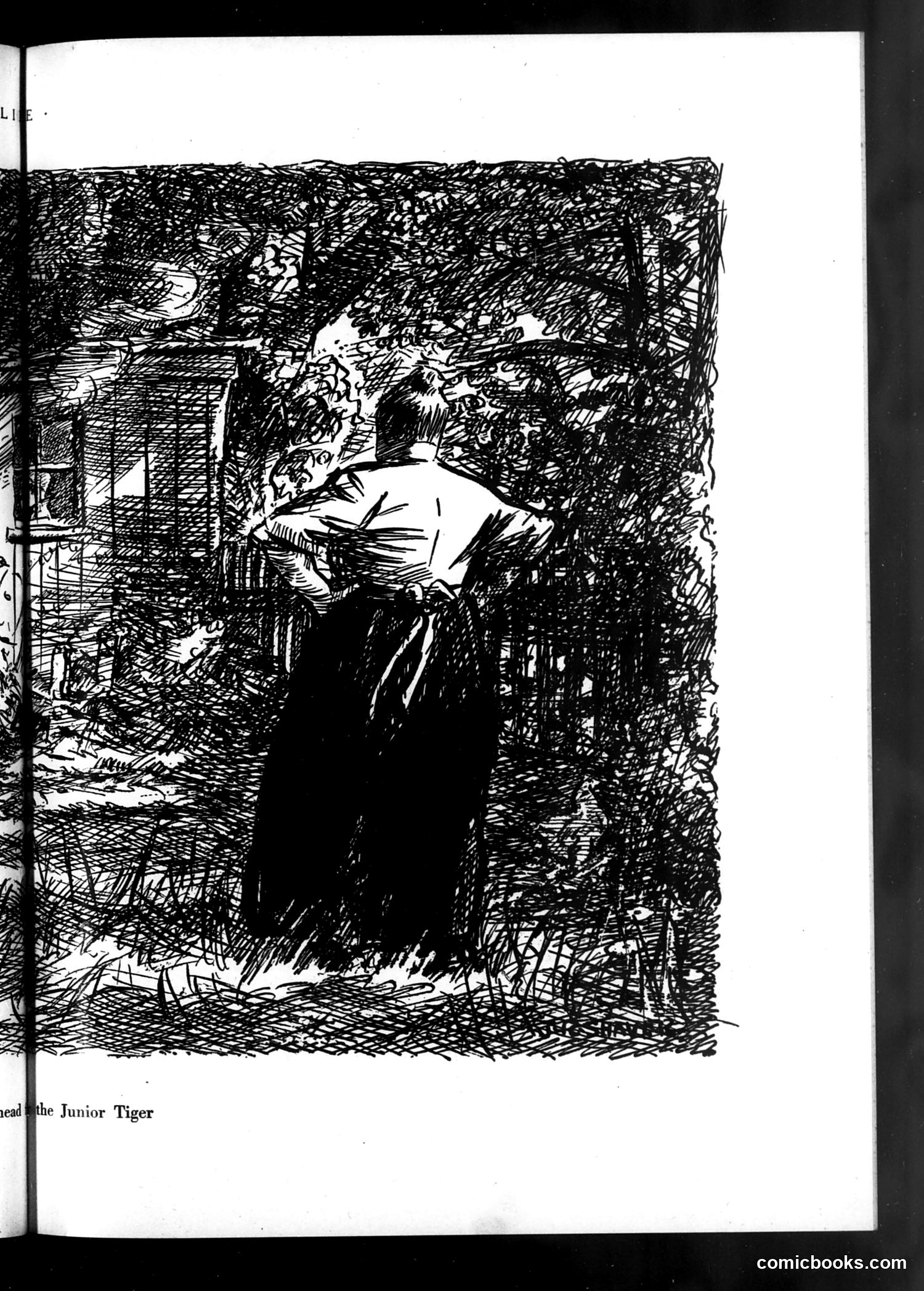
This appears to be a pen-and-ink illustration showing a figure viewed from behind, wearing formal dark clothing, gesturing toward or interacting with dense, chaotic cross-hatching that fills most of the composition. The heavily scribbled background creates an impression of chaos or turmoil. The caption references "the Junior Tiger," though the OCR is incomplete and unclear. Without additional context about *Life* magazine's publication date or surrounding articles, I cannot definitively identify who "the Junior Tiger" refers to or what specific political/social situation this satirizes. The image's style and technique suggest early-to-mid 20th century American political satire, but the specific target remains uncertain from this page alone.
This is a theater review column discussing two plays. The main focus is "Kempy," written by and starring members of the Nugent family (J.C. Nugent, Elliott Nugent, and Ruth Nugent). The reviewer praises it as an unexpectedly successful "home comedy" in the vein of "The First Year"—a popular domestic play of the era. The review highlights the Nugents' performances and notes the play avoids melodramatic clichés (no tearful lamp-in-window scenes). Grant Mitchell is mentioned as the featured player. A secondary review discusses "Fanny Hawthorn," originally produced as "Hindle Wakes" a decade earlier. The reviewer suggests the play's once-scandalous message about female independence now seems conservative by current standards. The page contains no political cartoons—it's straightforward theater criticism from an early 20th-century entertainment magazine.
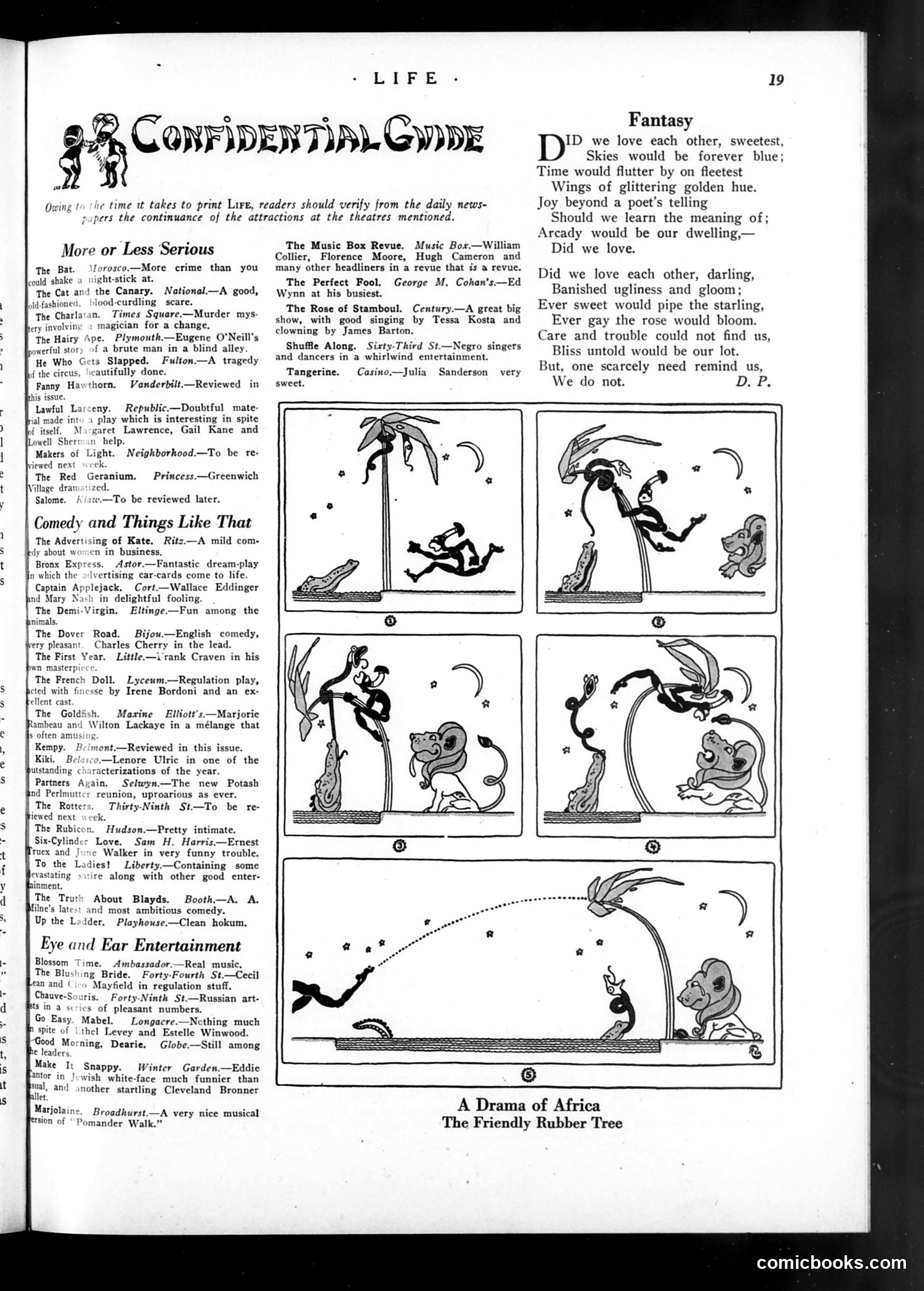
This is a six-panel wordless comic strip showing a slapstick sequence of physical comedy. A human figure repeatedly attempts to swing from or interact with a tree branch, while a monkey character observes. Each panel escalates the mishap: the human loses grip, falls, or collides with the tree in increasingly absurd ways, while the monkey's reactions shift from curiosity to apparent amusement. The humor relies on *slapstick*—exaggerated physical comedy—a staple of 1920s entertainment. The "Africa" and "Rubber Tree" framing suggests colonial-era adventure tropes popular in that period's entertainment, though the actual joke is simply repeated failure and comedic violence. The strip exemplifies the wordless visual comedy that magazines like *Life* regularly published alongside theater reviews and satirical content.
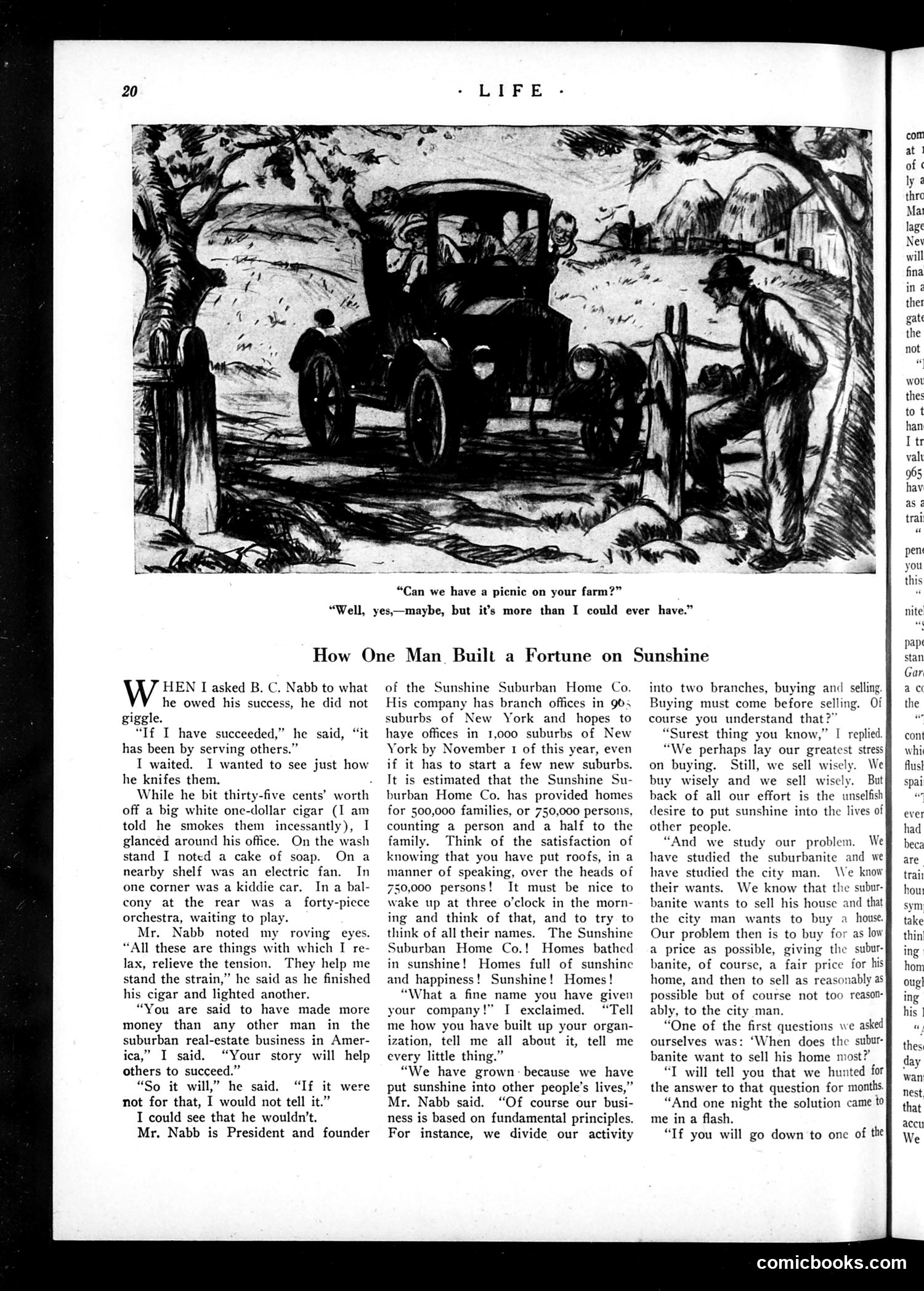
This satirical article mocks suburban real-estate developers and their hollow corporate rhetoric. B.C. Nabb, president of the Sunshine Suburban Home Co., embodies the type of early 20th-century businessman who disguises profit-driven motives with sanctimonious language about "serving others" and putting "sunshine into people's lives." The satire operates through contradiction: Nabb claims success comes from altruism while the article reveals his actual cynical strategy—buying homes cheaply from desperate suburbanites wanting to sell, then reselling them at inflated prices to city dwellers. His office filled with luxuries (expensive cigars, orchestras, electric fans) further exposes the gap between his proclaimed values and his actual wealth accumulation. The opening cartoon reinforces this: a farmer's naive question about a farm picnic receives a response suggesting Nabb will exploit the property. The joke is that businessmen like Nabb convert simple rural assets into commodified suburban developments for profit.
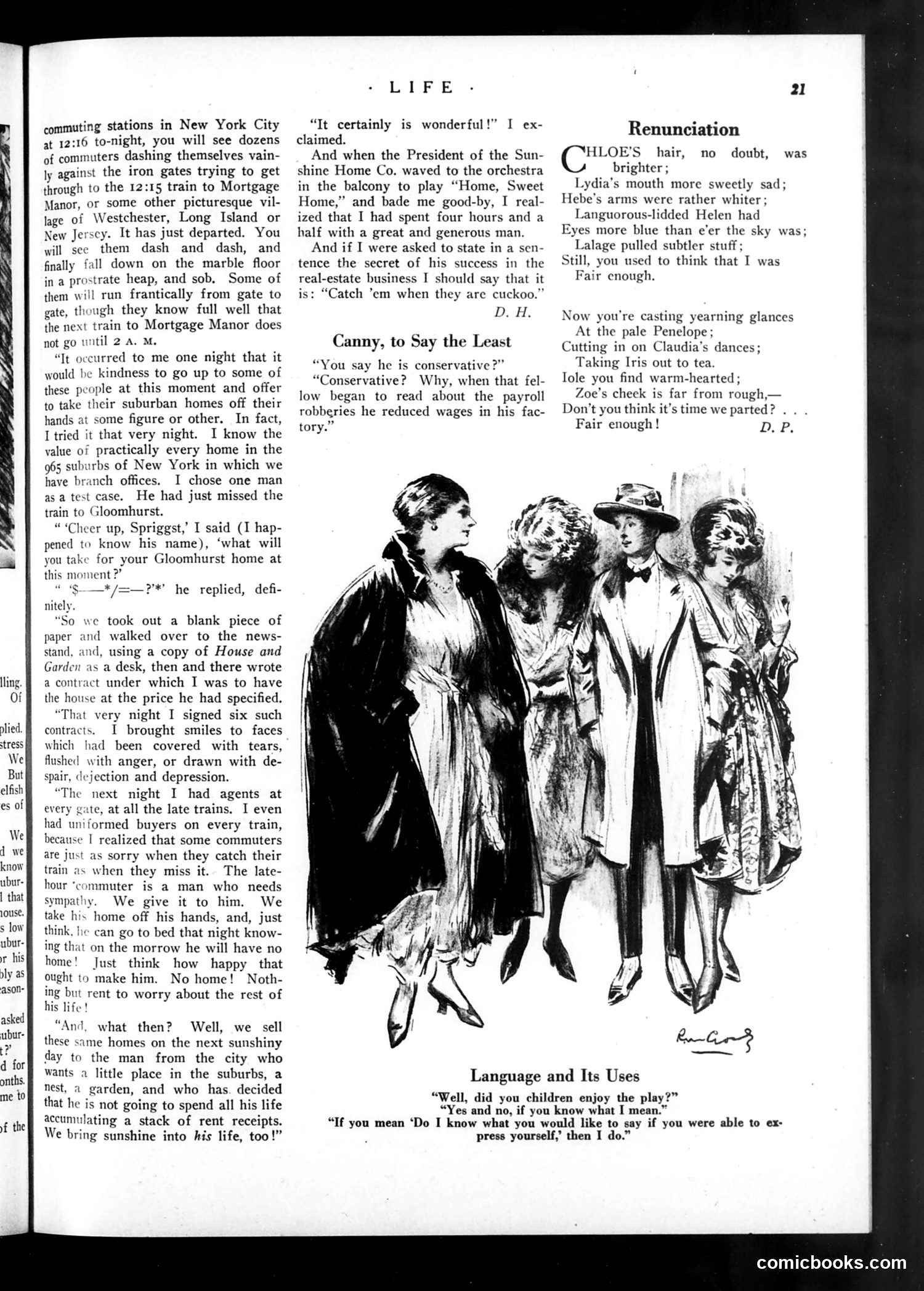
This page contains two satirical pieces mocking early 20th-century American suburban real estate and economic behavior. **"Mortgage Manor" Real Estate Satire:** The main text ridicules predatory real estate dealers who exploit commuters' desperation. A salesman describes targeting exhausted suburban commuters who've missed their trains home, offering to buy their houses at rock-bottom prices when they're emotionally vulnerable ("Catch 'em when they are cuckoo"). He then resells these same homes the next day to city dwellers seeking suburban escape. The satire exposes how this scheme profits from human desperation and the suburban housing bubble mentality. **"Canny, to Say the Least":** A brief joke mocking a conservative factory owner who, upon reading about payroll robberies, preemptively cuts workers' wages—suggesting conservatives harm workers under the guise of protection. **The illustration** shows fashionably dressed women, likely accompanying the "Renunciation" poem below about romantic rejection. The page satirizes both housing market exploitation and economic conservatism during the real estate boom era.
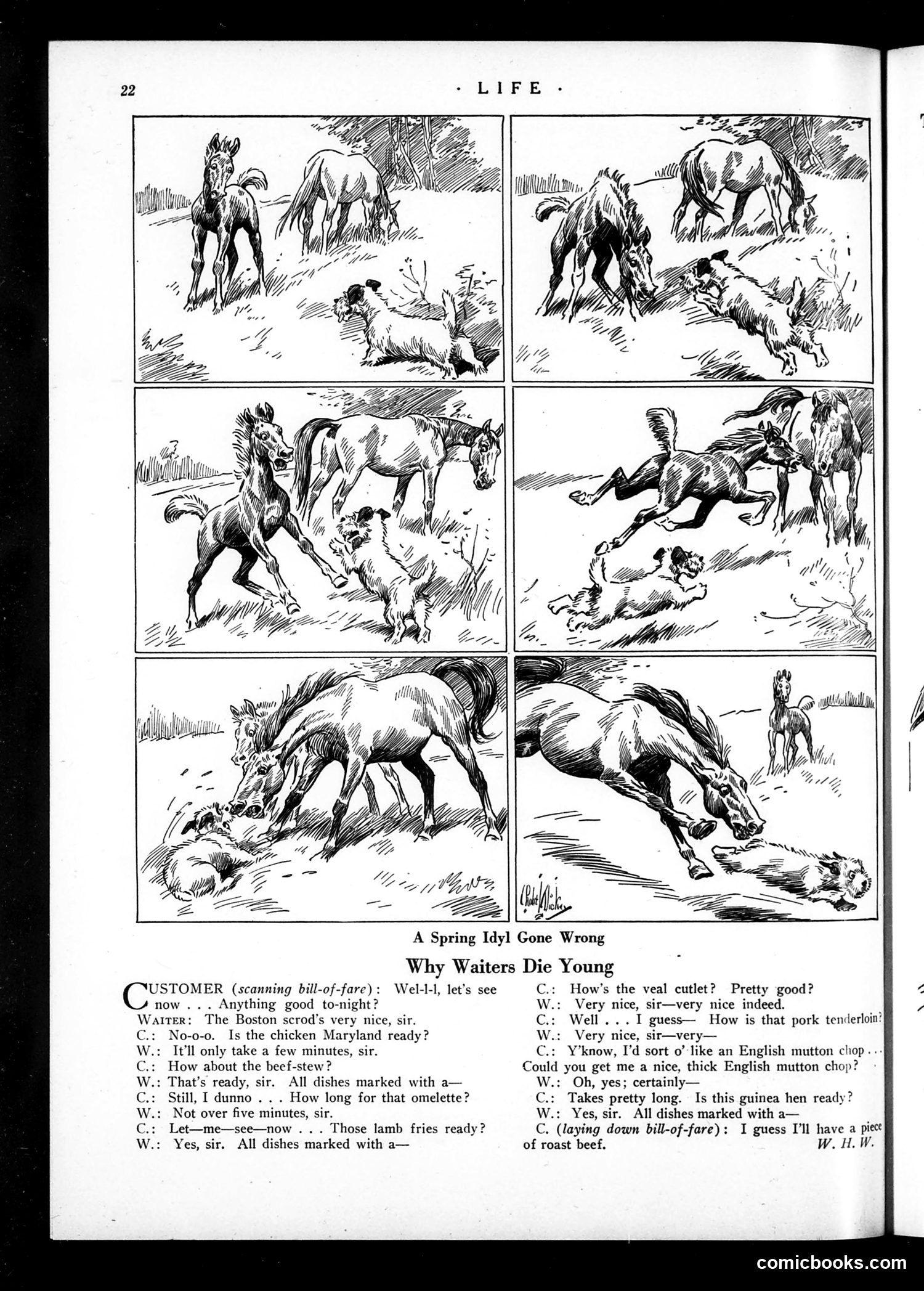
This is a satirical comic strip about restaurant frustration. A demanding customer scans the menu, asking a weary waiter about nearly every dish—Boston scrod, chicken Maryland, beef stew, omelette, lamb fries, veal cutlet, pork tenderloin, English mutton chop, guinea hen—with the waiter patiently assuring him everything is "very nice, sir." The joke is the customer's indecision and pickiness: after interrogating the waiter about virtually every option, he finally orders plain roast beef—the simplest choice. The title suggests waiters face this exhausting behavior constantly, explaining their premature deaths from stress. The comic illustrates the tension between demanding customers and service workers forced to maintain composure through tedious questioning. It's a workplace humor piece sympathetic to servers' plight, satirizing customer behavior that remains recognizable today.
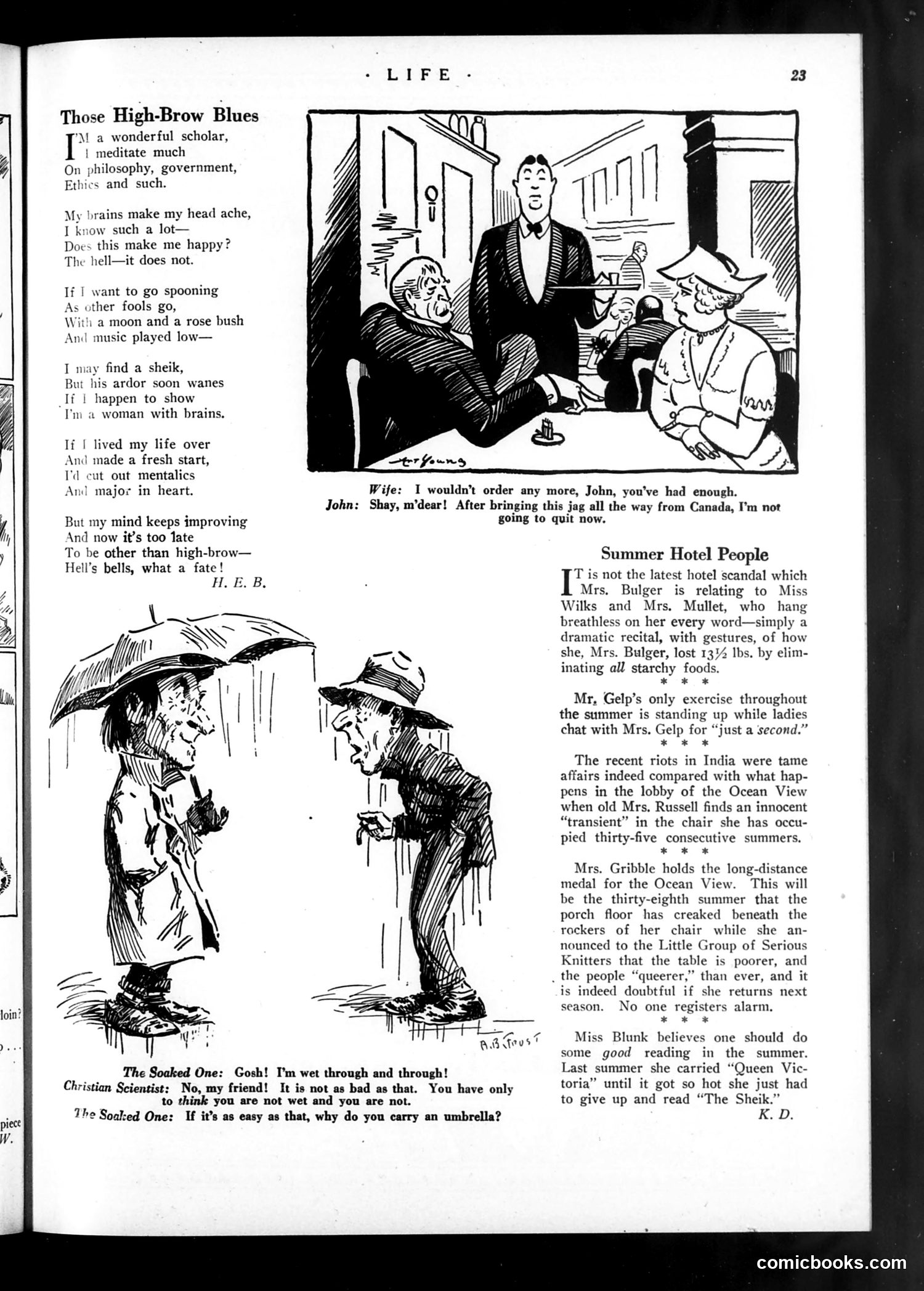
**"Those High-Brow Blues"** is a poem lamenting intellectual pursuits. The speaker, apparently a woman, complains that scholarly knowledge makes her unhappy and unattractive to men—potential romantic interests ("sheiks") lose interest upon discovering she's intelligent. She regrets her intellectual development, wishing she'd focused on "heart" instead of "mentalics." The accompanying **cartoon** shows a domestic scene where a drunk husband ("John") refuses to stop drinking, claiming he won't abandon liquor he brought from Canada. His exasperated wife protests he's had enough. **"Summer Hotel People"** is gossipy social commentary about predictable hotel guests: Mrs. Bulger discusses weight loss; Mr. Gelp avoids effort; Mrs. Russell guards her chair jealously; Mrs. Gribble complains annually; Miss Blunk reads heavy literature until the heat forces her to lighter fare like "The Sheik." The satirical point throughout: modern life—whether intellectual ambition, drinking, or vacation routines—produces anxiety and dissatisfaction rather than happiness.
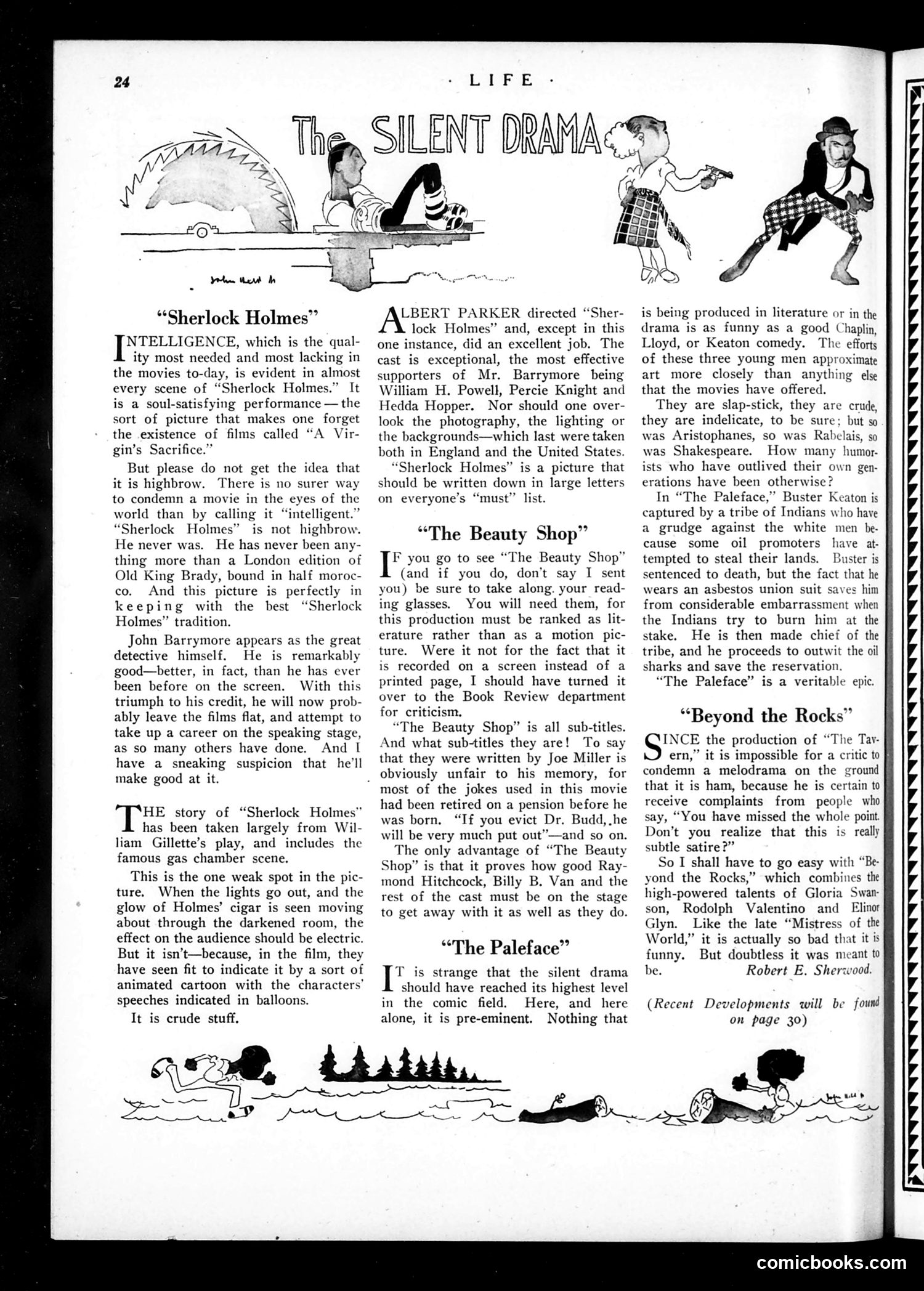
This page reviews four silent films. The cartoon at top depicts a seesaw with a porcupine, illustrating the physical comedy of slapstick cinema. **"Sherlock Holmes"** stars John Barrymore in an adaptation of William Gillette's play. The reviewer praises it as intelligent yet accessible—explicitly defending it against being "highbrow," since calling movies intelligent was considered box-office poison. One weakness: a gas-chamber scene uses crude animated cartoons with dialogue balloons instead of visual storytelling. **"The Beauty Shop"** is criticized as subtitle-heavy with ancient jokes (the reviewer compares them to Joe Miller, a 17th-century jokester). Its only value is proving the cast's stage talent. **"The Paleface"** and **"Beyond the Rocks"** receive brief mentions praising slapstick comedy—Chaplin, Lloyd, and Keaton—as genuinely artistic, comparing them favorably to classical literature (Aristophanes, Rabelais, Shakespeare). The reviews reflect 1920s anxieties: movies feared appearing too intellectual while struggling for artistic legitimacy against live theater.
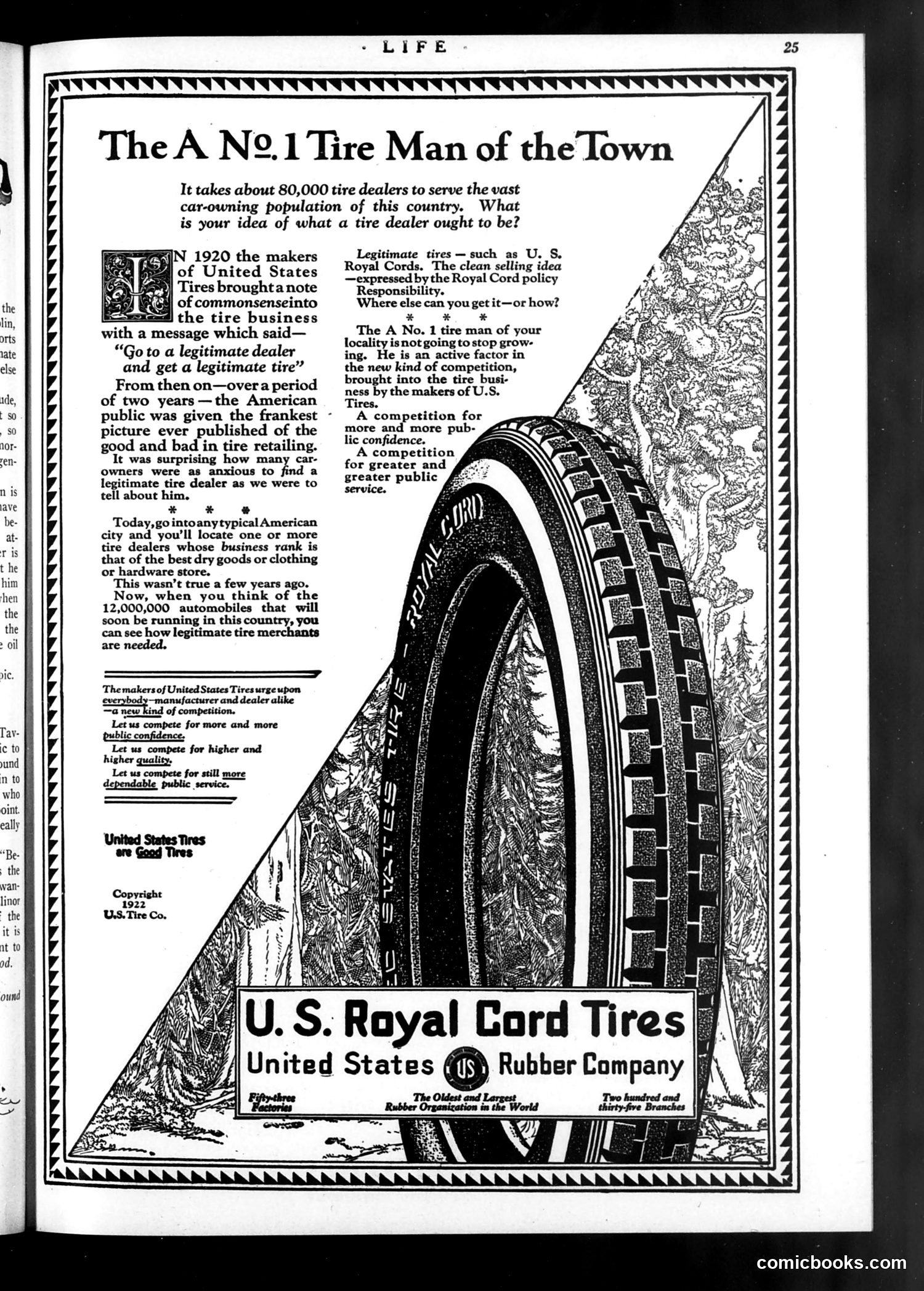
This is primarily a **corporate advertisement**, not satire. United States Tires uses the "Life" magazine platform to promote their brand and business philosophy circa 1922. The ad addresses a legitimate market problem of the early 1920s: the tire industry had a poor reputation due to illegitimate dealers selling defective products. The large tire illustration dominates the page, emphasizing product quality. The "message" references U.S. Tires' 1920 campaign encouraging consumers to patronize legitimate dealers selling quality "Royal Cord" tires. The ad argues that competition should be based on **public confidence, quality, and service**—not just price-cutting—and celebrates how tire dealers have elevated their standing to match "the best dry goods or clothing or hardware store." There is no political satire here. Rather, it's a manufacturer promoting ethical business practices while subtly asserting market dominance through a trusted satirical magazine. The tone is earnest corporate messaging, not mockery.
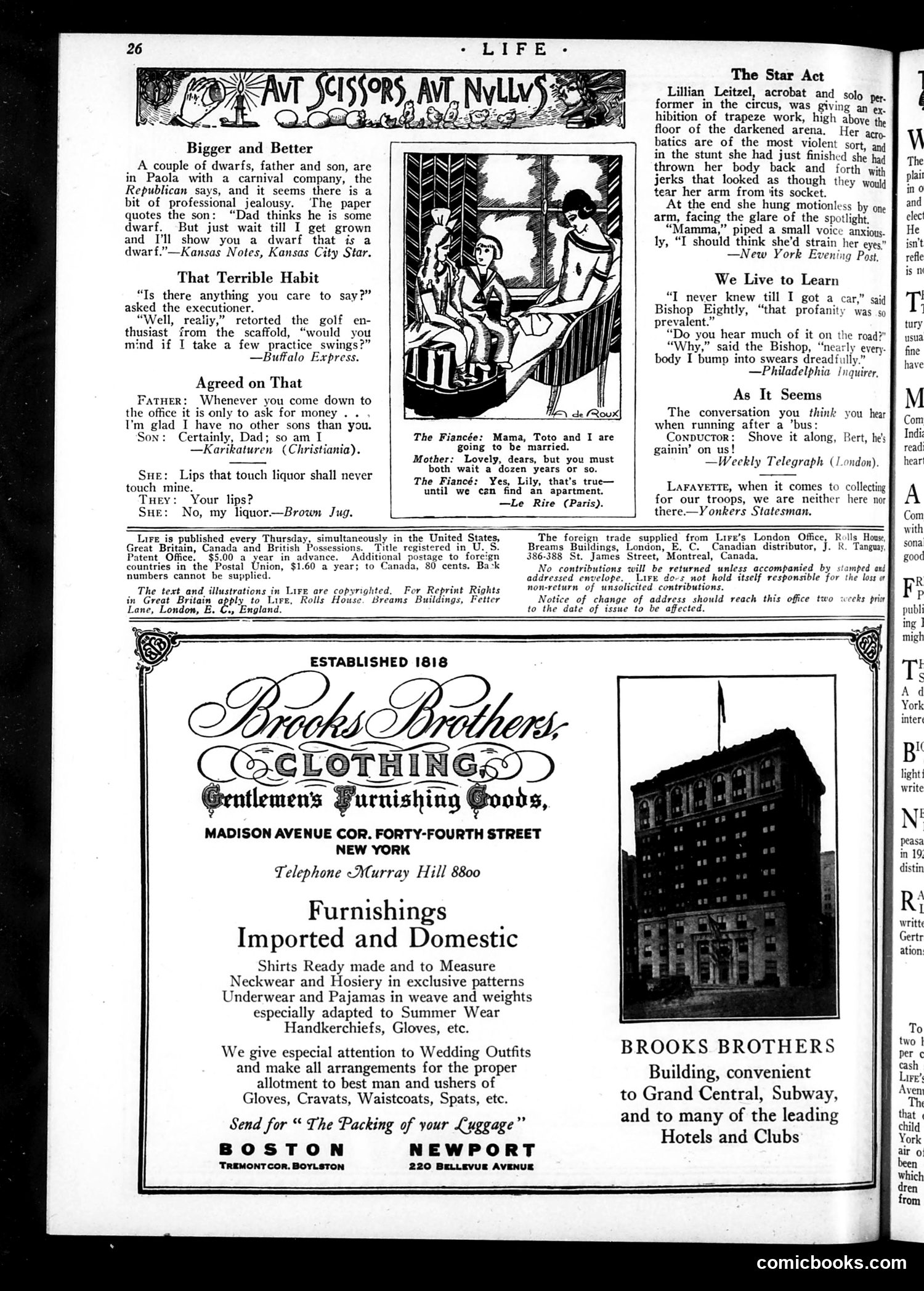
This page from *Life* magazine contains several humorous short anecdotes rather than a single political cartoon. The jokes satirize American social and professional life: **"Bigger and Better"** mocks professional rivalry—a dwarf father and son in a carnival compete, with the son boasting he'll outdo his father once grown. **"That Terrible Habit"** jokes about a golfer's obsession, even facing execution, asking for "practice swings"—satirizing how Americans prioritize their hobbies. **"Agreed on That"** presents a father and son bonding over their mutual agreement that the son should only visit to ask for money. The other brief pieces similarly mock everyday American manners and pretensions—a bishop discovering profanity, a mother delaying her son's wedding, and misheard urban conversations. The page is primarily filler content and advertisements (Brooks Brothers dominates the lower half), typical of *Life*'s satirical magazine format mixing social commentary with commercial notices.
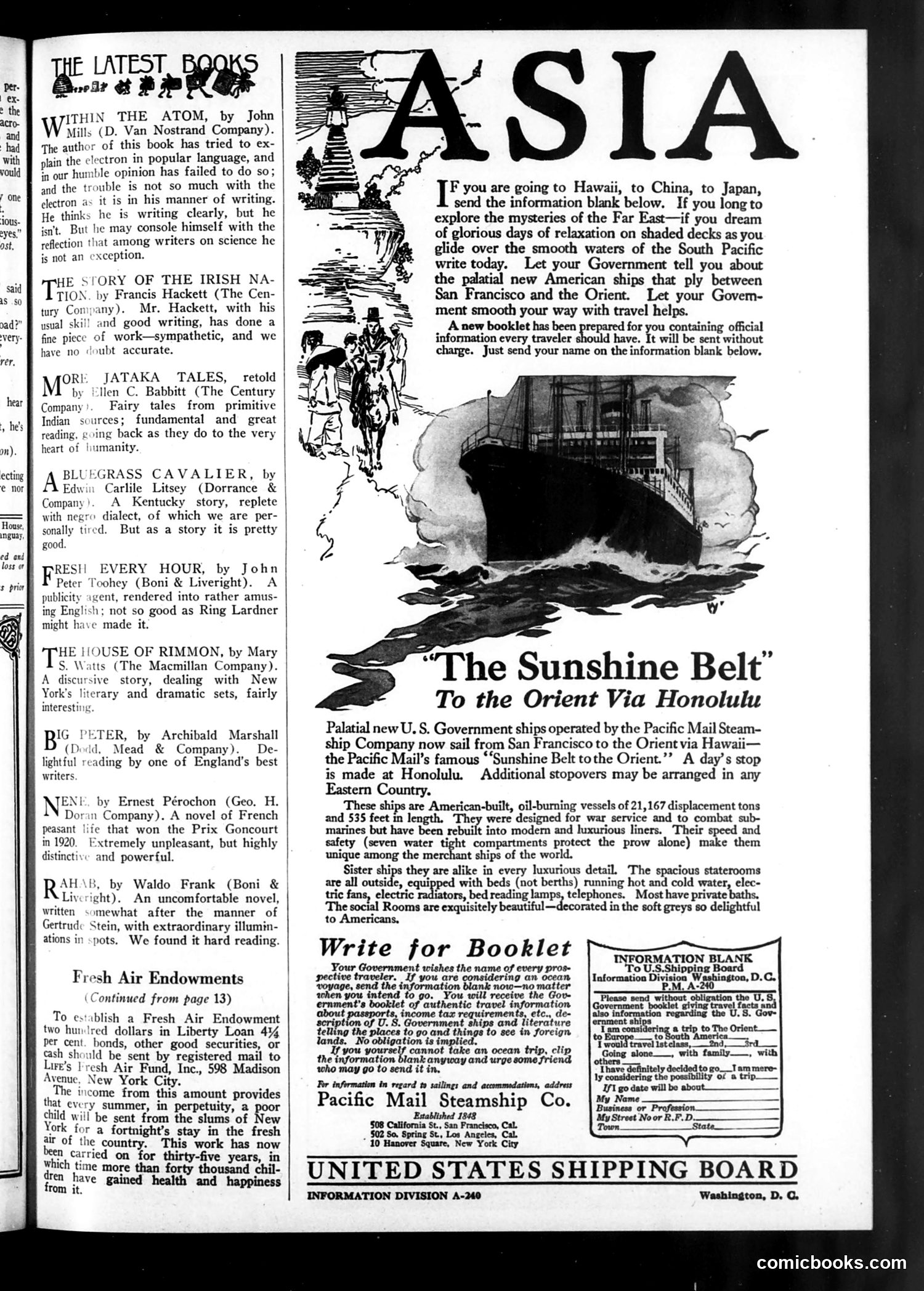
This page is primarily **advertising and travel promotion**, not political satire. The dominant content is a large advertisement for the Pacific Mail Steamship Company promoting luxury ocean voyages to Asia ("The Sunshine Belt to the Orient"). The left column contains brief book reviews of contemporary literature—works on atomic science, Irish history, fairy tales, and fiction. These are straightforward critical assessments without satirical intent. The main visual element is an illustration of a large passenger ship, accompanying text describing government-operated vessels: American-built, oil-burning ships originally designed for wartime submarine combat, now converted to luxury liners with amenities like private cabins, electric radiators, and social rooms. The advertisement encourages readers traveling to Hawaii, China, or Japan to request a government information booklet about these ships. **This is essentially a magazine page blending book reviews with government-sponsored commercial advertising**—common practice in 1920s American periodicals. There is no discernible political cartoon or satirical message present.
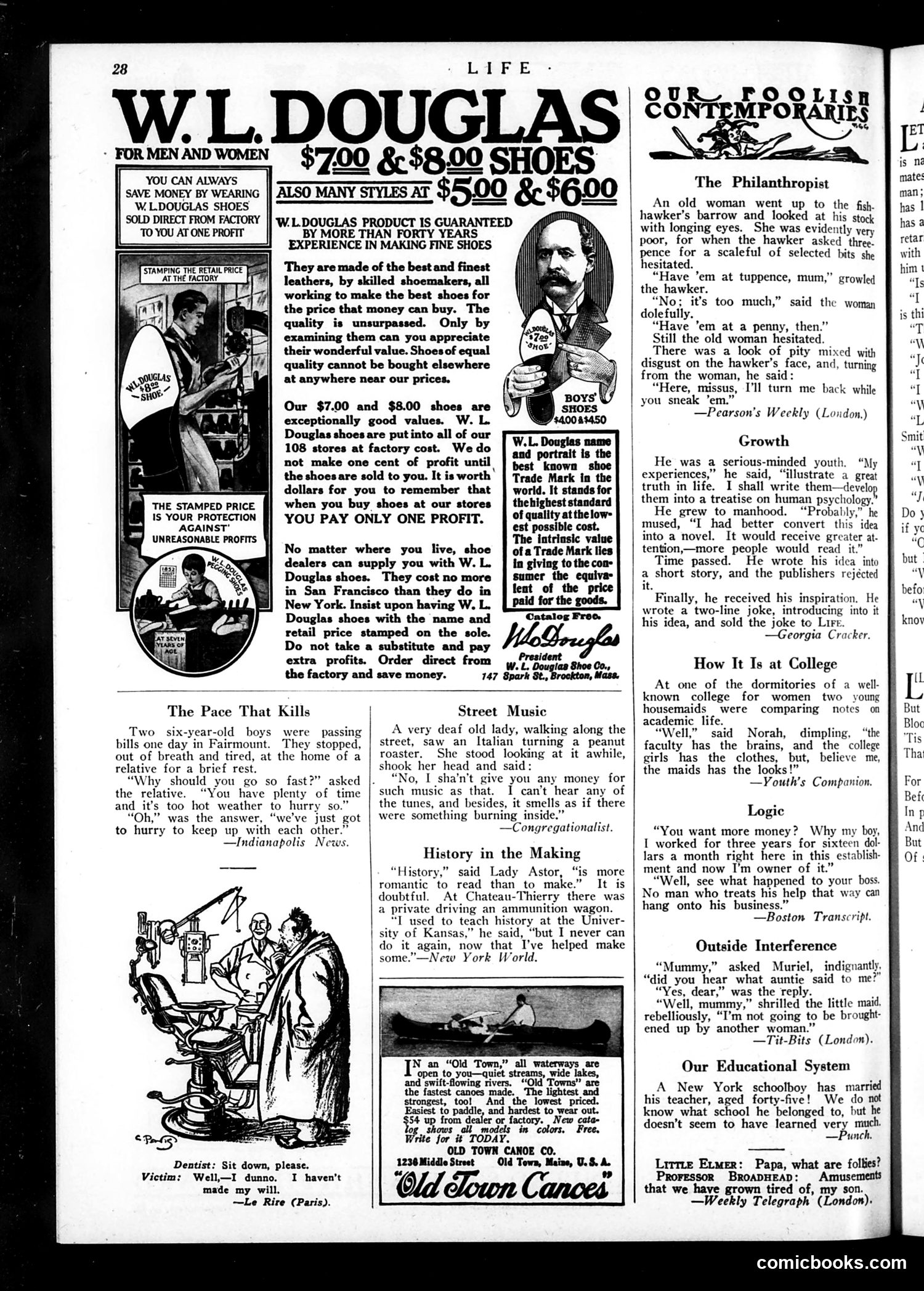
This page is primarily **advertising** (W.L. Douglas shoes dominate), but includes several satirical humor pieces typical of *Life* magazine's format. **Key Content:** The advertisements use common early-20th-century marketing claims about factory-direct sales and quality assurances—meant to counter skepticism about mail-order shoes. The humorous anecdotes are brief, morality-tinged jokes: - "The Pace That Kills": Children racing to "keep up" reflects anxiety about modern competitiveness - "Street Music": A deaf woman can't hear an organ grinder, satirizing the poor's inability to enjoy even "free" entertainment - "The Philanthropist": A fish hawker's eventual charity to a desperate woman—sentimental humor about class relations - "History in the Making": Lady Astor's comment about WWI reflects contemporary references to Château-Thierry (1918 battle) These pieces reflect *Life's* mix of gentle social satire and moralistic humor, targeting readers' class anxieties and sentiment about poverty and progress.
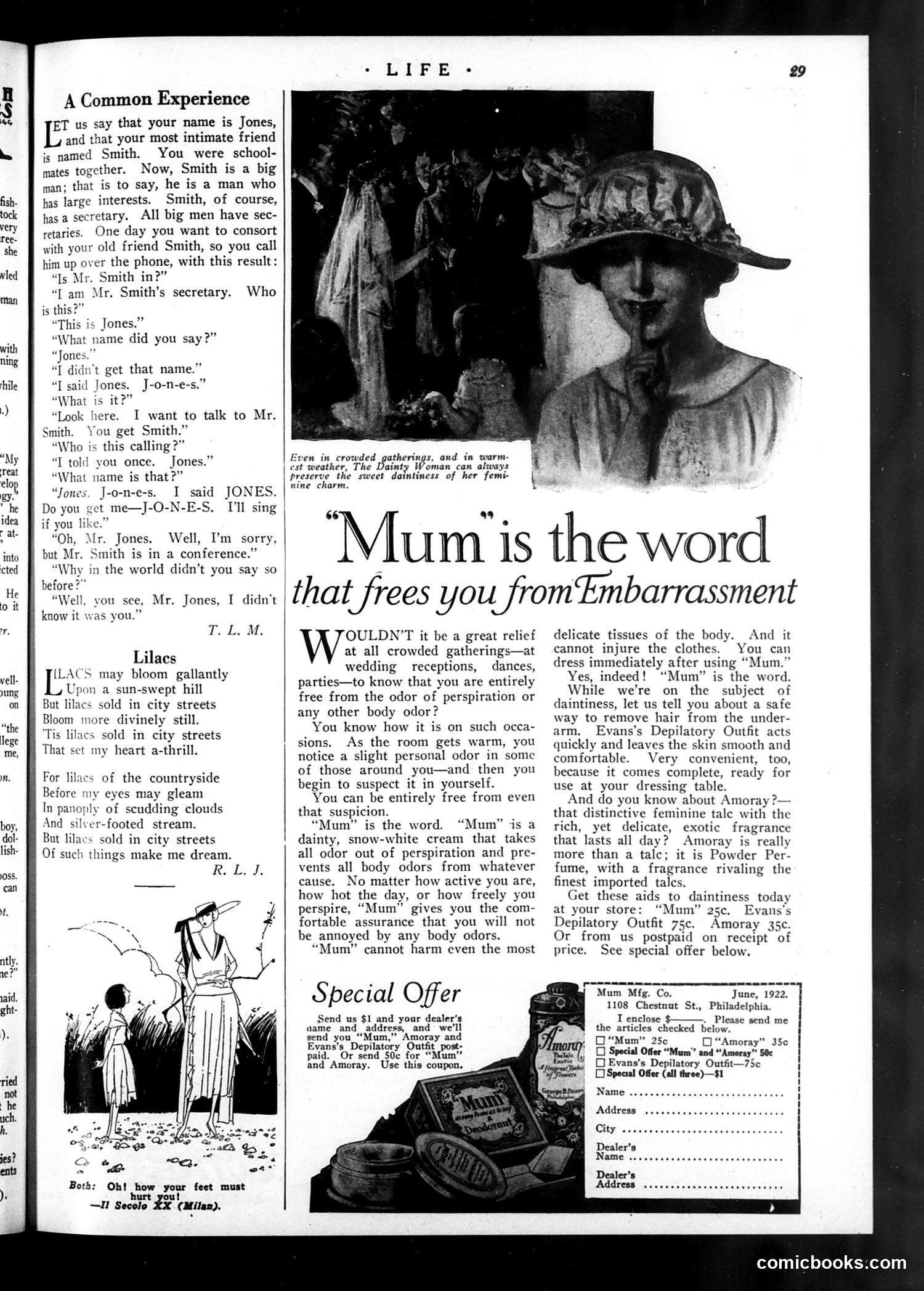
**"A Common Experience"** satirizes the frustration of calling a busy executive's office. When Jones tries reaching his old schoolmate Smith, Smith's secretary repeatedly misunderstands the simple name "Jones," asking him to spell it multiple times despite his clear enunciation. The joke critiques how secretaries—gatekeepers for important men—create absurd bureaucratic barriers to access, treating even old friends as inconvenient obstacles. The punchline, "I didn't know it was you," mocks how the secretary's obstruction was pointless all along. The page is otherwise **advertising**. The dominant feature promotes "Mum," a deodorant cream marketed as essential for women maintaining "daintiness" and avoiding embarrassment from body odor at social gatherings. The ad also pushes Evans's Depilatory Outfit and Amoray perfume talc as complementary products for feminine hygiene—reflecting 1920s marketing that weaponized women's anxiety about bodily functions to sell products.
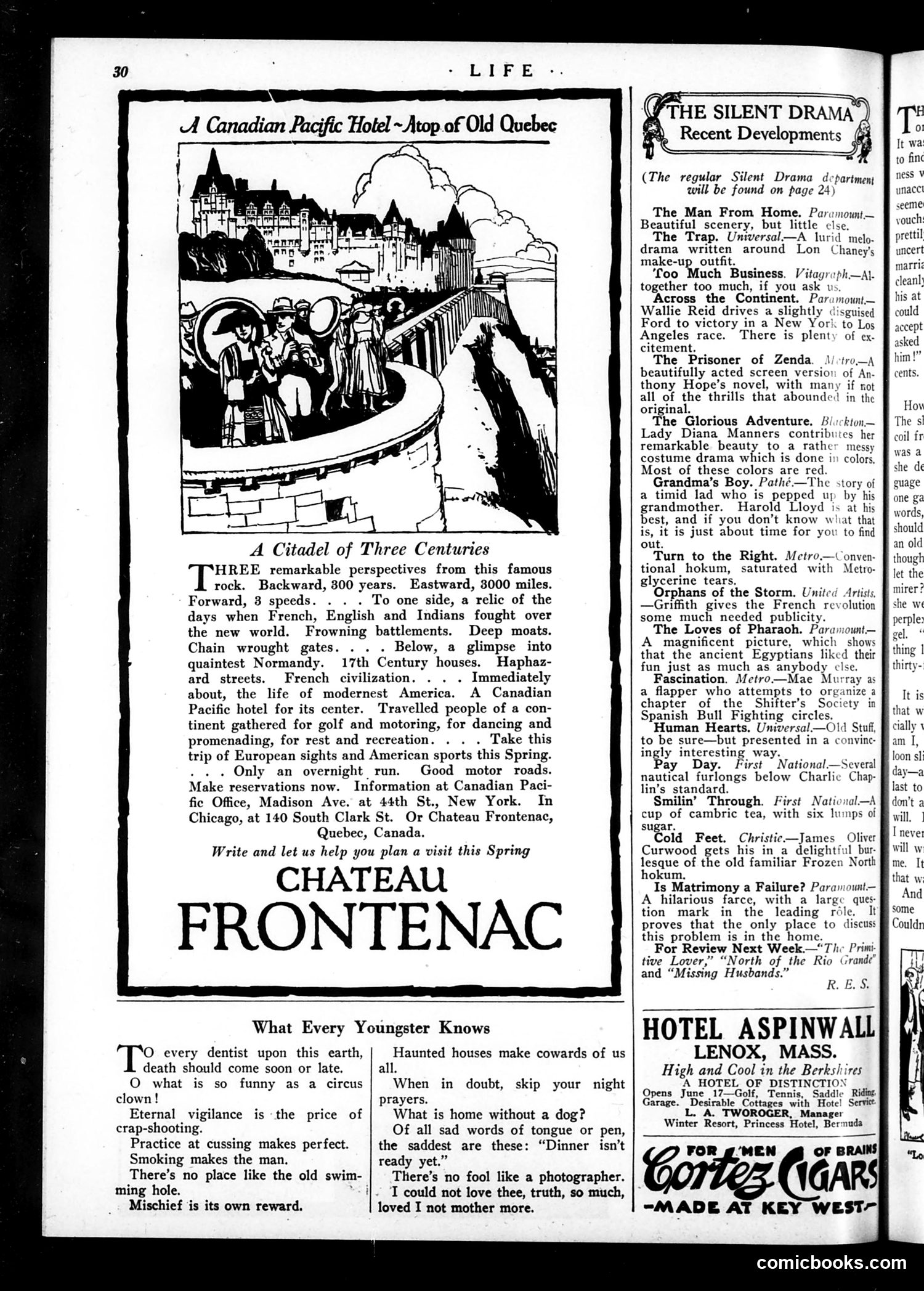
This page contains primarily **advertising and entertainment reviews** rather than political cartoons. The main visual element is an advertisement for **Chateau Frontenac**, a Canadian Pacific Hotel in Quebec City. The illustration depicts the hotel as a romantic, castle-like structure overlooking the St. Lawrence River, with tourists enjoying early-1920s leisure activities (automobiles, golf). The ad emphasizes the hotel's appeal as a destination combining "European sights and American sports." Below this is a humorous section titled "What Every Youngster Knows"—cynical aphorisms mocking conventional morality and childhood experiences (dentists, swimming holes, crap-shooting). This satirizes naive sentimentality. The right column reviews silent films, offering brief, often dismissive critiques. These reviews employ casual wit ("Most of these colors are red"), suggesting the magazine's satirical tone. **Context for modern readers**: This reflects the 1920s leisure industry, automobile tourism, and silent cinema's dominance in entertainment. The page demonstrates how Life combined sophisticated social satire with commercial promotion.
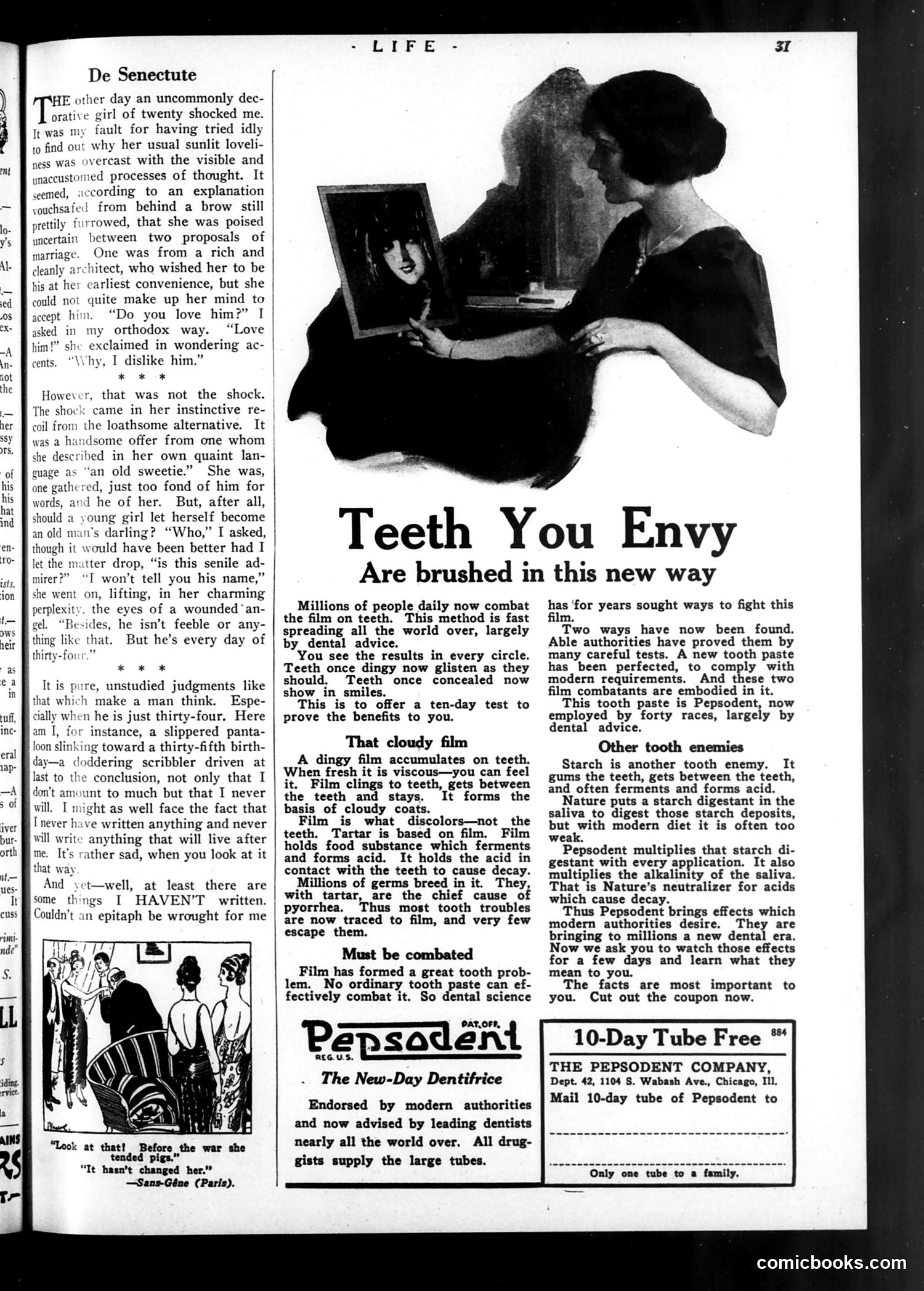
This page combines a humorous essay with a tooth-paste advertisement. The essay's title references Cicero's classical work on old age, establishing its satirical tone. **The Essay's Satire:** The unnamed author recounts a twenty-year-old woman choosing between two suitors: a wealthy architect and a man she describes as "an old sweetie"—who turns out to be thirty-four. The joke is that the author, also thirty-four, realizes he and his contemporaries are now considered "old" by the younger generation. The satire targets both youth's callousness and middle-aged anxiety about aging. **The Advertisement:** Pepsodent advertises its "new way" of brushing to combat "cloudy film" on teeth. The ad emphasizes scientific endorsement and offers a ten-day free trial. The advertisement uses the page to promote dental hygiene as modern, scientifically-validated progress—typical of 1920s advertising rhetoric positioning consumer products as solutions to newly-identified problems. Together, the juxtaposition is likely intentional: anxieties about aging paired with a product promising to restore youthful appearance.
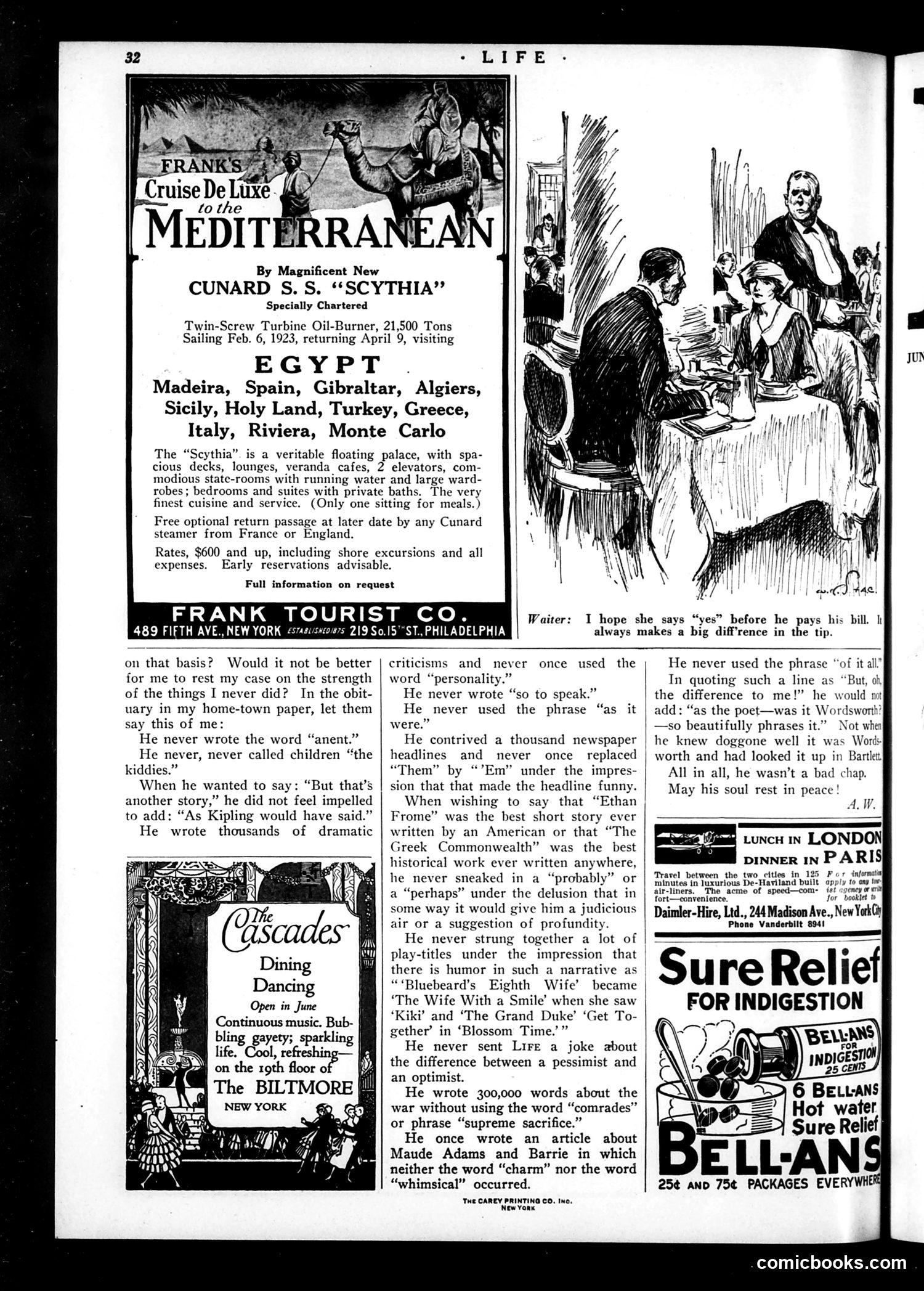
This page contains primarily **advertisements and a satirical article**, not political cartoons. The main content is a humorous obituary-style piece mocking a prolific writer (likely a literary critic or journalist) by cataloging what he *never* wrote—never used clichés like "personality," "so to speak," "as it were," or "supreme sacrifice." The satire targets overwrought, affected prose and lazy literary references common in early 20th-century journalism. The cartoon inset shows a waiter hoping a female diner says "yes" (presumably to a proposal) *before* paying her bill, as it affects his tip—a joke about men's self-interest in romance. The page is otherwise dominated by luxury travel advertisements (Cunard cruise line), a nightclub ad (The Cascades), and patent medicine ads (Bell-ans indigestion relief), typical of 1920s *Life* magazine marketing.