
Life, 1922-06-01 · page 30 of 34
Life — June 1, 1922 — page 30: what you’re looking at
What you’re looking at
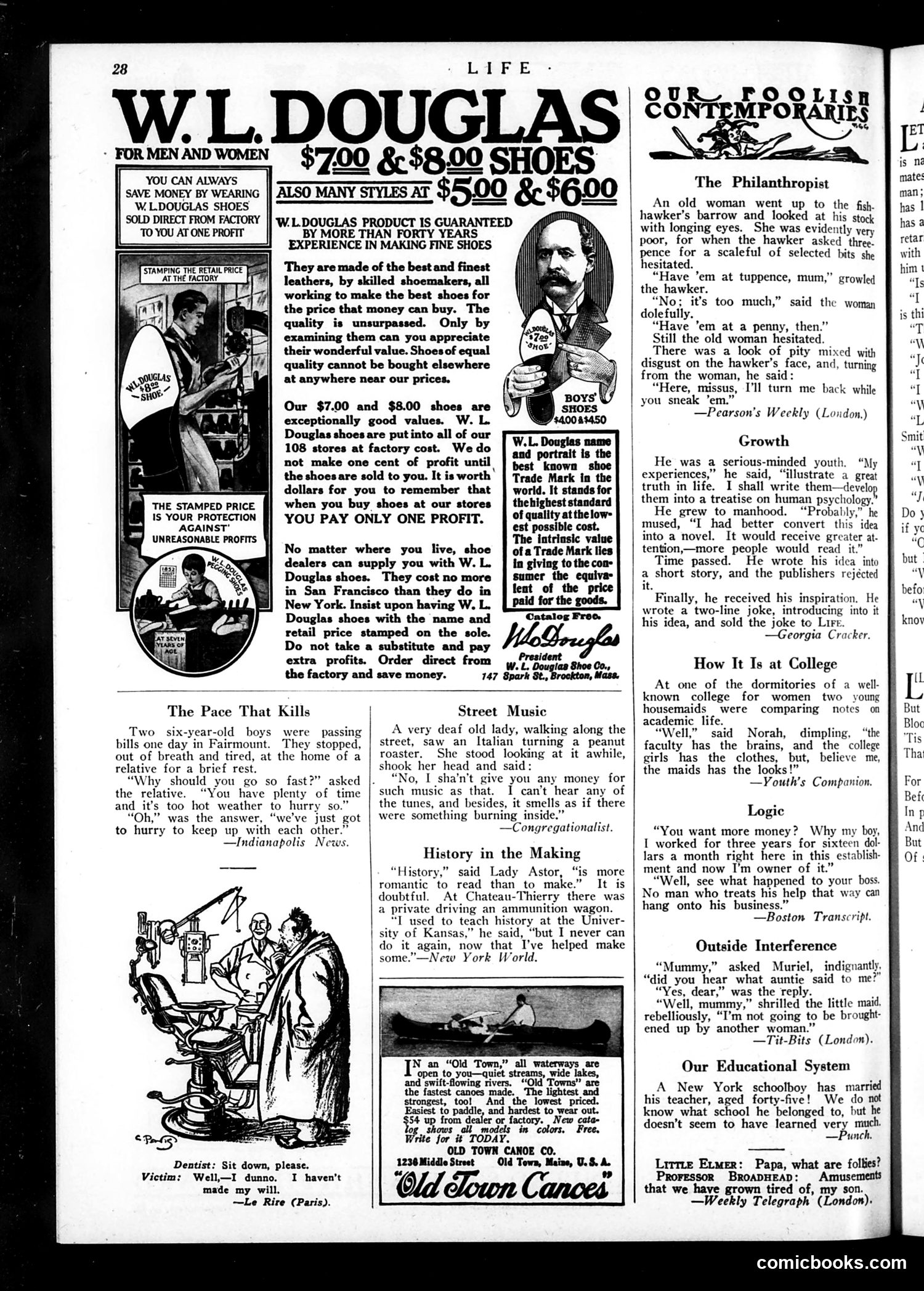
This page is primarily **advertising** (W.L. Douglas shoes dominate), but includes several satirical humor pieces typical of *Life* magazine's format. **Key Content:** The advertisements use common early-20th-century marketing claims about factory-direct sales and quality assurances—meant to counter skepticism about mail-order shoes. The humorous anecdotes are brief, morality-tinged jokes: - "The Pace That Kills": Children racing to "keep up" reflects anxiety about modern competitiveness - "Street Music": A deaf woman can't hear an organ grinder, satirizing the poor's inability to enjoy even "free" entertainment - "The Philanthropist": A fish hawker's eventual charity to a desperate woman—sentimental humor about class relations - "History in the Making": Lady Astor's comment about WWI reflects contemporary references to Château-Thierry (1918 battle) These pieces reflect *Life's* mix of gentle social satire and moralistic humor, targeting readers' class anxieties and sentiment about poverty and progress.
📄 Transcribed text from this page (OCR, searchable)
Machine-transcribed from the original scan — historical spelling and the odd misread are preserved.
LIFE WLDOUGLAS $700 & $800 SHOES EXPERIENCE IN MAKING FINE SHOES They are made of the best and finest leathers, by skilled shoemakers, all working to make the best shoes for the price that money can buy. The quality is unsurpassed. Only by examining them can you appreciate their wonderful value. Shoes of equal quality cannot be bought elsewhere at anywhere near our prices, Our $7.00 and $8.00 shoes are exceptionally good values. W. L. Douglas shoes are put into all of our 108 stores at factory cost. Wedo not make one cent of profit until the shoesare sold to you. It is worth dollars for you to remember that when you buy shoes at our stores YOU PAY ONLY ONE PROFIT. ‘THE STAMPED PRICE 1S YOUR PROTECTION AGAINST’ UNREASONABLE PROFITS No matter where you live, shoe dealers can supply you with W. L. Douglas shoes. They cost no more in San Francisco than they do in New York. Insist upon having W. L. Douglas shoes with the name and Trade Mark in the world. It stands for thehighest standard of quality at thelow- est possible cost. The intrinsic value of a Trade Mark lies in giving to the con- sumer the equiva: lent of the price paid for the goods. Catalog Free. retail price stamped on the sole. Do not take a substitute and pay extra profits. Order direct from woe ident the factory and save money. The Pace That Kills Two six-year-old boys were passing bills one day in Fairmount. They stopped, out of breath and tired, at the home of a relative for a brief rest. “Why should you go so fast?” asked the relative. “You have plenty of time and it’s too hot weather to hurry so.” “Oh,” was the answer, “we've just got to hurry to keep up with each other.” —Indianapolis News. Dentist: Sit down, please. Victim: Well,—I dunno. I haven't made my will. —Le Rire (Paris). | do it again, 1aB Shoe Co., 147 Spark Be Brockton, Mase. Street Music A very deaf old lady, walking along the street, saw an Italian’ turning a peanut roaster. She stood looking at it awhile, shook her head and said: “No, I sha'n't give you any money for such music as that. I can’t hear any of the tunes, and besides, it smells as if there were something burning inside.” —Congregationalist. History in the Making “History,” said Lady Astor, “is more romantic to read than to make.” It is doubtful. At Chateau-Thierry there was a private driving an ammunition wagon. “T used to teach history at the Univer- sity of Kansas,” he said, “but I never can ow that I’ve helped make some.”—New York World. N an “Old Town,” all waterways are ‘open to you—quiet streams, wide lakes, and swift-flowing rivers. ‘Old Towns” are the fastest canoes made. The lightest and strongest, tool And the lowest priced. Easiest to paddle, and hardest to wear out. $4 up from dealer or factory. New cata- 9g, shows all models in colors, Free. Write for it TODAY. OLD TOWN CANOE CO. 1236Middle Street Old Tows, Maine, U.S. A. Old down Canoes The Philanthropist An old woman went up to the fish. hawker’s barrow and looked at his stock with longing eyes. She was evidently very poor, for when the hawker asked three- pence for a scaleful of selected bits she hesitated. “Have ’em at tuppence, mum,” growled the hawker. “No; it’s too much,” said the woman dolefully. “Have ’em at a penny, then.” Still the old woman hesitated. There was a look of pity mixed with disgust on the hawker’s face, and, turning from the woman, he said: “Here, missus, you sneak ’em.” —Pearson’s Weekly (London.) I'll turn me back while Growth He was a serious-minded youth, experiences,” he said, “illustrate a great truth in life. I shall write them—develo them into a treatise on human psychology.” He grew to manhood. ‘Probab mused, “I had better convert th into a novel. It would receive greater at- tention,—more people would read it.” Time passed. He wrote his idea into a short story, and the publishers rejécted it. Finally, he received his inspiration. He wrote a two-line joke, introducing into it his idea, and sold the joke to Lire. —Georgia Cracker. “My How It Is at College At one of the dormitories of a well- known college for women two young housemaids were comparing notes on academic life. “Well,” said Norah, dimpling, “the faculty has the brains, and the college girls has the clothes, but, believe me, the maids has the looks!” —Youth’s Companion. Logic “You want more money? Why my boy, I worked for three years for sixteen dol- lars a month right here in this establish- ment and now I'm owner of it.” “Well, see what happened to your boss. No man who treats his help that way can hang onto his business.” —Boston Transcript. Outside Interference “Mummy,” asked Muriel, indignant! “did_you hear what auntie said to me? “Yes, dear,” was the reply. , “Well, mummy,” shrilled the little maid. rebelliously, “I’m not going to be brought- ened up by another woman.” —Tit-Bits (London). Our Educational System A New York schoolboy has married his teacher, aged forty-five! We do not know what school he belonged to, but he doesn’t seem to have learned very ma —Punch. Lrttte Ermer: Papa, what are follies? Proressor BroapHEAD: Amusements that we have grown tired of, my son. —Weekly Telegraph (London): E is na mate: man; has | has a retar with him t comicbooks.com