
Life, 1922-06-01 · page 26 of 34
Life — June 1, 1922 — page 26: what you’re looking at
What you’re looking at
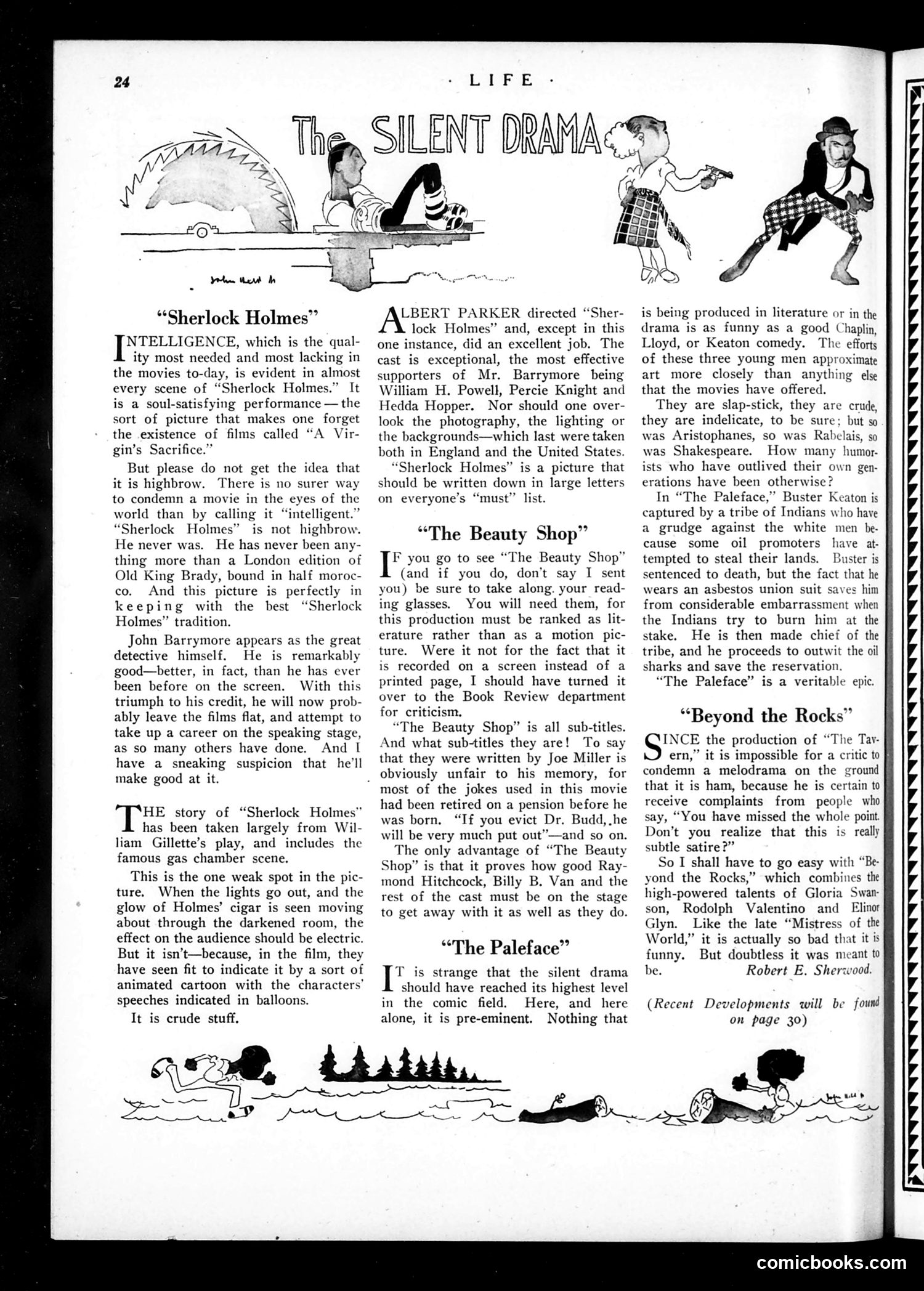
This page reviews four silent films. The cartoon at top depicts a seesaw with a porcupine, illustrating the physical comedy of slapstick cinema. **"Sherlock Holmes"** stars John Barrymore in an adaptation of William Gillette's play. The reviewer praises it as intelligent yet accessible—explicitly defending it against being "highbrow," since calling movies intelligent was considered box-office poison. One weakness: a gas-chamber scene uses crude animated cartoons with dialogue balloons instead of visual storytelling. **"The Beauty Shop"** is criticized as subtitle-heavy with ancient jokes (the reviewer compares them to Joe Miller, a 17th-century jokester). Its only value is proving the cast's stage talent. **"The Paleface"** and **"Beyond the Rocks"** receive brief mentions praising slapstick comedy—Chaplin, Lloyd, and Keaton—as genuinely artistic, comparing them favorably to classical literature (Aristophanes, Rabelais, Shakespeare). The reviews reflect 1920s anxieties: movies feared appearing too intellectual while struggling for artistic legitimacy against live theater.
📄 Transcribed text from this page (OCR, searchable)
Machine-transcribed from the original scan — historical spelling and the odd misread are preserved.
LIFE ye tot hh “Sherlock Holmes” NTELLIGENCE, which is the qual- ity most needed and most lacking in the movies to-day, is evident in almost every scene of “Sherlock Holmes.” It is a soul-satisfying performance — the sort of picture that makes one forget the existence of films called “A Vir- gin’s Sacrifice.” But please do not get the idea that it is highbrow. There is no surer way to condemn a movie in the eyes of the world than by calling it “intelligent.” “Sherlock Holmes” is not highbrow. He never was. He has never been any- thing more than a London edition of Old King Brady, bound in half moroc- co. And this picture is perfectly in keeping with the best “Sherlock Holmes” tradition. John Barrymore appears as the great detective himself. He is remarkably good—better, in fact, than he has ever been before on the screen. With this triumph to his credit, he will now prob- ably leave the films flat, and attempt to take up a career on the speaking stage, as so many others have done. And | have a sneaking suspicion that he'll make good at it. HE story of “Sherlock Holmes” has been taken largely from Wil- liam Gillette’s play, and includes the famous gas chamber scene. This is the one weak spot in the pic- ture. When the lights go out, and the glow of Holmes’ cigar is seen moving about through the darkened room, the effect on the audience should be electric. But it isn’t—because, in the film, they have seen fit to indicate it by a sort of animated cartoon with the characters’ speeches indicated in balloons. It is crude stuff. LBERT PARKER directed “Sher- lock Holmes” and, except in this one instance, did an excellent job. The cast is exceptional, the most effective supporters of Mr. Barrymore being William H. Powell, Percie Knight and Hedda Hopper. Nor should one over- look the photography, the lighting or the backgrounds—which last were taken both in England and the United States. “Sherlock Holmes” is a picture that should be written down in large letters on everyone’s “must” list. “The Beauty Shop” F you go to see “The Beauty Shop” (and if you do, don’t say I sent you) be sure to take along. your read- ing glasses. You will need them, for this production must be ranked as lit- erature rather than as a motion pic- ture. Were it not for the fact that it is recorded on a screen instead of a printed page, I should have turned it over to the Book Review department for criticism. “The Beauty Shop” is all sub-titles. And what sub-titles they are! To say that they were written by Joe Miller is obviously unfair to his memory, for most of the jokes used in this movie had been retired on a pension before he was born. “If you evict Dr. Budd,,he will be very much put out”—and so on. The only advantage of “The Beauty Shop” is that it proves how good Ray- mond Hitchcock, Billy B. Van and the rest of the cast must be on the stage to get away with it as well as they do. “The Paleface” T is strange that the silent drama should have reached its highest level in the comic field. Here, and here alone, it is pre-eminent. Nothing that is being produced in literature or in the drama is as funny as a good Chaplin, Lloyd, or Keaton comedy. The efforts of these three young men approximate art more closely than anything else that the movies have offered. They are slap-stick, they are crude, they are indelicate, to be sure; but so was Aristophanes, so was Rabelais, so was Shakespeare. How many humor- who have outlived their own gen- erations have been otherwise? In “The Paleface,” Buster Keaton is captured by a tribe of Indians who have a grudge against the white men be- cause some oil promoters have at- tempted to steal their lands. Buster is sentenced to death, but the fact that he wears an asbestos union suit saves him ff from considerable embarrassment when the Indians try to burn him at the stake. He is then made chief of the tribe, and he proceeds to outwit the oil sharks and save the reservation. “The Paleface” is a veritable epic. “Beyond the Rocks” INCE the production of “The Tav- ern,” it is impossible for a critic to condemn a melodrama on the ground that it is ham, because he is certain to receive complaints from people who say, “You have missed the whole point. Don’t you realize that this is really subtle satire?” So I shall have to go easy with “Be- yond the Rocks,” which combines the high-powered talents of Gloria Swan- son, Rodolph Valentino and Elinor Glyn. Like the late “Mistress of the World,” it is actually so bad that it is funny. But doubtless it was meant to be. Robert E. Sherwood. (Recent Developments will be found on page 30) RX oe, te al ee ee ee fe wis comicbooks.com r}