
Life, 1922-06-01 · page 6 of 34
Life — June 1, 1922 — page 6: what you’re looking at
What you’re looking at
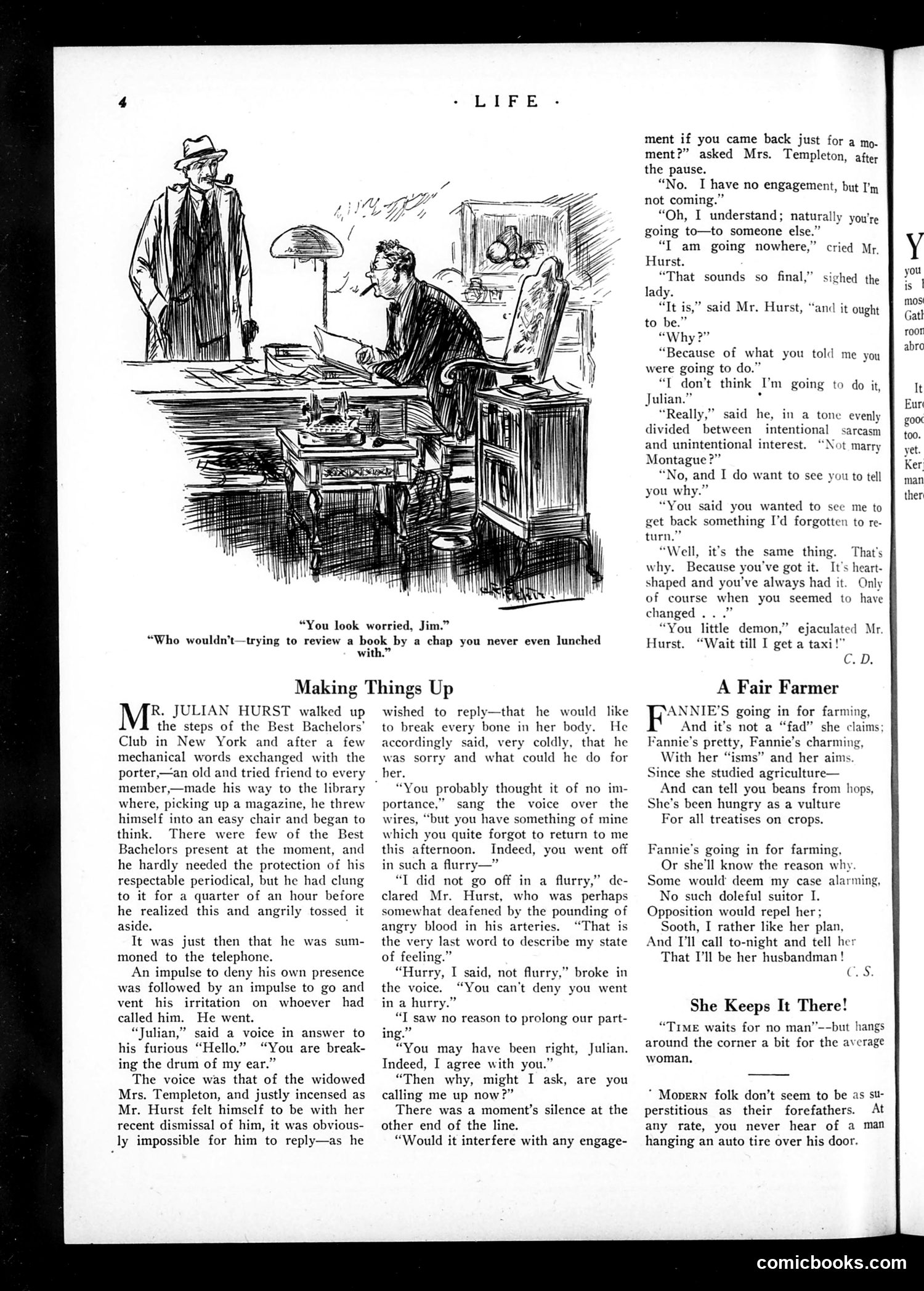
This page contains three separate short stories/humor pieces rather than political cartoons. The main illustration—"Making Things Up"—shows a man at a desk being interrupted by a visitor. The accompanying caption and text describe Mr. Julian Hurst receiving an unwelcome call from Mrs. Templeton regarding a broken engagement. The humor derives from their tense conversation about his refusal to marry her, with Hurst insisting he never promised anything and questioning why she's now contacting him. The other two pieces—"A Fair Farmer" and "She Keeps It There!"—are brief humorous poems about farming and domestic life. This page reflects early-20th-century Life magazine's focus: satirizing courtship conventions, relationship dynamics, and social expectations rather than political commentary. The humor targets romantic misunderstandings and the social pressures surrounding marriage.
📄 Transcribed text from this page (OCR, searchable)
Machine-transcribed from the original scan — historical spelling and the odd misread are preserved.
“You look worried, Jim.” “Who wouldn’t—trying to review a book by a chap you never even lunched with.” Making Things Up N HURST walked up the steps of the Best Bachelors’ R. JUL Club in New York and after a few mechanical words exchanged with the porter,—an old and tried friend to every member,—made his way to the library where, picking up a magazine, he threw himself into an easy chair and began to think. There were few of the Best Bachelors present at the moment, and he hardly needed the protection of his respectable periodical, but he had clung to it for a quarter of an hour before he realized this and angrily tossed it aside. It was just then that he was sum- moned to the telephone. An impulse to deny his own presence was followed by an impulse to go and vent his irritation on whoever had called him. He went. “Julian,” said a voice in answer to his furious “Hello.” “You are break- ing the drum of my ear.” The voice was that of the widowed Mrs. Templeton, and justly incensed as Mr. Hurst felt himself to be with her recent dismissal of him, it was obvious- ly impossible for him to reply—as he wished to reply—that he would like to break every bone in her body. He accordingly said, very coldly, that he was sorry and what could he do for her. “You probably thought it of no im- portance,” sang the voice over the wires, “but you have something of mine which you quite forgot to return to me this afternoon. Indeed, you went off in such a flurry—” “I did not go off in a flurry,” de- clared Mr. Hurst, who was perhaps somewhat deafened by the pounding of angry blood in his arteries. “That is the very last word to describe my state of feeling.” “Hurry, I said, not flurry,” broke in the voice. “You can’t deny you went in a hurry.” “IT saw no reason to prolong our part- ing.” “You may have been right, Julian. Indeed, I agree with you.” “Then why, might I ask, are you calling me up now?” There was a moment's silence at the other end of the line. “Would it interfere with any engage- ment if you came back just for a mo- ment?” asked Mrs. Templeton, after the pause. “No. I have no engagement, but I'm not coming.” “Oh, I understand; naturally you're going to—to someone else.” “IT am going nowhere,” cried Mr, Hurst. “That sounds so final,” sighed the lady. “Tt is,” said Mr. Hurst, “and it ought to be.” “Why?” “Because of what you told me you were going to do.” : “T don’t think I’m going to do it, Julian.” . “Really,” said he, in a tone evenly divided between intentional sarcasm and unintentional interest. “Not marry Montague?” ; “No, and I do want to see you to tell you why.” “You said you wanted to see me to get back something I'd forgotten to re- turn.” “Well, it’s the same thing. That's why. Because you've got it. It’s heart- shaped and you've always had it. Only of course when you seemed to have changed .. .” “You little demon,” ejaculated Mr. Hurst. “Wait till I get a taxi!” C.D. A Fair Farmer ANNIE’S going in for farming, And it’s not a “fad” she claims; Fannie’s pretty, Fannie’s charming, With her “isms” and her aims. Since she studied agriculture— And can tell you beans from hops, She’s been hungry as a vulture For all treatises on crops. Fannie’s going in for farming, Or she'll know the reason why. Some would deem my case alarming, No such doleful suitor I. Opposition would repel her; Sooth, I rather like her plan, And I'll call to-night and tell her That I'll be her husbandman ! GS: She Keeps It There! “TIME waits for no man’--but hangs around the corner a bit for the average woman. * Mopern folk don’t seem to be as su- perstitious as their forefathers. At any rate, you never hear of a man hanging an auto tire over his door. man ther comicbooks.com