
Life, 1922-06-01 · page 16 of 34
Life — June 1, 1922 — page 16: what you’re looking at
What you’re looking at
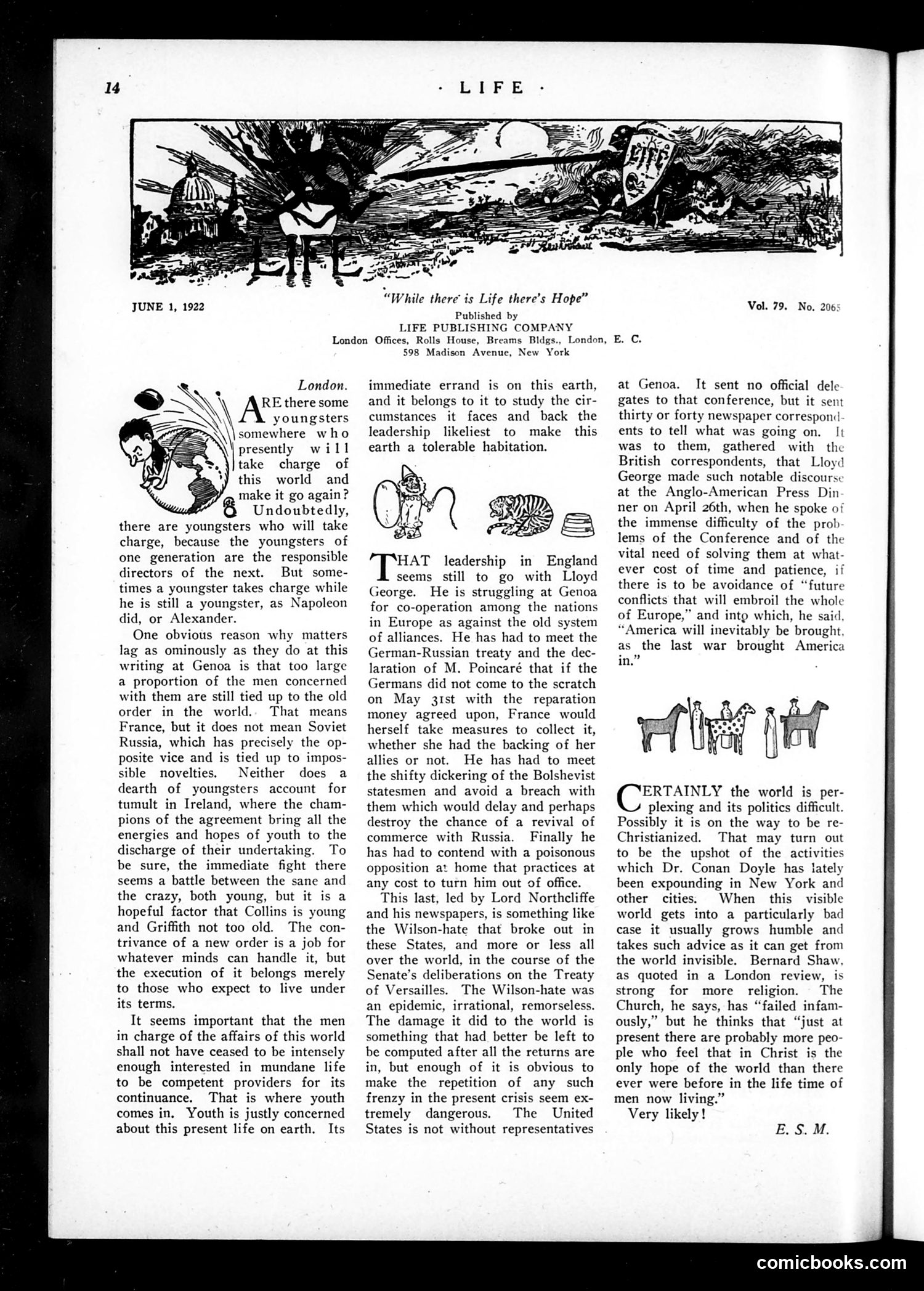
This June 1, 1922 *Life* editorial page addresses post-WWI leadership and youth's role in rebuilding. The central illustration depicts a large figure (appears to be representing a leader or nation) struggling with or carrying an enormous burden—likely symbolizing the weight of post-war reconstruction and treaty obligations. The text discusses Lloyd George's leadership at the Genoa Conference, focusing on international cooperation and preventing future conflicts. The article emphasizes that youth must take charge of world affairs to ensure lasting peace, contrasting idealistic youth leadership with the failures of older statesmen. The satirical point critiques how older generations created the war's problems while expecting youth to solve them—a common post-WWI sentiment. The cartoon visually reinforces this burden being placed on younger shoulders.
📄 Transcribed text from this page (OCR, searchable)
Machine-transcribed from the original scan — historical spelling and the odd misread are preserved.
JUNE 1, 1922 “While there’ is Life there’s Hope” Published by LIFE PUBLISHING COMPANY Vol. 79. No. 206 London Offices, Rolls House, Breams Bldgs., London, E. C. CY London. O\\ JXSE there some — youngsters Geez \ 2k sou who \e] \\ presently take charge of this world and A ee it go again? will Undoubtedly, there are youngsters who will take charge, because the youngsters of one generation are the responsible directors of the next. But some- times a youngster takes charge while he is still a youngster, as Napoleon did, or Alexander. One obvious reason why matters lag as ominously as they do at this writing at Genoa is that too large a proportion of the men concerned with them are still tied up to the old order in the world.. That means France, but it does not mean Soviet Russia, which has precisely the op- posite vice and is tied up to impos- sible novelties. Neither does a dearth of youngsters account for tumult in Ireland, where the cham- pions of the agreement bring all the energies and hopes of youth to the discharge of their undertaking. To be sure, the immediate fight there seems a battle between the sane and the crazy, both young, but it is a hopeful factor that Collins is young and Griffith not too old. The con- trivance of a new order is a job for whatever minds can handle it, but the execution of it belongs merely to those who expect to live under its terms. It seems important that the men in charge of the affairs of this world shall not have ceased to be intensely enough interested in mundane life to be competent providers for its continuance. That is where youth comes in. Youth is justly concerned about this present life on earth. Its 598 Madison Avenue, New York immediate errand is on this earth, and it belongs to it to study the cir- cumstances it faces and back the leadership likeliest to make this earth a tolerable habitation. HAT leadership in England seems still to go with Lloyd George. He is struggling at Genoa for co-operation among the nations in Europe as against the old system of alliances. He has had to meet the German-Russian treaty and the dec- laration of M. Poincaré that if the Germans did not come to the scratch on May 31st with the reparation money agreed upon, France would herself take measures to collect it, whether she had the backing of her allies or not. He has had to meet the shifty dickering of the Bolshevist statesmen and avoid a breach with them which would delay and perhaps destroy the chance of a revival of commerce with Russia. Finally he has had to contend with a poisonous opposition at home that practices at any cost to turn him out of office. This last, led by Lord Northcliffe and his newspapers, is something like the Wilson-hate that broke out in these States, and more or less all over the world, in the course of the Senate’s deliberations on the Treaty of Versailles. The Wilson-hate was an epidemic, irrational, remorseless. The damage it did to the world is something that had better be left to be computed after all the returns are in, but enough of it is obvious to make the repetition of any such frenzy in the present crisis seem ex- tremely dangerous. The United States is not without representatives at Genoa. It sent no official dele gates to that conference, but it sent thirty or forty newspaper correspond ents to tell what was going on. It was to them, gathered with the British correspondents, that Lloyd George made such notable discours¢ at the Anglo-American Press Din ner on April 26th, when he spoke of the immense difficulty of the prob lems of the Conference and of the vital need of solving them at what- ever cost of time and patience, if there is to be avoidance of “future conflicts that will embroil the whole of Europe,” and intg which, he said, “America will inevitably be brought, as the last war brought America in.” allen) ERTAINLY the world is per- plexing and its politics difficult. Possibly it is on the way to be re- Christianized. That may turn out to be the upshot of the activities which Dr. Conan Doyle has lately been expounding in New York and other cities. When this visible world gets into a particularly bad case it usually grows humble and takes such advice as it can get from the world invisible. Bernard Shaw, as quoted in a London review, is strong for more religion. The Church, he says, has “failed infam- ously,” but he thinks that “just at present there are probably more peo- ple who feel that in Christ is the only hope of the world than there ever were before in the life time of men now living.” Very likely! E. S. M. comicbooks.com