
Life, 1922-06-01 · page 22 of 34
Life — June 1, 1922 — page 22: what you’re looking at
What you’re looking at
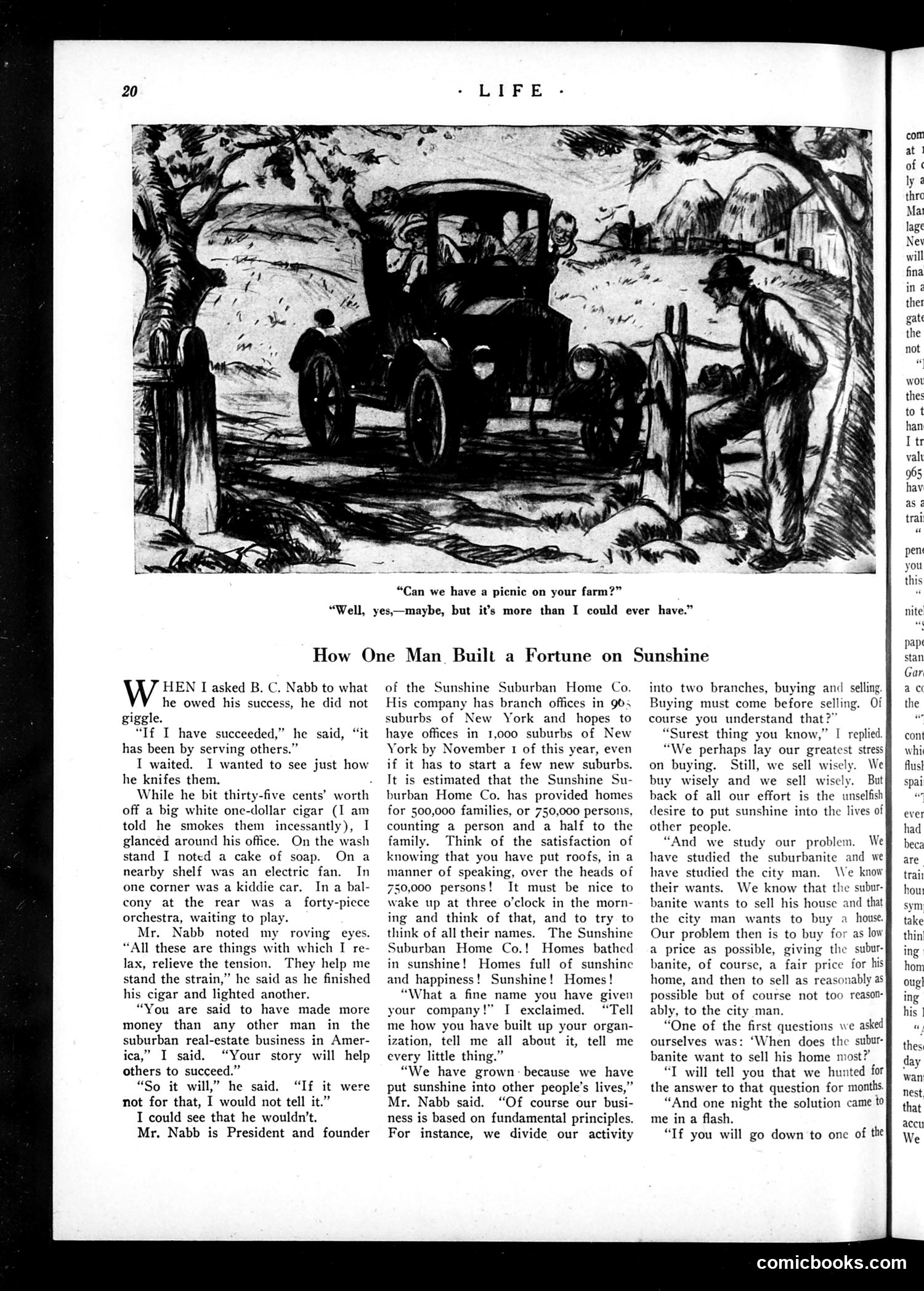
This satirical article mocks suburban real-estate developers and their hollow corporate rhetoric. B.C. Nabb, president of the Sunshine Suburban Home Co., embodies the type of early 20th-century businessman who disguises profit-driven motives with sanctimonious language about "serving others" and putting "sunshine into people's lives." The satire operates through contradiction: Nabb claims success comes from altruism while the article reveals his actual cynical strategy—buying homes cheaply from desperate suburbanites wanting to sell, then reselling them at inflated prices to city dwellers. His office filled with luxuries (expensive cigars, orchestras, electric fans) further exposes the gap between his proclaimed values and his actual wealth accumulation. The opening cartoon reinforces this: a farmer's naive question about a farm picnic receives a response suggesting Nabb will exploit the property. The joke is that businessmen like Nabb convert simple rural assets into commodified suburban developments for profit.
📄 Transcribed text from this page (OCR, searchable)
Machine-transcribed from the original scan — historical spelling and the odd misread are preserved.
“Can we have a picnic on your farm?” “Well, yes,—maybe, but it’s more than I could ever have.” How One Man Built a Fortune on Sunshine HEN | asked B. C. Nabb to what he owed his success, he did not giggle. “If I have succeeded,” he said, “it has been by serving others.” I waited. I wanted to see just how he knifes them. While he bit thirty-five cents’ worth off a big white one-dollar cigar (I am told he smokes them incessantly), I glanced around his office. On the wash stand I noted a cake of soap. On a nearby shelf was an electric fan. In one corner was a kiddie car. In a bal- cony at the rear was a forty-piece orchestra, waiting to play. Mr. Nabb noted my roving eyes. All these are things with which I re- lax, relieve the tension. They help me stand the strain,” he said as he finished his cigar and lighted another. “You are said to have made more money than any other man in the suburban real-estate business in Amer- ica,” I said. “Your story will help others to succeed.” “So it will,” he said. “If it were not for that, I would not tell it.” I could see that he wouldn't. Mr. Nabb is President and founder of the Sunshine Suburban Home Co. His company has branch offices in 905 suburbs of New York and hopes to haye offices in 1,000 suburbs of New York by November 1 of this year, even if it has to start a few new suburbs. It is estimated that the Sunshine Su- burban Home Co. has provided homes for 500,000 families, or 750,000 persons, counting a person and a half to the family. Think of the satisfaction of knowing that you have put roofs, in a manner of speaking, over the heads of 730,000 persons! It must be nice to wake up at three o’clock in the morn- ing and think of that, and to try to think of all their names. The Sunshine Suburban Home Co.! Homes bathed in sunshine! Homes full of sunshine and happiness! Sunshine! Homes! “What a fine name you have given your company!” I exclaimed. ‘Tell me how you have built up your organ- ization, tell me all about it, tell me every little thing.” “We have grown: because we have put sunshine into other people's lives,” Mr. Nabb said. “Of course our busi- ness is based on fundamental principles. For instance, we divide our activity into two branches, buying and selling. Buying must come before selling. Of course you understand that?” “Surest thing you know,” I replied “We perhaps lay our greatest stress on buying. Still, we sell wisely. We buy wisely and we sell wise back of all our effort is the unsel desire to put sunshine into the li other people. “And we study our problem. We have studied the suburbanite and we have studied the city man. We know their wants. We know that the subur- banite wants to sell his house and that the city man wants to buy a_ house. Our problem then is to buy for as low a price as possible, giving the subur- banite, of course, a fair price for his home, and then to sell as reasonably as possible but of course not too reason- ably, to the city man. “One of the first questions we asked ourselves was: ‘When does the subur- banite want to sell his home most?’ “I will tell you that we hunted for the answer to that question for months “And one night the solution came to me in a flash. “If you will go down to one of the nite pap stan Gar a the cont whi flust spai ever had beca are trait hou sym take thin ing hom ougl ing his | thes day wan nest. that accu We comicbooks.com