
Life, 1922-06-01 · page 20 of 34
Life — June 1, 1922 — page 20: what you’re looking at
What you’re looking at
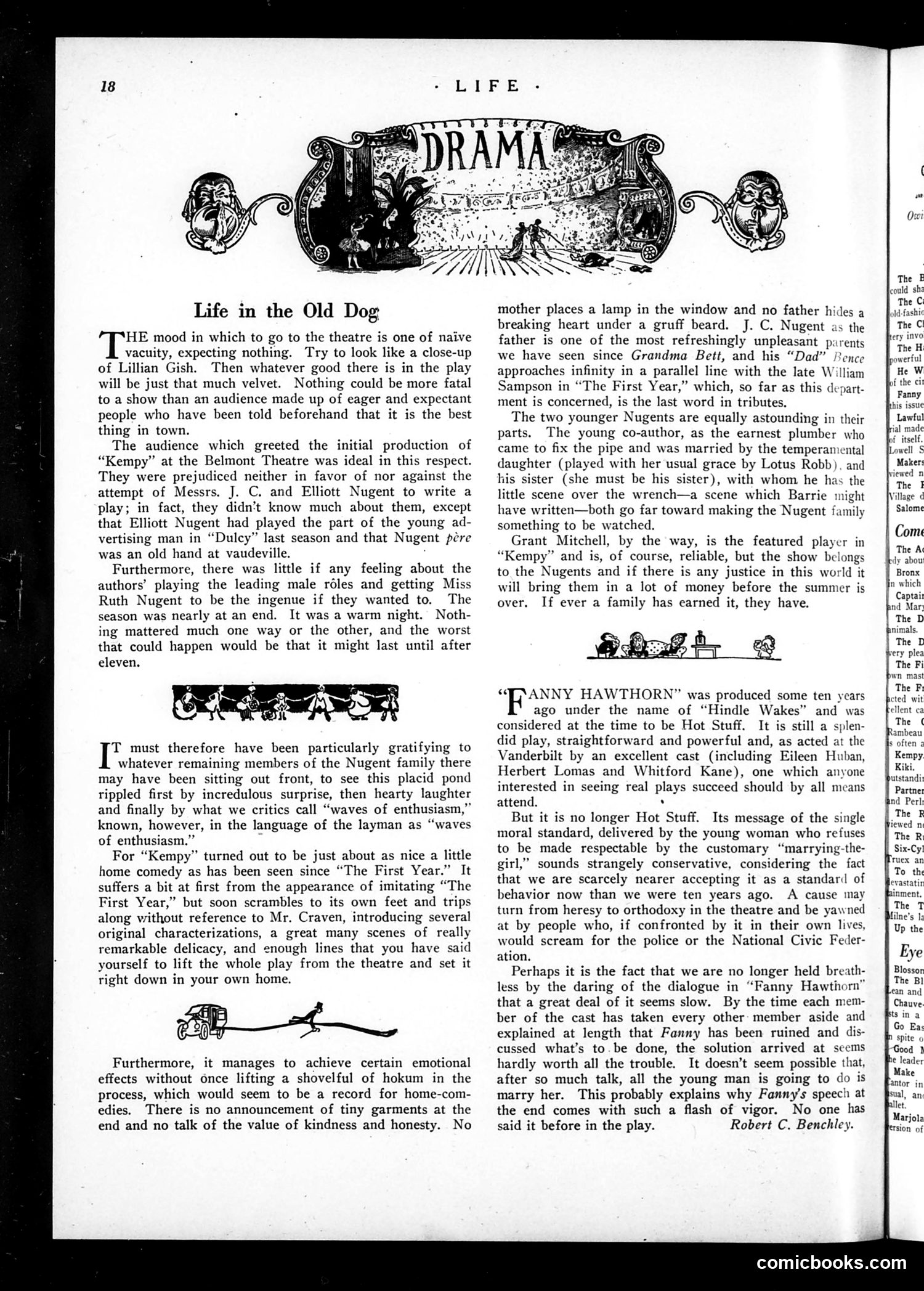
This is a theater review column discussing two plays. The main focus is "Kempy," written by and starring members of the Nugent family (J.C. Nugent, Elliott Nugent, and Ruth Nugent). The reviewer praises it as an unexpectedly successful "home comedy" in the vein of "The First Year"—a popular domestic play of the era. The review highlights the Nugents' performances and notes the play avoids melodramatic clichés (no tearful lamp-in-window scenes). Grant Mitchell is mentioned as the featured player. A secondary review discusses "Fanny Hawthorn," originally produced as "Hindle Wakes" a decade earlier. The reviewer suggests the play's once-scandalous message about female independence now seems conservative by current standards. The page contains no political cartoons—it's straightforward theater criticism from an early 20th-century entertainment magazine.
📄 Transcribed text from this page (OCR, searchable)
Machine-transcribed from the original scan — historical spelling and the odd misread are preserved.
Life in the Old Dog HE mood in which to go to the theatre is one of naive vacuity, expecting nothing. Try to look like a close-up of Lillian Gish. Then whatever good there is in the play will be just that much velvet. Nothing could be more fatal to a show than an audience made up of eager and expectant people who have been told beforehand that it is the best thing in town. The audience which greeted the initial production of “Kempy” at the Belmont Theatre was ideal in this respect. They were prejudiced neither in favor of nor against the attempt of Messrs. J. C. and Elliott Nugent to write a play; in fact, they didn’t know much about them, except that Elliott Nugent had played the part of the young ad- vertising man in “Dulcy” last season and that Nugent pére was an old hand at vaudeville. Furthermore, there was little if any feeling about the authors’ playing the leading male réles and getting Miss Ruth Nugent to be the ingenue if they wanted to. The season was nearly at an end. It was a warm night. Noth- ing mattered much one way or the other, and the worst that could happen would be that it might last until after eleven. T must therefore have been particularly gratifying to whatever remaining members of the Nugent family there may have been sitting out front, to see this placid pond rippled first by incredulous surprise, then hearty laughter and finally by what we critics call “waves of enthusiasm,” known, however, in the language of the layman as “waves of enthusiasm.” For “Kempy” turned out to be just about as nice a little home comedy as has been seen since “The First Year.” It suffers a bit at first from the appearance of imitating “The First Year,” but soon scrambles to its own feet and trips along without reference to Mr. Craven, introducing several original characterizations, a great many scenes of really remarkable delicacy, and enough lines that you have said yourself to lift the whole play from the theatre and set it right down in your own home. a _<—_. Furthermore, it manages to achieve certain emotional effects without once lifting a shovelful of hokum in the process, which would seem to be a record for home-com- edies. There is no announcement of tiny garments at the end and no talk of the value of kindness and honesty. No mother places a lamp in the window and no father hides a breaking heart under a gruff beard. J. C. Nugent as the father is one of the most refreshingly unpleasant parents we have seen since Grandma Bett, and his “Dad” Pence approaches infinity in a parallel line with the late William Sampson in “The First Year,” which, so far as this depart- ment is concerned, is the last word in tributes, The two younger Nugents are equally astounding in their parts. The young co-author, as the earnest plumber who came to fix the pipe and was married by the temperamental daughter (played with her usual grace by Lotus Robb), and his sister (she must be his sister), with whom he has the little scene over the wrench—a scene which Barrie might have written—both go far toward making the Nugent family something to be watched. Grant Mitchell, by the way, is the featured player in “Kempy” and is, of course, reliable, but the show belongs to the Nugents and if there is any justice in this world it will bring them in a lot of money before the summer is over, If ever a family has earned it, they have. “TS ANNY HAWTHORN” was produced some ten years ago under the name of “Hindle Wakes” and was considered at the time to be Hot Stuff. It is still a splen- did play, straightforward and powerful and, as acted at the Vanderbilt by an excellent cast (including Eileen Huban, Herbert Lomas and Whitford Kane), one which anyone interested in seeing real plays succeed should by all means attend. . But it is no longer Hot Stuff. Its message of the single moral standard, delivered by the young woman who refuses to be made respectable by the customary “marrying-the- girl,” sounds strangely conservative, considering the fact that we are scarcely nearer accepting it as a standari of behavior now than we were ten years ago. A cause may turn from heresy to orthodoxy in the theatre and be yawned at by people who, if confronted by it in their own lives, would scream for the police or the National Civic Feder- ation. Perhaps it is the fact that we are no longer held bre less by the daring of the dialogue in “Fanny Hawthor! that a great deal of it seems slow. By the time each mem- ber of the cast has taken every other member aside and explained at length that Fanny has been ruined and dis- cussed what’s to.be done, the solution arrived at seems hardly worth all the trouble. It doesn’t seem possible that, after so much talk, all the young man is going to do is marry her. This probably explains why Fanny's speech at the end comes with such a flash of vigor. No one has said it before in the play. Robert C. Benchley. The E icould sha iewed n The I illage d Salome Come | The A dy abou Bronx jn which Captain pai Mar; The D inimals. bwn mast The Fi icted wit ellent ca The ( Rambeau s often 3 Partner ind Perl: Marjots sion of comicbooks.com