
Life, 1922-06-01 · page 23 of 34
Life — June 1, 1922 — page 23: what you’re looking at
What you’re looking at
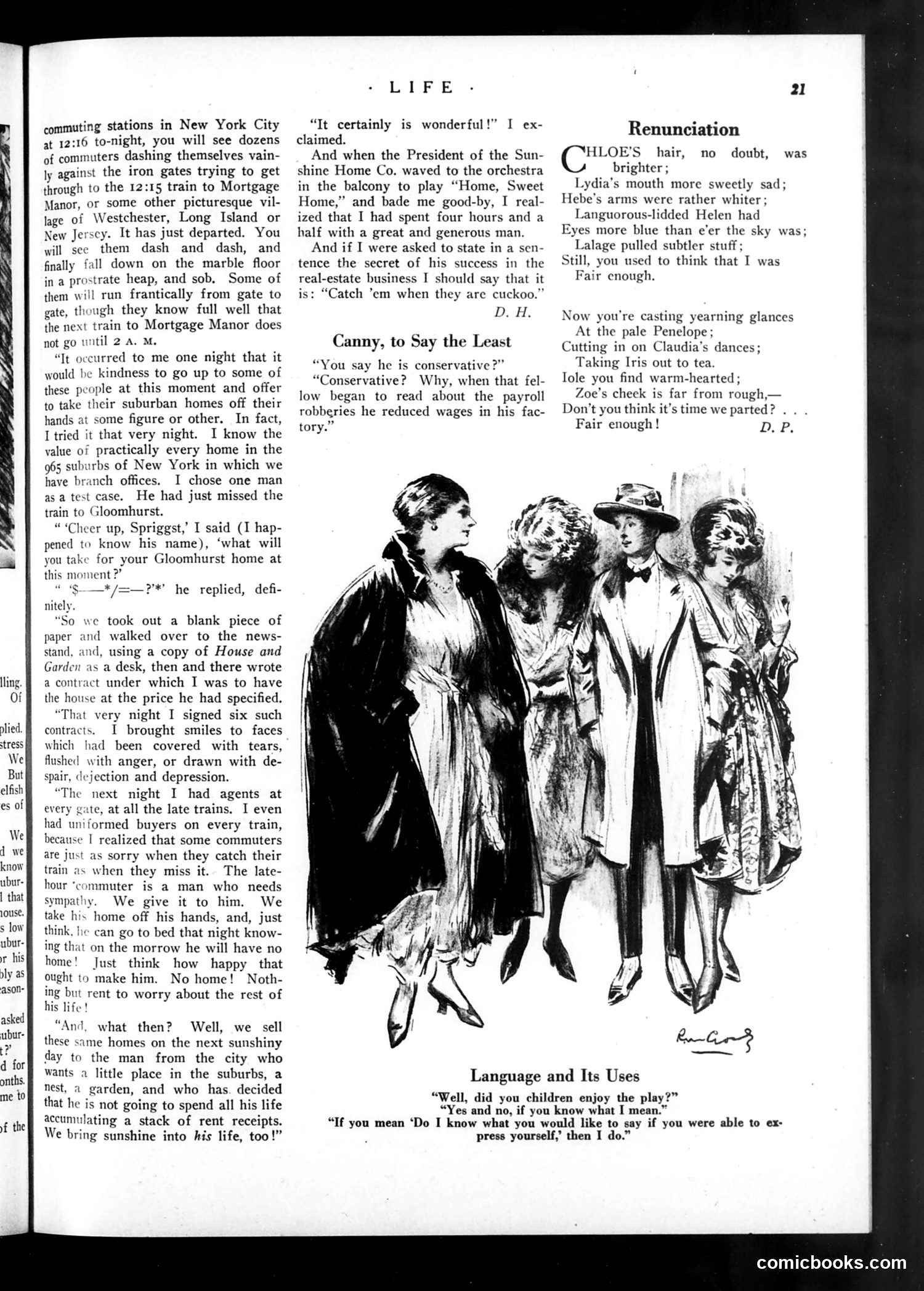
This page contains two satirical pieces mocking early 20th-century American suburban real estate and economic behavior. **"Mortgage Manor" Real Estate Satire:** The main text ridicules predatory real estate dealers who exploit commuters' desperation. A salesman describes targeting exhausted suburban commuters who've missed their trains home, offering to buy their houses at rock-bottom prices when they're emotionally vulnerable ("Catch 'em when they are cuckoo"). He then resells these same homes the next day to city dwellers seeking suburban escape. The satire exposes how this scheme profits from human desperation and the suburban housing bubble mentality. **"Canny, to Say the Least":** A brief joke mocking a conservative factory owner who, upon reading about payroll robberies, preemptively cuts workers' wages—suggesting conservatives harm workers under the guise of protection. **The illustration** shows fashionably dressed women, likely accompanying the "Renunciation" poem below about romantic rejection. The page satirizes both housing market exploitation and economic conservatism during the real estate boom era.
📄 Transcribed text from this page (OCR, searchable)
Machine-transcribed from the original scan — historical spelling and the odd misread are preserved.
We d we know ubur- | that 10UIse. s low ubur- ir his y as on asked 2 d for me to yf the commuting stations in New York City at 12:16 to-night, you will see dozens of commuters dashing themselves vain- ly against the iron gates trying to get through to the 12:15 train to Mortgage Manor, or some other picturesque vil- lage of Westchester, Long Island or New Jerscy. It has just departed. You will see them dash and dash, and finally fall down on the marble floor in a prostrate heap, and sob, Some of them will run frantically from gate to gate, though they know full well that the next train to Mortgage Manor does not go util 2 a. M. “It occurred to me one night that it would be kindness to go up to some of these people at this moment and offer to take their suburban homes off their hands at some figure or other. In fact, I tried it that very night. I know the value of practically every home in the 965 suburbs of New York in which we have branch offices. I chose one man asa test case. He had just missed the train to Gloomhurst. “‘Cheer up, Spriggst,’ I said (I hap- pened to know his name), ‘what will you take for your Gloomhurst home at this moment ‘$_—*/=—?™ he replied, defi- nitel “So we took out a blank piece of paper and walked over to the news- stand, and, using a copy of House and Garden as a desk, then and there wrote a contract under which I was to have the house at the price he had specified. “That very night I signed six such contracts. I brought smiles to faces which had been covered with tears, flushed with anger, or drawn with de- spair, dejection and depression. “The next night I had agents at every gate, at all the late trains. I even had uniformed buyers on every train, because | realized that some commuters are just as sorry when they catch their train as when they miss it. The late- hour ‘commuter is a man who needs sympathy. We give it to him. We take his home off his hands, and, just think, he can go to bed that night know- ing that on the morrow he will have no home! Just think how happy that ought to make him. No home! Noth- ing but rent to worry about the rest of his life! “And, what then? Well, we sell these same homes on the next sunshiny day to the man from the city who wants a little place in the suburbs, a nest, a garden, and who has. decided that he is not going to spend all his life accumulating a stack of rent receipts. We bring sunshine into his life, too!” LIFE “It certainly is wonderful!” I ex- claimed. And when the President of the Sun- shine Home Co. waved to the orchestra in the balcony to play “Home, Sweet Home,” and bade me good-by, I real- ized that I had spent four hours and a half with a great and generous man. And if I were asked to state in a sen- tence the secret of his success in the real-estate business I should say that it is: “Catch ’em when they are cuckoo.” D. H. Canny, to Say the Least “You say he is conservative?” “Conservative? Why, when that fel- low began to read about the payroll robberies he reduced wages in his fac- tory.” Renunciation HLOE'S hair, no doubt, brighter ; Lydia’s mouth more sweetly sad; Hebe’s arms were rather whiter; Languorous-lidded Helen had Eyes more blue than e’er the sky was; alage pulled subtler stuff; you used to think that I was enough. was Now you're casting yearning glances At the pale Penelope; Cutting in on Claudia’s dances; Taking Iris out to tea. Tole you find warm-hearted; Zoe’s cheek is far from rough,— Don’t you think it’s time we parted? . . . Fair enough! D.P. Language and Its Uses “Well, did you children enjoy the play?” “Yes and no, if you know what I mean.” “If you mean ‘Do I know what you would like to say if you were able to ex- press yourself,’ then I do.” comicbooks.com