
A complete issue · 34 pages · 1922
Life — May 4, 1922
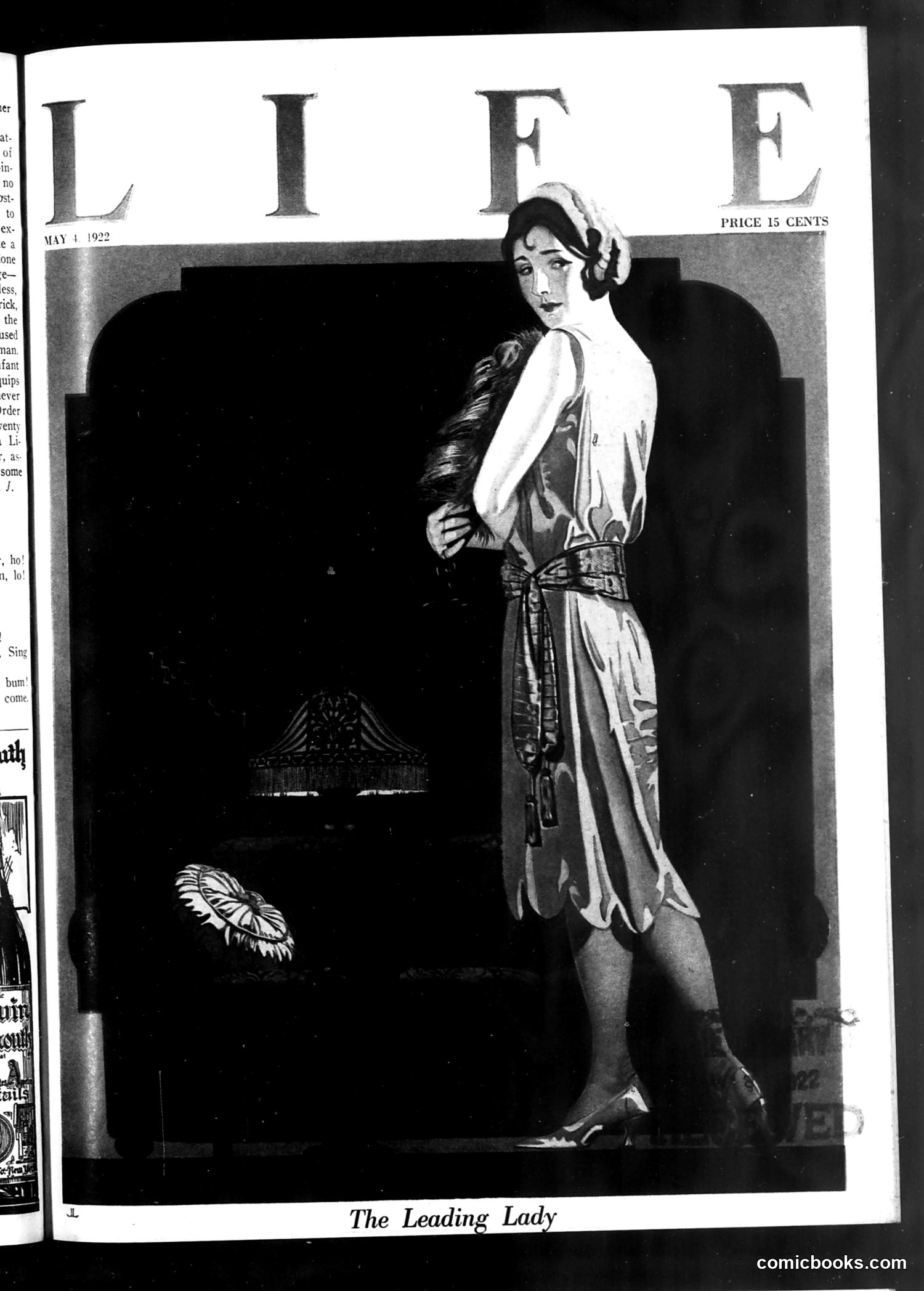
This is the cover of Life magazine from May 1, 1922, priced at 15 cents. The image shows a woman in fashionable 1920s attire—a short dress, headwrap, and fur stole—standing in an elegant interior setting. She's posed confidently, looking over her shoulder. The caption reads "The Leading Lady," a theatrical reference. This appears to be a glamour illustration celebrating the modern woman of the Jazz Age era. The sophisticated styling and pose reflect the period's fascination with fashionable, independent women—a cultural shift from previous Victorian ideals. The image likely represents idealized femininity and modernity that appealed to Life's readers during this decade of social change.
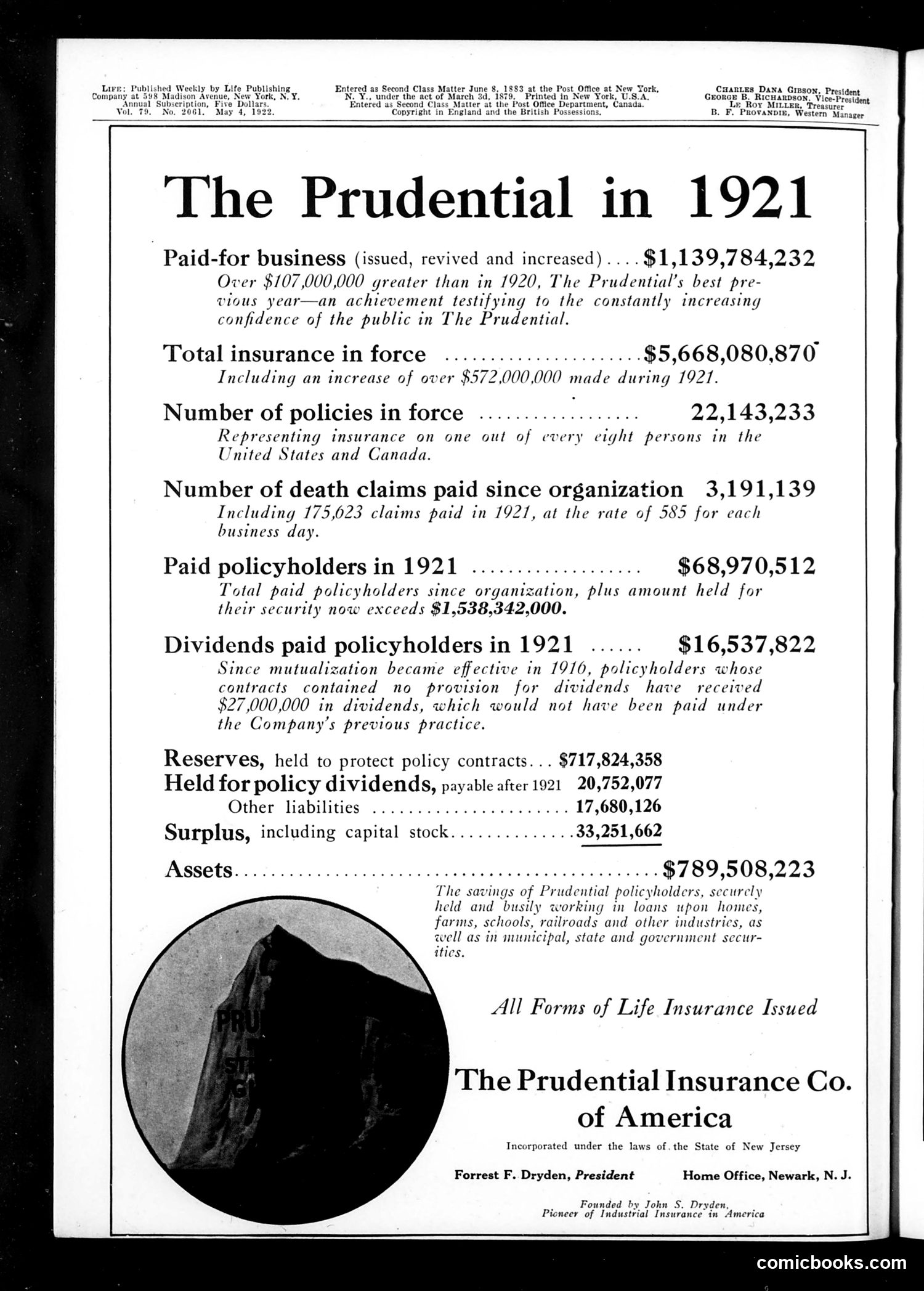
This page is **not a cartoon or satirical content** — it's a straightforward **insurance advertisement** for The Prudential Insurance Company of America, published in Life magazine's May 1922 issue. The page presents financial statistics showcasing Prudential's 1921 performance: $1.1 billion in paid-for business, $5.6 billion in total insurance in force, and 22 million policies. It emphasizes growth compared to 1920 and highlights dividend payments to policyholders. The circular image appears to be the company's logo or symbolic image. This represents early-20th-century corporate advertising in a major magazine, emphasizing financial stability and growth during the post-WWI economic period. There is no satire or political commentary present.
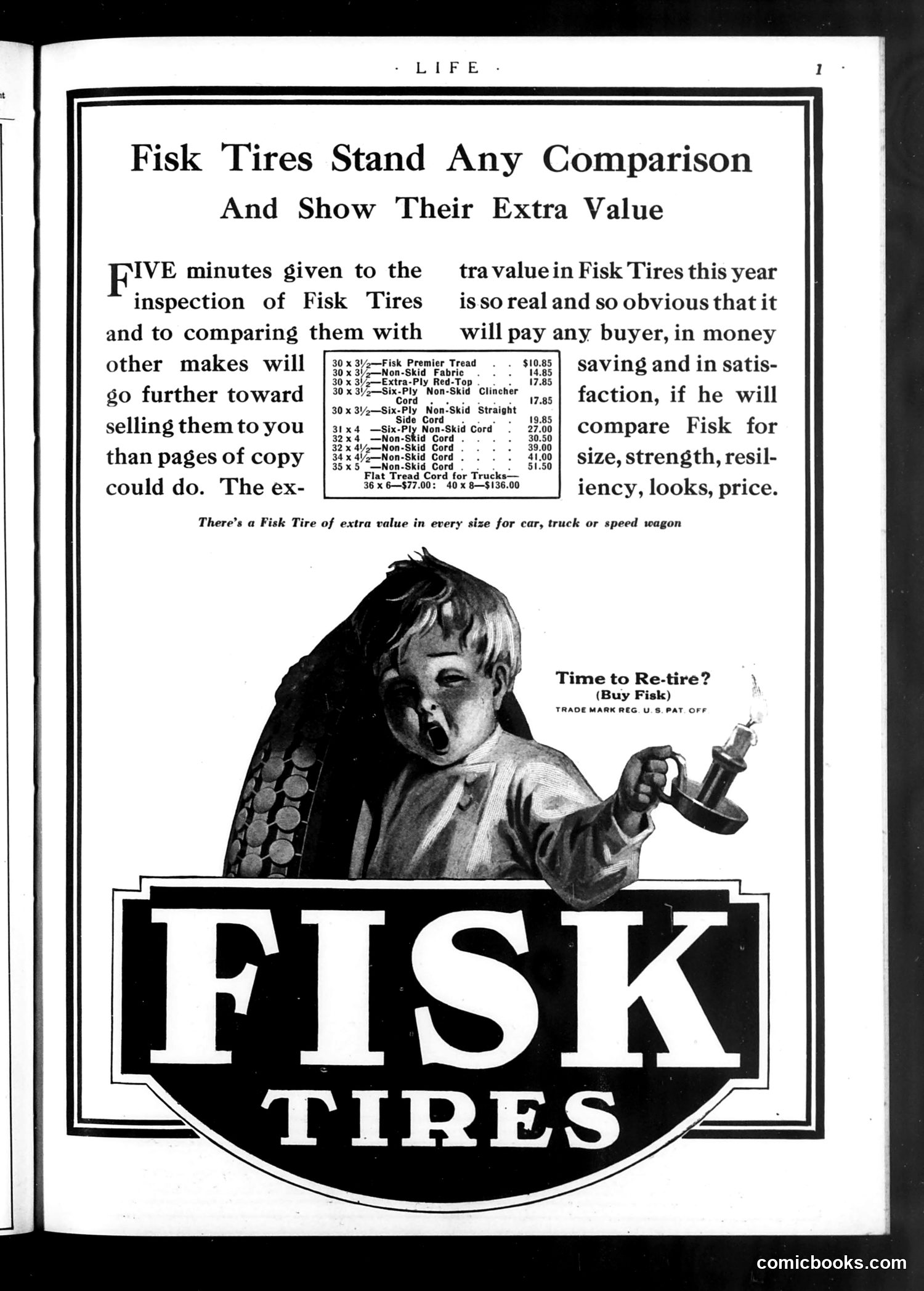
This is primarily a **Fisk Tires advertisement**, not political satire. The page promotes Fisk Tires by claiming five minutes of inspection proves their superiority over competitors in "size, strength, resiliency, looks, price." The famous mascot is a **baby in pajamas holding a candle**, captioned "Time to Re-tire? (Buy Fisk)." This iconic imagery—the "Fisk Boy"—became one of early advertising's most recognizable symbols, playing on the double meaning of "tire" (fatigue vs. rubber tire). The price list shows various tire sizes and costs. The advertisement's approach is comparative sales rhetoric rather than satire. The baby mascot was meant to be memorable and whimsical rather than to mock anything specific. This represents early 20th-century advertising in a major American magazine.
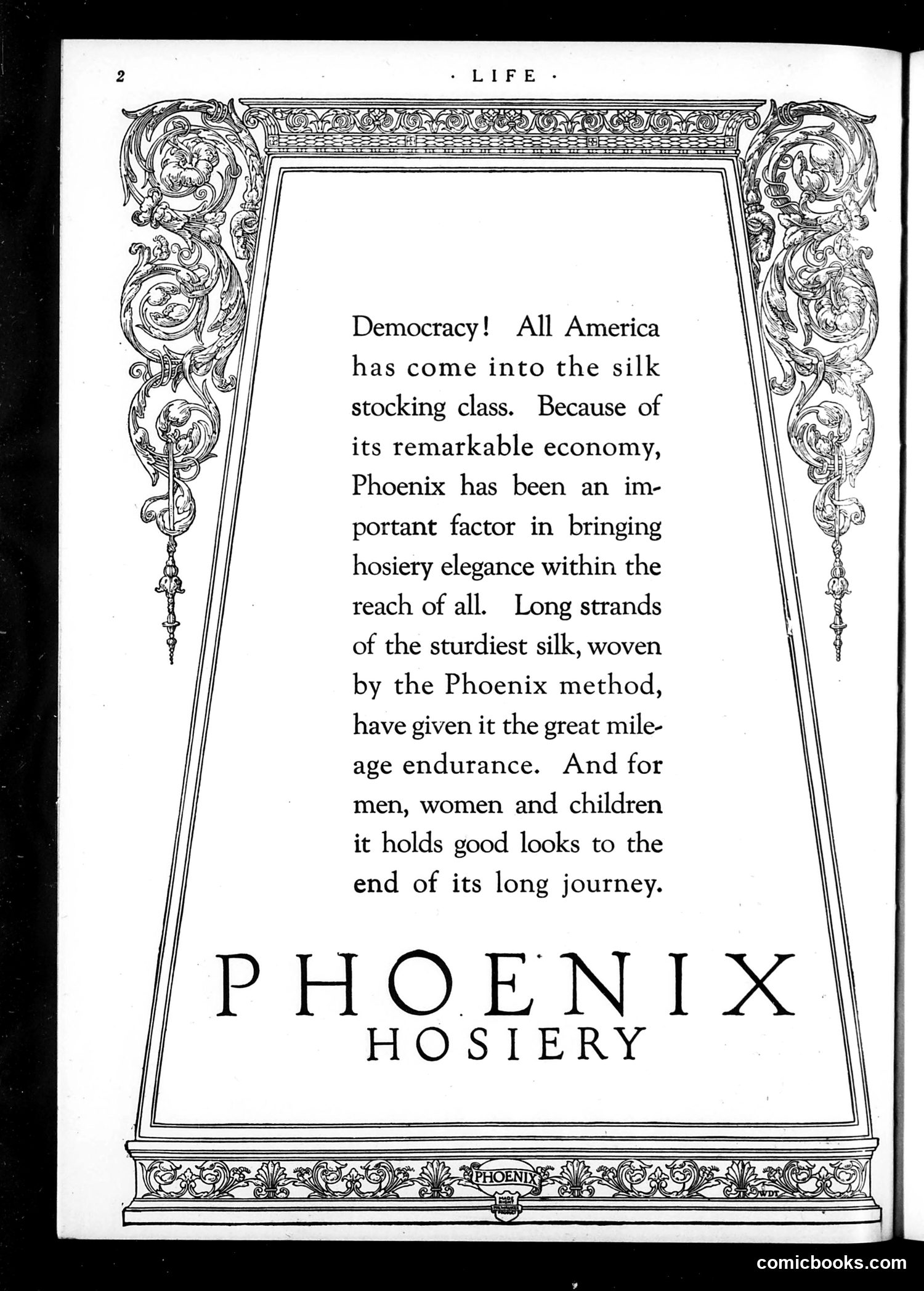
This is **not a cartoon or satire**—it's a **straight advertisement** for Phoenix Hosiery, appearing in Life magazine (page 2). The ad uses patriotic rhetoric, opening with "Democracy! All America has come into the silk stocking class" to appeal to democratic values and economic progress. It positions Phoenix hosiery as making luxury affordable to ordinary Americans of all classes—a notable claim for the early 20th century, when silk stockings were expensive items. The ad emphasizes durability ("mileage endurance") and aesthetic appeal ("good looks"), targeting "men, women and children." The ornate Art Deco border design typical of period advertising reinforces the product's claimed elegance and quality. This represents how companies marketed goods through patriotic and egalitarian messaging.
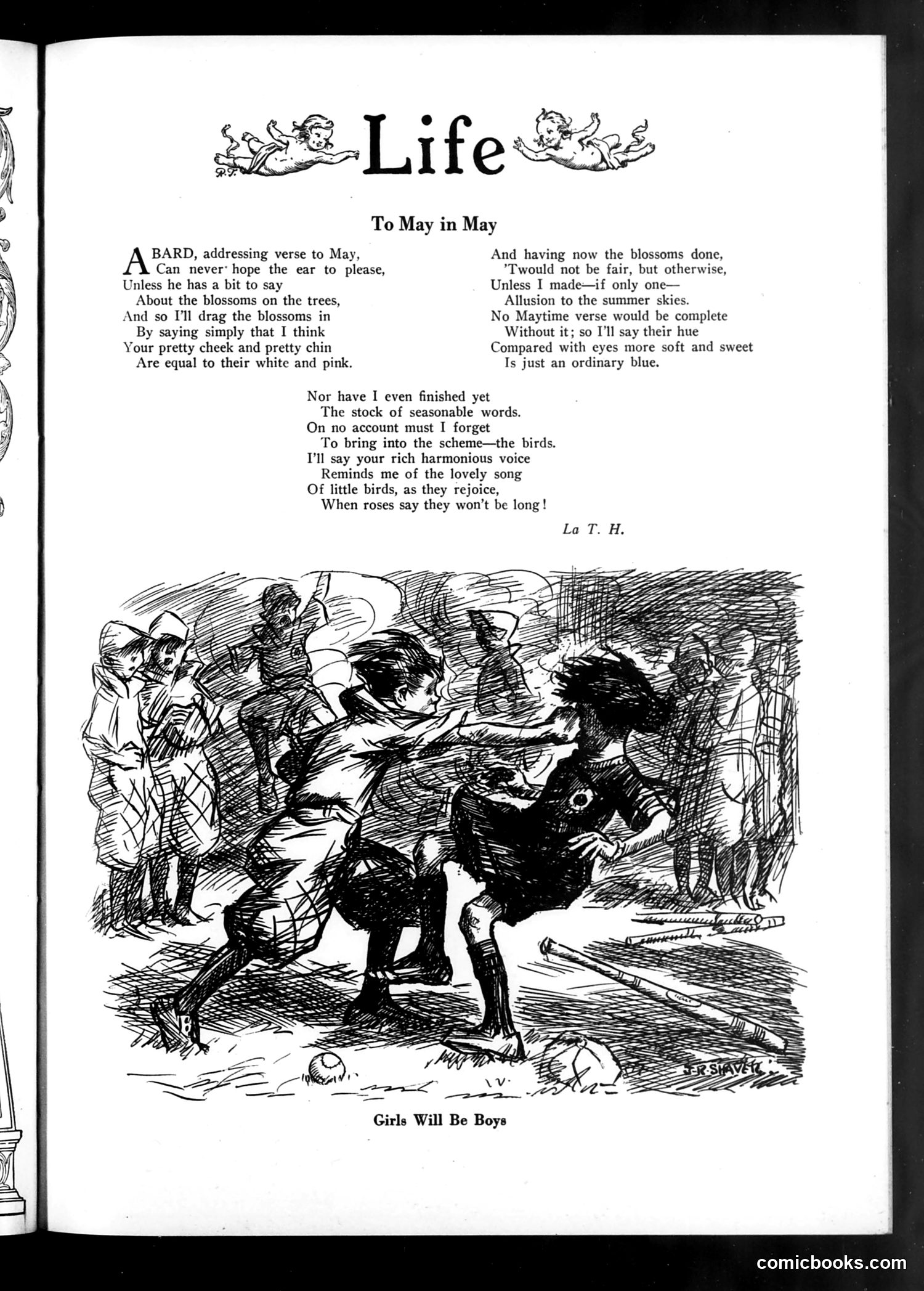
This page from *Life* magazine contains a romantic poem addressed to a woman named May, using traditional spring imagery (blossoms, birds, roses). The poem is credited to "La T. H." The accompanying illustration, titled "Girls Will Be Boys," depicts young women playing baseball—a sport traditionally associated with boys. The satire comments on changing gender roles in early 20th-century America. By showing girls actively engaging in athletics rather than passive, ladylike pursuits, the cartoon humorously suggests social transformation: women are adopting traditionally masculine activities. This reflects real historical shifts in women's athletics and independence during this era, presented here with lighthearted irony about evolving social expectations.
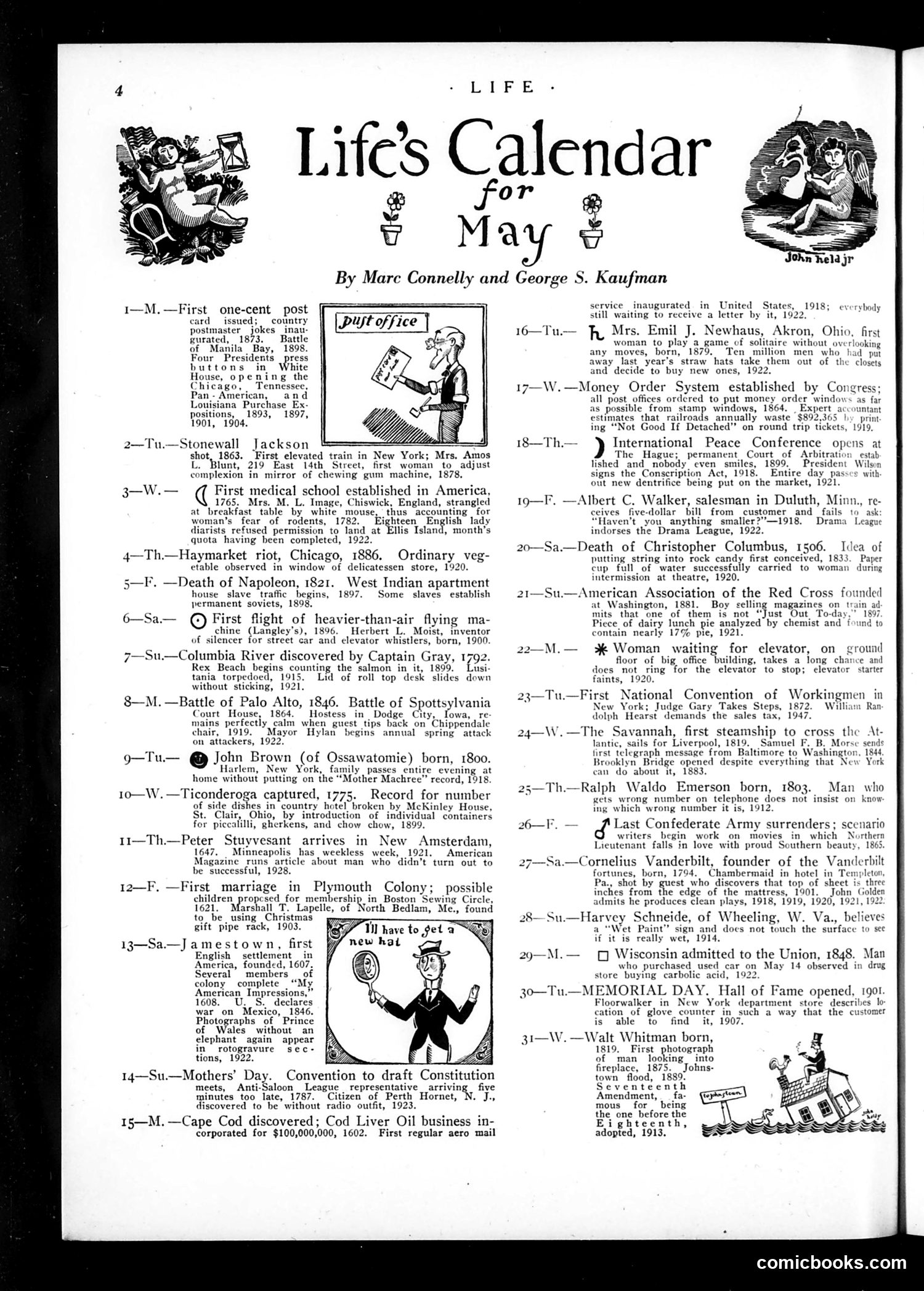
This page is a calendar of historical events and observances for May, compiled by Marc Connelly and George S. Kaufman. The two cartoons visible serve the calendar's humorous purpose: 1. **"Post Office" cartoon** (top): Shows a frustrated postal worker dealing with excessive mail, satirizing bureaucratic inefficiency—likely commenting on the U.S. Post Office's struggles with volume. 2. **"I'll have to get a new hat" cartoon** (center): A man's head grows so large it bursts through his hat, appearing to satirize either vanity, inflated ego, or possibly financial excess/wealth. The calendar entries themselves reference historical milestones (Columbus River discovery, Civil War events) alongside contemporary 1920s observations (woman waiting for elevator, money order system changes), blending historical significance with modern satirical social commentary typical of Life magazine's approach.
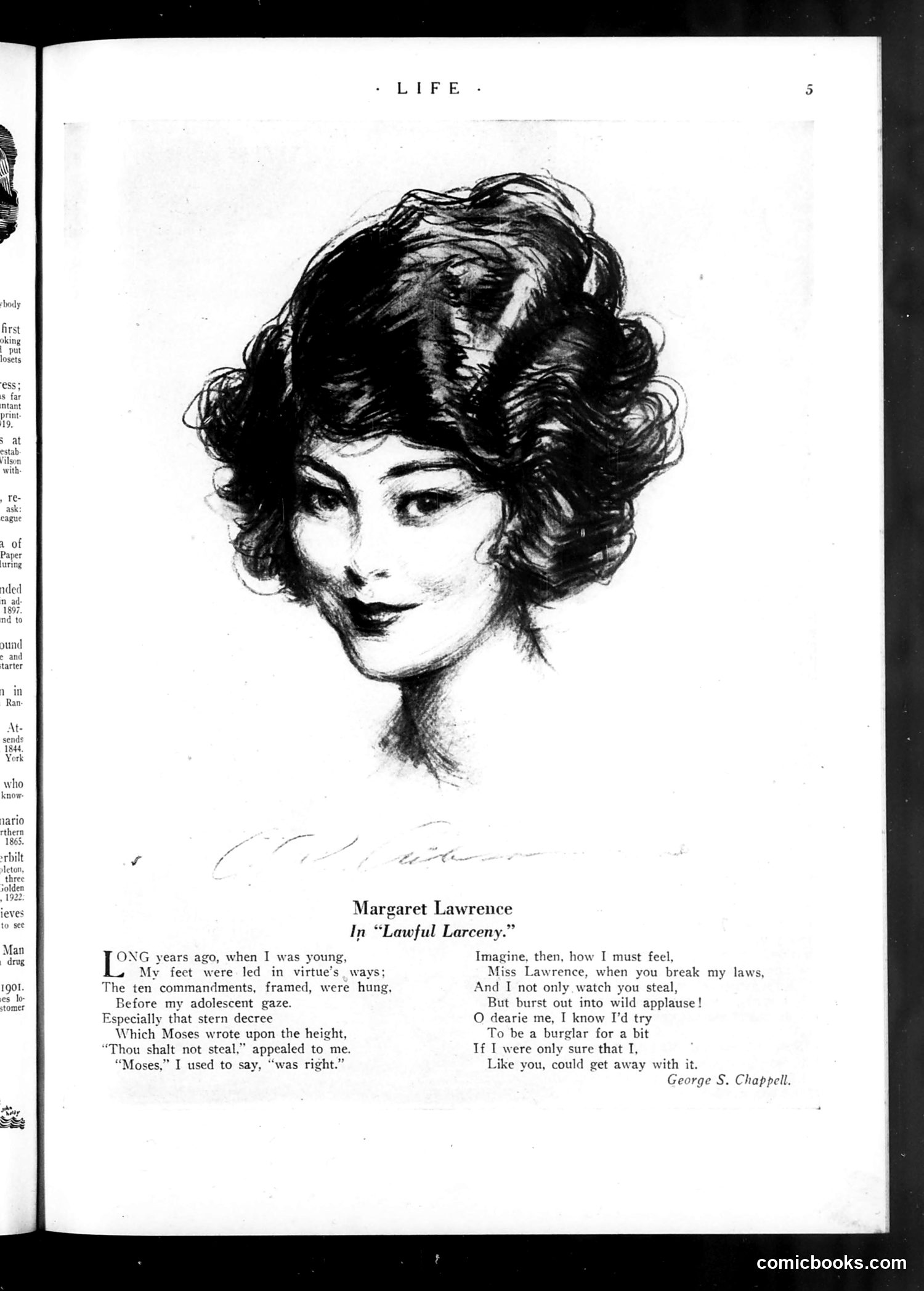
This page features a sketch portrait of actress Margaret Lawrence, accompanying a poem about her role in the play "Lawful Larceny." The poem, attributed to George S. Chappell, humorously addresses Miss Lawrence as a character who steals or commits petty crimes. The verses reference biblical law ("the ten commandments") and suggest the speaker is tempted to criminal behavior by watching her perform. The joke appears to be that Lawrence's stage presence and charm are so compelling that they could seduce even an honest person into wrongdoing—hence "lawful larceny," a playful oxymoron suggesting charming theft. This represents Life magazine's theatrical coverage, blending arts criticism with witty commentary on contemporary stage performances.
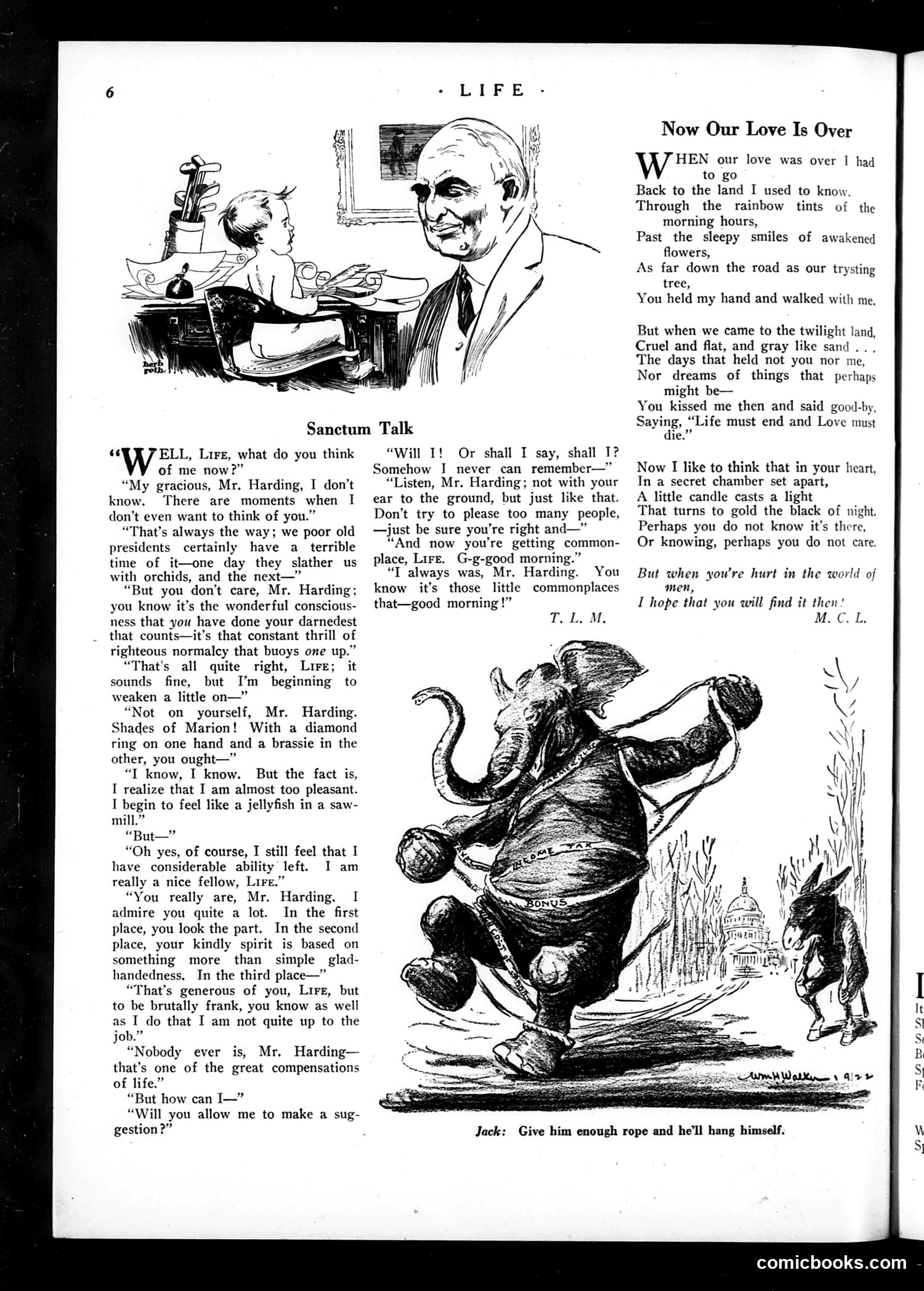
**"Sanctum Talk" Dialogue:** A conversation between "Life" (the magazine personified) and "Mr. Harding" (likely Warren G. Harding, U.S. President 1921-1923). Harding asks Life for advice about running the country, expressing self-doubt about his abilities. Life responds with gentle criticism, suggesting Harding is "too pleasant" and lacks sufficient ability for the job—ultimately recommending he allow more capable people to assist him. **Political Context:** This satirizes Harding's perceived weakness as president and his reliance on advisors (his "Ohio Gang"). The satire suggests he was intellectually unfit for office. **"Now Our Love Is Over" Poem:** A sentimental piece about a ended romance, seemingly unrelated to political content. **Bottom Cartoon:** Shows an elephant (Republican symbol) labeled "BONUS" struggling with rope, with caption "Jack: Give him enough rope and he'll hang himself"—likely referencing Republican disputes over veterans' bonus legislation.
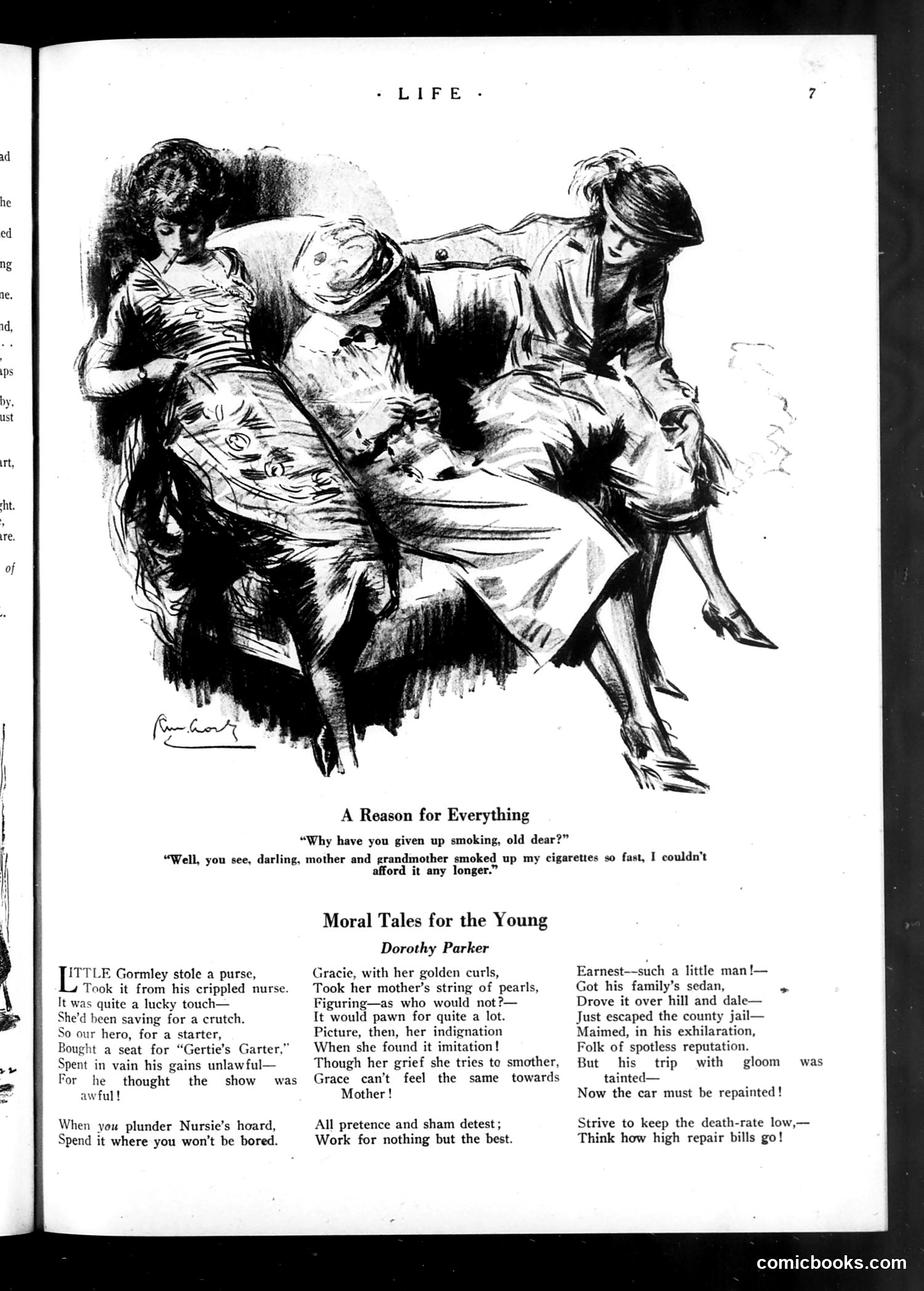
This page contains two distinct pieces of satire: **Top cartoon** ("A Reason for Everything"): Shows a man lounging while women attend to him. The caption reveals he's quit smoking because his female relatives smoked through his cigarettes too quickly—a humorous inversion of typical health concerns about smoking. The satire mocks men who rationalize their behaviors through self-serving logic rather than genuine principle. **"Moral Tales for the Young" by Dorothy Parker**: Three cautionary verses about characters (Gormley, Gracie, Earnest) who face consequences for theft, vanity, and crime respectively. Parker's dry, sarcastic tone undercuts the "moral lesson" format—the verses mock simplistic morality tales by presenting bleak outcomes with wry commentary, suggesting life's injustices aren't neatly resolved by virtue. Both pieces employ satirical humor characteristic of early 20th-century *Life* magazine.
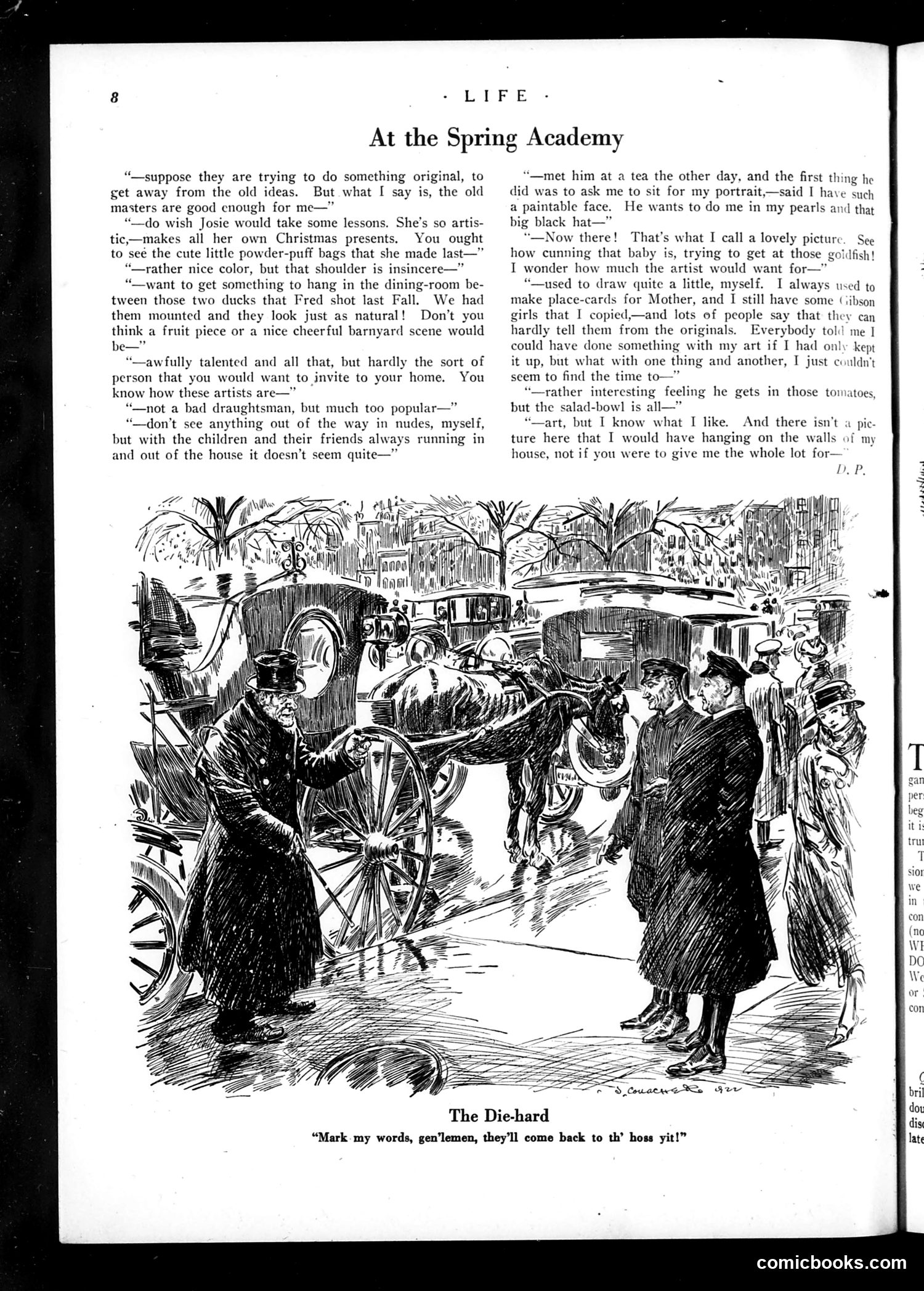
This cartoon satirizes stubborn resistance to change. The illustration shows two men in coats and hats confronting each other near horse-drawn vehicles on a city street. The caption reads: "Mark my words, gen'lemen, they'll come back to th' boss yit!" The "die-hard" figure appears to be someone clinging to outdated methods or technology—likely representing resistance to automobiles and modern transportation. His insistence that horse-drawn carriages will "come back" mocks those unable to accept inevitable progress. The accompanying text discusses artistic talent, originality, and finding one's unique style—suggesting the page's broader theme concerns adapting to modern ideas rather than recycling old conventions. The cartoon exemplifies Life magazine's satirical commentary on social and technological resistance.
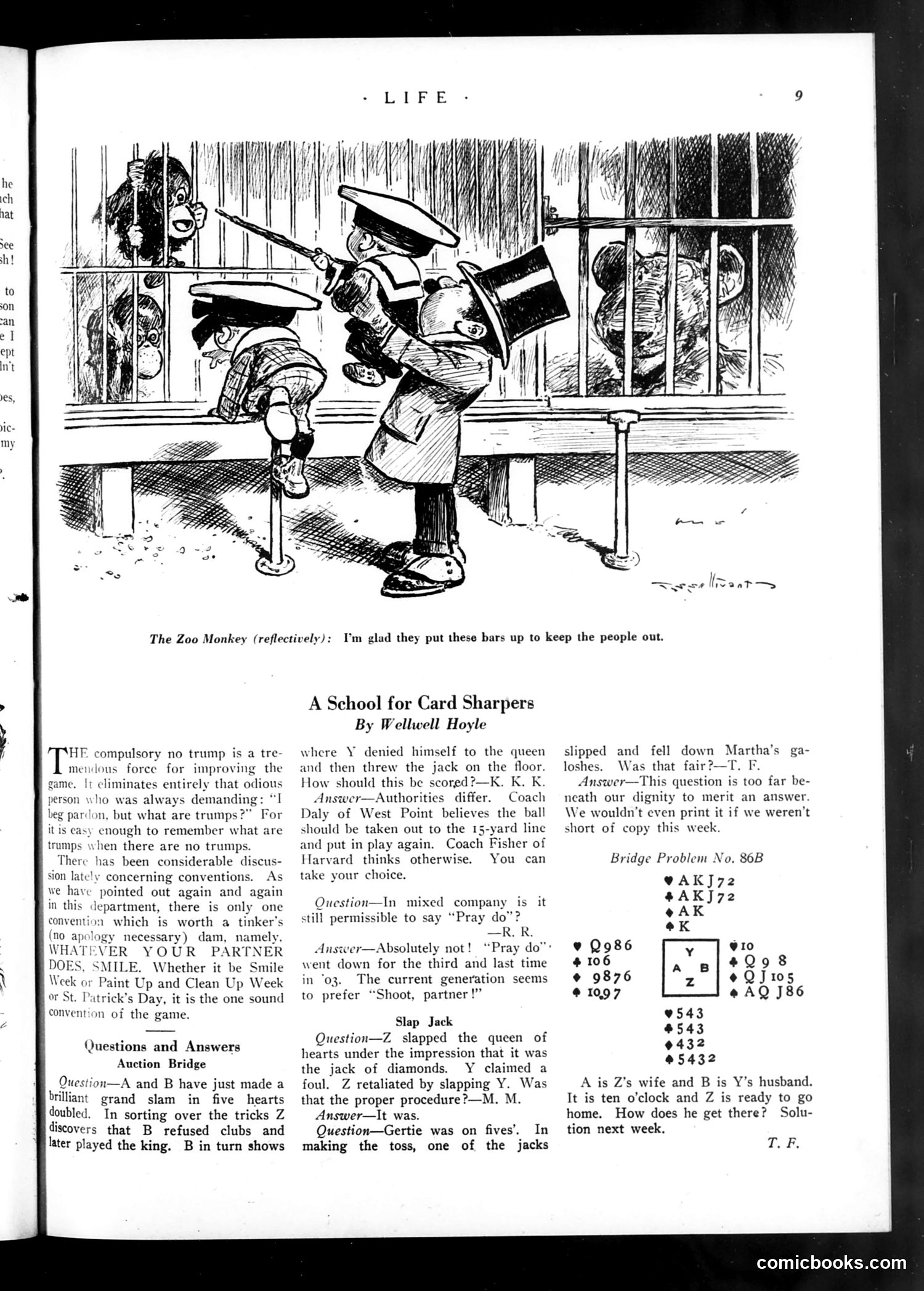
**The Cartoon:** The illustration shows a zookeeper juggling plates while managing a monkey behind bars. The zookeeper says (reflectively): "I'm glad they put these bars up to keep the people out." **Meaning:** This is a role-reversal satire. The joke inverts the typical purpose of zoo barriers—normally designed to protect visitors from animals. Here, the overwhelmed zookeeper suggests the bars actually protect the monkey from chaotic crowds of people. The implication is that human visitors are more unruly, dangerous, or bothersome than the animals themselves. It's social commentary on public behavior at zoos, suggesting crowds are the "wild animals" needing containment. The rest of the page contains bridge game Q&As and a card-playing instruction article—unrelated content typical of Life's mixed editorial approach.
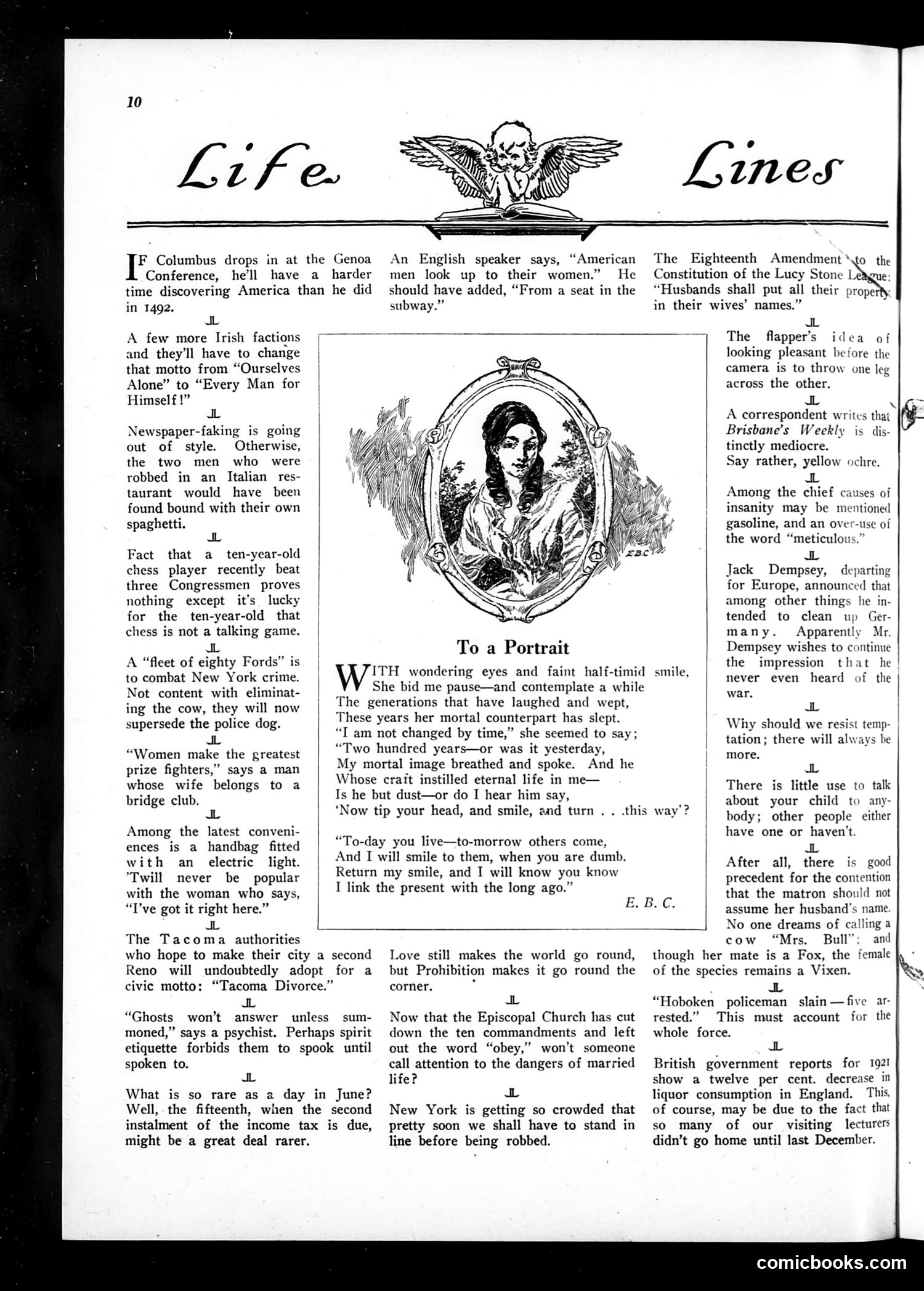
This page from *Life* magazine contains a collection of brief satirical comments and one central illustration titled "To a Portrait" by E.B.C. The illustrated portrait shows a young woman with a contemplative expression, surrounded by romantic imagery. The accompanying poem reflects on mortality and the passage of time—how portraits preserve a moment while life continues beyond them. The surrounding "Life Lines" are short, punchy satirical observations on contemporary American topics: Irish factions, newspaper fraud, women's rights (referencing the Lucy Stone League and property rights), crime in New York, and social conventions about marriage and naming. The page functions as a digest of topical humor and social commentary typical of *Life*'s satirical format, mixing visual art with witty editorial remarks.
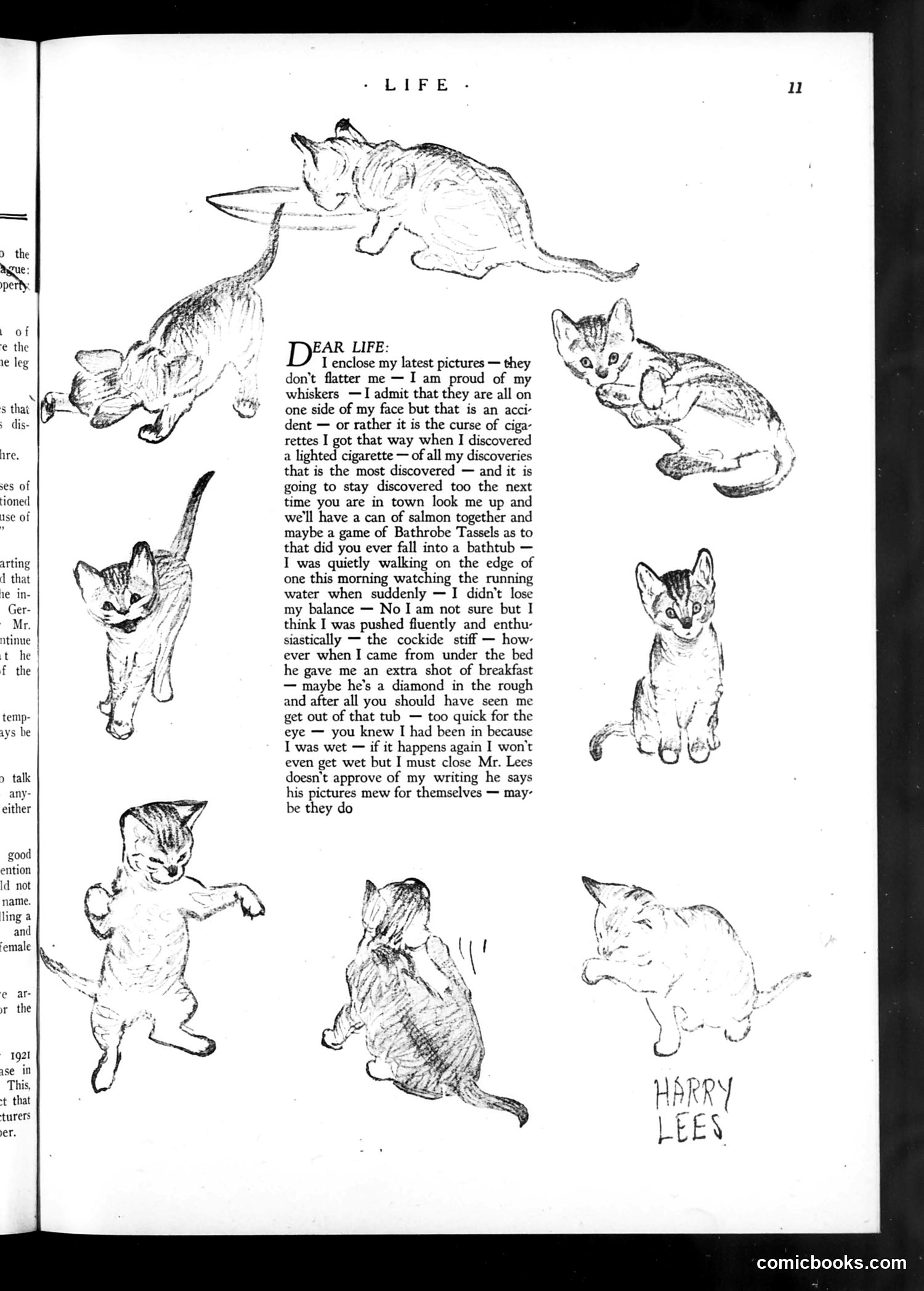
This page features a letter to the editor signed "Dear Life," accompanied by whimsical ink sketches of cats in various playful poses by artist Harry Lees. The letter humorously describes the sender's embarrassing mishap of falling into a bathtub while watching the water. The writer attributes this to being nudged by a cat, then jokes about getting extra breakfast as compensation. The tone is lighthearted self-deprecation. The letter concludes by mentioning "Mr. Lees" and his cat illustrations, suggesting this is reader correspondence responding to previously published feline artwork. The sketches show cats in natural, charming attitudes—sitting, walking, stretching—typical of early 20th-century magazine illustration style. This appears to be a humor column mixing reader letters with supporting artwork.
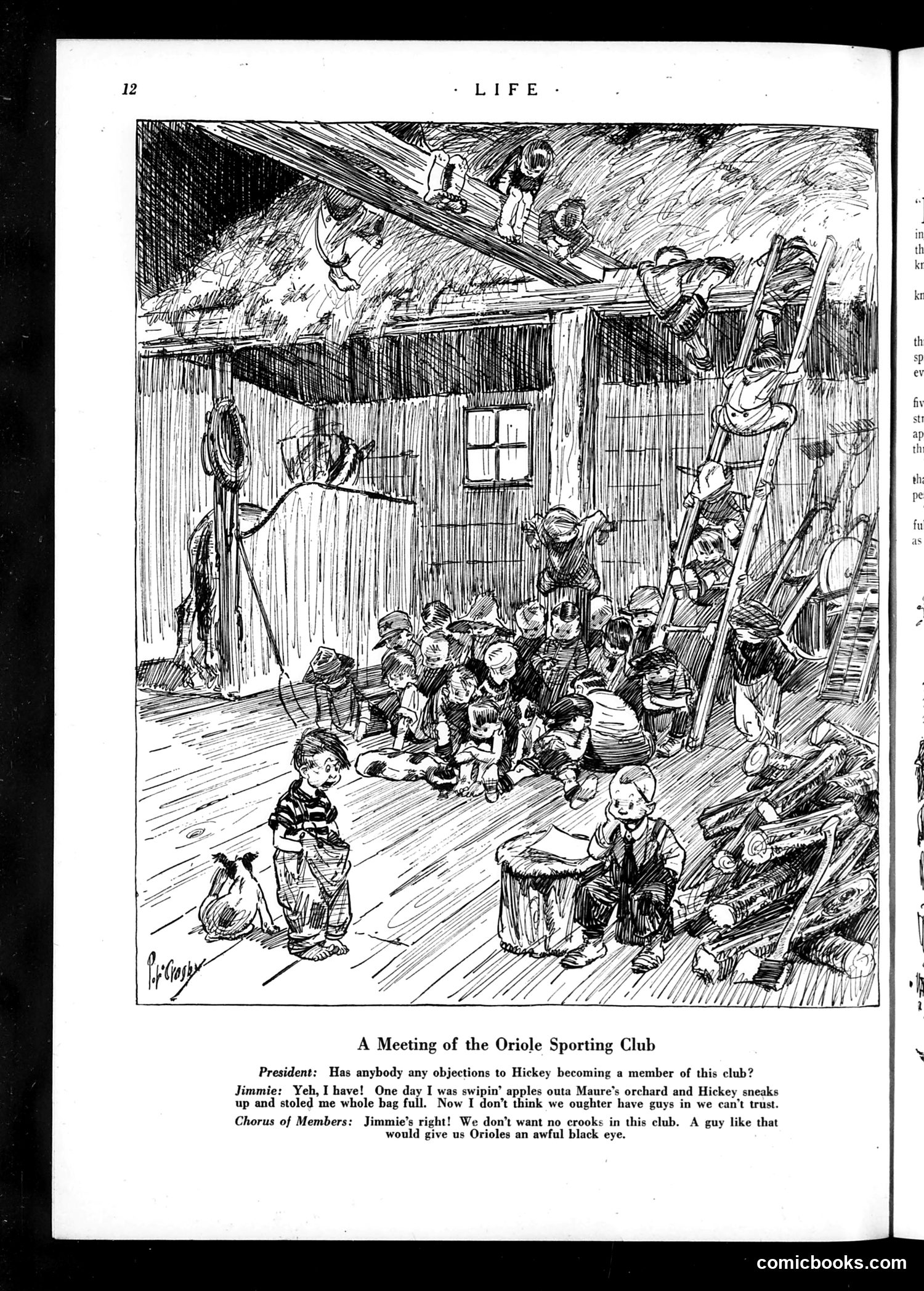
This is a humorous cartoon about club membership standards. The "Oriole Sporting Club" appears to be a children's or informal group meeting in a rustic barn setting. The satire centers on a membership dispute: Jimmie objects to "Hickey" joining because Hickey once stole apples from Maurie's orchard. The club president initially asks if anyone opposes Hickey's membership, but the other members chorus their agreement with Jimmie—they don't want "crooks" in their club, asserting that thieves would give the Orioles "an awful black eye." The joke is the irony of juvenile delinquents forming a moralistic club with strict ethical standards. The barn setting and crude conditions suggest these are poor or working-class children attempting to establish respectability through exclusionary rules.
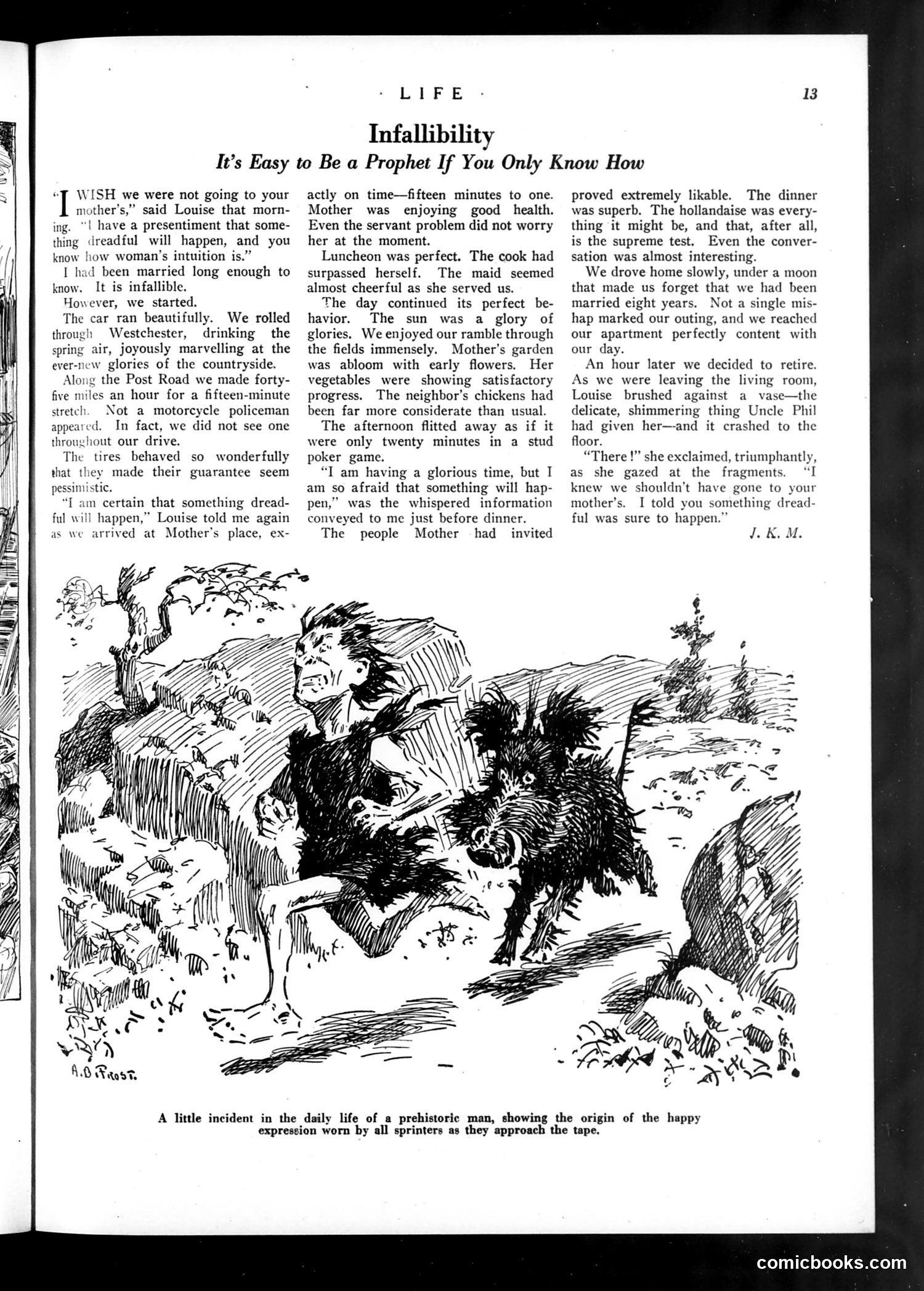
This humorous article recounts a visit to the narrator's mother's house in the countryside. The piece gently satirizes women's intuition and predictive abilities—the mother supposedly senses something "dreadful" will happen, yet the day proceeds perfectly: the car runs smoothly, lunch arrives on time, the cook performs well, and the weather cooperates beautifully. The accompanying cartoon depicts a prehistoric man with a dog approaching what appears to be the tape finish line—a visual pun on the article's title about "prophets" and prediction. The caption jokes that this is "the origin of the happy expression worn by all sprinters as they approach the tape," suggesting that making accurate predictions (or winning races) is easier than it seems—if you simply "know how."
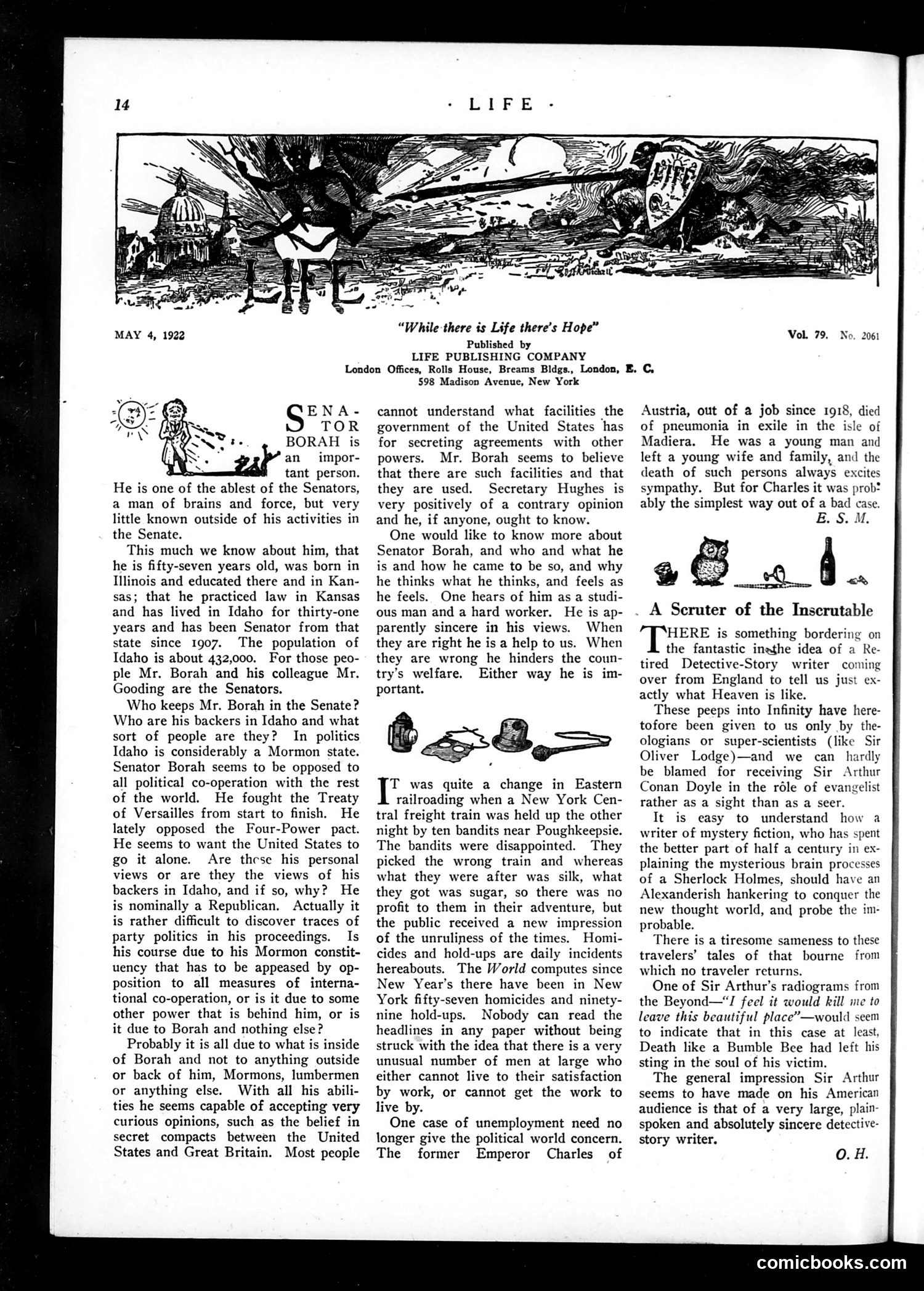
This page contains two articles—one about Senator William Borah of Idaho, and another reviewing a detective story by Sir Arthur Conan Doyle. The Borah article is the primary content, describing him as an important but enigmatic figure: fifty-seven years old, a lawyer and politician known for maverick views. The text suggests Borah holds idiosyncratic political positions—opposing international cooperation while supporting some progressive policies—making him difficult to categorize as simply Republican or Democrat. The article expresses curiosity about his actual beliefs and motivations. A decorative header illustration depicts a surreal, dreamlike scene typical of Life's satirical style. The second article briefly reviews Doyle's work, praising his straightforward detective fiction style.
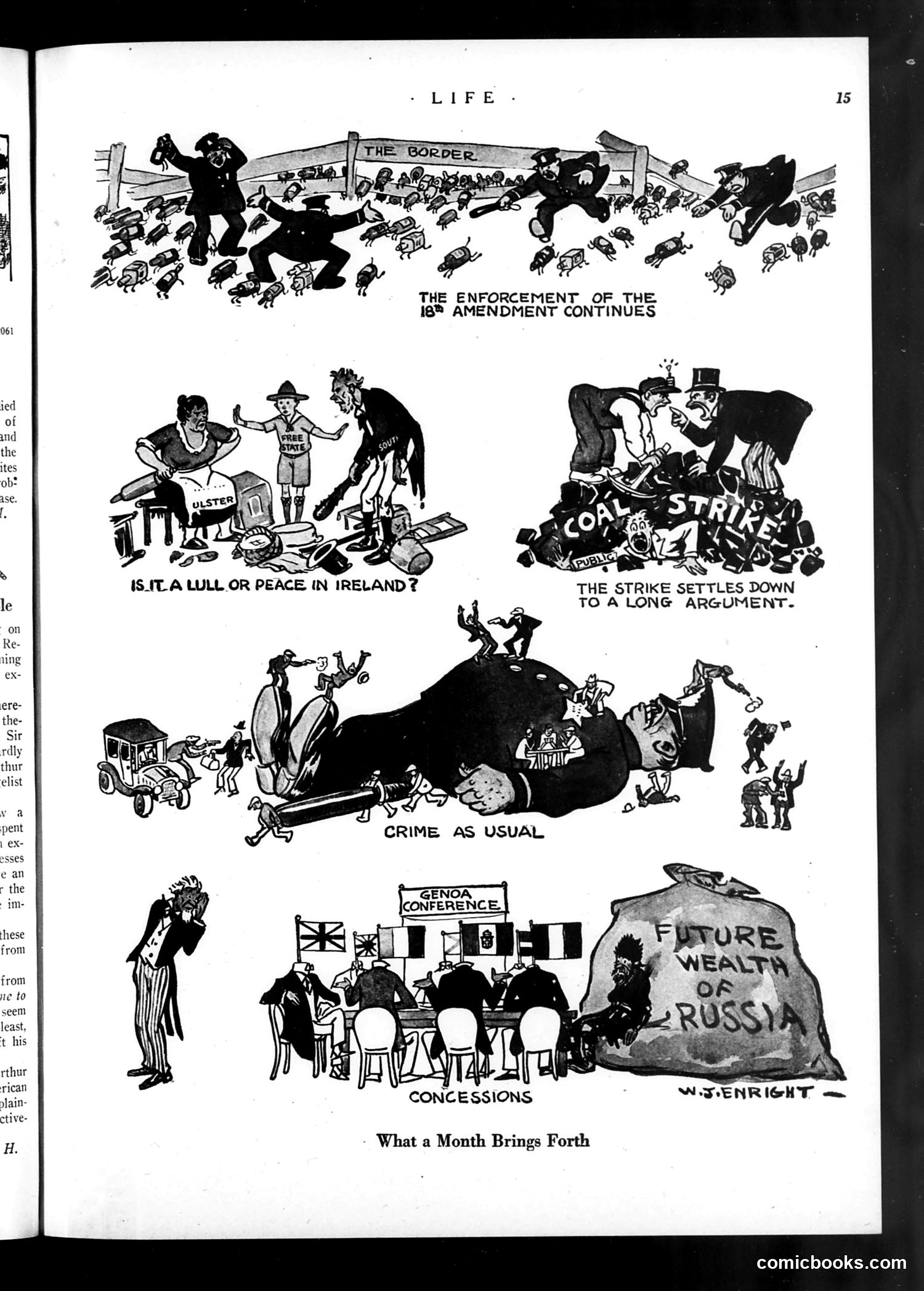
This Life magazine page satirizes major American events from approximately 1920-1922. The cartoons mock: 1. **18th Amendment enforcement**: Border agents chase bootleggers and smugglers, critiquing Prohibition's ineffectiveness. 2. **Irish independence**: Questions whether negotiations will bring "lull or peace," referencing ongoing conflict. 3. **Labor strikes**: Coal miners' strike depicted as prolonged argument with minimal resolution. 4. **General crime**: Shows criminal activity continuing despite authorities' efforts. 5. **Genoa Conference**: International diplomacy attempting to address "Future Wealth of Russia," likely referencing post-Russian Revolution economic discussions. The artist (W.S. Enright) presents a cynical view: despite government intervention and negotiations, fundamental problems—Prohibition failure, labor unrest, crime, geopolitical uncertainty—persist unchanged. The title emphasizes how rapidly political situations shift without real resolution.
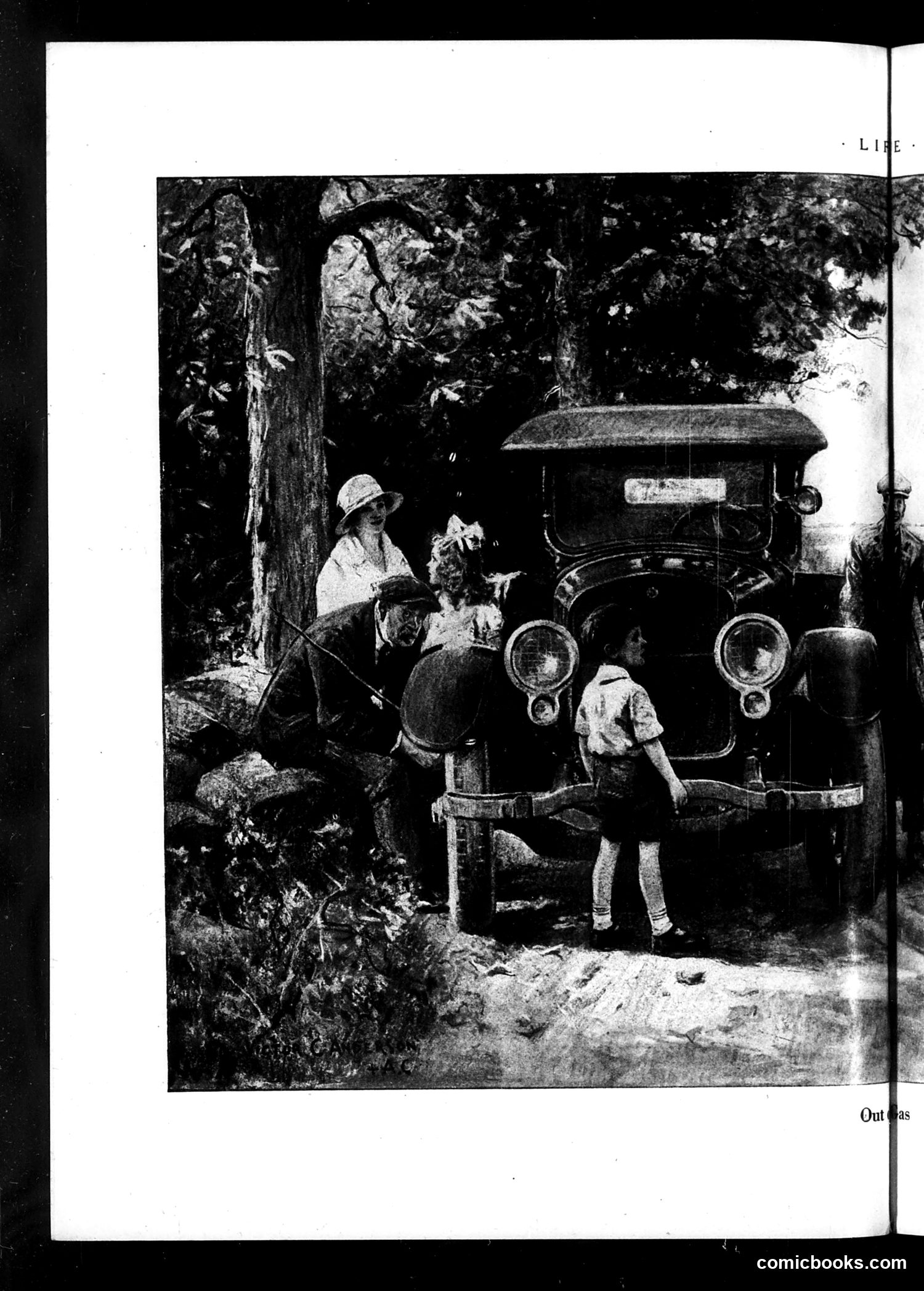
This page shows a black and white photograph rather than a cartoon. It depicts an early automobile (appears to be from the 1920s-1930s based on the design) stopped on a rural road near large trees. Several figures in period clothing are gathered around the vehicle—an adult wearing a hat and what appear to be children. The scene suggests a roadside stop or breakdown. The caption reads "Outgas" (unclear if this is the actual caption or OCR error). Without clearer text or visible satirical elements, the specific point of this image—whether it's satirizing motoring culture, rural life, or something else—cannot be determined with confidence from the visual content alone.
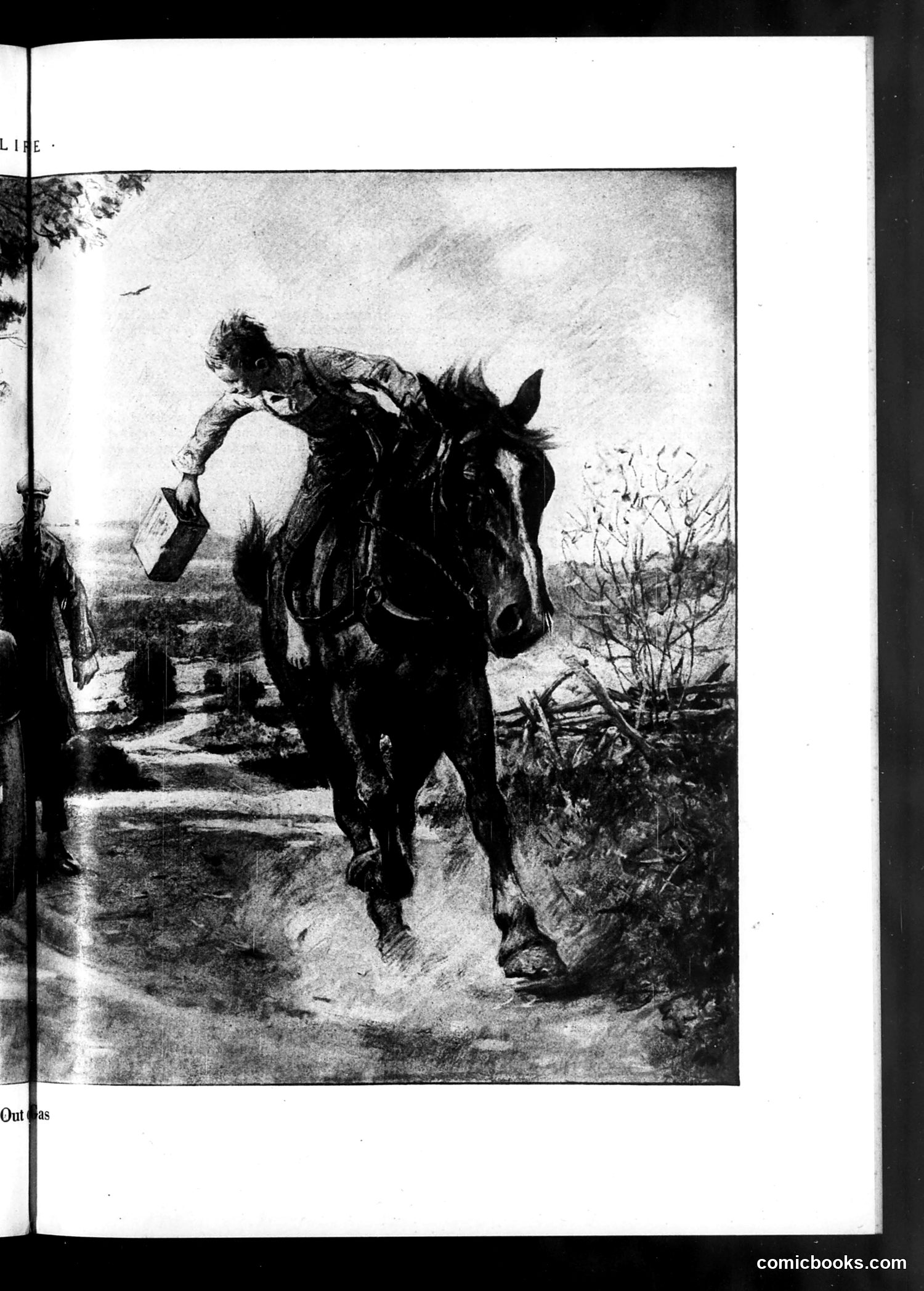
This appears to be a dramatic illustration rather than a political cartoon. It depicts a mounted soldier or cavalryman on horseback, leaning precariously to one side—possibly reaching down or falling. The setting suggests a rural or battlefield landscape with bare vegetation and rough terrain visible on the right. Without visible text identifying the specific political or social reference, the exact satirical meaning is unclear. The image could reference military incompetence, a specific historical event, or a commentary on cavalry tactics or leadership. The dramatic, exaggerated pose suggests satire of military conduct, but the particular target—whether a specific general, military branch, or historical moment—cannot be determined from the image alone. The "Life" magazine context indicates it's satirical commentary, but the specific reference remains ambiguous without additional identifying information.
This page reviews two plays: "The Goldfish" and "Lady Bug." The critic satirizes how theatrical producers cynically construct comedies by committee—literally asking friends to contribute funny scenes, as if assembling a Christmas tree with gags. "The Goldfish" was retitled multiple times (from "Up" to "Jenny Jones") with each version adding more slapstick. The review mocks actress Marjorie Rambeau's effectiveness despite the play's synthetic quality, and ridicules a running gag: an unexplained boy in brass buttons gets a huge opening-night ovation (compared to Theodore Roosevelt's Republican Convention reception), yet vanishes from the plot entirely—a joke about audience expectations versus lazy scriptwriting. The "Lady Bug" section sarcastically suggests producers assume hiring star John Cumberland guarantees success, requiring only minimal additional effort. The overall satire targets early 20th-century Broadway's formulaic, commercially-driven farce production.
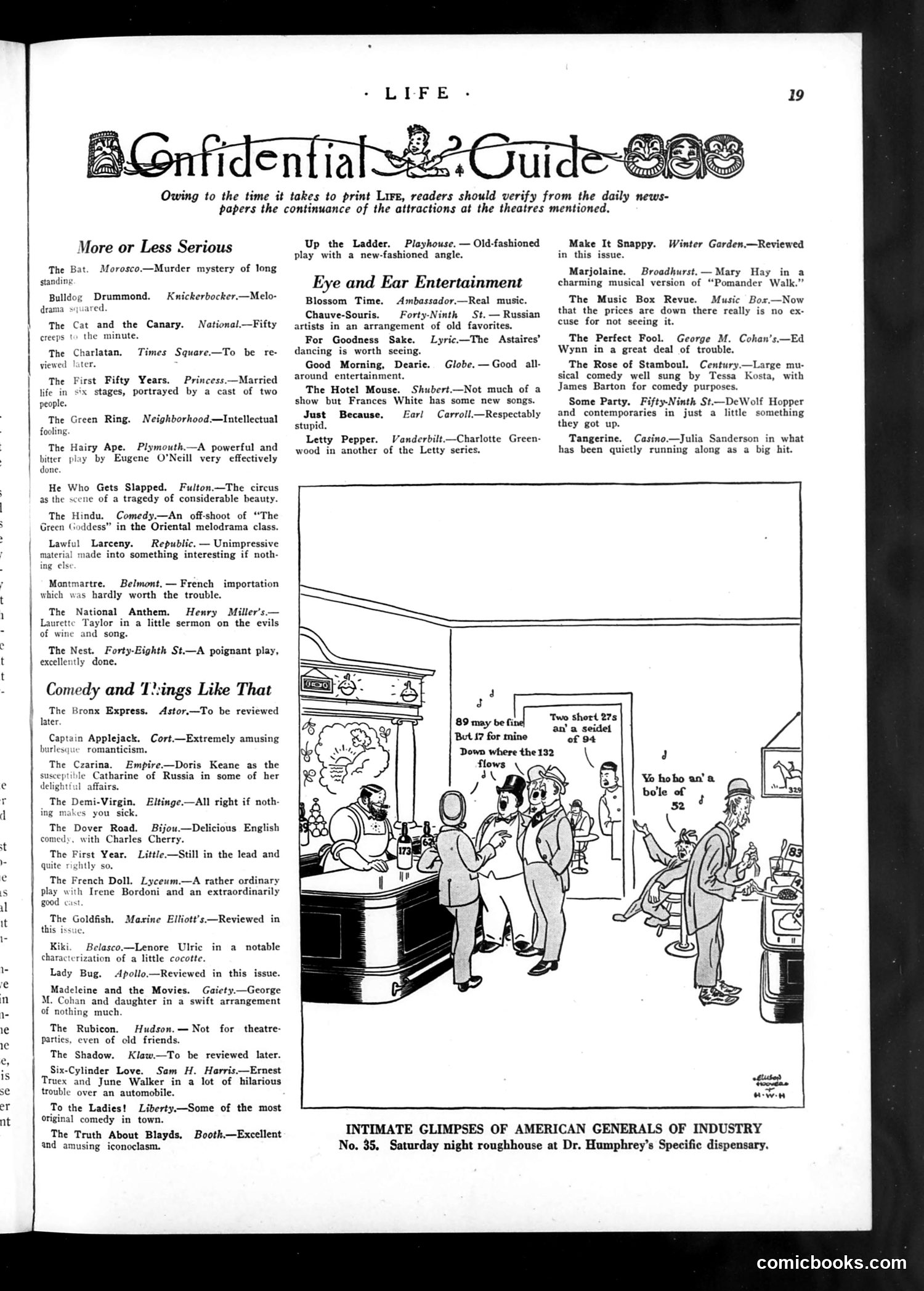
This page from *Life* magazine is a theater guide and review section for Broadway shows. The cartoon illustrates the page's satirical purpose: it depicts a Saturday night at "Dr. Humphrey's Specific dispensary"—a humorous reference to theater-going as a form of social medicine or cure. The cartoon shows well-dressed patrons in what appears to be a pharmacy or medical office, with dialogue about "short 87s" and prescriptions. The joke equates attending Broadway shows with medical treatment—theater as therapeutic entertainment for the urban elite. The surrounding text reviews current productions, mixing serious drama (*The Hairy Ape*, *He Who Gets Slapped*) with comedies and musicals (*Six-Cylinder Love*, *For Goodness Sake*). The reviews are brief, snide assessments typical of *Life*'s satirical voice, dismissing some offerings as "respectably stupid" or "hardly worth the trouble."
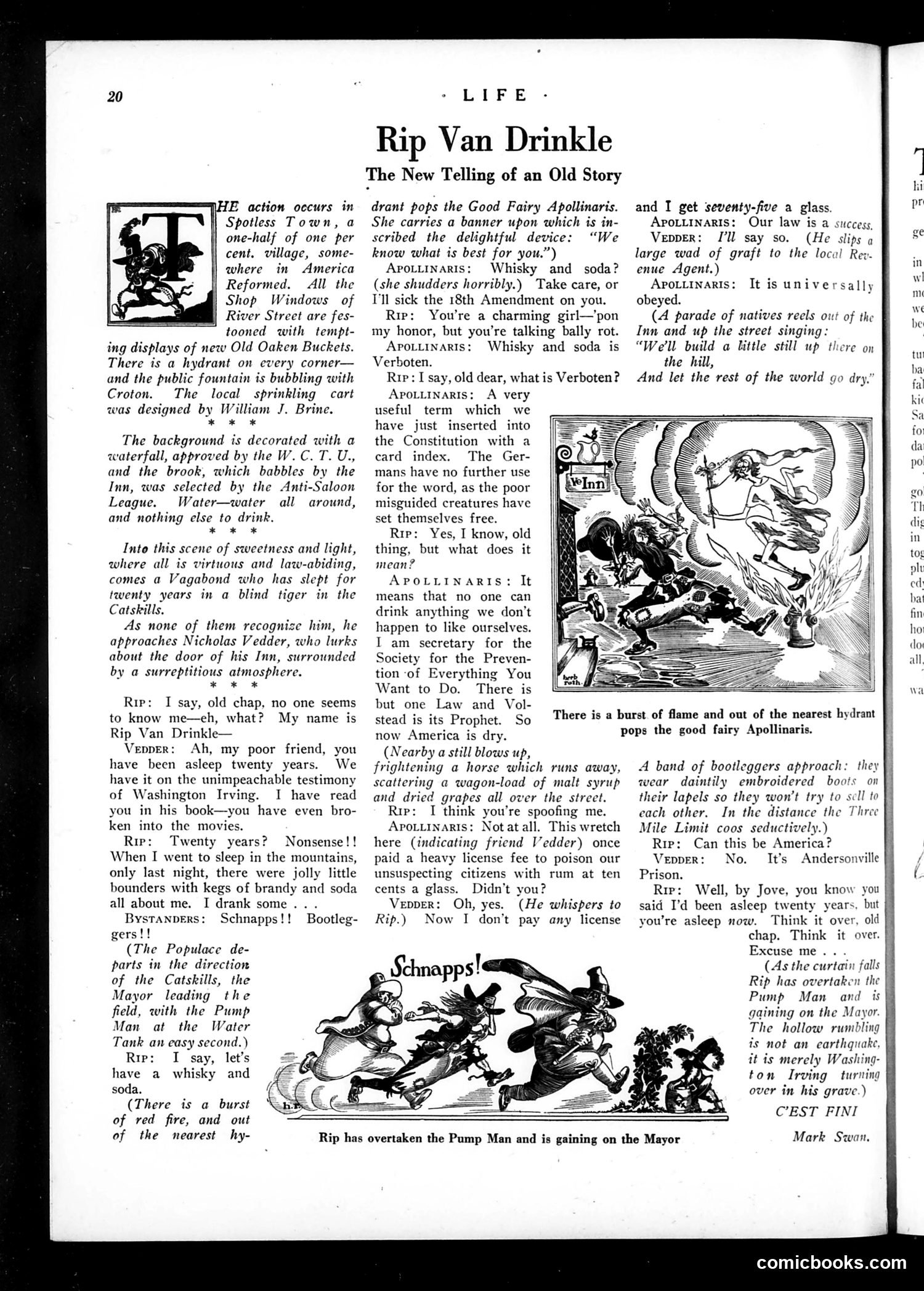
This 1920s *Life* magazine piece satirizes American Prohibition (the 18th Amendment and Volstead Act). Rip Van Winkle—renamed "Rip Van Drinkle"—awakens after twenty years to find alcohol banned. The satire targets Prohibition's absurdity and hypocrisy. "Spotless Town" is a dry utopia decorated with water fountains approved by the W.C.T.U. (Women's Christian Temperance Union) and Anti-Saloon League. The "good fairy Apollinaris" represents Prohibition's sanctimonious morality. When Rip requests whisky and soda, he's threatened with the 18th Amendment. The cartoon mocks enforcement's failure: bootleggers operate openly, stills explode in the streets, and a reverend accepts "graft" (bribes). The natives sing about building illegal stills on hills. The joke: Prohibition promised virtue but created widespread lawbreaking, corruption, and organized crime—the opposite of its goals. Rip's drunken pre-Prohibition world seems preferable to this hypocritical "reformed" America.
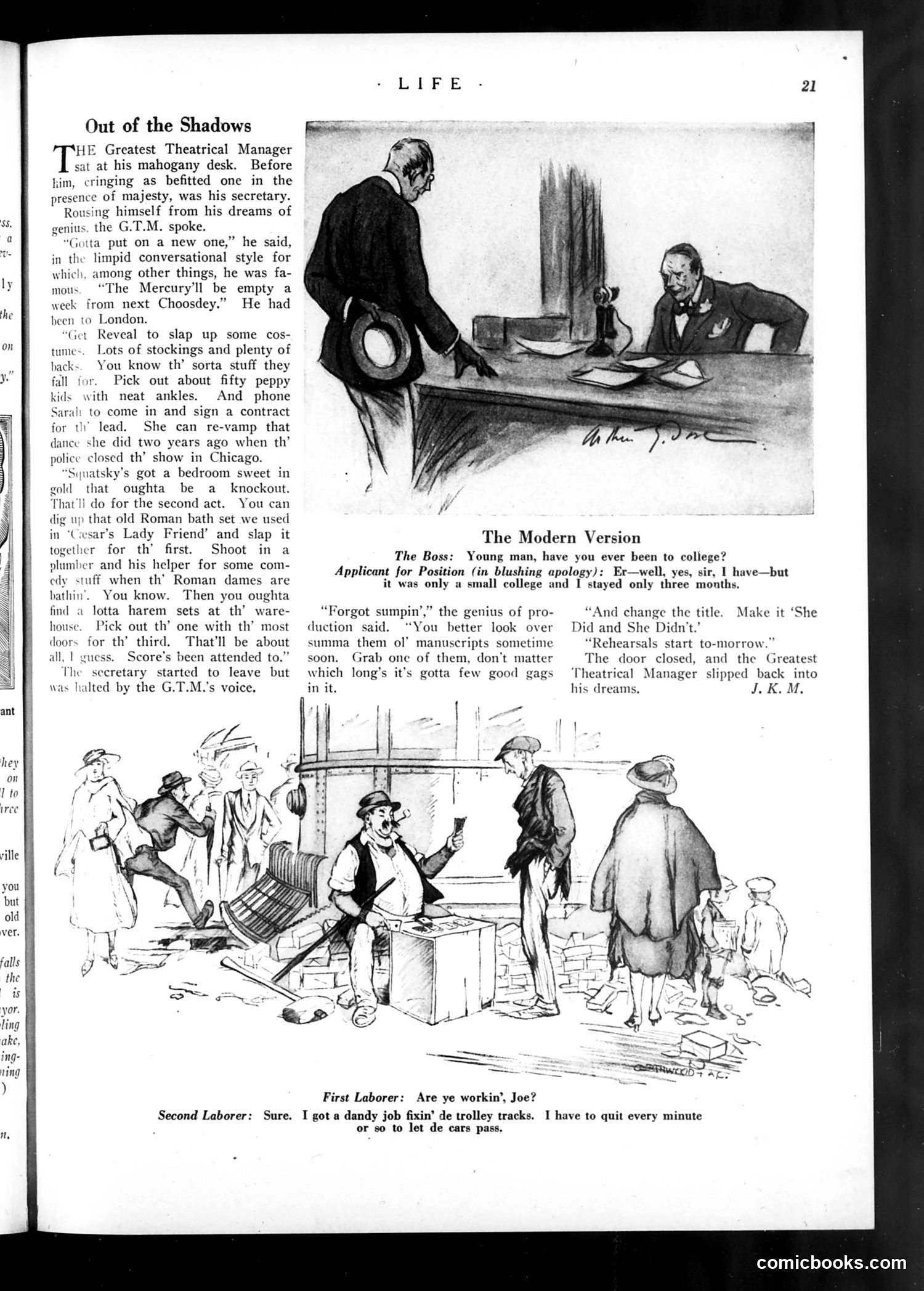
This page from *Life* magazine satirizes early 20th-century theatrical production through two contrasting scenarios. **"Out of the Shadows"** mocks the arrogant incompetence of a major theater manager (the G.T.M.). Despite his grandiose self-regard, he assembles shows through lazy recycling: reusing old sets, hiring dancers solely for "neat ankles," and grabbing random scripts without reading them. The satire targets his reliance on cheap spectacle and formulaic content ("She Did and She Didn't") rather than genuine artistry. His pretentious speech patterns—affected and clichéd—reinforce the mockery. **"The Modern Version"** contrasts this with a job applicant's humiliating interview about college attendance. The boss dismisses the applicant for attending "only a small college" for "only three months"—exposing class prejudice and arbitrary hiring standards in business. The bottom cartoon shows laborers casually discussing work interruptions, emphasizing working-class precarity. Together, the page satirizes both theatrical phoniness and class-based social hierarchies in American business and culture.
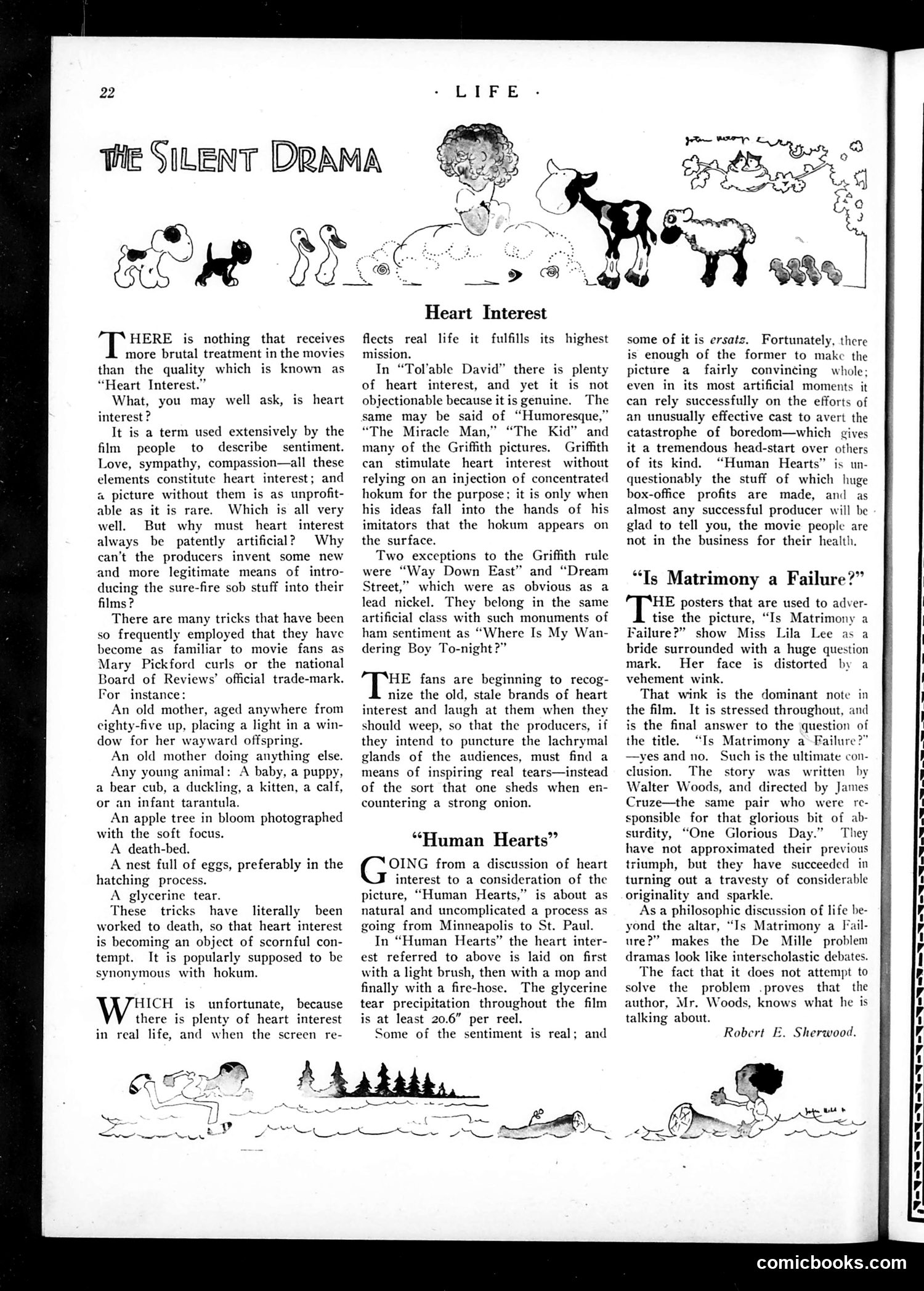
This page critiques how Hollywood films manufacture emotional responses through overused, artificial "heart interest" devices—sentimental tricks meant to make audiences cry. The author catalogs exhausted clichés: elderly mothers with window lights, cute animals, death-bed scenes, glycerine tears. These have become so familiar they inspire mockery rather than genuine emotion. The piece praises films like D.W. Griffith's work for achieving real sentiment authentically, while condemning "Way Down East" and "Dream Street" as heavy-handed. It argues audiences now recognize and laugh at stale emotional manipulation. The review of "Human Hearts" applies this critique: the film drowns viewers in artificial sentiment (glycerine tear precipitation of "20.6 inches per reel"), yet succeeds through strong acting and genuine moments mixed with false ones. The author concludes that while producers exploit emotion for profit, audiences increasingly demand authenticity.
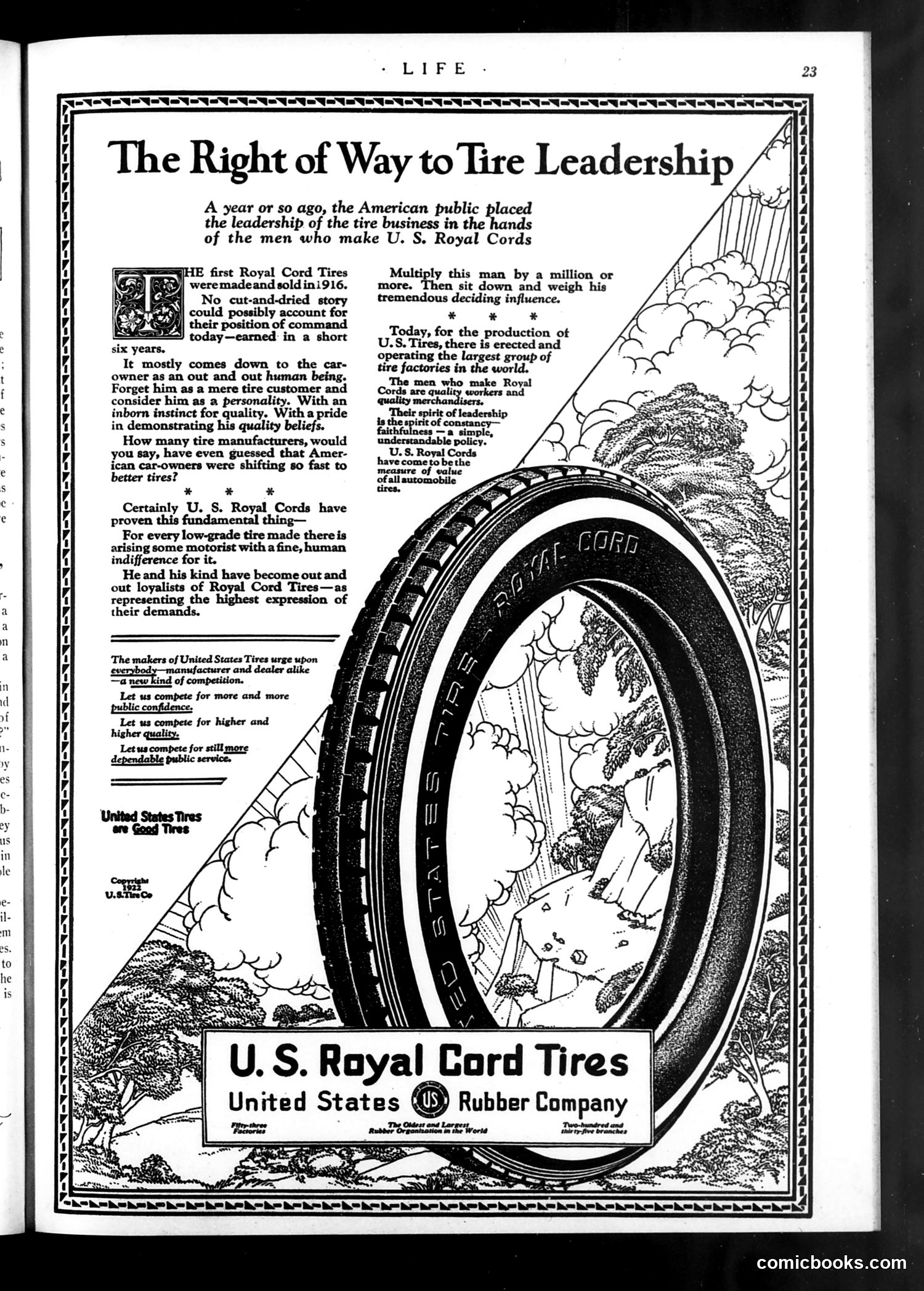
This is a **full-page advertisement** for U.S. Royal Cord Tires (United States Rubber Company), not satire or political commentary. The piece celebrates the company's market dominance by claiming American car owners have voluntarily chosen Royal Cord Tires based on quality and the "personality" of the informed consumer who demands better products. The large central image shows a tire dominating a landscape, visually asserting the brand's supremacy. The rhetoric emphasizes that quality competition—not price—should drive the tire industry, positioning Royal Cord as the winner of this "competition." References to "the men who make" these tires appeal to worker pride and craftsmanship. **Historical context**: This appears from the 1920s era when tire quality and durability were significant consumer concerns and competitive differentiators in the automobile industry. The ad reflects business confidence and assumes readers identify with aspirational "quality" values.
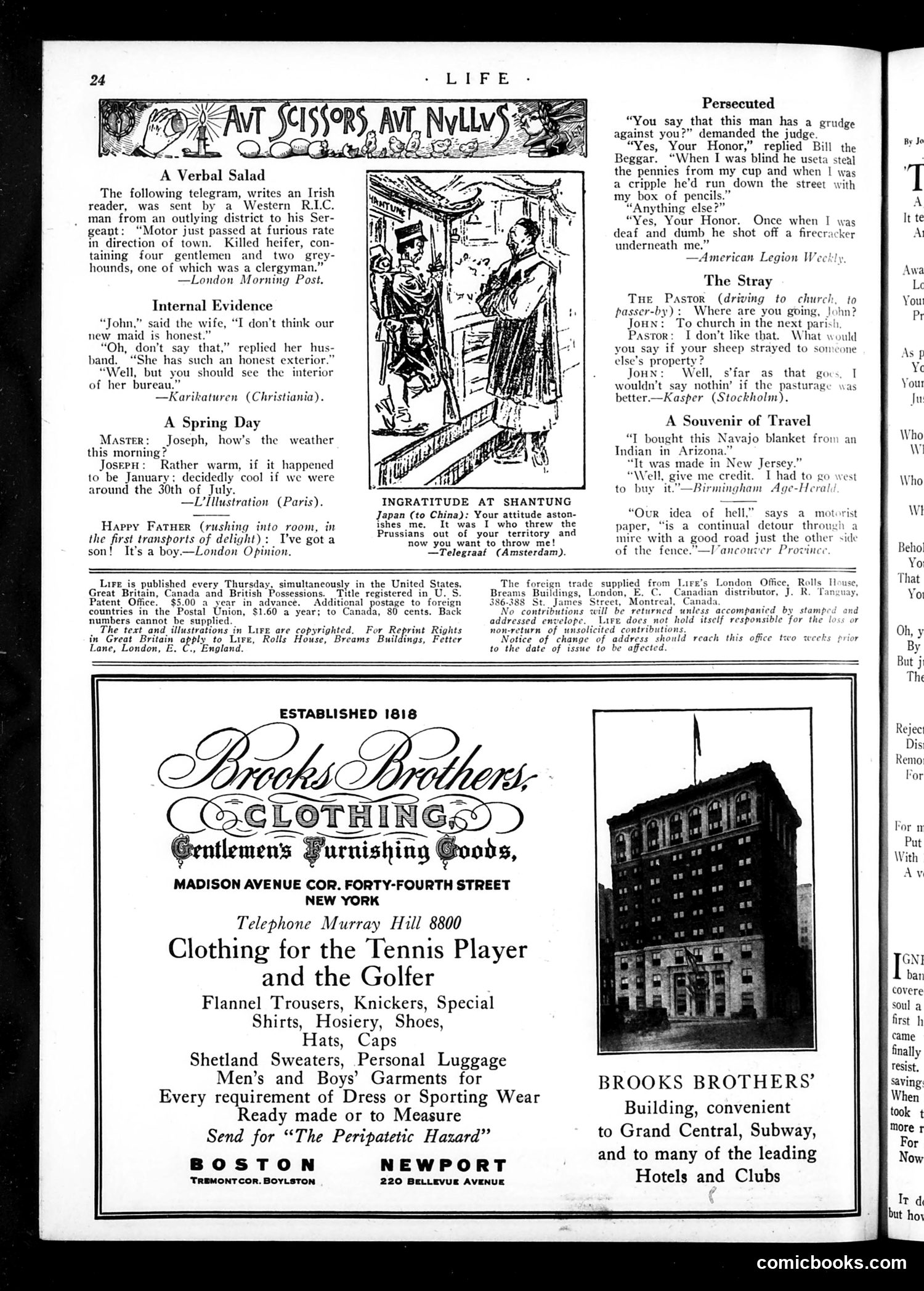
This page contains humorous anecdotal jokes translated from international newspapers—a common *Life* feature. The humor relies on linguistic confusion and absurd social situations: **"A Verbal Salad"** mocks garbled military communication: an Irish policeman accidentally creates nonsense by reporting a motor that "killed heifer, containing four gentlemen and two greyhounds." **"Internal Evidence"** jokes about judging character: a husband defends a supposedly honest maid, but his wife points out her bureau's interior reveals her true nature—a veiled reference to dishonesty or theft. **"Persecuted"** presents a beggar cataloging cruelties from an antagonist, including theft during blindness and firecracker harassment during deafness. **"The Stray"** presents rural dialogue where a pastor criticizes a man's sheep straying; the man replies he wouldn't complain if the neighboring pasture were better. **"A Souvenir of Travel"** reveals a tourist duped into buying a "Navajo" blanket actually made in New Jersey. These are light, domesticated jokes reflecting early 20th-century magazine humor—no sophisticated political satire, mostly wordplay and ironic situations.
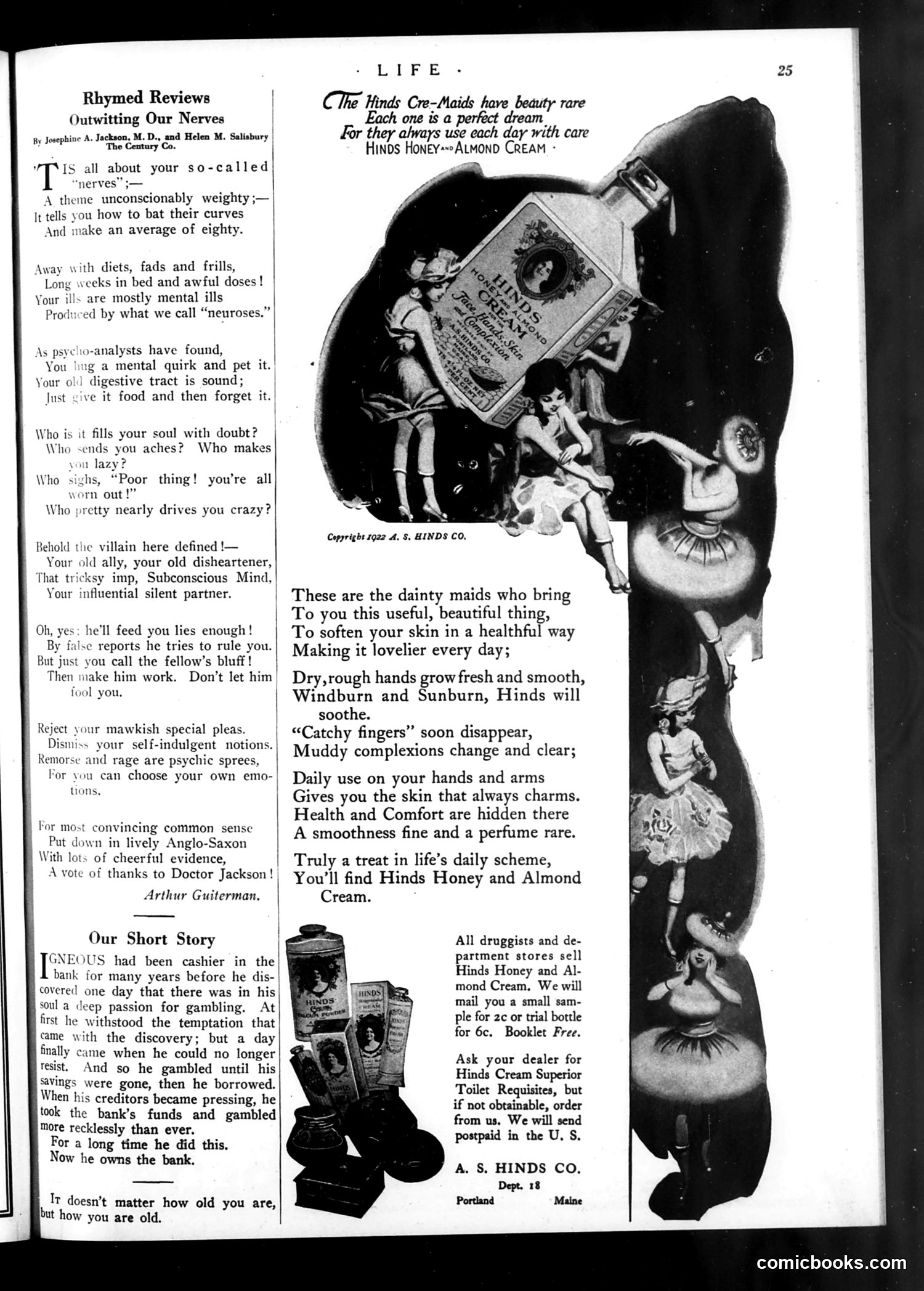
This page combines literary and commercial content typical of 1920s Life magazine. **"Outwitting Our Nerves"** is a humorous book review in verse by Arthur Guiterman, mocking the popular psychology trend of blaming personal problems on the "subconscious mind." The poem satirizes Dr. Josephine Jackson's self-help book by suggesting that neuroses and mental troubles are overdiagnosed fictions—that people should simply reject self-pity and choose better emotions through willpower. The tone is sardonic about the era's emerging psychoanalysis craze. **"Our Short Story"** is a brief satirical anecdote about a bank cashier named Igneous who embezzles funds for gambling, yet somehow ends up owning the bank. The joke appears to be dark commentary on either financial corruption or the absurdity of capitalist outcomes—unclear which precisely. **The right half is an advertisement** for Hinds Honey and Almond Cream skin product, featuring illustrated "Cre-Maids" (cream maids) and promotional copy about hand care. The juxtaposition of psychological satire with consumerist advertising reflects Life's mixed editorial-commercial format.
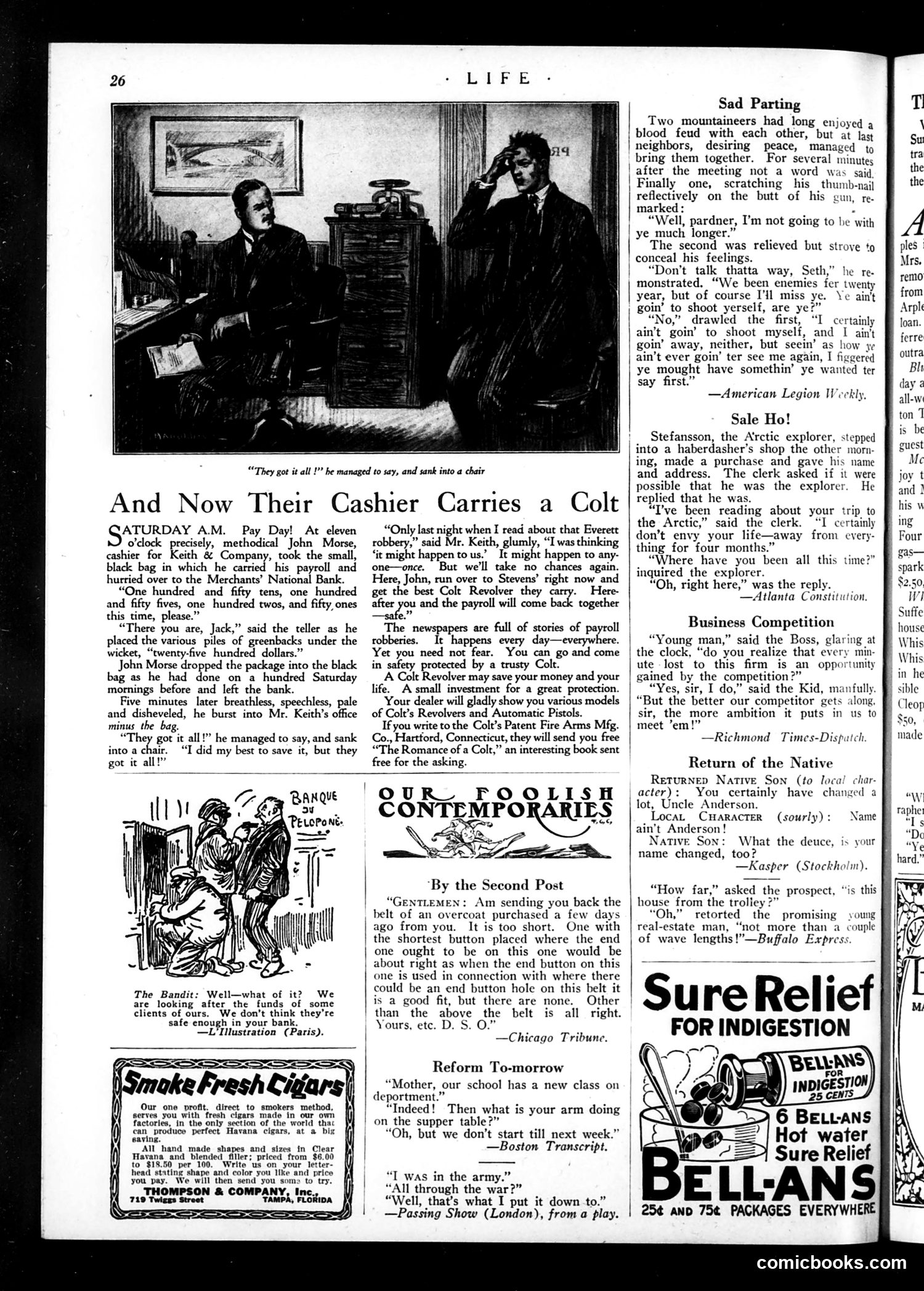
This page contains **advertising disguised as editorial content** rather than political satire. The main feature, "And Now Their Cashier Carries a Colt," presents a fictional robbery scenario: a company cashier is robbed of $2,500 in payroll, prompting his boss to send him to purchase a Colt revolver for protection. The entire narrative is a **Colt firearms advertisement** promoting handguns as essential business security. The "Our Foolish Contemporaries" section reprints humorous letters from other publications—including one about an overcoat's button placement—typical satirical filler. Minor content includes a cartoon showing a "Bandit" stating he's "looking after the funds" (a bank robbery joke), advertisements for cigars and indigestion remedy (Bellans), and a dialect humor piece "Sad Parting" about feuding mountaineers. **The satire here is minimal**; the page primarily serves as advertising wrapped in entertainment, typical of Life magazine's business model in this era.
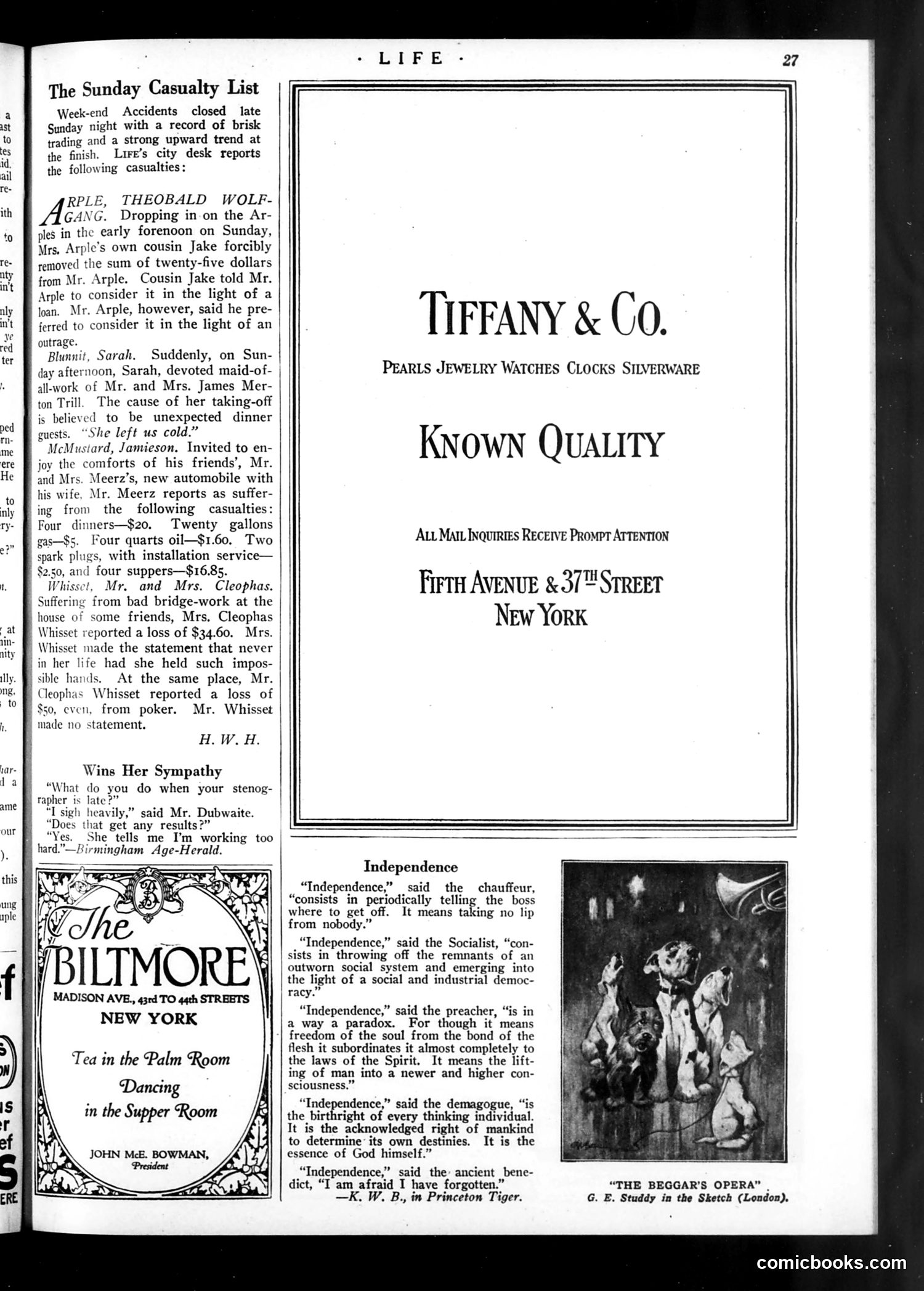
This page satirizes the modern American obsession with tracking trivial domestic mishaps as if they were serious news. The "Casualty List" mimics stock-market or wartime casualty reporting, treating mundane social embarrassments as major incidents: a cousin stealing $25 as a "loan," a maid quitting suddenly, the cost of an automobile outing ($20 for dinners, gas, oil, etc.), and card-game losses. The humor lies in the mock-serious tone and financial accounting of social disasters—essentially mocking both the sensationalism of early-20th-century newspapers and American materialism. Each "casualty" receives a name and detailed accounting, treating petty domestic drama with the gravitas of actual tragedy. The separate "Independence" piece below offers contrasting definitions from different social perspectives (chauffeur, socialist, preacher, demagogue, monk), gently mocking how everyone claims to understand independence differently—a commentary on competing ideologies of the era.
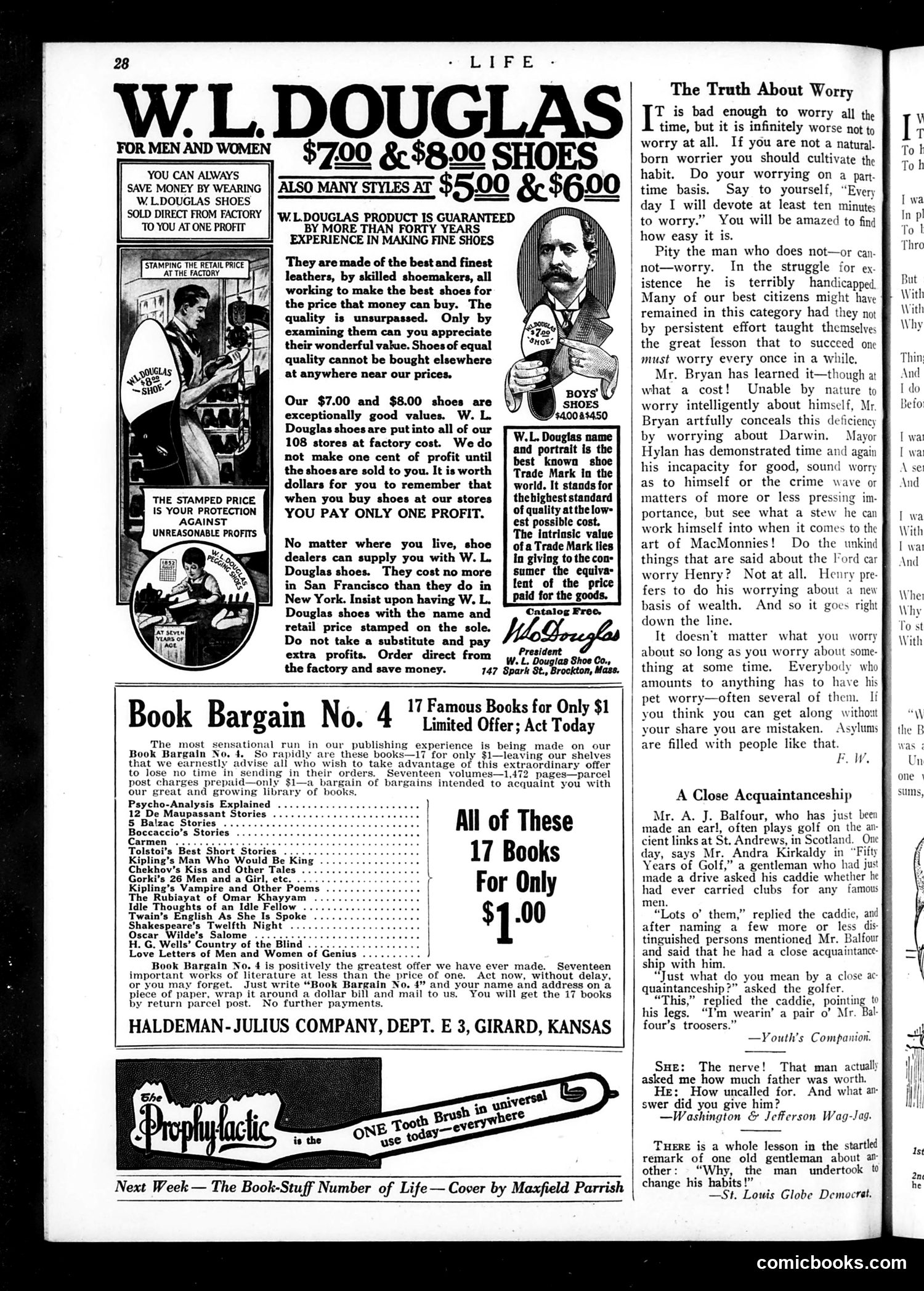
This page is primarily **advertising**, not satire or political commentary. The dominant content features a W.L. Douglas Shoes advertisement highlighting their direct-to-consumer factory model, which undercuts middlemen profits. The company's president's portrait appears, emphasizing the brand's trustworthiness. A secondary ad promotes the **Haldeman-Julius Company's "Book Bargain No. 4,"** offering 17 classic literary works for $1—an extraordinary deal for the era, selling mass-market paperback collections of famous authors like Tolstoy, Kipling, and Oscar Wilde. The right column contains a brief editorial essay titled "The Truth About Worry," which paradoxically advocates *cultivating* a worry habit as necessary for success and survival—likely gentle satire on American anxiety and self-improvement culture. The Prophylactic toothbrush advertisement at bottom is standard commercial copy. This page reflects early 20th-century Life's mixed editorial-advertising format and consumer culture marketing.
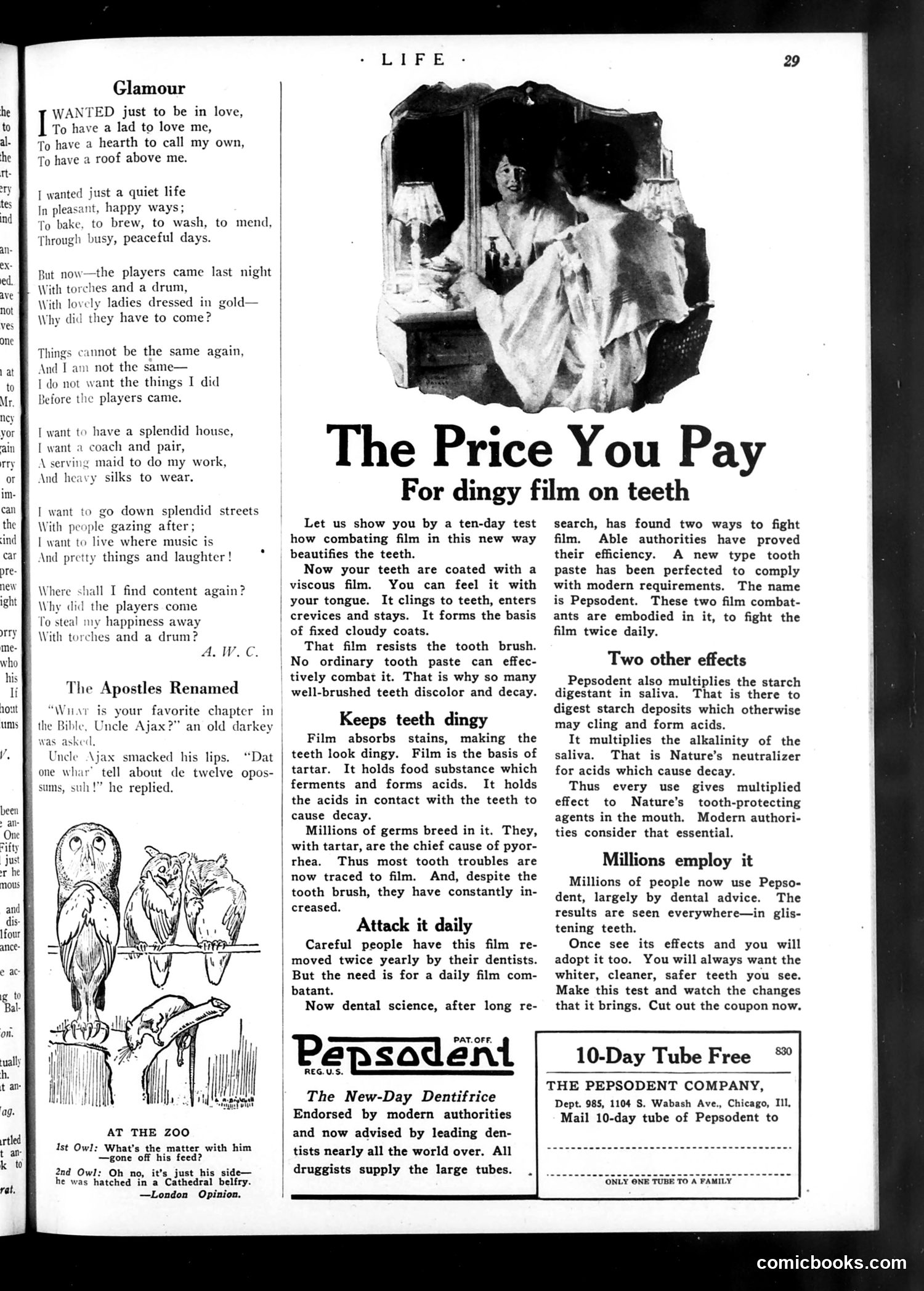
This page contains two distinct elements: **"Glamour" Poem (by A.W.C.):** A satirical poem about a young woman whose simple domestic aspirations are upended after theatrical players visit her town. She initially wanted quiet domesticity—"to bake, to brew, to wash, to mend"—but witnessing glamorous performers "dressed in gold" awakens desires for luxury: a splendid house, coach, servants, fine clothes, and urban excitement. The satire critiques how easily modest contentment is corrupted by exposure to theatrical glamour and materialism. The rhetorical question "Where shall I find content again?" underscores her lost innocence. **Supporting Content:** "The Apostles Renamed" and "At the Zoo" are brief humorous anecdotes. The page is otherwise dominated by a **Pepsodent toothpaste advertisement**—a full-page scientific pitch claiming the product fights tooth film through new dental science, featuring testimonials about "millions" of users. The ad exemplifies early 20th-century marketing's blend of pseudo-scientific authority and aspirational messaging. The juxtaposition suggests Life's dual purpose: literary satire alongside consumer advertising culture.
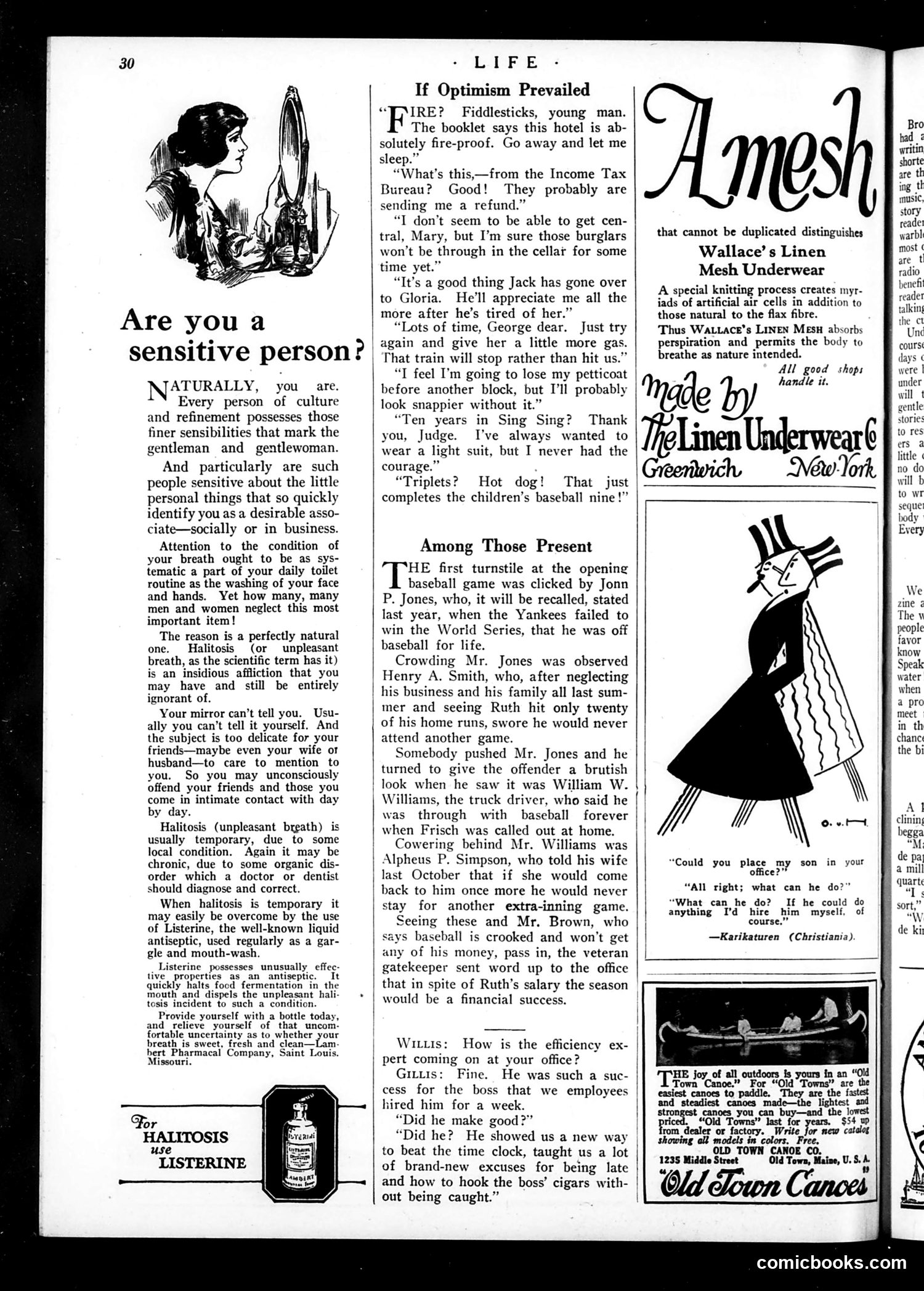
This page contains two distinct satirical pieces: **"If Optimism Prevailed"** presents absurd scenarios where people adopt unrealistic optimism about serious problems: a hotel guest dismisses fire-safety concerns, someone expects an income-tax refund, a woman trusts burglars won't rob her cellar, and a man ignores a train approaching his car. The satire mocks blind optimism as a coping mechanism for modern anxieties—fires, taxes, crime, accidents—that plagued 1920s readers. **"Among Those Present"** humorously catalogs baseball fans who swore off the sport after disappointments (like the Yankees losing the World Series, or Ruth's underperformance), yet are observed returning to opening day. The joke satirizes fans' predictable inability to maintain their angry vows, capturing the irrational loyalty sports inspire. The dominant imagery is a full-page **Listerine advertisement** about halitosis, which ironically contrasts with the surrounding satirical content—promoting anxiety about social acceptability through "scientific" terminology.
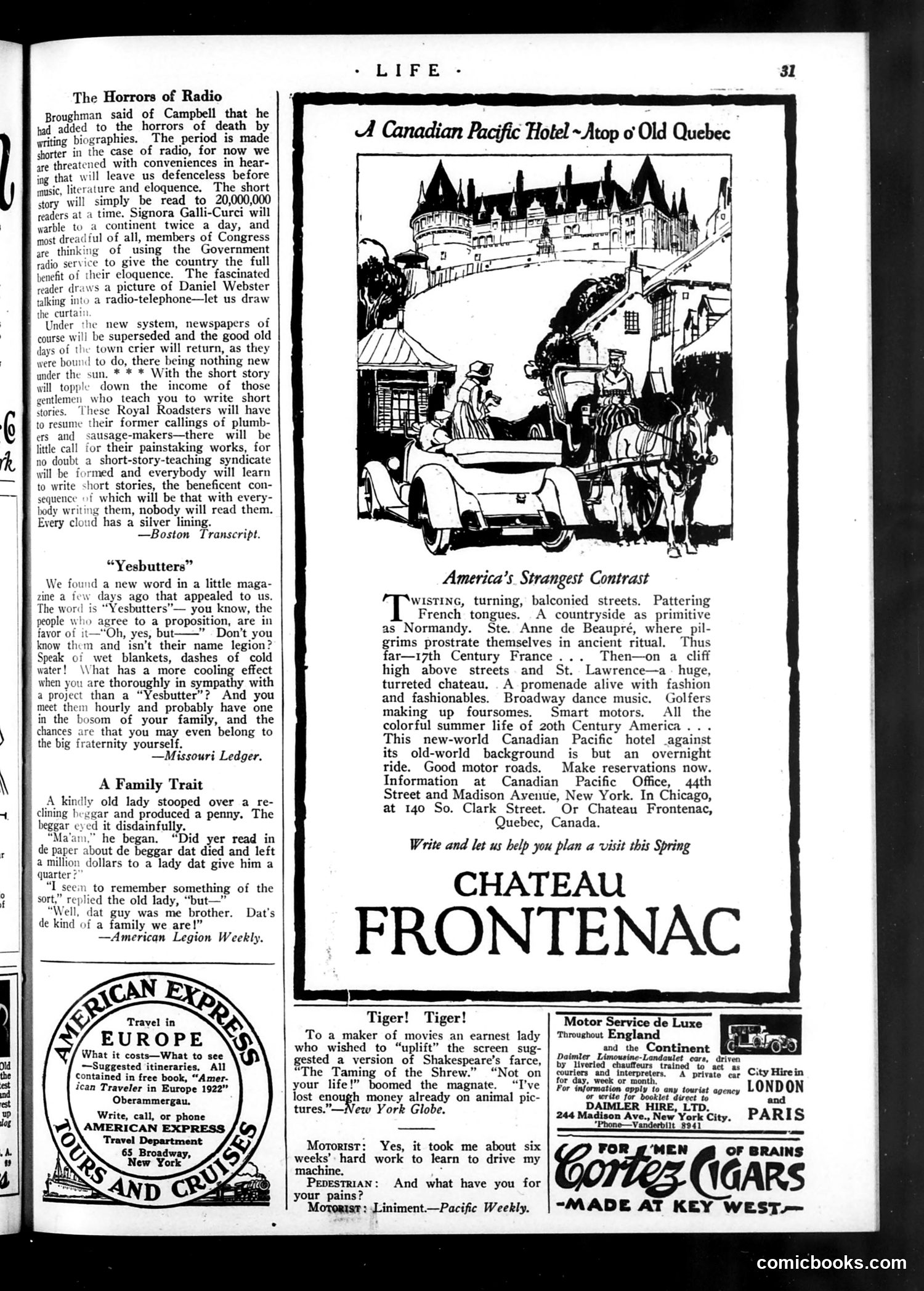
This page contains satirical commentary and advertisements rather than political cartoons. **"The Horrors of Radio"** mocks emerging radio technology, predicting it will destroy traditional media and professions. The satire warns that radio broadcasts will replace newspapers, town criers will return, and writing teachers will become plumbers—because when everyone learns to write via radio-syndicated lessons, nobody will actually read anything. The humor lies in this absurd dystopian projection of technological disruption. **"Yesbutters"** defines a contemporary social type: people who reflexively respond "yes, but..." to any proposal, dampening enthusiasm. This satirizes habitual pessimists and naysayers as widespread irritants in daily life. **"A Family Trait"** is a brief joke about a beggar's family legacy of begging rather than self-improvement. The page is primarily **advertisements**: American Express travel services, Chateau Frontenac hotel, motor services, and Cortez cigars dominate the layout. The Canadian Pacific Hotel advertisement is the most prominent visual element, featuring an illustration of Old Quebec contrasted with modern North American leisure culture.
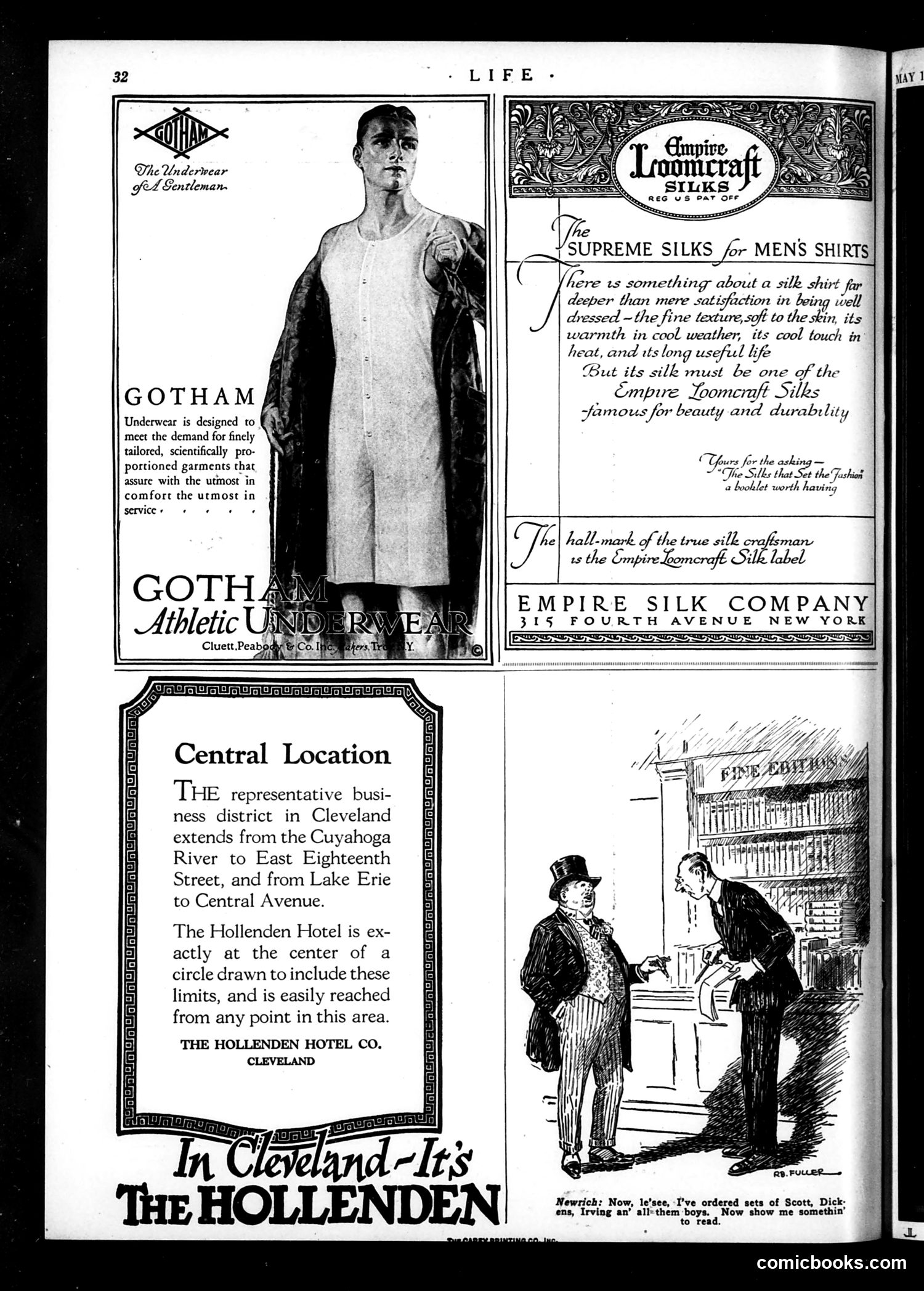
This page consists primarily of advertisements rather than political satire. The main content includes: **Gotham Athletic Underwear** (left): A straightforward product advertisement emphasizing tailored, comfortable undergarments for gentlemen. **Empire Loomcraft Silks** (top right): Marketing silk shirts, emphasizing quality and durability as markers of refined taste and good dressing. **The Hollenden Hotel** (bottom left): A Cleveland hotel advertisement highlighting its central business location. **Cartoon** (bottom right): A humorous sketch by R.B. Fuller depicting a social climber ("Newrich") ordering classic literature sets (Scott, Dickens, Irving) as status symbols, then asking for "something to read"—the joke being he wants actual reading material, not just decorative books. This mocks nouveau-riche attempts at cultural respectability through purchased collections rather than genuine interest in literature.