
Life, 1922-05-04 · page 24 of 34
Life — May 4, 1922 — page 24: what you’re looking at
What you’re looking at
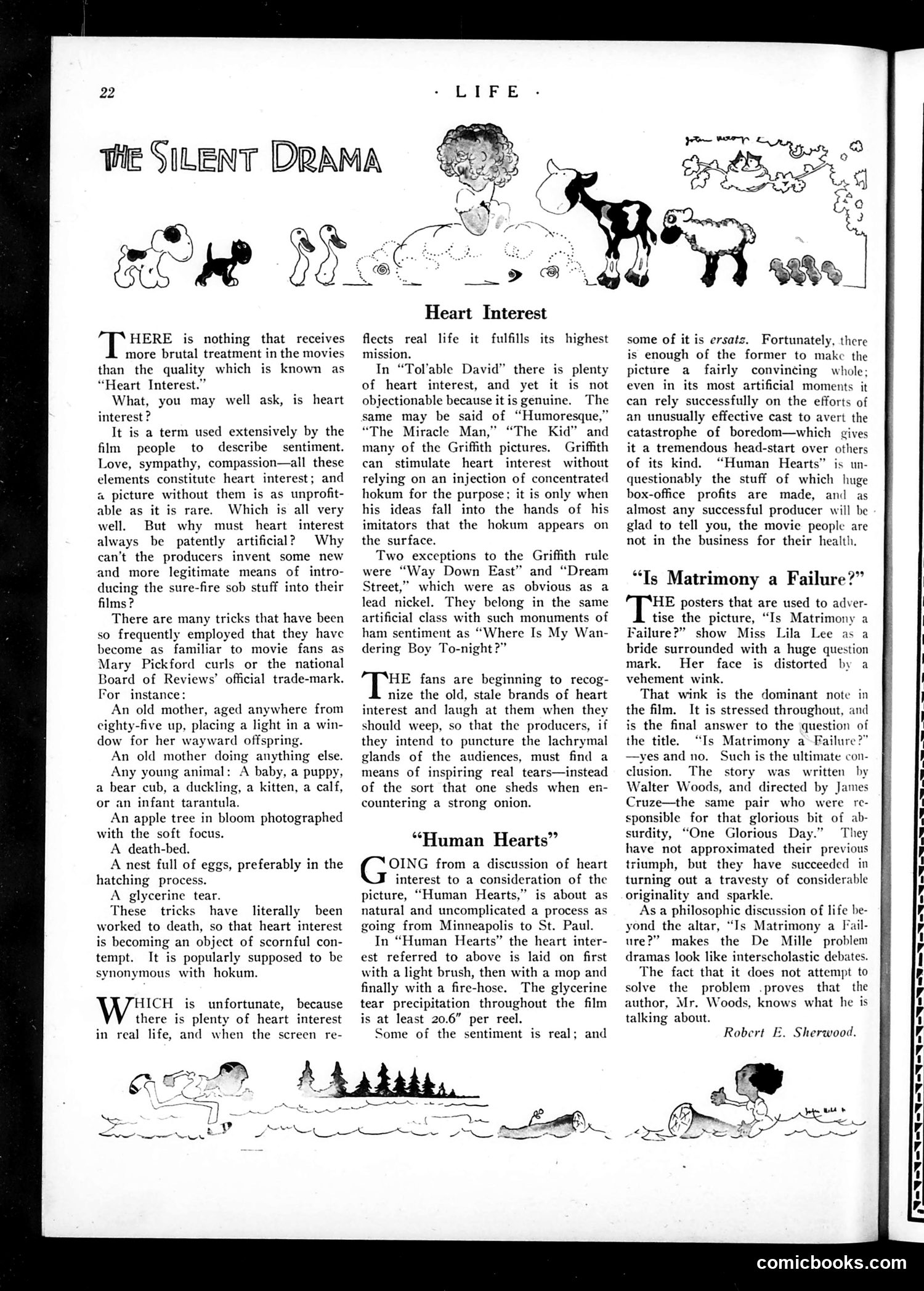
This page critiques how Hollywood films manufacture emotional responses through overused, artificial "heart interest" devices—sentimental tricks meant to make audiences cry. The author catalogs exhausted clichés: elderly mothers with window lights, cute animals, death-bed scenes, glycerine tears. These have become so familiar they inspire mockery rather than genuine emotion. The piece praises films like D.W. Griffith's work for achieving real sentiment authentically, while condemning "Way Down East" and "Dream Street" as heavy-handed. It argues audiences now recognize and laugh at stale emotional manipulation. The review of "Human Hearts" applies this critique: the film drowns viewers in artificial sentiment (glycerine tear precipitation of "20.6 inches per reel"), yet succeeds through strong acting and genuine moments mixed with false ones. The author concludes that while producers exploit emotion for profit, audiences increasingly demand authenticity.
📄 Transcribed text from this page (OCR, searchable)
Machine-transcribed from the original scan — historical spelling and the odd misread are preserved.
22 Te SILENT DRAM ne BS. HERE is nothing that receives more brutal treatment in the movies than the quality which is known as “Heart Interest.” What, you may well ask, is heart interest ? It is a term used extensively by the film people to describe sentiment. Love, sympathy, compassion—all these elements constitute heart interest; and a picture without them is as unprofit- able as it is rare. Which is all very well. But why must heart interest always be patently artificial? Why can’t the producers invent some new and more legitimate means of intro- ducing the sure-fire sob stuff into their films? There are many tricks that have been so frequently employed that they have become as familiar to movie fans as Mary Pickford curls or the national Board of Reviews’ official trade-mark. For instance: An old mother, aged anywhere from eighty-five up, placing a light in a win- dow for her wayward offspring. An old mother doing anything else. Any young animal: A baby, a puppy, a bear cub, a duckling, a kitten, a calf, or an infant tarantula. An apple tree in bloom photographed with the soft focus. A death-bed. A nest full of eggs, preferably in the hatching process. A glycerine tear. These tricks have literally been worked to death, so that heart interest is becoming an object of scornful con- tempt. It is popularly supposed to be synonymous with hokum. HICH is unfortunate, because there is plenty of heart interest in real life, and when the screen re- A Heart Interest flects real life it fulfills its highest mission. In “Tol’able David” there is plenty of heart interest, and yet it is not objectionable because it is genuine. The same may be said of “Humoresque,” “The Miracle Man,” “The Kid” and many of the Griffith pictures. Griffith can stimulate heart interest without relying on an injection of concentrated hokum for the purpose; it is only when his ideas fall into the hands of his imitators that the hokum appears on the surface. Two exceptions to the Griffith rule were “Way Down East” and “Dream Street,” which were as obvious as a lead nickel. They belong in the same artificial class with such monuments of ham sentiment as “Where Is My Wan- dering Boy To-night?” HE fans are beginning to recog- nize the old, stale brands of heart interest and laugh at them when they should weep, so that the producers, if they intend to puncture the lachrymal glands of the audiences, must find a means of inspiring real tears—instead of the sort that one sheds when en- countering a strong onion. “Human Hearts” OING from a discussion of heart interest to a consideration of the picture, “Human Hearts,” is about as natural and uncomplicated a process as going from Minneapolis to St. Paul. In “Human Hearts” the heart inter- est referred to above is laid on first with a light brush, then with a mop and finally with a fire-hose. The glycerine tear precipitation throughout the film is at least 20.6” per reel. Some of the sentiment is real; and GAG some of it is ersatz. Fortunately, there is enough of the former to make the picture a fairly convincing whole; even in its most artificial moments it can rely successfully on the efforts of an unusually effective cast to avert the catastrophe of boredom—which gives it a tremendous head-start over others of its kind. “Human Hearts” is un- questionably the stuff of which huge box-office profits are made, and as almost any successful producer will be glad to tell you, the movie people are not in the business for their health, “Ts Matrimony a Failure?” y 'HE posters that are used to adver- tise the picture, “Is Matrimony a Failure?” show Miss Lila Lee a bride surrounded with a huge question mark. Her face is distorted by a vehement wink. That wink is the dominant note in the film. It is stressed throughout, and is the final answer to the question of the title. “Is Matrimony a Failure?” —yes and no. Such is the ultimate con- clusion. The story was written by Walter Woods, and directed by James Cruze—the same pair who were re- sponsible for that glorious bit of ab- surdity, “One Glorious Day.” They have not approximated their previous triumph, but they have succeeded in turning out a travesty of considerable originality and sparkle. Asa philosophic discussion of life be- yond the altar, “Is Matrimony a Fail- ure?” makes the De Mille problem dramas look like interscholastic debates. The fact that it does not attempt to solve the problem .proves that the author, Mr. Woods, knows what he is talking about. Robert E. Sherwood. comicbooks.com a ow oo So od ee PS