
Life, 1922-05-04 · page 8 of 34
Life — May 4, 1922 — page 8: what you’re looking at
What you’re looking at
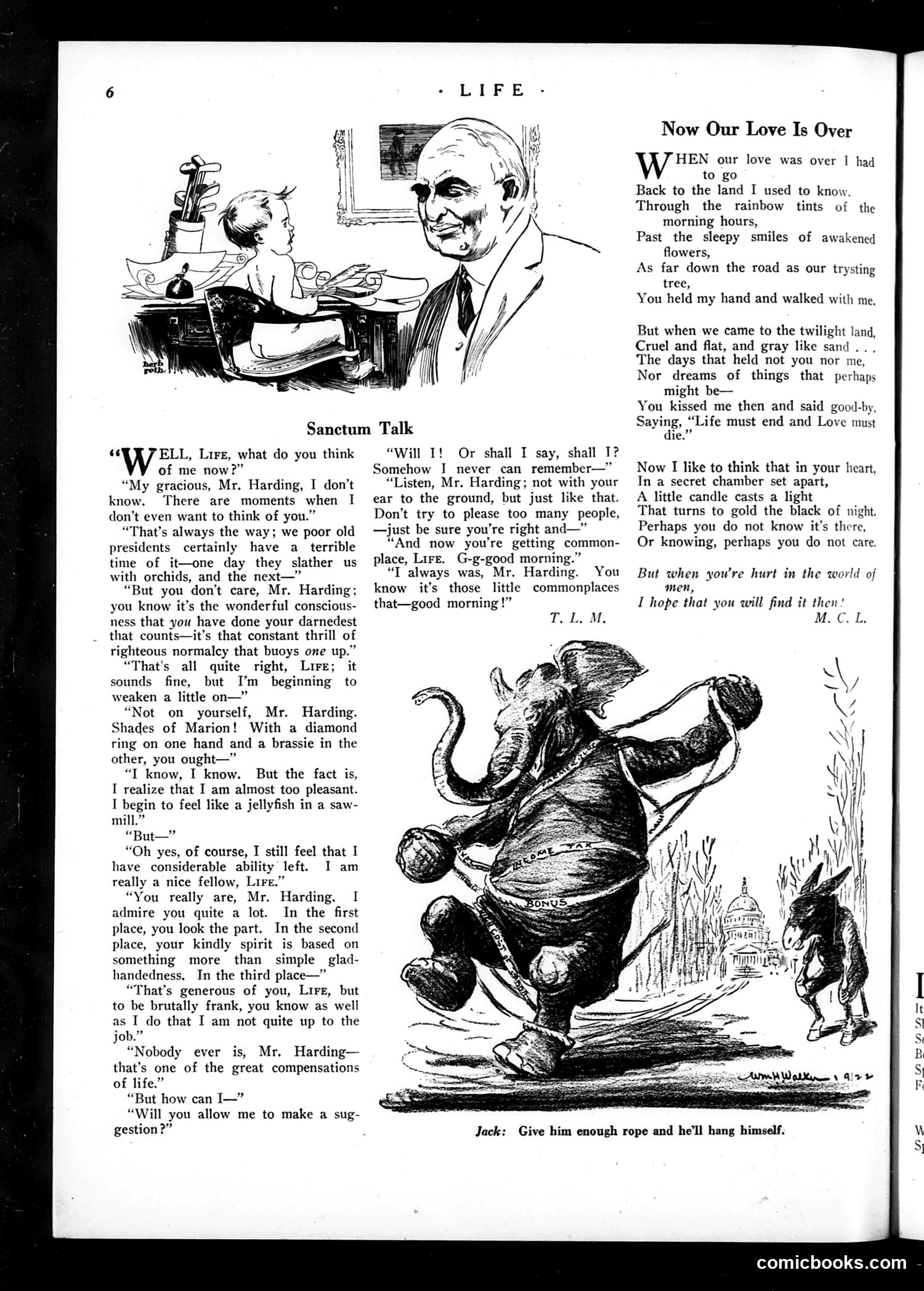
**"Sanctum Talk" Dialogue:** A conversation between "Life" (the magazine personified) and "Mr. Harding" (likely Warren G. Harding, U.S. President 1921-1923). Harding asks Life for advice about running the country, expressing self-doubt about his abilities. Life responds with gentle criticism, suggesting Harding is "too pleasant" and lacks sufficient ability for the job—ultimately recommending he allow more capable people to assist him. **Political Context:** This satirizes Harding's perceived weakness as president and his reliance on advisors (his "Ohio Gang"). The satire suggests he was intellectually unfit for office. **"Now Our Love Is Over" Poem:** A sentimental piece about a ended romance, seemingly unrelated to political content. **Bottom Cartoon:** Shows an elephant (Republican symbol) labeled "BONUS" struggling with rope, with caption "Jack: Give him enough rope and he'll hang himself"—likely referencing Republican disputes over veterans' bonus legislation.
📄 Transcribed text from this page (OCR, searchable)
Machine-transcribed from the original scan — historical spelling and the odd misread are preserved.
Sanctum Talk “ce ELL, Lire, what do you think of me now?” “My gracious, Mr. Harding, I don’t know. There are moments when I don’t even want to think of you.” “That’s always the way; we poor old presidents certainly have a_ terrible time of it—one day they slather us with orchids, and the next—” “But you don’t care, Mr. Harding; you know it’s the wonderful conscious- ness that you have done your darnedest that counts—it’s that constant thrill of righteous normalcy that buoys one up.” “That's all quite right, Lire; it sounds fine, but I’m beginning to weaken a little on—” “Not on yourself, Mr. Harding. Shades of Marion! With a diamond ring on one hand and a brassie in the other, you ought—” “I know, I know. But the fact is, I realize that I am almost too pleasant. I begin to feel like a jellyfish in a saw- mill.” “But—” “Oh yes, of course, I still feel that I have considerable ability left. I am really a nice fellow, Lire.” “You really are, Mr. Harding. I admire you quite a lot. In the first place, you look the part. In the second place, your kindly spirit is based on something more than simple glad- handedness, In the third place—” “That’s generous of you, Lire, but to be brutally frank, you know as well as I do that I am not quite up to the job.” “Nobody ever is, Mr. Harding— that’s one of the great compensations of life.” “But how can I—” “Will you allow me to make a sug- gestion?” “Will I! Or shall I say, shall I? Somehow I never can remember—” “Listen, Mr. Harding; not with your ear to the ground, but just like that. Don’t try to please too many people, —just be sure you're right and—” “And now you're getting common- place, Lire. G-g-good morning.” “I always was, Mr. Harding. You know it’s those little commonplaces that—good morning !” TM: Now Our Love Is Over HEN our love was over I had to go Back to the land I used to know. Through the rainbow tints of the morning hours, Past the sleepy smiles of awakened flowers, As far down the road as our trysting tree, You held my hand and walked with me, But when we came to the twilight land, Cruel and flat, and gray like sand... The days that held not you nor me, Nor dreams of things that perhaps might be— You kissed me then and said good-by, Saying, ‘Life must end and Love must 1e. Now I like to think that in your heart, In a secret chamber set apart, A little candle casts a light That turns to gold the black of night. Perhaps you do not know it’s there, Or knowing, perhaps you do not care. But when you're hurt in the world of men, I hope that you will find it then! MeCol: Jack: Give him enough rope and he'll hang himself. comicbooks.com