
Life, 1922-05-04 · page 16 of 34
Life — May 4, 1922 — page 16: what you’re looking at
What you’re looking at
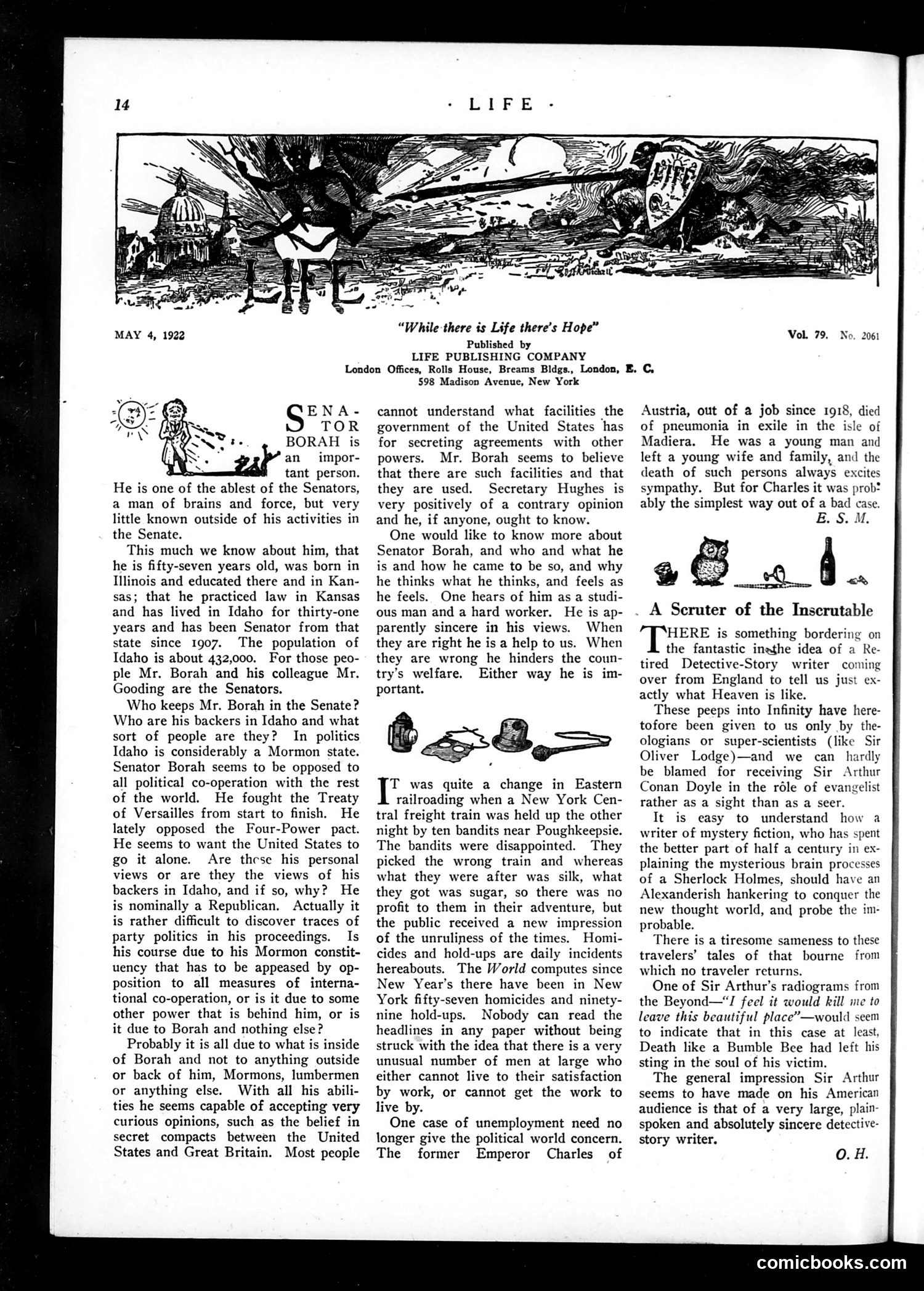
This page contains two articles—one about Senator William Borah of Idaho, and another reviewing a detective story by Sir Arthur Conan Doyle. The Borah article is the primary content, describing him as an important but enigmatic figure: fifty-seven years old, a lawyer and politician known for maverick views. The text suggests Borah holds idiosyncratic political positions—opposing international cooperation while supporting some progressive policies—making him difficult to categorize as simply Republican or Democrat. The article expresses curiosity about his actual beliefs and motivations. A decorative header illustration depicts a surreal, dreamlike scene typical of Life's satirical style. The second article briefly reviews Doyle's work, praising his straightforward detective fiction style.
📄 Transcribed text from this page (OCR, searchable)
Machine-transcribed from the original scan — historical spelling and the odd misread are preserved.
MAY 4, 1922 “While there is Life there’s Hope” Published by LIFE PUBLISHING COMPANY Vol. 79. No. 2061 London Offices, Rolls House, Breams Bldgs., London, E. C, ENA- TOR BORAH is f an impor- b> & tant person. He is one of the ablest of the Senators, a man of brains and force, but very little known outside of his activities in the Senate. This much we know about him, that he is fifty-seven years old, was born in Illinois and educated there and in Kan- sas; that he practiced law in Kansas and has lived in Idaho for thirty-one years and has been Senator from that state since 1907. The population of Idaho is about 432,000. For those peo- ple Mr. Borah and his colleague Mr. Gooding are the Senators. Who keeps Mr. Borah in the Senate? Who are his backers in Idaho and what sort of people are they? In politics Idaho is considerably a Mormon state. Senator Borah seems to be opposed to all political co-operation with the rest of the world. He fought the Treaty of Versailles from start to finish. He lately opposed the Four-Power pact. He seems to want the United States to go it alone. Are these his personal views or are they the views of his backers in Idaho, and if so, why? He is nominally a Republican. Actually it is rather difficult to discover traces of party politics in his proceedings. Is his course due to his Mormon constit- uency that has to be appeased by op- position to all measures of interna- tional co-operation, or is it due to some other power that is behind him, or is it due to Borah and nothing else? Probably it is all due to what is inside of Borah and not to anything outside or back of him, Mormons, lumbermen or anything else. With all his abili- ties he seems capable of accepting very curious opinions, such as the belief in secret compacts between the United States and Great Britain. Most people 598 Madison Avenue, New York cannot understand what facilities the government of the United States has for secreting agreements with other powers. Mr. Borah seems to believe that there are such facilities and that they are used. Secretary Hughes is very positively of a contrary opinion and he, if anyone, ought to know. One would like to know more about Senator Borah, and who and what he is and how he came to be so, and why he thinks what he thinks, and feels as he feels. One hears of him as a studi- ous man and a hard worker. He is ap- parently sincere in his views. When they are right he is a help to us. When they are wrong he hinders the coun- try’s welfare. Either way he is im- portant. t=38,— T was quite a change in Eastern railroading when a New York Cen- tral freight train was held up the other night by ten bandits near Poughkeepsie. The bandits were disappointed. They picked the wrong train and whereas what they were after was silk, what they got was sugar, so there was no profit to them in their adventure, but the public received a new impression of the unruliness of the times. Homi- cides and hold-ups are daily incidents hereabouts. The World computes since New Year’s there have been in New York fifty-seven homicides and ninety- nine hold-ups. Nobody can read the headlines in any paper without being struck with the idea that there is a very unusual number of men at large who either cannot live to their satisfaction by work, or cannot get the work to live by. One case of unemployment need no longer give the political world concern. The former Emperor Charles of Austria, out of a job since 1918, died of pneumonia in exile in the isle of Madiera. He was a young man and left a young wife and family, and the death of such persons always excites sympathy. But for Charles it was pr ably the simplest way out of a bad case. E. S. M. a» 4h. A Scruter of the Inscrutable HERE is something bordering on the fantastic inathe idea of a Re- tired Detective-Story writer coming over from England to tell us just ex- actly what Heaven is like. These peeps into Infinity have here- tofore been given to us only by the- ologians or super-scientists (like Sir Oliver Lodge)—and we can_ hardly be blamed for receiving Sir Arthur Conan Doyle in the réle of evangelist rather as a sight than as a seer. It is easy to understand how a writer of mystery fiction, who has spent the better part of half a century in ex- plaining the mysterious brain processes of a Sherlock Holmes, should have an Alexanderish hankering to conquer the new thought world, and probe the im- probable. There is a tiresome sameness to these travelers’ tales of that bourne from which no traveler returns. One of Sir Arthur’s radiograms from the Beyond—“I feel it would kill me to leave this beautiful place”—would seem to indicate that in this case at least, Death like a Bumble Bee had left his sting in the soul of his victim. The general impression Sir Arthur seems to have made on his American audience is that of a very large, plain- spoken and absolutely sincere detective- story writer. O. H. comicbooks.com