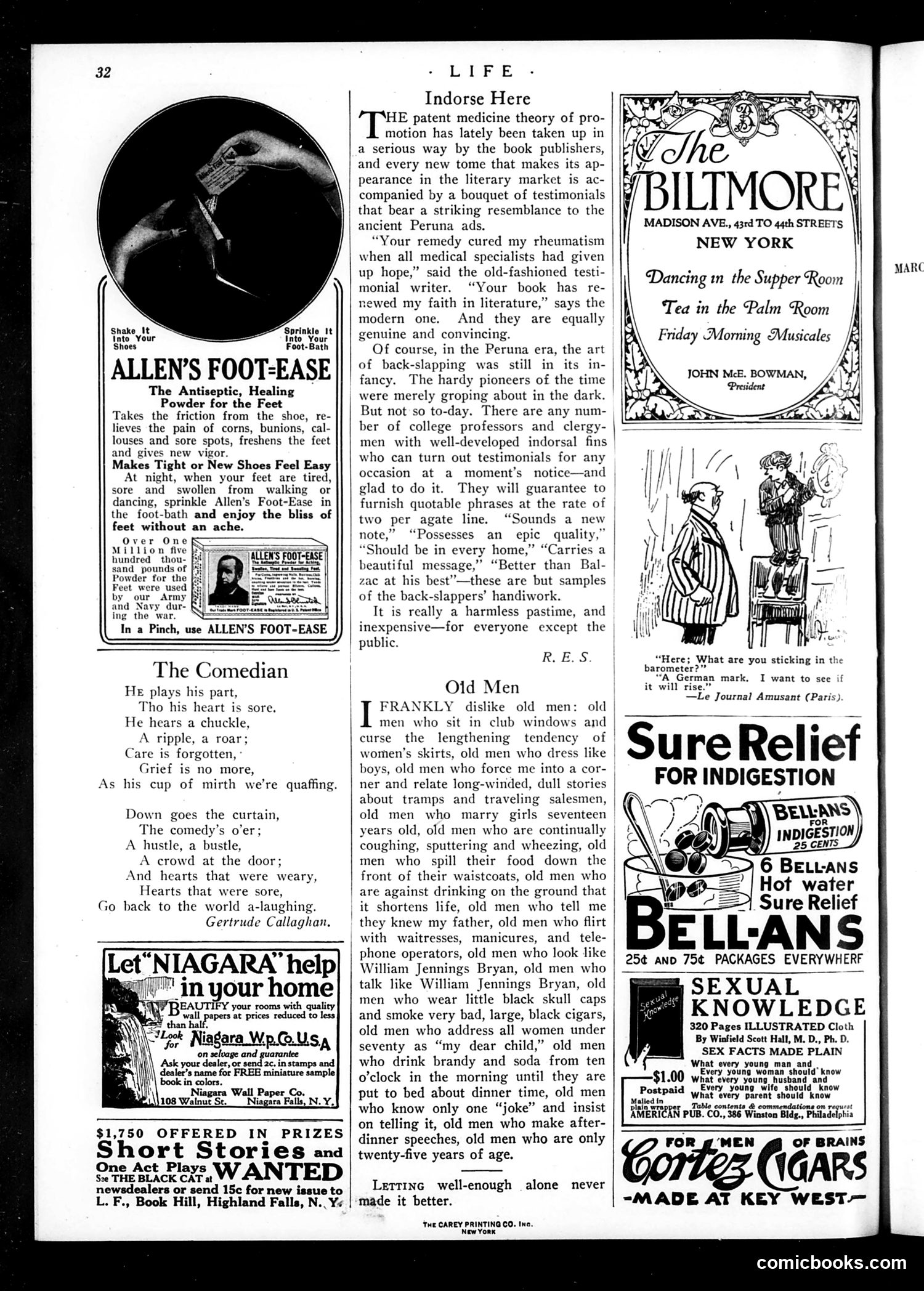
A complete issue · 34 pages · 1922
Life — March 9, 1922
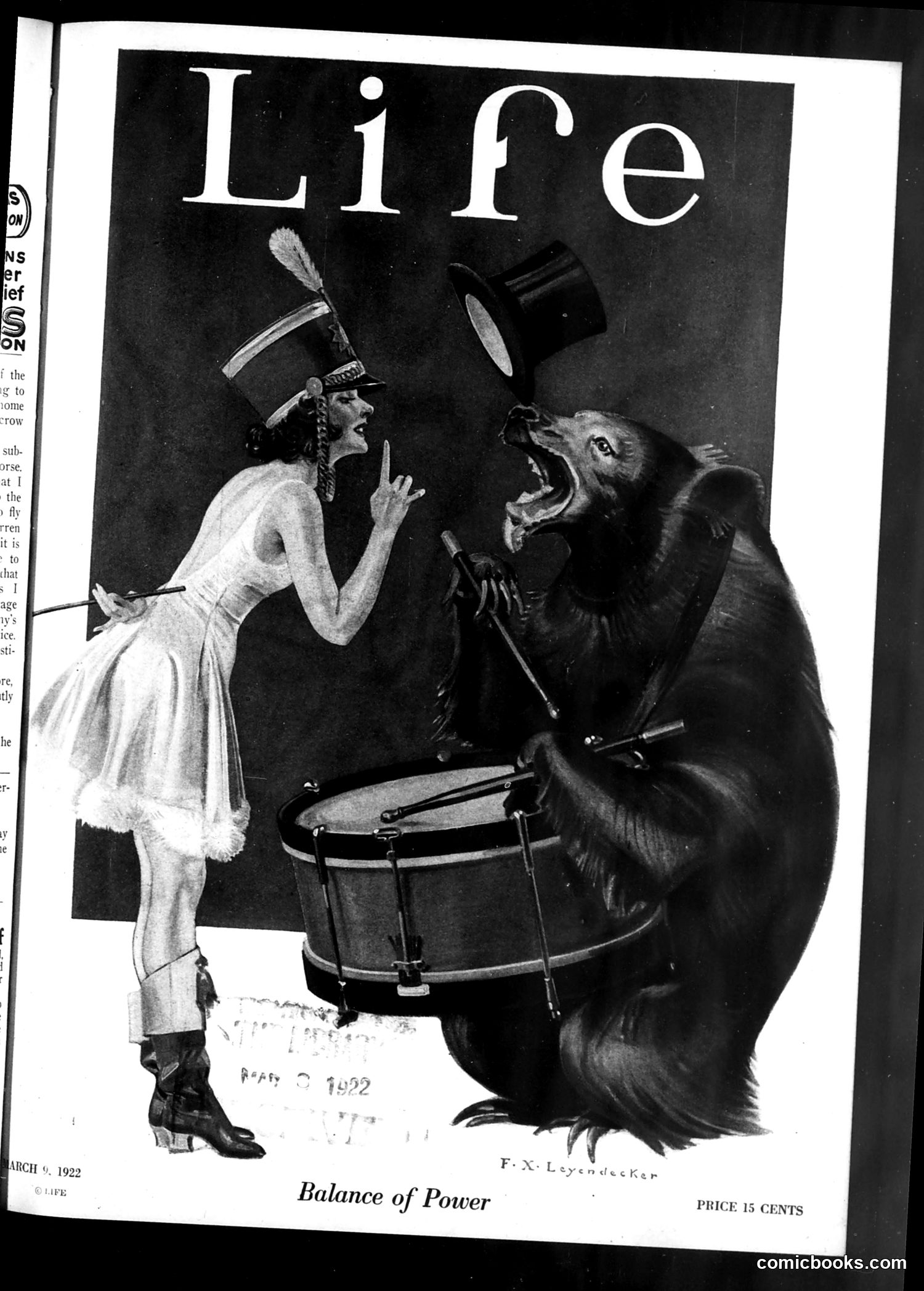
This political cartoon depicts a woman in an elaborate feathered headdress and fashionable dress facing off against a chimpanzee in formal attire (tuxedo and top hat) at a drum. The title "Balance of Power" suggests commentary on gender relations or social dynamics. The satire likely critiques either: - The emerging power of women in the 1920s (post-suffrage era) - Contemporary debates about "civilized" behavior and gender roles - The absurdity of treating women as equals to "primitive" forces The chimp's formal dress ironically suggests that giving women social standing is as ridiculous as dressing an animal as a gentleman. This reflects early 1920s anxieties about women's expanding rights and social roles following women's suffrage (1920).
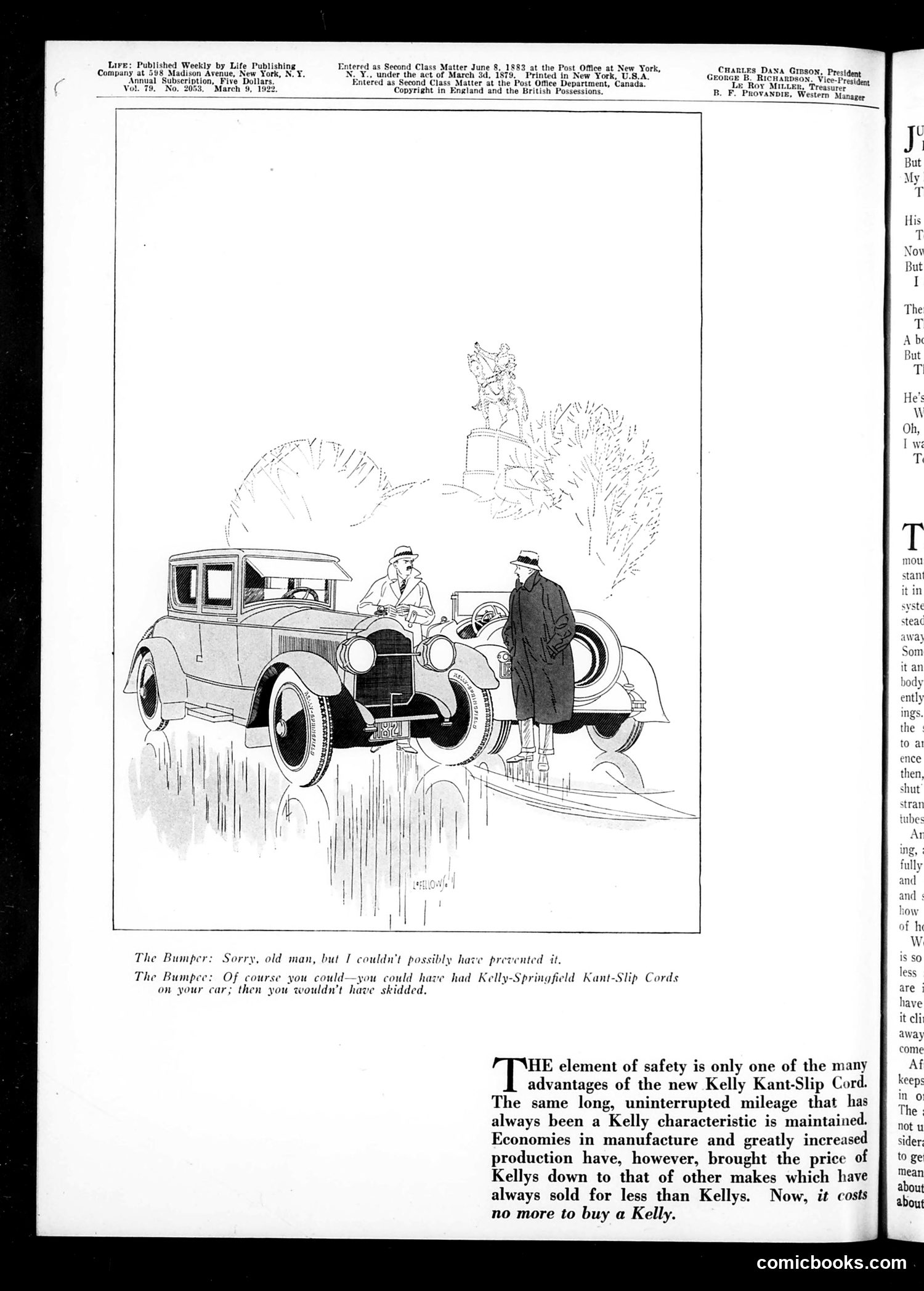
This page is primarily a **Kelly automobile advertisement** from 1922, not political satire. The cartoon depicts two men beside damaged cars after an accident. The "bumper" (the man who caused the collision) apologizes, and the other driver responds that Kelly-Springfield Kant-Slip Cords on his vehicle would have prevented the skid. The joke is straightforward product marketing: the ad demonstrates how Kelly tire cords provide safety advantages. The text below emphasizes that while Kellys maintain their traditional quality and long mileage, improved manufacturing has reduced prices to match competitors—making them cost-effective. This represents typical early-20th-century magazine advertising that used humor and relatable scenarios to promote automotive safety features to middle-class consumers.
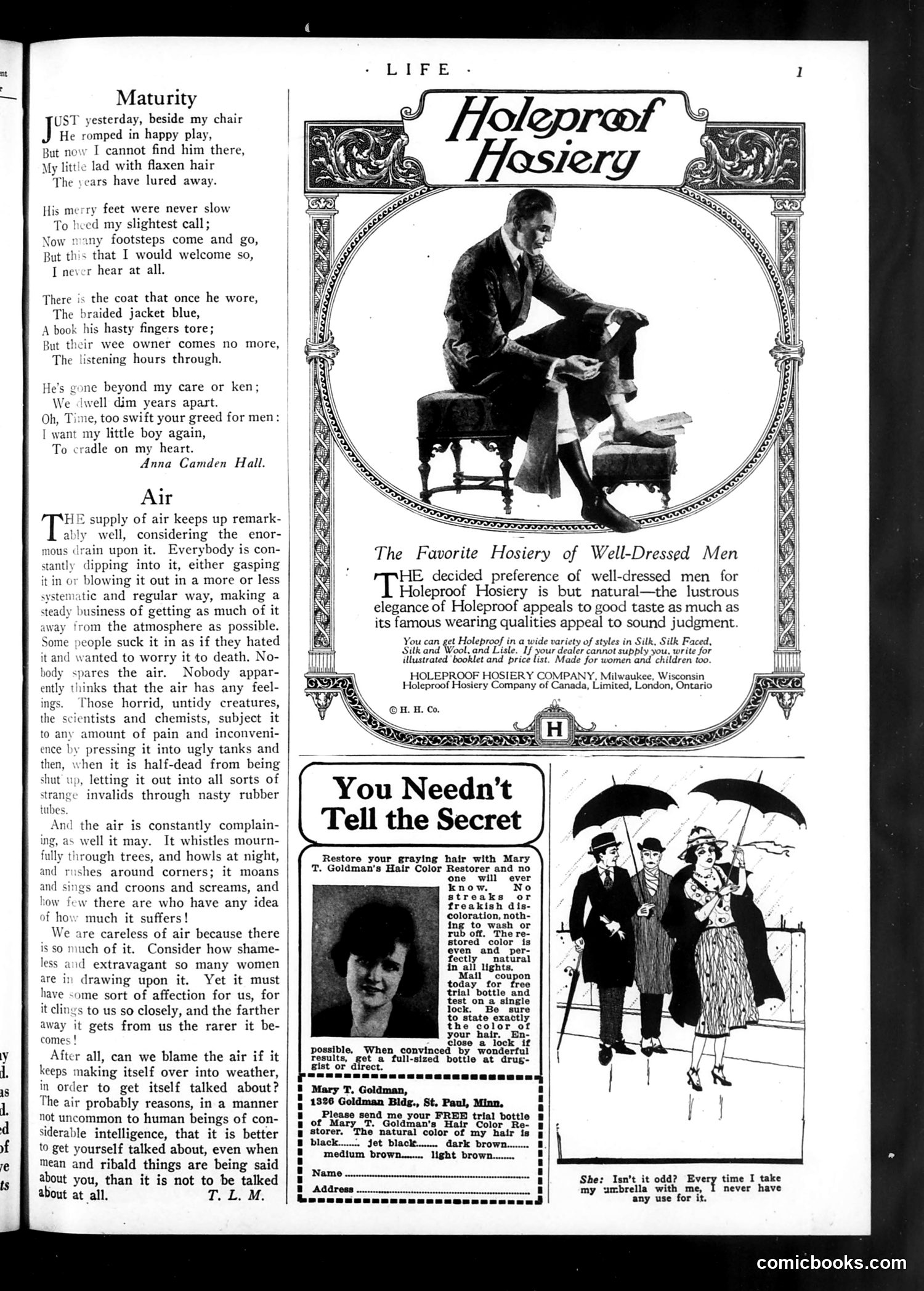
This page contains three distinct elements: **"Maturity" (poem, left):** A sentimental verse by Anna Gamden Hall about a mother observing her grown son's absence—his childhood belongings (coat, flaxen hair) remain, but he has moved beyond her care. **Holeproof Hosiery Advertisement (center):** A product advertisement featuring a man examining hosiery, positioning the brand as "The Favorite Hosiery of Well-Dressed Men." This is straightforward commercial copy with no satirical intent. **"You Needn't Tell the Secret" (bottom right):** An advertisement for Mary T. Goldman's Hair Color Restorer. The cartoon shows people under umbrellas in rain, with the caption suggesting one needn't reveal using hair dye—it appears natural. The satire gently mocks social pretense about hiding aging through cosmetics. The page mixes sincere sentiment, commercial advertising, and mild social commentary typical of *Life*'s format during this era.
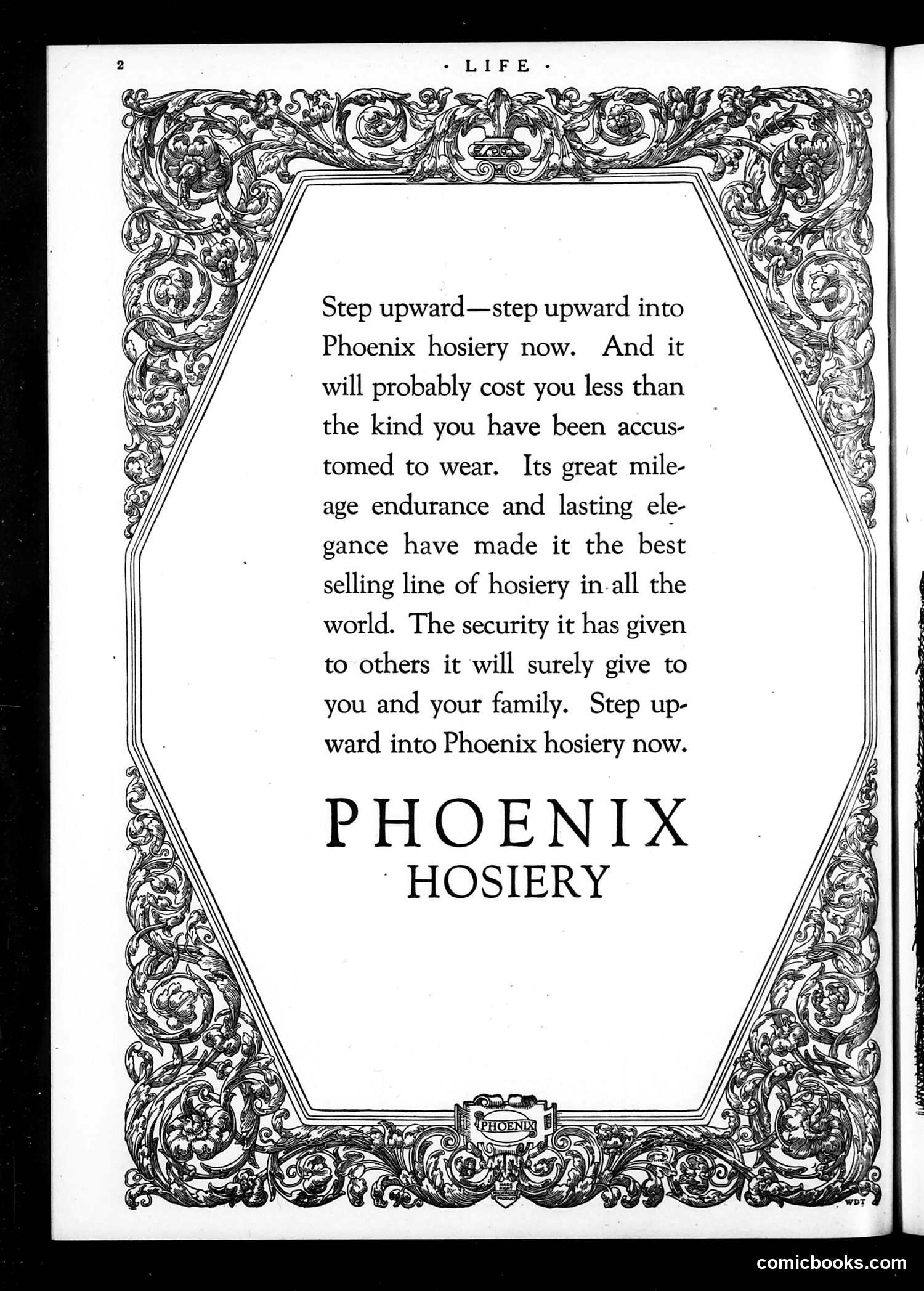
This page is **not a political cartoon or satire**—it's a straightforward advertisement for Phoenix Hosiery, a real brand that was apparently a bestseller. The ad uses the rhetorical device "step upward" to encourage consumers to upgrade to Phoenix brand, promising superior durability and affordability compared to competitors. It appeals to middle-class values: the product provides "security" for "you and your family," a common advertising strategy of the era. The ornate decorative border is typical of early 20th-century magazine design. No caricatures, political figures, or satirical content appear here. This represents *Life* magazine's advertising revenue model rather than its editorial content.
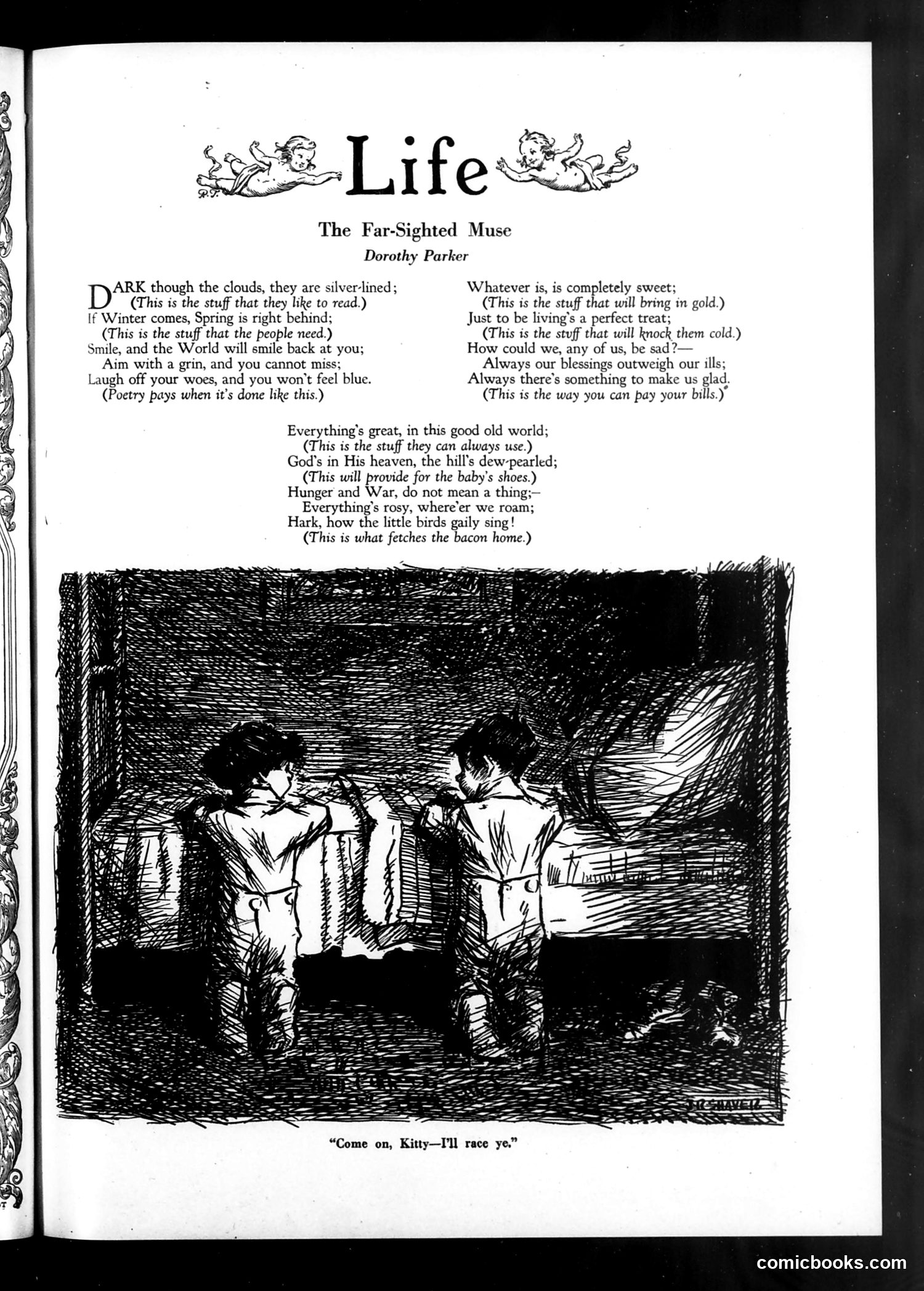
This page presents Parker's satirical poem mocking optimistic platitudes about life. The poem ironically celebrates clichéd wisdom ("Everything's great, in this good old world") while parenthetical asides reveal harsh realities: poverty ("provide for the baby's shoes"), hunger and war, and financial struggle ("pay your bills"). The accompanying illustration shows two children gazing out a window at what appears to be a bleak landscape, with one saying "Come on, Kitty—I'll race ye." The image's starkness contrasts with the poem's surface cheerfulness, reinforcing Parker's biting critique of false optimism used to pacify the struggling poor during difficult economic times—likely the Great Depression era.
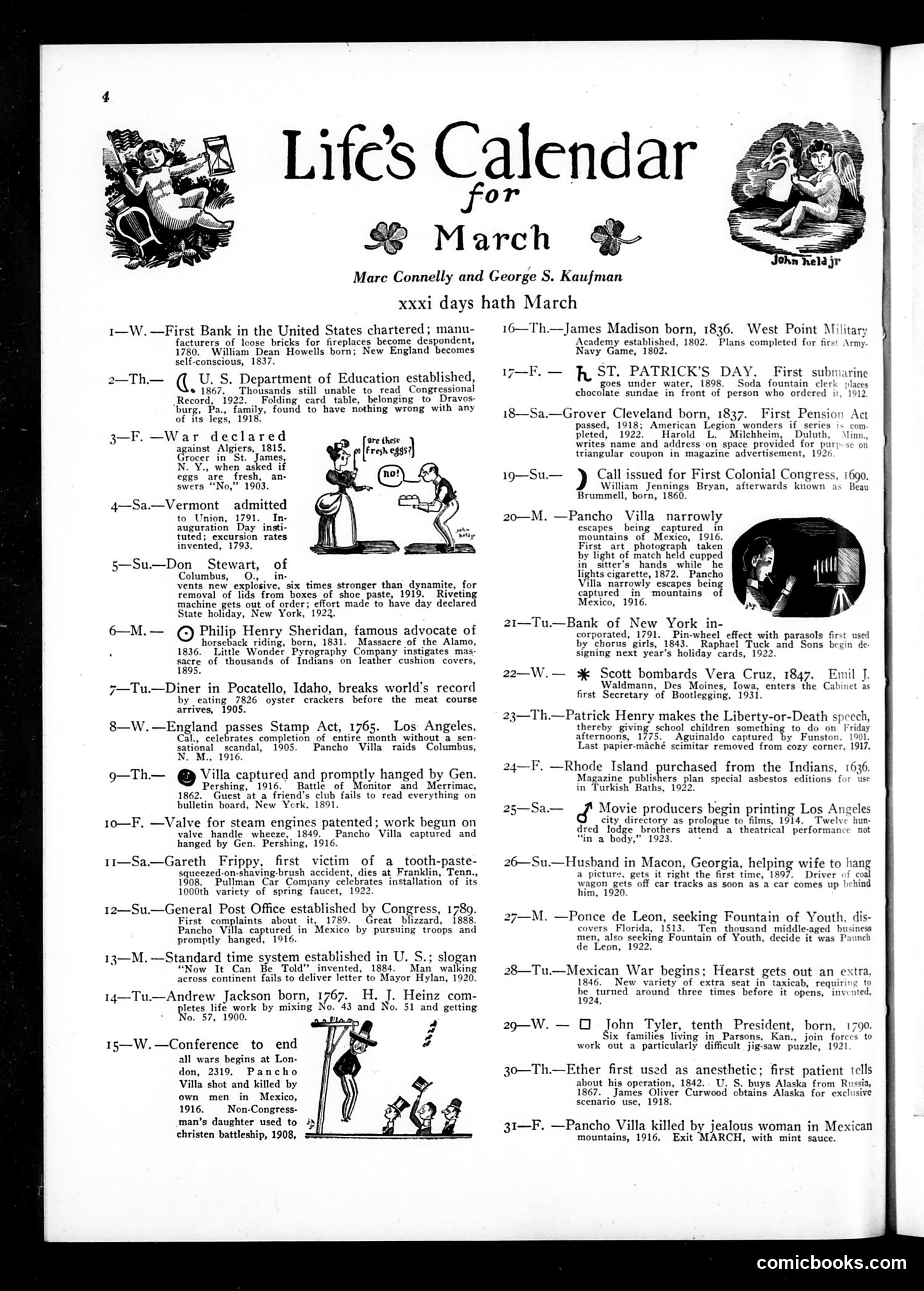
This is a historical calendar page mixing notable events with satirical illustrations. The small cartoons appear to be generic visual gags rather than specific political commentary. The calendar entries reference significant historical events: James Madison's birth (1836), the Department of Education's establishment, St. Patrick's Day traditions, Grover Cleveland's birth, and Pancho Villa's 1916 Mexican activities. Notable entries include Patrick Henry's Liberty-or-Death speech (1775), the Bank of New York's incorporation (1791), and the Mexican-American War (1846). The small illustrations show everyday domestic scenes—a woman with a baby, a child being disciplined—appearing to be generic humor rather than political satire. They complement the calendar's miscellaneous historical information without advocating particular positions.
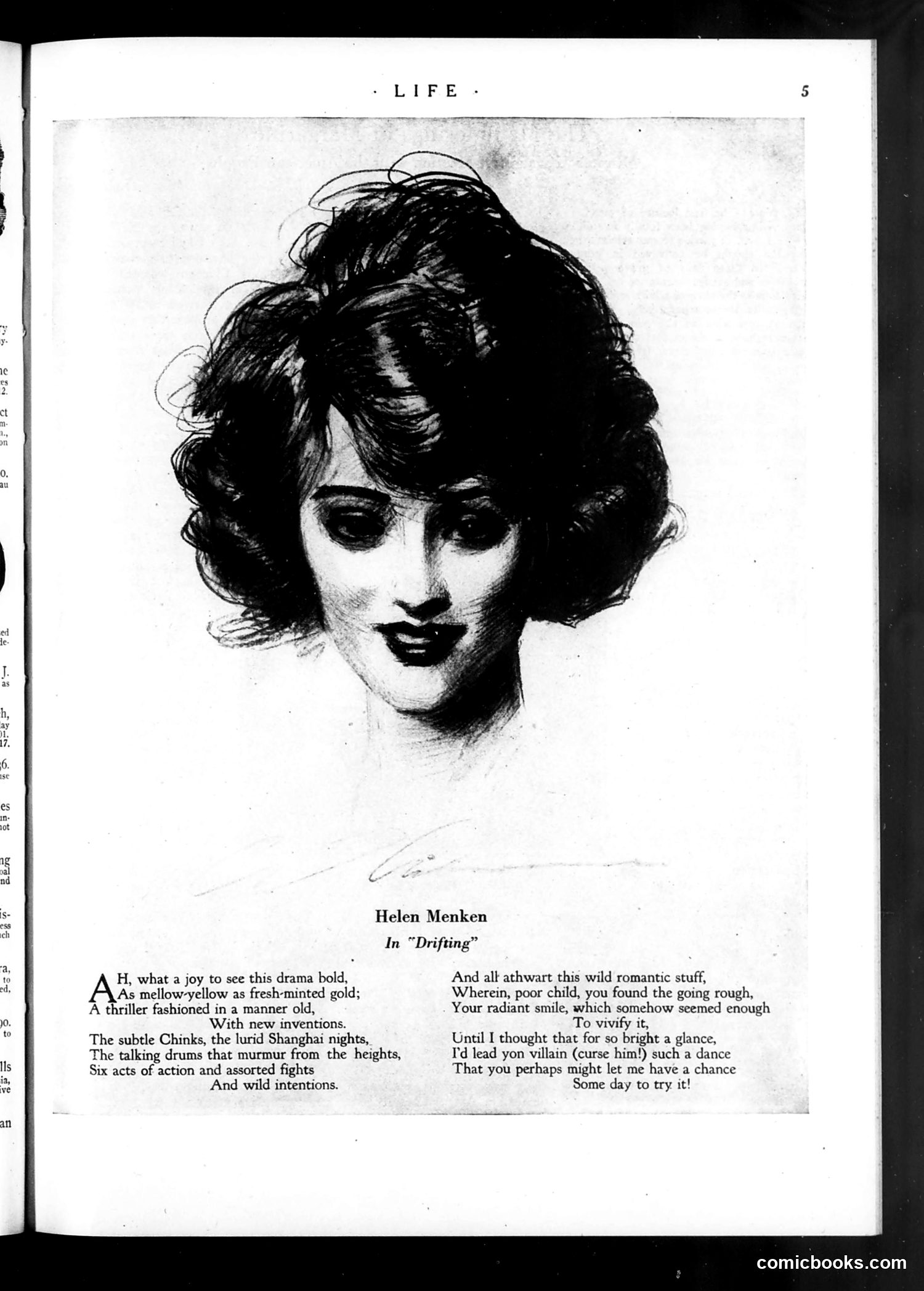
This page features a portrait and poem reviewing actress Helen Menken's performance in a drama called "Drifting." The poem praises the production as an exciting thriller with "wild romantic stuff," featuring Shanghai settings, action sequences, and dramatic intrigue. The reviewer particularly commends Menken's "radiant smile" and stage presence, suggesting her performance and charm could captivate audiences. The tone is enthusiastically positive—the poem uses vivid language ("joy," "bold," "wild") to convey the drama's entertainment value and Menken's appeal as a leading actress in this theatrical production. This appears to be standard theatrical criticism/promotion from Life magazine's entertainment coverage.
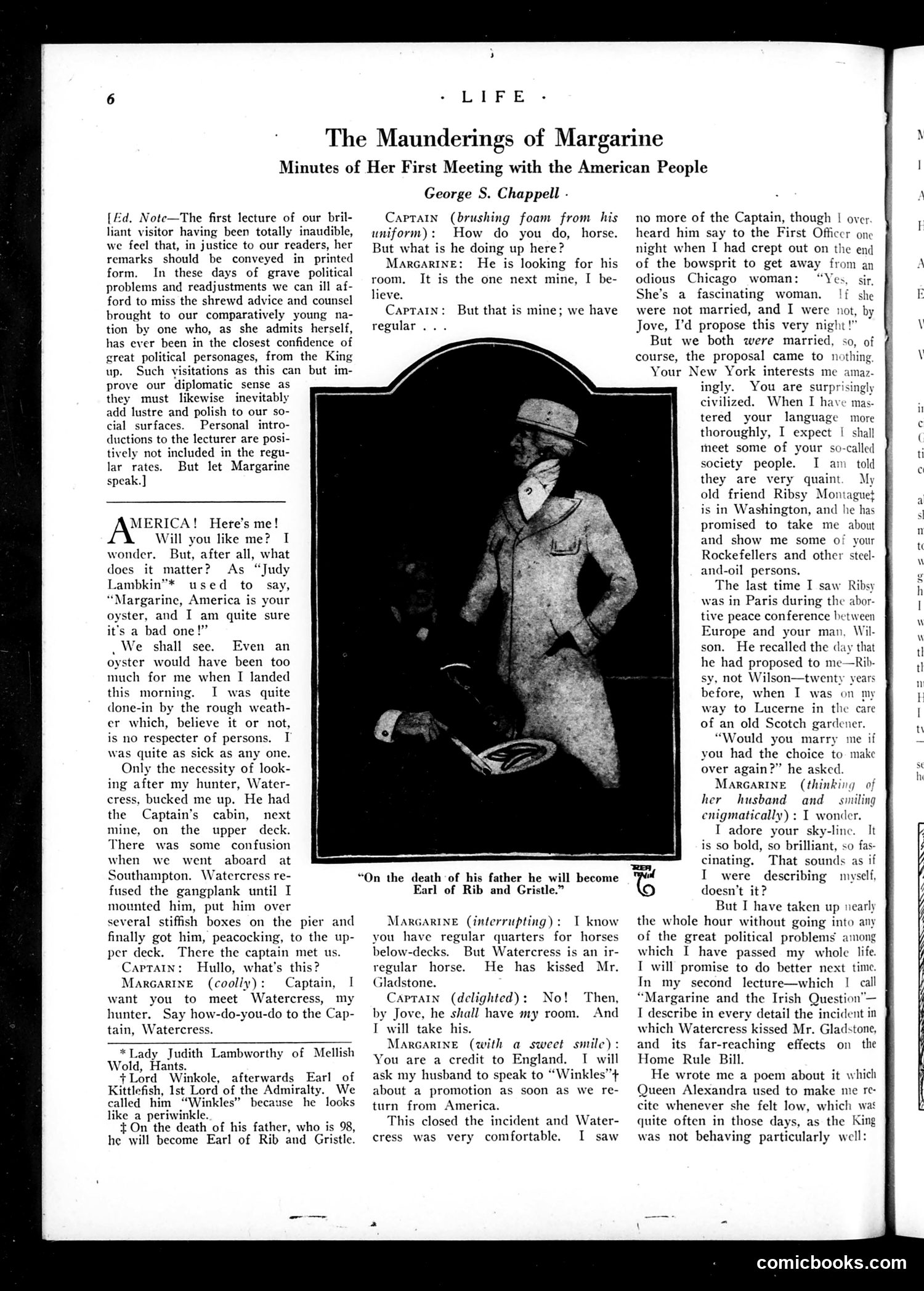
This is a satirical piece featuring "Margarine," a character representing a somewhat naïve British woman visiting America. The illustration shows her in period dress (early 1900s). The satire mocks her affected, gossipy observations about American society and her name-dropping of British aristocratic connections—she references knowing "Kibsy Montague" in Washington and encounters with Queen Alexandra. The humor targets both Margarine's pretentiousness and contemporary Anglo-American social dynamics. She speaks condescendingly about American "society people" while boasting of her British connections, embodying the snobbish British visitor stereotype that American audiences would find laughable. The piece appears designed to satirize British attitudes toward America and transatlantic social pretension generally.
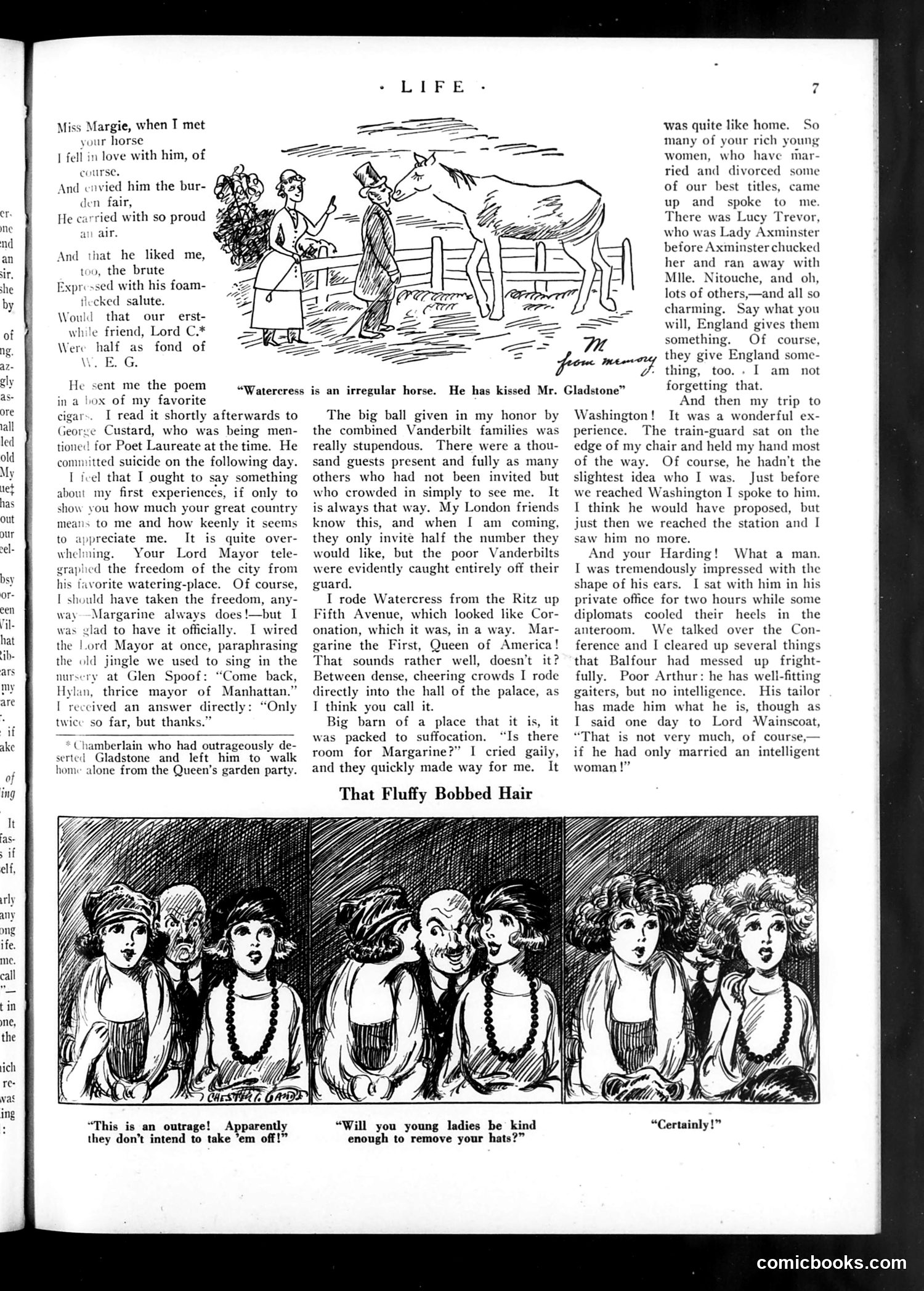
This page contains two distinct pieces from *Life* magazine: **Top section**: A memoir excerpt about meeting a horse named Watercress at a social event. The accompanying sketch shows the author with fashionable women and the horse. The humor derives from treating the horse as a social equal at what appears to be an upper-class gathering—a satirical jab at pretentious society where even animals receive invitations. **Bottom section ("That Fluffy Bobbed Hair")**: A three-panel comic strip mocking the "bobbed hair" trend of the 1920s. Women with the newly fashionable short hairstyles attend what appears to be a formal event. The joke plays on the shock value of this radical hairstyle change—conservative attendees are scandalized, treating the bobbed hair as an outrageous breach of propriety worthy of removing one's hat in protest.
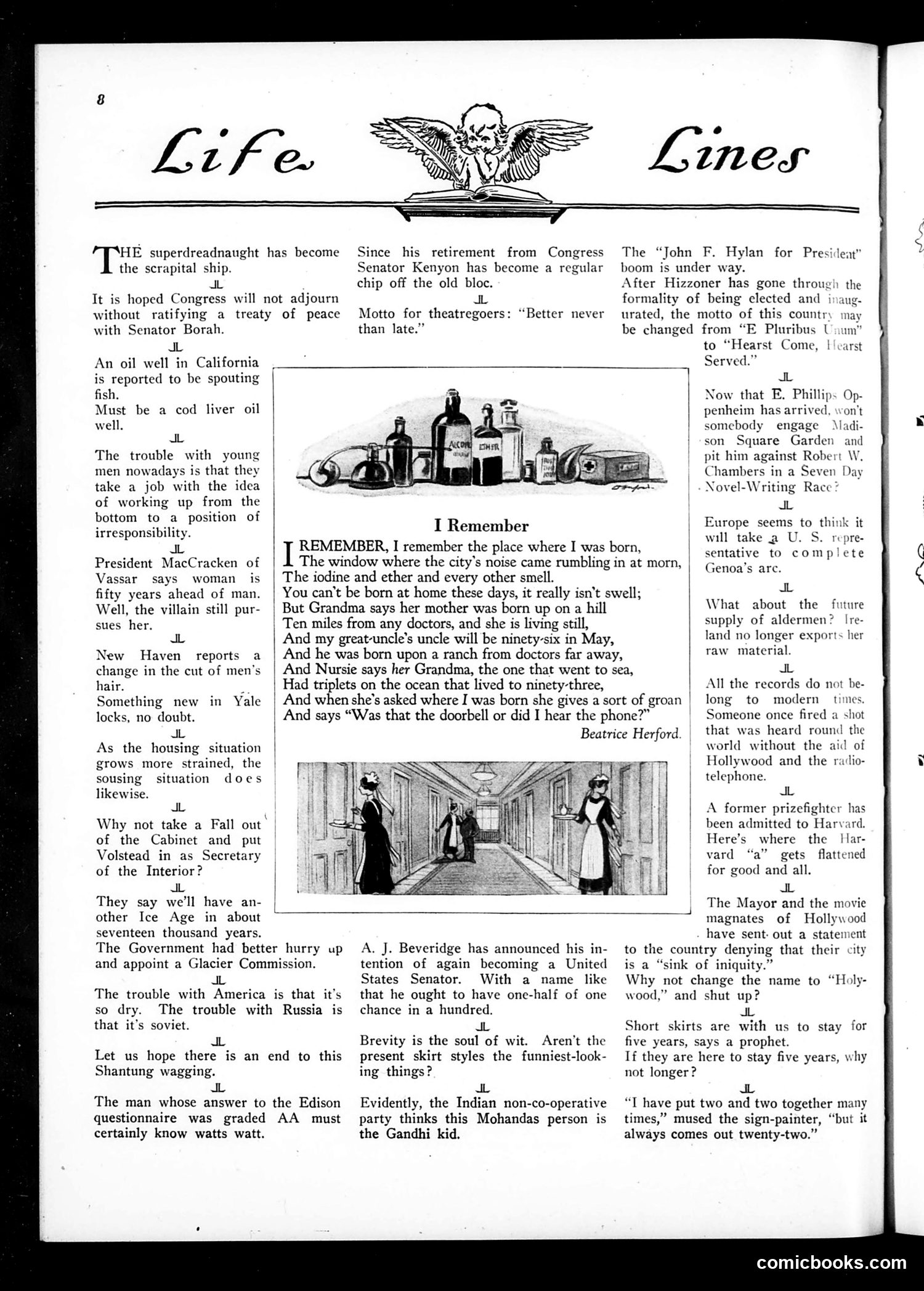
This page contains satirical "Life Lines" commentary and two illustrations rather than political cartoons. The text includes brief jokes about contemporary issues: oil wells in California, the dwindain of young men toward work, and diplomatic tensions (references to "Senator Borah" and negotiations). The poem "I Remember" by Beatrice Herford nostalgically describes birthplaces and family origins—a common sentimental theme. The two illustrations show period-appropriate interior scenes with figures in formal dress, appearing to depict social situations rather than political satire. The page's humor relies on observations about modern life and social foibles typical of 1920s Life magazine—lighthearted commentary on contemporary manners and news rather than pointed political critique. Without visible dates or clearer context, specific references remain difficult to identify precisely.
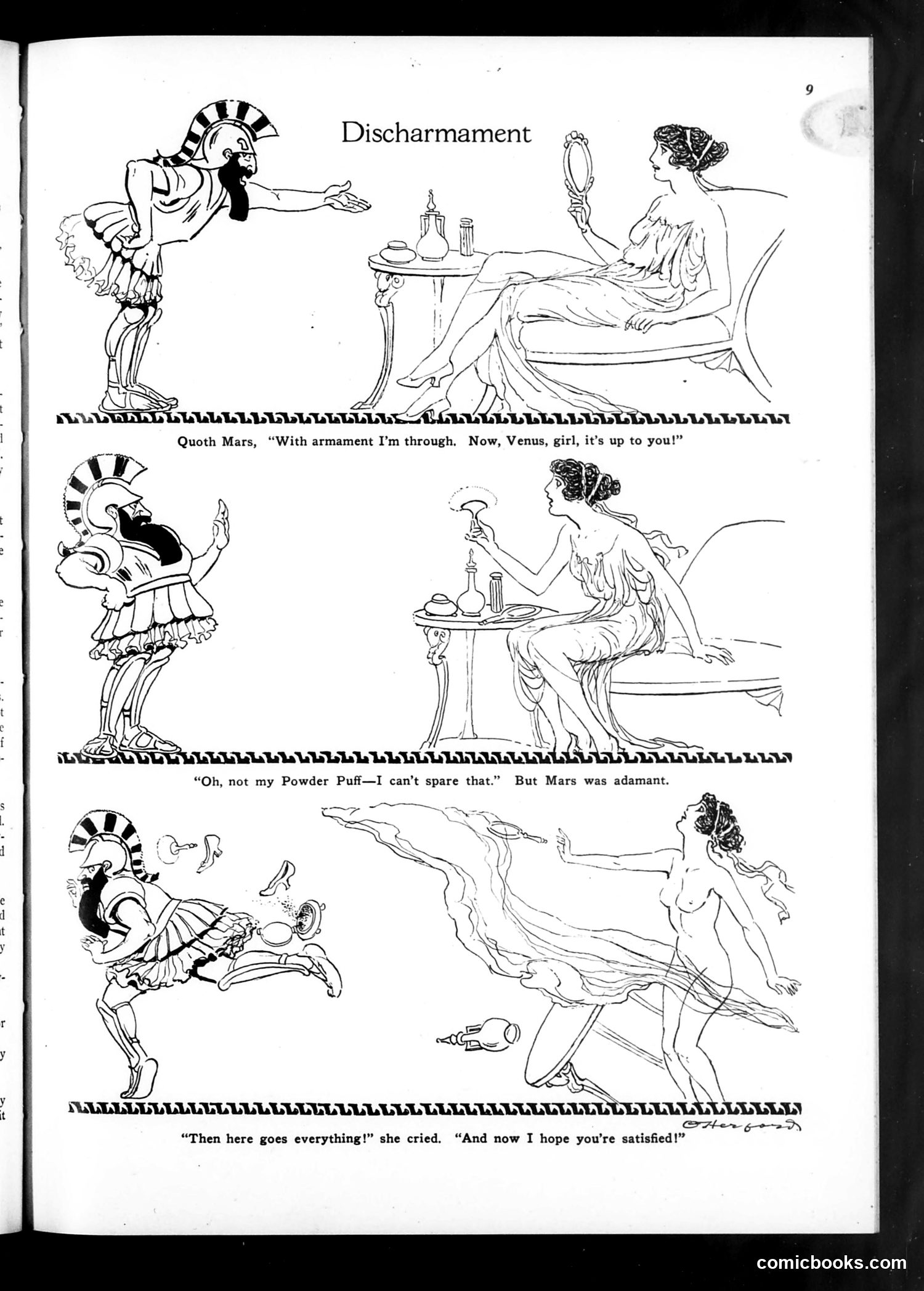
This satirical comic depicts the Roman god Mars (god of war) attempting to seduce Venus (goddess of love) into disarmament. The title plays on "disarmament" and "charm." The narrative shows Mars progressively undressing or disarming himself to win Venus's affection. In the first panel, he claims to be "through" with armor. Venus remains unmoved, focused on her mirror and cosmetics. Mars becomes increasingly desperate, eventually throwing away all his weapons and military equipment in the final panel, crying "Then here goes everything!" The satire mocks post-WWI disarmament efforts and peace movements by suggesting that achieving peace requires nations to completely abandon military power—presenting this as both absurd and ultimately futile, since Venus remains indifferent to Mars's sacrifice.
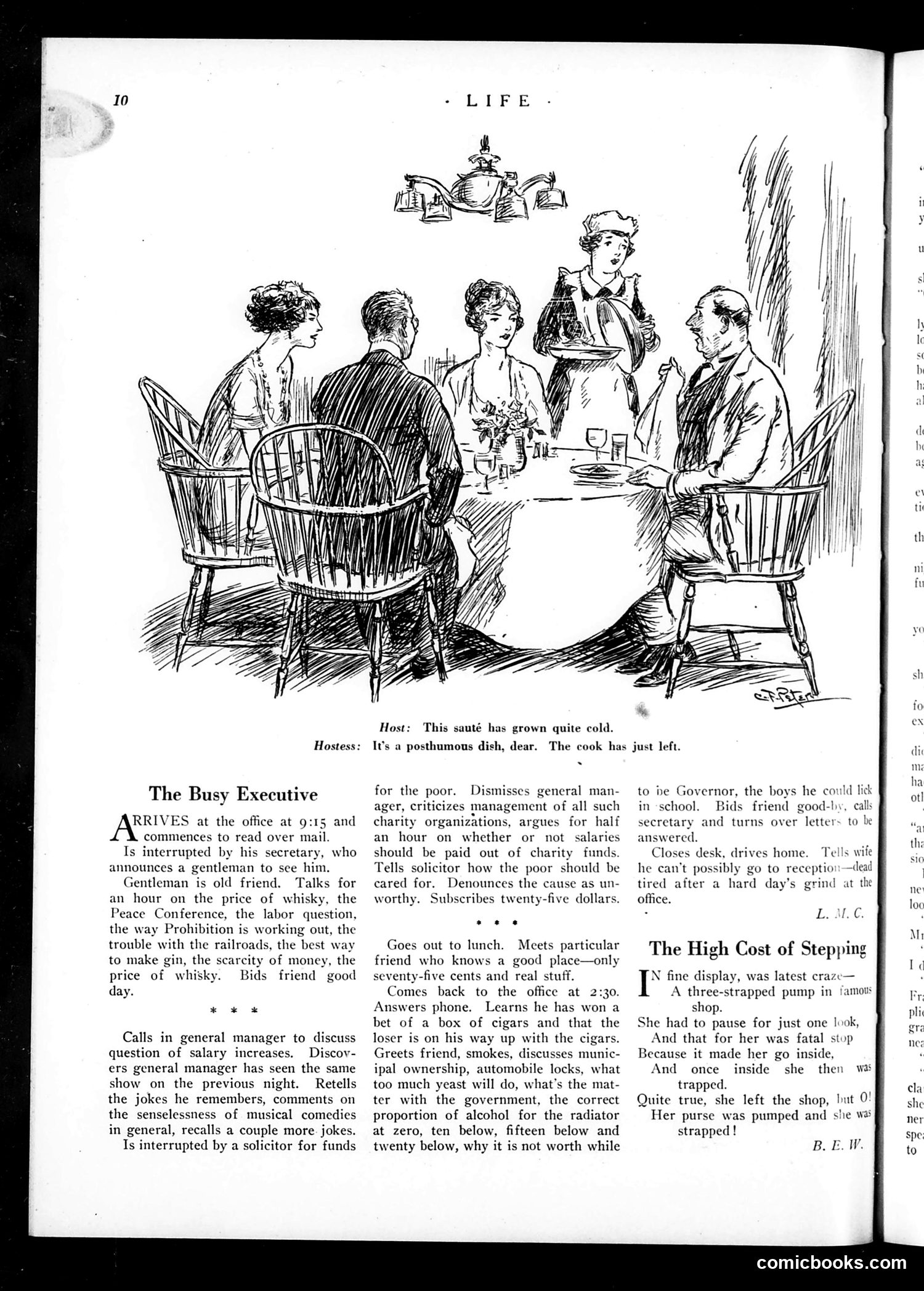
The main illustration depicts a dinner party where a hostess apologizes for serving cold food, explaining "the cook has just left." This satirizes the era's domestic servant crisis—a common early-20th-century complaint about cook and household staff turnover and unreliability. "The Busy Executive" column humorously chronicles a businessman's workday obsessing over trivial matters (whiskey prices, charity donations, employee salaries) while conducting pointless office meetings. The satire mocks corporate inefficiency and executives preoccupied with minutiae. "The High Cost of Stepping Out" briefly jokes about a woman trapped in a shop after her purse was stolen—wordplay on being literally "strapped" (penniless). The overall theme lampoons upper-class domestic and professional frustrations of the period.
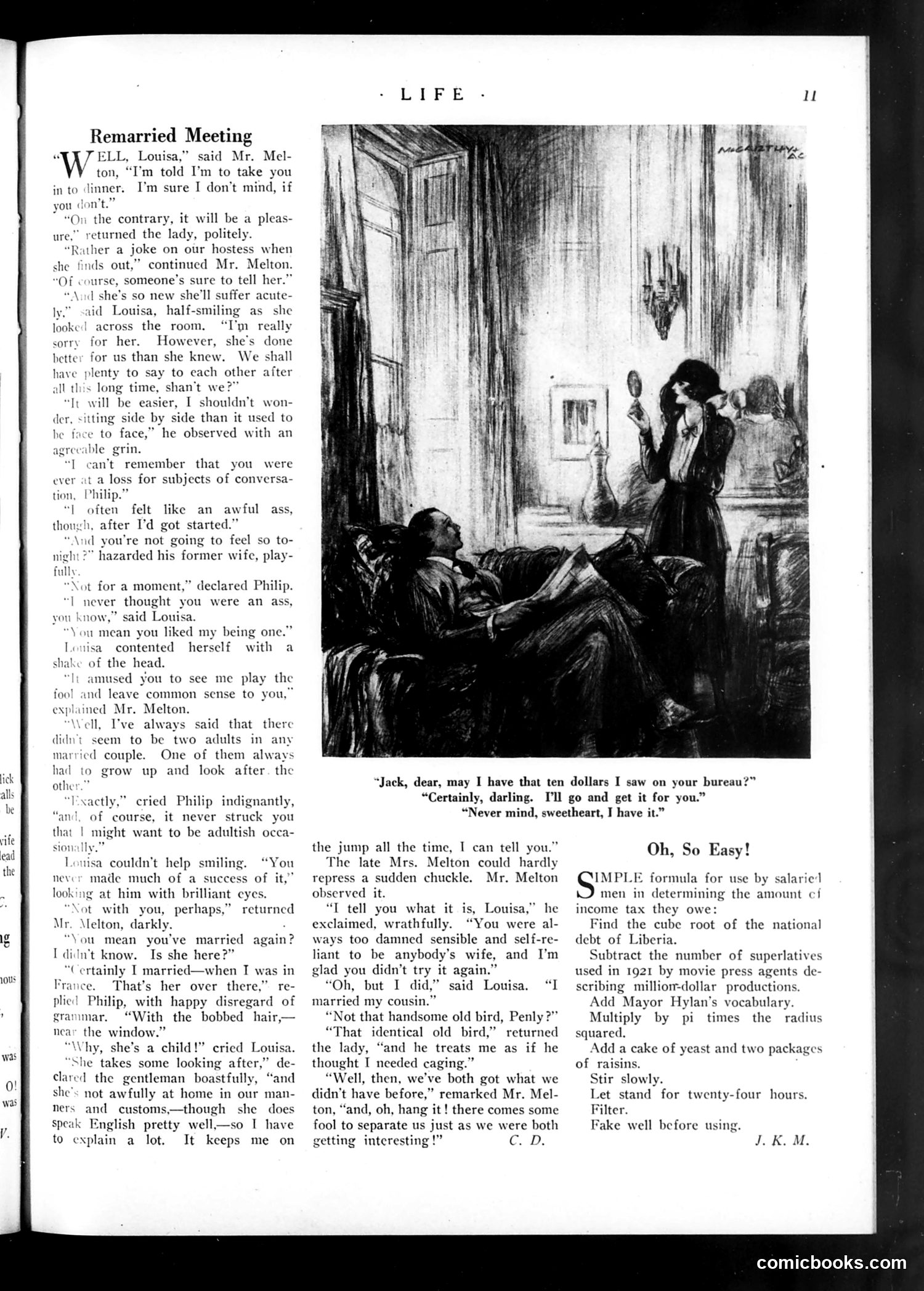
This page contains a short story titled "Remarried Meeting" depicting an encounter between Mr. Melton and his ex-wife Louisa. The narrative centers on their awkward social interaction and the tension between them regarding their past marriage and current remarriage to others. The accompanying illustration shows the two figures in what appears to be a parlor setting, with other guests present, capturing the moment of their reunion. The page also includes a separate humor piece titled "Oh, So Easy!" offering a satirical "simple formula" for calculating income tax—poking fun at the complexity of tax calculations through absurdist instructions involving cube roots and mathematical operations on national debt figures. Both pieces are light social satire typical of Life magazine's humor content.
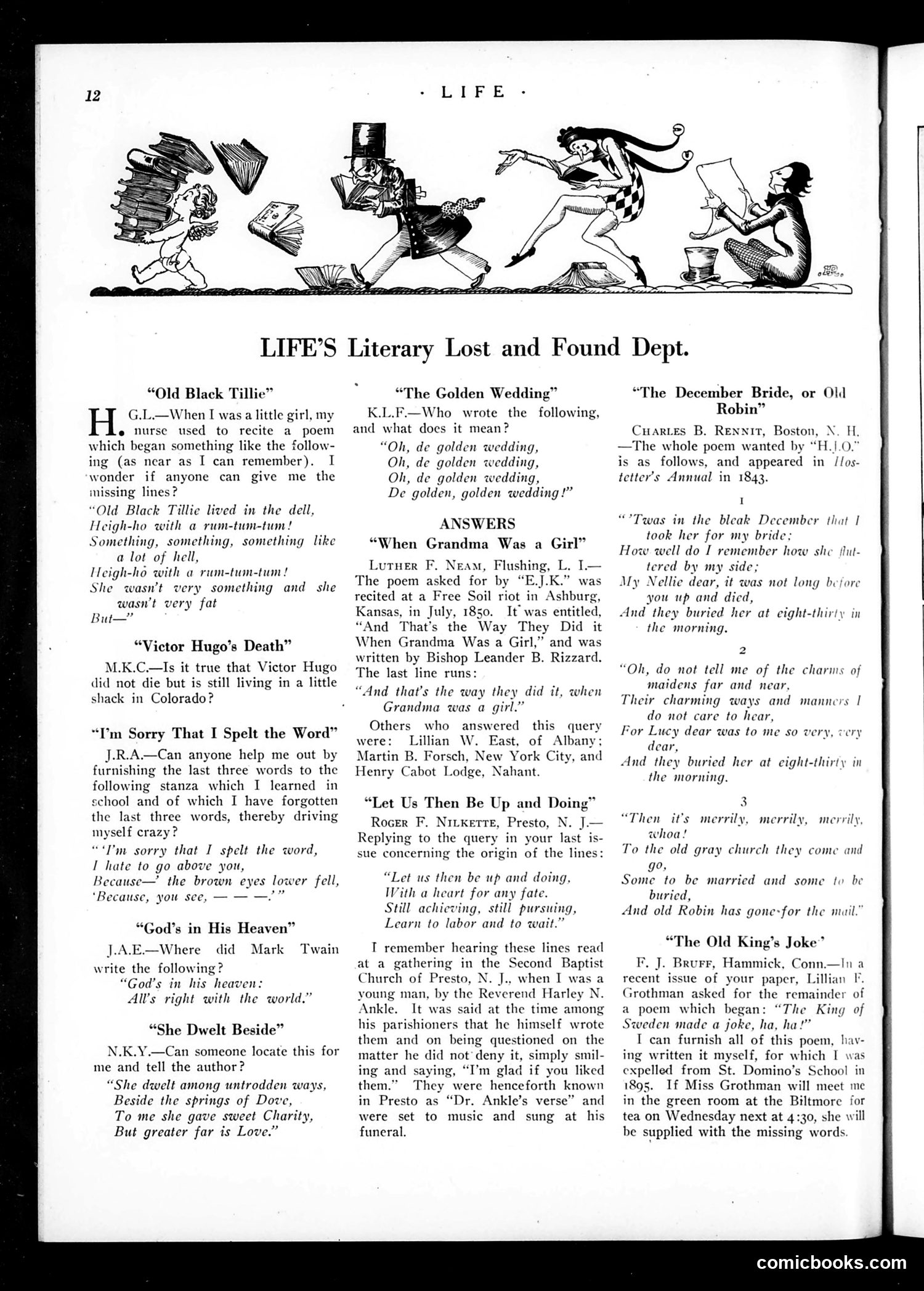
This is a humor column featuring reader queries about literary mysteries. The cartoon at the top uses whimsical illustration to depict the "lost and found" concept—showing figures in chaotic motion, with one character in formal dress (top hat) surrounded by flying papers and objects, while others scramble or fish in a bucket. The column answers reader questions about poem origins and authorship. Queries include identifying "Old Black Tillie," verifying whether Victor Hugo actually died in Colorado, and locating sources for various verses. Readers provide answers citing specific publications and people. This reflects how pre-internet audiences sought help identifying literary fragments through magazine correspondence—a common feature of early 20th-century periodicals.
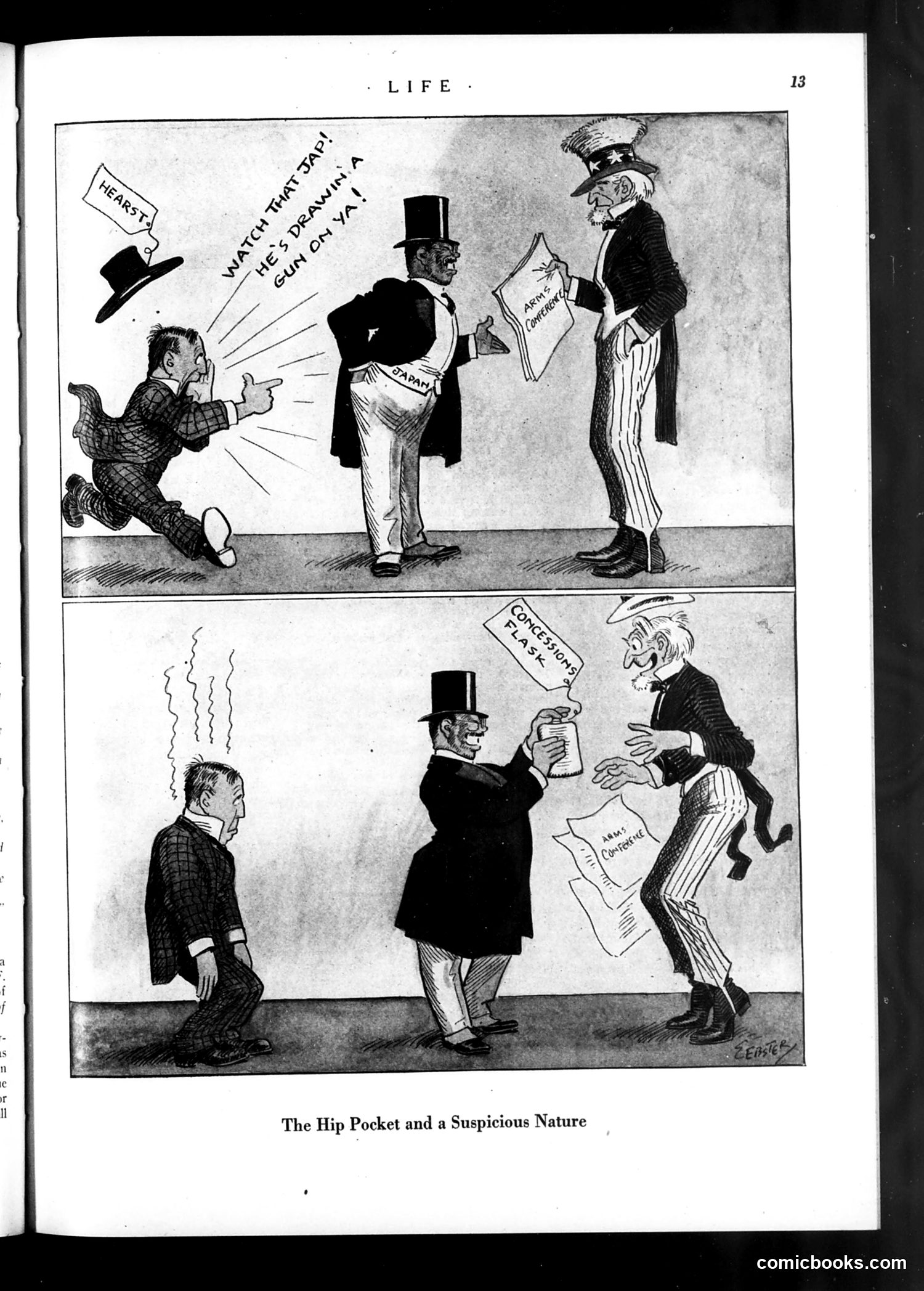
This two-panel cartoon satirizes suspicion about pickpockets or theft. In the top panel, a man in a checkered suit frantically gestures at a well-dressed figure in a top hat labeled "CANADA," warning "WATCH THAT CHAP! HE'S DRAWN ON YA!" while Uncle Sam (the tall American figure on the right) holds what appears to be a contract or agreement. In the bottom panel, the Canadian figure produces a "CONFISCATION LEASE" document while the American looks dismayed, having apparently fallen victim to the very behavior warned about moments before. The joke appears to be about Canadian trade practices or economic dealings being deceptive or taking advantage of American interests—depicting Canada as a "pickpocket" stealing from America through suspicious contracts or policies. The "suspicious nature" of the title references both the initial warning and Uncle Sam's gullibility despite it.
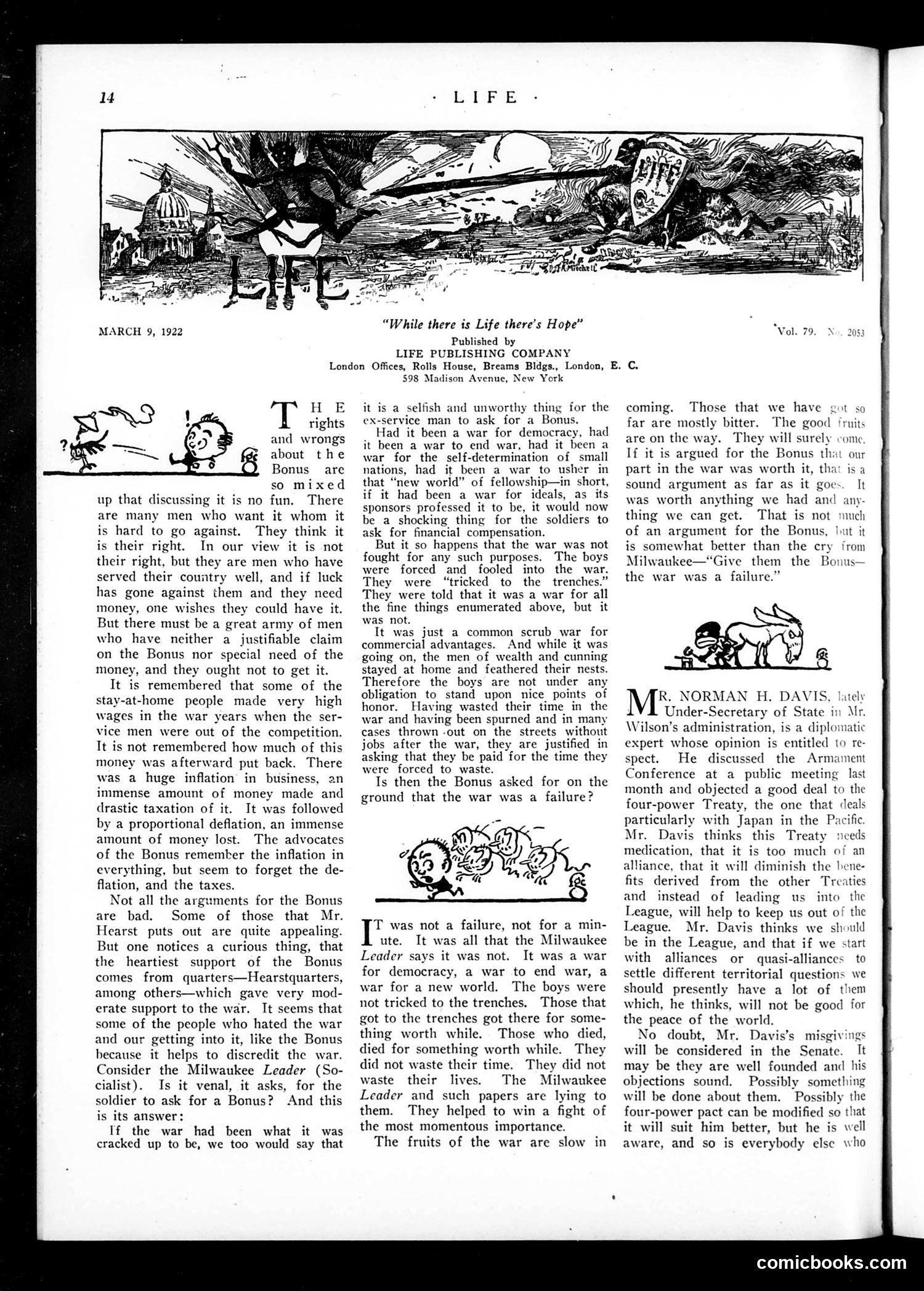
This March 9, 1922 *Life* editorial page addresses the post-WWI "Bonus" debate—whether soldiers deserved financial compensation beyond their wages for military service. The article argues **against** the bonus, claiming it's "selfish" for ex-servicemen to demand extra pay. The author contends the war itself was fought for ideals, not profit, and soldiers shouldn't expect additional reward. The small cartoon illustrations (children fighting) satirize bonus advocates, suggesting their demands are childish squabbling. The page also discusses **Norman H. Davis**, Under-Secretary of State, who opposed the Four-Power Treaty with Japan as too restrictive. The satire targets those seeking financial bonuses while simultaneously criticizing diplomatic caution—reflecting post-war American isolationism and fiscal conservatism.
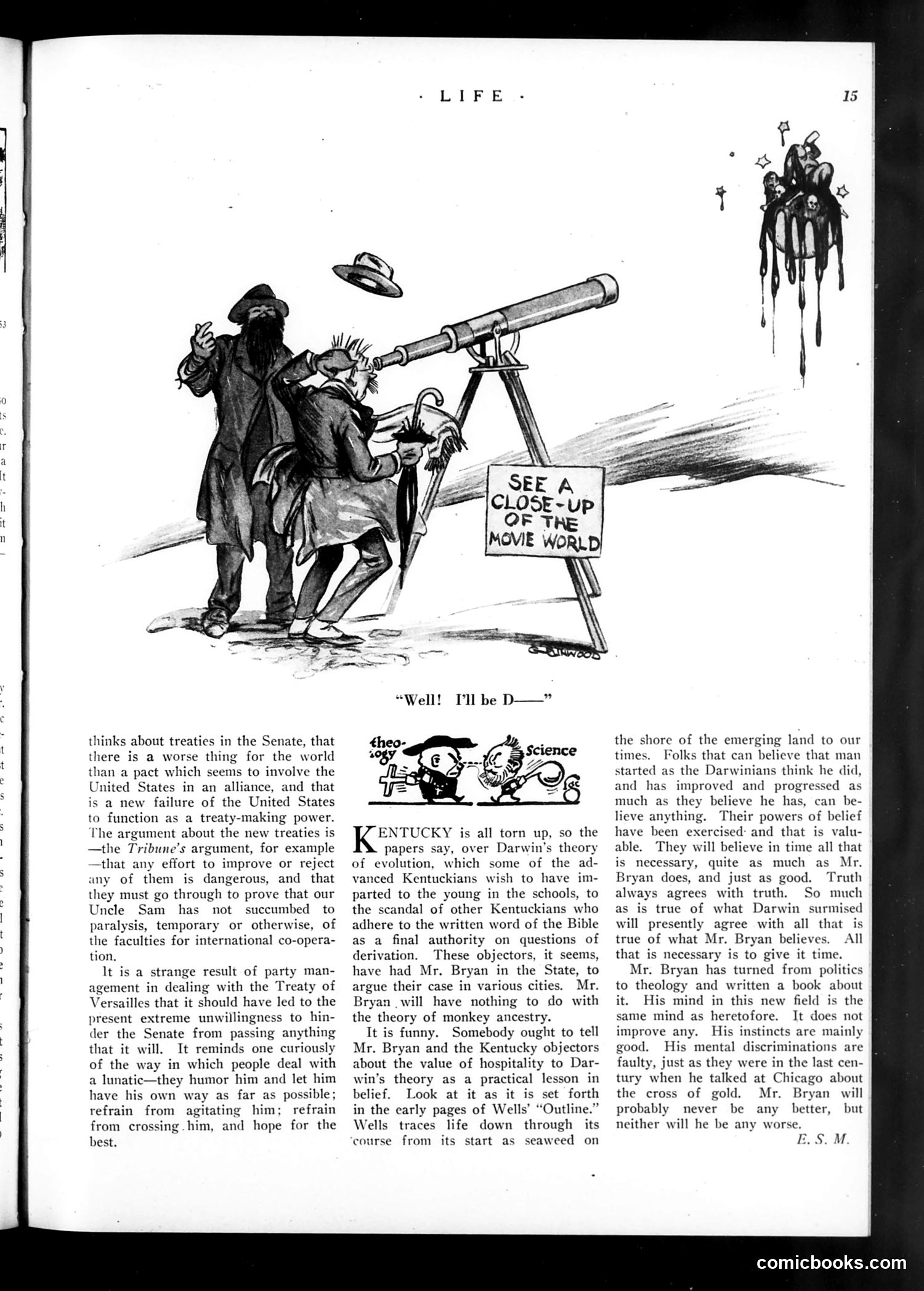
**The Main Cartoon ("Well! I'll be D——"):** This depicts a man with a telescope observing what appears to be religious or political figures on the right side. The sign reads "SEE A CLOSE-UP OF THE MOVIE WORLD," satirizing how cinema sensationalizes and magnifies events. The hat flying off suggests shock or surprise at what's being observed through magnification. **The Text Commentary:** The article discusses William Jennings Bryan's involvement in Kentucky's evolution controversy—the famous Scopes trial era debates over teaching Darwin's theory in schools. Bryan, a three-time presidential candidate turned religious activist, opposed evolution. Life magazine mocks both Bryan and evolution's opponents, arguing that belief in evolutionary progress demonstrates sufficient faith that accepting Darwin's theory shouldn't be difficult. The satire suggests Bryan's mental faculties haven't improved since his famous "Cross of Gold" speech, implying his religious arguments lack intellectual rigor. The overall tone is one of bemused contempt for the anti-evolution position.
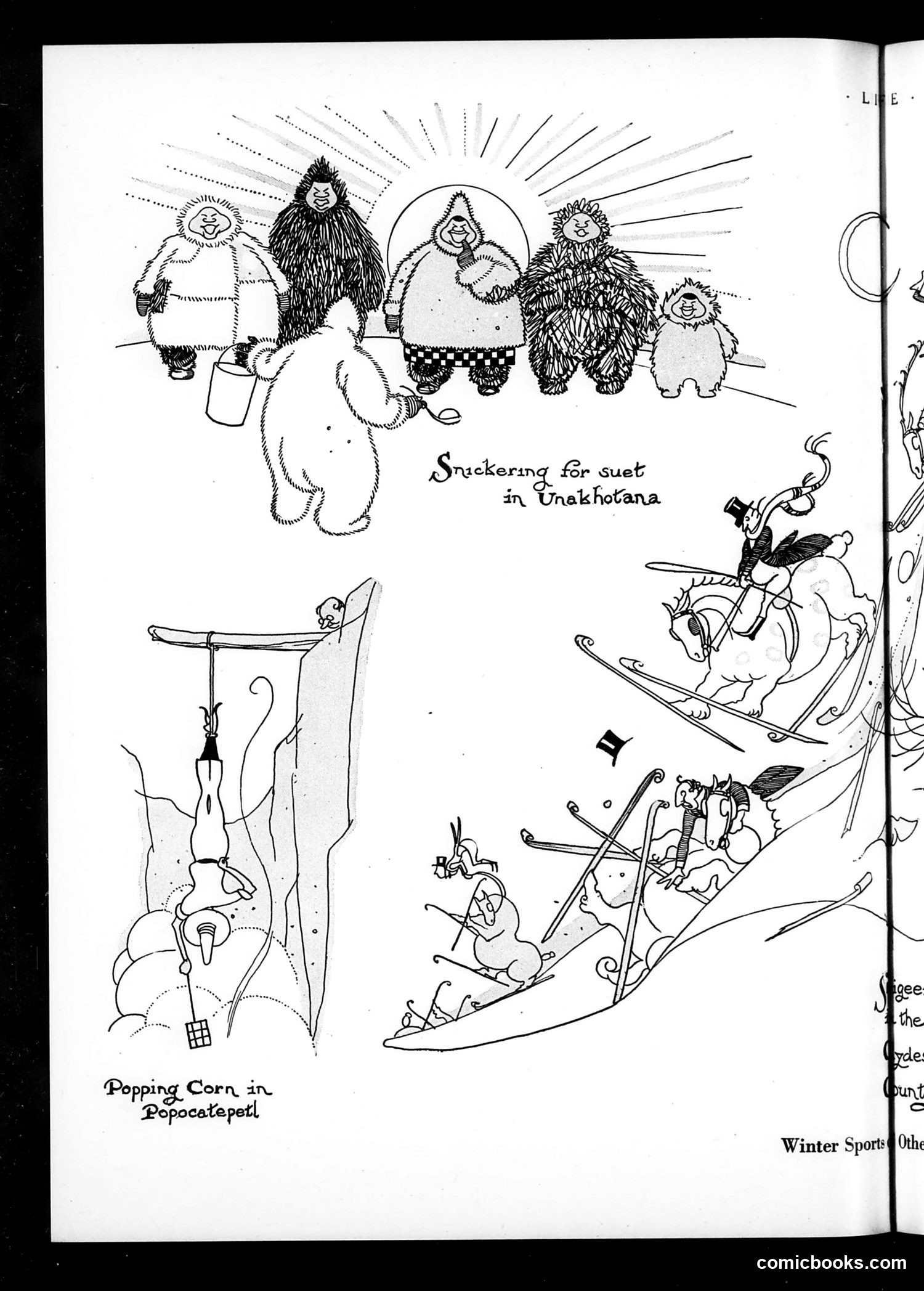
This page contains two whimsical illustrated vignettes rather than political satire: **"Snackering for suet in Unakhotana"** (top): Depicts cheerful, rotund creatures gathering around a glowing figure, suggesting a fantastical or imaginary location where these beings seek food. **"Popping Corn in Popocatepetl"** (bottom left): Shows figures near a volcano, playing on the name similarity between "popping" corn and Popocatépetl (the Mexican volcano). The visual pun uses the volcano's heat as a cooking mechanism. **"Winter Sport"** (bottom right): Illustrates small creatures skiing down a snowy slope in comedic fashion. These appear to be humorous, invented scenarios combining real place names (Popocatépetl, possibly "Unakhotana") with fantastical or pun-based activities—typical of Life magazine's lighthearted, imaginative humor rather than political commentary.
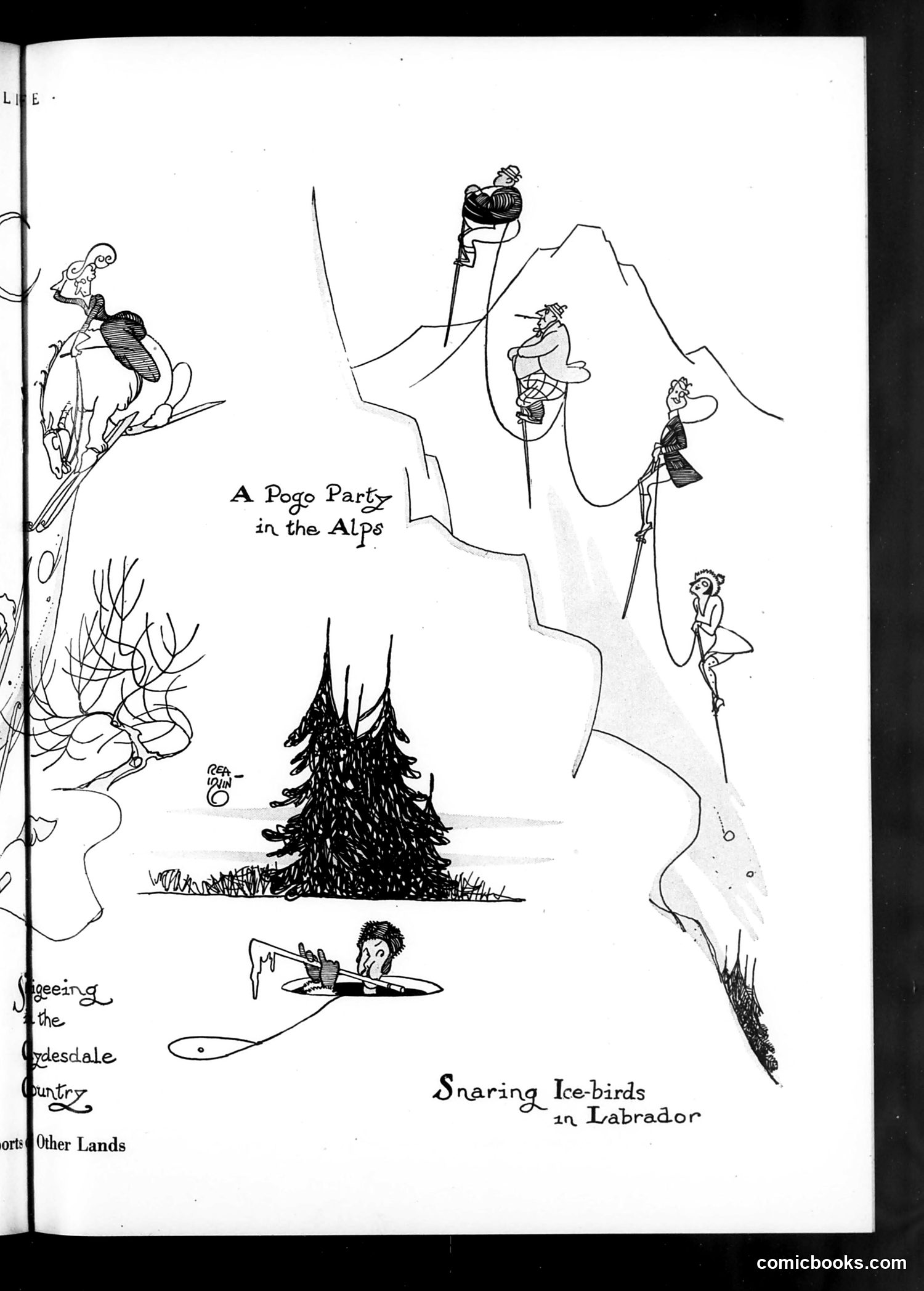
This page contains two distinct cartoon vignettes satirizing recreational activities: 1. **"A Pogo Party in the Alps"**: Depicts figures using pogo sticks on Alpine mountain slopes. The satire appears to mock an absurd or impractical recreational trend—using children's toys for mountaineering. This likely references either a fad or foolish behavior among wealthy leisure-seekers. 2. **"Snaring Ice-birds in Labrador"**: Shows a figure attempting to catch birds in a frozen landscape, appearing comically inept or ridiculous in the effort. Both cartoons seem to ridicule fashionable but impractical sporting pursuits or outdoor activities, using exaggerated visual humor typical of *Life* magazine's satirical style. The exact topical references remain unclear without additional historical context about contemporary 1920s-30s leisure trends.
This is a theater review of the 1922 play "To the Ladies!" by Kaufman and Connelly. The critic notes an ironic contradiction: the same authors who satirized meddling wives in their previous play "Dulcy" now argue women are essential to business success. The review praises the banquet scene—depicting a piano company dinner—as genuinely original comedy, comparing it favorably even to Shakespeare's banquet scene in "Macbeth." The critic applauds actress Helen Hayes and actor Otto Kruger's performances, particularly Hayes' ability to convey sincerity despite the play's sentimental moments about spousal sacrifice. The review gently mocks the play's hokum while acknowledging the authors' talent (Kaufman won Life magazine's "Clean Fun Prize"). Playwright Joseph Gonnick even appears in the production itself, playing piano company president John Kincaid.
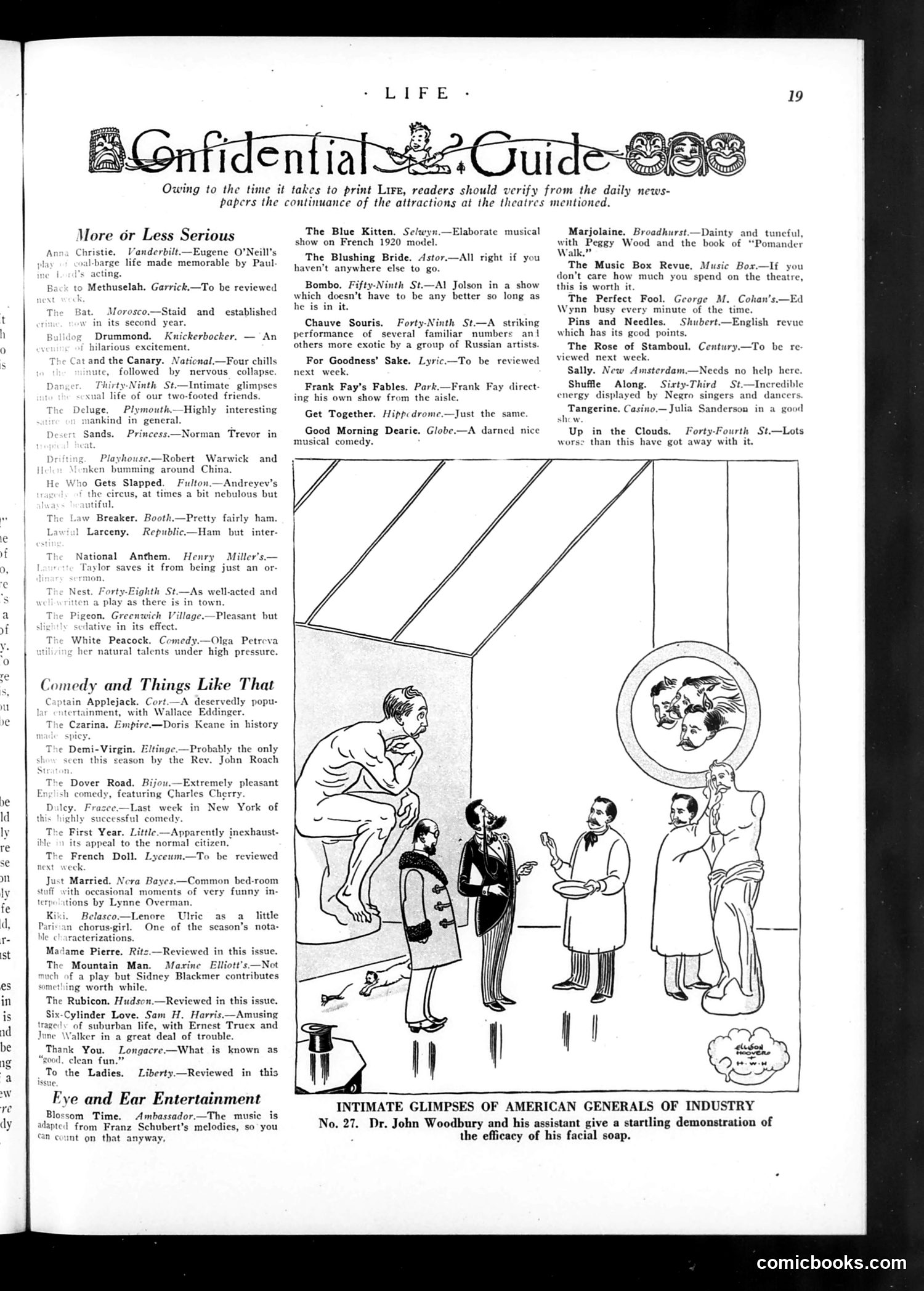
This page is a **theater review section** from Life magazine, listing Broadway shows with brief critical assessments. The cartoon at the bottom, captioned "Intimate Glimpses of American Generals of Industry," shows **Dr. John Woodbury demonstrating his facial soap** to an audience of well-dressed men and women. The satire is straightforward: it mocks the exaggerated advertising claims of the era by calling soap manufacturers "Generals of Industry" and presenting a product demonstration as if it were a serious scientific or military achievement. The cartoon ridicules both the grandiose marketing language of 1920s consumer goods and the gullibility of the audience watching intently. The reviews above reference contemporary Broadway hits like Al Jolson's *Bombo*, George M. Cohan's *The Perfect Fool*, and *Shuffle Along* (notably one of the first successful all-Black Broadway musicals). The casual critical tone—"All right if you haven't anywhere else to go"—captures Life's sardonic theater criticism style.
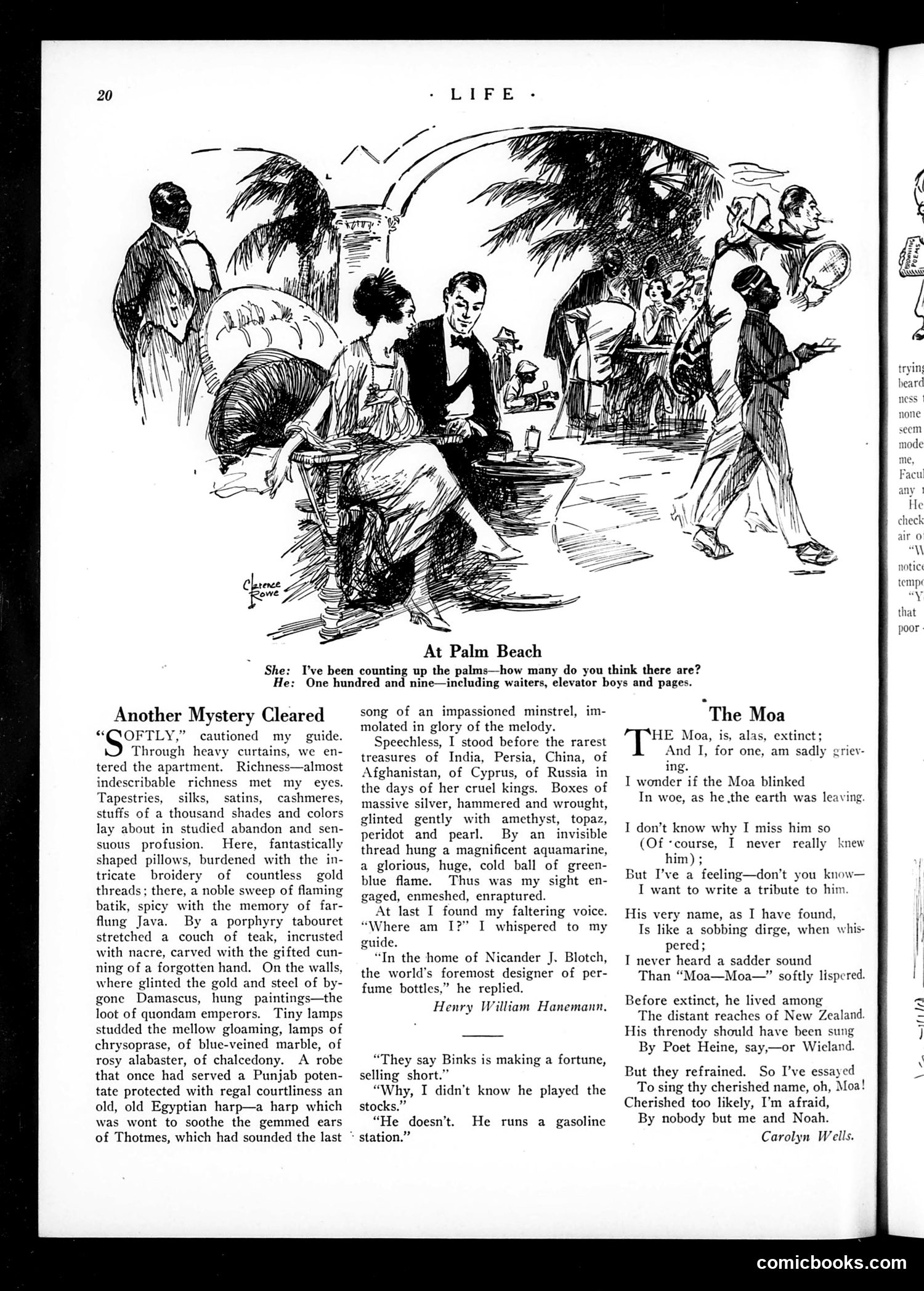
**The Cartoon ("At Palm Beach"):** This satirizes wealthy Palm Beach tourists. The joke is that when the woman counts "palms," her husband quips that most of the "palms" are actually service workers (waiters, elevator boys, pages)—a sharp commentary on the resort's dependence on a large working-class staff serving the wealthy elite. The humor targets both the naïveté of the wealthy and the invisible labor supporting their leisure. **"Another Mystery Cleared":** This is absurdist satire mocking excessive wealth and pretension. A wealthy collector's apartment is described in ornate, overwrought language befitting ancient treasures and royal artifacts—but the punchline reveals it belongs to "Nicander J. Blotch, the world's foremost designer of perfume bottles." The joke deflates pomposity: all that theatrical richness is merely from designing trivial cosmetic containers, not genuine cultural achievement. **"The Moa":** A sentimental poem about an extinct New Zealand bird, likely included for comedic contrast or as filler.
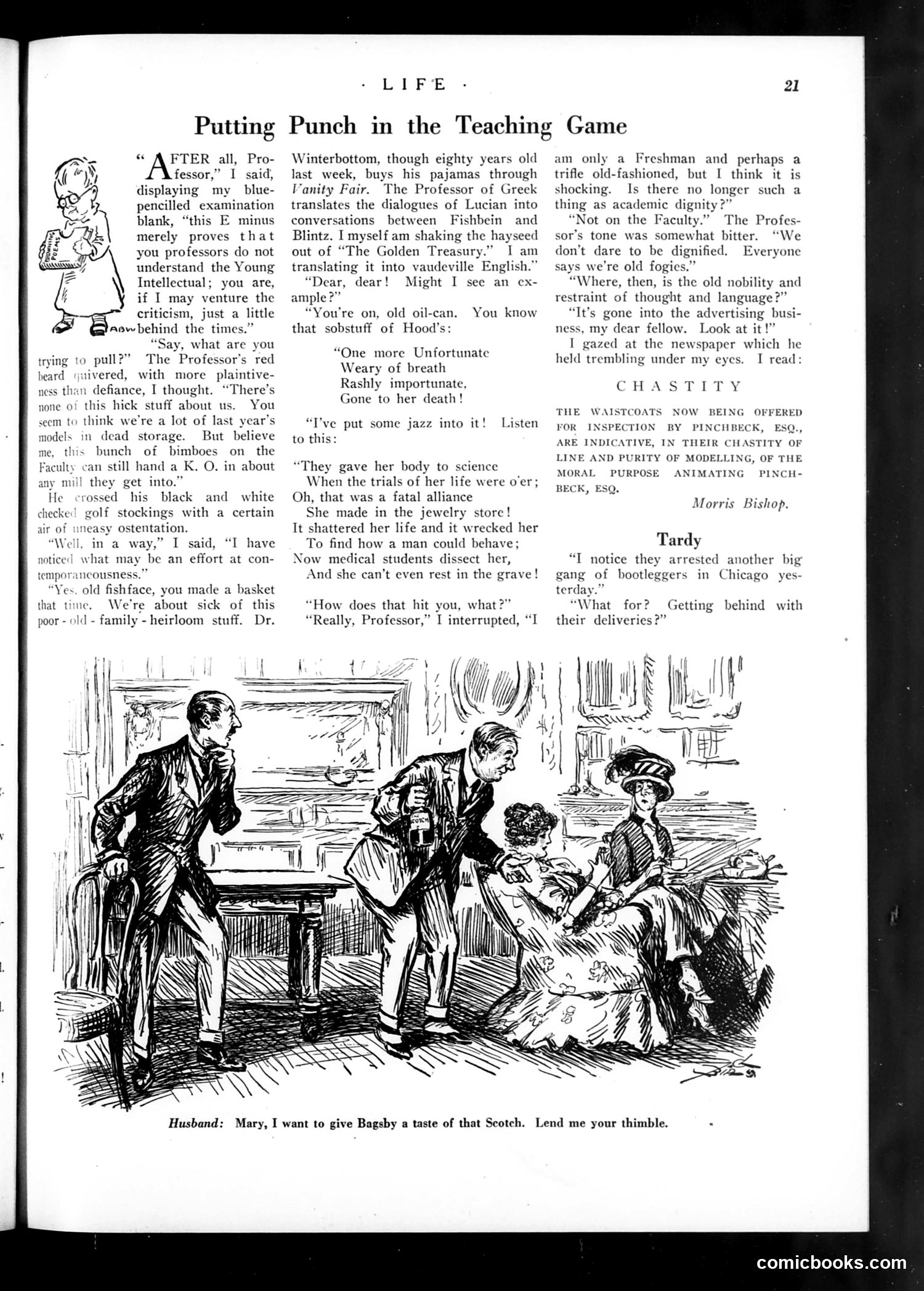
This 1920s *Life* magazine piece satirizes the clash between old academic tradition and modern commercial culture. **The Main Satire:** A young student criticizes his elderly Professor Winterbottom for being "behind the times" and lacking dignity. The Professor responds by claiming professors *cannot* maintain dignity anymore—everyone demands they be modern and entertaining. **The Joke:** To prove his point, the Professor recites a Victorian poem about a dead woman, but rewrites it in "jazz" style with crude jokes about her body being dissected. The student is horrified, expecting academic restraint. **The Punchline:** The Professor notes that all dignity has fled to advertising—he points to a newspaper ad for "chastity waistcoats" that uses absurdly pompous language. The contrast is clear: advertising now steals the flowery language academia once owned, forcing professors to adopt crude entertainment to seem relevant. **Historical Context:** This reflects 1920s anxieties about commercialization eroding intellectual culture, and the era's tension between "old fogies" and modern youth culture. The bottom cartoon is unrelated—a domestic joke about scotch and a thimble.
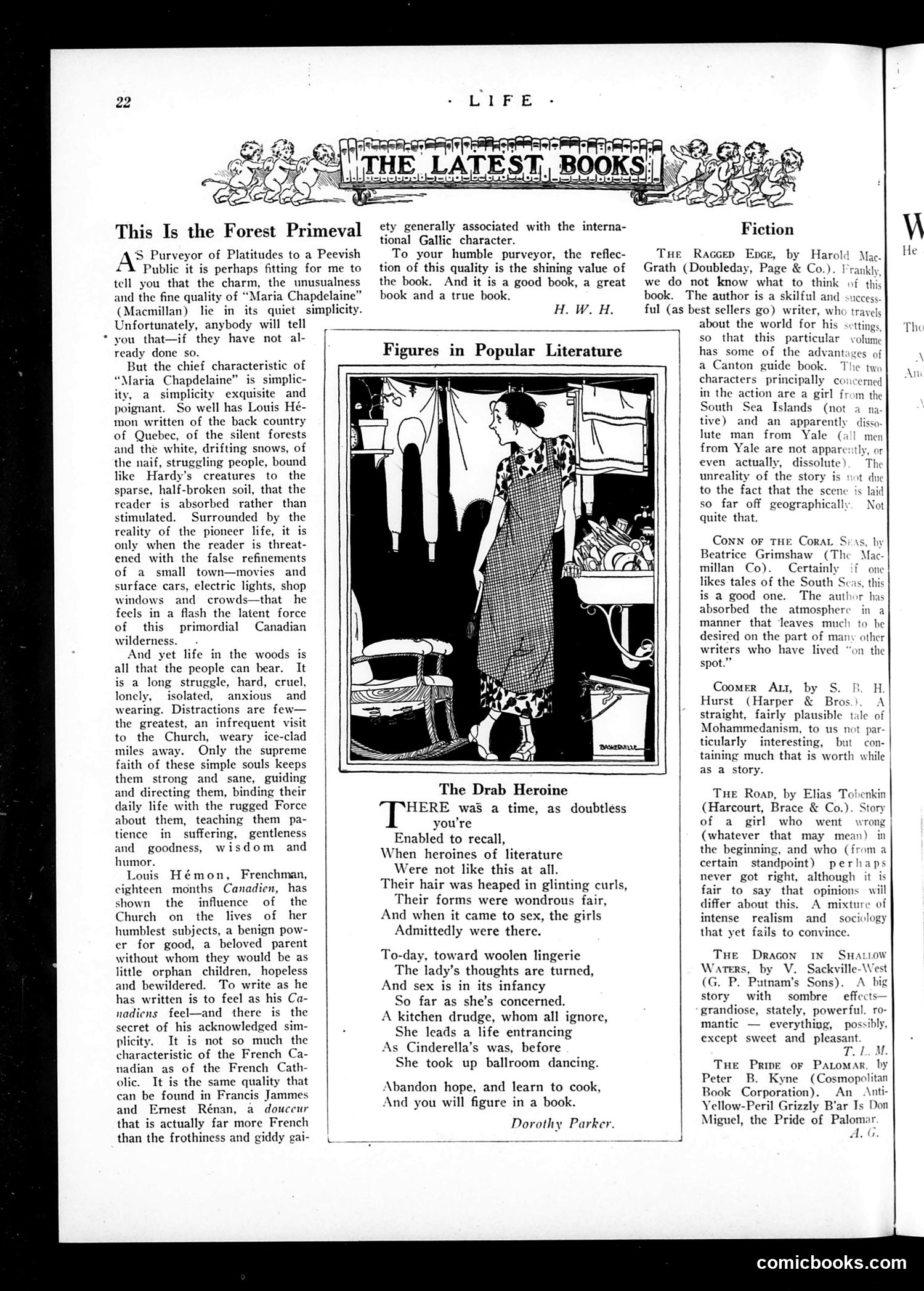
This page features a literary essay by Dorothy Parker critiquing the evolution of female characters in fiction. Parker contrasts the heroines of earlier literature—women with "glinting curls" and "wondrous fair" forms who were sexually alluring and passive—with modern literary heroines who are more complex and less idealized. The essay's title sarcastically refers to contemporary fiction's move away from romanticized female characters. Parker notes that modern heroines lack the glamour of their predecessors: they're "kitchen drudge[s]" without Cinderella's transformative potential. She suggests this shift reflects changing literary realism, where women are depicted as ordinary rather than idealized. The surrounding book reviews discuss various novels, including *Maria Chapdelaine* (praised for its simple realism about pioneer life) and works set in exotic locations like the South Seas. The page represents *Life* magazine's literary criticism section, typical of 1920s-era American magazine publishing.
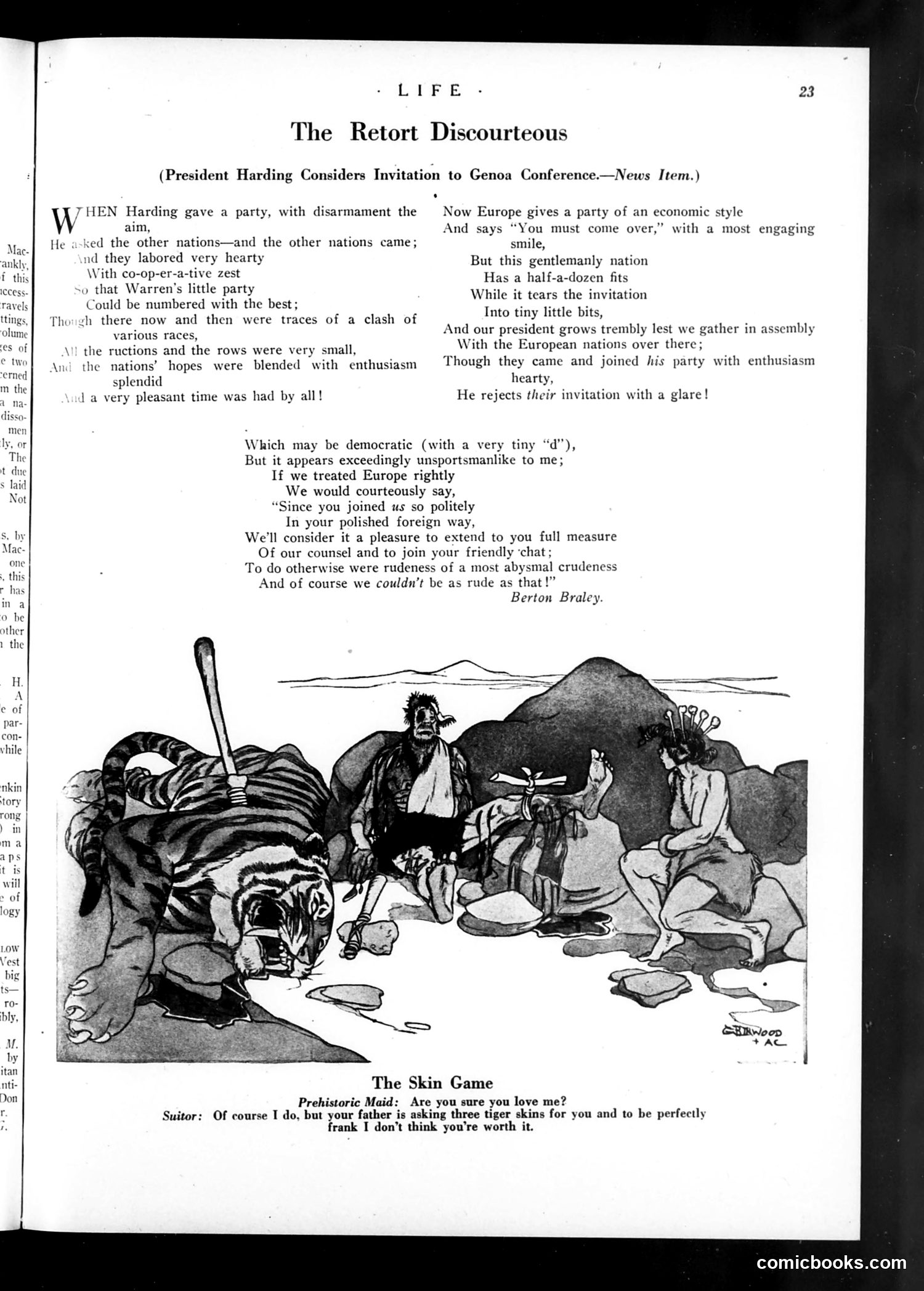
This page satirizes President Warren Harding's rejection of an invitation to the Genoa Conference (an international economic conference). The poem, attributed to Berton Braley, uses ironic contrast: Harding eagerly hosted a disarmament party that other nations attended enthusiastically, but now Europe invites him to their economic conference and he "rejects their invitation with a glare." The satire mocks Harding's hypocrisy and poor sportsmanship—he welcomed international cooperation when *he* organized it, but refuses reciprocal engagement. The poem argues this is "unsportsmanlike" and suggests America should graciously accept, rather than rudely reject, European overtures. The unrelated bottom cartoon, "The Skin Game," is a prehistoric humor joke about a suitor negotiating with a father over bride-price, making light of women as commodities.
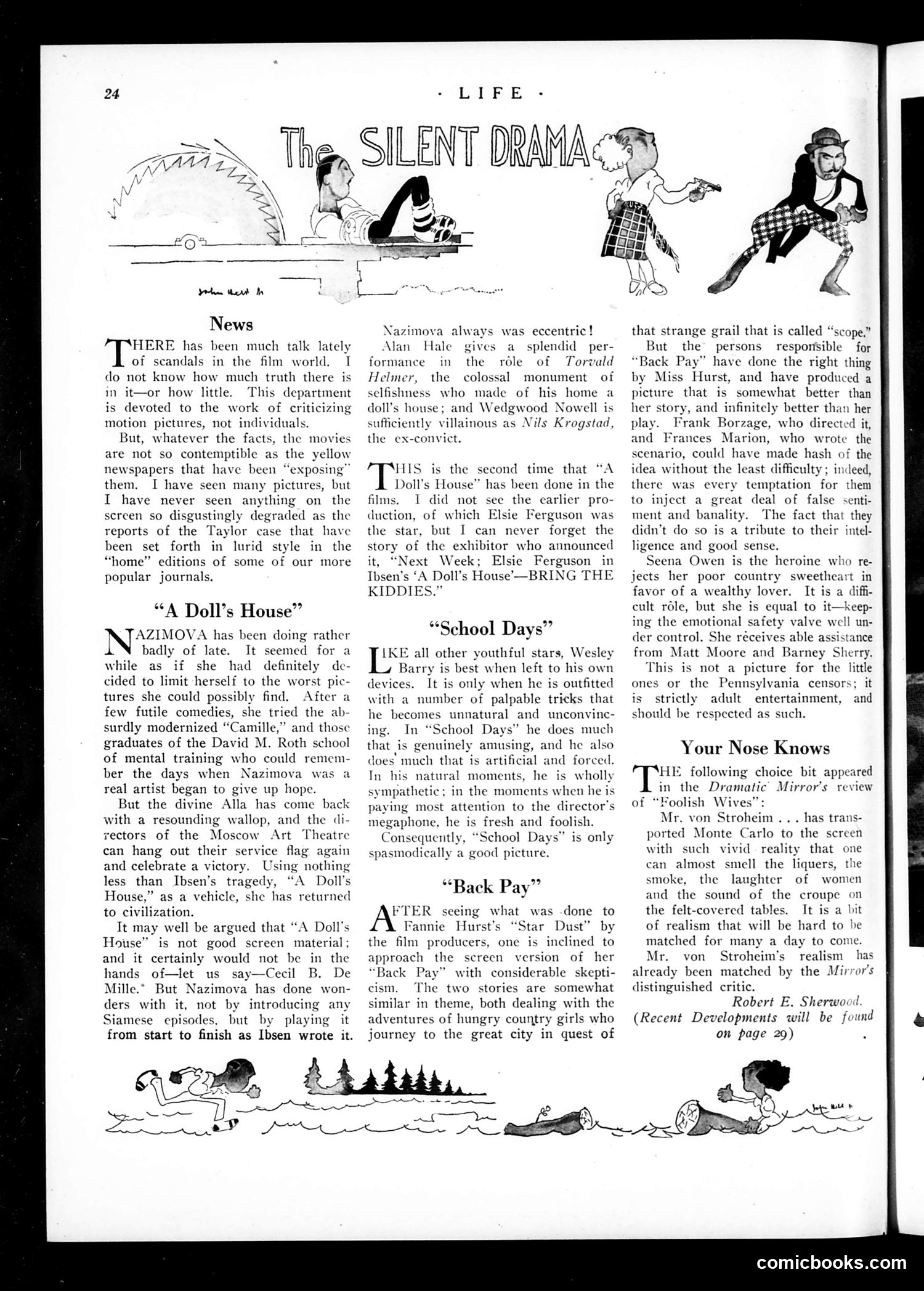
This page reviews three silent films for a general audience skeptical of Hollywood scandals. The critic defends cinema against "yellow newspaper" exposés of industry scandals (likely referencing the unsolved William Desmond Taylor murder case). **"A Doll's House"**: Actress Nazimova has redeemed herself after making poor films by adapting Ibsen's play faithfully. Alan Hale plays the controlling husband Torvald Helmer. The critic notes an earlier film version absurdly marketed to children as "BRING THE KIDDIES"—satirizing exhibitors' obliviousness to content. **"School Days"**: Actor Wesley Barry works best improvising naturally; when following heavy-handed directorial instruction, he becomes artificial and forced. **"Back Pay"**: An adaptation of Fannie Hurst's novel about country girls seeking fortune in the city. Director Frank Borzage and writer Frances Marion are praised for restraint—they resisted melodramatic excess. The page emphasizes good filmmaking requires artistic integrity over cheap sensationalism, directly contrasting cinema's creative potential against the tabloid scandals dominating public discourse.
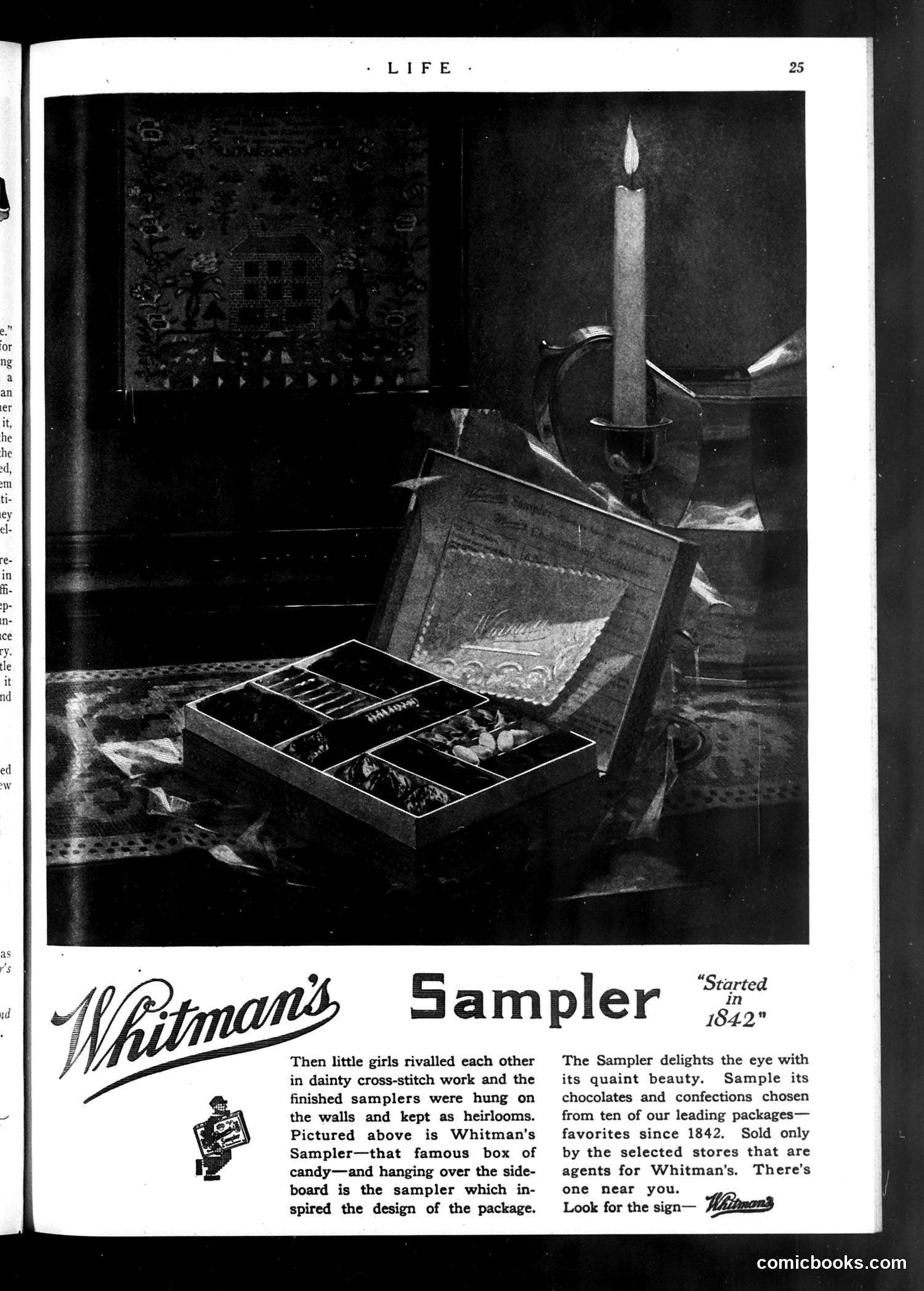
This is a **candy advertisement**, not political satire. It's a full-page ad for Whitman's Sampler chocolates, showing a styled still-life photograph of the candy box alongside a decorative embroidered sampler (a piece of needlework). The ad connects the product to nostalgic Americana: it references how young girls historically created cross-stitch samplers as domestic crafts and kept them as family heirlooms. Whitman's marketing strategy linked their chocolate box design to this tradition, positioning their product as both refined and wholesome. The "quaint beauty" language and historical framing appealed to early-20th-century consumers' sentimentality about the past. The ad emphasizes exclusivity ("selected stores") and longevity ("favorites since 1842"), suggesting quality and heritage.
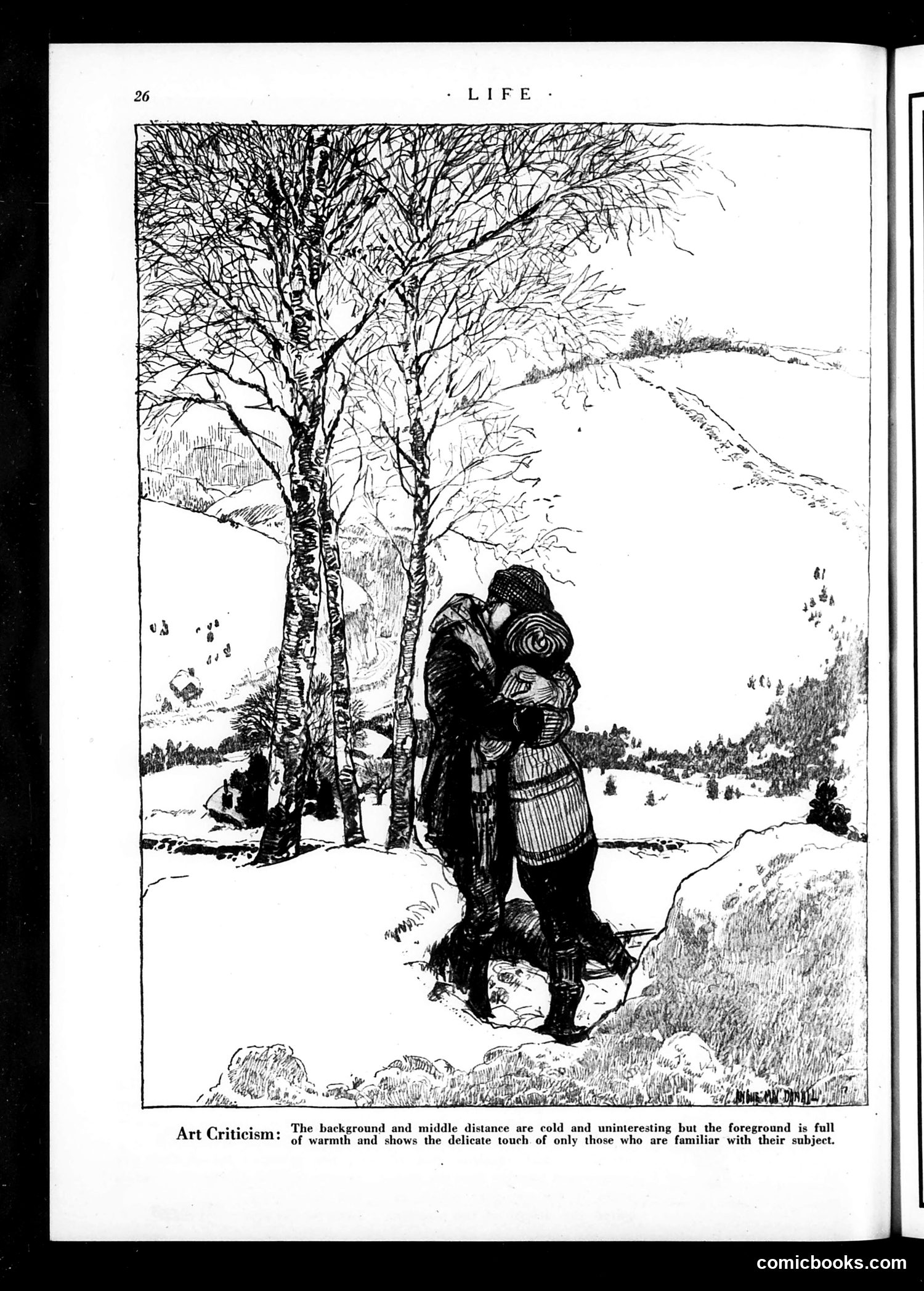
This page presents a winter landscape illustration with an "Art Criticism" caption below. The image depicts two figures in heavy coats embracing beneath bare birch trees in a snowy setting, with distant hills and sparse vegetation visible. The caption offers critical commentary on the artwork's composition, praising the warm, intimate treatment of the foreground figures while noting the cold, uninteresting distant landscape. This appears to be satirizing pretentious art criticism—the type that uses flowery language to praise technical execution while overlooking (or excusing) less skillfully rendered elements. The juxtaposition of genuine emotional warmth in the foreground against the sterile background mirrors the critique itself, suggesting the artwork succeeds precisely where it matters most: in conveying human connection and intimacy.
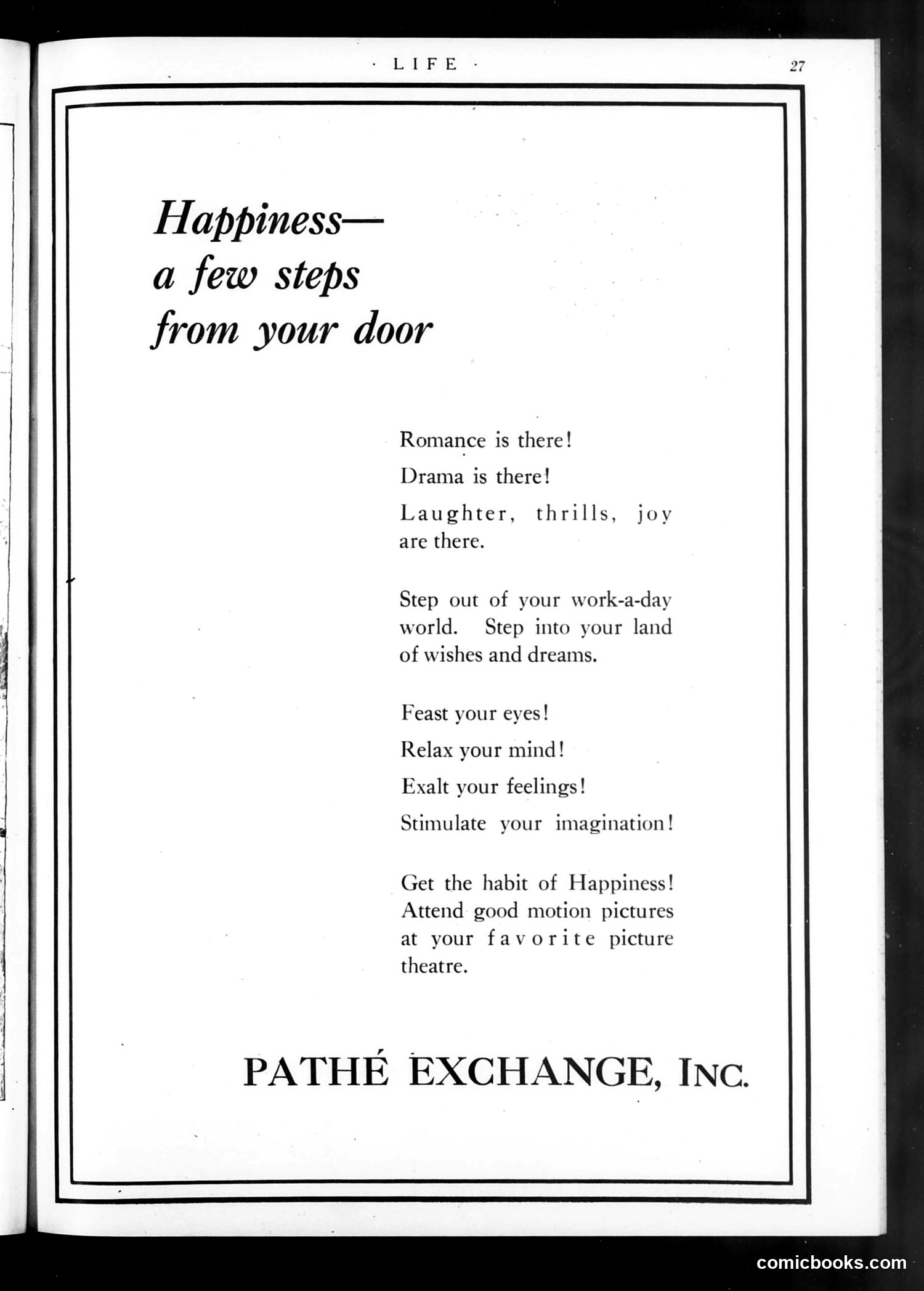
This is an **advertisement**, not a cartoon or satirical content. It's a promotional piece by Pathé Exchange, Inc., a major early film distribution company, encouraging people to attend movies at their local theaters. The ad uses persuasive, almost poetic language to sell cinema-going as an escape from mundane daily life. It promises emotional rewards—romance, drama, laughter, and thrills—positioning movies as a gateway to "wishes and dreams." The satire (if any) is gentle: the ad assumes that ordinary people's lives are dull ("work-a-day world") and that cinema offers necessary psychological relief. For a modern reader, it's notable how earnestly movies were promoted as *moral and emotional therapy* rather than mere entertainment. This reflects the 1920s-era cultural moment when motion pictures were still relatively new and their social legitimacy was being actively marketed to respectable audiences.
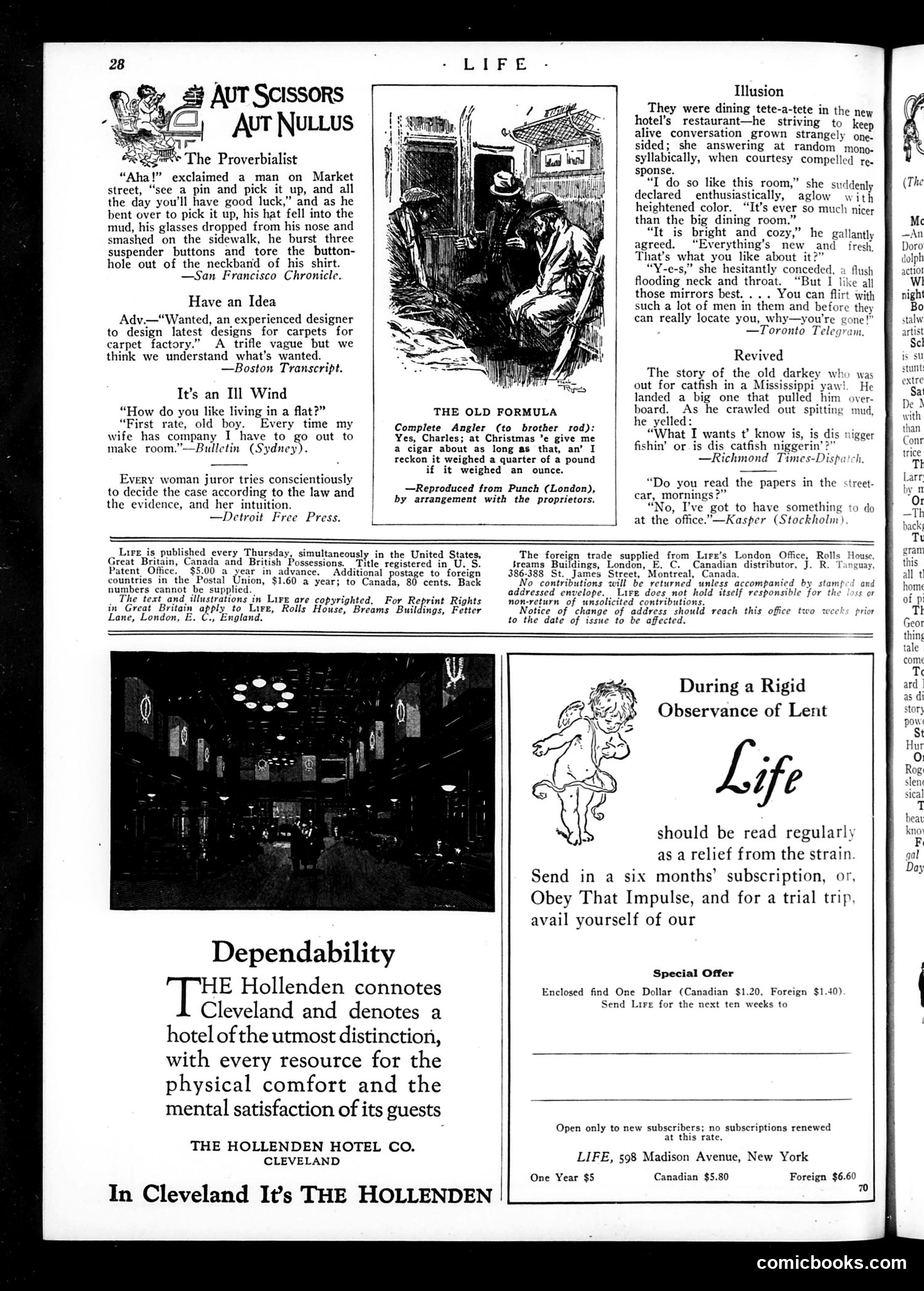
This page contains short humor pieces typical of early 20th-century *Life* magazine—a satirical publication featuring jokes, witticisms, and brief comic anecdotes rather than political cartoons. The central cartoon titled "The Old Formula" shows two fishing rods in conversation, with one exaggerating a Christmas cigar's size—satirizing fishermen's tendency to embellish their catches. The text pieces mock various social absurdities: a man finding a lucky penny who then suffers immediate misfortunes (ironic reversal); an intentionally vague job advertisement; a husband's relief at his wife's dinner parties forcing him out; a woman juror relying on intuition rather than evidence; and a woman admitting she flirts with men's reflections in restaurant mirrors to avoid genuine engagement. The "Revived" piece contains a dialect-heavy anecdote about an enslaved man fishing—reflecting the era's problematic racial humor common to period publications. These pieces humorously critique human nature: superstition, poor communication, gender dynamics, judicial reasoning, and infidelity—reflecting *Life*'s satirical focus on everyday social hypocrisy and foolishness.
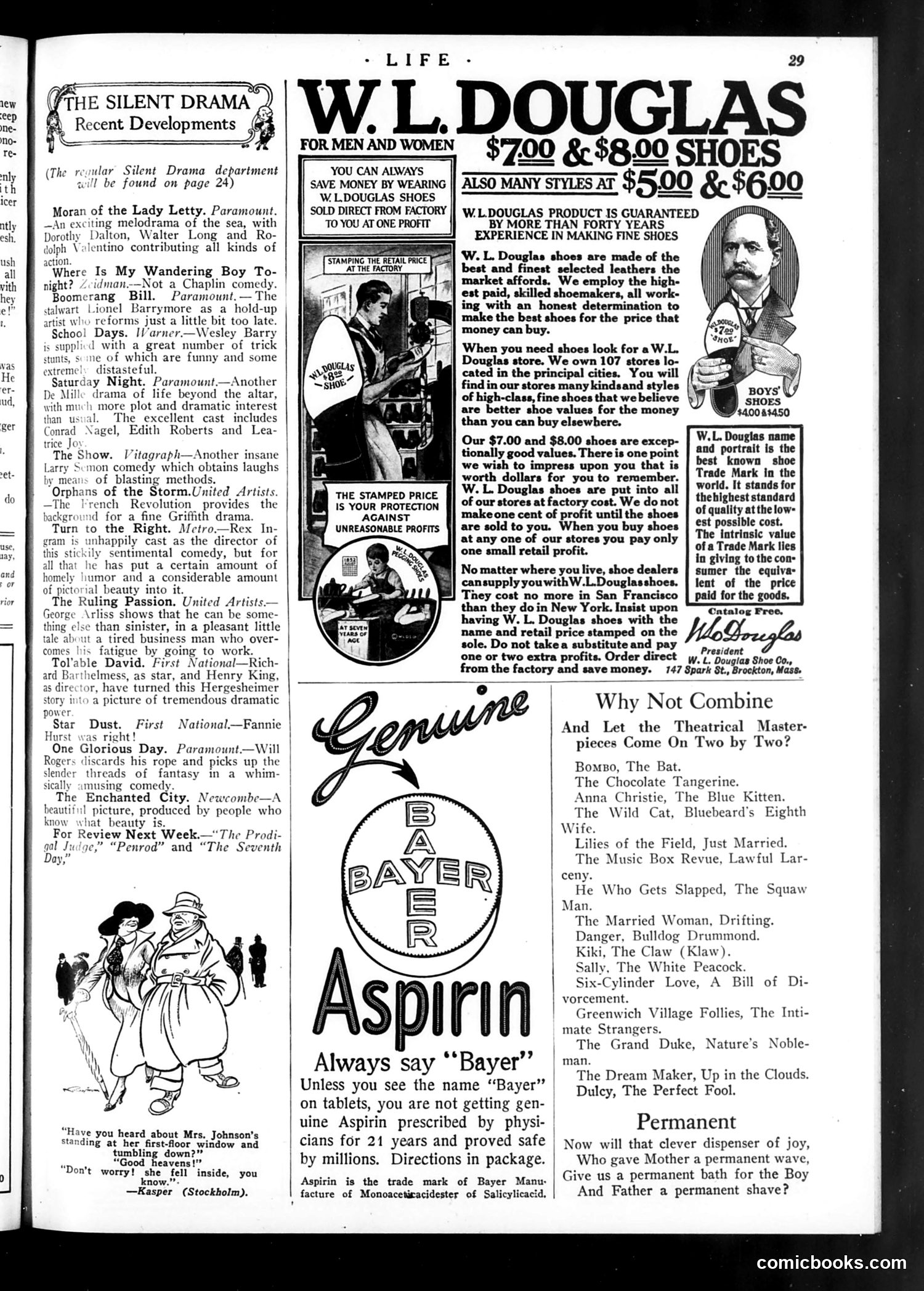
This page is primarily **advertising**, not political satire. The dominant content is a full-page W.L. Douglas shoe advertisement featuring the company president's portrait and detailed sales pitch about factory-direct pricing. The small "Silent Drama" section at left reviews current films—mostly Paramount and other studio releases from what appears to be the early 1920s, mentioning stars like Valentino, Lionel Barrymore, and Will Rogers. At bottom left is a **mild joke** (credited to "Kasper, Stockholm"): a woman falls from a window but lands inside—a play on unexpected safety that's meant to be darkly humorous. The Bayer Aspirin advertisement promotes the brand as medically proven, emphasizing the importance of the "Bayer" name—likely a response to post-WWI trademark issues when German companies lost American patents. **For modern readers**: This reflects 1920s consumer culture emphasizing brand names, factory efficiency, and direct sales as cost-saving innovations.
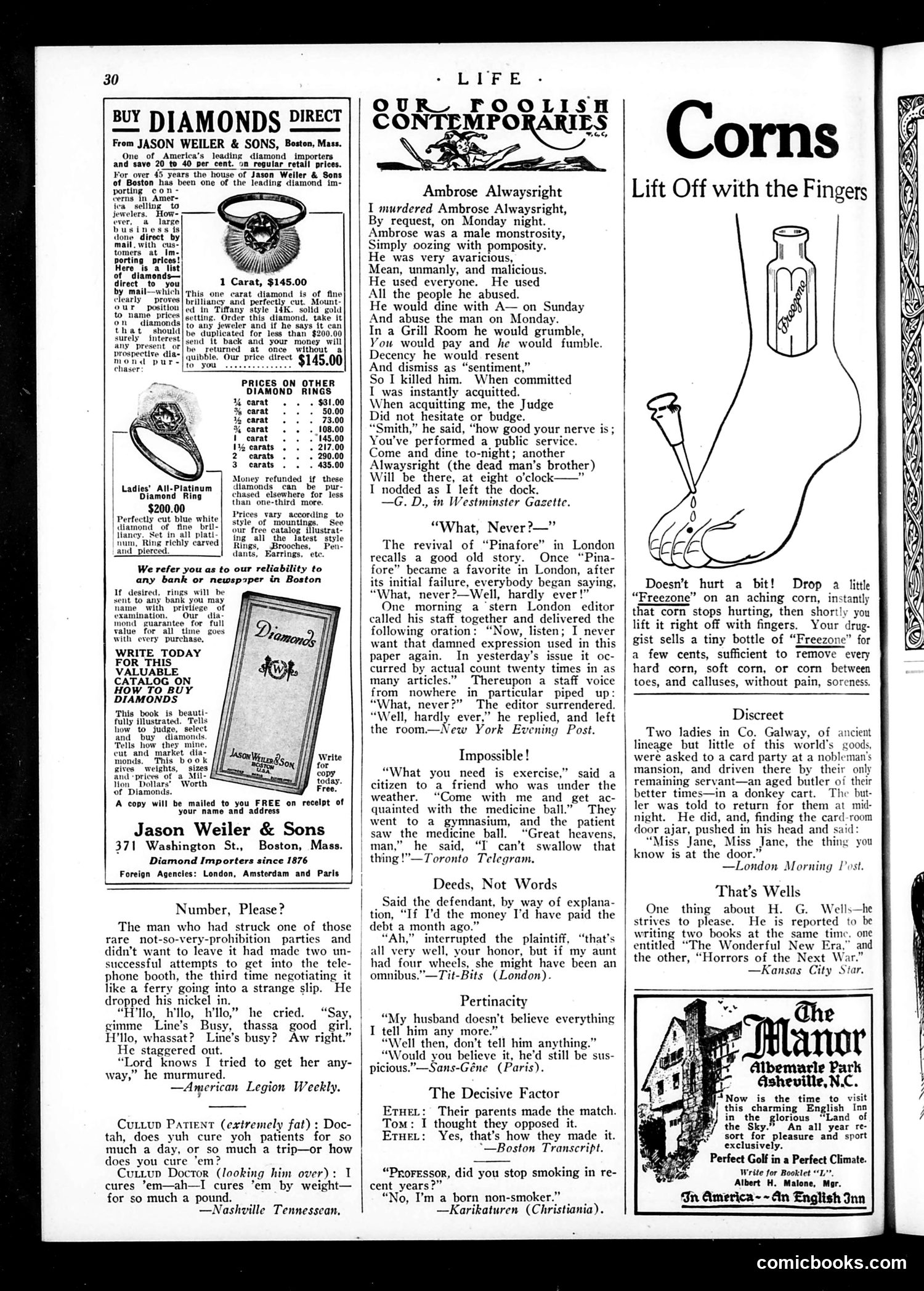
This is primarily an **advertising and humor page** from Life magazine (a satirical publication predating the modern photo-weekly). The main content consists of diamond merchant ads and miscellaneous comic anecdotes. The notable satirical piece is the poem **"Ambrose Alwaysright,"** which depicts a social type common to early 20th-century satire: an insufferable, pompous man who exploits friends, avoids paying bills, and dismisses genuine feeling as mere "sentiment." The dark humor lies in the narrator murdering him and being **acquitted by a judge who congratulates him as a public benefactor**—satirizing both the character type and suggesting societal exasperation with such parasitic figures. The other humor pieces ("Number, Please?" and "Cuttup Patient") are standard period jokes about drunk telephone operators and a comedically obese patient, reflecting casual early-century comic conventions. The **advertisements** for Jason Weiler & Sons diamonds dominate, using price-comparison claims and mail-order marketing typical of the era.
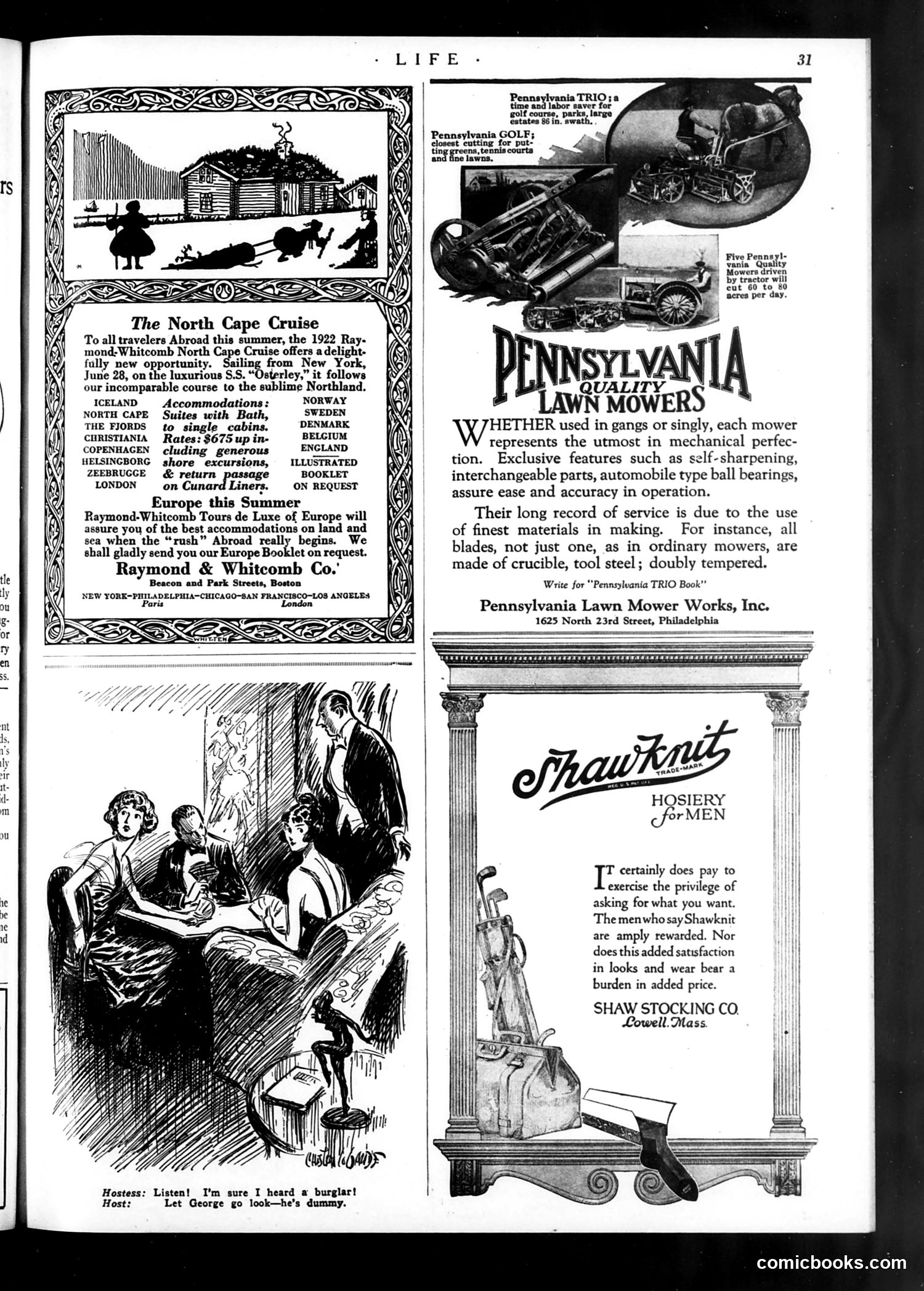
**The Main Cartoon (Bottom Left):** This is a domestic humor sketch with no political content. A hostess alerts guests to a possible burglar, and the host suggests sending "George"—who appears to be a servant or lower-ranking household member—to investigate, calling him a "dummy." The joke relies on class-based humor typical of the era: the absurdity and callousness of risking the expendable servant while the family remains safe. It's meant to be amusing through its casual cruelty. **The Page's Primary Content:** The page is dominated by advertisements for travel (Raymond & Whitcomb's North Cape Cruise), lawn mowers (Pennsylvania Lawn Mower Works), and men's hosiery (Shawknit and Shaw Stocking Co.). These are commercial advertisements rather than editorial content or satire. The cartoon itself contains no political commentary—it's purely social humor aimed at affluent readers who would employ household staff.