
Life, 1922-03-09 · page 8 of 34
Life — March 9, 1922 — page 8: what you’re looking at
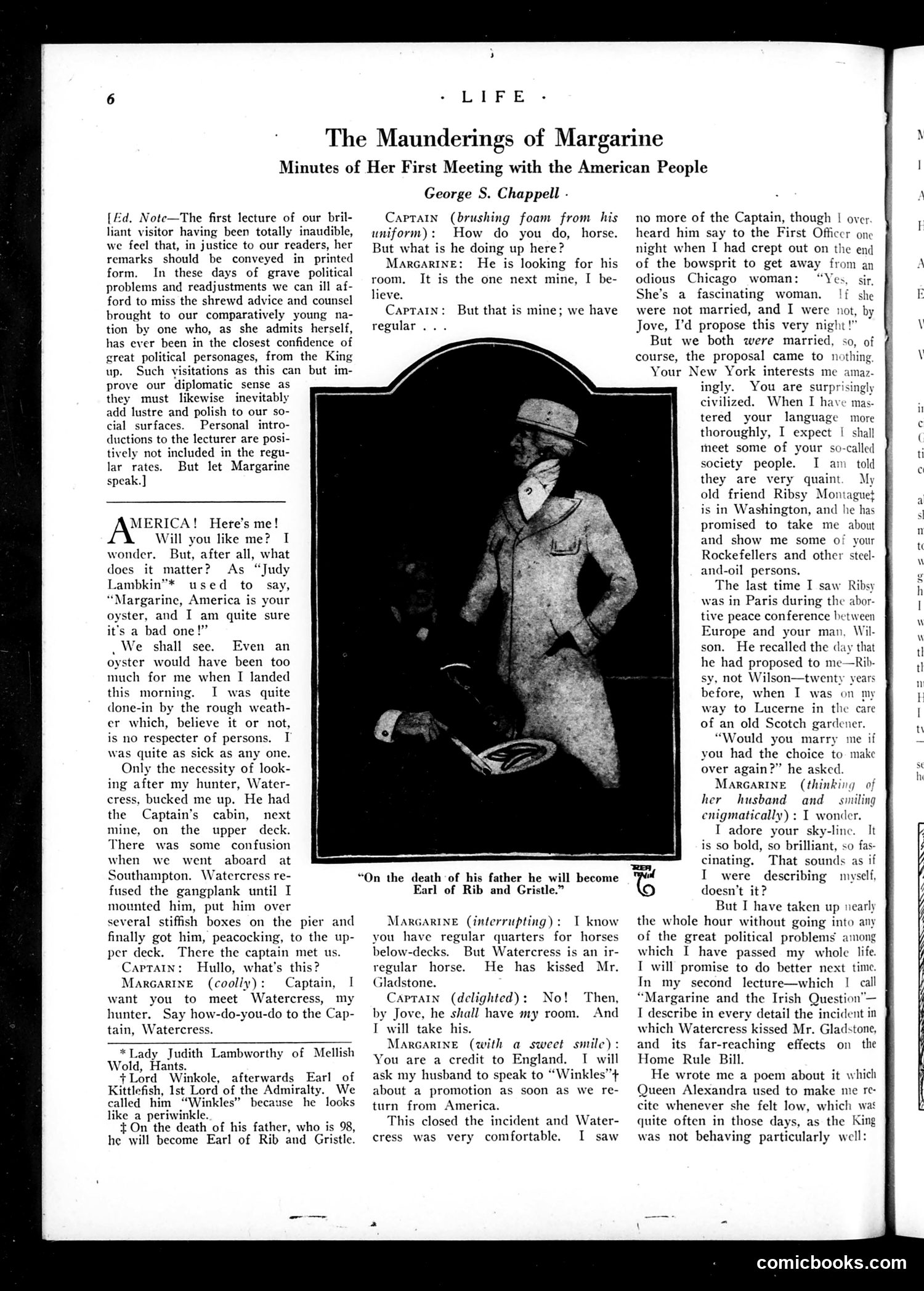
What you’re looking at
This is a satirical piece featuring "Margarine," a character representing a somewhat naïve British woman visiting America. The illustration shows her in period dress (early 1900s). The satire mocks her affected, gossipy observations about American society and her name-dropping of British aristocratic connections—she references knowing "Kibsy Montague" in Washington and encounters with Queen Alexandra. The humor targets both Margarine's pretentiousness and contemporary Anglo-American social dynamics. She speaks condescendingly about American "society people" while boasting of her British connections, embodying the snobbish British visitor stereotype that American audiences would find laughable. The piece appears designed to satirize British attitudes toward America and transatlantic social pretension generally.
📄 Transcribed text from this page (OCR, searchable)
Machine-transcribed from the original scan — historical spelling and the odd misread are preserved.
> LIFE - The Maunderings of Margarine Minutes of Her First Meeting with the American People [Ed. Note—The first lecture of our bril- liant visitor having been totally inaudible, we feel that, in justice to our readers, her remarks should be conveyed in printed form. In these days of grave political problems and readjustments we can ill af- ford to miss the shrewd advice and counsel brought to our comparatively young na- tion by one who, as she admits herself, has ever been in the closest confidence of great political personages, from the King up. Such visitations as this can but im- prove our diplomatic sense as they must likewise inevitably add lustre and polish to our so- cial surfaces. Personal intro- ductions to the lecturer are posi- tively not included in the regu- lar rates. But let Margarine speak.] MERICA! Here's me! Will you like me? I wonder. But, after all, what does it matter? As “Judy Lambkin”* used to. say, “Margarine, America is your oyster, and I am quite sure it’s a bad one!” _ We shall see. Even an oyster would have been too much for me when I landed this morning. I was quite done-in by the rough weath- er which, believe it or not, is no respecter of persons. I was quite as sick as any one. Only the necessity of look- ing after my hunter, Water- cress, bucked me up. He had the Captain’s cabin, next mine, on the upper deck. There was some confusion when we went aboard at Southampton. Watercress re- fused the gangplank until I mounted him, put him over several stiffish boxes on the pier and finally got him, peacocking, to the up- per deck. There the captain met us. Captain: Hullo, what's this? MarcartnE (coolly): Captain, [| want you to meet Watercress, my hunter. Say how-do-you-do to the Cap- tain, Watercress. *Lady Judith Lambworthy of Mellish Wold, Hants. Lord Winkole, afterwards Earl of Kittlefish, Ist Lord of the Admiralty. We called him “Winkles” because he looks like a periwinkle. On the death of his father, who is 98, he will become Earl of Rib and Gristle. George S. Chappell - Captain (brushing foam from his uniform): How do you do, horse. But what is he doing up here? Marcarine: He is looking for his room. It is the one next mine, I be- lieve. Caprain: regular... But that is mine; we have “On the death of his father he will become Earl of Rib and Gristle.” MARGARINE (interrupting): I know you have regular quarters for horses below-decks. But Watercres: an ir- regular horse. He has kissed Mr. Gladstone. Captain (delighted): No! Then, by Jove, he shall have my room. And I will take his. MARGARINE (with a sweet smile): You are a credit to England. I will ask my husband to speak to “Winkles”+ about a promotion as soon as we re- turn from America. This closed the incident and Water- cress was very comfortable. I saw no more of the Captain, though | over heard him say to the First Officer one night when I had crept out on the end of the bowsprit to get away from an odious Chicago woman: “Yes, sir, She’s a fascinating woman. !{ she were not married, and I were not, by Jove, I'd propose this very night!” But we both were married, so, of course, the proposal came to nothing Your New York interests me amaz- ingl You are surprisingly civilized. When I have mas- tered your language more thoroughly, I expect | shall meet some of your so-called society people. I am told they are very quaint. My old friend Ribsy Montague} is in Washington, and he has promised to take me about and show me some of your Rockefellers and other steel- and-oil persons. The last time I saw Ribsy was in Paris during the abor- tive peace conference between Europe and your man, Wil- son. He recalled the day that he had proposed to me—Rib- sy, not Wilson—twenty years before, when I was on my way to Lucerne in the care of an old Scotch gardener. “Would you marry me if you had the choice to make over again?” he asked. MarcarinE (thinking of her husband and smiling enigmatically) : I wonder. I adore your sky-line. It is so bold, so brilliant, so fas- cinating. That sounds as if I were describing myself, doesn’t it? But I have taken up nearly the whole hour without going into any of the great political problems among which I have passed my whole life. I will promise to do better next time. In my second lecture—which | call “Margarine and the Irish Question”"— I describe in every detail the incident in which Watercress kissed Mr. Gladstone, and its far-reaching effects on the Home Rule Bill. He wrote me a poem about it which Queen Alexandra used to make me re- cite whenever she felt low, which was quite often in those days, as the King was not behaving particularly well: comicbooks.com