
Life, 1922-03-09 · page 20 of 34
Life — March 9, 1922 — page 20: what you’re looking at
What you’re looking at
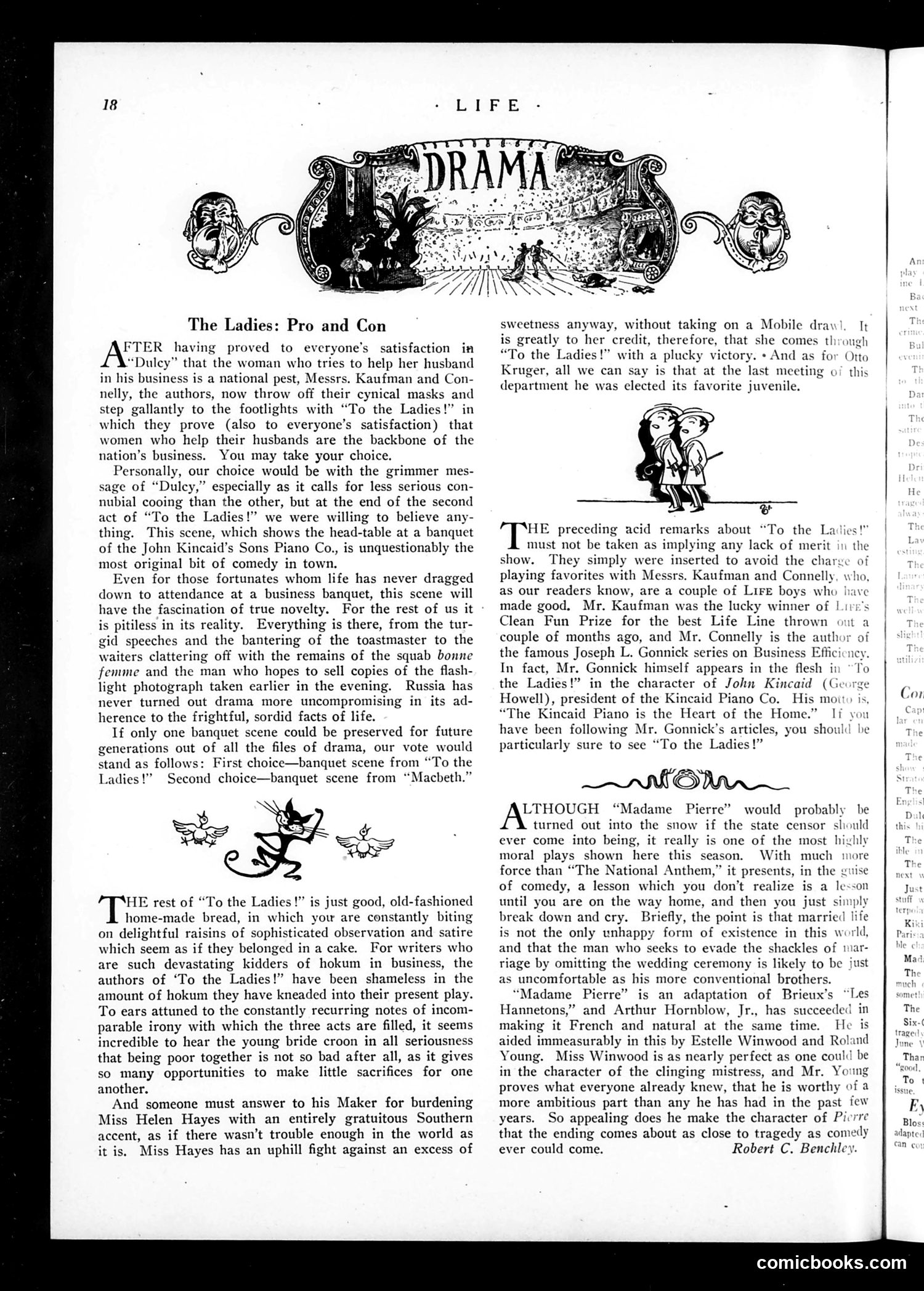
This is a theater review of the 1922 play "To the Ladies!" by Kaufman and Connelly. The critic notes an ironic contradiction: the same authors who satirized meddling wives in their previous play "Dulcy" now argue women are essential to business success. The review praises the banquet scene—depicting a piano company dinner—as genuinely original comedy, comparing it favorably even to Shakespeare's banquet scene in "Macbeth." The critic applauds actress Helen Hayes and actor Otto Kruger's performances, particularly Hayes' ability to convey sincerity despite the play's sentimental moments about spousal sacrifice. The review gently mocks the play's hokum while acknowledging the authors' talent (Kaufman won Life magazine's "Clean Fun Prize"). Playwright Joseph Gonnick even appears in the production itself, playing piano company president John Kincaid.
📄 Transcribed text from this page (OCR, searchable)
Machine-transcribed from the original scan — historical spelling and the odd misread are preserved.
The Ladies: Pro and Con Ae having proved to everyone's satisfaction in “Duley” that the woman who tries to help her husband in his business is a national pest, Messrs. Kaufman and Con- nelly, the authors, now throw off their cynical masks and step gallantly to the footlights with “To the Ladies!” in which they prove (also to everyone’s satisfaction) that women who help their husbands are the backbone of the nation’s business. You may take your choice. Personally, our choice would be with the grimmer mes- sage of “Dulcy,” especially as it calls for less serious con- nubial cooing than the other, but at the end of the second act of “To the Ladies!” we were willing to believe any- thing. This scene, which shows the head-table at a banquet of the John Kincaid’s Sons Piano Co., is unquestionably the most original bit of comedy in town. Even for those fortunates whom life has never dragged down to attendance at a business banquet, this scene will have the fascination of true novelty. For the rest of us it is pitiless in its reality. Everything is there, from the tur- gid speeches and the bantering of the toastmaster to the waiters clattering off with the remains of the squab bonne femme and the man who hopes to sell copies of the flash- light photograph taken earlier in the evening. Russia has never turned out drama more uncompromising in its ad- herence to the frightful, sordid facts of life. If only one banquet scene could be preserved for future generations out of all the files of drama, our vote would stand as follows: First choice—banquet scene from “To the Ladies!” Second choice—banquet scene from “Macbeth.” Se, he HE rest of “To the Ladies!” is just good, old-fashioned home-made bread, in which you are constantly biting on delightful raisins of sophisticated observation and satire which seem as if they belonged in a cake. For writers who are such devastating kidders of hokum in business, the authors of ‘To the Ladies!” have been shameless in the amount of hokum they have kneaded into their present play. To ears attuned to the constantly recurring notes of incom- parable irony with which the three acts are filled, it seems incredible to hear the young bride croon in all seriousness that being poor together is not so bad after all, as it gives so many opportunities to make little sacrifices for one another. And someone must answer to his Maker for burdening Miss Helen Hayes with an entirely gratuitous Southern accent, as if there wasn’t trouble enough in the world as it is. Miss Hayes has an uphill fight against an excess of sweetness anyway, without taking on a Mobile draw|. It is greatly to her credit, therefore, that she comes through “To the Ladies!” with a plucky victory. + And as for Otto Kruger, all we can say is that at the last meeting o/ this department he was elected its favorite juvenile. HE preceding acid remarks about “To the Laiies!" must not be taken as implying any lack of merit i the show. They simply were inserted to avoid the charge of playing favorites with Messrs. Kaufman and Connelly, who, as our readers know, are a couple of Lire boys who have made good. Mr. Kaufman was the lucky winner of Livs’s Clean Fun Prize for the best Life Line thrown out a couple of months ago, and Mr. Connelly is the author of the famous Joseph L. Gonnick series on Business i In fact, Mr. Gonnick himself appears in the flesh in “To the Ladies!” in the character of John Kincaid (Georg Howell), president of the Kincaid Piano Co. His moity is, “The Kincaid Piano is the Heart of the Home.” li have been following Mr. Gonnick’s articles, you should be particularly sure to see “To the Ladies!” AnaniOGin. LTHOUGH “Madame Pierre” would probably be turned out into the snow if the state censor should ever come into being, it really is one of the most highly moral plays shown here this son. With much tore force than “The National Anthem,” it presents, in the guise of comedy, a lesson which you don’t realize is a lesson until you are on the way home, and then you just simply break down and cry. Briefly, the point is that marr: fe is not the only unhappy form of existence in this world, and that the man who seeks to evade the shackles of miar- riage by omitting the wedding ceremony is likely to be just as uncomfortable as his more conventional brothers. “Madame Pierre” is an adaptation of Brieux’s “Les Hannetons,” and Arthur Hornblow, Jr., has succeeded in making it French and natural at the same time. He is aided immeasurably in this by Estelle Winwood and Roland Young. Miss Winwood is as nearly perfect as one could be in the character of the clinging mistress, and Mr. Young proves what everyone already knew, that he is worthy of a more ambitious part than any he has had in the past few years. So appealing does he make the character of Picrre that the ending comes about as close to tragedy as comedy ever could come. Robert C. Benchley. comicbooks.com