
Life, 1922-03-09 · page 26 of 34
Life — March 9, 1922 — page 26: what you’re looking at
What you’re looking at
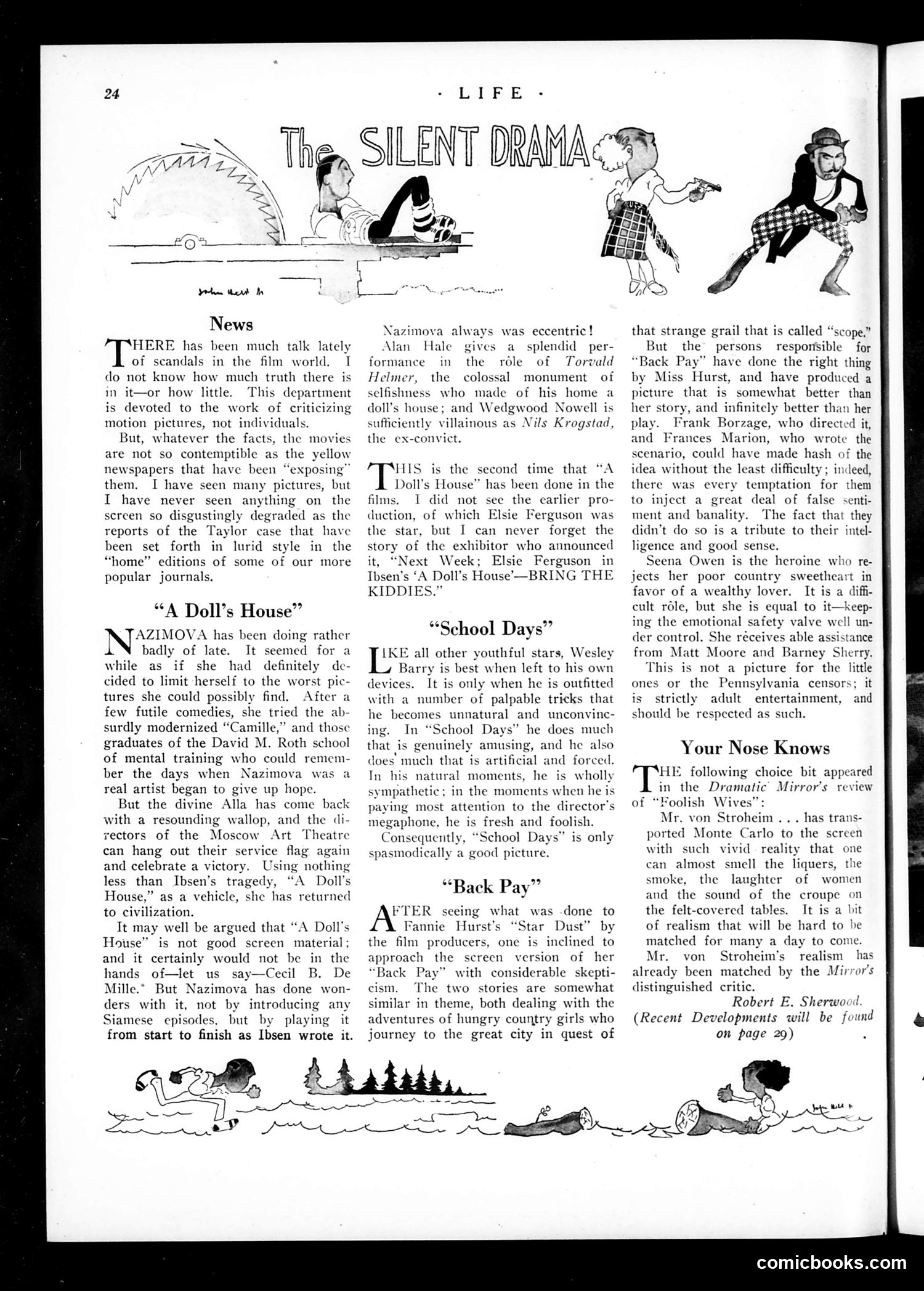
This page reviews three silent films for a general audience skeptical of Hollywood scandals. The critic defends cinema against "yellow newspaper" exposés of industry scandals (likely referencing the unsolved William Desmond Taylor murder case). **"A Doll's House"**: Actress Nazimova has redeemed herself after making poor films by adapting Ibsen's play faithfully. Alan Hale plays the controlling husband Torvald Helmer. The critic notes an earlier film version absurdly marketed to children as "BRING THE KIDDIES"—satirizing exhibitors' obliviousness to content. **"School Days"**: Actor Wesley Barry works best improvising naturally; when following heavy-handed directorial instruction, he becomes artificial and forced. **"Back Pay"**: An adaptation of Fannie Hurst's novel about country girls seeking fortune in the city. Director Frank Borzage and writer Frances Marion are praised for restraint—they resisted melodramatic excess. The page emphasizes good filmmaking requires artistic integrity over cheap sensationalism, directly contrasting cinema's creative potential against the tabloid scandals dominating public discourse.
📄 Transcribed text from this page (OCR, searchable)
Machine-transcribed from the original scan — historical spelling and the odd misread are preserved.
ee tat hh News TERE has been much talk lately of scandals in the film world. I do not know how much truth there is in it—or how little. This department is devoted to the work of criticizing motion pictures, not individuals. But, whatever the facts, the movies are not so contemptible as the yellow newspapers that have been “exposing” them. I have seen many pictures, but I have never seen anything on the screen so disgustingly degraded as the reports of the Taylor case that have been set forth in lurid style in the “home” editions of some of our more popular journals. “A Doll’s House” ZIMOVA has been doing rather it badly of late. It seemed for a while as if she had definitely de- cided to limit herself to the worst pic- tures she could possibly find. After a few futile comedies, she tried the ab- surdly modernized “Camille,” and those graduates of the David M. Roth school of mental training who could remem- ber the days when Nazimova was a real artist began to give up hope. But the divine Alla has come back with a resounding wallop, and the di- rectors of the Moscow Art Theatre can hang out their service flag again and celebrate a victory. Using nothing less than Ibsen’s tragedy, “A Doll's House,” as a vehicle, she has returned to civ tion. It may well be argued that “A Doll's House” is not good screen material ; and it certainly would not be in the hands of—let us say—Cecil B. De Mille.” But Nazimova has done won- ders with it, not by introducing any Siamese episodes, but by playing it from start to finish as Ibsen wrote it. ys was eccentric! ives a splendid pe the role of Torvald Helmer, the colossal monument of selfishness who made of his home a doll’s house; and Wedgwood Nowell is sufficiently villainous as Nils Krogstad, the Nazimova alw Alan Hale formance in ex-convict. HIS is the second time that “A Doll's House” has been done in the films. I did not see the earlier pro- duction, of which Elsie Ferguson was the star, but I can never forget the story of the exhibitor who announced it, “Next Week; Elsie Ferguson in Ibsen's ‘A Doll’s House’-—BRING THE KIDDIES.” “School Days” TS all other youthful stars, Wesley Barry is best when left to his own It is only when he is outfitted tricks that devices. with a number of palpable he becomes unnatural and unconvinc- ing. In “School Days” he does much that is genuinely amusing, and he also does’ much that is artificial and forced. In his natural moments, he is wholly sympathetic; in the moments when he is paying most attention to the director's megaphone, he is fresh and foolish. Consequently, “School Days” is only spasmodically a good picture. “Back Pay” what was -done to Hurst’s “Star Dust” by the film producers, one is inclined to approach the screen version of her “Back Pay” with considerable skepti- cism. The two stories are somewhat similar in theme, both dealing with the adventures of hungry country girls who journey to the great city in quest of TER s ‘annie that strange grail that is called “scope.” But the persons responsible for “Back Pay” have done the right thing by Miss Hurst, and have produced a picture that is somewhat better than her story, and infinitely better than her play. Frank Borzage, who directed it, and ances Marion, who wrote the scenario, could have made hash of the idea without the least difficulty ; indeed, there was ev temptation for them to inject a great deal of false senti- ment and banality. The fact that they didn’t do so is a tribute to their intel- ligence and good sense. Seena Owen is the heroine who re- jects her poor country sweetheart in favor of a wealthy lover. It is a diffi- cult réle, but she is equal to it—keep- ing the emotional safety valve well un- der control. She réceives able assistance from Matt Moore and Barney Sherry. This is not a picture for the little ones or the Pennsylvania censors; it is strictly adult entertainment, and should be respected as such. Your Nose Knows HE following choice bit appeared in the Dramatic Mirror’s review of “Foolish Wives Mr. von Stroheim ... has trans- ported Monte Carlo to the screen with such vivid reality that one can almost smell the liquers, the smoke, the laughter of women and the sound of the croupe on the felt-covered tables. It is a bit of realism that will be hard to be matched for many a day to come. Mr. von Stroheim’s realism has already been matched by the Mirror's distinguished critic. Robert E. Sherwood. (Recent Developments will be found on page 29) - comicbooks.com