
Life, 1922-03-09 · page 14 of 34
Life — March 9, 1922 — page 14: what you’re looking at
What you’re looking at
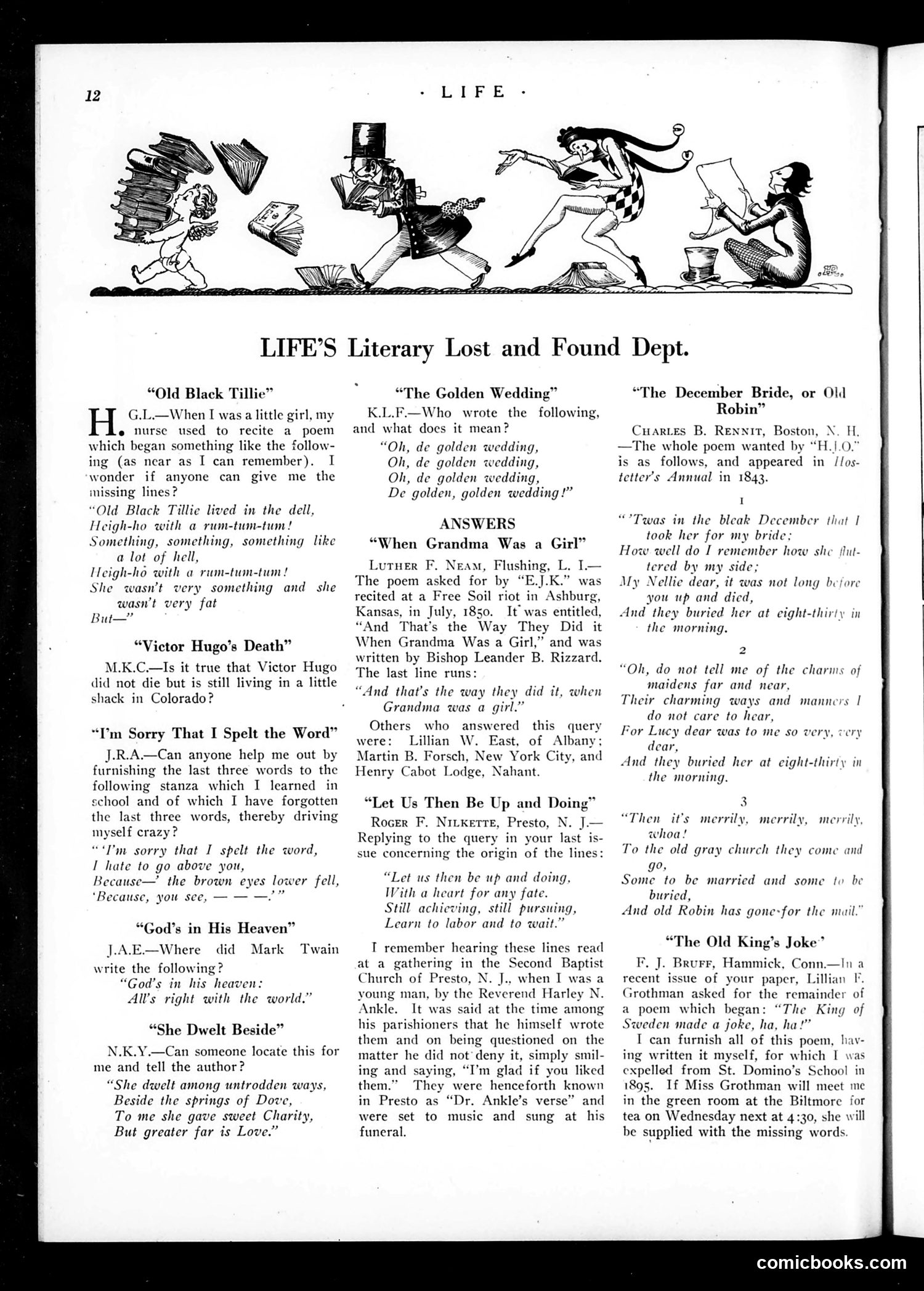
This is a humor column featuring reader queries about literary mysteries. The cartoon at the top uses whimsical illustration to depict the "lost and found" concept—showing figures in chaotic motion, with one character in formal dress (top hat) surrounded by flying papers and objects, while others scramble or fish in a bucket. The column answers reader questions about poem origins and authorship. Queries include identifying "Old Black Tillie," verifying whether Victor Hugo actually died in Colorado, and locating sources for various verses. Readers provide answers citing specific publications and people. This reflects how pre-internet audiences sought help identifying literary fragments through magazine correspondence—a common feature of early 20th-century periodicals.
📄 Transcribed text from this page (OCR, searchable)
Machine-transcribed from the original scan — historical spelling and the odd misread are preserved.
LIFE’S Literary Lost and Found Dept. “Old Black Tillie” G.L.—When I was a little girl, my e nurse used to recite a poem which began something like the follow- ing (as near as I can remember). I wonder if anyone can give me the missing lines? “Old Black Tillie lived in the dell, Heigh-ho with a rum-tum-tum! Something, something, something like a lot of hell, Heigh-ho with a rum-tum-tum! She wasn’t very something and she wasn't very fat But—”’ “Victor Hugo’s Death” M.K.C.—Is it true that Victor Hugo did not die but is still living in a little shack in Colorado? “[’'m Sorry That I Spelt the Word” J.R.A.—Can anyone help me out by furnishing the last three words to the following stanza which I learned in school and of which I have forgotten the last three words, thereby driving myself crazy? “‘T’'m sorry that I spelt the word, I hate to go above you, Because— the brown eyes lower fell, ‘Because, you see, —— —.” “God’s in His Heaven” J.A.E—Where did Mark write the following? “God's in his heaven: All’s right with the world.” Twain “She Dwelt Beside” N.K.Y.—Can someone locate this for me and tell the author? “She dwelt among untrodden ways, Beside the springs of Dove, To me she gave sweet Charity, But greater far is Love.” “The Golden Wedding” K.L.F.—Who wrote the following, and what does it mean? “Oh, de golden wedding, Oh, de golden wedding, Oh, de golden wedding, De golden, golden wedding!” ANSWERS “When Grandma Was a Girl” Lutuer F, Neam, Flushing, L. I1— The poem asked for by ‘ recited at a Free Soil riot in Kansas, in July, 1850. s entitled, “And That's the Way Did it When Grandma Was a Girl,” and was written by Bishop Leander B. Rizzard. The last line runs: “And that’s the way they did it, when Grandma was a girl.” Others who answered this query were: Lillian W. East, of Albany; Martin B. Forsch, New York City, and Henry Cabot Lodge, Nahant. shburg, “Let Us Then Be Up and Doing” Rocer F. Nivkerre, Presto, j— Replying to the query in your last sue concerning the origin of the lines: “Let us then be up and doing, rt for any fate. ving, still pursuing, Learn to labor and to wait.” I remember hearing these lines read at a gathering in the Second Baptist Church of Presto, N. J., when I was a young man, by the Reverend Harley N. Ankle. It was said at the time among his parishioners that he himself wrote them and on being questioned on the matter he did not’ deny it, simply smil- ing and saying, “I’m glad if you liked them.” They were henceforth known in Presto as “Dr. Ankle’s verse” and were set to music and sung at his funeral. “The December Bride, or Old Robin” Cuartes B. Rennit, Boston, N. H. —The whole poem wanted by “H.J.0." is as follows, and appeared in //os- tetter’s Annual in 1843. I ‘was in the bleak December that 1 took her for my bride; How well do I remember how she jlut- tered by my side; My Nellie dear, it was not long before you up and died, And they buried her at cight-thirty the morning. “Oh, do not tell me of the charms of maidens far and near, Their charming ways and manners | do not care to hear, For Lucy dear was to me so very, very dear, And they buried her at eight-thirty in the morning. 3 “Then it's merrily, merrily, whoa! To the old gray church they come and 9% Some to be married and some to be buried, And old Robin has gone-for the muil.” merrily, “The Old King’s Joke” J. Brurr, Hammick, Conn.—In a recent issue of your paper, Lillian I’. Grothman asked for the remainder of a poem which began: “The King of Sweden made a joke, ha, ha!” I can furnish all of this poem, hav- ing written it myself, for which I was expelled from St. Domino’s School in 1895. If Miss Grothman will meet me in the green room at the Biltmore for tea on Wednesday next at 4:30, she will be supplied with the missing words comicbooks.com