
Life, 1922-03-09 · page 22 of 34
Life — March 9, 1922 — page 22: what you’re looking at
What you’re looking at
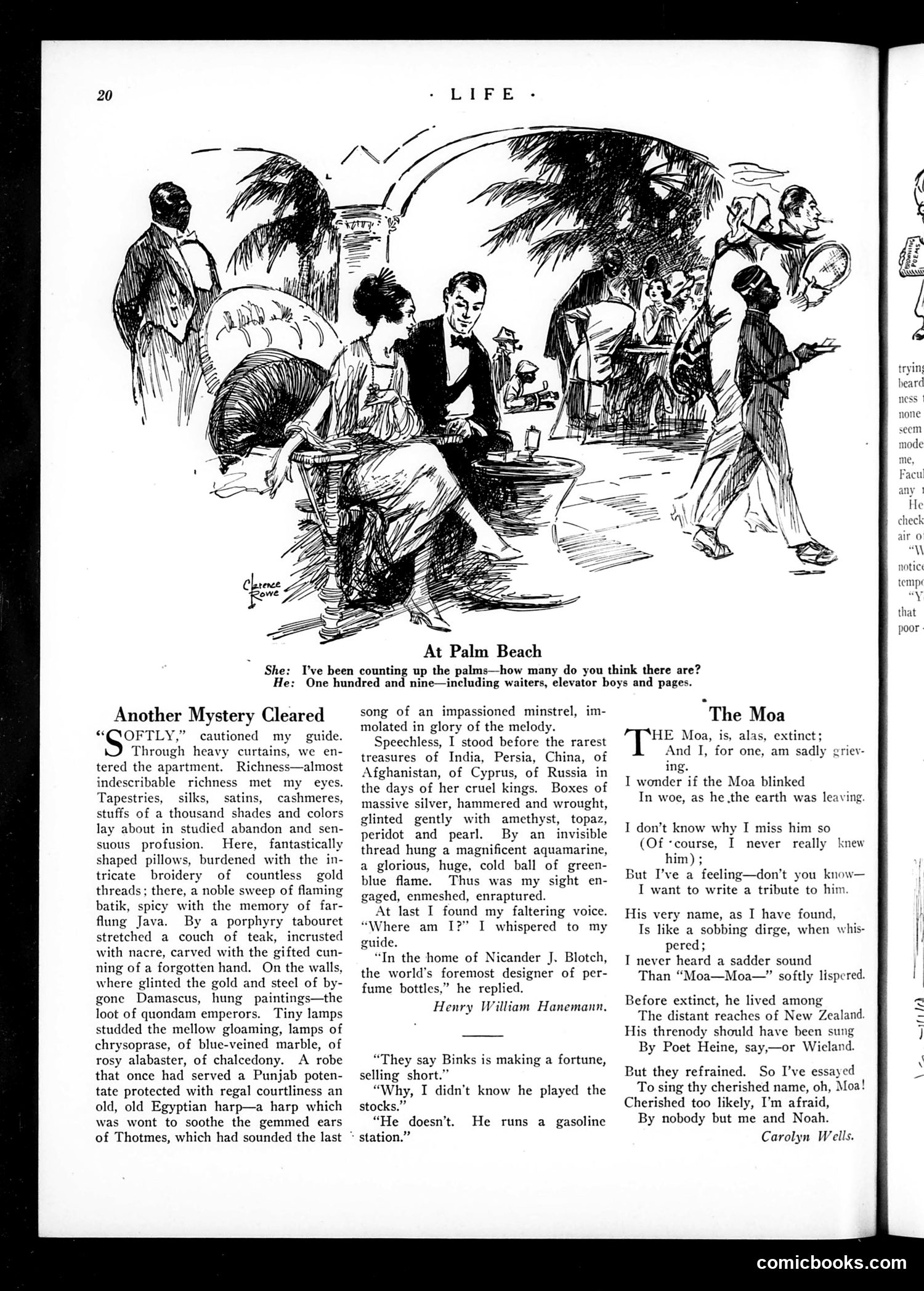
**The Cartoon ("At Palm Beach"):** This satirizes wealthy Palm Beach tourists. The joke is that when the woman counts "palms," her husband quips that most of the "palms" are actually service workers (waiters, elevator boys, pages)—a sharp commentary on the resort's dependence on a large working-class staff serving the wealthy elite. The humor targets both the naïveté of the wealthy and the invisible labor supporting their leisure. **"Another Mystery Cleared":** This is absurdist satire mocking excessive wealth and pretension. A wealthy collector's apartment is described in ornate, overwrought language befitting ancient treasures and royal artifacts—but the punchline reveals it belongs to "Nicander J. Blotch, the world's foremost designer of perfume bottles." The joke deflates pomposity: all that theatrical richness is merely from designing trivial cosmetic containers, not genuine cultural achievement. **"The Moa":** A sentimental poem about an extinct New Zealand bird, likely included for comedic contrast or as filler.
📄 Transcribed text from this page (OCR, searchable)
Machine-transcribed from the original scan — historical spelling and the odd misread are preserved.
At Palm Beach She: Ive been counting up the palms—how many do you think there are? He: One hundred and nine—including waiters, elevator boys and pages. Another Mystery Cleared “QOFTLY,” cautioned my guide. Through heavy curtains, we en- tered the apartment. Richness—almost indescribable richness met my eyes. Tapestries, silks, satins, cashmeres, stuffs of a thousand shades and colors lay about in studied abandon and sen- suous profusion. Here, fantastically shaped pillows, burdened with the in- tricate broidery of countless gold threads; there, a noble sweep of flaming batik, spicy with the memory of far- flung Java. By a porphyry tabouret stretched a couch of teak, incrusted with nacre, carved with the gifted cun- ning of a forgotten hand. On the walls, where glinted the gold and steel of by- gone Damascus, hung paintings—the loot of quondam emperors. Tiny lamps studded the mellow gloaming, lamps of chrysoprase, of blue-veined marble, of rosy alabaster, of chalcedony. A robe that once had served a Punjab poten- tate protected with regal courtliness an old, old Egyptian harp—a harp which was wont to soothe the gemmed ears of Thotmes, which had sounded the last song of an impassioned minstrel, im- molated in glory of the melody. Speechless, I stood before the rarest treasures of India, Persia, China, of Afghanistan, of Cyprus, of Russia in the days of her cruel kings. Boxes of massive silver, hammered and wrought, glinted gently with amethyst, topaz, peridot and pearl. By an_ invisible thread hung a magnificent aquamarine, a glorious, huge, cold ball of green- blue flame. Thus was my sight en- gaged, enmeshed, enraptured. At last I found my faltering voice. “Where am 1?” I whispered to my guide. “In the home of Nicander J. Blotch, the world’s foremost designer of per- fume bottles,” he replied. Henry William Hanemann, “They say Binks is making a fortune, selling short.” “Why, I didn’t know he played the stocks,” “He doesn’t. He runs a gasoline * station.” “The Moa HE Moa, is, alas, extinct; And I, for one, am sadly griev- ing. I wonder if the Moa blinked In woe, as he the earth was leaving. I don’t know why I miss him so (Of ‘course, I never really knew him) ; But I’ve a feeling—don’t you know— I want to write a tribute to him. His very name, as I have found, Is like a sobbing dirge, when whis- pered; I never heard a sadder sound Than “Moa—Moa—” softly lispered. Before extinct, he lived among The distant reaches of New Zealand. His threnody should have been sung By Poet Heine, say,—or Wieland. But they refrained. So I’ve essayed To sing thy cherished name, oh, Moa! Cherished too likely, I’m afraid, By nobody but me and Noah. Carolyn Wells. tryin; beard notice tempi that poor comicbooks.com