
Life, 1922-03-09 · page 24 of 34
Life — March 9, 1922 — page 24: what you’re looking at
What you’re looking at
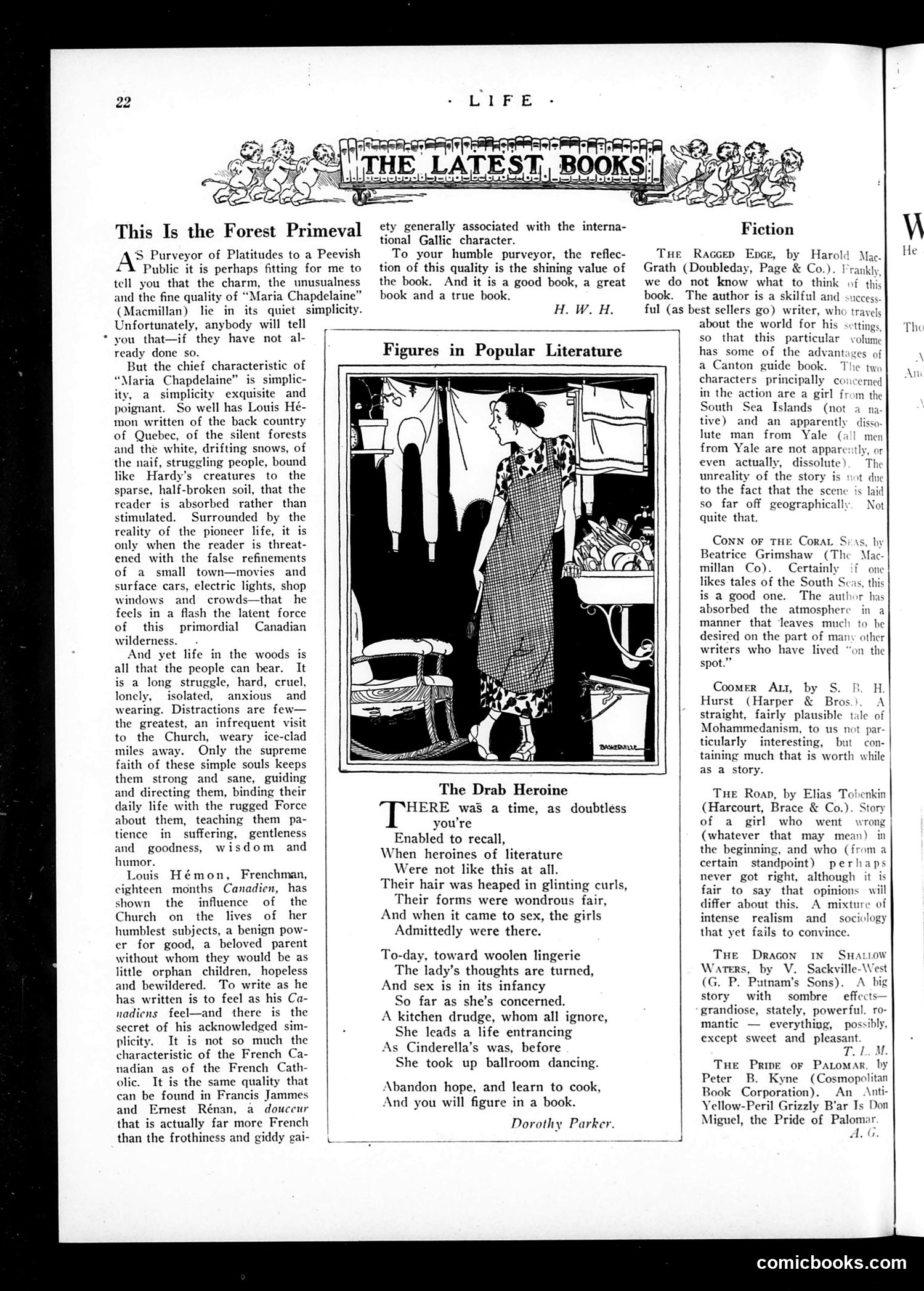
This page features a literary essay by Dorothy Parker critiquing the evolution of female characters in fiction. Parker contrasts the heroines of earlier literature—women with "glinting curls" and "wondrous fair" forms who were sexually alluring and passive—with modern literary heroines who are more complex and less idealized. The essay's title sarcastically refers to contemporary fiction's move away from romanticized female characters. Parker notes that modern heroines lack the glamour of their predecessors: they're "kitchen drudge[s]" without Cinderella's transformative potential. She suggests this shift reflects changing literary realism, where women are depicted as ordinary rather than idealized. The surrounding book reviews discuss various novels, including *Maria Chapdelaine* (praised for its simple realism about pioneer life) and works set in exotic locations like the South Seas. The page represents *Life* magazine's literary criticism section, typical of 1920s-era American magazine publishing.
📄 Transcribed text from this page (OCR, searchable)
Machine-transcribed from the original scan — historical spelling and the odd misread are preserved.
ety generally associated with the interna- i . Fiction This Is the Forest Primeval tional Gallic character. 'S Purveyor of Platitudes to a Peevish To your humble purveyor, the reflec- Tue Racceo Epce, by Harold Mac} He LA Public it is perhaps fitting for me to tion of this quality is the shining value of Grath (Doubleday, Page & Co.). !’rankly tell you that the charm, the unusualness the book. And it is a good book, a great we do not know what to think of this and the fine quality of “Maria Chapdelaine” book and a true book. book. The author is a skilful and (Macmillan) lie in its quiet simplicity. H.W. H. ful (as best sellers go) writer, who travels Unfortunately, anybody will tell about the world for his settings, The you that—if they have not al- ready done so. But the chief characteristic of “Maria Chapdelaine” is simplic- ity, a simplicity exquisite and poignant. So well has Louis Hé- mon written of the back country of Quebec, of the silent forests and the white, drifting snows, of the naif, struggling people, bound like Hardy's creatures to the sparse, half-broken soil, that the reader is absorbed rather than stimulated. Surrounded by the reality of the pioneer life, it is only when the reader is threat- ened with the false refinements Beatrice Grimshaw (The _Mae- of a small town—movies and millan Co). Certainly f one surface cars, electric lights, shop likes tales of the South Seas, this windows and crowds—that he is a good one. The author has feels in a flash the latent force absorbed the atmosphere in a of this primordial Canadian manner that leaves much to be eildcrness: desired on the part of many other And yet life in the woods is we epenwne nave lived. “onthe all that the people can bear. It spot. is a long struggle, hard, cruel, Coomer Aut, by S. BR. H lonely, isolated, anxious and Hurst (Harper & Bros.) A wearing. Distractions are few— | straight, fairly plausible tale of the greatest, an infrequent. v | Mohammedanism, to us not par- | to the Church, weary ice-clad | ticularly interesting, but con- miles away. Only the supreme faith of these simple souls keeps them strong and sane, guiding and directing them, binding their daily life with the rugged Force about them, teaching them pa- voiltre Cf Gill ‘who. went wrone| a oA eulfering, | eenteness Enabled to recall, Atateyer that rey mean) in al odness, wis ; *, . Cr, ‘ rom a # fi ik i standpoi perhaps Louis Hémon, Frenchman, Were not like this at all. eighteen months Canadien, has shown the influence of the Church on the lives of her humblest subjects, a benign pow- er for good, a beloved parent 7 Figures in Popular Literature The Drab Heroine HERE was a time, as doubtless Their hair was heaped in glinting curls, Their forms were wondrous fair, And when it came to sex, the girls Admittedly were there. so that this particular has some of the advantag: a Canton guide book. 7 characters principally in the ion are a girl from the South Sea Islands (not tive) and an apparently lute man from Yale (all from Yale are not appar even actually, dissolute) unreality of the story is: to the fact that the scen so far off geographically quite that. cerned a na Conn oF THE Cora Sis, by taining much that is worth while | as a story. Tue Roan, by Elias Tolenkin (Harcourt, Brace & Co.). Story never got right, although it is fair to say that opinions will differ about this. A mixture of intense realism and sociclogy that yet fails to convince. without whom they would be as To-day, toward woolen lingerie Tue Dracon IN SHatiow little orphan children, hopeless The lady’s thoughts are turned, Waters, by V. Sackville-\West and bewildered. To write as he And sex is in its infancy (G. P. Putnam's Sons). A big has written is to feel as his Ca- So far as she’s concerned. a ci i aoe ’ stecis nagiens econ anes i the A kitchen drudge, whom all ignore, rane se ‘every hii - pos i secret of his acknowledged sim- = 5 A zi ia a ssibly, characteristic of the French Ca- ; "She ¢ k halt” ae PLM nadian as of the French Cath- She took up ballroom dancing. THE Prive or Patomar. by olic. It is the same quality that Peter B. Kyne (Cosmopolitan can be found in Francis Jammes and Emest Rénan, a douceur that is actually far more French than the frothiness and giddy gai- \bandon hope, and learn to cook, And you will figure in a book. Dorothy Parker. aM EN = ee Book Corporation). An Anti- Yellow-Peril Grizzly B’ar Is Don Miguel, the Pride of Palomar AG comicbooks.com