
Life, 1922-03-09 · page 16 of 34
Life — March 9, 1922 — page 16: what you’re looking at
What you’re looking at
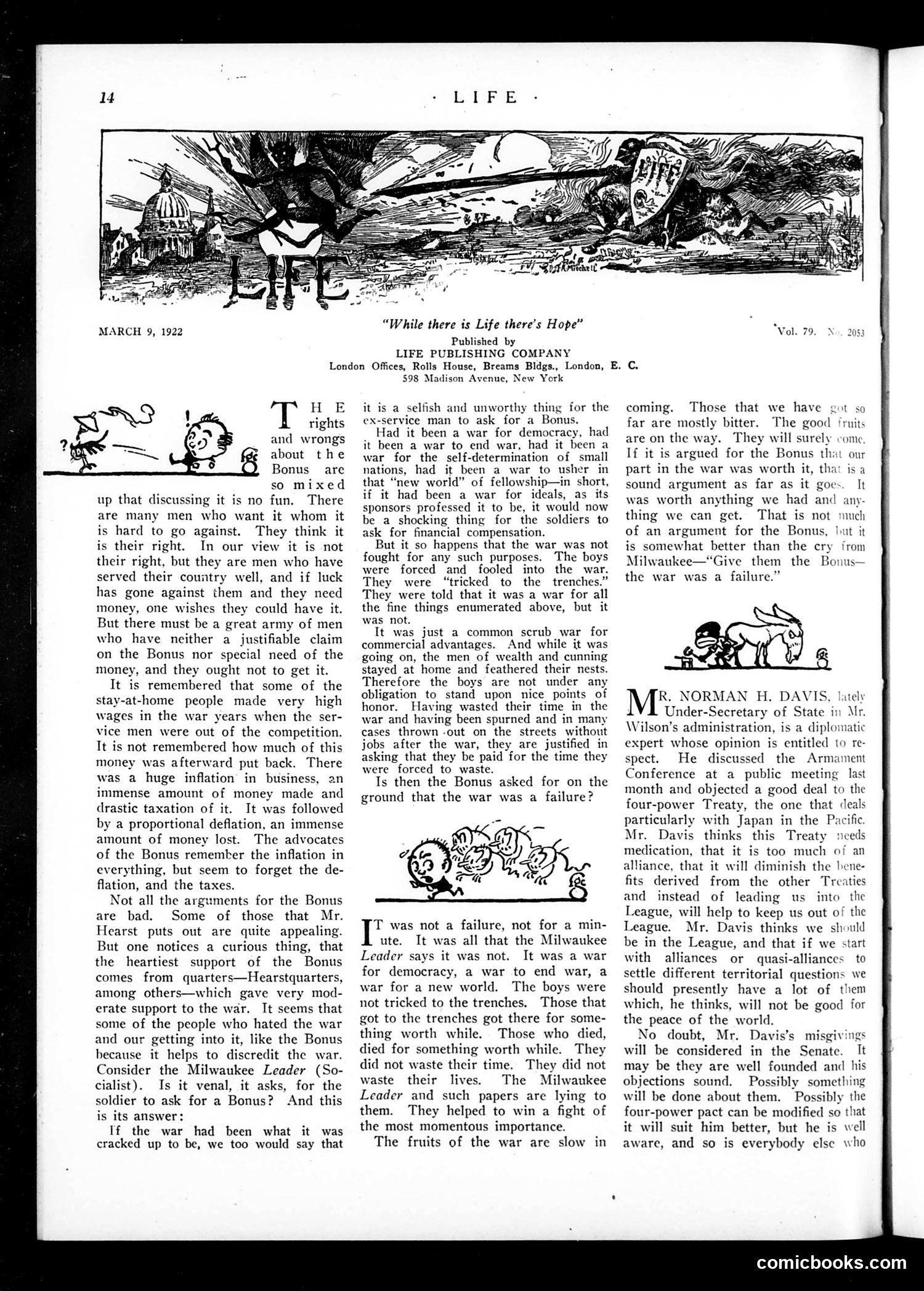
This March 9, 1922 *Life* editorial page addresses the post-WWI "Bonus" debate—whether soldiers deserved financial compensation beyond their wages for military service. The article argues **against** the bonus, claiming it's "selfish" for ex-servicemen to demand extra pay. The author contends the war itself was fought for ideals, not profit, and soldiers shouldn't expect additional reward. The small cartoon illustrations (children fighting) satirize bonus advocates, suggesting their demands are childish squabbling. The page also discusses **Norman H. Davis**, Under-Secretary of State, who opposed the Four-Power Treaty with Japan as too restrictive. The satire targets those seeking financial bonuses while simultaneously criticizing diplomatic caution—reflecting post-war American isolationism and fiscal conservatism.
📄 Transcribed text from this page (OCR, searchable)
Machine-transcribed from the original scan — historical spelling and the odd misread are preserved.
MARCH 9, 1922 “While there is Life there’s Hope” Published by LIFE PUBLISHING COMPANY London Offices, Rolls House, Breams Bldgs., London, E. C. T H E rights and wrongs about the Bonus are so mixed up that discussing it is no fun. There are many men who want it whom it is hard to go against. They think it is their right. In our view it is not their right, but they are men who have served their country well, and if luck has gone against them and they need money, one wishes they could have it. But there must be a great army of men who have neither a justifiable claim on the Bonus nor special need of the money, and they ought not to get it. It is remembered that some of the stay-at-home people made very high wages in the war years when the ser- vice men were out of the competition. It is not remembered how much of this money was afterward put back. There was a huge inflation in business, an immense amount of money made and drastic taxation of it. It was followed by a proportional deflation, an immense amount of money lost. The advocates of the Bonus remember the inflation in everything, but seem to forget the de- flation, and the taxes. Not all the arguments for the Bonus are bad. Some of those that Mr. Hearst puts out are quite appealing. But one notices a curious thing, that the heartiest support of the Bonus comes from quarters—Hearstquarters, among others—which gave very mod- erate support to the war. It seems that some of the people who hated the war and our getting into it, like the Bonus because it helps to discredit the war. Consider the Milwaukee Leader (So- cialist). Is it venal, it asks, for the soldier to ask for a Bonus? And this is its answer: If the war had been what it was cracked up to be, we too would say that 598 Madison Avenue, New York it is a selfish and unworthy thing for the ex-service man to ask for a Bonus. Had it been a war for democracy, had it been a war to end war, had it been a war for the self-determination of small nations, had it been a war to usher in that “new world” of fellowship—in short, if it had been a war for ideals, as its sponsors professed it to be, it would now be a shocking thing for the soldiers to ask for financial compensation. But it so happens that the war was not fought for any such purposes. The boys were forced and fooled into the war. They were “tricked to the trenches.” They were told that it was a war for all the fine things enumerated above, but it was not. It was just a common scrub war for commercial advantages. And while it was going on, the men of wealth and cunning stayed at home and feathered their nests. Therefore the boys are not under any obligation to stand upon nice points of honor. Having wasted their time in the war and having been spurned and in many cases thrown -out on the streets without jobs after the war, they are justified in asking that they be paid for the time they were forced to waste. Is then the Bonus asked for on the ground that the war was a failure? BSA « T was not a failure, not for a min- ute. It was all that the Milwaukee Leader says it was not. It was a war for democracy, a war to end war, a war for a new world. The boys were not tricked to the trenches. Those that got to the trenches got there for some- thing worth while. Those who died, died for something worth while. They did not waste their time. They did not waste their lives. The Milwaukee Leader and such papers are lying to them. They helped to win a fight of the most momentous importance. The fruits of the war are slow in coming. Those that we have got so far are mostly bitter. The good /ruits are on the way. They will surely come If it is argued for the Bonus that our part in the war was worth it, that is a sound argument as far as it goes. It was worth anything we had and any- thing we can get. That is not much of an argument for the Bonus, |ut it is somewhat better than the cry from Milwaukee—“Give them the war was a failure.” the Bonus— R. NORMAN H. DAVIS, lately Under-Secretary of State in Mr. Wilson’s administration, is a diplomatic expert whose opinion is entitled to re- spect. He discussed the Armament Conference at a public meeting last month and objected a good deal to the four-power Treaty, the one that deals particularly with Japan in the i Mr. Davis thinks this Treaty medication, that it is too much of an alliance, that it will diminish the hene- fits derived from the other Treaties and instead of leading us into the League, will help to keep us out of the League. Mr. Davis thinks we should be in the League, and that if we start with alliances or quasi-alliances to settle different territorial questions we should presently have a lot of them which, he thinks, will not be good for the peace of the world. No doubt, Mr. Davis’s misgivings will be considered in the Senate. It may be they are well founded and his objections sound. Possibly something will be done about them. Possibly the four-power pact can be modified so that it will suit him better, but he is well aware, and so is everybody else who comicbooks.com