
A complete issue · 34 pages · 1921
Life — December 22, 1921
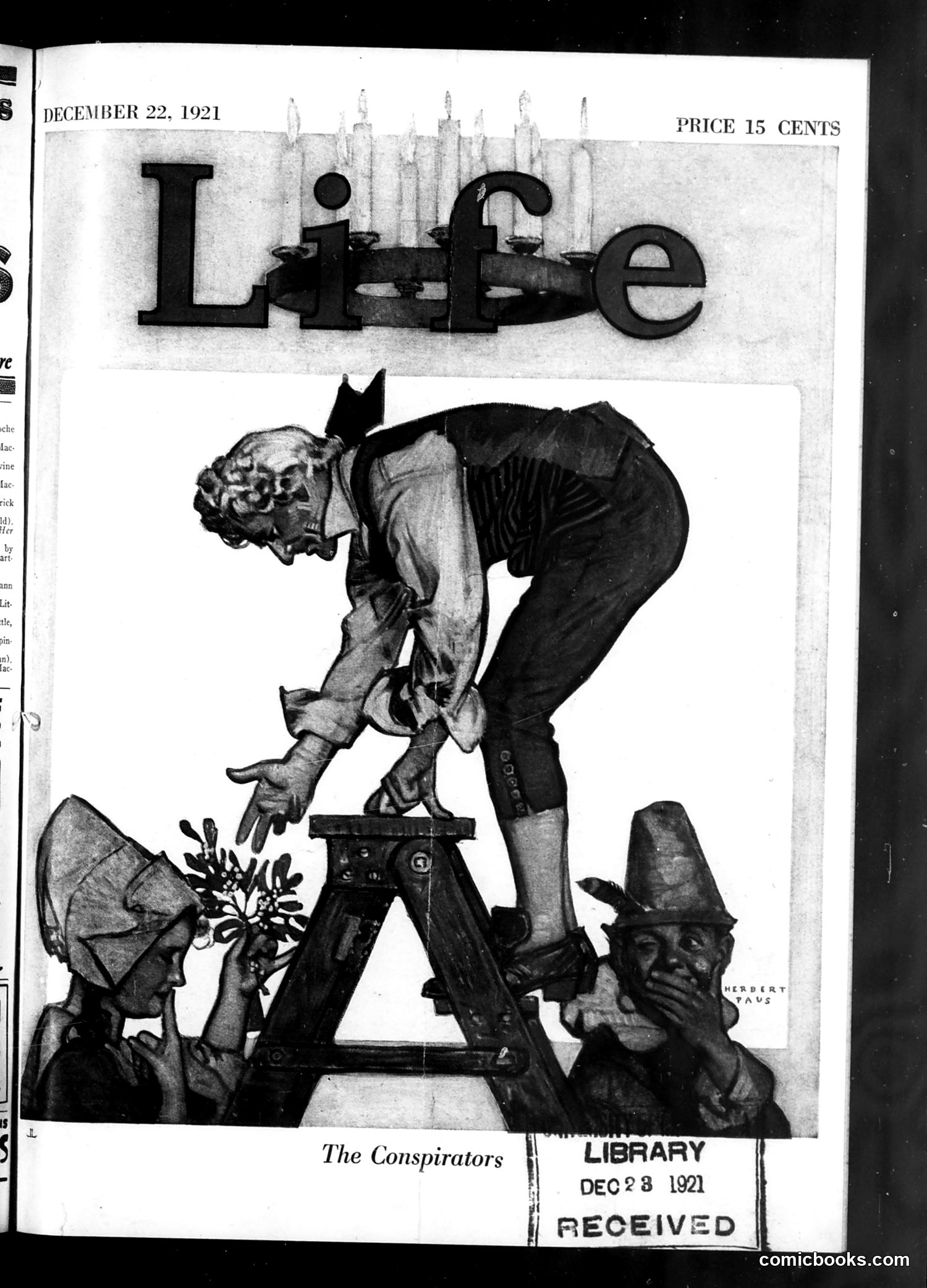
This satirical cover depicts three figures labeled "The Conspirators." A man stands on a ladder/platform in the center, bending over in an exaggerated pose, while two smaller gnome-like or imp-like creatures sit beneath him—one holding what appears to be flowers or a plant, the other in formal attire. The specific political or social conspiracy being referenced is unclear without additional context from the magazine's interior. The grotesque caricatured figures suggest mockery of particular public figures or groups involved in contemporary events of late 1921. The distorted body language and cartoonish styling indicate the cartoonist (signed "Herbert Paus") intended ridicule of whoever "the conspirators" represented to readers of that era.
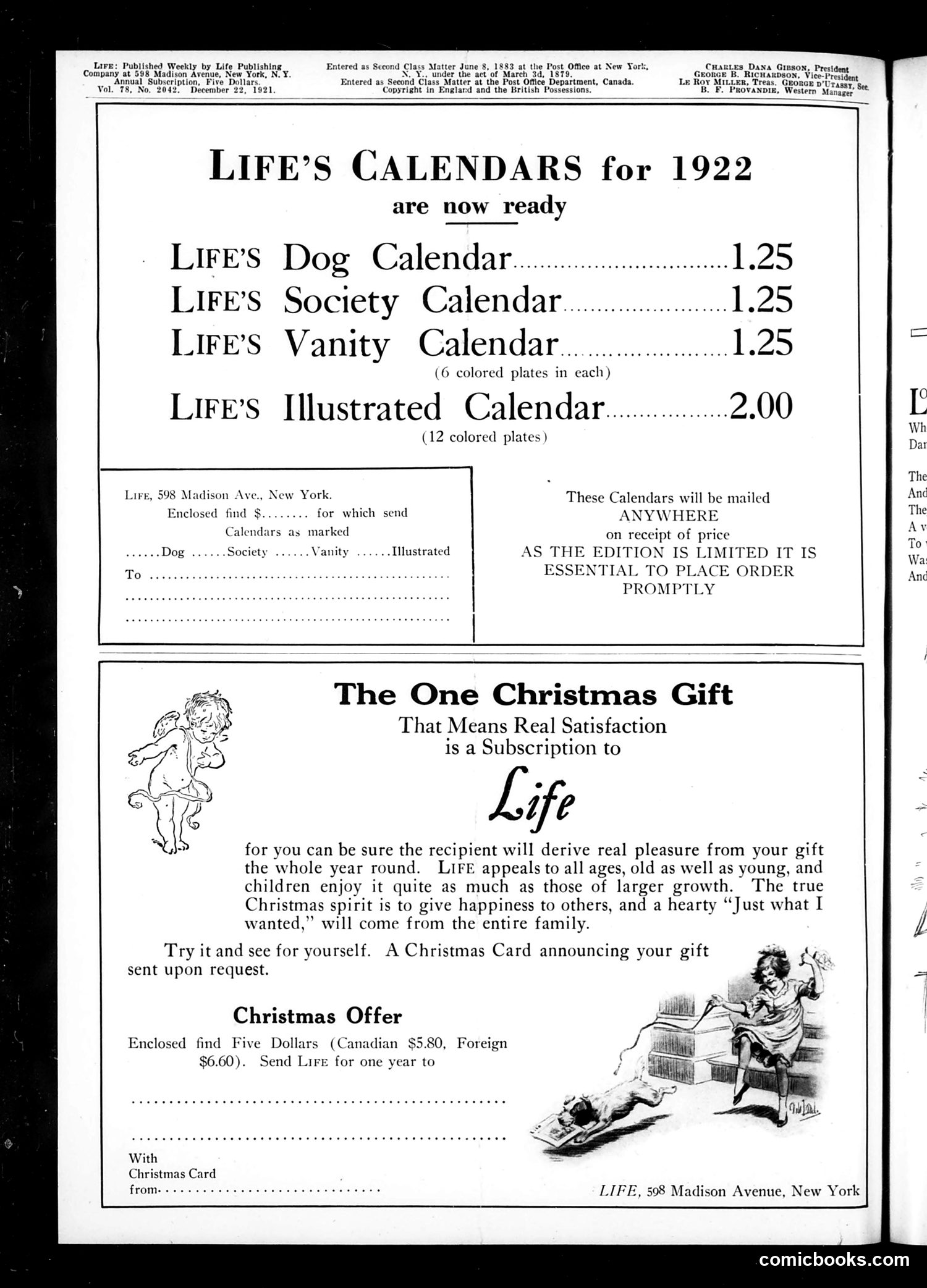
This page is primarily **advertising**, not satire or political commentary. It consists of two promotional sections from *Life* magazine (dated December 22, 1921): 1. **Calendar Advertisement**: Promotes *Life*'s 1922 calendars in various styles (Dog, Society, Vanity, and Illustrated), priced $1.25–$2.00, with an order form. 2. **Christmas Gift Promotion**: The lower section advertises a *Life* magazine subscription as a Christmas gift. It features decorative illustrations of cherubs/putti (classical winged children figures) in winter scenes with sleds and books—typical Victorian-style holiday imagery meant to convey joy, gift-giving, and intellectual pleasure. The text emphasizes that a *Life* subscription appeals "to all ages, old as well as young" and embodies the "true Christmas spirit." There is no political satire present on this page.
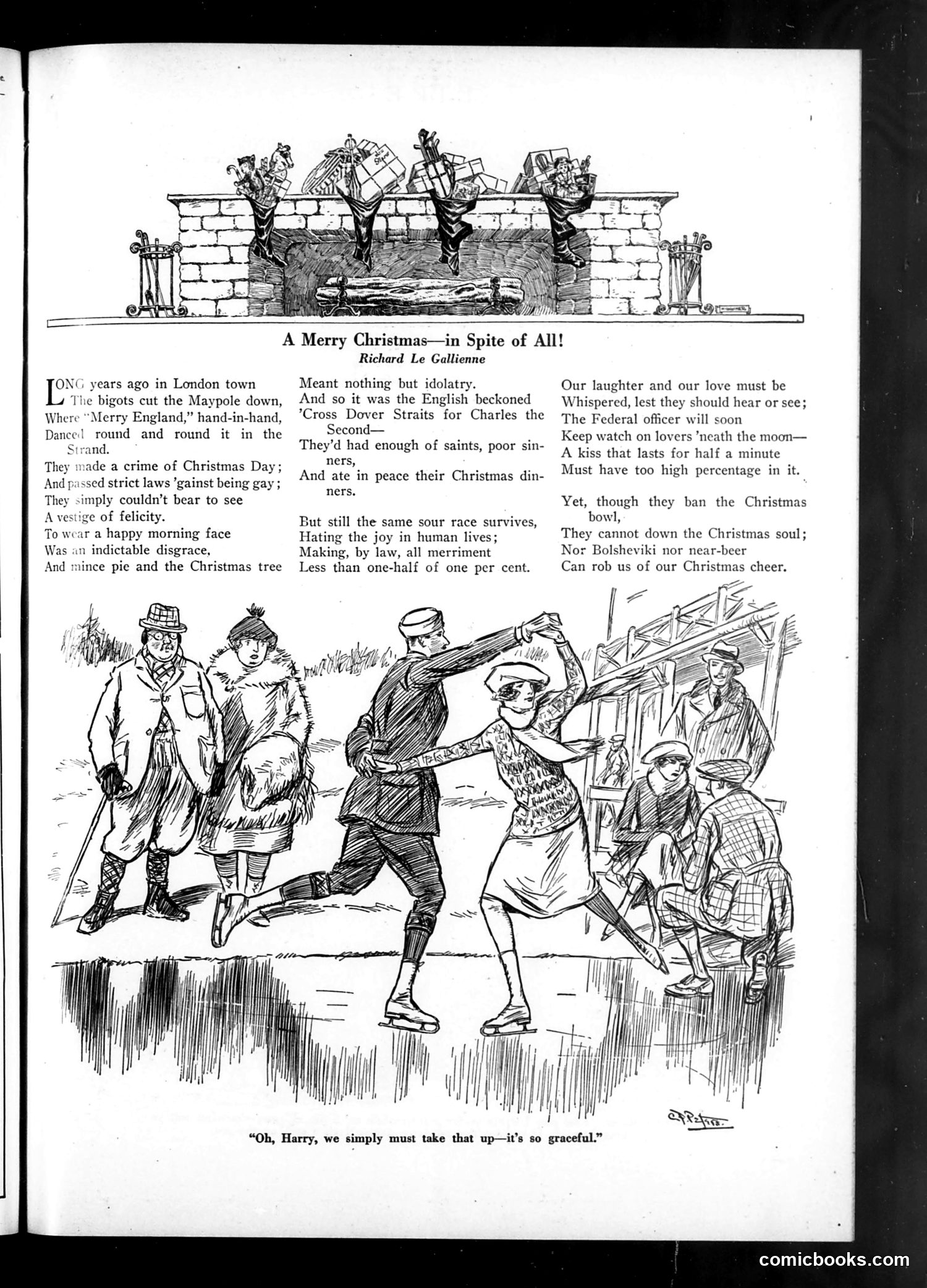
This satirical poem by Richard Le Gallienne critiques early 20th-century authorities who banned Christmas celebrations. The text references historical instances when officials (identified as "bigots") suppressed Christmas observances in London, calling them "idolatry" and forbidding festive behavior. The illustration depicts ice-skating youth defying such restrictions—continuing Christmas revelry despite prohibition. The caption, "Oh, Harry, we simply must take that up—it's so graceful," suggests young people ironically maintaining holiday joy despite bans. The poem's message: oppressive authorities cannot suppress human happiness and Christmas spirit. Even when legal restrictions attempt to eliminate festive celebration, the desire for Christmas cheer persists—the "Christmas soul" cannot be extinguished by Bolsheviks, Federal officers, or other killjoys.
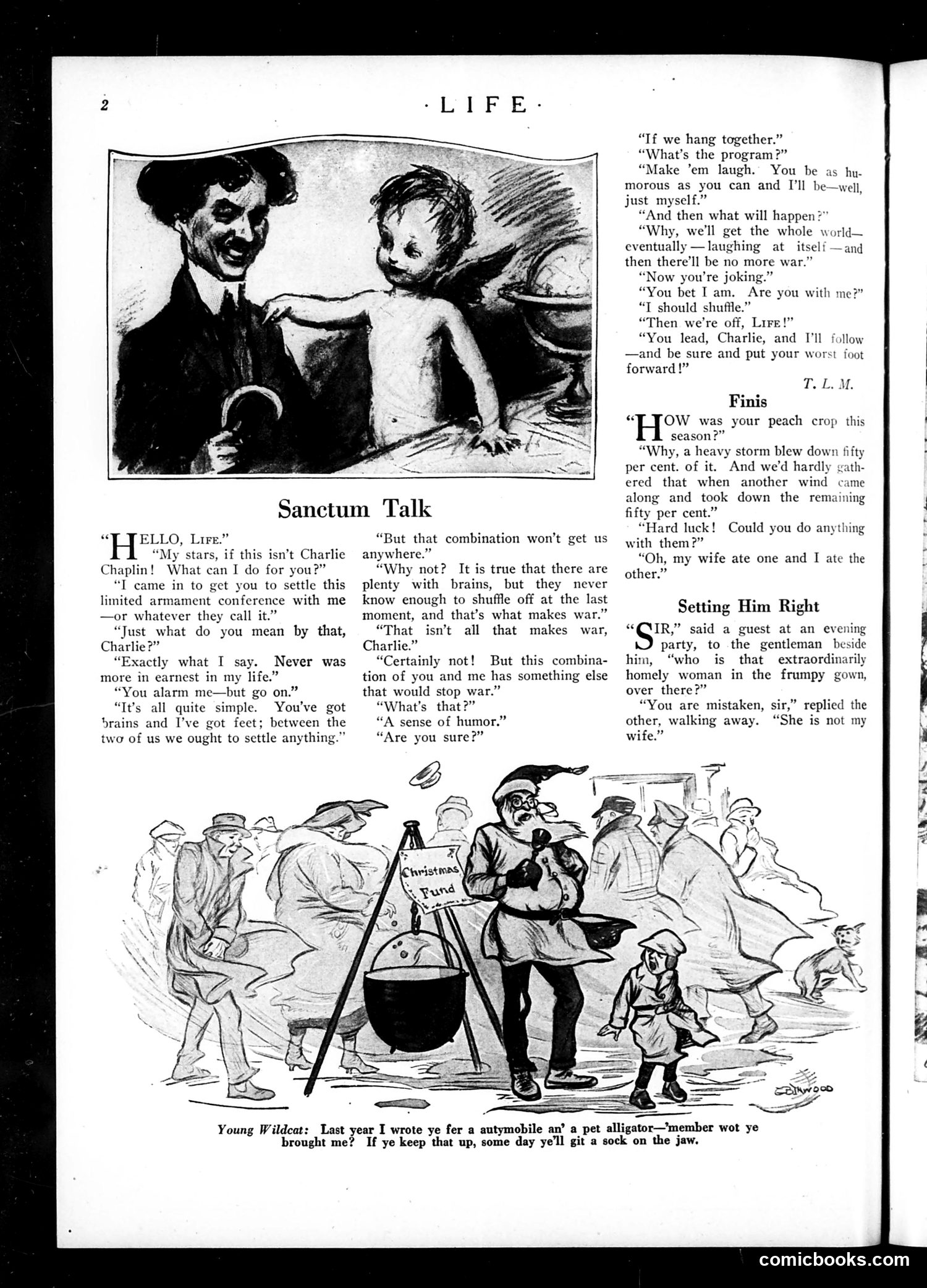
**"Sanctum Talk"** features a conversation between two figures—one identified as "Charlie" (likely a recurring character). The dialogue satirizes WWI peace efforts through dark humor: they propose making the world laugh to end war, suggesting humor as a solution to conflict. The exchange mocks naive optimism about resolving the war through absurd means. **"Finis"** presents a brief rural anecdote about crop damage, offering comic relief. **"Setting Him Right"** depicts a social comedy where a guest mistakes a woman's identity at a party, leading to an awkward correction—standard domestic humor of the era. The large cartoon below shows a military Christmas scene with soldiers and what appears to be wartime satire, though specific context requires clearer identification of the central figure.
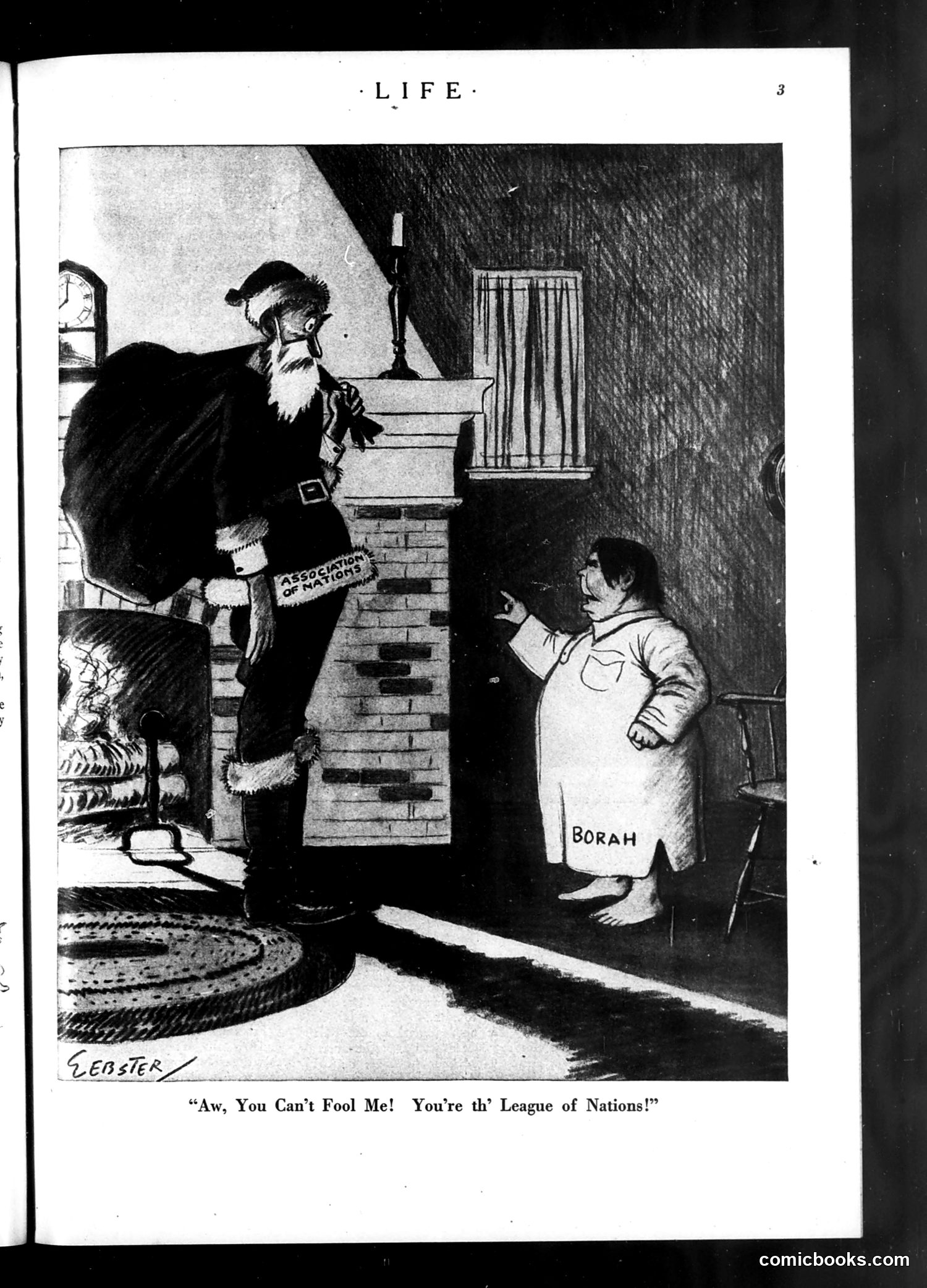
This cartoon satirizes the League of Nations' ineffectiveness. An elderly bearded figure (likely representing the League of Nations itself) stands at a door labeled "LEAGUE OF NATIONS," holding what appears to be official documents. A child labeled "BORAH" confronts him with the taunt: "Aw, You Can't Fool Me! You're th' League of Nations!" The joke targets Senator William Borah, a prominent isolationist who opposed U.S. membership in the League. By depicting him as a child seeing through the League's pretenses, the cartoon mocks Borah's skepticism while simultaneously suggesting the League lacks real authority or legitimacy—even a child can recognize it's ineffectual. The satire works on multiple levels, criticizing both American isolationism and the League's actual impotence.
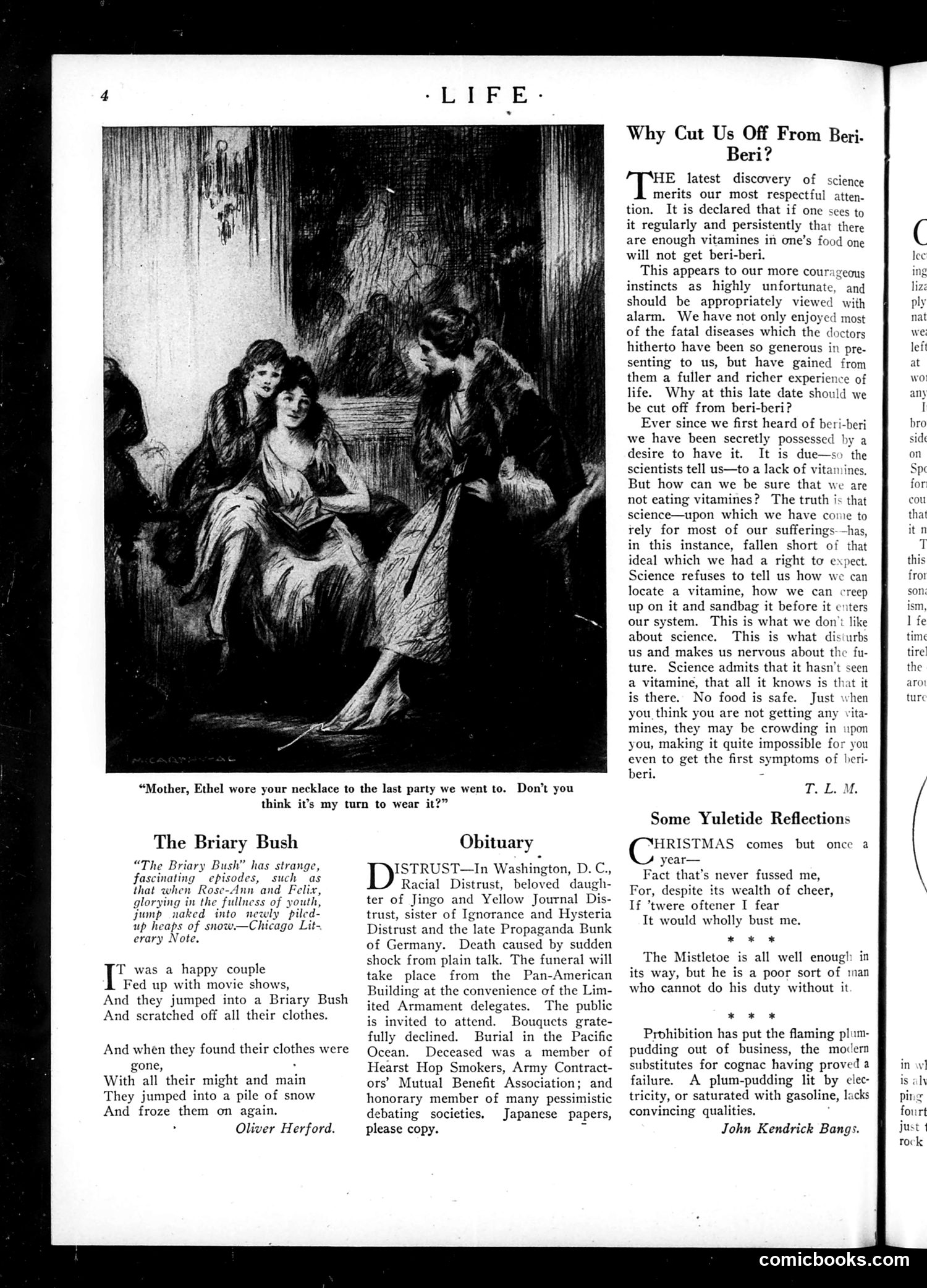
**Main Illustration & Caption:** The large illustration depicts a domestic scene with the caption: "Mother, Ethel wore your necklace to the last party we went to. Don't you think it's my turn to wear it?" This appears to be satirizing social pretension and materialism among the wealthy—specifically mocking women's obsession with jewelry and competitive display at social events. **"The Briary Bush" Poem:** Oliver Herford's humorous verse describes a couple undressing after going to movies, jumping into snow fully clothed, then freezing again. It's lighthearted physical comedy satirizing impulsive behavior and courtship customs. **Other Content:** The page includes an obituary, reflections on Christmas (by John Kendrick Bangs), and an article about vitamin deficiency ("beri-beri"), representing typical magazine miscellany rather than unified satire.
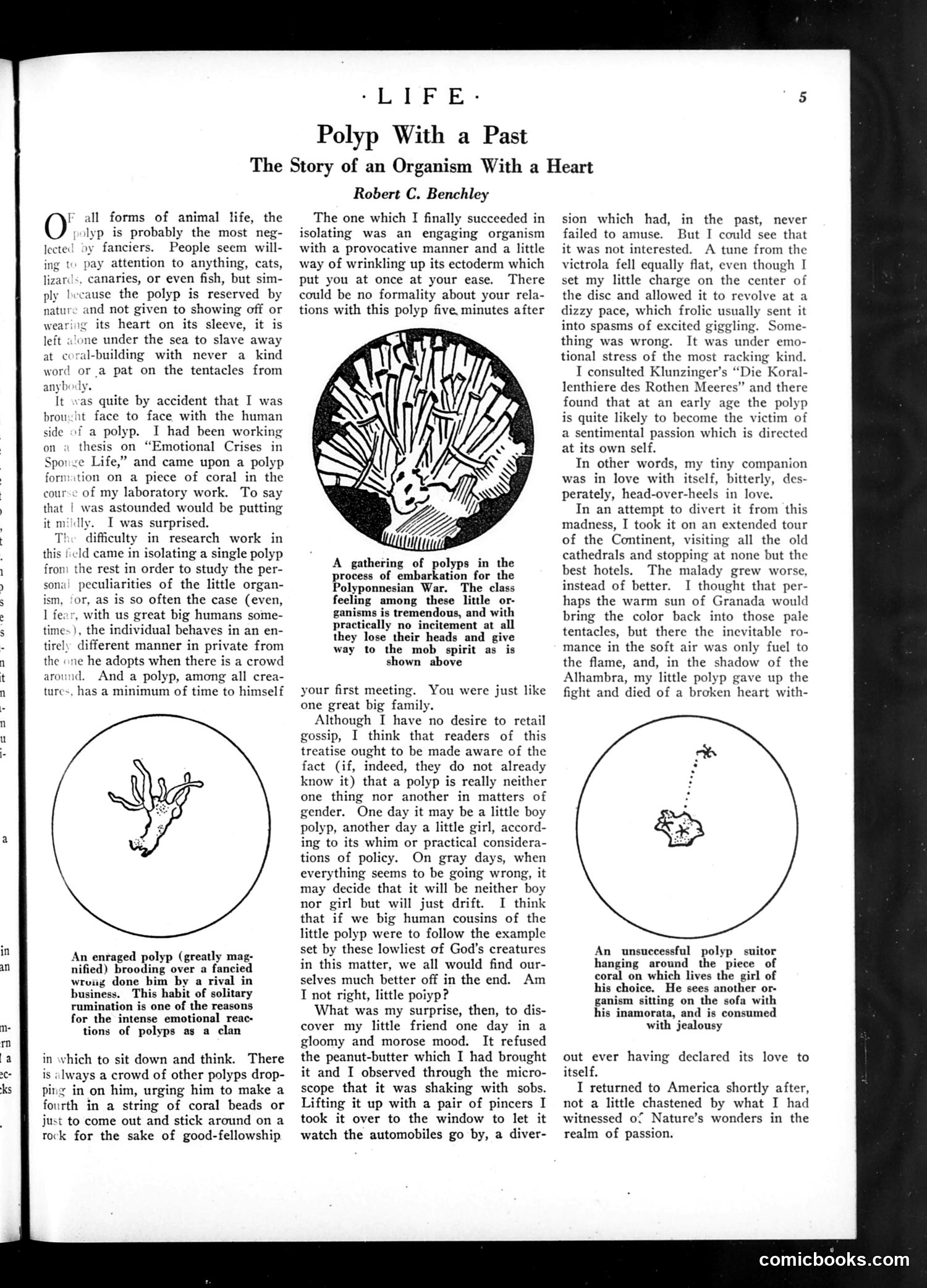
This is a humorous scientific essay by Robert C. Benchley about a polyp (a small marine organism) that unexpectedly displays emotional behavior—specifically, romantic attachment to itself and heartbreak. The illustrations show the polyp's form and a depicted scene of it viewing passing automobiles. The satire is gentle and whimsical rather than political: Benchley anthropomorphizes the polyp, attributing human emotions and vulnerabilities to a creature that "should" lack such capacities. The humor lies in treating this tiny, primitive organism with the emotional complexity of a human character—it becomes melancholic, falls in love with itself, experiences jealousy, and ultimately dies of heartbreak during a trip to Europe. This reflects Benchley's characteristic style: using scientific subjects as vehicles for absurdist comedy and social commentary about human nature.
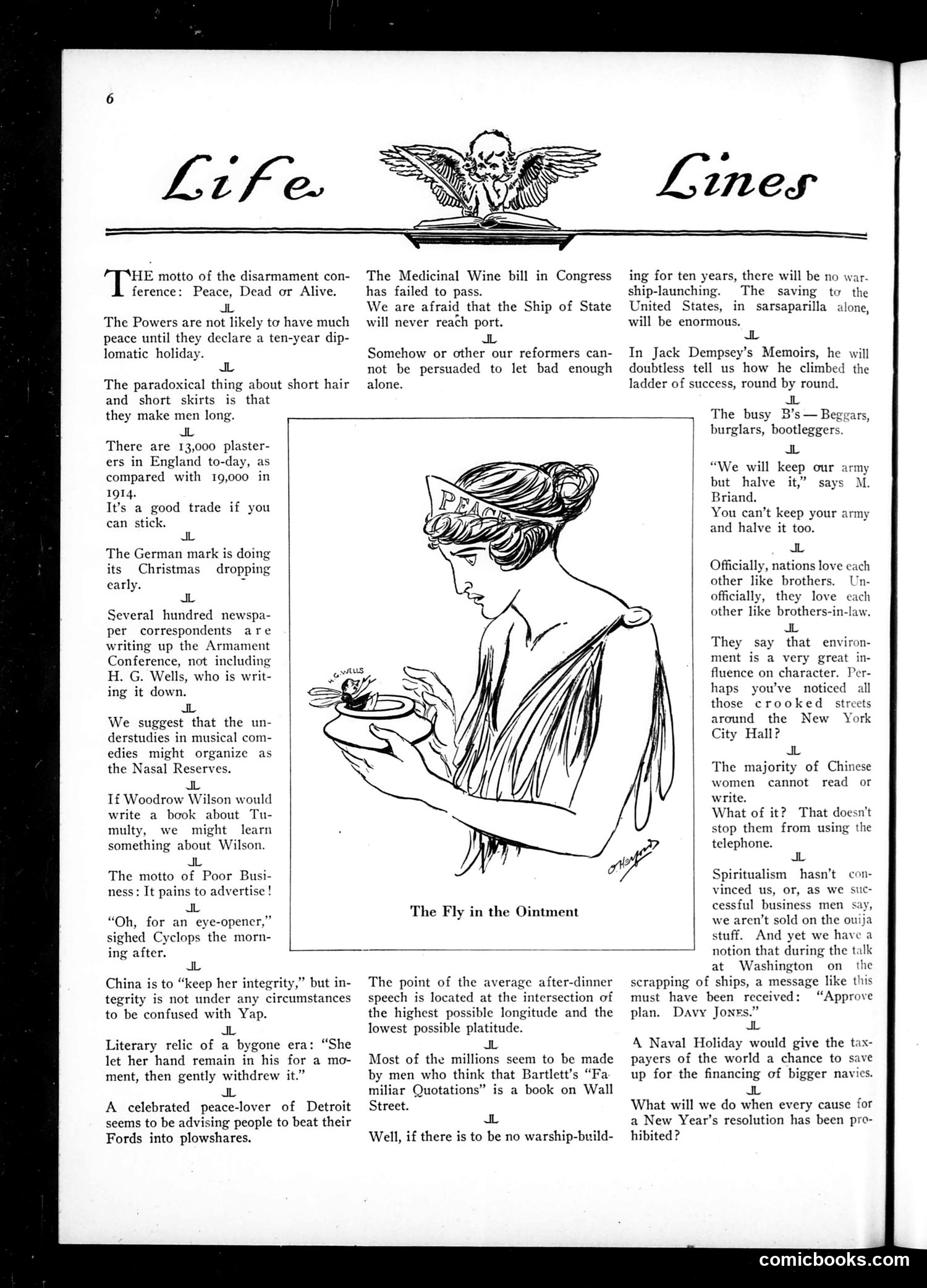
This is a satirical illustration of an elegant woman holding a small fly on her fingertip. The cartoon's caption references a common proverb about something small spoiling something otherwise perfect. The accompanying text discusses various social and political observations of the era, including comments on: - Peace negotiations and disarmament conferences - Economic conditions (plasters/unemployment in England) - Gender and fashion commentary - International relations and character formation - Chinese women's literacy - Business and spiritualism The cartoon likely represents a contemporary concern about a seemingly minor issue disrupting broader social or political harmony, though the specific "fly" isn't explicitly identified in the visible text. The illustration's style and subject matter are typical of Life magazine's satirical approach to early 20th-century American society.
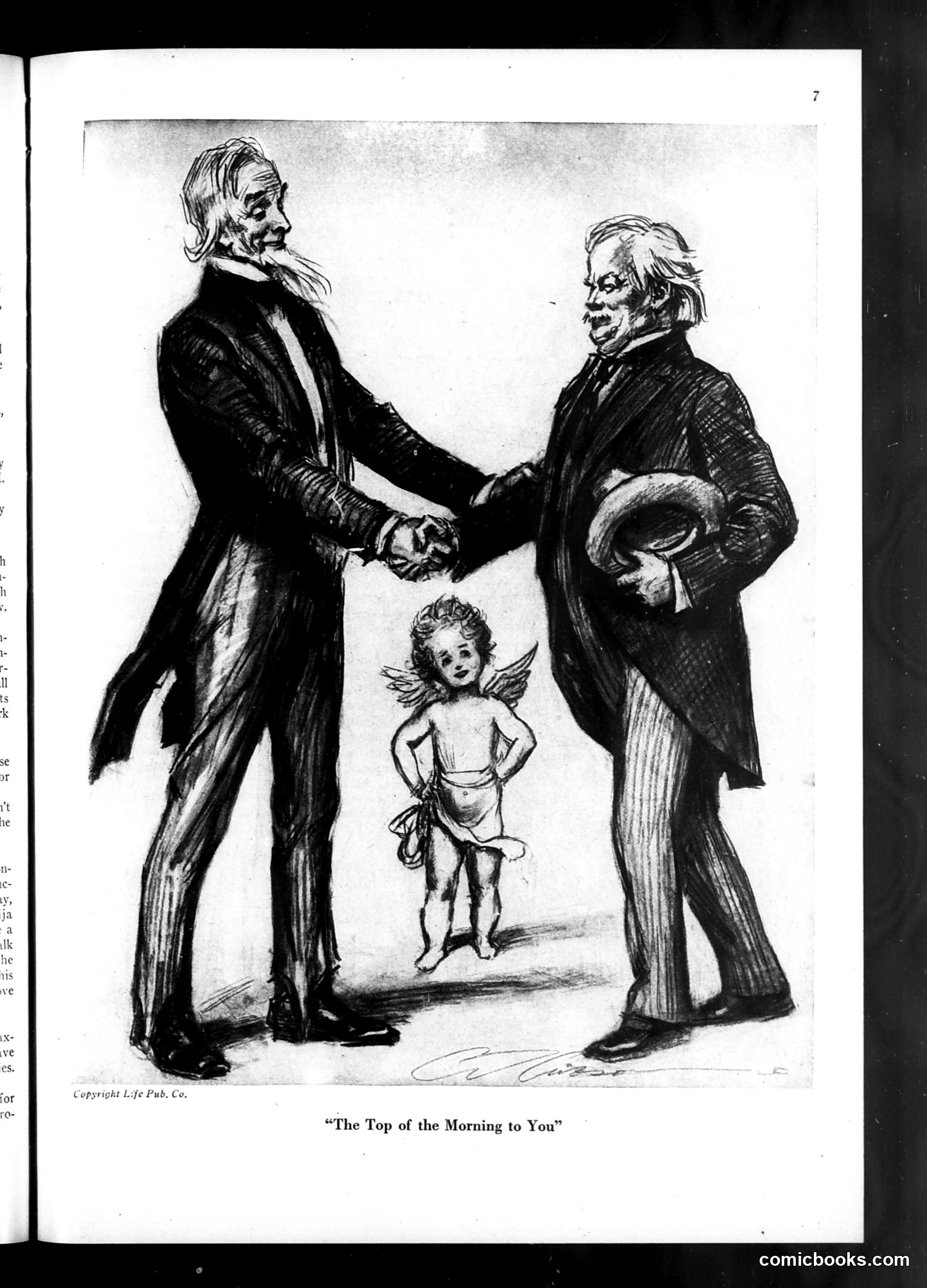
This cartoon depicts two gentlemen in formal Victorian dress shaking hands over a cherub figure. The title is an Irish greeting, suggesting the cartoon comments on Irish-American relations or immigration. The composition—with two adult figures clasping hands above a child-like angelic figure—likely satirizes some form of agreement or deal-making involving Irish interests. The cherub's positioning between them suggests innocence caught in adult negotiations, possibly commenting on how Irish-Americans or Irish affairs were being handled or exploited by political figures. Without additional context from the magazine's date and editorial content, the specific political situation remains unclear, but the image evidently critiques some arrangement between parties regarding Irish or Irish-American concerns during Life magazine's satirical period.
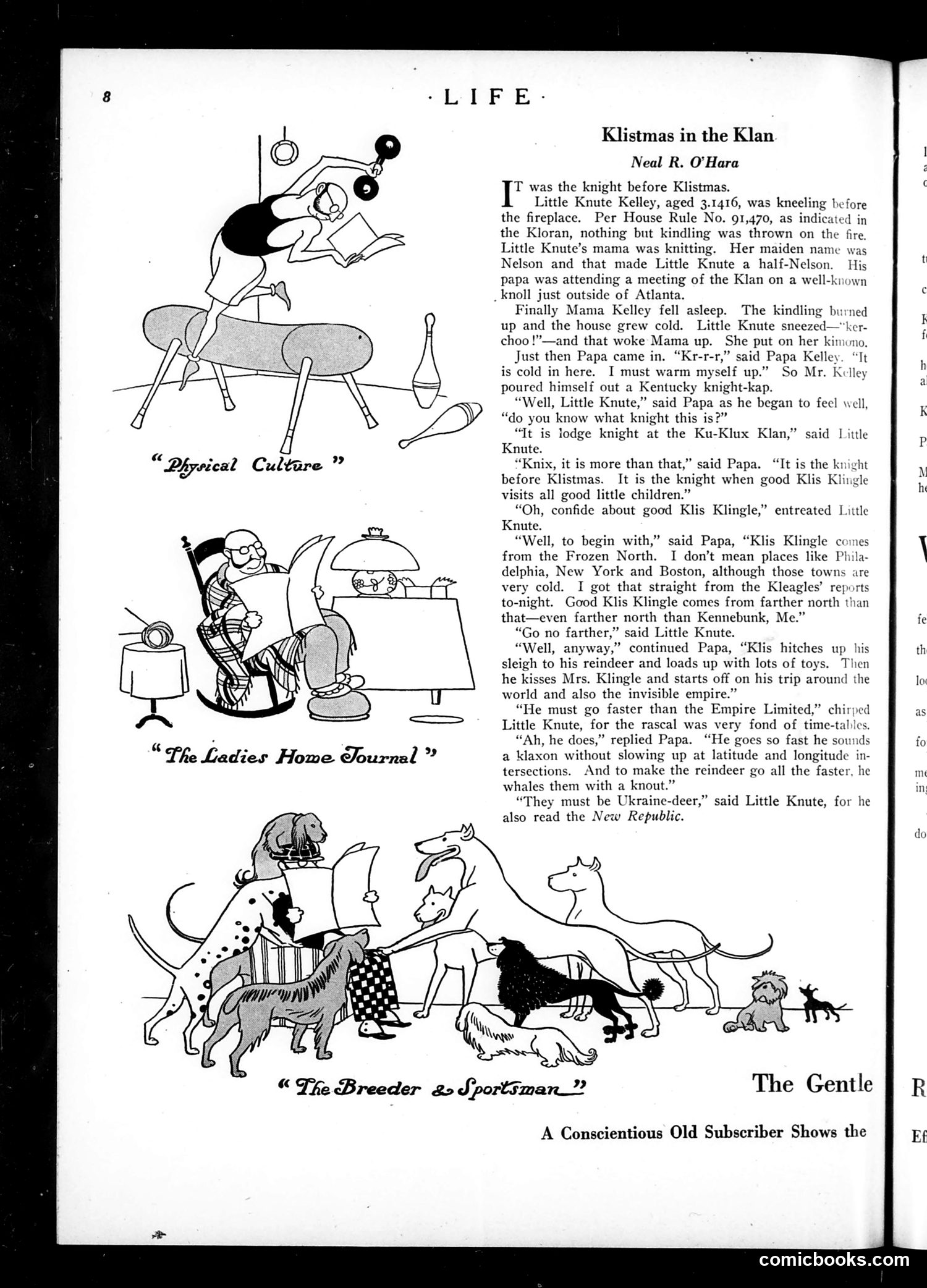
This satirical story mocks the Ku Klux Klan by presenting a domestic scene where a KKK member ("Papa" Kelley) explains to his young daughter "Little Knute" that the "knight before Klistmas" involves lodge meetings rather than traditional Christmas celebrations. The humor derives from the ironic contrast between wholesome family Christmas traditions and the Klan's actual violent activities. The accompanying cartoons labeled "Physical Culture," "The Ladies Home Journal," and "The Breeder & Sportsman" parody magazine mastheads, suggesting the Klan presents itself through respectable domestic imagery while concealing its true nature. The satire exposes how ordinary-seeming American families and institutions could harbor extremist ideology, critiquing both the Klan's deceptions and contemporary society's willingness to normalize them.
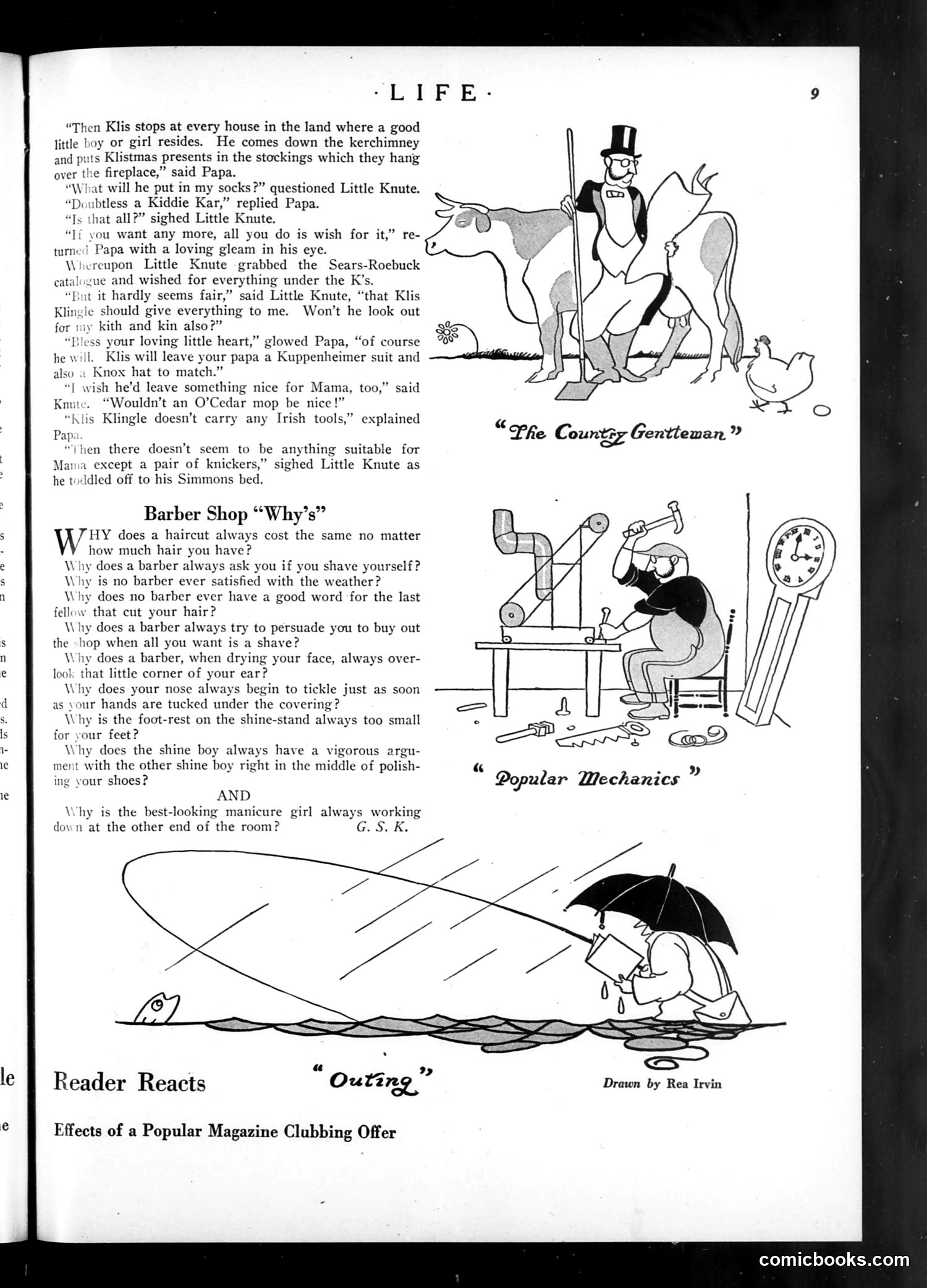
This page contains three humorous satirical pieces: 1. **"The Country Gentleman"** - A cartoon mocking a wealthy man in top hat posing with reindeer, likely satirizing pretentious or artificial displays of rural/aristocratic lifestyle. 2. **"Barber Shop 'Why's'"** - A humorous list of rhetorical questions about barber shops (why haircuts cost the same regardless, why barbers try to upsell, etc.), poking fun at common frustrations customers experience. The satire targets barber shop practices and customer annoyances. 3. **"Outing"** - A cartoon showing a person struggling with an umbrella in heavy rain, captioned as "Outing." The joke critiques the gap between idealized leisure activities and their disappointing reality. These represent typical *Life* magazine humor: gentle social satire targeting everyday irritations and pretensions of middle-class American life.
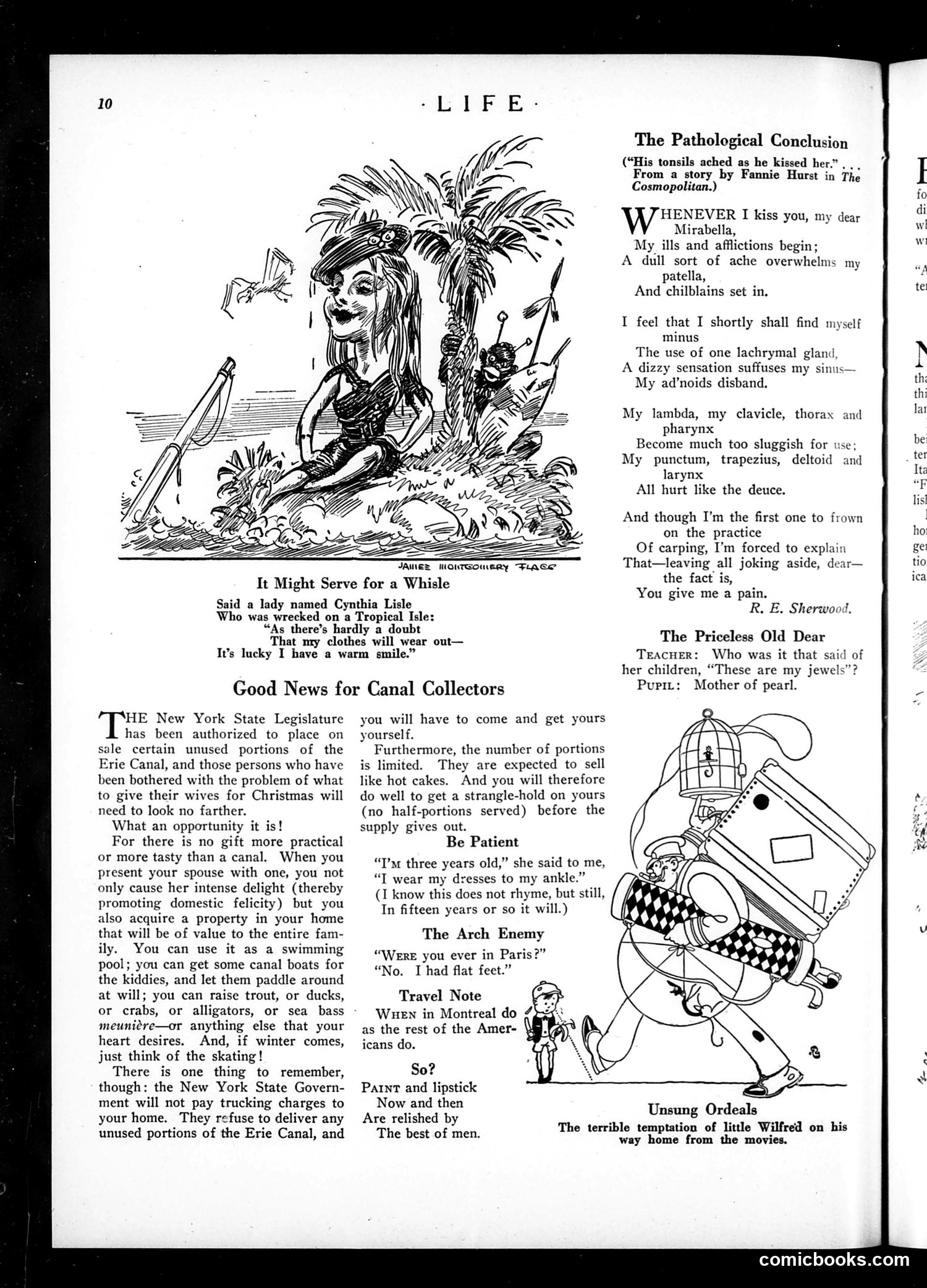
This page contains several unrelated humorous pieces typical of Life's satirical format: **"It Might Serve for a Whale"** is a cartoon joke about a shipwrecked woman (Cynthia Lisle) whose clothes are so worn they'd fit a whale—playing on the absurdity of tropical island survival. **"Good News for Canal Collectors"** satirizes the New York State Legislature's authorization to sell Erie Canal portions. The humor mocks the impracticality: someone could own a canal segment, use it as a swimming pool, and keep sea creatures. It's absurdist commentary on government property disposition. The remaining pieces—"The Pathological Conclusion," "The Priceless Old Dear," "Be Patient," "The Arch Enemy," and others—are brief humorous poems and jokes covering romance, aging, and travel, typical of Life's miscellaneous humor sections.
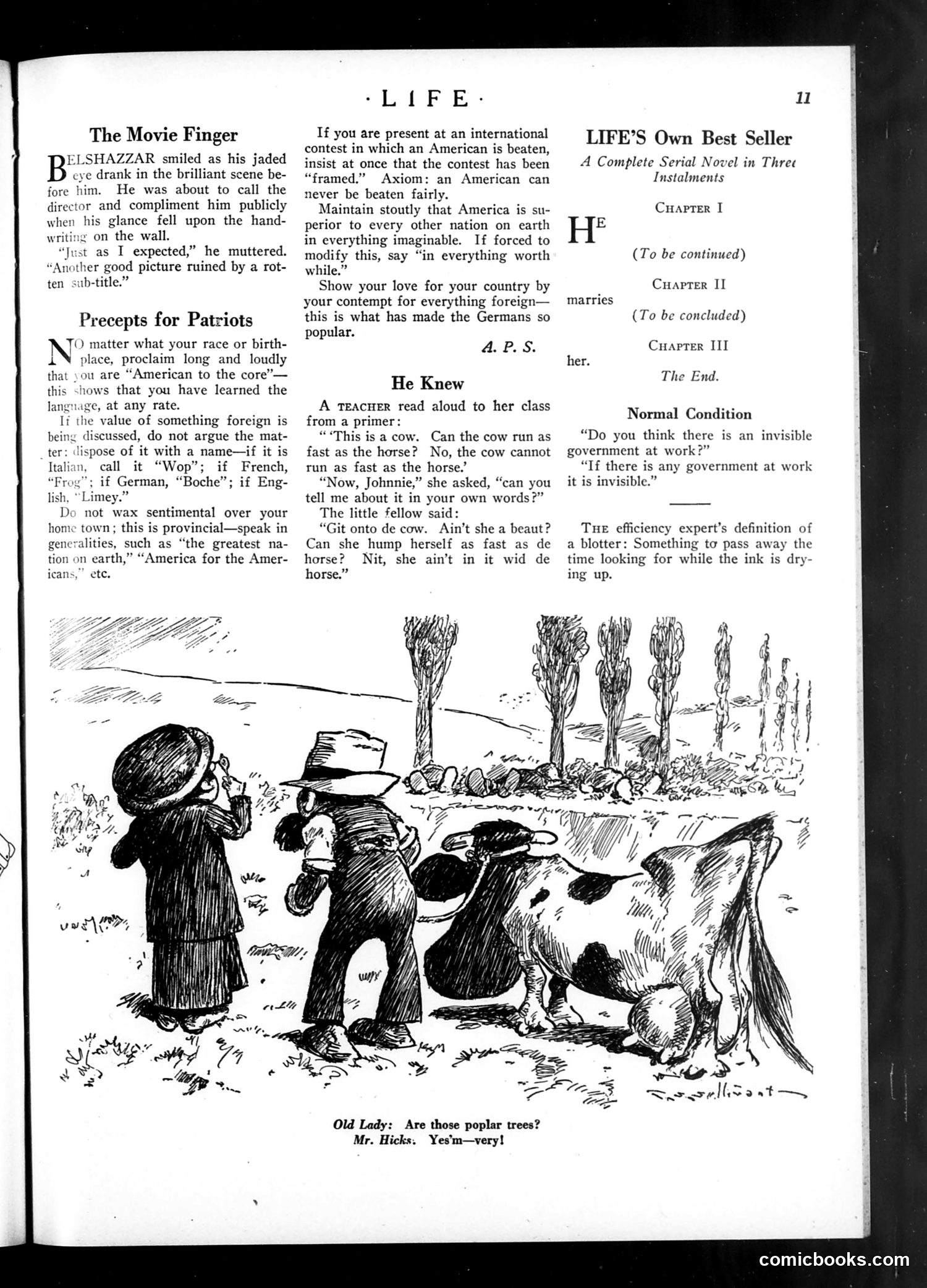
This page contains satirical commentary and humor typical of *Life* magazine's editorial voice. **"The Movie Finger"** mocks a film director's pretension—he congratulates himself publicly over a minor achievement, then blames a "rotten sub-title" when criticized. The satire targets Hollywood's self-importance. **"Precepts for Patriots"** offers tongue-in-cheek advice about American nationalism, warning against excessive patriotic sentimentality while encouraging genuine national pride. It advises disposing of foreign concepts with dismissive nicknames rather than serious engagement. **The cartoon below** shows Mr. Hicks and an old lady discussing poplar trees. The humor appears to rely on a visual or conversational pun, though the exact joke isn't entirely clear without additional context about what Hicks represents or the implied double meaning.
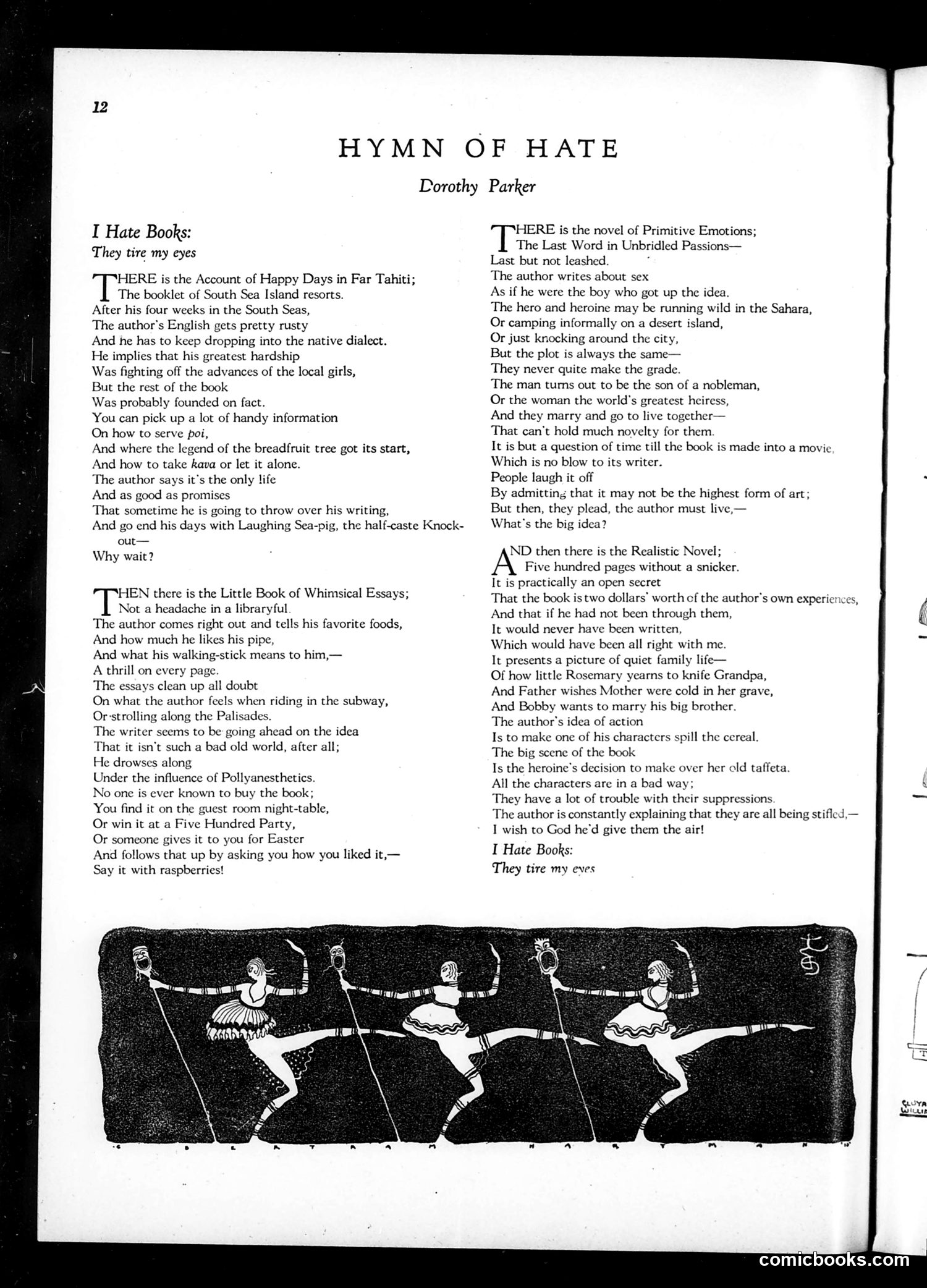
This page presents Parker's satirical poem mocking literary trends of her era. The text ridicules: 1. **South Sea/Exotic Adventure novels** — books set in tropical locations featuring superficial adventure plots and romance 2. **Whimsical essay collections** — lightweight, pretentious literary works 3. **Realistic novels** — lengthy, tedious domestic fiction focusing on mundane family life details Parker's refrain "I Hate Books: They tire my eyes" frames the critique. The decorative art-deco illustration at bottom (three stylized female figures) reflects 1920s-30s design aesthetics. The satire targets publishing industry trends and reader tastes rather than specific titles or authors. Parker attacks both escapist adventure fiction and earnest realism as equally tiresome, reflecting broader modernist literary debates about what constitutes serious writing.
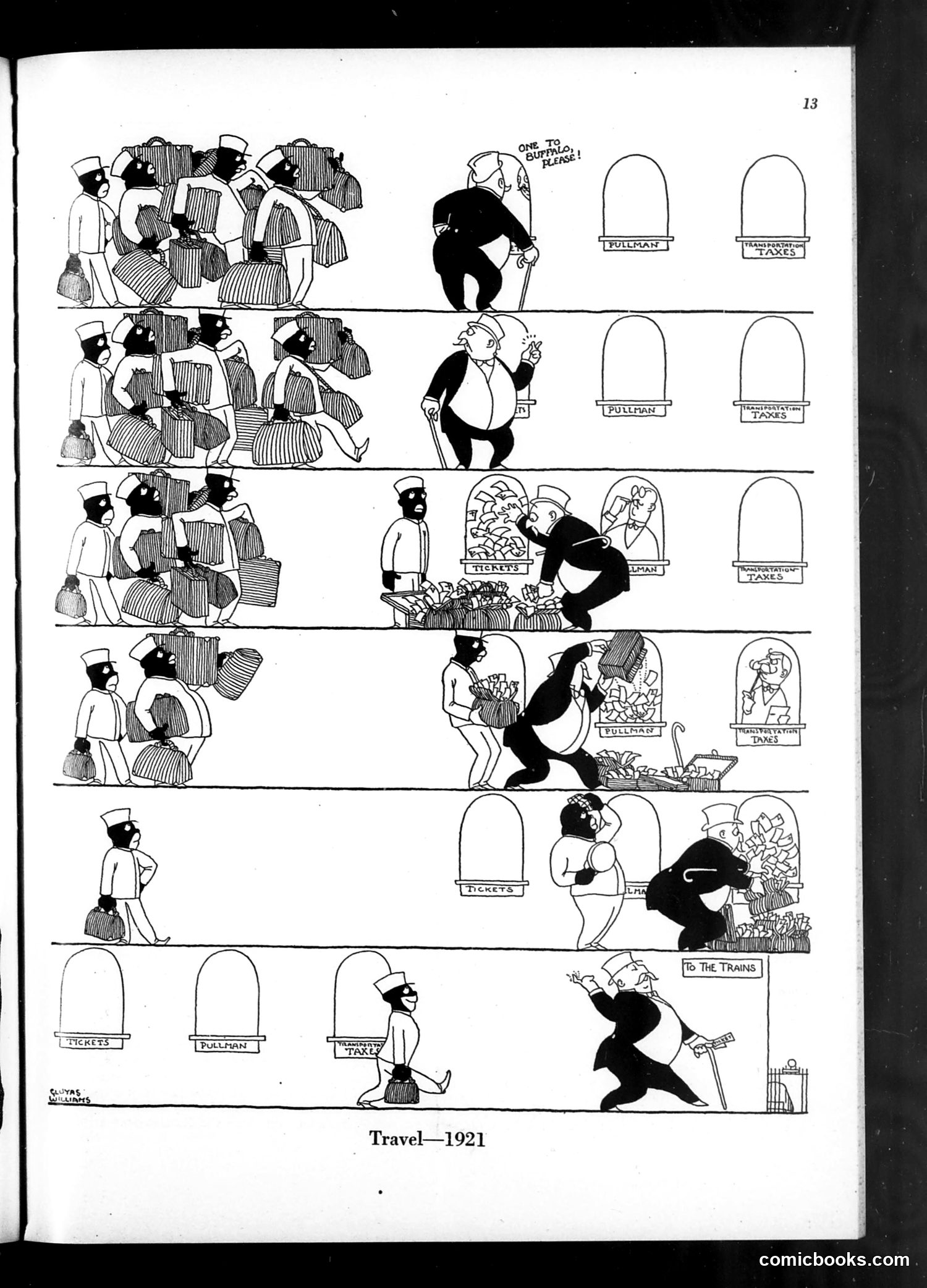
This cartoon satirizes the mounting costs and complications of travel in post-WWI America. The sequence shows a traveler attempting to purchase tickets, but repeatedly encountering various fees and taxes that accumulate as he progresses. The left panels show growing crowds of officials at ticket windows labeled "Pullman," "Immigrant Taxes," and "Excise Taxes." The right panels depict the traveler being progressively weighed down and frustrated as additional charges are imposed at each stage—eventually fleeing toward "the Trains" in desperation. The satire targets America's expanding tax burden following World War I, when new federal taxes were introduced to pay war debts. The cartoon humorously suggests that by 1921, the cost of simply traveling had become absurdly complicated, with taxes and fees multiplying faster than the traveler can manage.
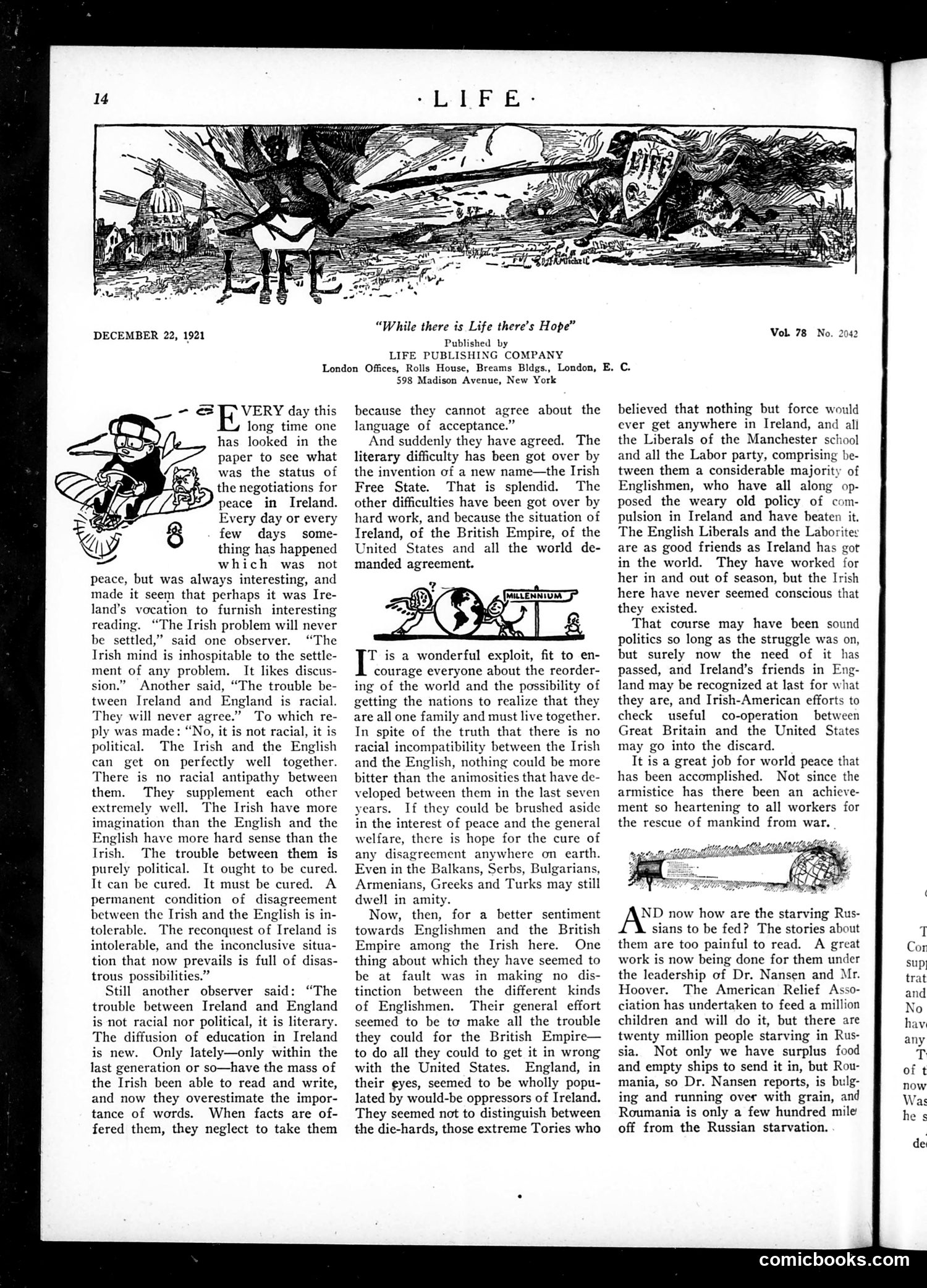
The page's main illustration depicts a figure (likely representing Ireland or an Irish political entity) sitting beneath a tree labeled "LIFE," with various symbolic elements including what appears to be governmental or institutional buildings in the background. The article discusses ongoing peace negotiations in Ireland, addressing tensions between Irish and English interests. It references the "Irish Free State" negotiations and disputes over language acceptance in political agreements. The text critiques the historical animosity between Ireland and England, arguing that racial and political differences have made coexistence difficult. The piece suggests hope for reconciliation through practical cooperation, and shifts to discussing famine relief efforts in Russia under American assistance. The overall tone treats Ireland's political situation with cautious optimism for peaceful resolution.
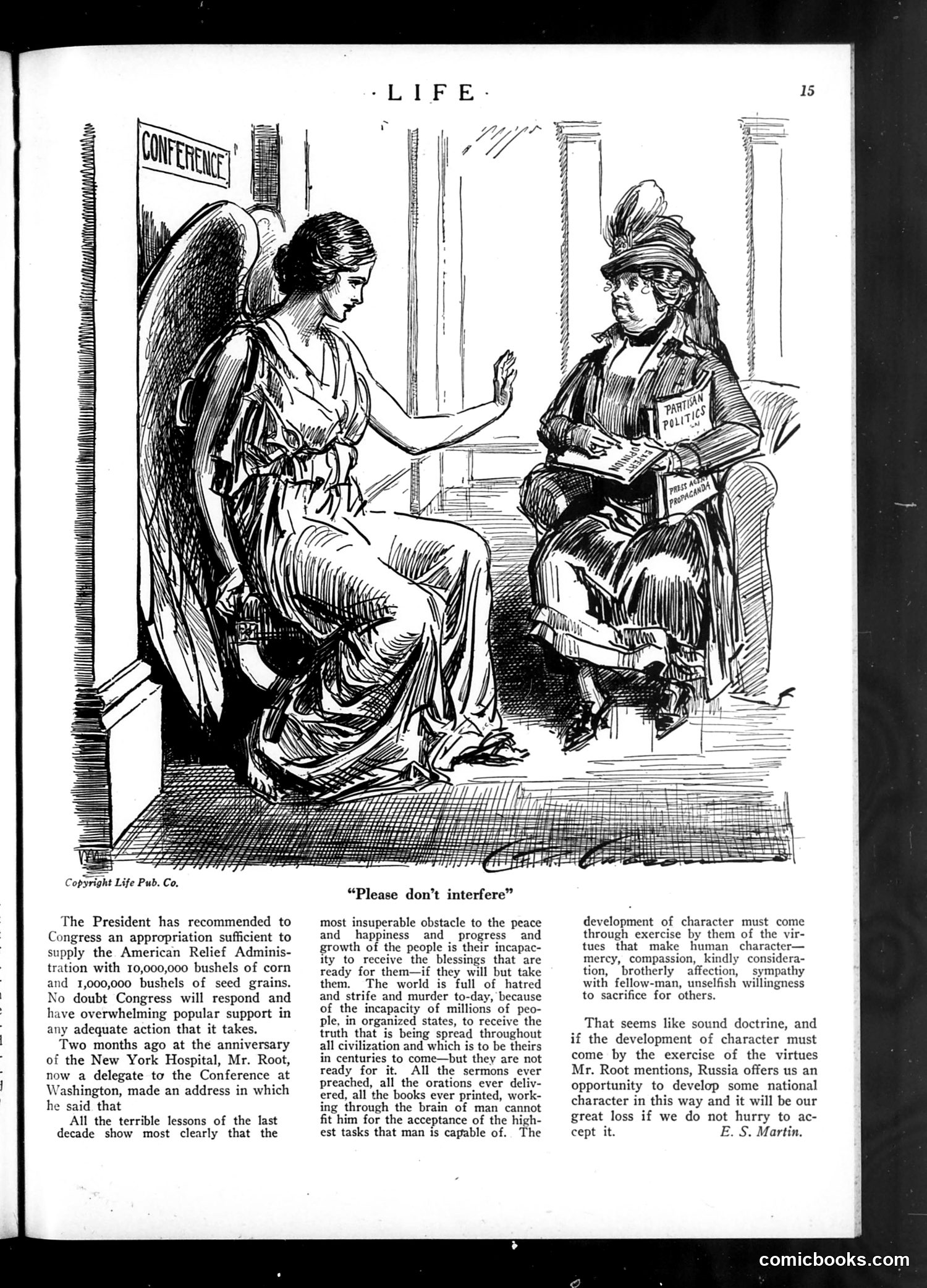
This cartoon satirizes American humanitarian intervention in post-WWI Russia. An angel (representing American idealism/charity) offers aid to a weary, suspicious Russian figure holding papers labeled "Pamphlets" and "Politics." The joke: Mr. Root and other American leaders argue that Russia needs American *moral* and *material* support to develop character and civilization. However, the cartoon suggests Russia resists this well-intentioned interference—hence the angel's plea "Please don't interfere." The satire cuts both ways: it mocks America's paternalistic assumption that Russians need American instruction in virtue, while also suggesting Russian suspicion of U.S. motives (viewing American aid as ideological imposition rather than genuine charity). The accompanying text by E.S. Martin supports American aid to Russia as character-building opportunity, but the cartoon implies the Russians aren't receptive to American interference, however benevolent its framing.
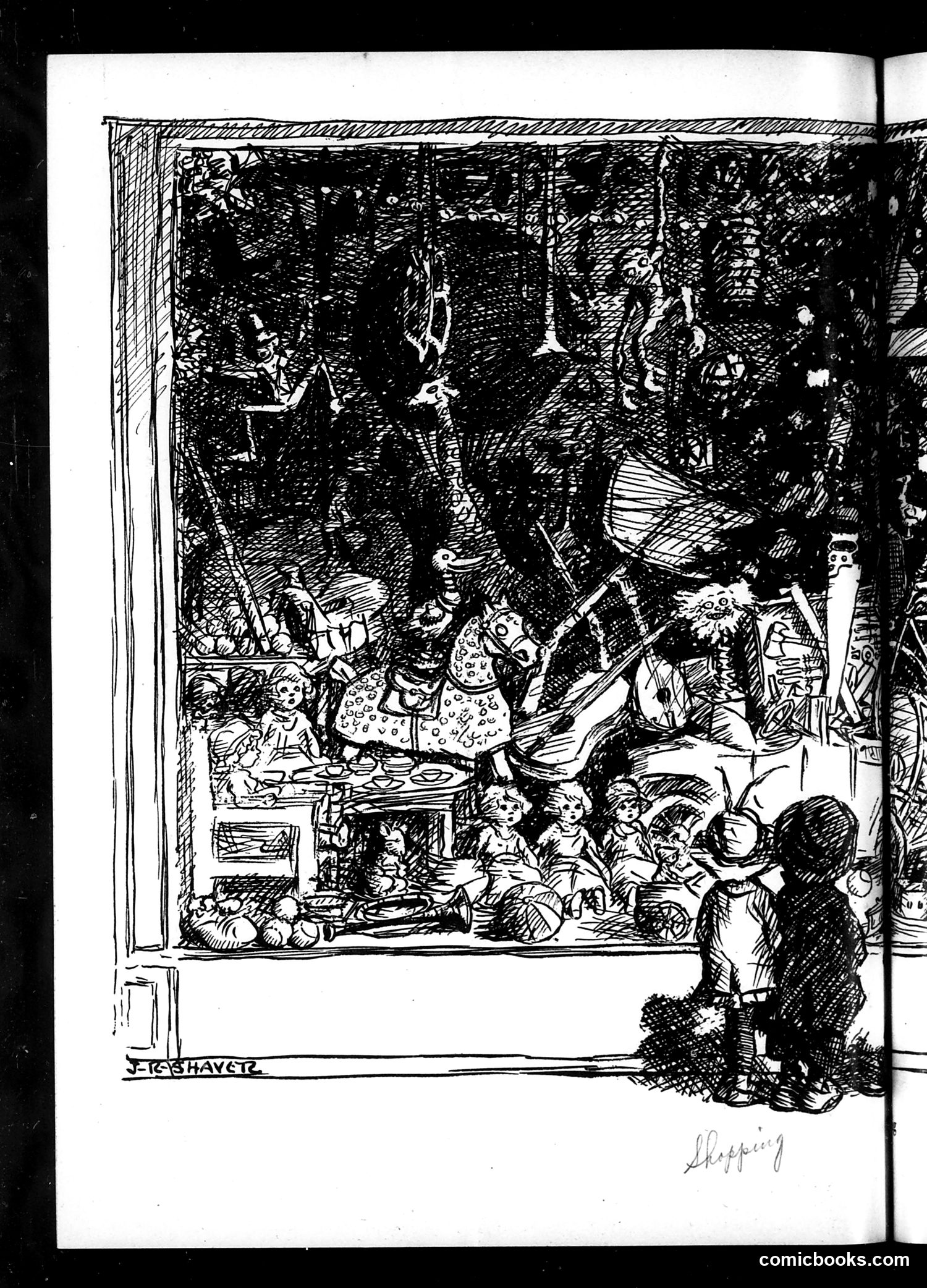
The OCR text is too corrupted to read clearly. Based on the image alone, this appears to be a detailed ink illustration showing a window display or shop scene. Inside the window, numerous figures are depicted in what seems to be a crowded, chaotic arrangement—possibly showing people shopping, working, or gathering. Two figures stand outside looking in. The artist's signature reads "J.G.Havet" (or similar). The dense crosshatching and intricate linework suggests this is a satirical commentary on consumer culture, retail, or urban commerce, though without legible text, the specific target of the satire remains unclear. The style is consistent with early-to-mid twentieth century American satirical illustration.
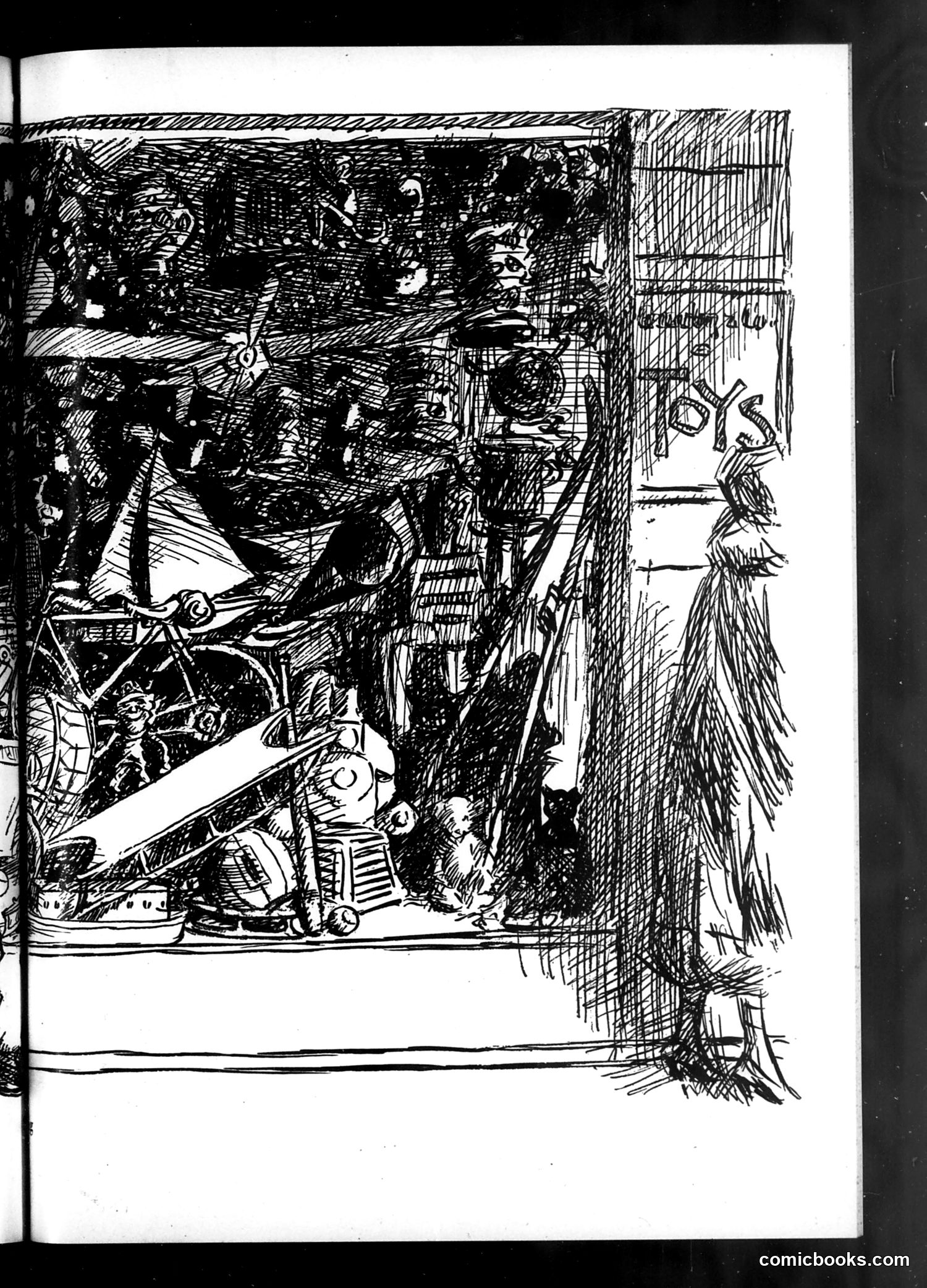
I can see this is a detailed ink sketch showing what appears to be a crowded interior scene—possibly a workshop, garage, or factory space with multiple figures, machinery, and various objects. The drawing style is characteristic of early-to-mid 20th century satirical illustration, with heavy cross-hatching and expressive linework. However, without legible text on the page itself (the OCR only provides a website attribution), I cannot definitively identify the specific political figures, events, or satirical targets this cartoon addresses. The dense, chaotic composition suggests social commentary on labor, industry, or urban life, but I cannot accurately explain the specific joke or references to a modern reader without being able to read the accompanying caption or article text that would clarify the cartoon's meaning.
This is a satirical essay attacking theatergoers' behavior and poor taste. The author (writing under Life's Drama department) adopts critic Gilbert Seldes's provocative slogan to argue that audiences—not playwrights or actors—are theater's real problem. The piece specifically criticizes women for laughing at inappropriate moments (during tragic scenes in plays like *Liliom* and *Anna Christie*), and men for coughing loudly during performances. It mocks matinee audiences as intellectually shallow, suggesting their "powers of discrimination" are barely measurable. The illustrations show rows of identical male and female faces, visually emphasizing the author's point about undifferentiated, unreflective audiences. The tone is deliberately caustic—the author even proposes a humorous "reflex test" to screen out laughers. This reflects early 20th-century cultural tensions between "serious" theater (seeking emotional authenticity) and popular entertainment preferences, with class and gender assumptions embedded throughout.
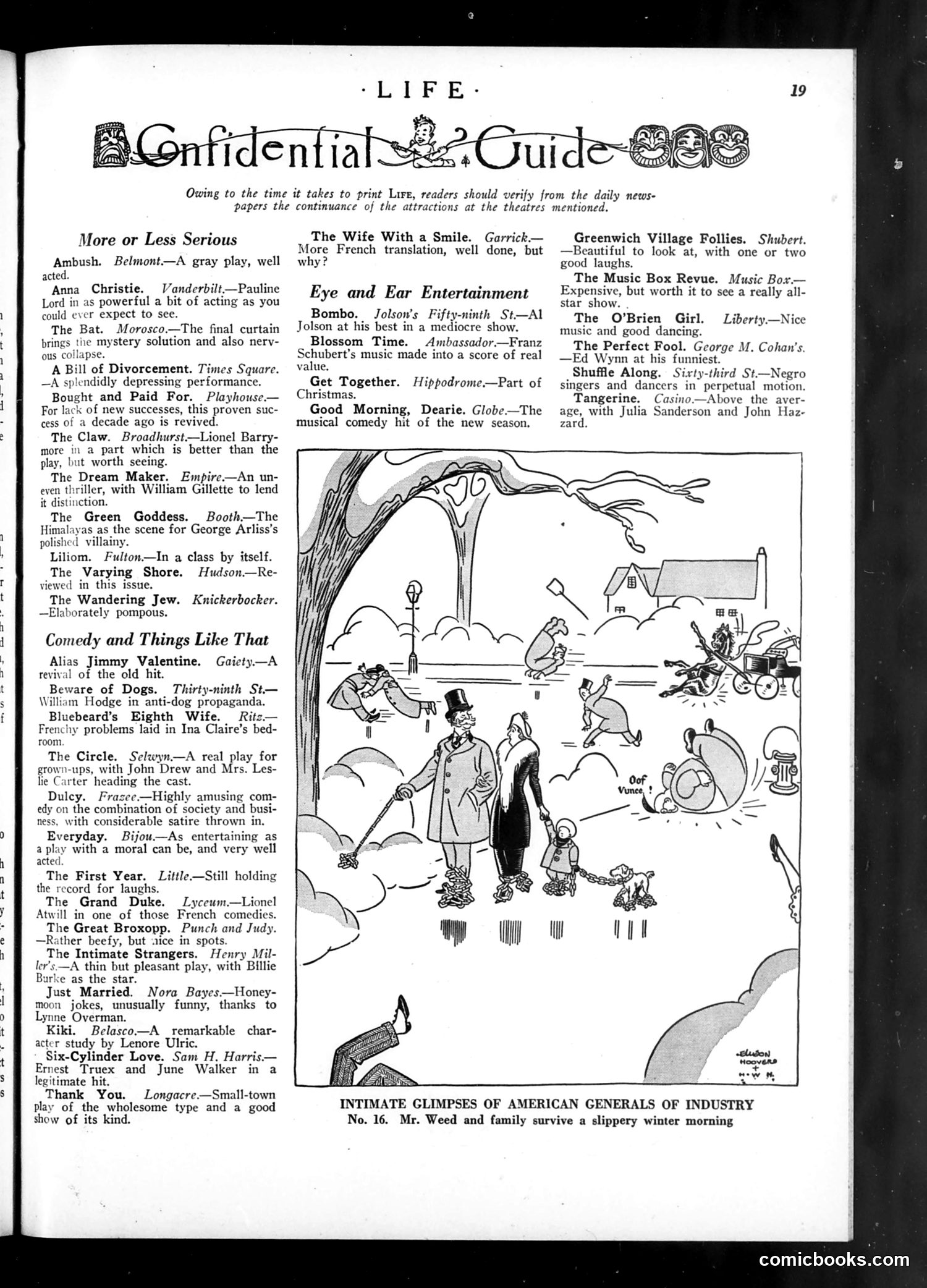
This page is primarily a theatrical listings guide for New York productions, but the cartoon at bottom depicts satirical social commentary. The illustration shows "Mr. Weed and family" experiencing a comedic winter accident—the man in top hat and formal dress has slipped on ice while his family tumbles around him in various states of disarray, with a carriage and servants also affected. The phrase "Generals of Industry" sarcastically elevates wealthy businessmen to military status. The joke targets the contrast between the pretensions of the industrial elite (suggested by formal dress and servants) and their helplessness when facing ordinary physical mishaps. The "slippery winter morning" serves as metaphor—these supposedly commanding figures are literally and figuratively unable to maintain their footing, suggesting the fragility of their elevated status or the chaos lurking beneath their orderly lives.
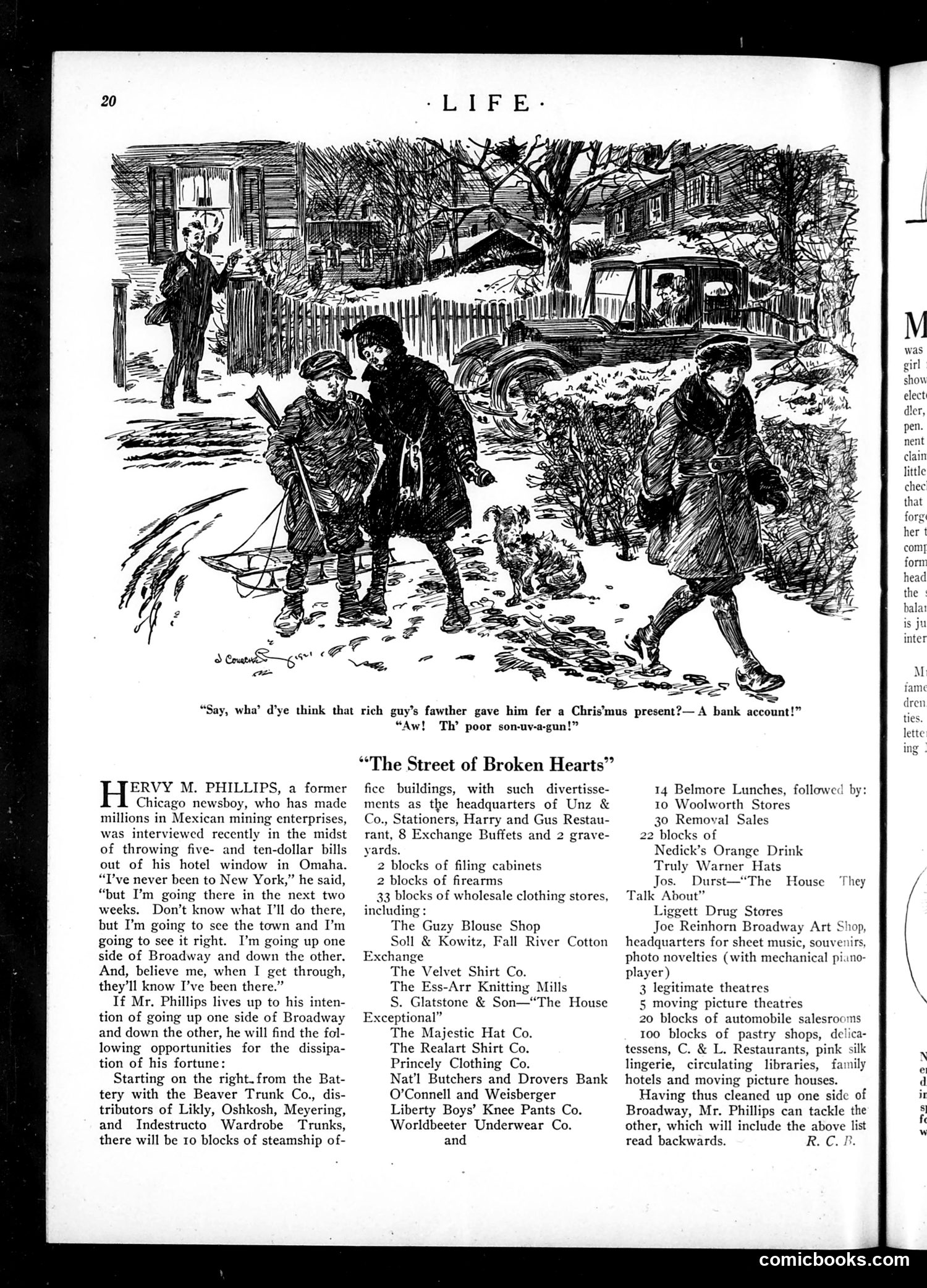
This page satirizes the newly wealthy through two interconnected pieces: **The Main Cartoon** depicts street urchins mocking a rich boy's Christmas gift—a bank account. The joke: even a child from poverty recognizes that inherited wealth, not earned money, marks true privilege. The urchins' dialect ("wha' d'ye think," "Aw! Th' poor son-uy-a-gun!") contrasts their street wisdom with the boy's sheltered naiveté. **The Featured Article** profiles Hervy M. Phillips, a self-made millionaire (former Chicago newsboy turned Mexican mining tycoon) who throws money from hotel windows and boasts of conquering Broadway through sheer spending. The accompanying "Street of Broken Hearts" directory mockingly catalogs his potential expenses—from steamship offices to pastry shops to automobile showrooms—suggesting Broadway exists primarily to extract wealth from nouveau-riche spenders like him. **The Satire's Point**: Both pieces mock the ostentatious display of new money and the illusion that wealth equals sophistication. The "broken hearts" reference implies such extravagant spending leaves financial and moral wreckage.
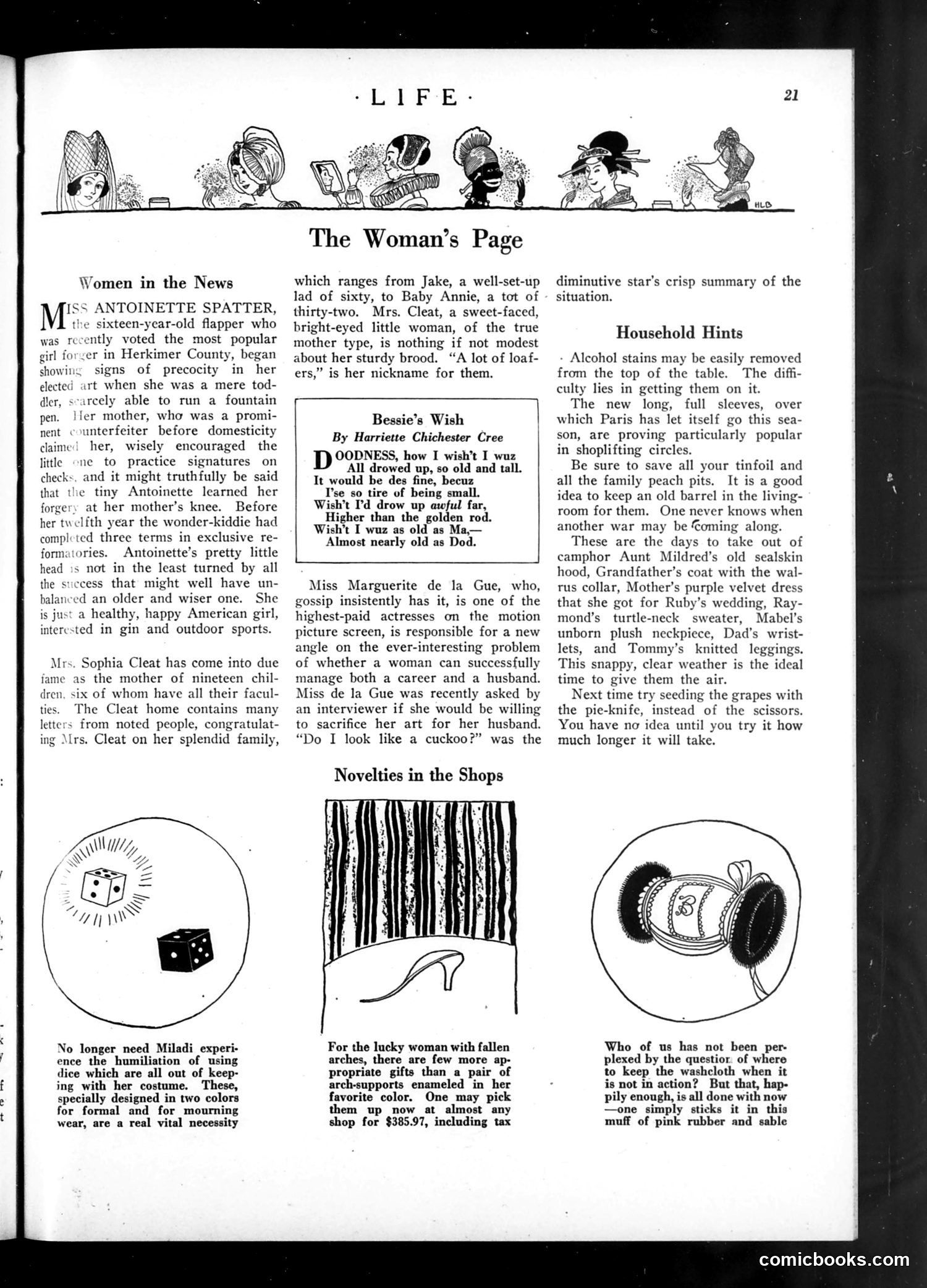
This satirical page mocks contemporary women through exaggerated vignettes and absurdist humor typical of 1920s Life magazine. **"Women in the News"** presents fabricated biographical snippets: Antoinette Spatter, a "flapper" (young modern woman) praised for precocity in *forgery* learned from her counterfeiter mother; Mrs. Sophia Cleat, celebrated for producing nineteen children of questionable quality, whom she dismissively calls "loafers." The satire targets the era's contradictory attitudes toward women—simultaneously celebrating motherhood and domesticity while mocking women's ambitions and capabilities. **"Household Hints"** offers deliberately useless advice ("getting [alcohol stains] on it") and wartime paranoia ("save all your tinfoil...another war may be coming"), satirizing women's magazines' earnest domestic instruction. **"Novelties in the Shops"** ridicules consumer culture, featuring ludicrous luxury items like decorative dice ($385.97) and expensive arch-supports for wealthy women. The overall tone suggests Life's skepticism toward modern women's independence, consumerism, and changing social roles.
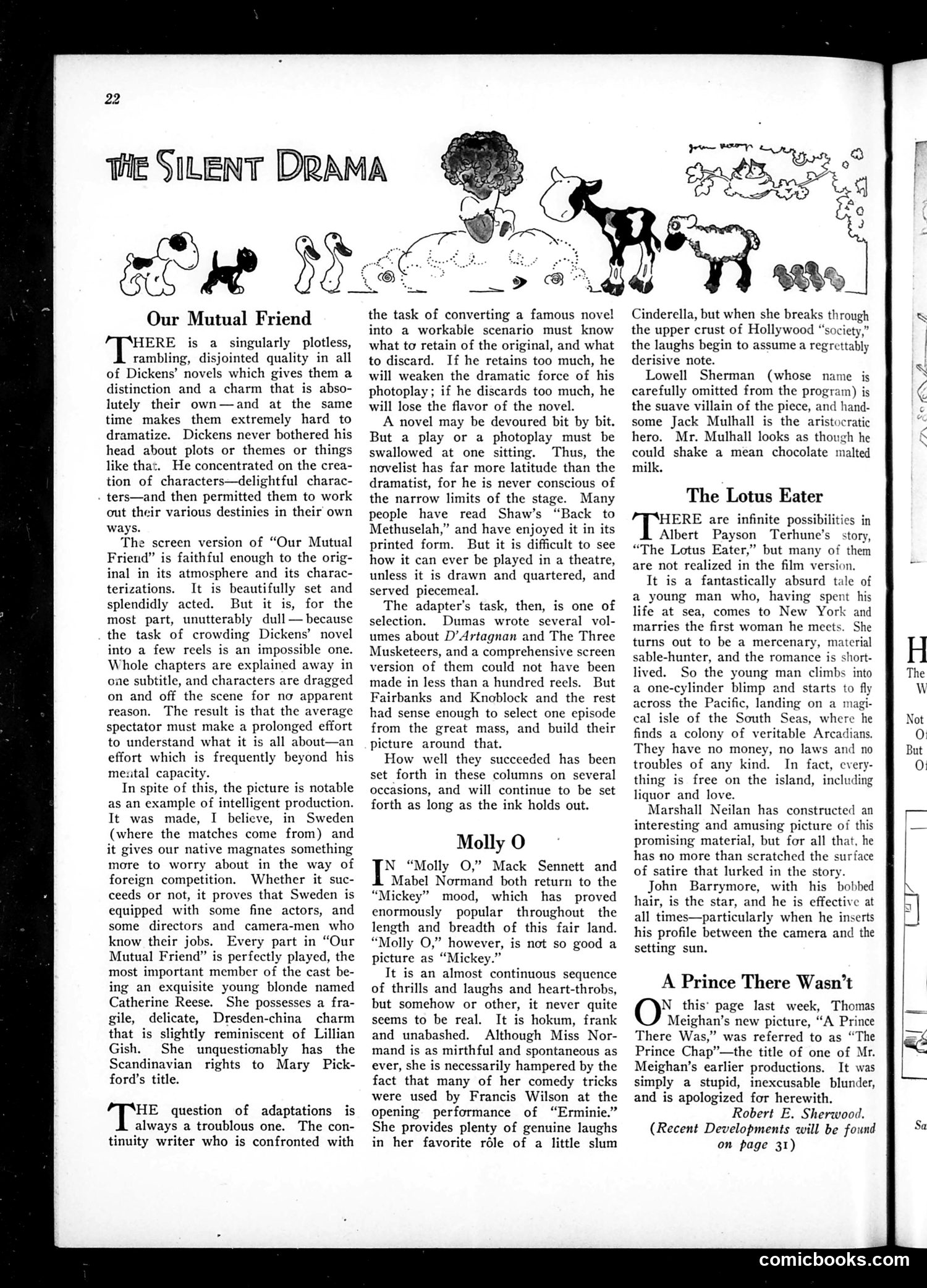
This page contains three film reviews from the silent era. The masthead cartoon shows animals, likely representing different film studios or production companies in a playful hierarchy. **"Our Mutual Friend"** reviews a Swedish adaptation of Dickens' novel, praising its intelligent production and the "exquisite young blonde" Catherine Reese (compared to Mary Pickford), while noting that condensing Dickens into film necessarily loses narrative complexity. **"Molly O"** discusses Mack Sennett and Mabel Normand's comedy returning to their successful "Mickey" formula, though the reviewer finds this version less effective—"hokum, frank and unabashed." **"The Lotus Eater"** and **"A Prince There Wasn't"** receive brief mentions. The reviews reflect silent cinema's challenge: adapting literature while respecting theatrical time constraints, and the era's fascination with Scandinavian talent competing against American studios.
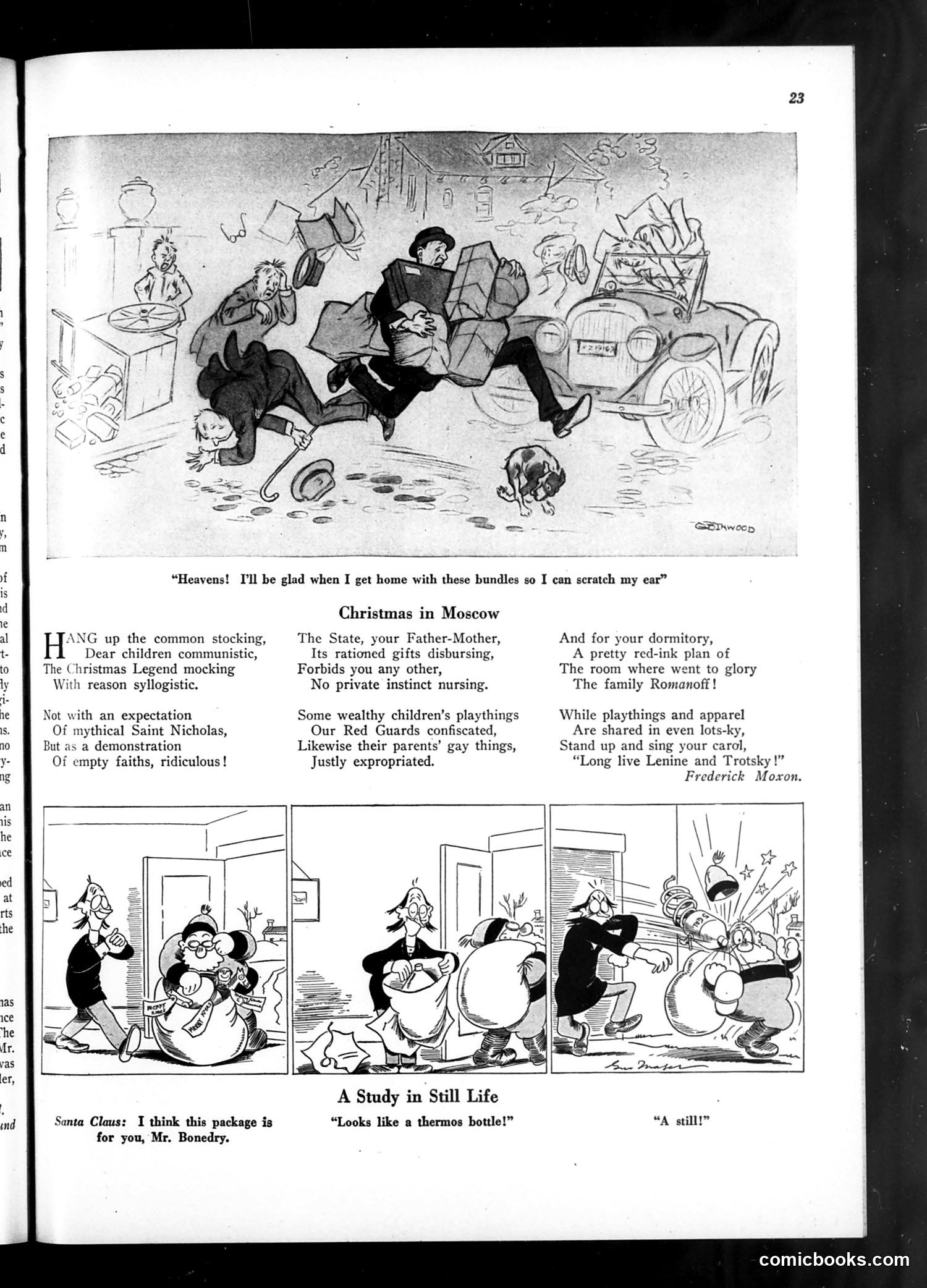
This page contains Cold War-era American satire mocking Soviet communism through Christmas imagery. **"Christmas in Moscow"** (poem by Frederick Moxon): Satirizes Soviet suppression of religious tradition and private property. The State replaces Santa Claus and Saint Nicholas; children receive state-rationed gifts in dormitories rather than family homes. The poem ridicules confiscation of "wealthy children's playthings" and references Lenin and Trotsky, suggesting Soviet ideology strips away individual joy and family bonds. **Top cartoon**: Shows a man struggling with bulky Christmas packages—satirizing the material excess of American capitalism versus Soviet austerity. **"A Study in Still Life" comic strip** (bottom): A visual pun depicting Santa delivering what appears to be a thermos bottle but is actually revealed as "a still"—an illegal alcohol distillery. This likely references Prohibition-era bootlegging, creating dark humor about hidden contraband during both American Prohibition and Soviet restriction of goods. The overall message critiques Soviet communism as joyless and authoritarian while implicitly defending American consumer culture.
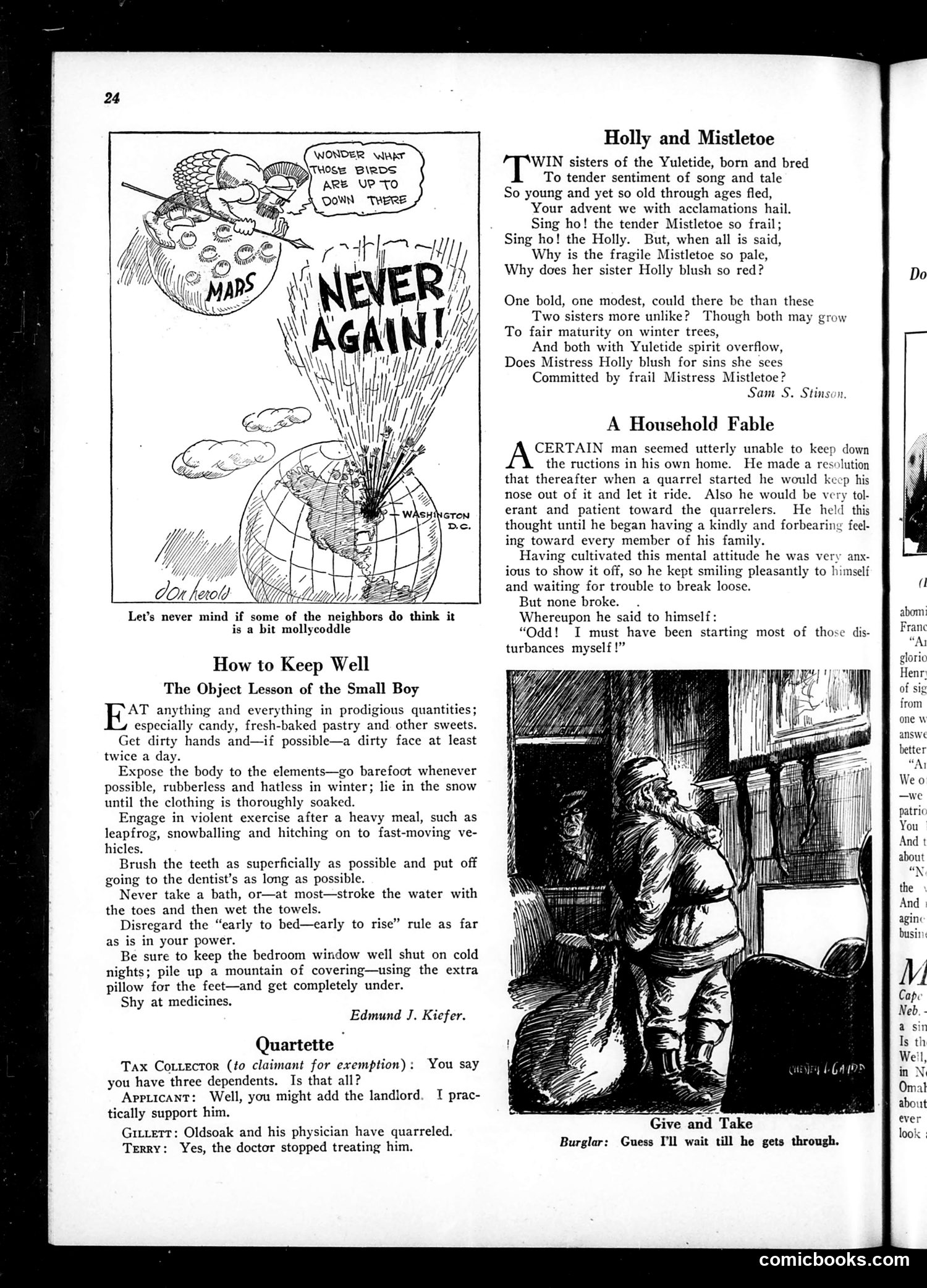
The main cartoon satirizes overprotective parenting advice of the era. Titled "The Object Lesson of the Small Boy," it sarcastically prescribes the *opposite* of what parents should do—eat excessive candy, stay dirty, expose yourself to harsh winter conditions barefoot, exercise violently after meals, avoid dentists and baths, ignore sleep schedules, and seal bedroom windows. The satire targets the genteel, cautious "mollycoddle" parenting philosophy that was gaining traction (the caption's reference to "neighbors" thinking such care "a bit mollycoddle" acknowledges this contemporary debate). By inverting proper health advice into absurd extremes, the author mocks both overindulgent and overly restrictive parenting approaches, suggesting children thrive through hardy, practical neglect rather than fussy protection. The page also contains unrelated literary content: a poem about Holly and Mistletoe, a brief moral fable about family quarrels, and a humor quartette.
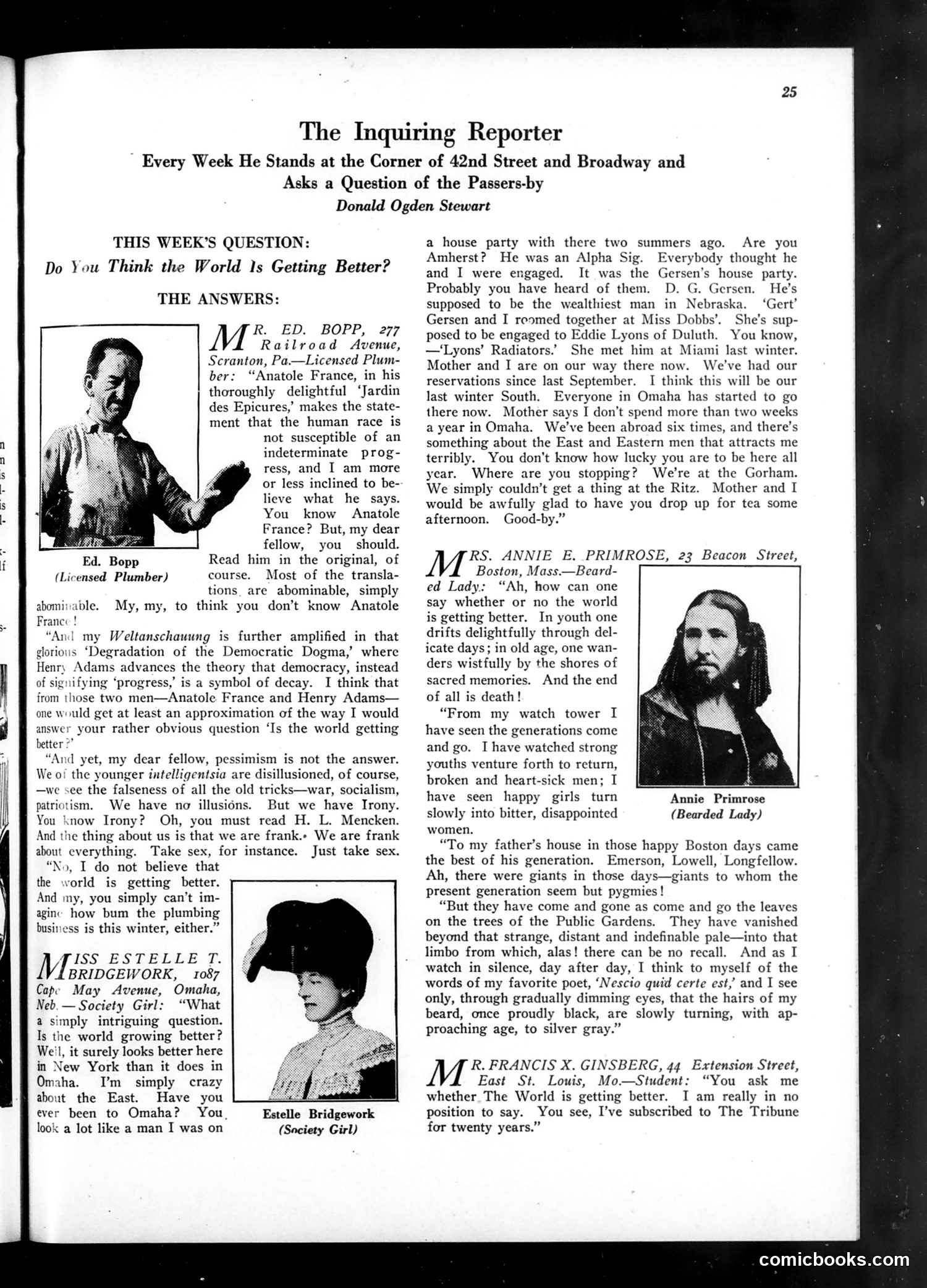
This page features a satirical column where pedestrians answer whether "the world is getting better." The humor lies in contrasting answers that reveal each speaker's pretensions and blind spots. **Ed. Bopp** (licensed plumber) demonstrates intellectual snobbery by name-dropping Anatole France and Henry Adams while complaining his actual plumbing business is terrible—undercutting his philosophical pessimism with mundane reality. **Estelle Bridgework** (society girl) answers by obsessing over East Coast social circles, wealthy acquaintances, and Miami vacations, entirely missing the question's substance through shallow materialism. **Annie E. Primrose** (bearded lady) offers genuine melancholy reflection on aging and mortality—contrasting with the other two speakers' self-absorbed obliviousness. The satire mocks 1920s American society: intellectual pretension, social climbing, and disconnection from actual conditions. The column suggests people answer not based on objective reality but filtered through their narrow social positions.
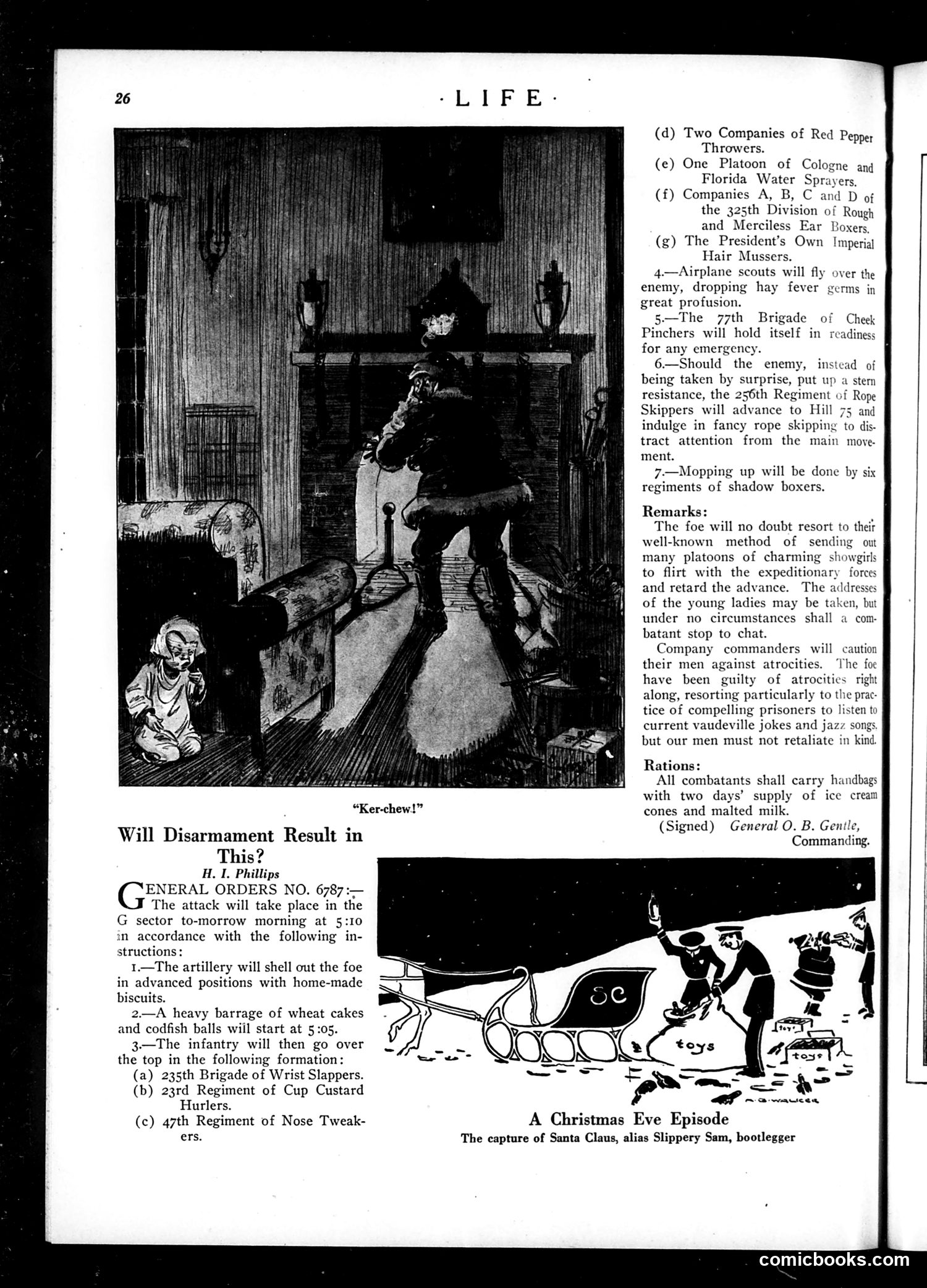
This page contains two pieces of WWI-era satirical humor from *Life* magazine: **"Will Disarmament Result in This?"** presents absurdist "General Orders" for a mock military attack using food and playground pranks instead of weapons—"Wrist Slappers," "Cup Custard Hurlers," "Nose Tweakers," "Hay Fever germs," and "shadow boxers." The satire mocks pacifist arguments about disarmament by imagining a ridiculous scenario where armies fight harmlessly. The "Remarks" section adds period comedy: warnings against showgirls and vaudeville jokes, and rations of ice cream cones. **"A Christmas Eve Episode"** shows the capture of "Santa Claus, alias Slippery Sam, bootlegger"—a Prohibition-era joke conflating the jolly gift-giver with illegal alcohol smuggling. The cartoon likely satirizes how Prohibition enforcement portrayed criminals romantically or how civilians viewed "bootleggers." Both pieces use humor to comment on contemporary debates: military preparedness/pacifism and Prohibition enforcement.
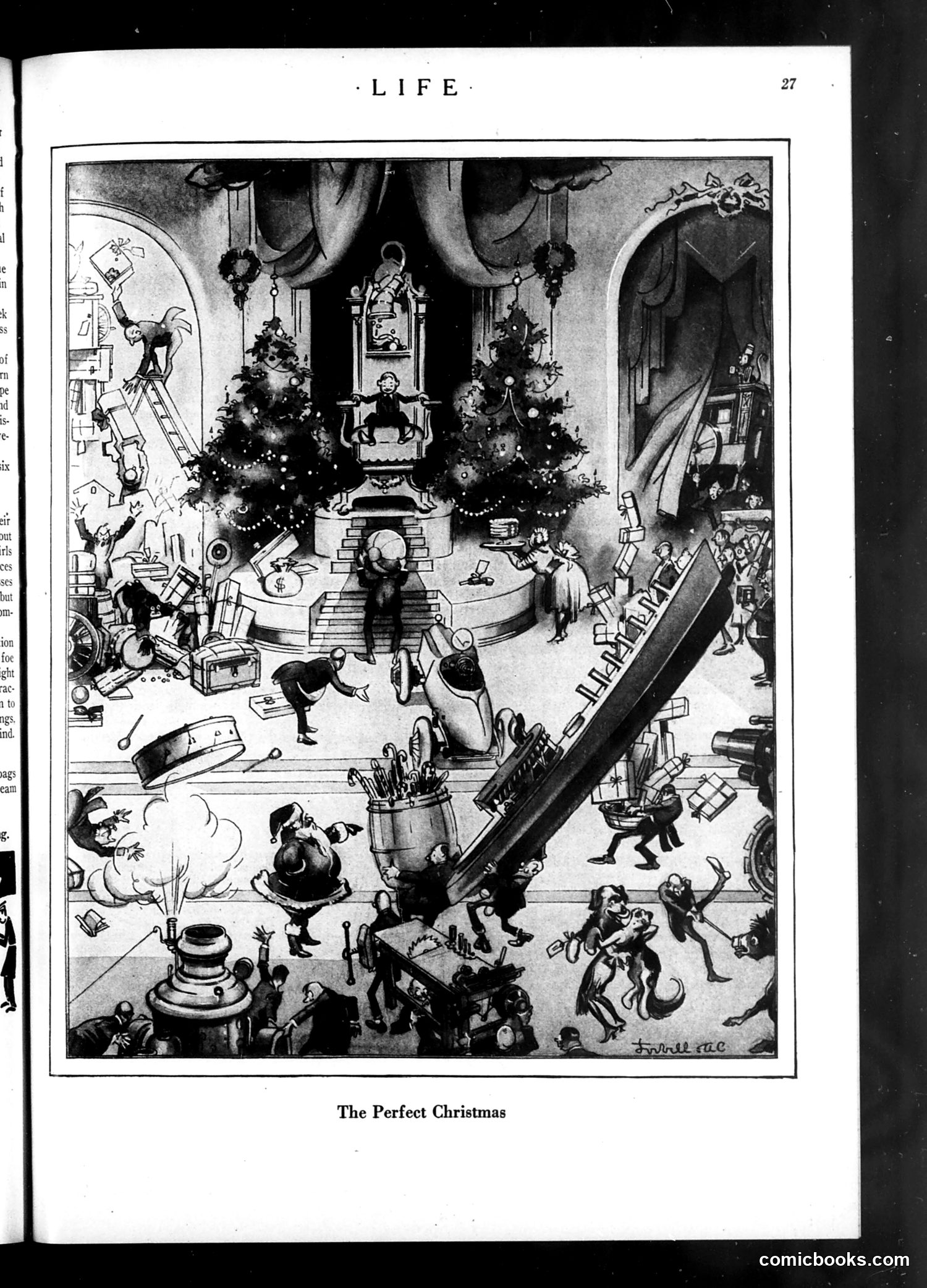
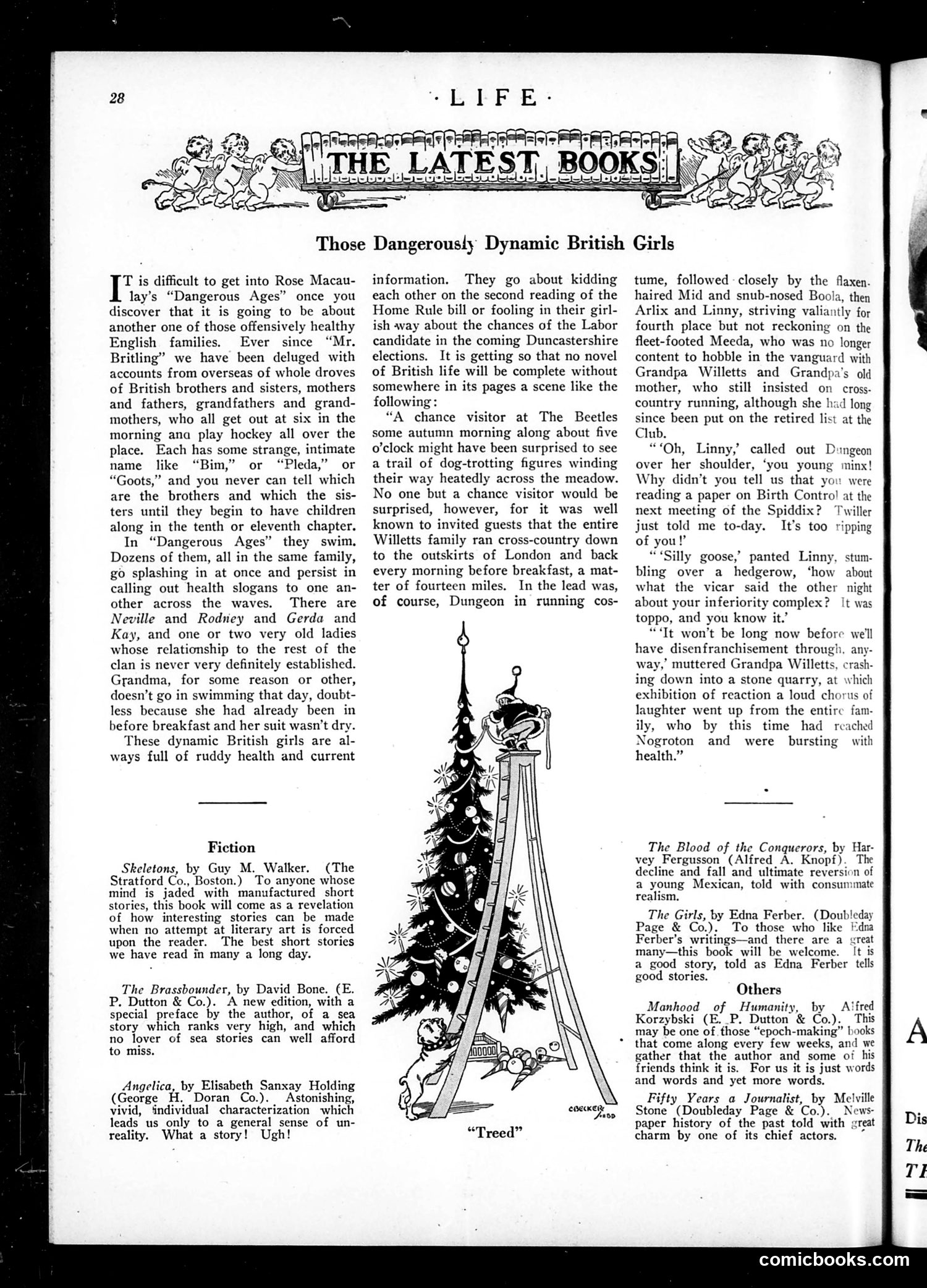
This page satirizes the popularity of British novels featuring absurdly robust, health-obsessed families—particularly Rose Macaulay's "Dangerous Ages." The reviewer mocks a literary trend where entire British clans engage in relentless physical activity (swimming, running, hockey) and possess quirky, indistinguishable nicknames. The accompanying illustration labeled "Treed" depicts an exaggerated Christmas tree decorated with these hyper-active family members, visualizing the critic's point: these novels are stuffed with interchangeable, wholesome characters doing constant exercise. The satire targets post-WWI British literature's celebration of vigorous, outdoor-loving families—likely reflecting actual social anxieties about health, class, and national vitality. The parodic passage about the Willetts family's 14-mile pre-breakfast run and casual discussion of Birth Control represents the critic's eye-rolling dismissal of such novels as simultaneously preachy and absurd. It's essentially a book review joke: these works had become a tiresome genre cliché.
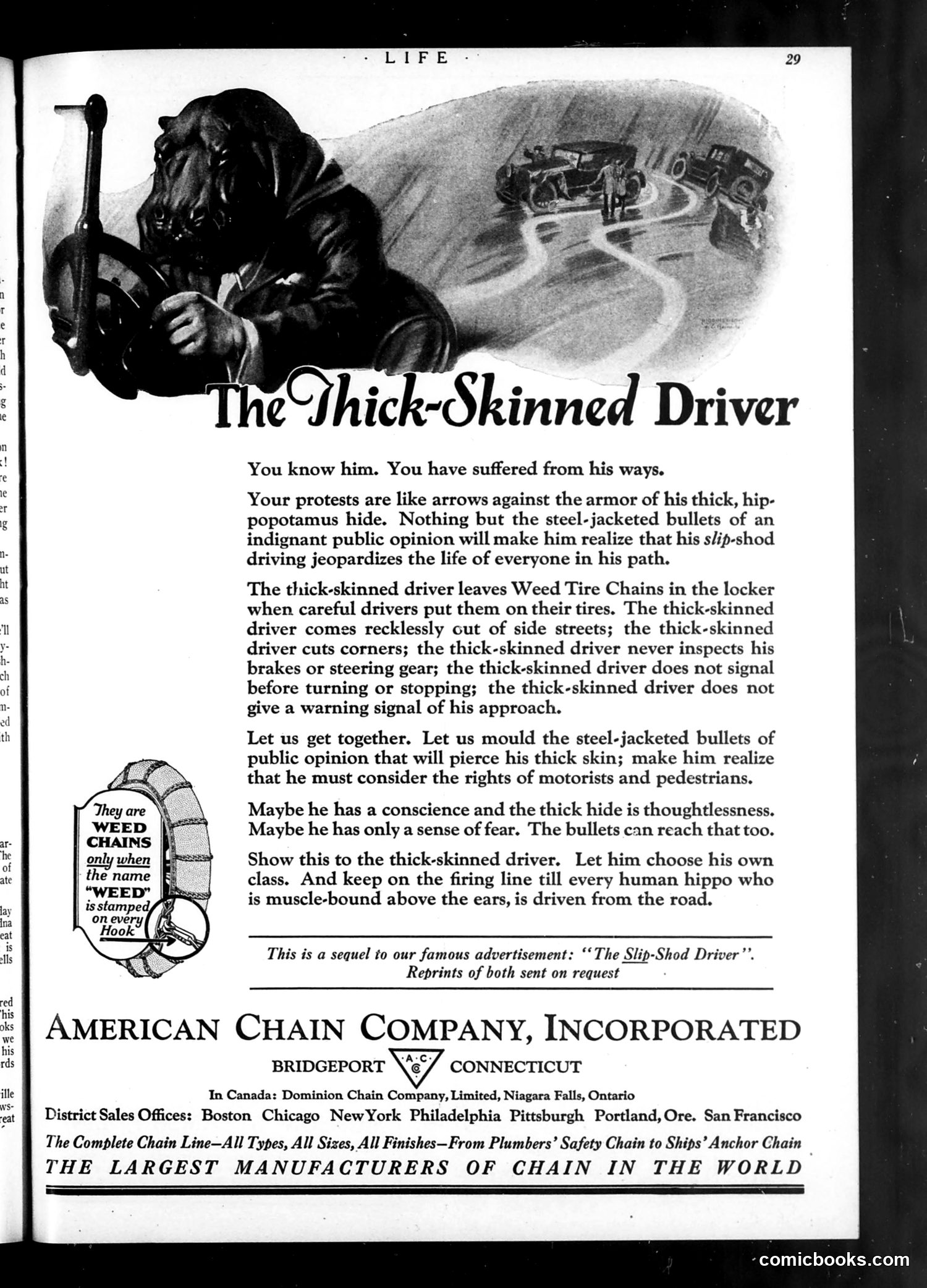
This is a **safety advertisement** by American Chain Company promoting tire chains (for winter driving). It's not political satire but rather a public-service campaign against reckless drivers. The "thick-skinned driver" is a generic caricature representing any careless motorist who ignores road safety: doesn't use tire chains in winter, cuts corners, ignores traffic signals, and endangers others. The hippopotamus metaphor emphasizes imperviousness to criticism. The advertisement uses aggressive, militaristic language—"steel-jacketed bullets of public opinion"—to shame unsafe drivers into compliance. It's a sequel to an earlier campaign called "The Slip-Shod Driver." The underlying message: unsafe driving kills; tire chains prevent accidents; public shame and peer pressure should modify dangerous behavior. This reflects early-automotive-era safety concerns when driving standards were largely unregulated.
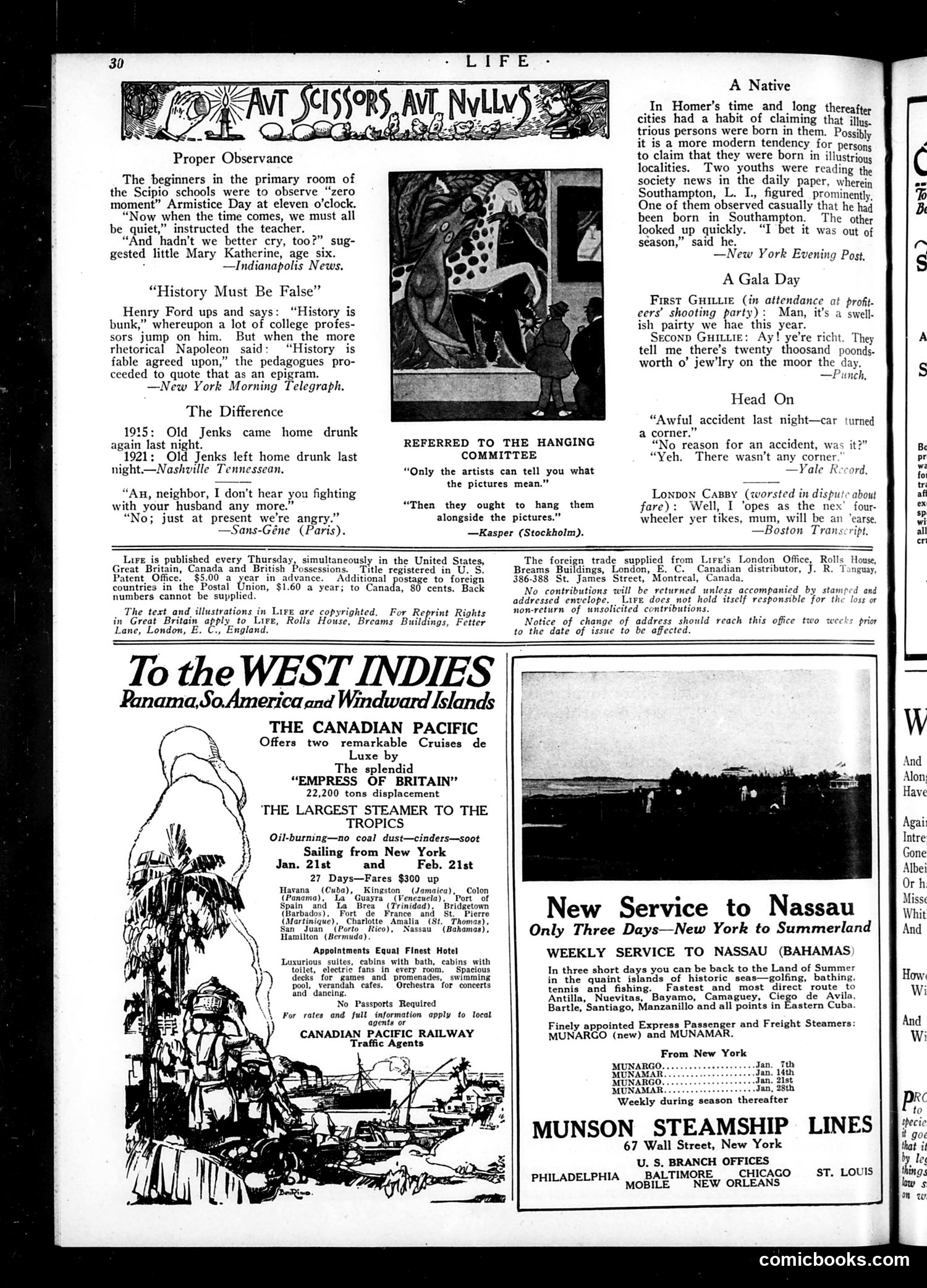
This page contains **short satirical humor pieces** and **advertisements**, typical of Life magazine's format. The cartoon/humor section titled "**Referred to the Hanging Committee**" appears to mock art criticism. The accompanying illustration shows what seems to be questionable artwork. The joke suggests artists claim viewers cannot interpret their work's meaning, yet ironically these same pieces should be "hung" (displayed) alongside the pictures—a pun implying the art itself is so poor it deserves to be "hanged" (destroyed). Other humor pieces satirize contemporary issues: Henry Ford's famous 1916 statement that "history is bunk," changing marital dynamics between 1915-1921, and social pretension about birthplaces. The remainder is **advertising**: The Canadian Pacific Railway promotes luxury cruise ships to the West Indies, and Munson Steamship Lines advertises service to Nassau, Bahamas. These reflect the 1920s leisure travel market for wealthy Americans. No major political figures or events are specifically caricatured on this page.
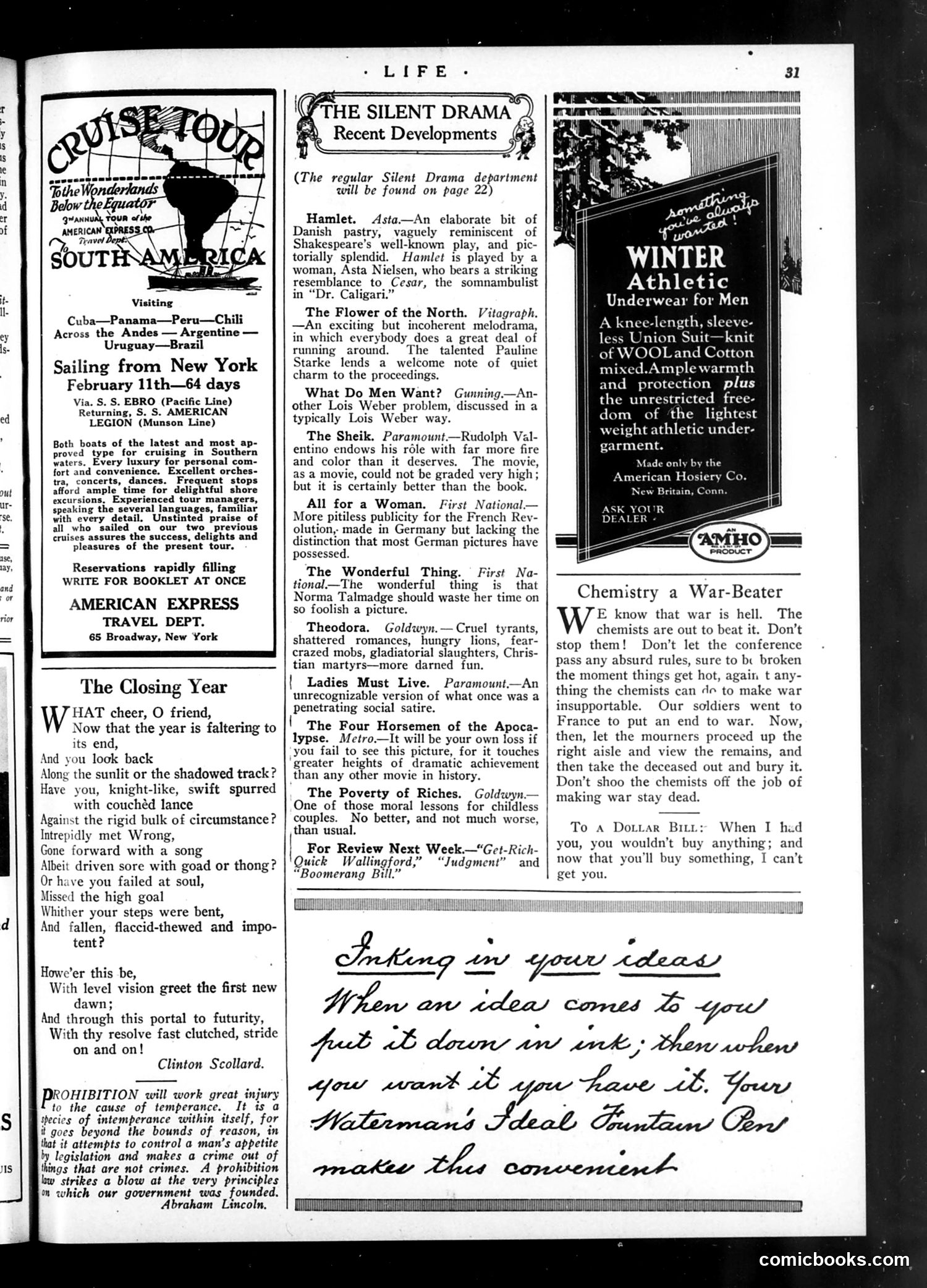
This page contains film reviews from Life's silent cinema column. The reviews critique current movies, mostly from 1921-1922 based on references (Rudolph Valentino's "The Sheik," Norma Talmadge films). The reviews are brief, sarcastic assessments. Notable examples: the reviewer praises "The Four Horsemen of the Apocalypse" as superior cinema, while mocking "The Wonderful Thing" for wasting Talmadge's talent on a foolish picture. "Theodora" is sarcastically praised for its melodramatic excess ("more darned fun"). "The Sheik" is criticized as inferior to its source material. The page also includes a poem "The Closing Year" by Clinton Scollard and an Abraham Lincoln quote opposing Prohibition—reflecting contemporary 1920s political debate. Travel advertisements promote South American cruises and athletic underwear.
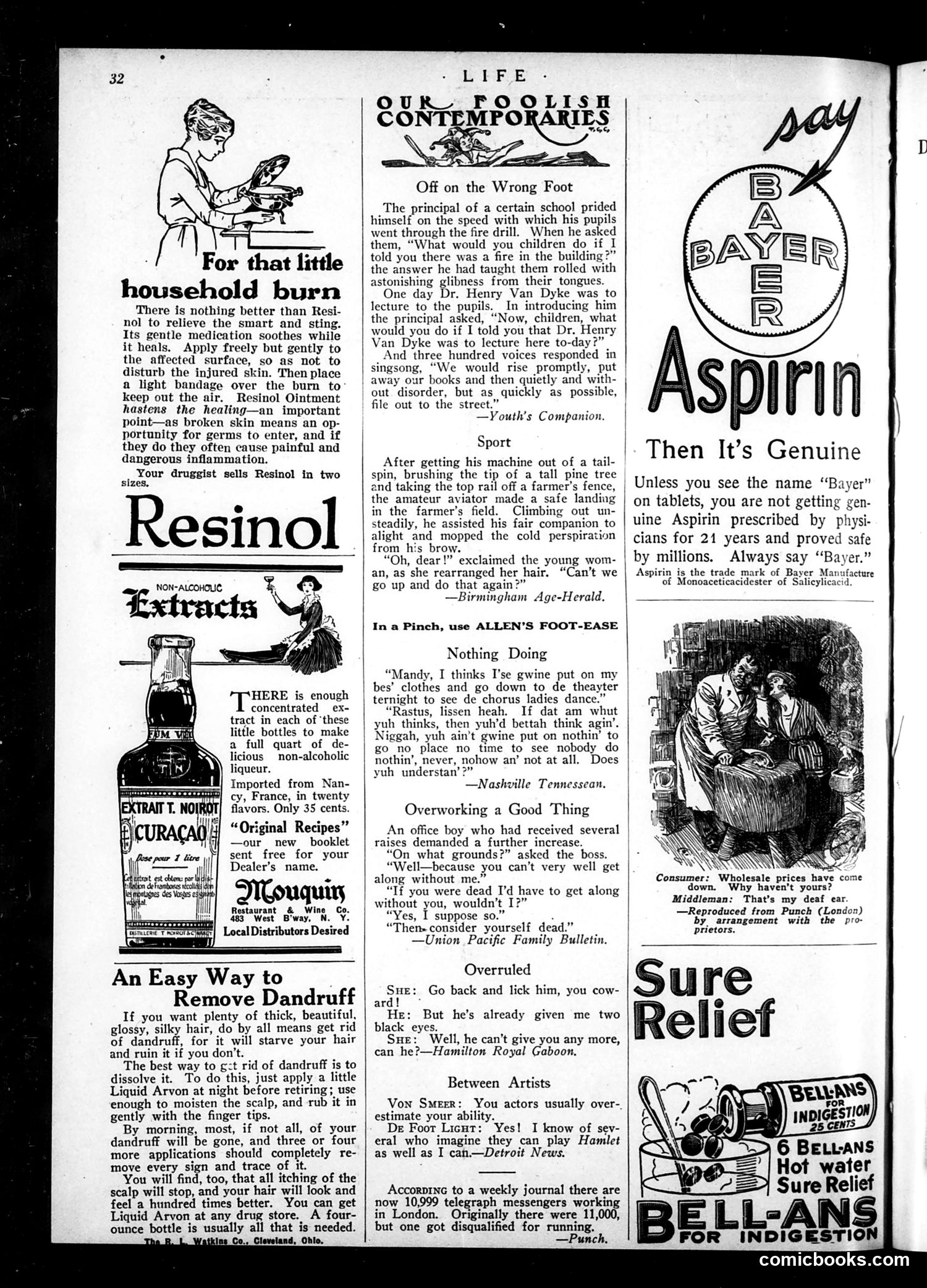
This page is primarily **advertisements and humorous anecdotes** rather than political content. The satirical sections include: **"Off on the Wrong Foot"**: A joke about a school principal's rigid fire-drill training. When asked what they'd do if Dr. Henry Van Dyke (a famous writer/lecturer) visited, students robotically responded they'd "file out to the street"—applying their emergency procedures to an inappropriate situation. The humor mocks overzealous institutional conformity. **"Nothing Doing"**: A dialect-heavy joke (using period stereotypes) about a woman refusing her husband's request to go out dancing. **"Overworking a Good Thing"**: A brief office comedy where an employee demands a raise, arguing the boss "can't get along without" him. The boss counters that he'd manage if the employee died, deflating the worker's leverage. The remaining content is product advertising (Resinol ointment, hair treatments, Bayer Aspirin, digestive remedies)—typical of Life's mixed editorial-commercial format.