
Life, 1921-12-22 · page 27 of 34
Life — December 22, 1921 — page 27: what you’re looking at
What you’re looking at
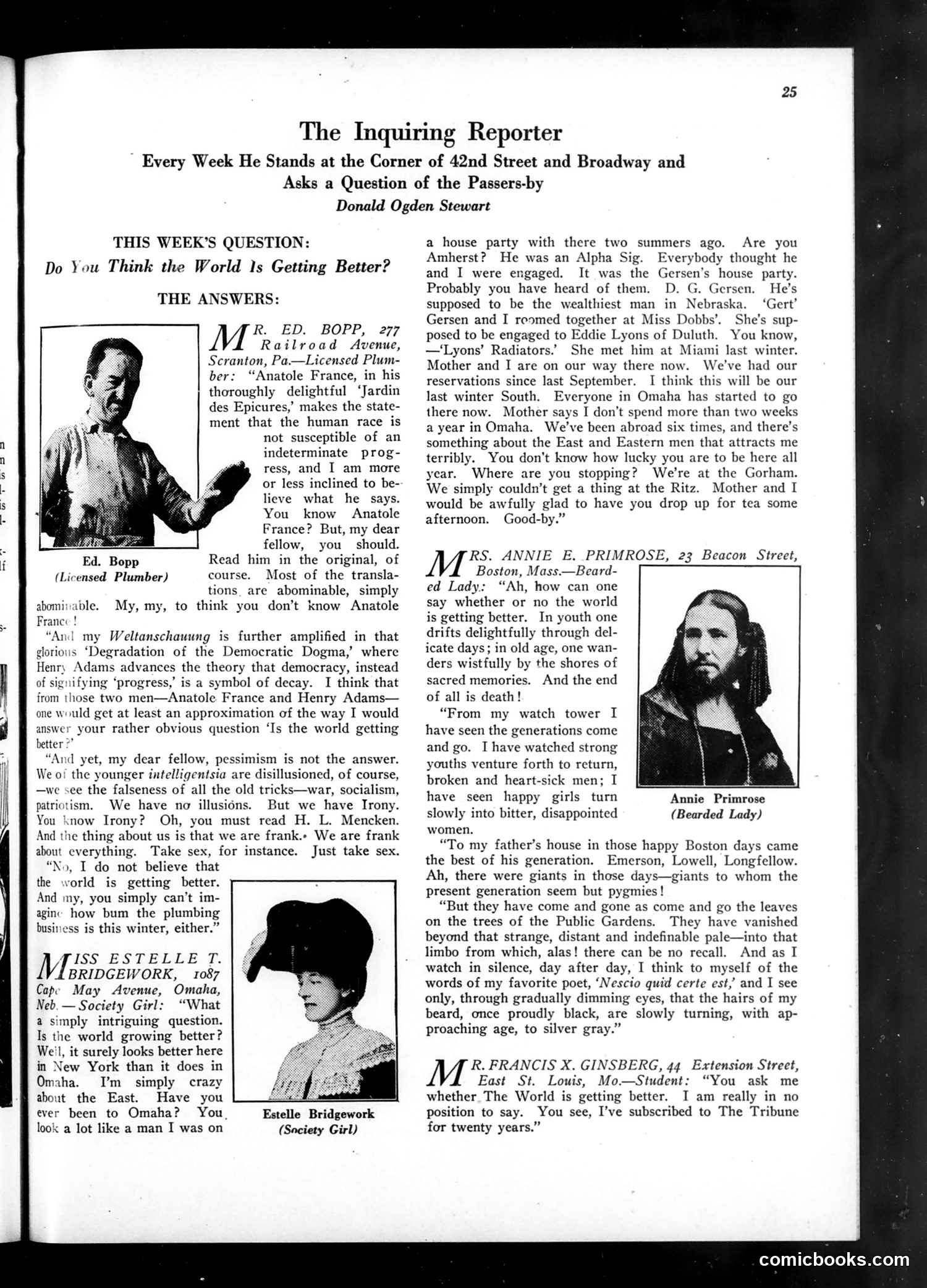
This page features a satirical column where pedestrians answer whether "the world is getting better." The humor lies in contrasting answers that reveal each speaker's pretensions and blind spots. **Ed. Bopp** (licensed plumber) demonstrates intellectual snobbery by name-dropping Anatole France and Henry Adams while complaining his actual plumbing business is terrible—undercutting his philosophical pessimism with mundane reality. **Estelle Bridgework** (society girl) answers by obsessing over East Coast social circles, wealthy acquaintances, and Miami vacations, entirely missing the question's substance through shallow materialism. **Annie E. Primrose** (bearded lady) offers genuine melancholy reflection on aging and mortality—contrasting with the other two speakers' self-absorbed obliviousness. The satire mocks 1920s American society: intellectual pretension, social climbing, and disconnection from actual conditions. The column suggests people answer not based on objective reality but filtered through their narrow social positions.
📄 Transcribed text from this page (OCR, searchable)
Machine-transcribed from the original scan — historical spelling and the odd misread are preserved.
The Inquiring Reporter Every Week He Stands at the Corner of 42nd Street and Broadway and Asks a Question of the Passers-by Donald Ogden Stewart THIS WEEK’S QUESTION: You Think the World 1s Getting Better? THE ANSWERS: R. ED. BOPP, 277 Railroad Avenue, Scranton, Pa—Licensed Plum- ber: “Anatole France, in his thoroughly delightful ‘Jardin des Epicures,’ makes the state- ment that the human race is not susceptible of an indeterminate prog- ress, and I am more or less inclined to be- lieve what he says. You know Anatole France? But, my dear fellow, you should. Read him in the original, of course. Most of the transla- tions. are abominable, simply My, my, to think you don’t know Anatole Ed. Bopp (Licensed Plumber) abominable. France! “And my Weltanschauung is further amplified in that glorious ‘Degradation of the Democratic Dogma,’ where dams advances the theory that democracy, instead ng ‘progress,’ is a symbol of decay. I think that from those two men—Anatole France and Henry Adams— one would get at least an approximation of the way I would answer your rather obvious question ‘Is the world getting better 2” “And yet, my dear fellow, pessimism is not the answer. We of the younger intelligentsia are disillusioned, of course, —we see the falseness of all the old tricks—war, socialism, patriotism. We have no illusions. But we have Irony. You know Irony? Oh, you must read H. L. Mencken. And the thing about us is that we are frank.» We are frank about everything. Take sex, for instance. Just take sex. “No, I do not believe that the world is getting better. And my, you simply can’t im- agine how bum the plumbing business is this winter, either.” MES ESTEL DE: Tf. BRIDGEWORK, 1087 Cape May Avenue, Omaha, Neb.— Society Girl: “What a simply intriguing question. Is the world growing better? Weil, it surely looks better here in New York than it does in Omaha. I’m simply crazy about the East. Have you ever been to Omaha? You, look a lot like a man I was on Estelle Bridgework (Society Girl) a house party with there two summers ago. Are you Amherst? He was an Alpha Sig. Everybody thought he and I were engaged. It was the Gersen’s house party. Probably you have heard of them. D. G. Gersen. He’s supposed to be the wealthiest man in Nebraska. ‘Gert’ Gersen and I roomed together at Miss Dobbs’. She's sup- posed to be engaged to Eddie Lyons of Duluth. You know, — ‘Lyons’ Radiators.’ She met him at Miami last winter. Mother and I are on our way there now. We've had our reservations since last September. I think this will be our last winter South. Everyone in Omaha has started to go there now. Mother says I don’t spend more than two weeks a year in Omaha. We’ve been abroad six times, and there’s something about the East and Eastern men that attracts me terribly. You don't know how lucky you are to be here all year. Where are you stopping? We're at the Gorham. We simply couldn’t get a thing at the Ritz. Mother and I would be awfully glad to have you drop up for tea some afternoon. Good-by.” RS. ANNIE E. PRIMROSE, 23 Beacon Street, Boston, Mass.—Beard- ed Lady: “Ah, how can one say whether or no the world is getting better. In youth one drifts delightfully through del- icate days; in old age, one wan- ders wistfully by the shores of sacred memories. And the end of all is death! “From my watch tower I have seen the generations come and go. I have watched strong youths venture forth to return, broken and heart-sick men; I have seen happy girls turn slowly into bitter, disappointed women. “To my father’s house in those happy Boston days came the best of his generation. Emerson, Lowell, Longfellow. Ah, there were giants in those days—giants to whom the present generation seem but pygmies! “But they have come and gone as come and go the leaves on the trees of the Public Gardens. They have vanished beyond that strange, distant and indefinable pale—into that limbo from which, alas! there can be no recall. And as I watch in silence, day after day, I think to myself of the words of my favorite poet, ‘Nescio quid certe est,’ and I see only, through gradually dimming eyes, that the hairs of my beard, once proudly black, are slowly turning, with ap- proaching age, to silver gray.” Annie Primrose (Bearded Lady) R. FRANCIS X. GINSBERG, 44 Extension Street, East St. Louis, Mo—Student: “You ask me whether The World is getting better. I am really in no Position to say. You see, I’ve subscribed to The Tribune for twenty years.” comicbooks.com