
Life, 1921-12-22 · page 24 of 34
Life — December 22, 1921 — page 24: what you’re looking at
What you’re looking at
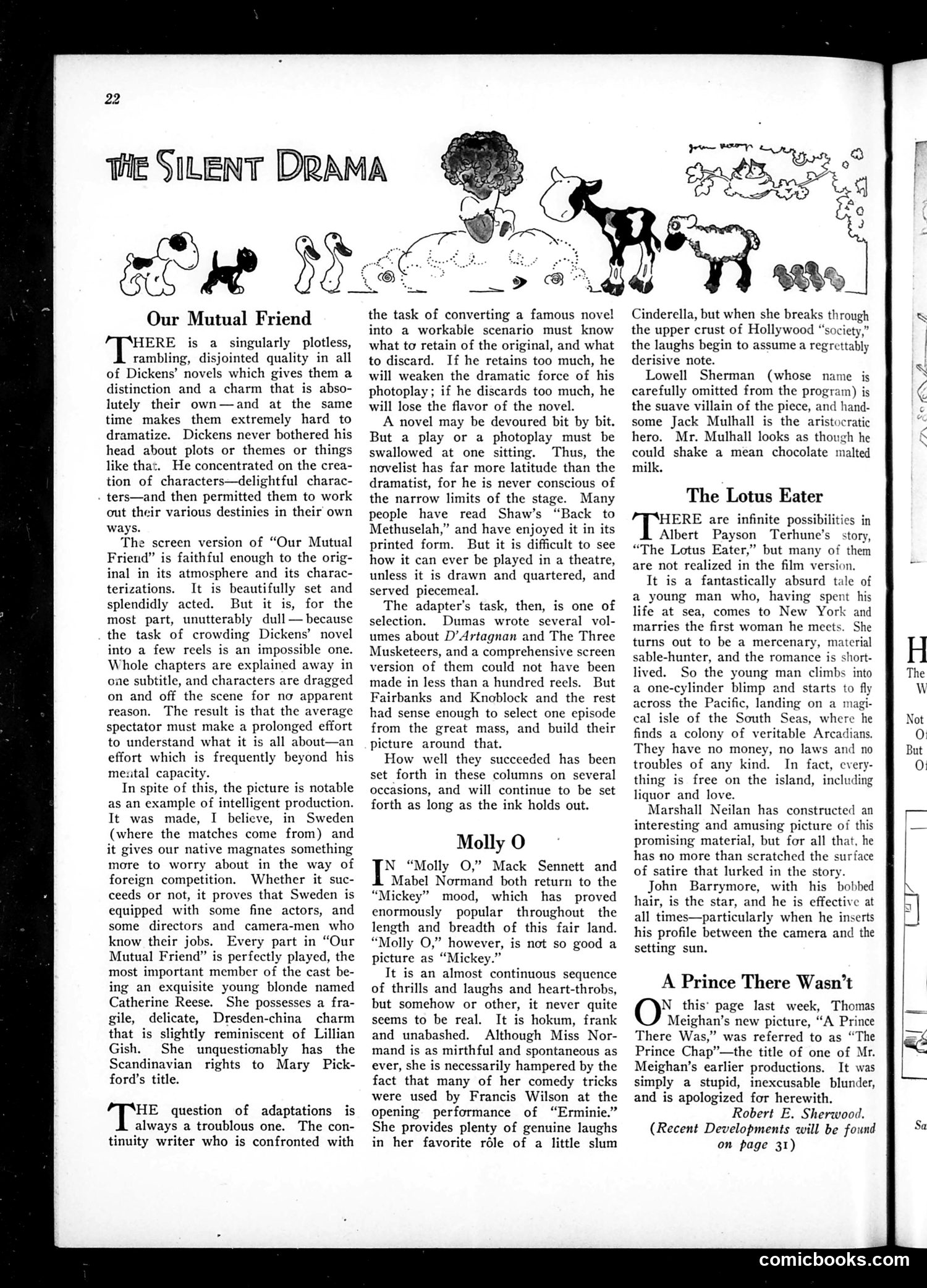
This page contains three film reviews from the silent era. The masthead cartoon shows animals, likely representing different film studios or production companies in a playful hierarchy. **"Our Mutual Friend"** reviews a Swedish adaptation of Dickens' novel, praising its intelligent production and the "exquisite young blonde" Catherine Reese (compared to Mary Pickford), while noting that condensing Dickens into film necessarily loses narrative complexity. **"Molly O"** discusses Mack Sennett and Mabel Normand's comedy returning to their successful "Mickey" formula, though the reviewer finds this version less effective—"hokum, frank and unabashed." **"The Lotus Eater"** and **"A Prince There Wasn't"** receive brief mentions. The reviews reflect silent cinema's challenge: adapting literature while respecting theatrical time constraints, and the era's fascination with Scandinavian talent competing against American studios.
📄 Transcribed text from this page (OCR, searchable)
Machine-transcribed from the original scan — historical spelling and the odd misread are preserved.
Our Mutual Friend HERE is a singularly plotless, rambling, disjointed quality in all of Dickens’ novels which gives them a distinction and a charm that is abso- lutely their own—and at the same time makes them extremely hard to dramatize. Dickens never bothered his head about plots or themes or things like that. He concentrated on the crea- tion of characters—delightful charac- ters—and then permitted them to work out their various destinies in their own ways. The screen version of “Our Mutual Friend” is faithful enough to the orig- inal in its atmosphere and its charac- terizations. It is beautifully set and splendidly acted. But it is, for the most part, unutterably dull — because the task of crowding Dickens’ novel into a few reels is an impossible one. Whole chapters are explained away in one subtitle, and characters are dragged on and off the scene for no apparent reason. The result is that the average spectator must make a prolonged effort to understand what it is all about—an effort which is frequently beyond his meatal capacity. In spite of this, the picture is notable as an example of intelligent production. It was made, I believe, in Sweden (where the matches come from) and it gives our native magnates something more to worry about in the way of foreign competition. Whether it suc- ceeds or not, it proves that Sweden is equipped with some fine actors, and some directors and camera-men who know their jobs. Every part in “Our Mutual Friend” is perfectly played, the most important member of the cast be- ing an exquisite young blonde named Catherine Reese. She possesses a fra- gile, delicate, Dresden-china charm that is slightly reminiscent of Lillian Gish. She unquestionably has the Scandinavian rights to Mary Pick- ford’s title. HE question of adaptations is always a troublous one. The con- tinuity writer who is confronted with the task of converting a famous novel into a workable scenario must know what to retain of the original, and what to discard. If he retains too much, he will weaken the dramatic force of his photoplay; if he discards too much, he will lose the flavor of the novel. A novel may be devoured bit by bit. But a play or a photoplay must be swallowed at one sitting. Thus, the novelist has far more latitude than the dramatist, for he is never conscious of the narrow limits of the stage. Many people have read Shaw’s “Back to Methuselah,” and have enjoyed it in its printed form. But it is difficult to see how it can ever be played in a theatre, unless it is drawn and quartered, and served piecemeal. The adapter’s task, then, is one of selection. Dumas wrote several vol- umes about D’Artagnan and The Three Musketeers, and a comprehensive screen version of them could not have been made in less than a hundred reels. But Fairbanks and Knoblock and the rest had sense enough to select one episode from the great mass, and build their picture around that. How well they succeeded has been set forth in these columns on several occasions, and will continue to be set forth as long as the ink holds out. Molly O N “Molly O,” Mack Sennett and Mabel Normand both return to the “Mickey” mood, which has proved enormously popular throughout the length and breadth of this fair land. “Molly O,” however, is not so good a picture as “Mickey.” It is an almost continuous sequence of thrills and laughs and heart-throbs, but somehow or other, it never quite seems to be real. It is hokum, frank and unabashed. Although Miss Nor- mand is as mirthful and spontaneous as ever, she is necessarily hampered by the fact that many of her comedy tricks were used by Francis Wilson at the opening performance of “Erminie.” She provides plenty of genuine laughs in her favorite rdle of a little slum Cinderella, but when she breaks through the upper crust of Hollywood “society,” the laughs begin to assume a regrettably derisive note. Lowell Sherman (whose name jis carefully omitted from the program) is the suave villain of the piece, and hand- some Jack Mulhall is the aristocratic hero. Mr. Mulhall looks as though he could shake a mean chocolate malted milk. The Lotus Eater ‘HERE are infinite possibilities in Albert Payson Terhune’s story, “The Lotus Eater,” but many of them are not realized in the film version. It is a fantastically absurd tale of a young man who, having spent his life at sea, comes to New York and marries the first woman he mects. She turns out to be a mercenary, material sable-hunter, and the romance is short- lived. So the young man climbs into a one-cylinder blimp and starts to across the Pacific, landing on a magi- cal isle of the South Seas, where he finds a colony of veritable Arcadians. They have no money, no laws and no troubles of any kind. In fact, every- thing is free on the island, including liquor and love. Marshall Neilan has constructed an interesting and amusing picture of this promising material, but for all t he has no more than scratched the of satire that lurked in the story. John Barrymore, with his bobbed hair, is the star, and he is effective at all times—particularly when he inserts his profile between the camera and the setting sun. A Prince There Wasn’t N this’ page last week, Thomas Meighan’s new picture, “A Prince There Was,” was referred to as “The Prince Chap”—the title of one of Mr. Meighan’s earlier productions. It was simply a stupid, inexcusable blunder, and is apologized for herewith. Robert E. Sherwood. (Recent Developments will be found on page 31) Sa comicbooks.com