
Life, 1921-12-22 · page 14 of 34
Life — December 22, 1921 — page 14: what you’re looking at
What you’re looking at
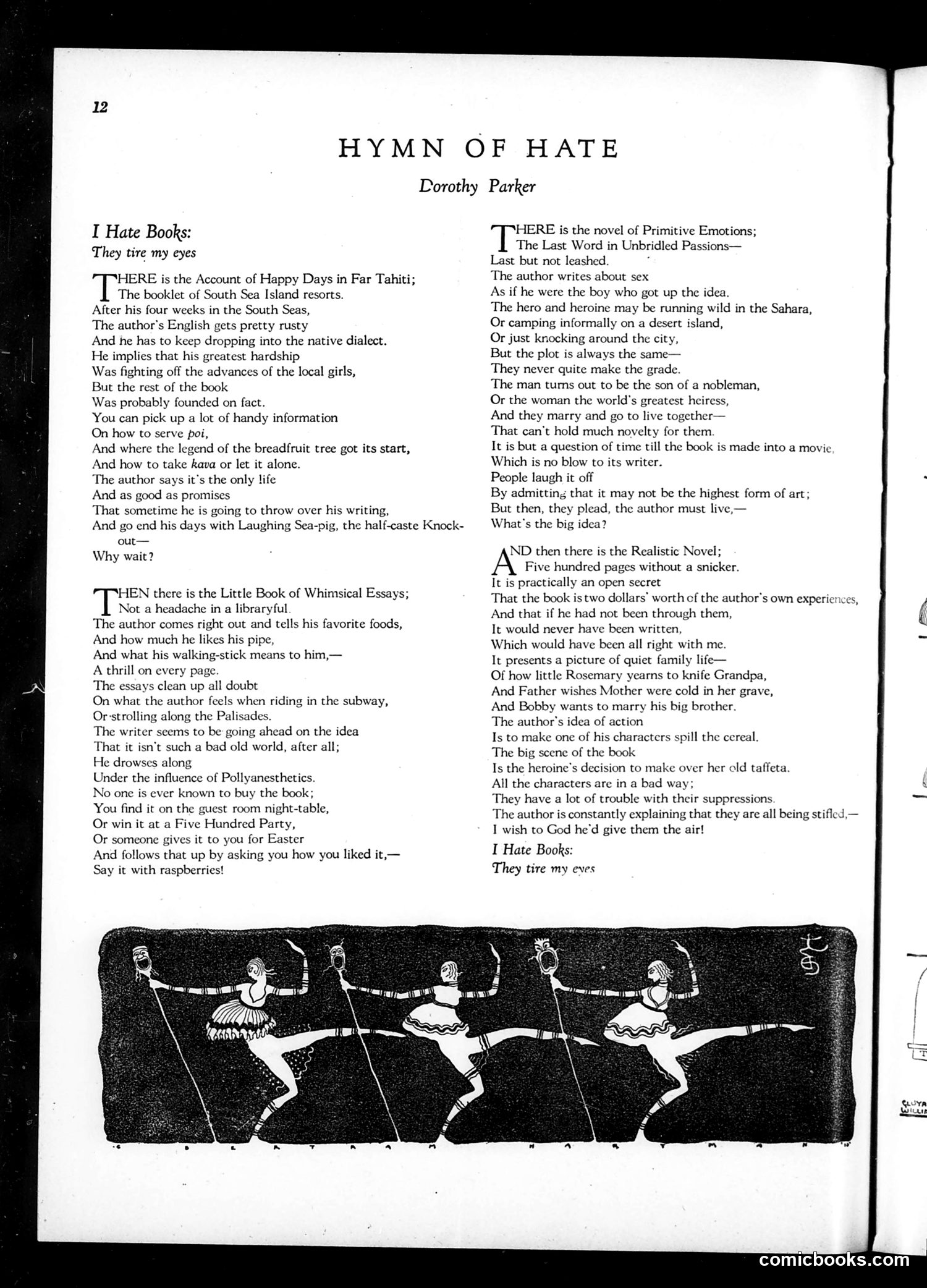
This page presents Parker's satirical poem mocking literary trends of her era. The text ridicules: 1. **South Sea/Exotic Adventure novels** — books set in tropical locations featuring superficial adventure plots and romance 2. **Whimsical essay collections** — lightweight, pretentious literary works 3. **Realistic novels** — lengthy, tedious domestic fiction focusing on mundane family life details Parker's refrain "I Hate Books: They tire my eyes" frames the critique. The decorative art-deco illustration at bottom (three stylized female figures) reflects 1920s-30s design aesthetics. The satire targets publishing industry trends and reader tastes rather than specific titles or authors. Parker attacks both escapist adventure fiction and earnest realism as equally tiresome, reflecting broader modernist literary debates about what constitutes serious writing.
📄 Transcribed text from this page (OCR, searchable)
Machine-transcribed from the original scan — historical spelling and the odd misread are preserved.
HYMN OF HATE Dorothy Parker I Hate Books: They tire my eyes 'HERE is the Account of Happy Days in Far Tahiti; The booklet of South Sea Island resorts. After his four weeks in the South Seas, The author's English gets pretty rusty And he has to keep dropping into the native dialect. He implies that his greatest hardship Was fighting off the advances of the local girls, But the rest of the book Was probably founded on fact. You can pick up a lot of handy information On how to serve poi, And where the legend of the breadfruit tree got its start, And how to take kava or let it alone. The author says it’s the only life And as good as promises That sometime he is going to throw over his writing, And go end his days with Laughing Sea-pig, the half-caste Knock- out— Why wait? ‘HEN there is the Little Book of Whimsical Essays; Not a headache in a libraryful The author comes right out and tells his favorite foods, And how much he likes his pipe, And what his walking-stick means to him,— A thrill on every page. The essays clean up all doubt On what the author feels when riding in the subway, Or-strolling along the Palisades. The writer seems to be going ahead on the idea That it isn’t such a bad old world, after all; He drowses along Under the influence of Pollyanesthetics. No one is ever known to buy the book; You find it on the guest room night-table, Or win it at a Five Hundred Party, Or someone gives it to you for Easter And follows that up by asking you how you liked it,— Say it with raspberries! fesanr ‘HERE is the novel of Primitive Emotions; The Last Word in Unbridled Passions— Last but not leashed. . The author writes about sex As if he were the boy who got up the idea. The hero and heroine may be running wild in the Sahara, Or camping informally on a desert island, Or just knocking around the city, But the plot is always the same— They never quite make the grade. The man turns out to be the son of a nobleman, Or the woman the world’s greatest heiress, And they marry and go to live together— That can't hold much novelty for them. It is but a question of time till the book is made into a movie Which is no blow to its writer. People laugh it off By admitting that it may not be the highest form of art; But then, they plead, the author must live,— What's the big idea? ND then there is the Realistic Novel; Five hundred pages without a snicker. It is practically an open secret That the book is two dollars’ worth cf the author's own experience And that if he had not been through them, It would never have been written, Which would have been all right with me. It presents a picture of quiet family life— Of how little Rosemary yearns to knife Grandpa, And Father wishes Mother were cold in her grave, And Bobby wants to marry his big brother. The author's idea of action Is to make one of his characters spill the cereal. The big scene of the book Is the heroine's decision to make over her old taffeta. All the characters are in a bad way; They have a lot of trouble with their suppressions. The author is constantly explaining that they are all being stifled, — I wish to God he'd give them the air! I Hate Books: They tire my eves comicbooks.com