
Life, 1921-12-22 · page 7 of 34
Life — December 22, 1921 — page 7: what you’re looking at
What you’re looking at
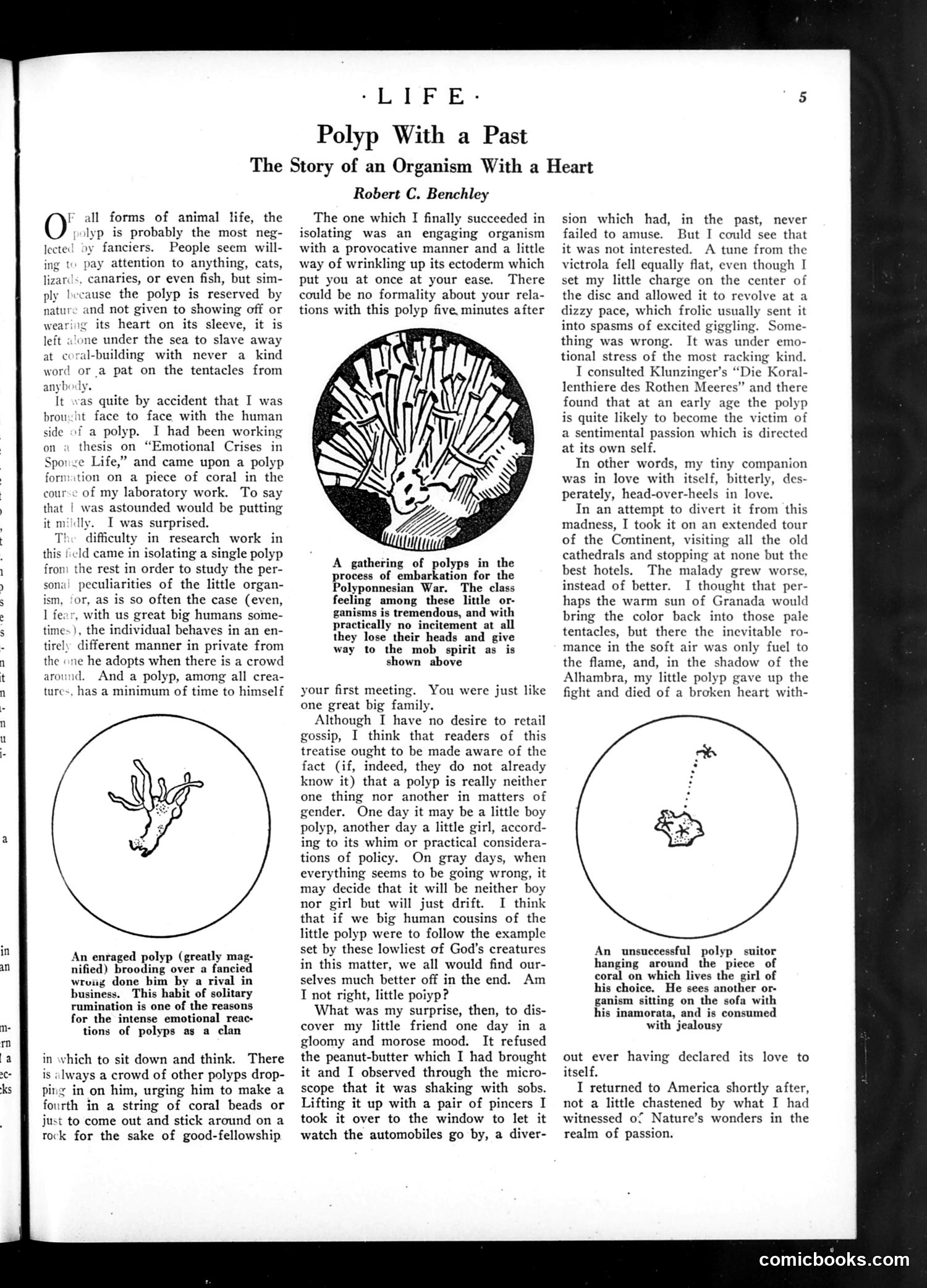
This is a humorous scientific essay by Robert C. Benchley about a polyp (a small marine organism) that unexpectedly displays emotional behavior—specifically, romantic attachment to itself and heartbreak. The illustrations show the polyp's form and a depicted scene of it viewing passing automobiles. The satire is gentle and whimsical rather than political: Benchley anthropomorphizes the polyp, attributing human emotions and vulnerabilities to a creature that "should" lack such capacities. The humor lies in treating this tiny, primitive organism with the emotional complexity of a human character—it becomes melancholic, falls in love with itself, experiences jealousy, and ultimately dies of heartbreak during a trip to Europe. This reflects Benchley's characteristic style: using scientific subjects as vehicles for absurdist comedy and social commentary about human nature.
📄 Transcribed text from this page (OCR, searchable)
Machine-transcribed from the original scan — historical spelling and the odd misread are preserved.
-LIFE- Polyp With a Past The Story of an Organism With a Heart F all forms of animal life, the O lyp is probably the most neg- lected by fanciers. People seem will- t y attention to anything, cats, . canaries, or even fish, but sim- cause the polyp is reserved by and not given to showing off or ig its heart on its sleeve, it is one under the sea to slave away at coral-building with never a kind word or a pat on the tentacles from anybody. It was quite by accident that I was brousht face to face with the human side of a polyp. I had been working on « thesis on “Emotional Crises in Sponze Life,” and came upon a polyp formation on a piece of coral in the course of my laboratory work. To say that | was astounded would be putting it mildly. I was surprised. The difficulty in research work in this eld came in isolating a single polyp fron) the rest in order to study the per- sonai peculiarities of the little organ- or, as is so often the case (even, 1 fear, with us great big humans some- times), the individual behaves in an en- tirely different manner in private from the one he adopts when there is a crowd around. And a polyp, among all crea- tures, has a minimum of time to himself natur wear left An enraged polyp (greatly mag- nified) brooding over a fancied wrong done bim by a rival in business. This habit of solitary rumination is one of the reasons for the intense emotional reac- tions of polyps as a clan in which to sit down and think. There is always a crowd of other polyps drop- ping in on him, urging him to make a fourth in a string of coral beads or just to come out and stick around on a tock for the sake of good-fellowship. Robert C. Benchley The one which I finally succeeded in isolating was an engaging organism with a provocative manner and a little way of wrinkling up its ectoderm which put you at once at your ease. There could be no formality about your rela- tions with this polyp five minutes after A gathering of polyps in the process of embarkation for the Polyponnesian War. The class feeling among these little or- ganisms is tremendous, and with practically no incitement at all they lose their heads and give way to the mob spirit as is shown above your first meeting. You were just like one great big family. Although I have no desire to retail gossip, I think that readers of this treatise ought to be made aware of the fact (if, indeed, they do not already know it) that a polyp is really neither one thing nor another in matters of gender. One day it may be a little boy polyp, another day a little girl, accord- ing to its whim or practical considera- tions of policy. On gray days, when everything seems to be going wrong, it may decide that it will be neither boy nor girl but will just drift. I think that if we big human cousins of the little polyp were to follow the example set by these lowliest of God’s creatures in this matter, we all would find our- selves much better off in the end. Am I not right, little poiyp? What was my surprise, then, to dis- cover my little friend one day in a gloomy and morose mood. It refused the peanut-butter which I had brought it and I observed through the micro- scope that it was shaking with sobs. Lifting it up with a pair of pincers I took it over to the window to let it watch the automobiles go by, a diver- sion which had, in the past, never failed to amuse. But I could see that it was not interested. A tune from the victrola fell equally flat, even though I set my little charge on the center of the disc and allowed it to revolve at a dizzy pace, which frolic usually sent it into spasms of excited giggling. Some- thing was wrong. It was under emo- tional stress of the most racking kind. I consulted Klunzinger’s “Die Koral- lenthiere des Rothen Meeres” and there found that at an early age the polyp is quite likely to become the victim of a sentimental passion which is directed at its own self. In other words, my tiny companion was in love with itself, bitterly, des- perately, head-over-heels in love. In an attempt to divert it from this madness, I took it on an extended tour of the Continent, visiting all the old cathedrals and stopping at none but the best hotels. The malady grew worse, instead of better. I thought that per- haps the warm sun of Granada would bring the color back into those pale tentacles, but there the inevitable ro- mance in the soft air was only fuel to the flame, and, in the shadow of the Alhambra, my little polyp gave up the fight and died of a broken heart with- An unsuccessful polyp suitor hanging around the piece of coral on which lives the girl of his choice. He sees another or- ganism sitting on the sofa with his inamorata, and is consumed with jealousy out ever having declared its love to itself. I returned to America shortly after, not a little chastened by what I had witnessed of Nature’s wonders in the realm of passion. comicbooks.com