
Life, 1921-12-22 · page 16 of 34
Life — December 22, 1921 — page 16: what you’re looking at
What you’re looking at
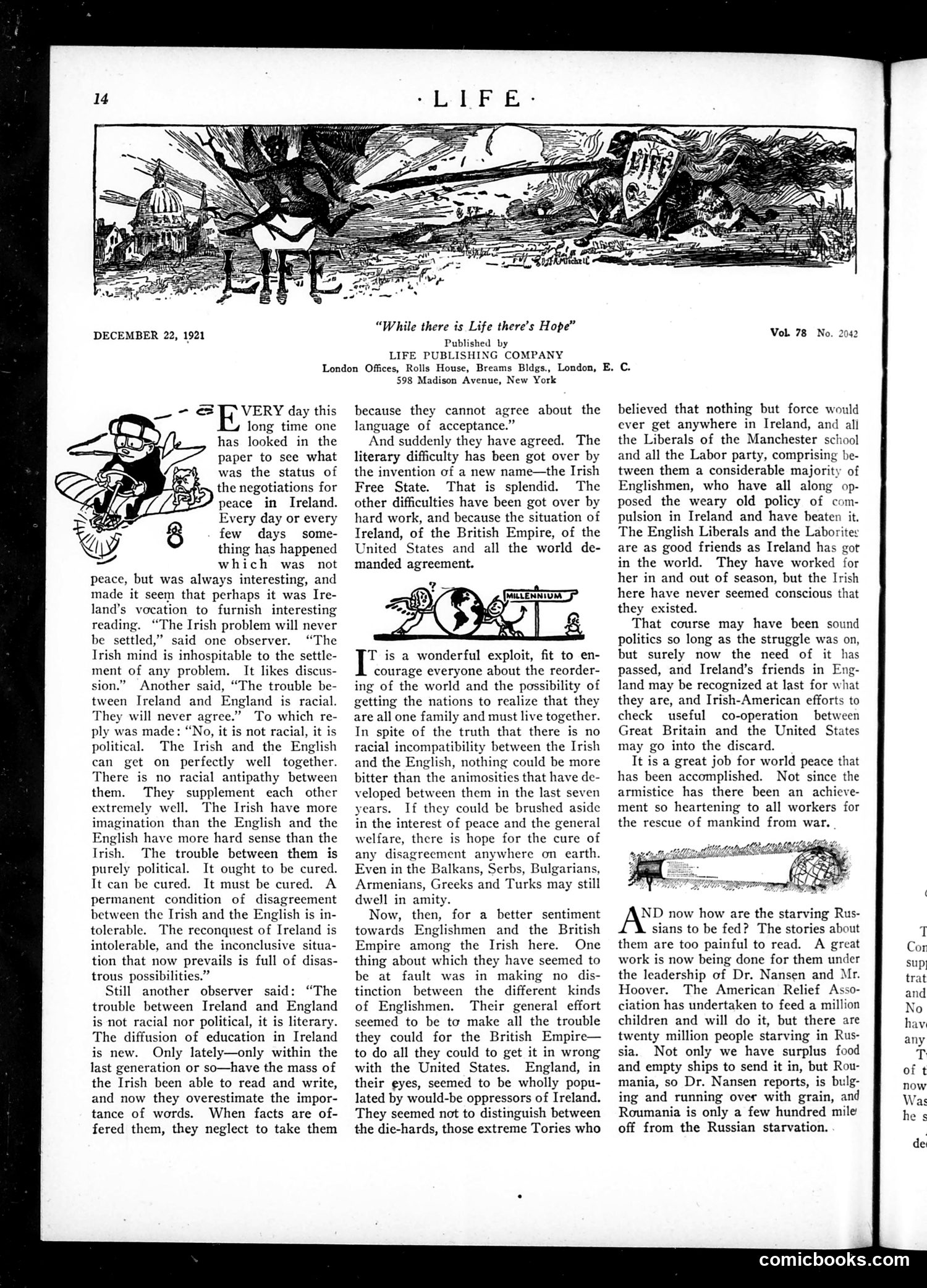
The page's main illustration depicts a figure (likely representing Ireland or an Irish political entity) sitting beneath a tree labeled "LIFE," with various symbolic elements including what appears to be governmental or institutional buildings in the background. The article discusses ongoing peace negotiations in Ireland, addressing tensions between Irish and English interests. It references the "Irish Free State" negotiations and disputes over language acceptance in political agreements. The text critiques the historical animosity between Ireland and England, arguing that racial and political differences have made coexistence difficult. The piece suggests hope for reconciliation through practical cooperation, and shifts to discussing famine relief efforts in Russia under American assistance. The overall tone treats Ireland's political situation with cautious optimism for peaceful resolution.
📄 Transcribed text from this page (OCR, searchable)
Machine-transcribed from the original scan — historical spelling and the odd misread are preserved.
DECEMBER 22, 1921 “While there is Life there’s Hope” Published by LIFE PUBLISHING COMPANY Vol. 78 No. 2042 London Offices, Rolls House, Breams Bldgs., London, E. C. — - SG VERY day this long time one has looked in the paper to see what & iy was the status of A eX FS the negotiations for “4 Mi sha peace in Ireland. Y, ~ 8 few days some- Wy thing has happened — which was not made it seem that perhaps it was Ire- land’s vocation to furnish interesting reading. “The Irish problem will never Every day or every peace, but was always interesting, and be settled,” said one observer. “The Irish mind is inhospitable to the settle- ment of any problem. It likes discus- sion.” Another said, “The trouble be- tween Ireland and England is racial. They will never agree.” To which re- ply was made: “No, it is not racial, it is political. The Irish and the English can get on perfectly well together. There is no racial antipathy between them. They supplement each other extremely well. The Irish have more imagination than the English and the English have more hard sense than the Irish. The trouble between them is purely political. It ought to be cured. It can be cured. It must be cured. A permanent condition of disagreement between the Irish and the English is in- tolerable. The reconquest of Ireland is intolerable, and the inconclusive situa- tion that now prevails is full of disas- trous possibilities.” Still another observer said: “The trouble between Ireland and England is not racial nor political, it is literary. The diffusion of education in Ireland is new. Only lately—only within the last generation or so—have the mass of the Irish been able to read and write, and now they overestimate the impor- tance of words. When facts are of- fered them, they neglect to take them 598 Madison Avenue, New York because they cannot agree about the language of acceptance.” And suddenly they have agreed. The literary difficulty has been got over by the invention of a new name—the Irish Free State. That is splendid. The other difficulties have been got over by hard work, and because the situation of Ireland, of the British Empire, of the United States and all the world de- manded agreement. T is a wonderful exploit, fit to en- courage everyone about the reorder- ing of the world and the possibility of getting the nations to realize that they are all one family and must live together. In spite of the truth that there is no racial incompatibility between the Irish and the English, nothing could be more bitter than the animosities that have de- veloped between them in the last seven years. If they could be brushed aside in the interest of peace and the general welfare, there is hope for the cure of any disagreement anywhere on earth. Even in the Balkans, Serbs, Bulgarians, Armenians, Greeks and Turks may still dwell in amity. Now, then, for a better sentiment towards Englishmen and the British Empire among the Irish here. One thing about which they have seemed to be at fault was in making no dis- tinction between the different kinds of Englishmen. Their general effort seemed to be to make all the trouble they could for the British Empire— to do all they could to get it in wrong with the United States. England, in their eyes, seemed to be wholly popu- lated by would-be oppressors of Ireland. They seemed not to distinguish between the die-hards, those extreme Tories who believed that nothing but force would ever get anywhere in Ireland, and ali the Liberals of the Manchester school and all the Labor party, comprising be- tween them a considerable majority of Englishmen, who have all along op- posed the weary old policy of com- pulsion in Ireland and have beaten it. The English Liberals and the Laboriter are as good friends as Ireland has got in the world. They have worked for her in and out of season, but the Irish here have never seemed conscious that they existed. That course may have been sound politics so long as the struggle was on, but surely now the need of it has passed, and Ireland’s friends in Eng- land may be recognized at last for what they are, and Irish-American efforts to check useful co-operation between Great Britain and the United States may go into the discard. It is a great job for world peace that has been accomplished. Not since the armistice has there been an achieve- ment so heartening to all workers for the rescue of mankind from war. D now how are the starving Rus- sians to be fed? The stories about them are too painful to read. A great work is now being done for them under the leadership of Dr. Nansen and Mr. Hoover. The American Relief A: ciation has undertaken to feed a million children and will do it, but there are twenty million people starving in Rus- sia. Not only we have surplus food and empty ships to send it in, but Rou- mania, so Dr. Nansen reports, is bulg- ing and running over with grain, and Roumania is only a few hundred mile off from the Russian starvation. T Cor sup trat now Was he s de comicbooks.com