
Life, 1921-12-22 · page 30 of 34
Life — December 22, 1921 — page 30: what you’re looking at
What you’re looking at
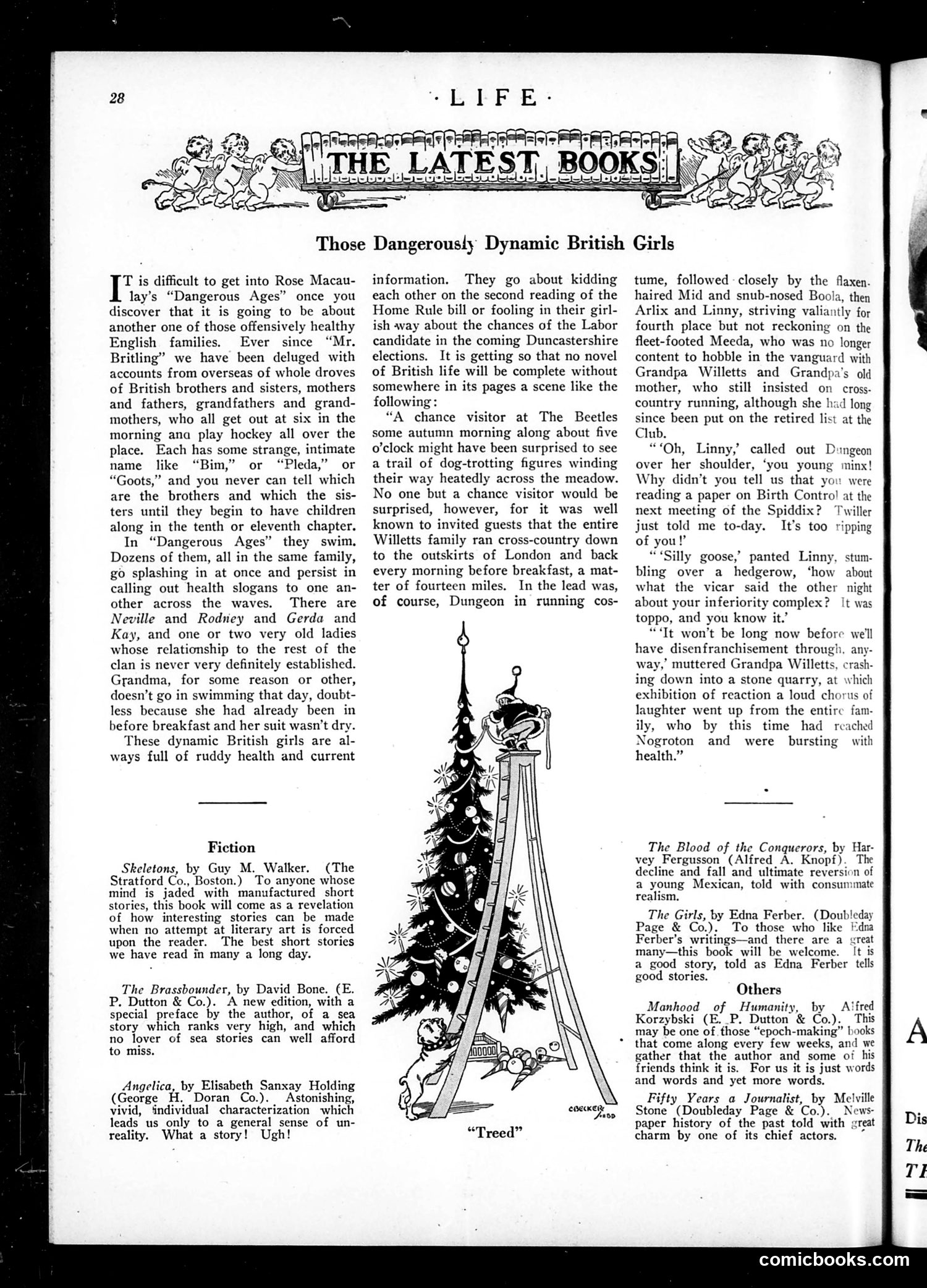
This page satirizes the popularity of British novels featuring absurdly robust, health-obsessed families—particularly Rose Macaulay's "Dangerous Ages." The reviewer mocks a literary trend where entire British clans engage in relentless physical activity (swimming, running, hockey) and possess quirky, indistinguishable nicknames. The accompanying illustration labeled "Treed" depicts an exaggerated Christmas tree decorated with these hyper-active family members, visualizing the critic's point: these novels are stuffed with interchangeable, wholesome characters doing constant exercise. The satire targets post-WWI British literature's celebration of vigorous, outdoor-loving families—likely reflecting actual social anxieties about health, class, and national vitality. The parodic passage about the Willetts family's 14-mile pre-breakfast run and casual discussion of Birth Control represents the critic's eye-rolling dismissal of such novels as simultaneously preachy and absurd. It's essentially a book review joke: these works had become a tiresome genre cliché.
📄 Transcribed text from this page (OCR, searchable)
Machine-transcribed from the original scan — historical spelling and the odd misread are preserved.
Those Dangerously Dynamic British Girls T is difficult to get into Rose Macau- lay’s “Dangerous Ages” once you discover that it is going to be about another one of those offensively healthy English families. Ever since “Mr. Britling” we have been deluged with accounts from overseas of whole droves of British brothers and sisters, mothers and fathers, grandfathers and grand- mothers, who all get out at six in the morning ana play hockey all over the place. Each has some strange, intimate name like “Bim,” or “Pleda,” or “Goots,” and you never can tell which are the brothers and which the sis- ters until they begin to have children along in the tenth or eleventh chapter. In “Dangerous Ages” they swim. Dozens of them, all in the same family, go splashing in at once and persist in calling out health slogans to one an- other across the waves. There are Neville and Rodney and Gerda and Kay, and one or two very old ladies whose relationship to the rest of the clan is never very definitely established. Grandma, for some reason or other, doesn’t go in swimming that day, doubt- less because she had already been in before breakfast and her suit wasn’t dry. These dynamic British girls are al- ways full of ruddy health and current Fiction Skeletons, by Guy M. Walker. (The Stratford Co., Boston.) To anyone whose mind is jaded with manufactured short stories, this book will come as a revelation of how interesting stories can be made when no attempt at literary art is forced upon the reader. The best short stories we have read in many a long day. The Brassbounder, by David Bone. €E. P. Dutton & Co.). A new edition, with a special preface by the author, of a sea story which ranks very high, and which no lover of sea stories can well afford to miss. Angelica, by Elisabeth Sanxay Holding (George H. Doran Co.). Astonishing, vivid, ‘individual characterization which leads us only to a general sense of un- reality. What a story! Ugh! information. They go about kidding each other on the second reading of the Home Rule bill or fooling in their girl- ish way about the chances of the Labor candidate in the coming Duncastershire elections. It is getting so that no novel of British life will be complete without somewhere in its pages a scene like the following: “A chance visitor at The Beetles some autumn morning along about five o’clock might have been surprised to see a trail of dog-trotting figures winding their way heatedly across the meadow. No one but a chance visitor would be surprised, however, for it was well known to invited guests that the entire Willetts family ran cross-country down to the outskirts of London and back every morning before breakfast, a mat- ter of fourteen miles. In the lead was, of course, Dungeon in running cos- eOeKER Par tume, followed closely by the flaxen. haired Mid and snub-nosed Boola, then Arlix and Linny, striving valiantly for fourth place but not reckoning on the fleet-footed Meeda, who was no longer content to hobble in the vanguard with Grandpa Willetts and Grandpa’s old mother, who still insisted on cross- country running, although she had long since been put on the retired list at the Club. “‘Oh, Linny,’ called out Dungeon over her shoulder, ‘you young minx! Why didn’t you tell us that you were reading a paper on Birth Control at the next meeting of the Spiddix? Tiller just told me to-day. It’s too ripping of you!’ ““Silly goose,’ panted Linny, bling over a hedgerow, ‘how what the vicar said the other about your inferiority complex? toppo, and you know it.’ “It won’t be long now before we'll have disenfranchisement through, any- way,’ muttered Grandpa Willetts, crash- ing down into a stone quarry, at which exhibition of reaction a loud chorus of laughter went up from the entire fam- who by this time had reached Nogroton and were bursting with health.” stum- about night t was The Blood of the Conquerors, by Har- vey Fergusson (Alfred A. Knopf). The decline and fall and ultimate reversion of a young Mexican, told with consummate realism. The Girls, by Edna Ferber. (Doubleday Page & Co.). To those who like Edna Ferber’s writings—and there are a great many—this book will be welcome. It is a good story, told as Edna Ferber tells good stories. Others Manhood of Humanity, by _ Alfred Korzybski (E. P. Dutton & Co.). This may be one of those “epoch-making” books that come along every few weeks, and we gather that the author and some oi his friends think it is. For us it is just words and words and yet more words. Fifty Years a Journalist by Mel ile Stone (Doubleday Page & Co.). paper history of the past told with charm by one of its chief actors. comicbooks.com