
Life, 1921-12-22 · page 20 of 34
Life — December 22, 1921 — page 20: what you’re looking at
What you’re looking at
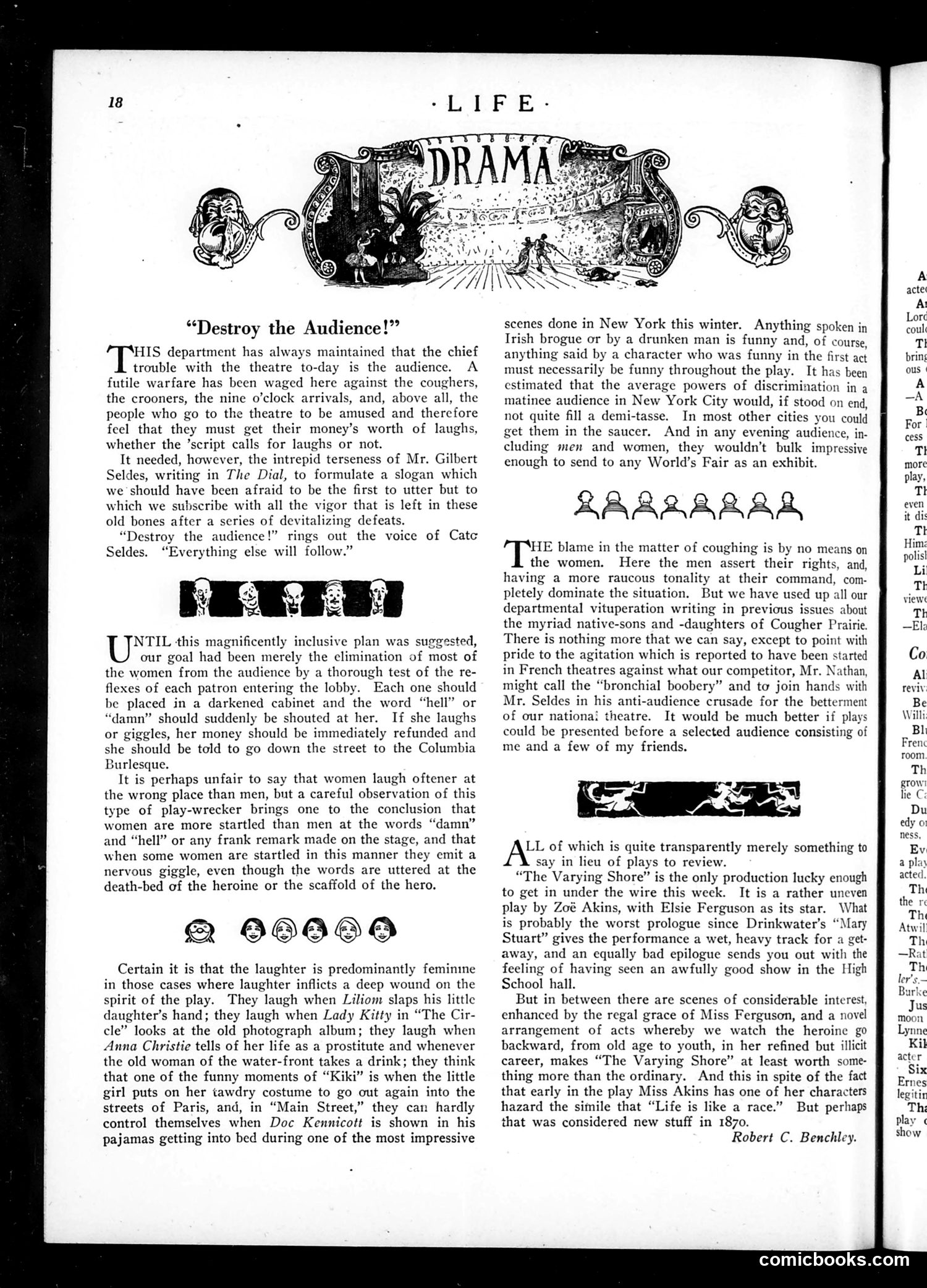
This is a satirical essay attacking theatergoers' behavior and poor taste. The author (writing under Life's Drama department) adopts critic Gilbert Seldes's provocative slogan to argue that audiences—not playwrights or actors—are theater's real problem. The piece specifically criticizes women for laughing at inappropriate moments (during tragic scenes in plays like *Liliom* and *Anna Christie*), and men for coughing loudly during performances. It mocks matinee audiences as intellectually shallow, suggesting their "powers of discrimination" are barely measurable. The illustrations show rows of identical male and female faces, visually emphasizing the author's point about undifferentiated, unreflective audiences. The tone is deliberately caustic—the author even proposes a humorous "reflex test" to screen out laughers. This reflects early 20th-century cultural tensions between "serious" theater (seeking emotional authenticity) and popular entertainment preferences, with class and gender assumptions embedded throughout.
📄 Transcribed text from this page (OCR, searchable)
Machine-transcribed from the original scan — historical spelling and the odd misread are preserved.
“Destroy the Audience!” HIS department has always maintained that the chief trouble with the theatre to-day is the audience. A futile warfare has been waged here against the coughers, the crooners, the nine o’clock arrivals, and, above all, the people who go to the theatre to be amused and therefore feel that they must get their money’s worth of laughs, whether the ’script calls for laughs or not. It needed, however, the intrepid terseness of Mr. Gilbert Seldes, writing in The Dial, to formulate a slogan which we should have been afraid to be the first to utter but to which we subscribe with all the vigor that is left in these old bones after a series of devitalizing defeats. “Destroy the audience!” rings out the voice of Cate Seldes. “Everything else will follow.” NTIL this magnificently inclusive plan was suggested, our goal had been merely the elimination of most of the women from the audience by a thorough test of the re- flexes of each patron entering the lobby. Each one should be placed in a darkened cabinet and the word “hell” or “damn” should suddenly be shouted at her. If she laughs or giggles, her money should be immediately refunded and she should be told to go down the street to the Columbia Burlesque. It is perhaps unfair to say that women laugh oftener at the wrong place than men, but a careful observation of this type of play-wrecker brings one to the conclusion that women are more startled than men at the words “damn” and “hell” or any frank remark made on the stage, and that when some women are startled in this manner they emit a nervous giggle, even though the words are uttered at the death-bed of the heroine or the scaffold of the hero. Q Certain it is that the laughter is predominantly feminine in those cases where laughter inflicts a deep wound on the spirit of the play. They laugh when Liliom slaps his little daughter’s hand; they laugh when Lady Kitty in “The Cir- cle” looks at the old photograph album; they laugh when Anna Christie tells of her life as a prostitute and whenever the old woman of the water-front takes a drink; they think that one of the funny moments of “Kiki” is when the little girl puts on her tawdry costume to go out again into the streets of Paris, and, in “Main Street,” they can hardly control themselves when Doc Kennicott is shown in his pajamas getting into bed during one of the most impressive scenes done in New York this winter. Anything spoken in Irish brogue or by a drunken man is funny and, of course, anything said by a character who was funny in the first act must necessarily be funny throughout the play. It has been estimated that the average powers of discrimination in a matinee audience in New York City would, if stood on end, not quite fill a demi-tasse. In most other cities you could get them in the saucer. And in any evening audience, in- cluding men and women, they wouldn't bulk impressive enough to send to any World’s Fair as an exhibit. RARZARRR ‘HE blame in the matter of coughing is by no means on the women. Here the men assert their rights, and, having a more raucous tonality at their command, com- pletely dominate the situation. But we have used up all our departmental vituperation writing in previous issues about the myriad native-sons and -daughters of Cougher Prairie. There is nothing more that we can say, except to point with pride to the agitation which is reported to have been started in French theatres against what our competitor, Mr. Nathan, might call the “bronchial boobery” and to join hands with Mr. Seldes in his anti-audience crusade for the betterment of our nationai theatre. It would be much better if plays could be presented before a selected audience consisting of me and a few of my friends. LL of which is quite transparently merely something to say in lieu of plays to review. “The Varying Shore” is the only production lucky enough to get in under the wire this week. It is a rather uneven play by Zoé Akins, with Elsie Ferguson as its star. What is probably the worst prologue since Drinkwater’s “Mary Stuart” gives the performance a wet, heavy track for a get away, and an equally bad epilogue sends you out with the feeling of having seen an awfully good show in the High School hall. But in between there are scenes of considerable interest, enhanced by the regal grace of Miss Ferguson, and a novel arrangement of acts whereby we watch the heroine go backward, from old age to youth, in her refined but illicit career, makes “The Varying Shore” at least worth some- thing more than the ordinary. And this in spite of the fact that early in the play Miss Akins has one of her characters hazard the simile that “Life is like a race.” But perhaps that was considered new stuff in 1870. Robert C. Benchley. moon Lynne Kil acter Six Ernes legitin Thi Play «¢ show comicbooks.com