
A complete issue · 34 pages · 1921
Life — October 27, 1921
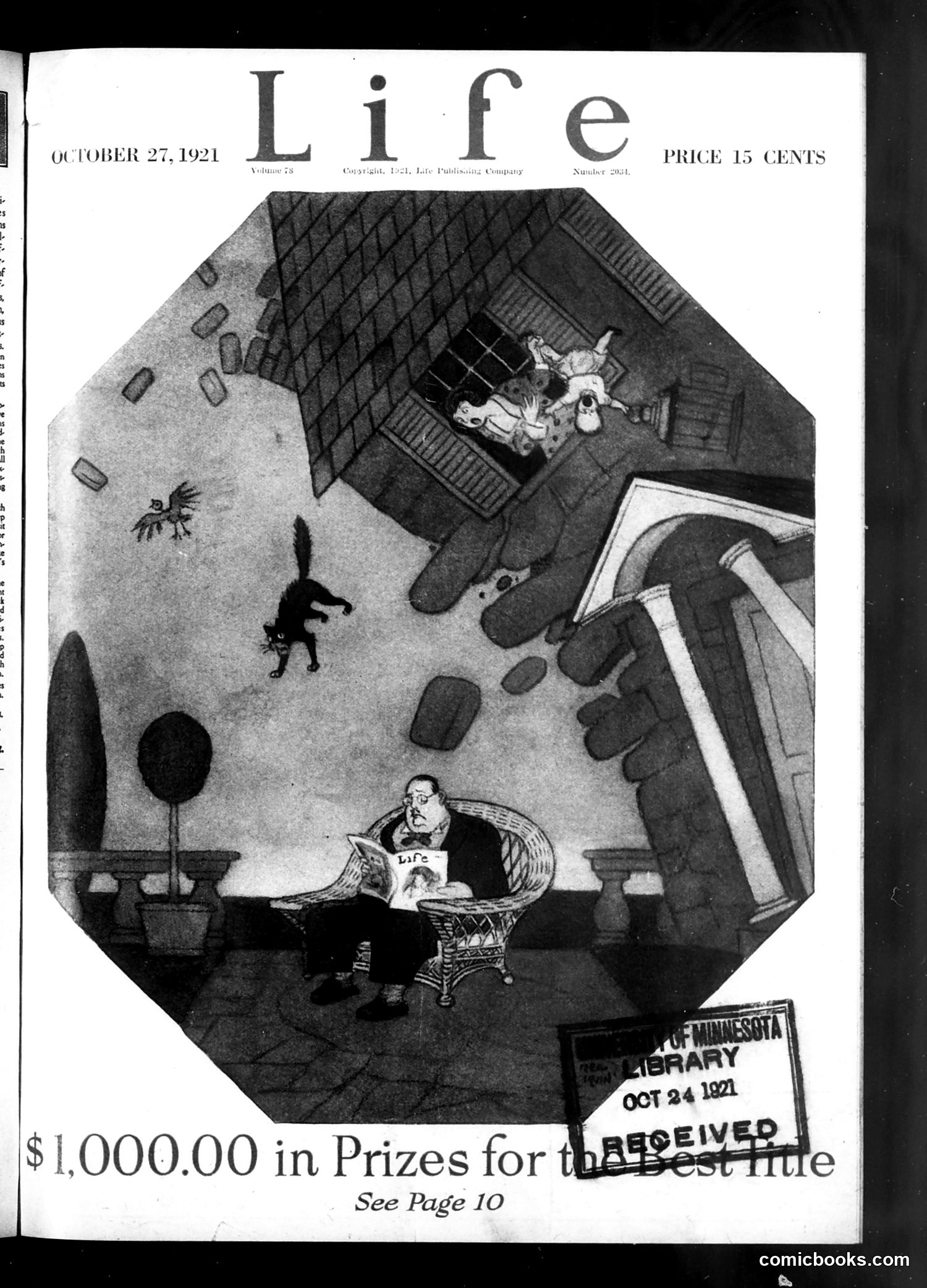
This cover satirizes the contrast between domestic chaos and oblivious contentment. A man sits peacefully reading *Life* magazine in an armchair, seemingly unaware of the literal disorder surrounding him: a woman appears to be falling from an upper window/bed, a child is on the floor, a black cat stretches, furniture is askew, and household items are scattered. A potted plant and topiary sit calmly on pedestals. The satire targets male indifference to household turmoil—a common theme in 1920s humor about henpecked husbands or domesticity's chaos. The man's serene absorption in reading represents either willful ignorance or comic obliviousness to family emergency happening literally overhead. The magazine's title watermark on his reading material adds ironic self-reference to the satire.
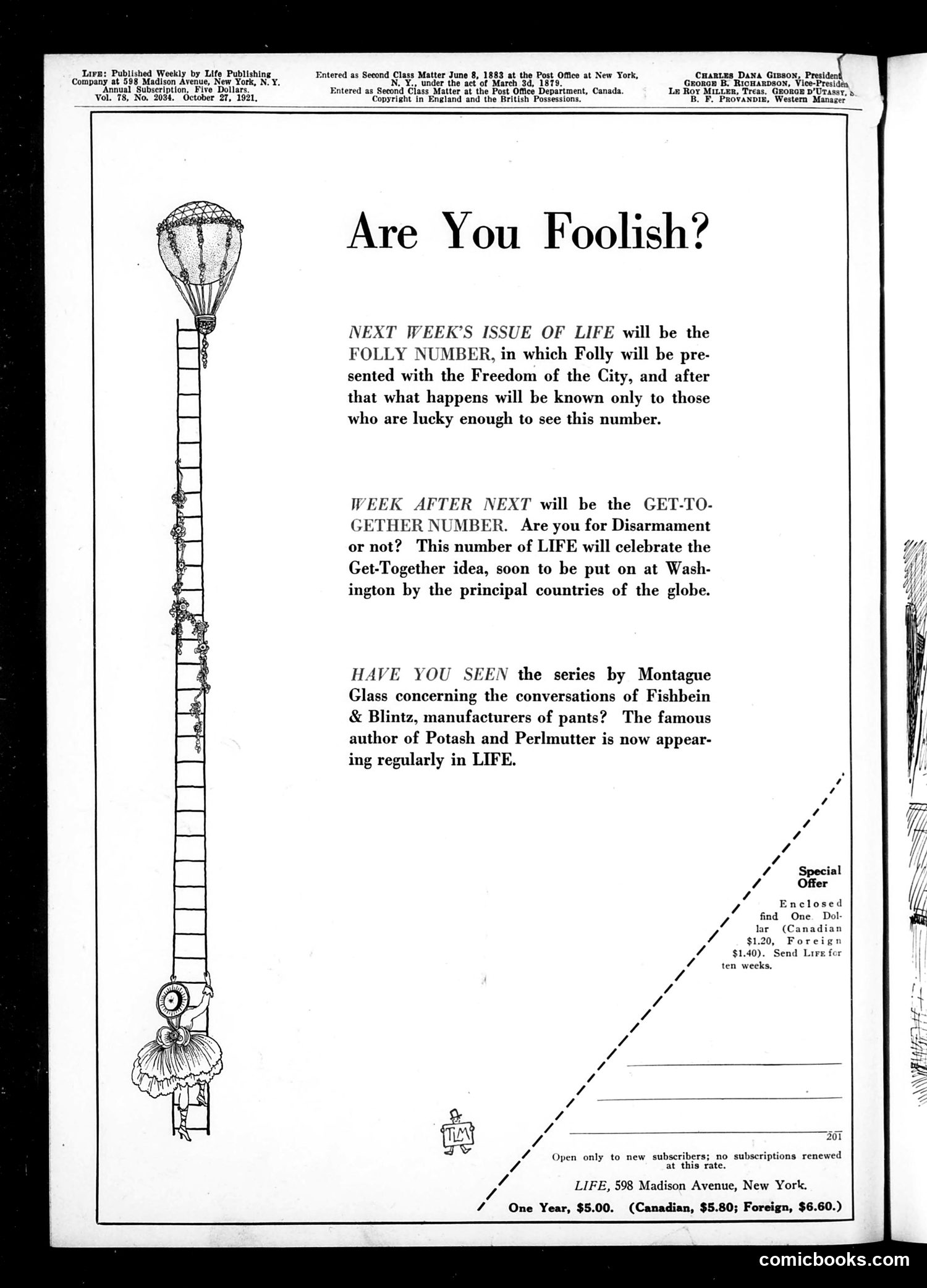
This page is primarily **advertising/promotional content** for *Life* magazine itself, not political satire. The headline "Are You Foolish?" is a teasing hook to attract readers. The **hot air balloon illustration** is a visual pun supporting the "foolish" theme—suggesting frivolous or inflated ideas. The text promotes upcoming special issues: - A "Folly Number" celebrating follies/foolishness - A "Get-Together Number" about disarmament conferences in Washington - Ongoing satirical series about businessmen (Fishbein & Blintz) and their pants The **subscription offer** at bottom ($5 annually) targets new subscribers only. This is essentially clickbait from 1921—using provocative questions and promised exclusive content to drive subscriptions, much like modern magazine promotion, though the specific references to Washington disarmament talks suggest this appeared during post-WWI peace conference discussions.
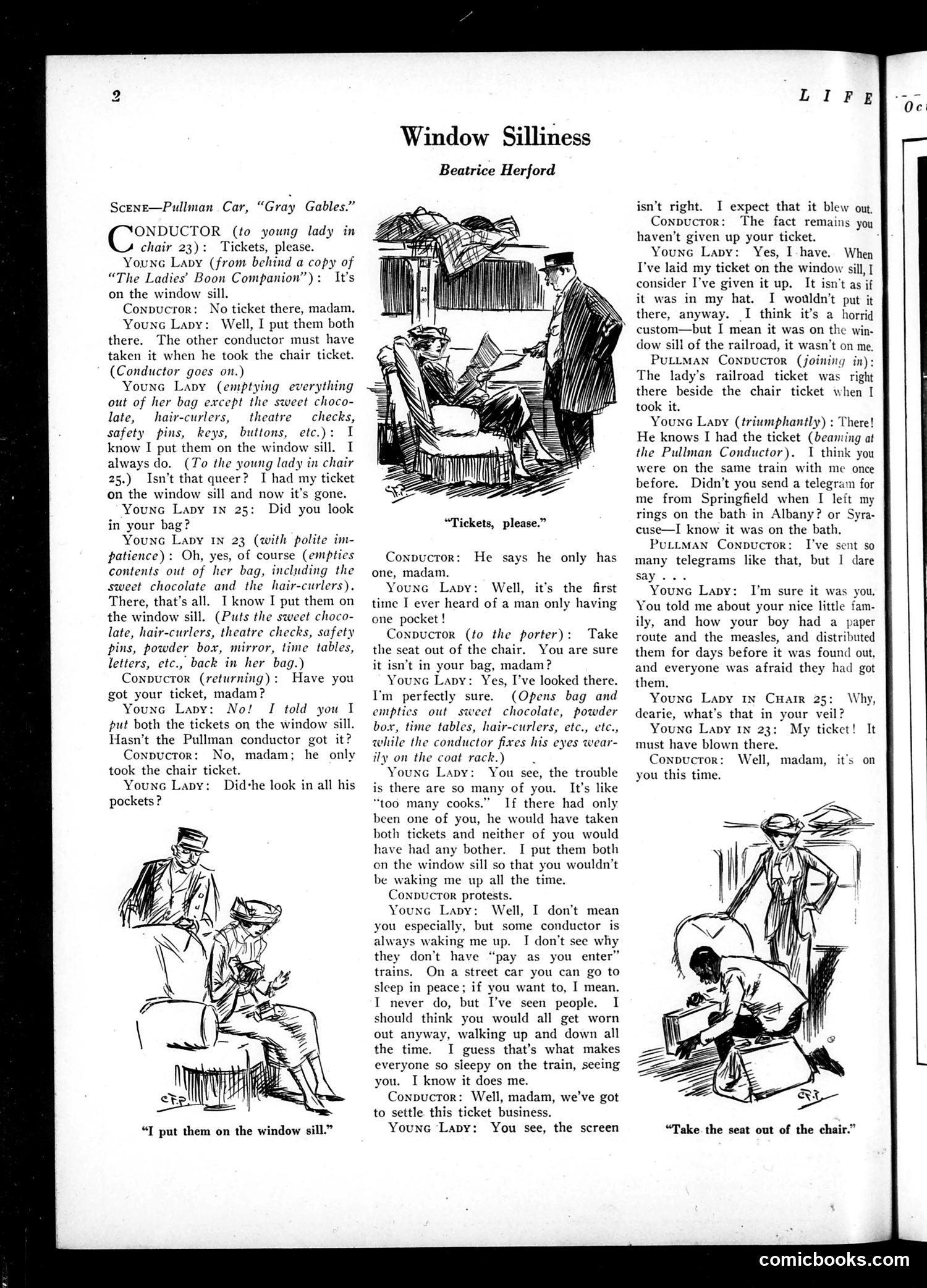
This is a humorous sketch set in a Pullman railroad car, satirizing the absurdity of train travel etiquette. A young woman traveling on the "Gray Gables" complains to the conductor about her lost ticket, which she claims she placed on the window sill. The conductor dismissively suggests she look in her bag, but she insists she examined everything—chocolates, hair-curlers, theater checks, etc. The joke plays on the impracticality of using a window sill to store important documents while traveling, and the resulting bureaucratic frustration when the ticket vanishes. The accompanying illustrations show the conductor and porter becoming increasingly exasperated as they try to resolve this self-inflicted problem, mocking passenger carelessness and railway procedures of the era.
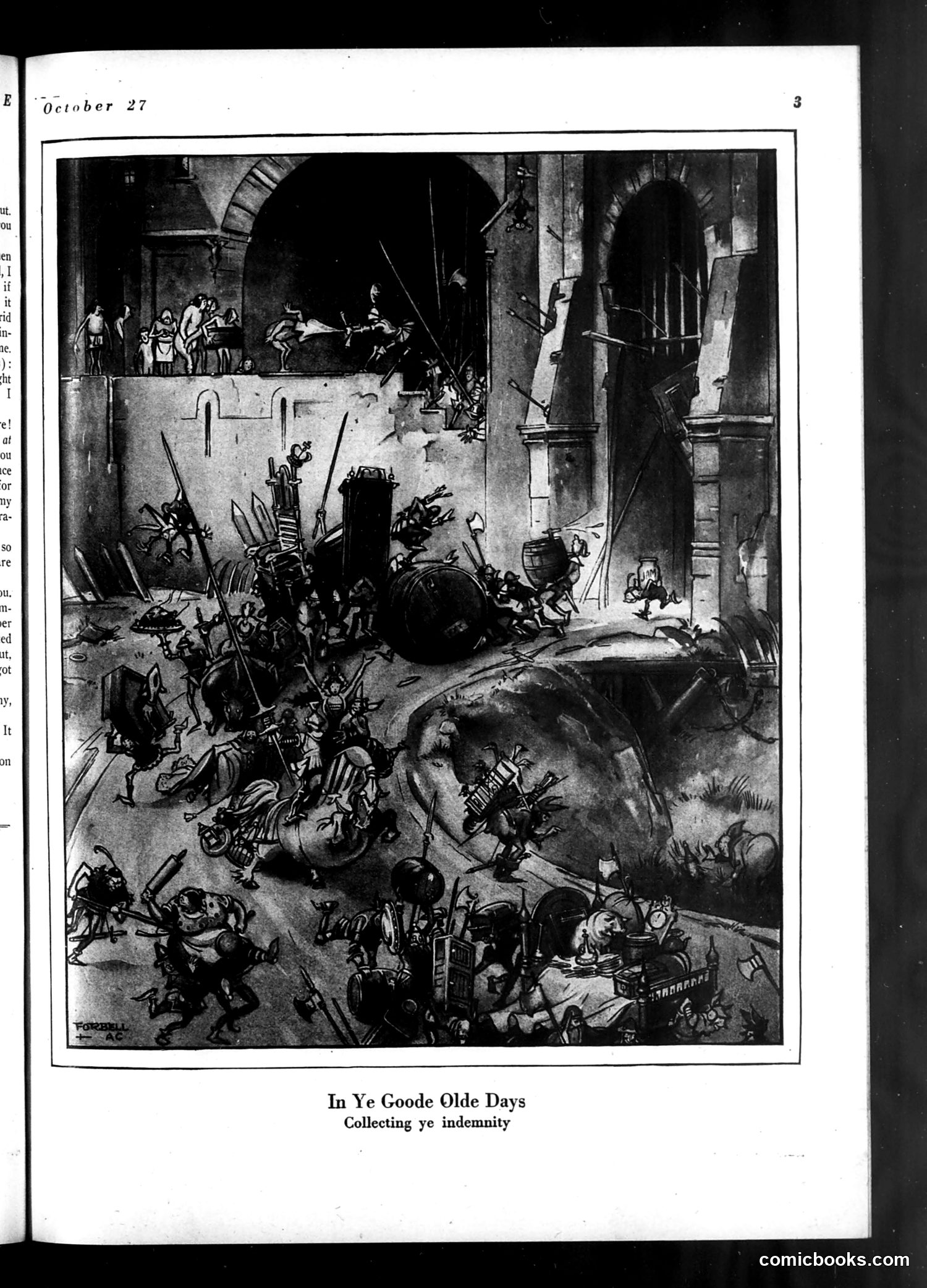
This satirical illustration depicts a chaotic medieval or Renaissance-era castle scene, contrasting "the good old days" with modern concerns about indemnity payments. The image shows armed soldiers and common people in apparent conflict or negotiation within fortress walls, with weaponry and disorder scattered throughout. The satire appears to critique contemporary indemnity disputes—likely referencing post-war reparations or financial settlements of the early 20th century. By depicting such collection efforts in a supposedly more "honorable" historical period, the cartoon suggests that demanding compensation has always been messy, violent, and chaotic, regardless of era. The subtitle's ironic tone emphasizes that collecting debts or indemnities was never actually genteel or orderly.
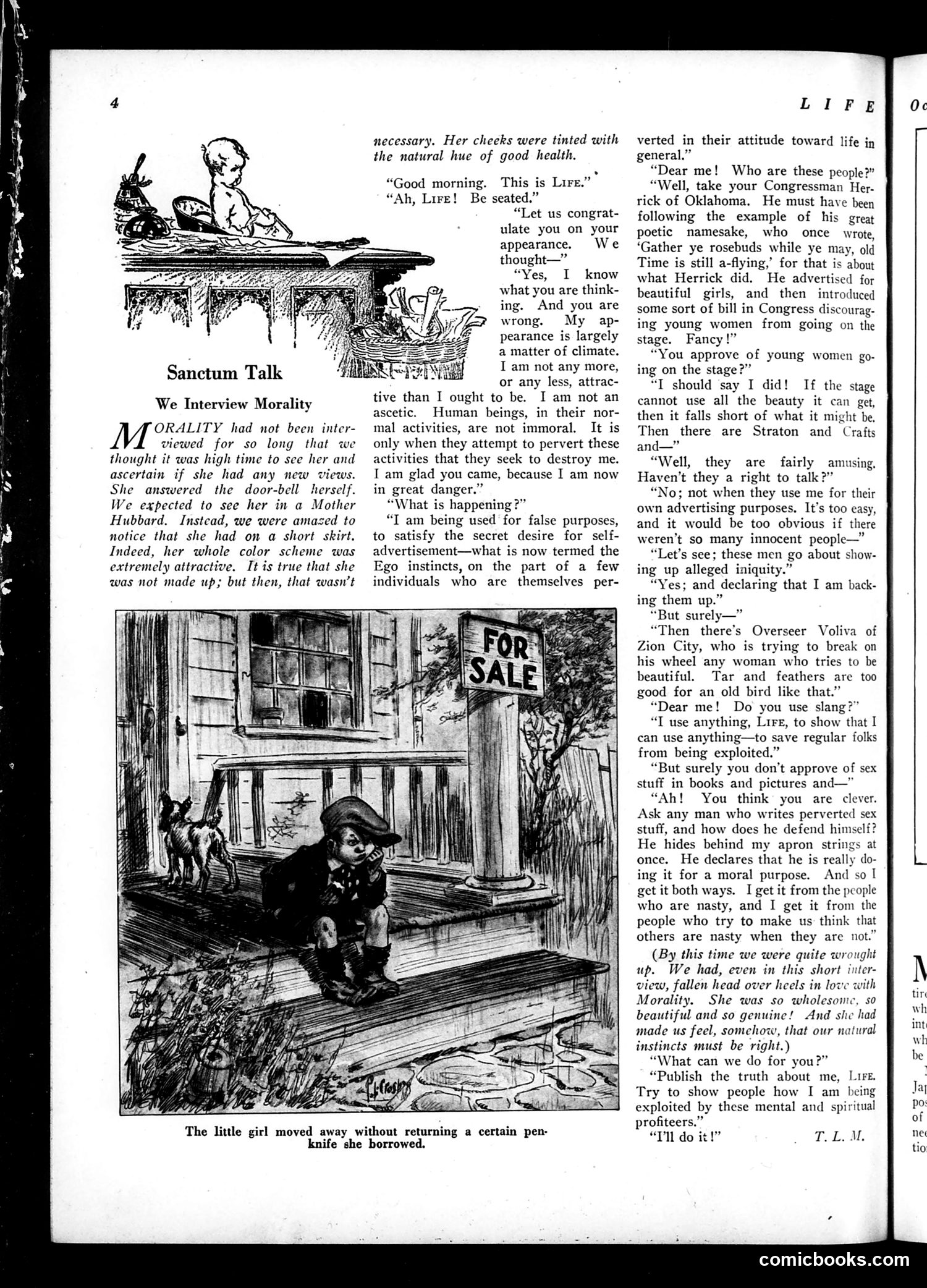
This satirical piece personifies "Morality" as a woman being interviewed. The text reveals the satire's target: she's being exploited for advertising purposes by those claiming moral authority while engaging in the very behaviors they condemn. Key social critiques include: - **Hypocrisy about women**: A Congressman from Oklahoma (likely referencing real political figures) promoted young women for stage work while advertising "poetic" ideals - **Double standards**: Writers defend "perverted sex stuff" in books as morally educational while attacking others as immoral - **Selective outrage**: The wealthy and powerful hide behind morality rhetoric while profiting from exploitation The cartoon shows a poor child outside a "For Sale" house—illustrating economic hardship contrasting with the wealthy's moral posturing. The satire attacks how "Morality" becomes a convenient mask for self-interest and exploitation.
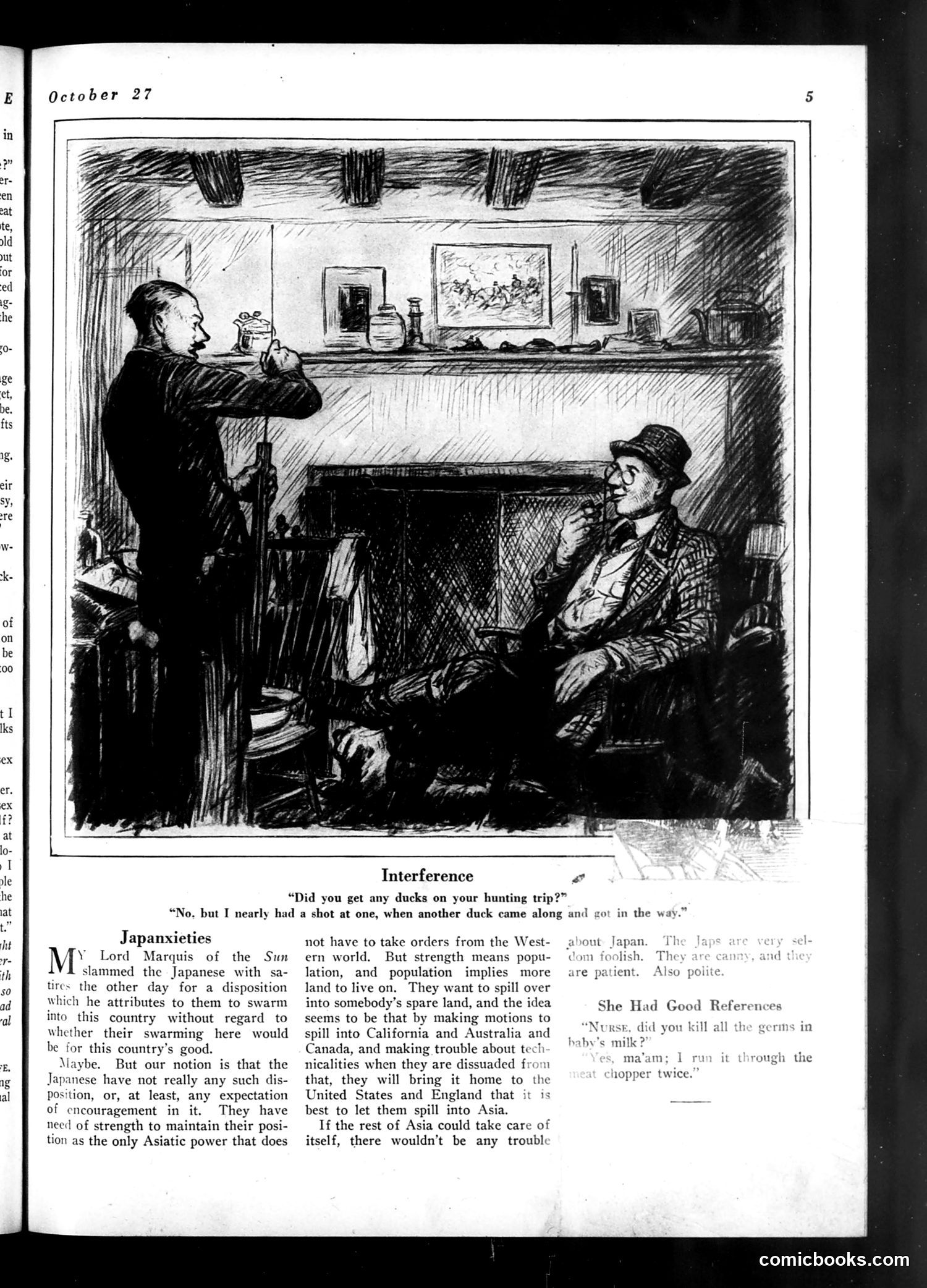
The cartoon titled "Interference" depicts two men by a fireplace: one standing and gesturing animatedly, the other seated. The caption reads: "Did you get any ducks on your hunting trip?" with the standing man's response: "No, but I nearly had a shot at one, when another duck came along and got in the way." This is a simple visual pun about unwanted interference during hunting. The joke relies on the double meaning of "interference"—both the literal obstruction of a hunting shot and the figurative sense of someone meddling in another's affairs. Below is an article titled "Japanxieties" discussing Lord Marquis of the *Sun* and Japanese immigration concerns, touching on geopolitical tensions regarding Japanese expansion into California, Australia, and Canada.
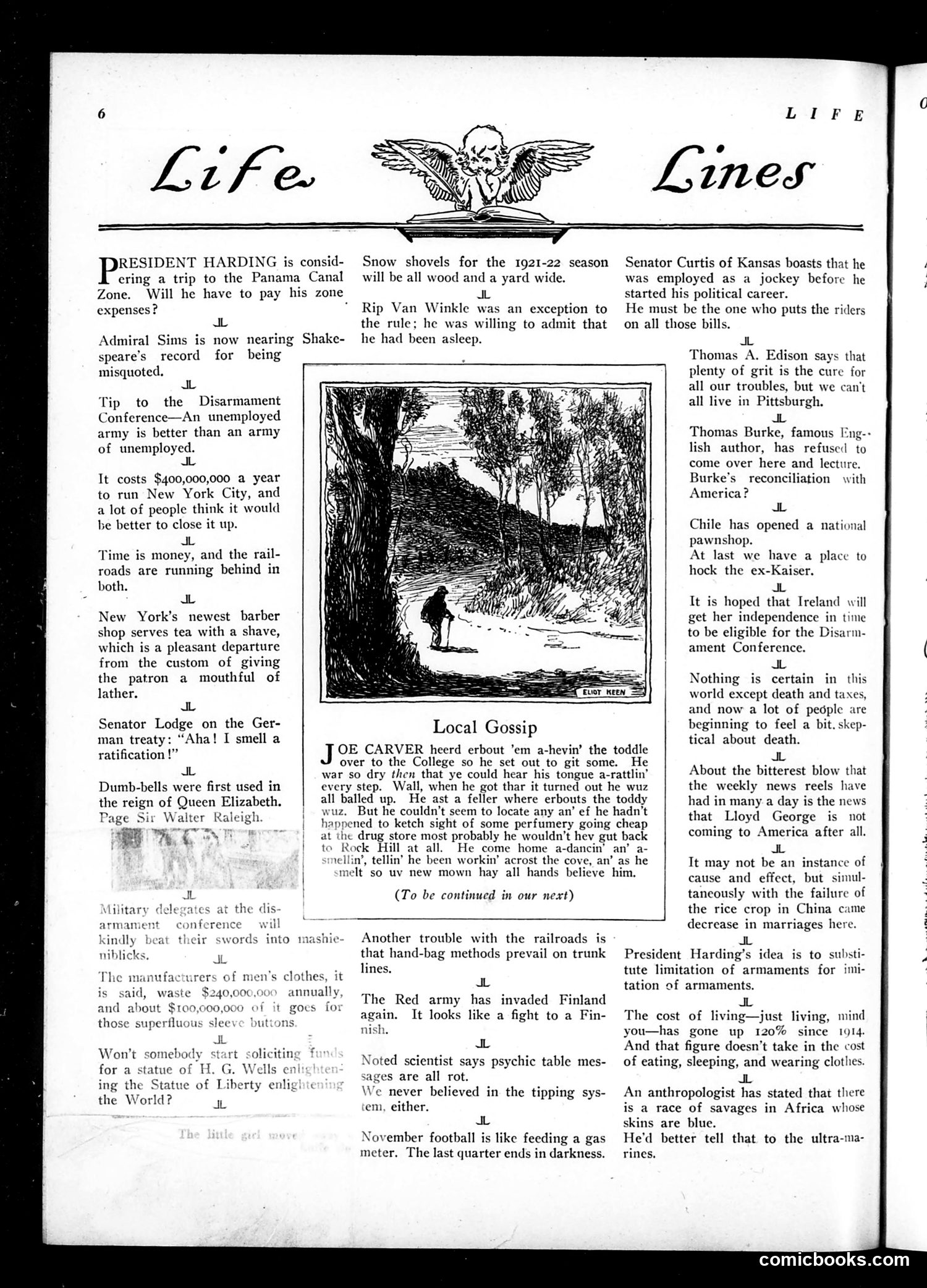
This page contains a "Life Lines" column of miscellaneous social and political commentary rather than a single cartoon. The content includes brief satirical observations on contemporary issues: - President Harding's Panama Canal trip expenses - Admiral Sims' misquote about Shakespeare - NYC's cost of running ($400 million annually) - Railroad inefficiency - A barber shop as "departure from custom" - Senator Lodge on German treaty ratification - References to Ireland's independence hopes - Commentary on the cost of living and marriage rates The center features an illustration titled "Local Gossip" depicting a rural scene with a figure at a creek, accompanying a humorous anecdote about someone named Joe Carver trying to locate whiskey during Prohibition. The satire targets government spending, bureaucratic inefficiency, and social changes of the early 1920s.
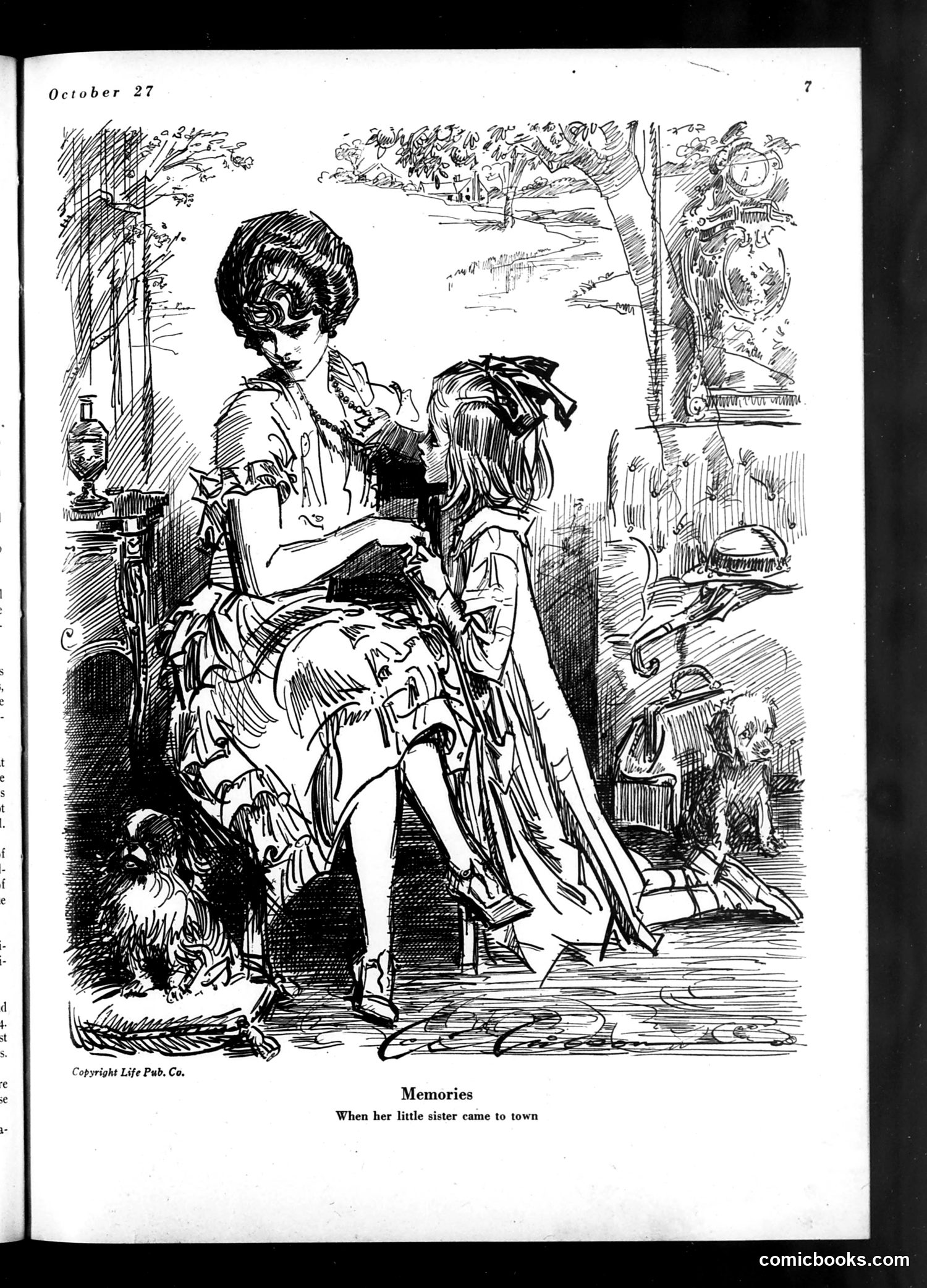
This is a domestic humor illustration rather than political satire. The sketch depicts an adult woman with her younger sister visiting from out of town. The scene shows them in what appears to be an elegant interior, with the older sister presenting or showing off her younger sibling to a small dog and a young child (possibly her own). The title's joke likely plays on nostalgia and the awkwardness of adult siblings reconnecting, or perhaps the contrast between the visiting sister's simpler attire and the host's more refined urban setting. The illustration captures a sentimental domestic moment typical of Life magazine's lighthearted social commentary on middle-class family life in the early 20th century.
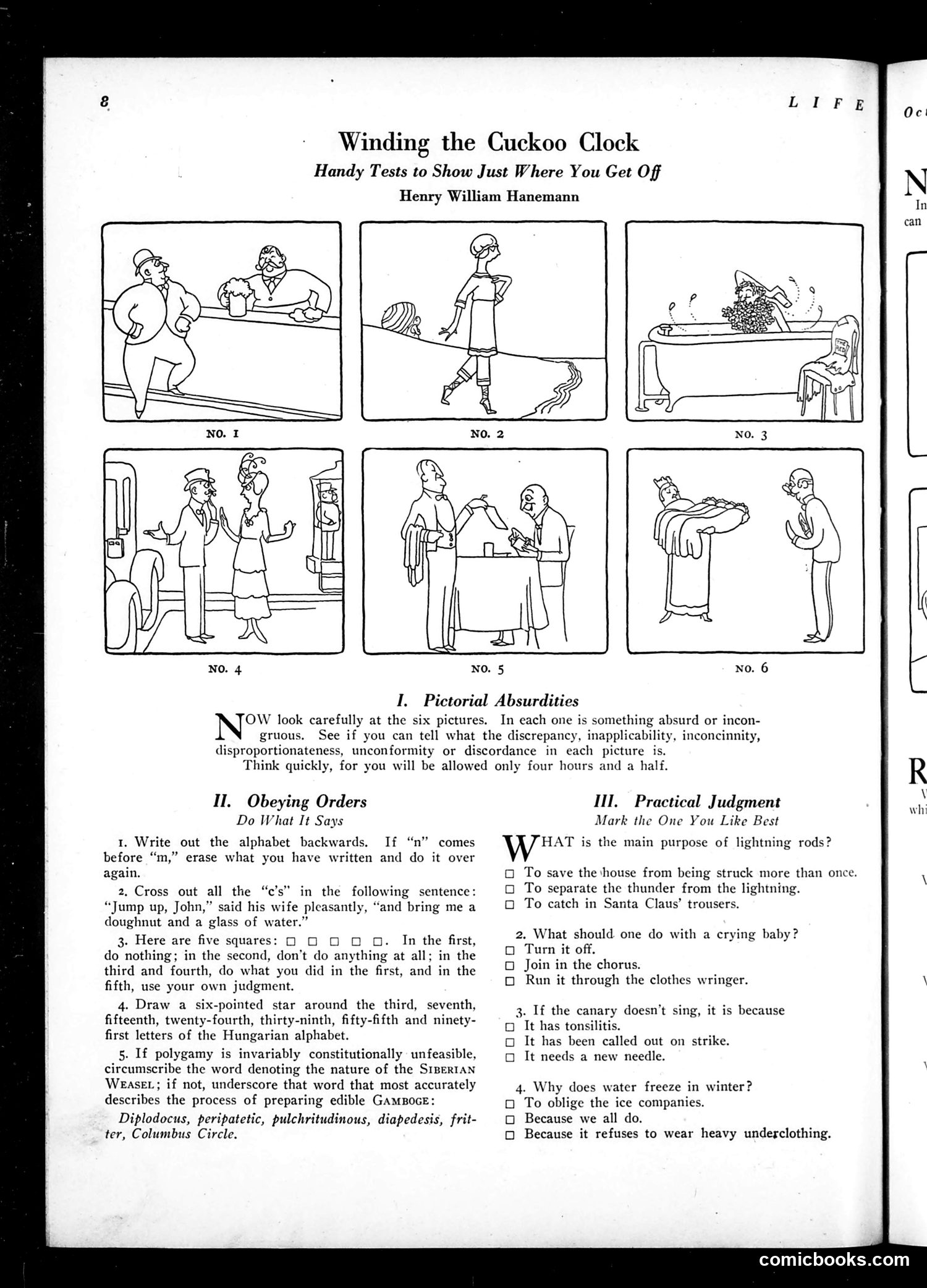
This page presents three separate games/puzzles for readers, not political cartoons: **I. Pictorial Absurdities**: Six cartoon panels showing deliberately illogical domestic scenes—people in impossible situations (bathing with groceries, playing ball indoors, etc.). Readers must identify what's wrong in each image within 4.5 hours. **II. Obeying Orders**: Word puzzles requiring readers to follow written instructions literally (writing alphabet backwards, crossing out letters, etc.). **III. Practical Judgment**: Multiple-choice trivia questions about everyday scenarios (lightning rods, crying babies, freezing water, etc.) with humorous incorrect answers. These are lighthearted recreational puzzles typical of 1920s-30s Life magazine, designed to entertain rather than satirize. The humor comes from absurd situations and trick-answer questions, not political commentary.
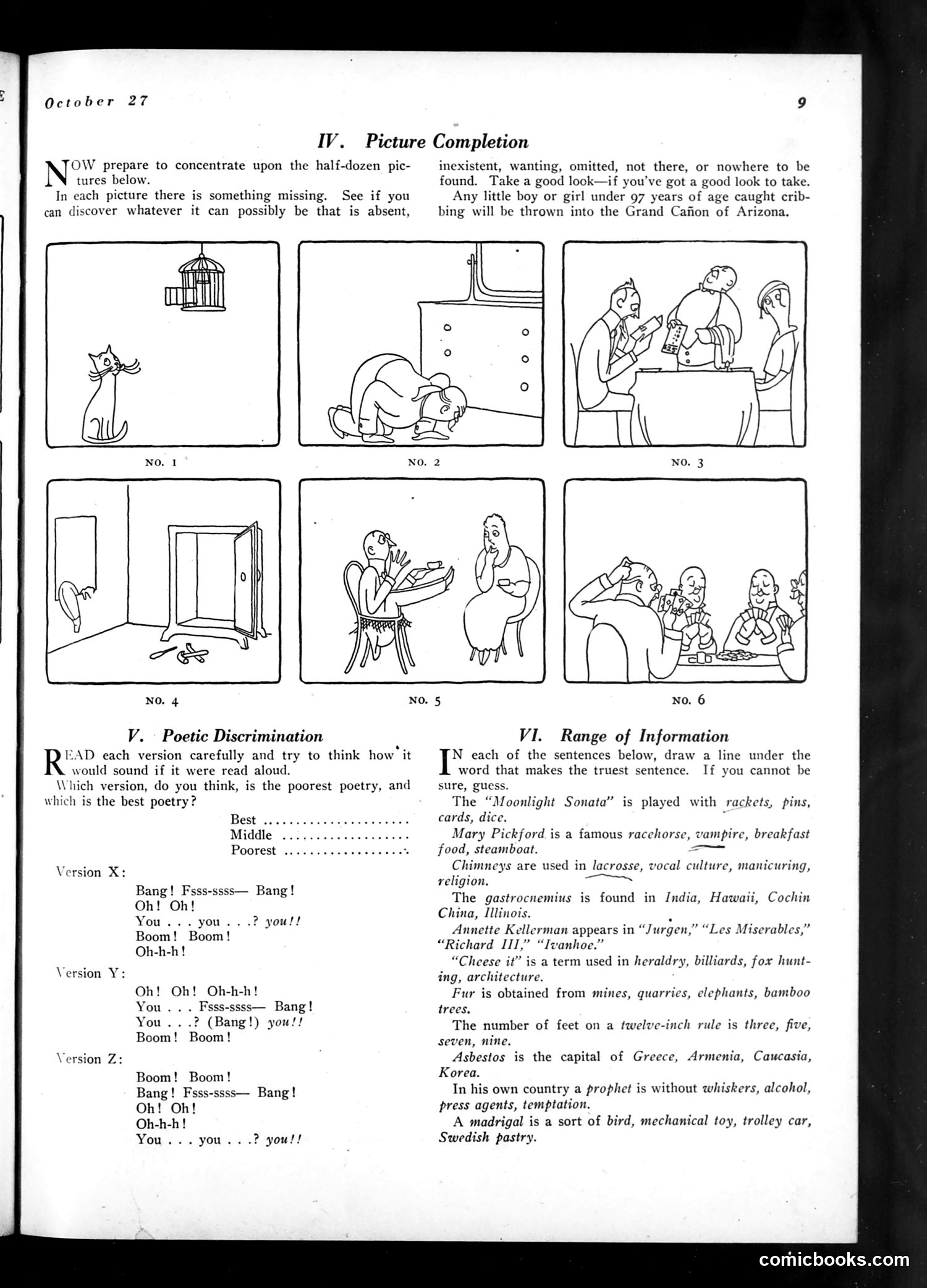
This page from *Life* magazine contains educational puzzle and word-game content rather than political cartoons. **Section IV (Picture Completion)** presents six simple line drawings with missing elements—a cat without a birdcage, a person without furniture, a dining scene—that readers must identify what's absent from each scene. **Section V (Poetic Discrimination)** asks readers to evaluate three versions of onomatopoeia ("Bang! Pssss— Bang!") and rank them as best, middle, or poorest poetry. **Section VI (Range of Information)** is a vocabulary exercise where readers identify which underlined word makes each sentence true, testing knowledge of obscure terms like "gastrocnemius" (a leg muscle) and "madrigal" (a type of song). These are recreational puzzles for readers, not satirical commentary.
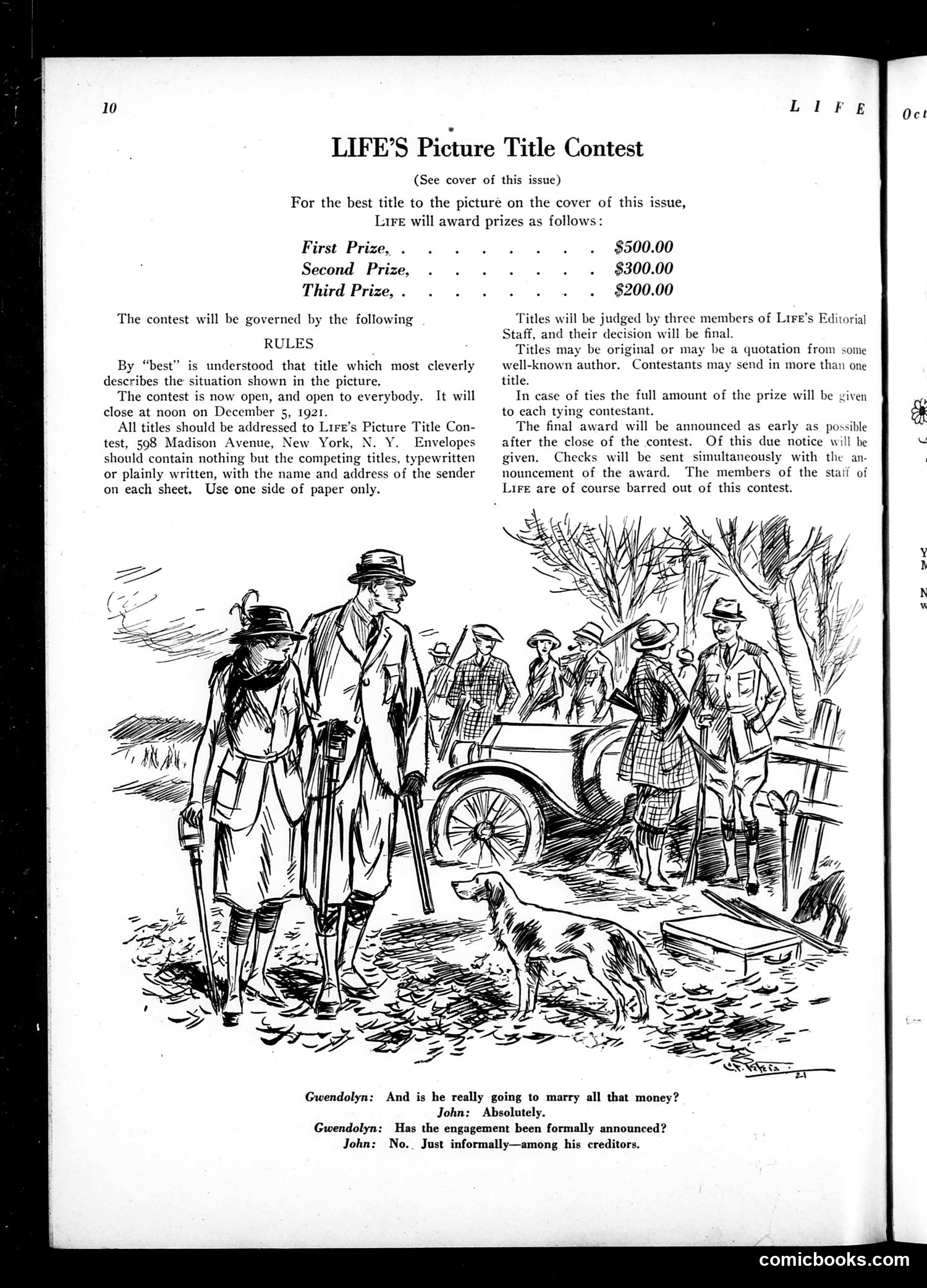
This page announces LIFE magazine's contest for the best title to their cover picture. The prize structure offers $500 for first place, $300 for second, $200 for third. The cartoon below depicts two well-dressed men observing a scene with a broken-down automobile, onlookers, and a dog. The dialogue reveals the satire: one man (Gwendolyn) asks if the other (John) is really going to marry "all that money," and whether the engagement has been formally announced. John replies it's only been announced "informally—among his creditors." The joke targets a wealthy man whose financial situation is apparently so dire that creditors are essentially his primary stakeholders. The satire mocks both excessive debt and the mercenary nature of engagements based on presumed wealth.
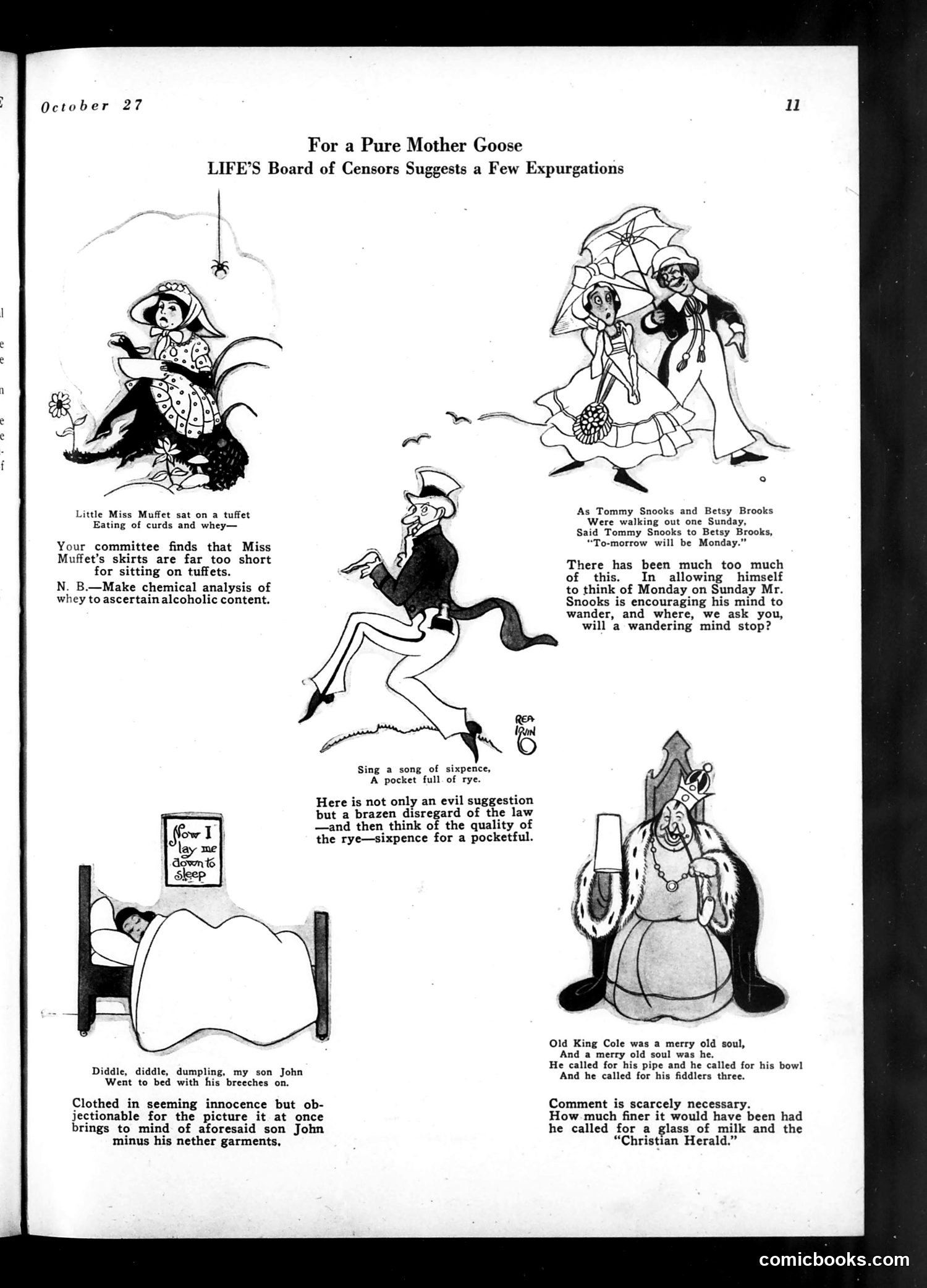
This is a satirical piece titled "For a Pure Mother Goose: LIFE's Board of Censors Suggests a Few Expurgations." It mocks moral censorship by presenting "cleaned up" versions of classic nursery rhymes with darkly humorous commentary. The page critiques censors who object to innocent details while overlooking deeper problems: 1. **Miss Muffet**: Censors want shorter skirts, but LIFE sarcastically suggests analyzing whey for alcohol instead. 2. **Tommy Snooks**: Censors object to a child thinking about Monday on Sunday, calling it a "wandering mind." 3. **"Sing a song of sixpence"**: References rye whiskey smuggling, mocking the absurdity of literal censorship. 4. **John and his breeches**: Censors object to a child sleeping clothed, finding indecency where none exists. 5. **Old King Cole**: Censors should prefer milk to his pipe and bowl. The satire highlights how moral crusaders focus on trivial or imaginary problems while missing actual vice.
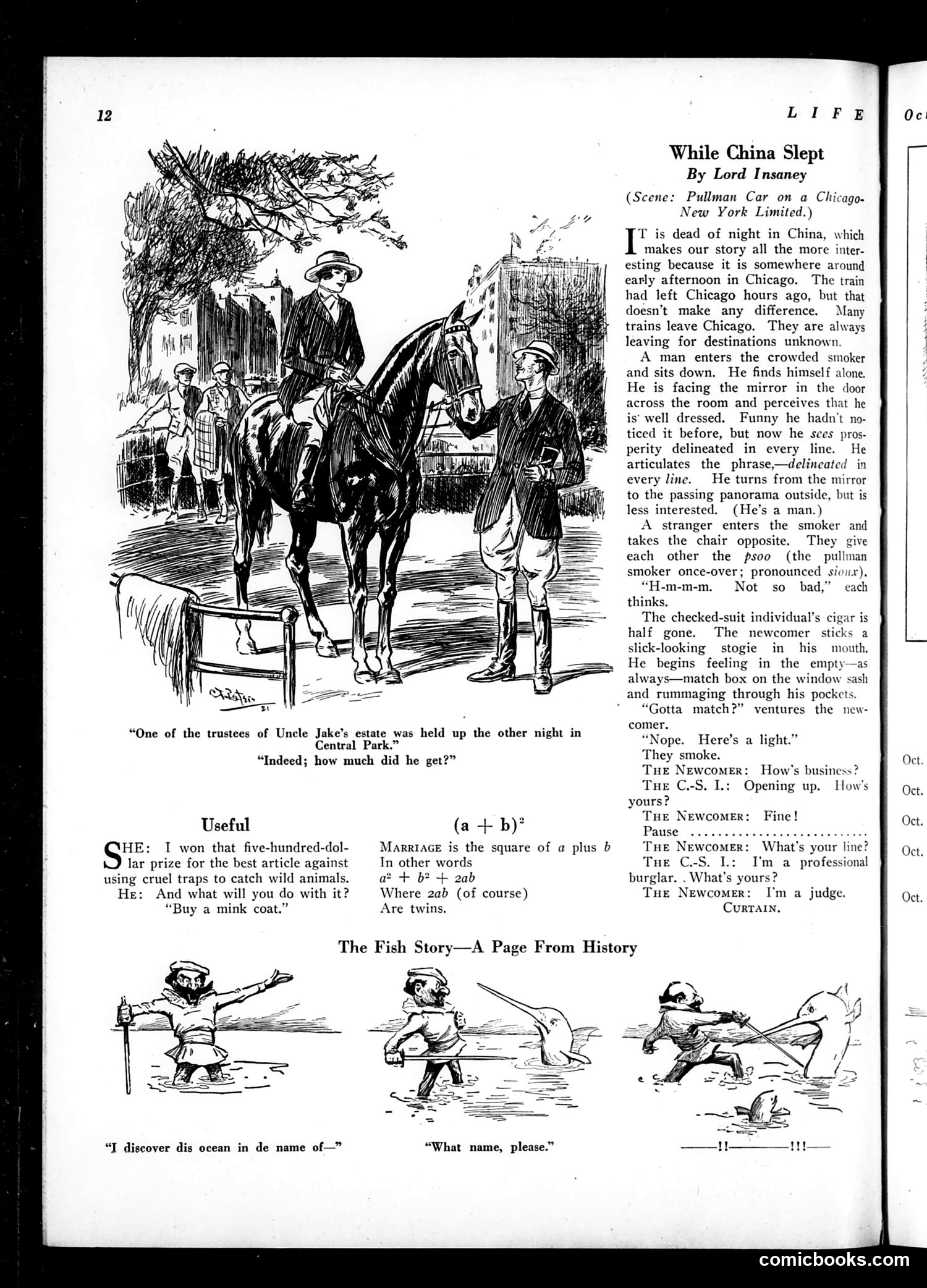
**"While China Slept"** by Lord Insaney depicts a scene on a Chicago-New York train. The narrative follows a well-dressed man entering a smoker car, observing the passengers with detached superiority. He encounters another man and they exchange pleasantries about business and professions—one claims to be a burglar, the other a judge. The story appears to satirize class pretension and the hypocrisy of social hierarchies: a "judge" and "burglar" sharing cigars suggests moral equivalence among supposedly different social classes. **"The Fish Story"** below is a visual joke showing someone discovering something in the ocean, then asking its name, followed by the discoverer being attacked—a humorous take on exploration and naming conventions. The overall page reflects early 20th-century American social satire about class, morality, and urban life.
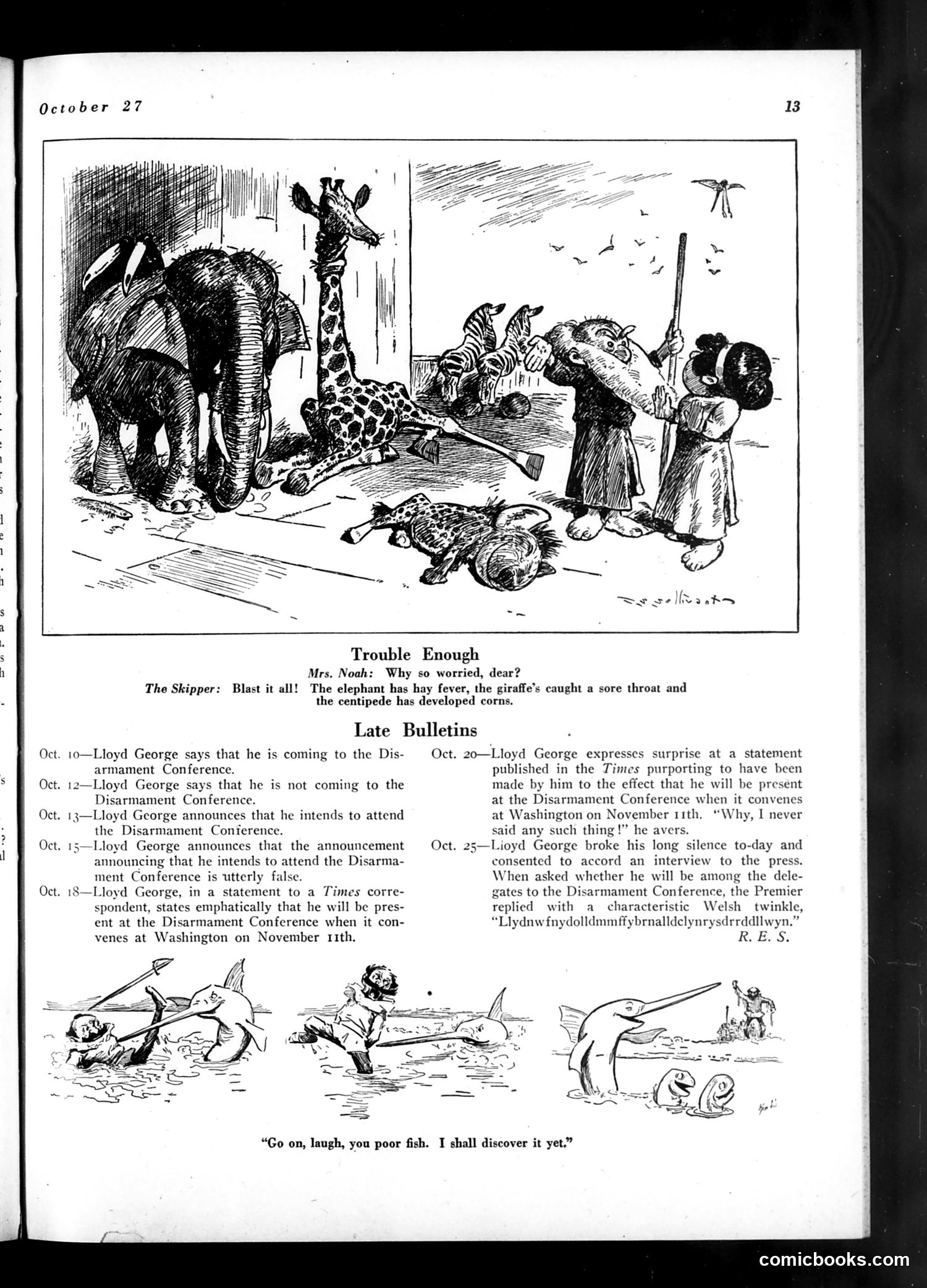
**Top Cartoon: "Trouble Enough"** A satirical scene showing animals (elephant, giraffe, leopard, centipede) suffering various ailments while two figures (labeled "The Skipper" and "Mrs. Noah") discuss their misfortunes. The joke plays on the Noah's Ark narrative—even in that refuge, the animals have contemporary problems (fever, sore throat, corns). This likely mocks how no situation, even mythical salvation, escapes modern troubles. **"Late Bulletins" Section** A satirical chronicle of Lloyd George's contradictory statements about attending the Disarmament Conference in Washington (November 11th), ranging from refusals to commitments to silence. The humor derives from his flip-flopping positions and deliberately unintelligible Welsh response when finally questioned. **Bottom Cartoon** Depicts figures fishing, with one boasting to a fish they'll eventually catch it—absurdist humor about persistence versus futility.
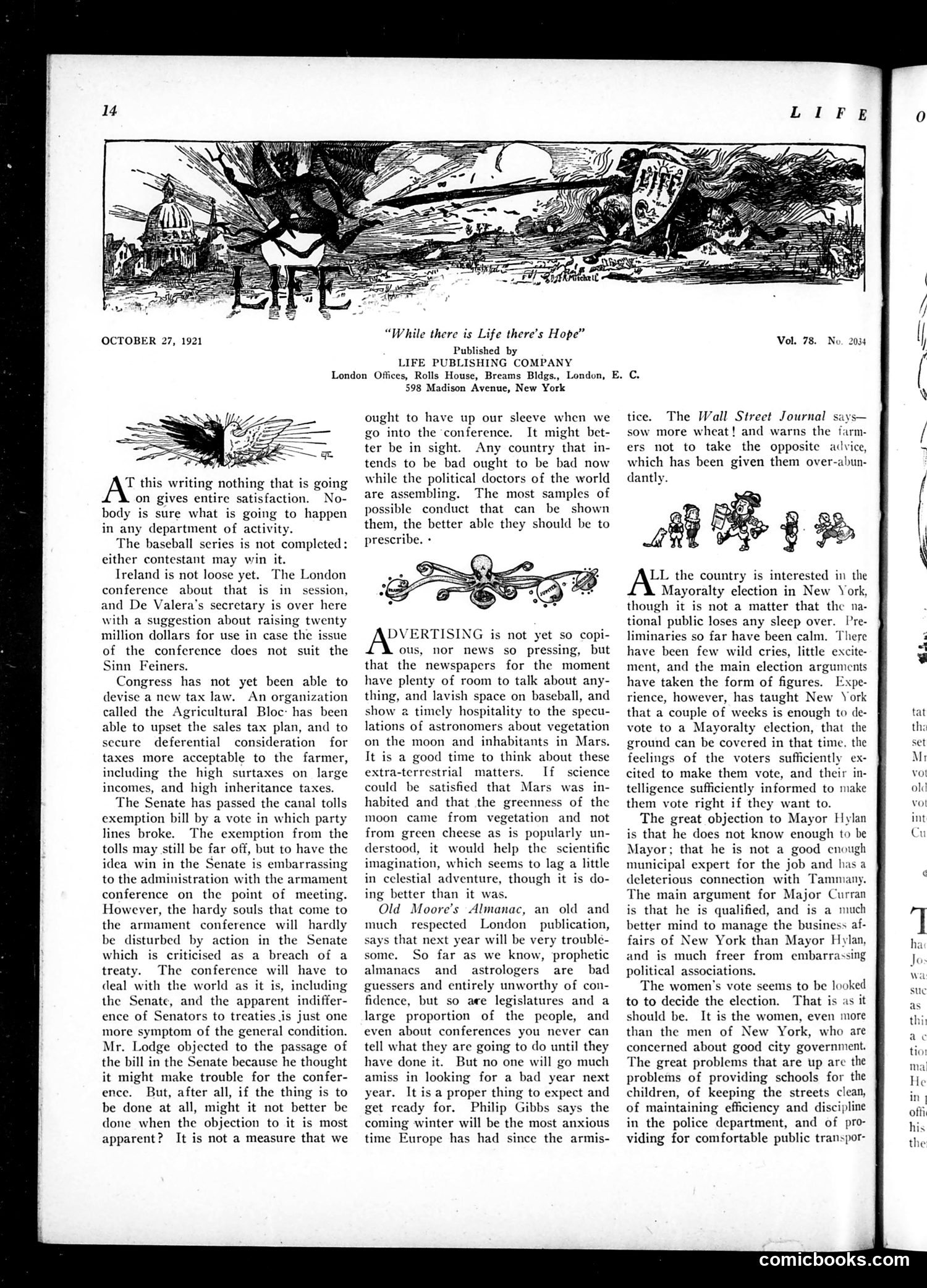
The page contains editorial text rather than a prominent political cartoon. The visible illustration at top appears to be a decorative header showing a pastoral landscape with classical elements. The text discusses several contemporary issues: a proposed capital gains tax exemption (debated in the Senate), the upcoming Mayoralty election in New York, and women's voting interests in local governance. The editorial argues against Mayor John F. Hylan's re-election, claiming he lacks sufficient qualifications for the position. It also discusses women voters' focus on practical municipal concerns—schools, street maintenance, police efficiency, and public transportation—rather than abstract political philosophy. The tone suggests skepticism about both Hylan's competence and the depth of political engagement among newly enfranchised female voters.
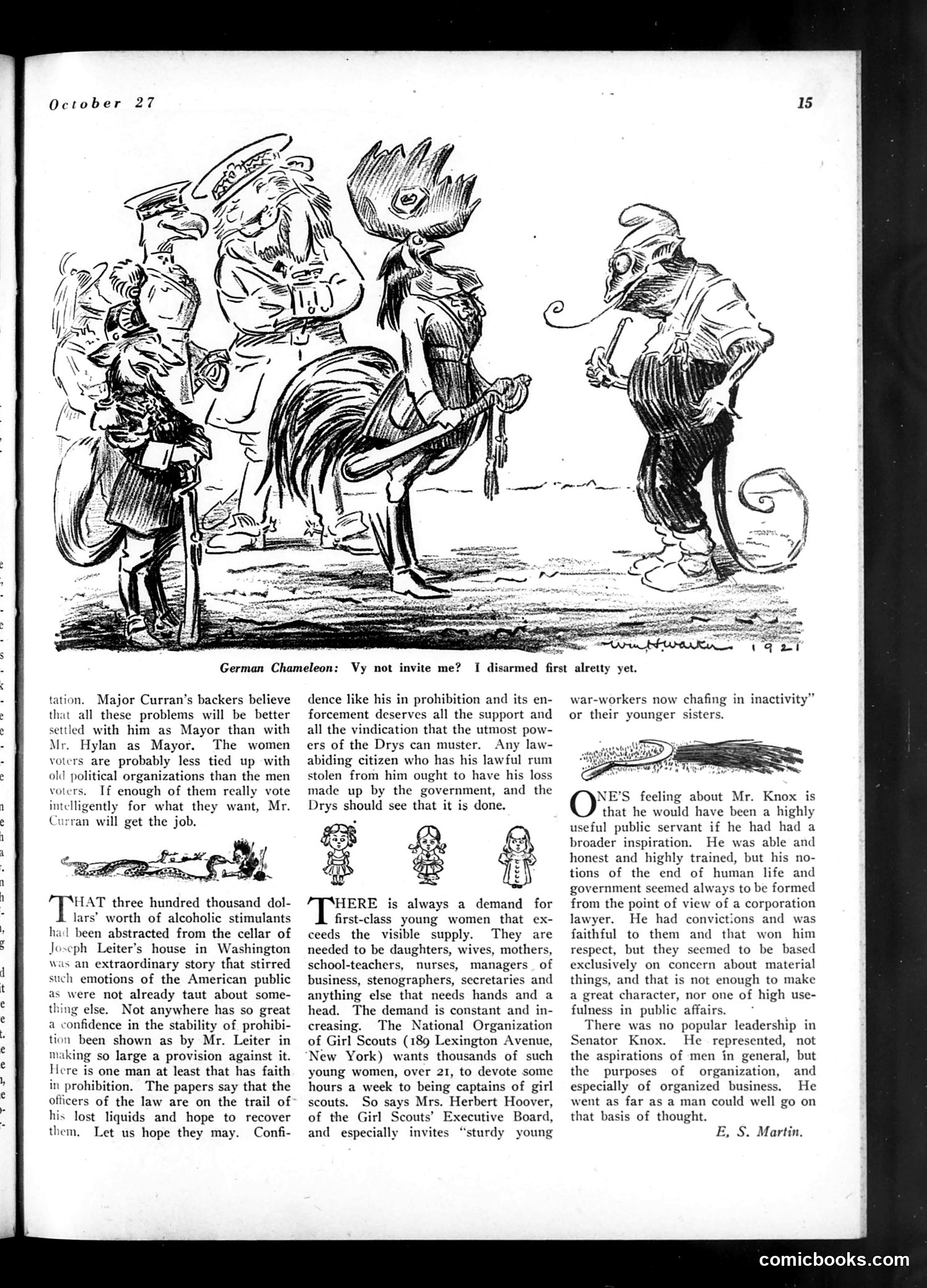
The top cartoon depicts a German military figure (identified as "German Chameleon") being excluded from a gathering of Allied officers, sarcastically asking "Why not invite me? I disarmed first already yet." This post-WWI satire mocks Germany's claimed disarmament and its attempt to rejoin the international community after defeat. The "chameleon" metaphor suggests Germany was being deceptive about its true intentions. The page's text discusses American domestic issues: a NYC mayoral race (Curran vs. Hylan), Prohibition enforcement (Joseph Leiter's stolen liquor), Girl Scouts recruitment, and a retrospective assessment of Senator Knox's public service as overly corporate-focused rather than inspirational. The cartoons and articles collectively reflect 1920s American preoccupations with post-war geopolitics, Progressive Era social reform, and evaluating leadership character versus technical competence.
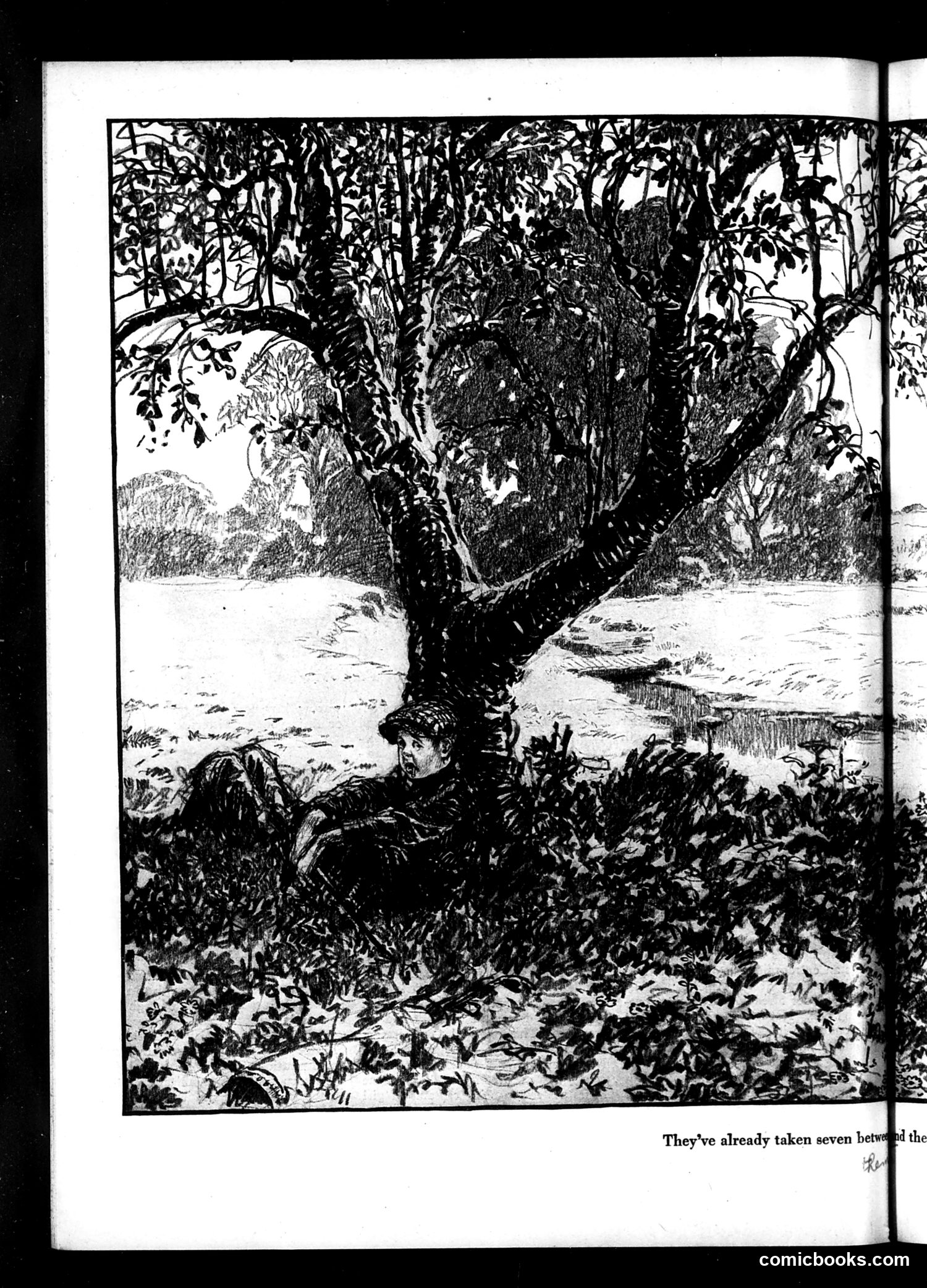
This is a black and white illustration showing a figure crouched or hiding among vegetation near a large tree trunk, with a body of water and landscape visible in the background. The caption reads: "They've already taken seven between the—" The OCR text is largely corrupted and unreadable, providing no clear context. Without additional visible text or identifying details in the image itself, I cannot definitively explain the political or social satire this cartoon intends. The scene suggests someone in hiding or concealment, and the incomplete caption implies an ongoing situation of things being "taken," but the specific reference—whether to historical events, political figures, or social commentary—remains unclear without legible accompanying text.
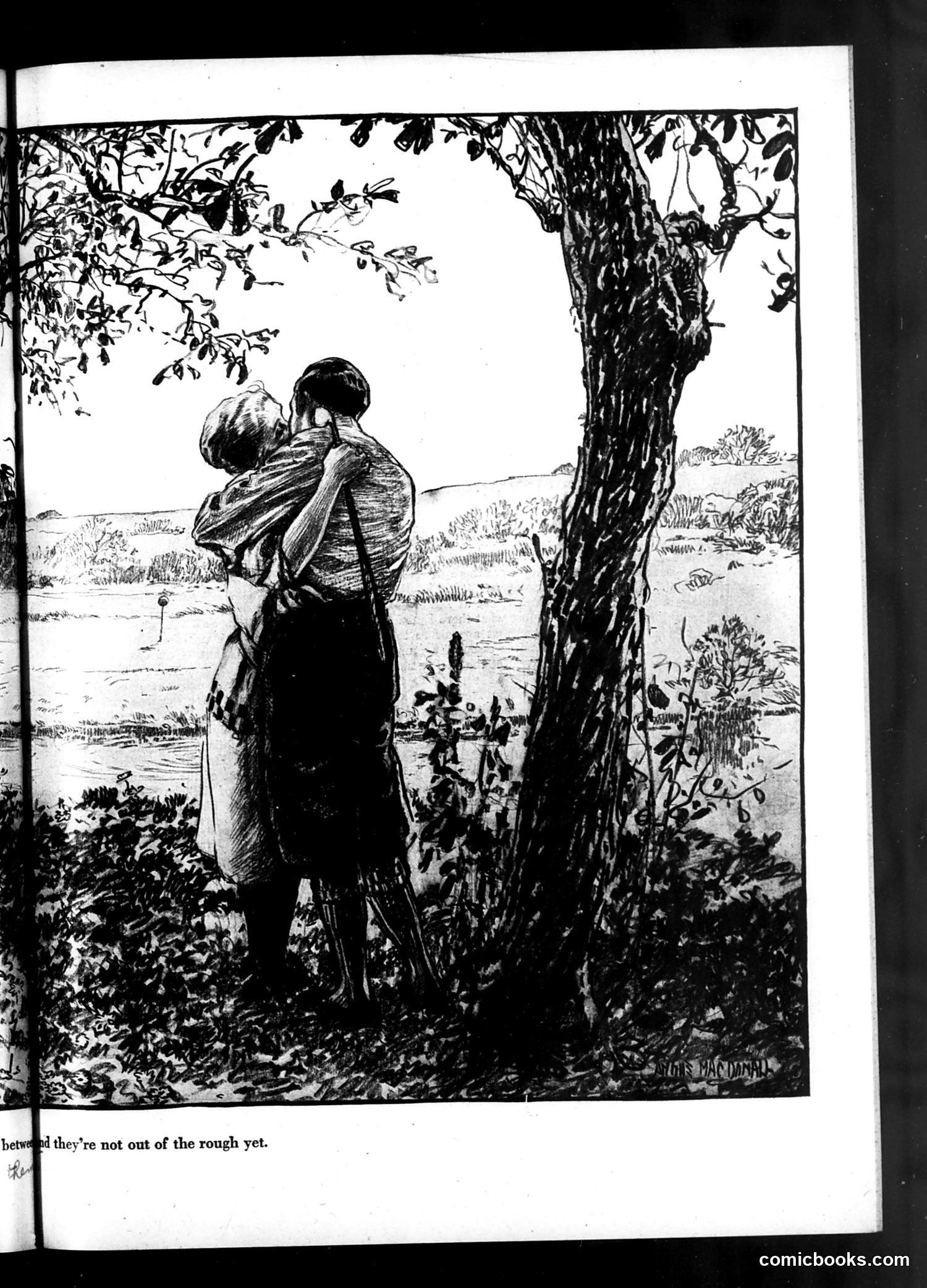
This is a single black-and-white illustration showing an adult holding a child, both gazing at a pastoral landscape with a large tree. The partial caption reads "...ed they're not out of the rough yet." The image appears to be sentimental rather than satirical—depicting a tender domestic scene of caretaking. Without the complete caption or additional context, the precise meaning is unclear. "Out of the rough" likely refers to navigating difficulties (a golf metaphor), suggesting the figures face ongoing challenges ahead. The artist's signature appears in the lower right. The illustration's tone suggests hopeful contemplation rather than political commentary, though the incomplete text prevents certain interpretation of the intended message.
This page reviews Broadway plays with small-town American settings that were becoming popular during an economically difficult theatrical season. The critic discusses several productions: **"Thank You"** and **"The Wren"** are praised as competent small-town comedies, with particular credit given to actor Sam Reed for his authentic "Down East" Maine accent. The reviewer gently mocks the theatrical set design for its unrealistic portrayal of the Maine coast. **"Main Street,"** adapted from Sinclair Lewis's novel, receives the most attention. The critic humorously notes that sophisticated New York theater audiences—sitting in Battery Park—laughed inappropriately at a serious bedroom scene simply because the actor wore pajamas and got into bed. The satire targets urban sophistication: the "boob highway" the play mocks begins not in fictional Gopher Prairie, Minnesota, but at the theater itself. The adaptation by O'Higgins and Ford is praised for maintaining Lewis's satirical intent about small-town life, while the casting with authentic character actors (rather than vaudeville performers) is commended.
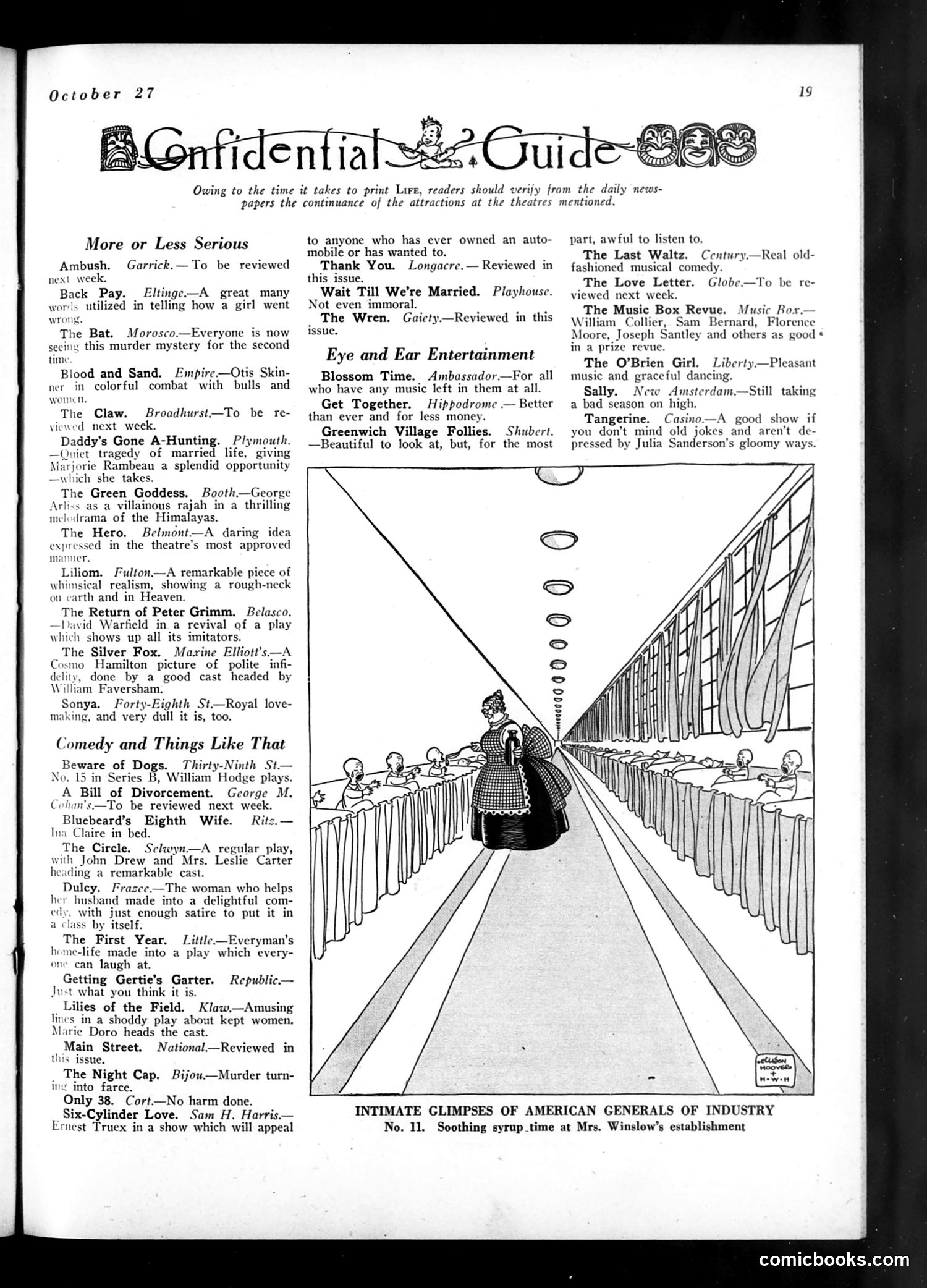
This cartoon satirizes industrial magnates as infants being soothed like babies at "Mrs. Winslow's establishment"—a reference to **Mrs. Winslow's Soothing Syrup**, a popular (and famously opium-containing) patent medicine of the era used to calm fussy babies. The image depicts powerful businessmen lined up in cribs, pacified by a nurse figure, suggesting they are petulant, dependent children requiring constant coddling rather than serious adults. This is social satire mocking the entitlement and infantile behavior of wealthy industrialists during the Gilded Age/Progressive Era. The joke is that these supposedly mighty "generals of industry" are actually helpless babies requiring artificial soothing—implying they're emotionally immature, pampered, or overly dependent on government protection (tariffs, monopolies, etc.). The series title indicates this is part of a recurring satirical feature in *Life* magazine targeting American business elites.
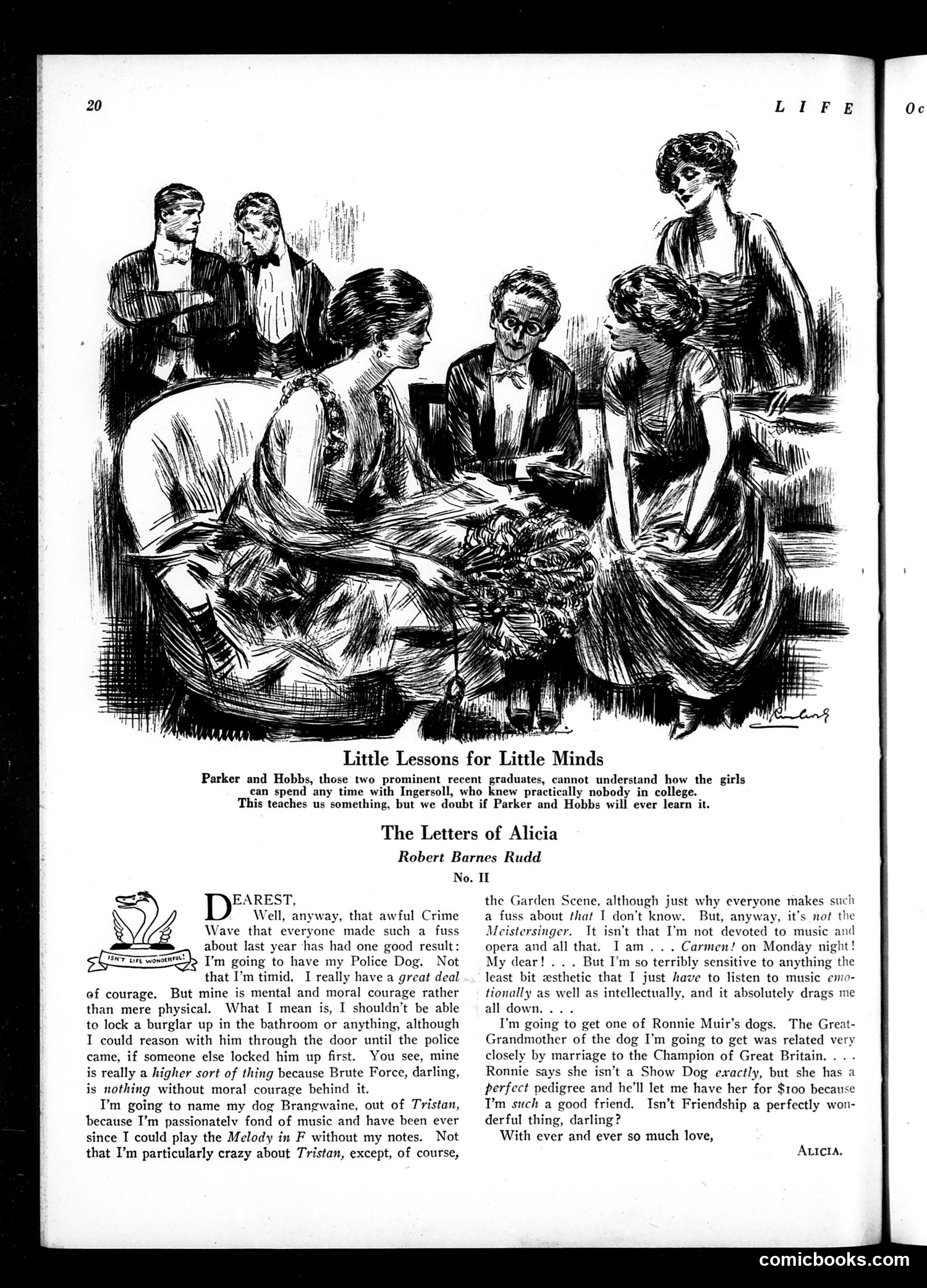
The page contains two distinct pieces from *Life* magazine's satirical humor section. **"Little Lessons for Little Minds"** is a brief joke illustrated at top: two college graduates (Parker and Hobbs) can't fathom why girls spend time with someone named Ingersoll despite his lack of college connections. The satire mocks the graduates' shallow social assumptions—they assume popularity requires campus prominence, missing that Ingersoll apparently has other appealing qualities. **"The Letters of Alicia"** is a humorous character sketch satirizing an upper-class, pretentious woman. Writing to a friend, Alicia describes getting a police dog following a recent "crime wave," but reveals her actual timidity while claiming "higher" moral rather than physical courage. She name-drops musical references (Tristan, Carmen) to appear cultured while admitting she plays simple pieces. The satire peaks when she plans to buy an expensive dog from her friend Ronnie at inflated price, calling it "friendship"—transparently exposing her self-deception about both refinement and financial relationships among the wealthy.
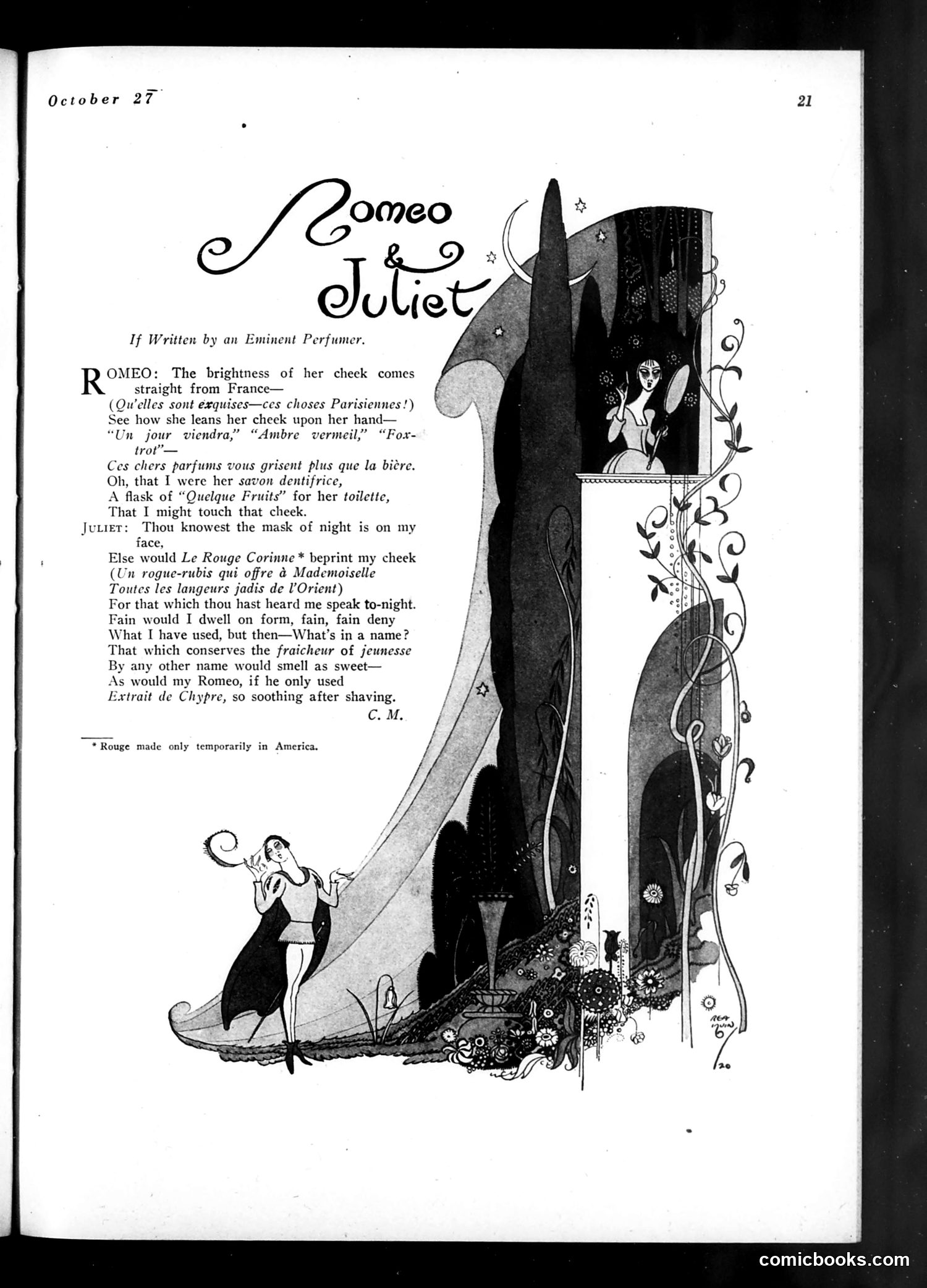
This is a humorous parody of Shakespeare's famous balcony scene from *Romeo and Juliet*, rewritten by "an Eminent Perfumer" to advertise cosmetics and toiletries. The satire works by replacing romantic declarations with product plugs—Romeo praises Juliet's appearance while name-dropping French perfumes ("Ambre vermeil," "Le Rouge Corinne"), soaps, and aftershave. The joke lampoons both excessive consumerism and the fashion industry's obsession with French beauty products in early 20th-century America. The footnote about "Rouge made only temporarily in America" suggests American cosmetics companies couldn't match French quality, poking fun at American vanity and commercial competition. The elaborate Art Deco illustration frames the text as high-class advertising, though the content is deliberately absurd—reducing timeless romance to a shopping list.
This page contains three brief film reviews from Life's entertainment section, likely from the 1920s based on the silent film references and actors mentioned (Richard Dix, Helene Chadwick, Anna Q. Nilsson). **"Dangerous Curve Ahead"** is criticized as derivative melodrama about a young married couple with children. The reviewer sarcastically compares director Rupert Hughes to French novelist Balzac. The film loses sympathy when the wife abandons her sick child for a social event—the reviewer mocks this as fake "movie actress" theatricality rather than authentic human behavior. **"Why Girls Leave Home"** ironically began as a joke title comedians used in vaudeville acts. The reviewer is pleasantly surprised the actual film succeeds, crediting actress Anna Q. Nilsson's emotional performance. **"After the Show"** critiques Rita Weiman's theatrical story about a chorus girl, noting the tired fiction trope of kind-hearted stage-door keepers, which the reviewer claims bears no resemblance to real life. The tone throughout is witty, slightly condescending toward cinema as an art form.
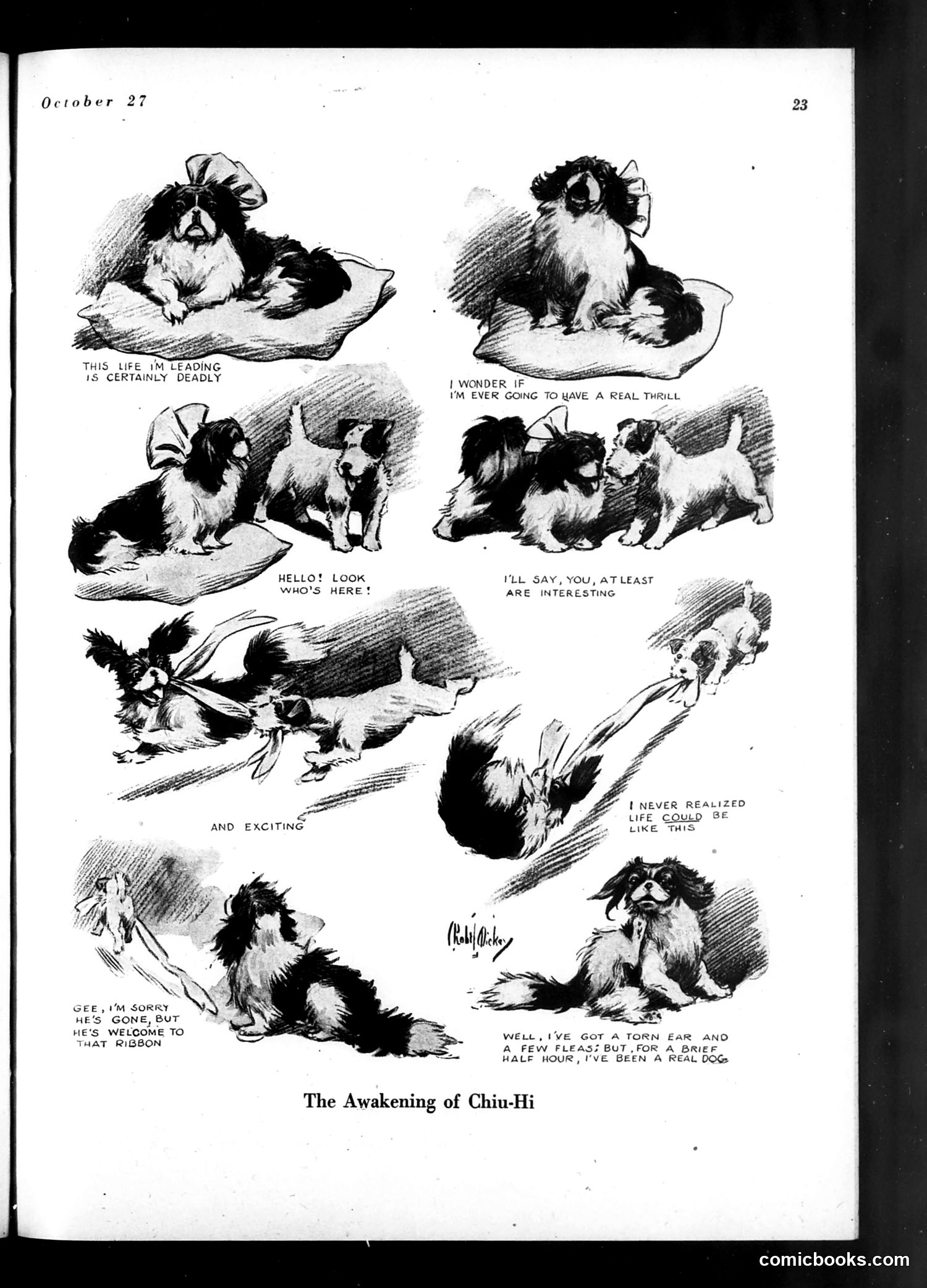
This is a comic strip about a lapdog's transformation. The narrative follows what appears to be a pampered, well-groomed small dog (likely a Pekingese or similar breed, given the name "Chiu-Hi") who initially complains that his sheltered life is "deadly" and boring, lacking real thrills. When a scrappy street dog arrives, the lapdog experiences genuine excitement and adventure for the first time—playing, roughhousing, and getting dirty (acquiring a torn ear and fleas in the process). The satire critiques the artificiality of pampered, over-protected existence versus the vitality found in authentic, unrefined living. The final panel's admission—that despite the discomfort, he briefly felt like "a real dog"—suggests the cartoonist is commenting on how domestication and excessive refinement can drain life of genuine meaning and experience. It's a gentle social commentary on the cost of comfort and gentility.
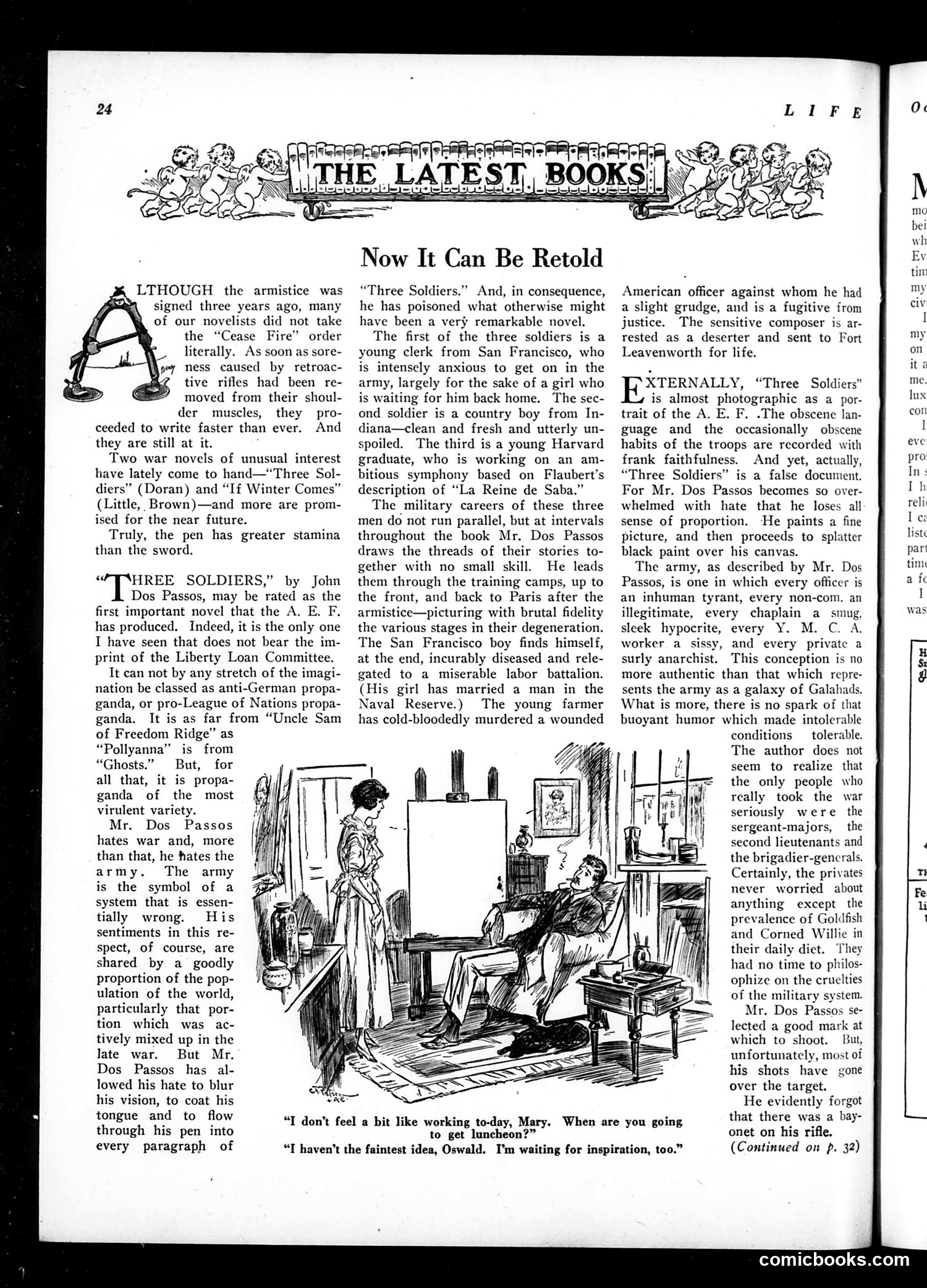
This page reviews John Dos Passos's 1921 novel *Three Soldiers*, one of the first major American literary treatments of World War I. The reviewer acknowledges Dos Passos's important achievement—a war novel free from patriotic propaganda or Liberty Loan Committee messaging—yet criticizes him for letting his hatred of war and the military corrupt his artistic vision. The review characterizes the novel as "propaganda of the most virulent variety," arguing that while Dos Passos captures army life photographically, he loses proportion by painting all officers as tyrants and non-commissioned officers as illegitimate. The three soldier protagonists meet tragic fates: disease, murder/fugitive status, and desertion. The accompanying cartoon shows two office workers (labeled Mary and Oswald) procrastinating—a lighter commentary on creative inspiration versus actual work, contrasting with Dos Passos's weighty subject matter.
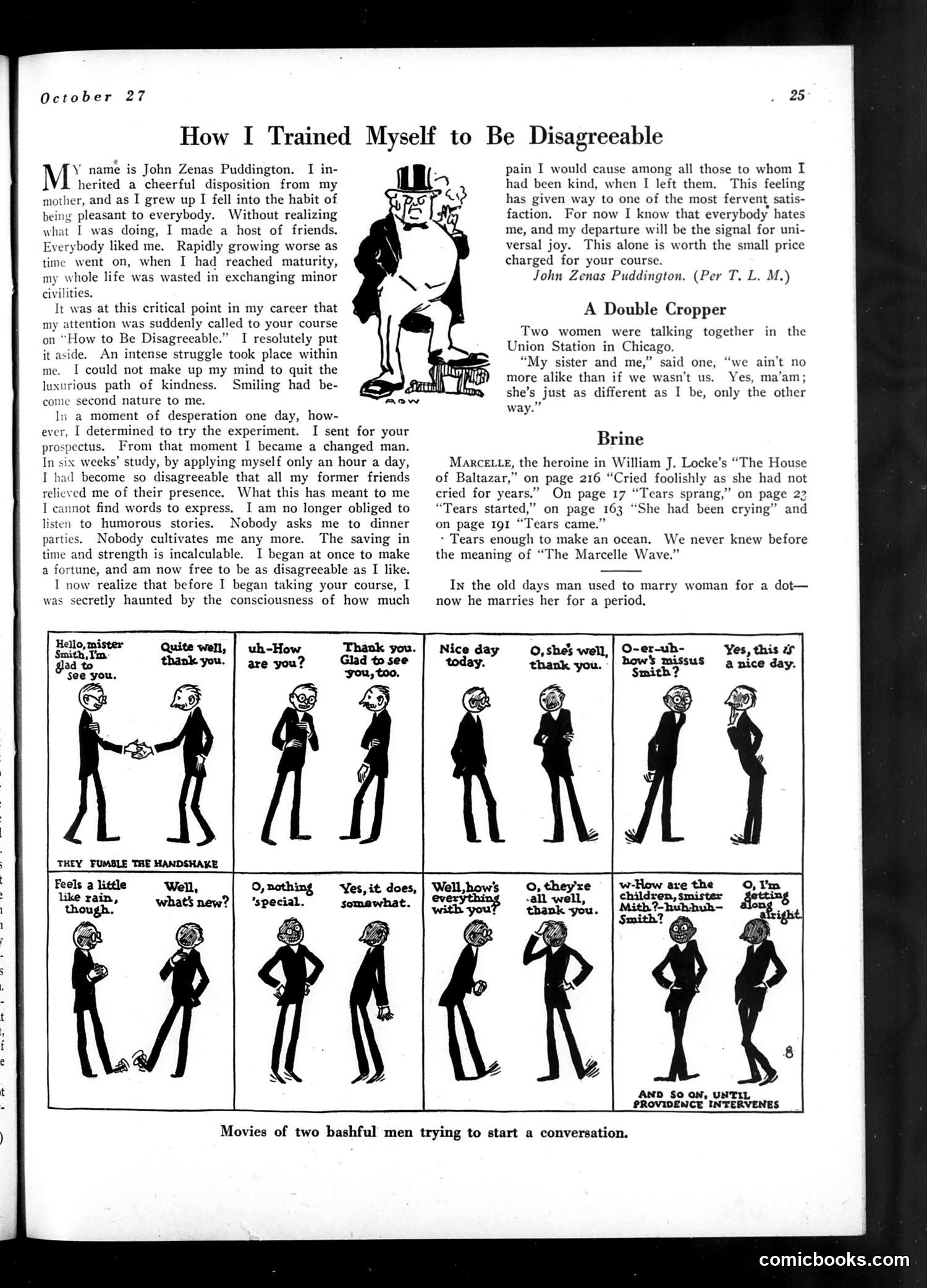
This page satirizes social awkwardness and behavioral self-improvement through three pieces: **"How I Trained Myself to Be Disagreeable"** mocks self-help culture by presenting a testimonial from a man who took a course to become deliberately unpleasant. The satire is that being disagreeable—rejecting kindness and civility—supposedly freed him from social obligations and made him wealthy. It's a commentary on how excessive politeness wastes time and energy, inverting the era's emphasis on etiquette. **"A Double Cropper"** is a brief joke about indistinguishable differences—two sisters are "as different as I be, only the other way"—poking fun at circular logic and unclear speech. **"Brine"** ridicules William J. Locke's novel for excessive tearfulness, counting multiple instances of crying across pages. The bottom cartoon shows two socially awkward men struggling through an excruciatingly stilted conversation, illustrating the difficulty of basic social interaction—the visual punchline being their painful, repetitive small talk continuing "until Providence intervenes" (death).
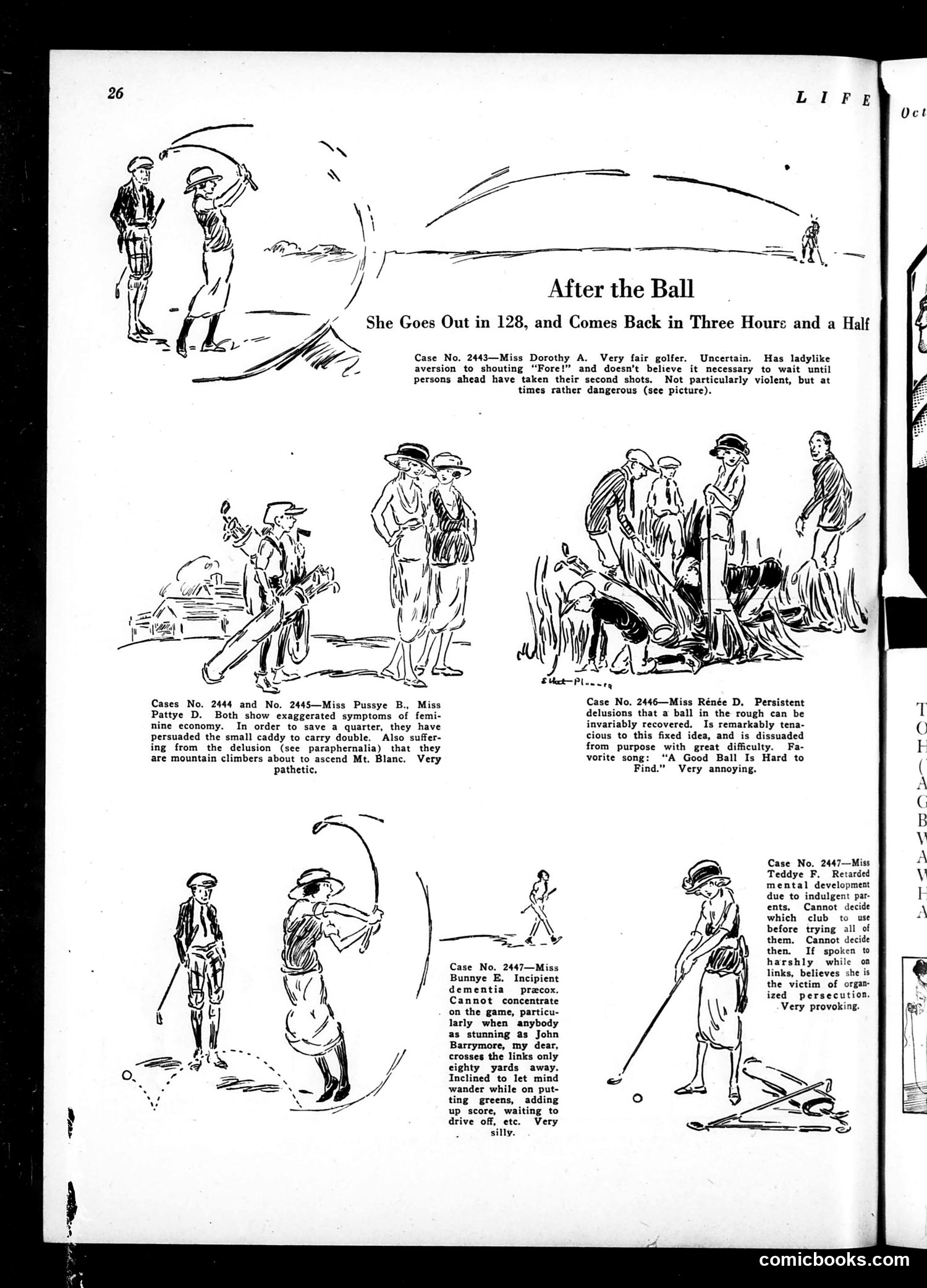
This 1920s Life magazine page satirizes women golfers through mock medical "case studies." The humor targets female golf players as mentally or socially deficient: **The cases mock:** - Women's supposed timidity (not shouting "Fore!" warnings) - Economic stinginess (sharing caddies to save a quarter) - Distraction by male celebrities (John Barrymore) - Indecision and stubbornness on the course - Overly dramatic sensitivity to criticism The title's joke—a woman leaves at 128 strokes and returns in 3.5 hours—suggests slow, incompetent play. This reflects early-20th-century gender anxiety: as women increasingly participated in golf and other leisure activities previously male-dominated, satirists used pseudo-scientific humor ("dementia praecox," "retarded mental development") to mock their participation as inherently ridiculous or pathological. The cartoons present female golfers as emotional, illogical, and comically unsuited to the sport.
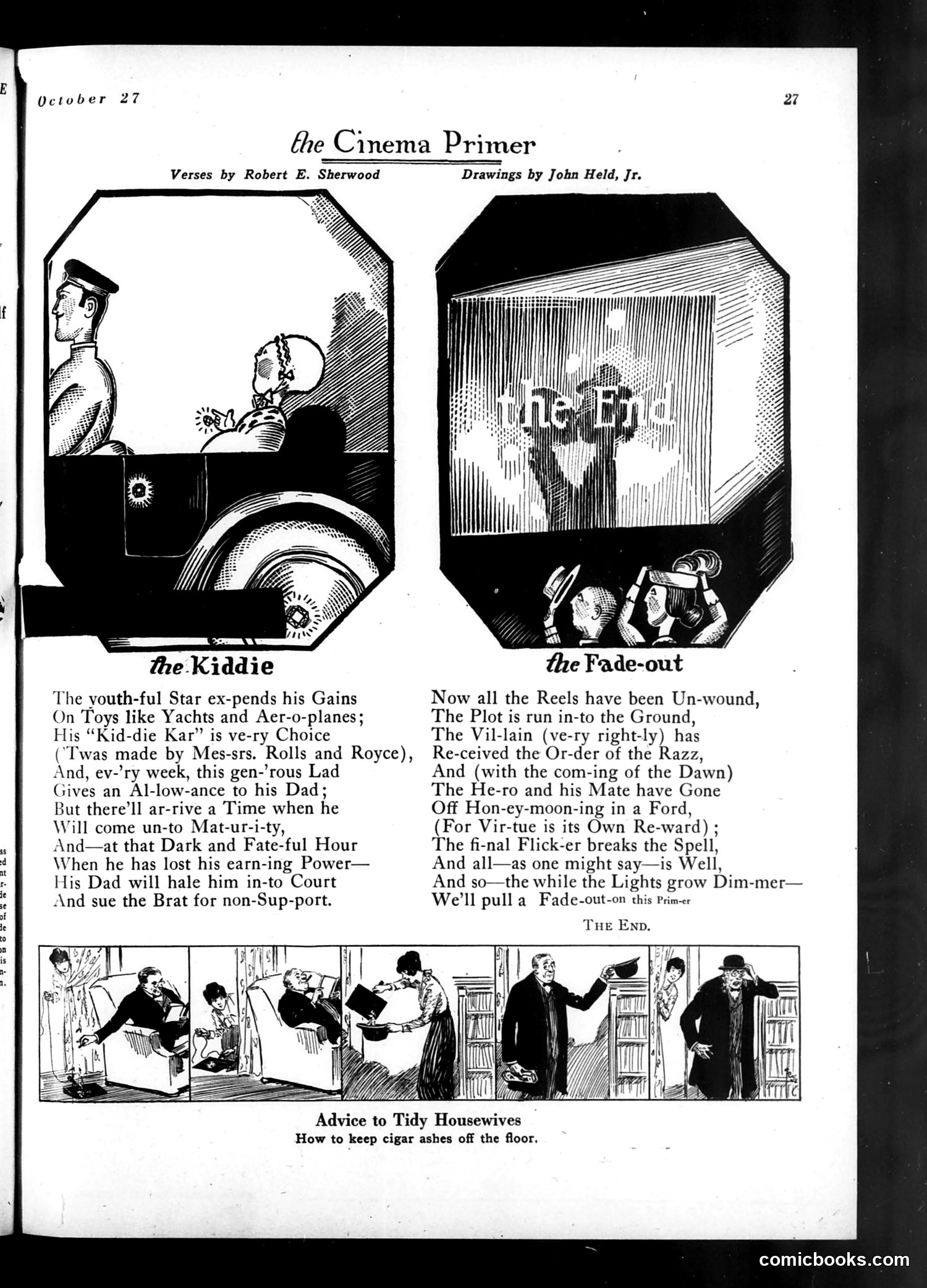
This is a satirical feature about silent film tropes, with two cartoon scenarios: **"The Kiddie"**: Mocks wealthy young film stars who squander fortunes on luxury toys (Rolls-Royce cars, yachts, planes) and support idle fathers through allowances. The joke's dark punchline: when the child star's earning power fades with age, the father will sue him for non-support—reversing the dependency. **"The Fade-out"**: Parodies predictable movie endings: the villain gets booed, the hero and heroine elope in a Ford (a humble car, humorous contrast to the "Kiddie's" extravagance), virtue is its own reward, and the film ends with standard theatrical fade-to-black as theater lights dim. The bottom strip, "Advice to Tidy Housewives," appears unrelated—practical domestic humor about cigar ash management. Robert E. Sherwood's verse and John Held Jr.'s drawings satirize both child-star excess and formulaic silent-film conventions of the 1920s.
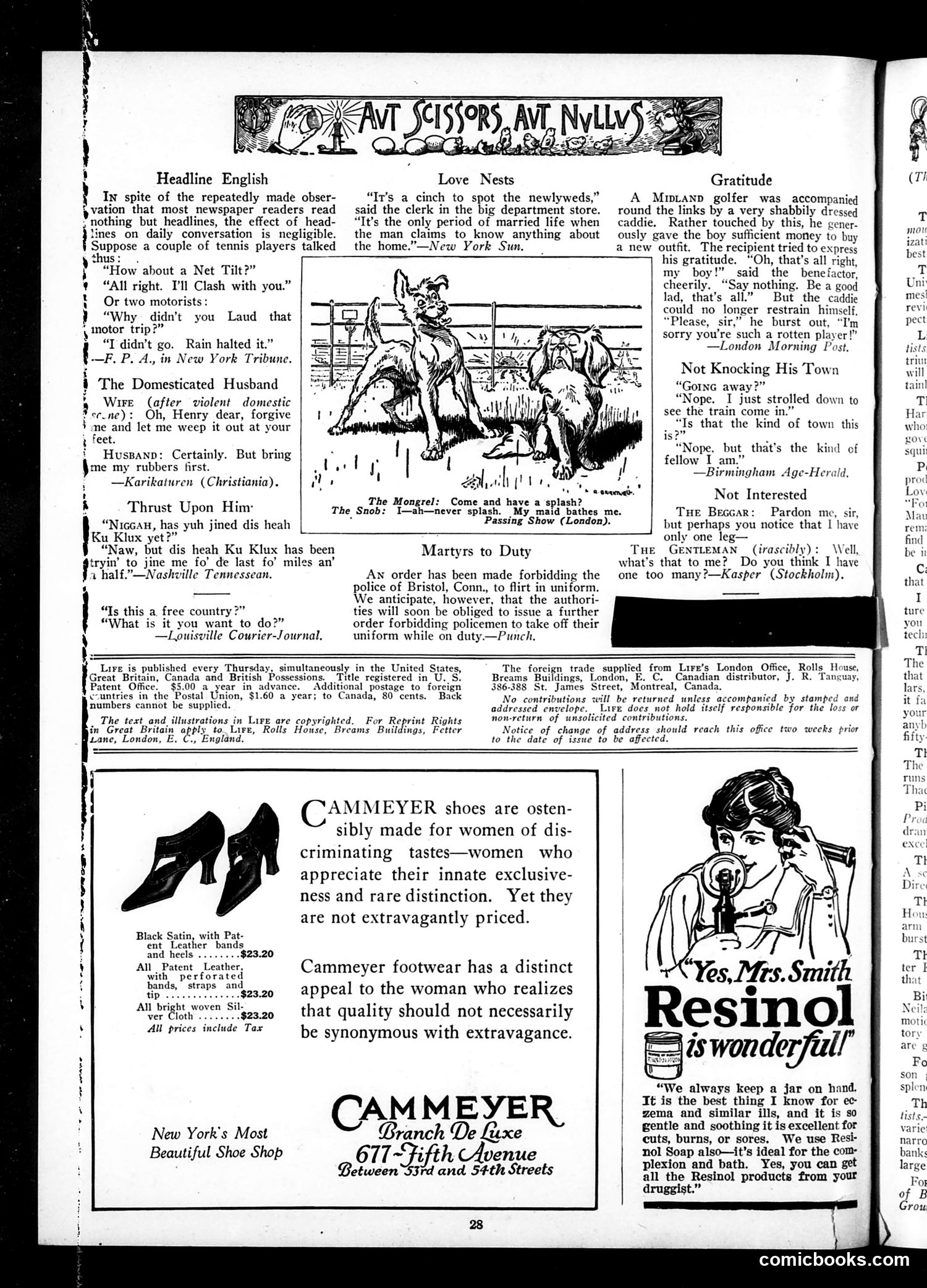
This page from *Life* magazine consists primarily of **short humorous jokes and anecdotes** organized under headers like "Headline English" and "Love Nests," along with advertisements for Cammeyer shoes and Resinol product. The jokes satirize everyday social situations: a caddie's blunt honesty about his employer's golf skills, a snobbish character claiming his maid bathes him (mocking pretension), and a beggar with one leg challenging a gentleman's assumptions. One piece mocks newspaper headline-reading culture, suggesting people discuss events based only on headlines rather than full stories. The "Martyrs to Duty" item references a real Bristol, Connecticut police order forbidding officers to flirt in uniform—*Punch* humorously predicts authorities will next ban them removing uniforms entirely, commenting on absurd bureaucratic escalation. The overall tone targets human vanity, social pretension, and bureaucratic excess through observational humor typical of early 20th-century American satirical magazines.
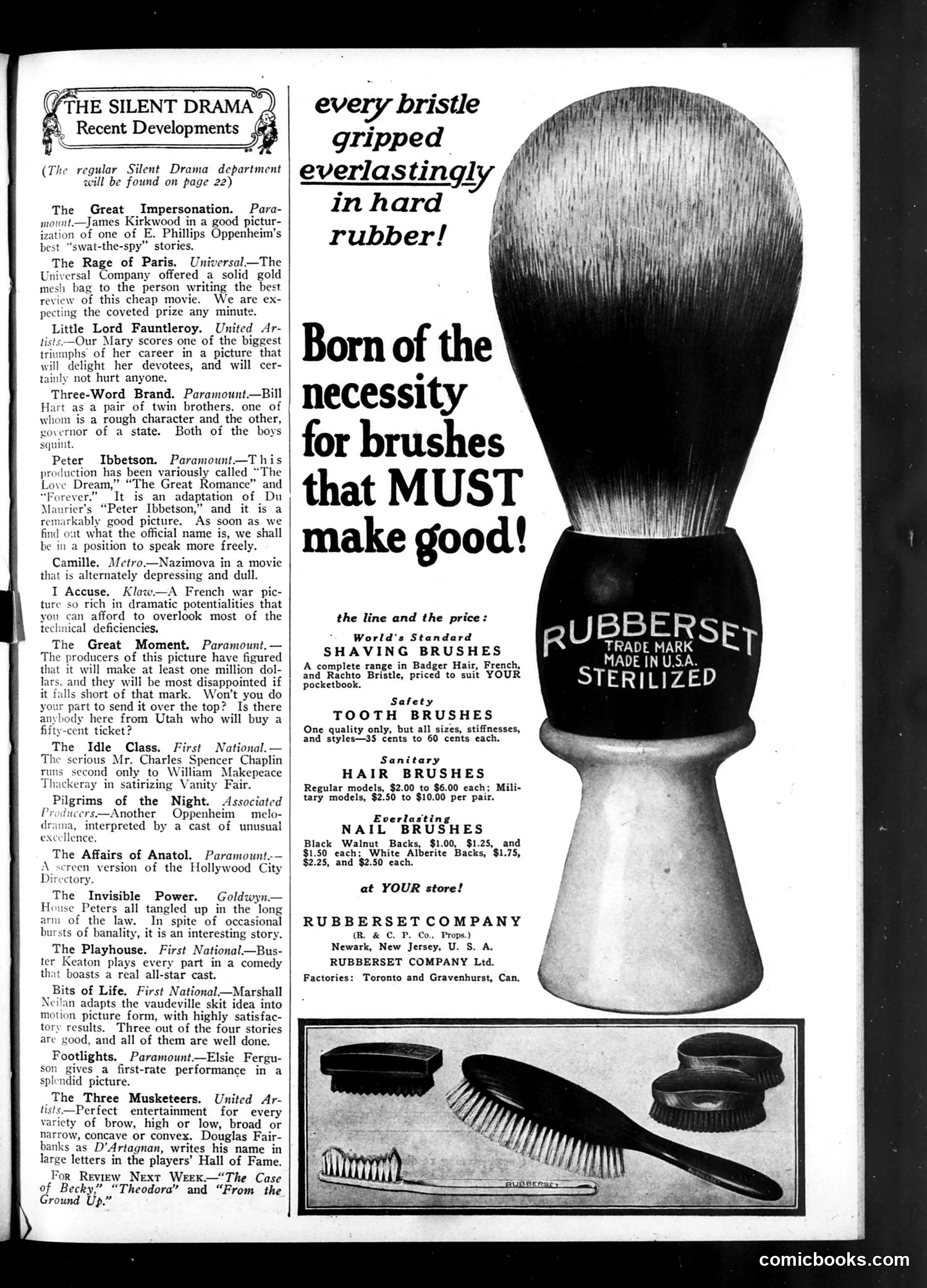
This page is primarily **advertising disguised as editorial content**. The left column contains brief reviews of silent films (titled "The Silent Drama: Recent Developments"), but the dominant feature is a full-page advertisement for Rubberset brand brushes. The advertisement uses a large illustration of a brush head to make a straightforward commercial pitch: these are durable, practical brushes "born of necessity" that perform well. The text emphasizes quality ("every bristle gripped everlastingly in hard rubber") and lists product lines—shaving, tooth, hair, and nail brushes—with prices. **There is no political satire or cartoon here.** This appears to be a standard editorial-advertising hybrid common in early 20th-century magazines, where product advertisements were integrated into magazine pages alongside content. The brush illustration is product-focused rather than editorial commentary. The film reviews are brief, somewhat dismissive notices typical of Life magazine's sardonic house style ("cheap movie," "alternately depressing and dull"), but they comment on contemporary Hollywood productions, not social issues.
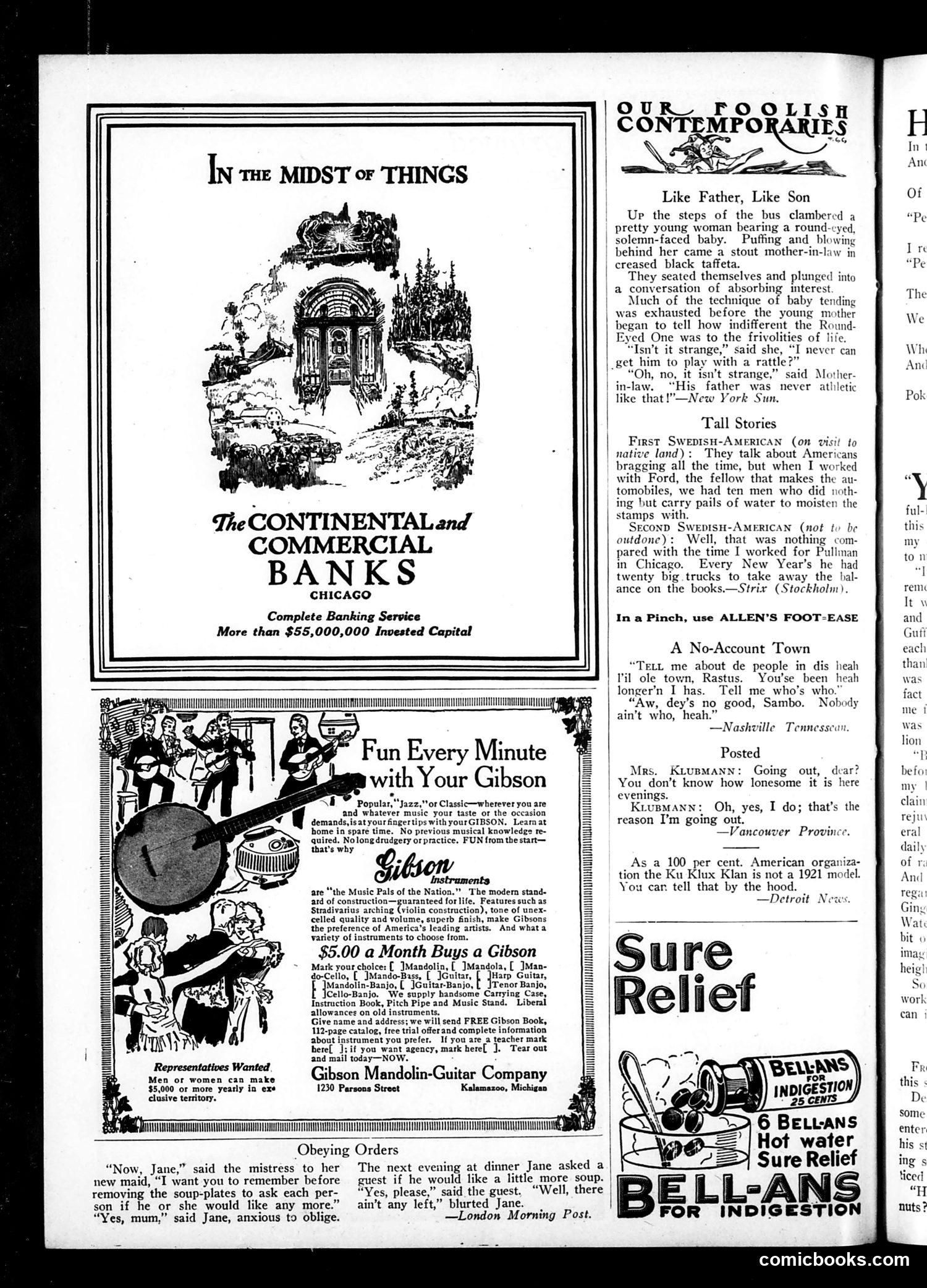
This page from *Life* magazine contains several short humorous anecdotes reflecting early 20th-century American social attitudes: **"Like Father, Like Son"**: A joke about heredity—a baby won't play with a rattle, and the mother-in-law explains it's because his father was never athletic either. The humor relies on the period's belief in inherited personality traits. **"Tall Stories"**: Two Swedish immigrants compete with exaggerated workplace tales. The satire targets both immigrant boasting and American industrial culture—one claims Ford's factory wasted labor on water-carrying; the other tops it with a Pullman Railroad story about yearly write-offs. The humor mocks both immigrant stereotypes and corporate inefficiency. **"A No-Account Town"**: A brief dialect joke between two Black characters dismissing their town's inhabitants. It reflects the racist humor typical of the era's publications. **"As a 100 per cent. American organization..."**: A brief, biting comment that the KKK's 1921 resurgence is identifiable "by the hood"—dark satire on the organization's recent revival and violence. The page primarily advertises Gibson musical instruments and other products.
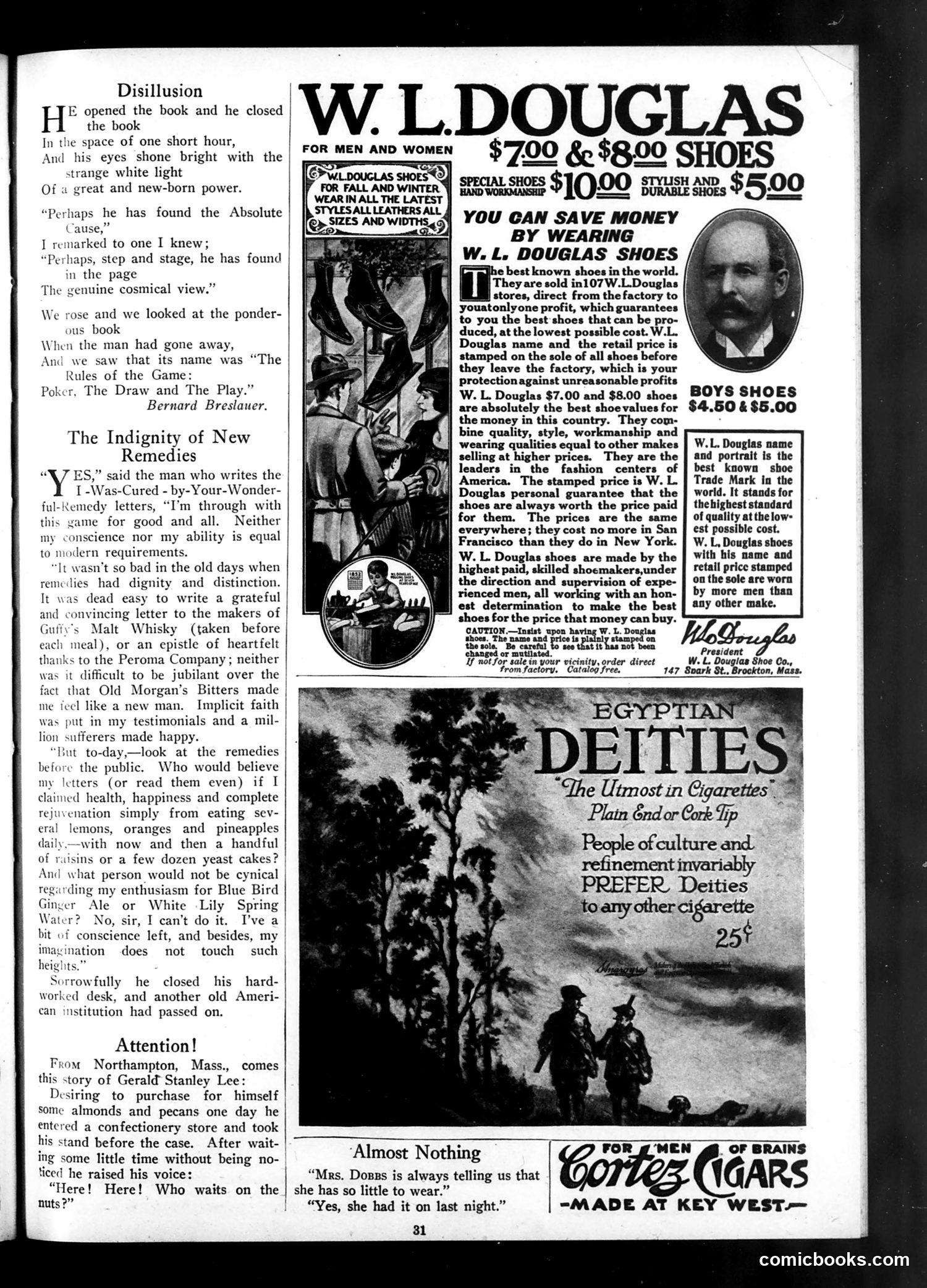
This page contains three distinct satirical pieces mocking American culture: **"Disillusion"** ridicules pretentious intellectualism. A man reads a book that appears profoundly meaningful ("great and new-born power"), but it's revealed to be merely a poker instruction manual—satirizing how people project sophistication onto mundane subjects. **"The Indignity of New Remedies"** mocks the patent medicine industry's decline. A testimonial writer laments that old "wonder cures" (whisky, tonics) commanded credibility, but modern remedies claiming health benefits from fruit and yeast seem absurd. The satire critiques both the industry's previous shamelessness and modern skepticism. **"Attention!"** is a brief joke about inattentive service, where a customer waiting at a confectionery counter sarcastically asks "Who waits on the nuts?"—a pun conflating the merchandise with the staff's mental capacity. The page is otherwise dominated by period advertisements (W.L. Douglas shoes, Egyptian Deities cigarettes, Cortez cigars), which are not satirical content but standard commercial messaging.
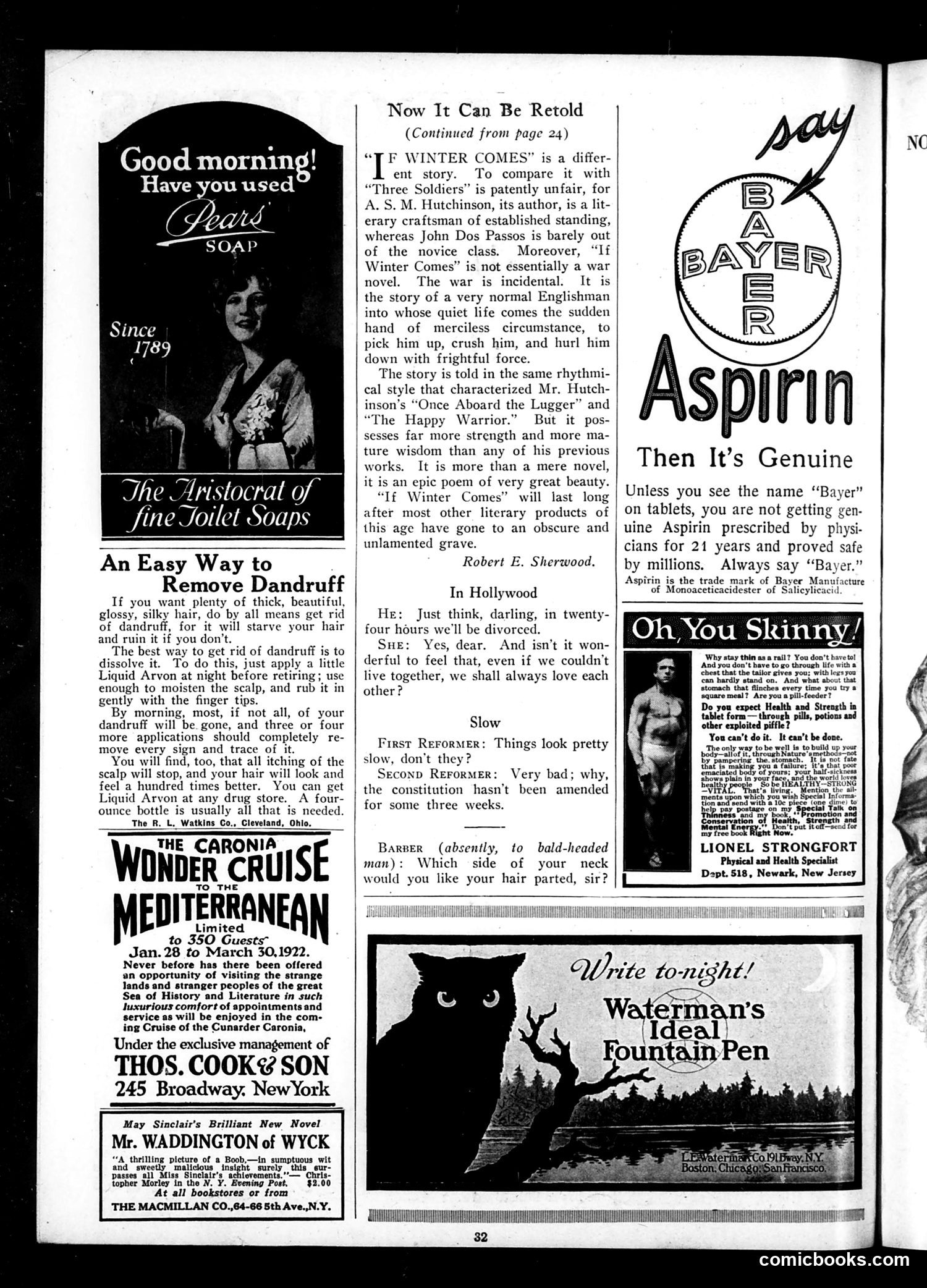
This page is primarily **advertising and book reviews**, not political satire or comics in the modern sense. The substantive content includes: **Book Reviews**: Robert E. Sherwood reviews A.S.M. Hutchinson's novel "If Winter Comes," praising it as superior to John Dos Passos's "Three Soldiers" for its literary craftsmanship and depth. **Light Humor Pieces**: Three brief jokes—one about a Hollywood couple divorcing, one mocking slow constitutional reform, and one with a barber's wordplay about hair parting—are mild social commentary reflecting 1920s concerns (divorce, slow legal progress, appearance). **Advertisements**: The page is dominated by product ads (Pear's Soap, Bayer Aspirin, Waterman's pens, cruise lines, health tonics), typical of Life magazine's commercial content. **No Political Cartoons**: Despite the request, this page contains no political cartoons or sustained satirical imagery—just conventional period advertising and brief, gentle satirical vignettes.