
Life, 1921-10-27 · page 20 of 34
Life — October 27, 1921 — page 20: what you’re looking at
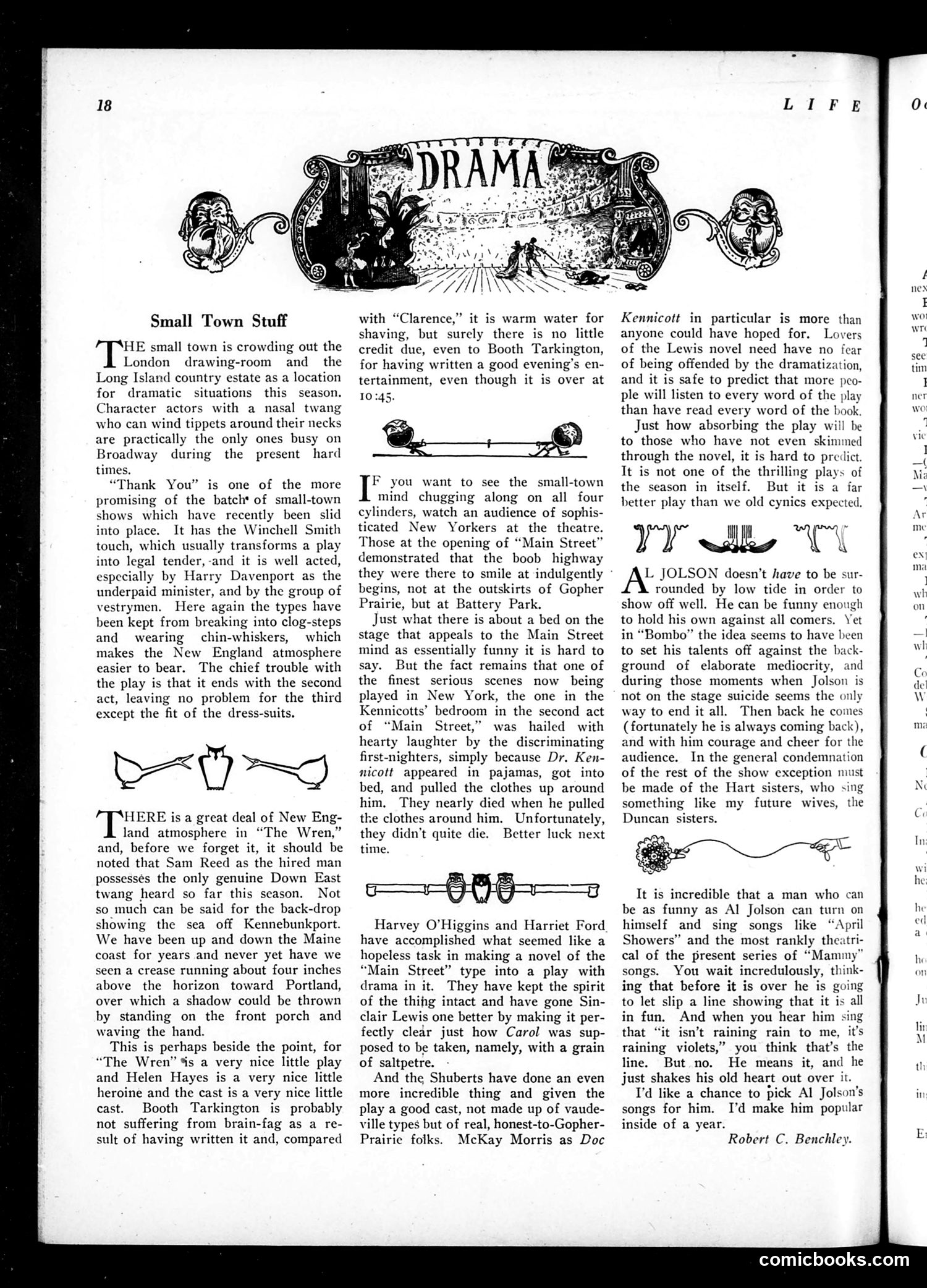
What you’re looking at
This page reviews Broadway plays with small-town American settings that were becoming popular during an economically difficult theatrical season. The critic discusses several productions: **"Thank You"** and **"The Wren"** are praised as competent small-town comedies, with particular credit given to actor Sam Reed for his authentic "Down East" Maine accent. The reviewer gently mocks the theatrical set design for its unrealistic portrayal of the Maine coast. **"Main Street,"** adapted from Sinclair Lewis's novel, receives the most attention. The critic humorously notes that sophisticated New York theater audiences—sitting in Battery Park—laughed inappropriately at a serious bedroom scene simply because the actor wore pajamas and got into bed. The satire targets urban sophistication: the "boob highway" the play mocks begins not in fictional Gopher Prairie, Minnesota, but at the theater itself. The adaptation by O'Higgins and Ford is praised for maintaining Lewis's satirical intent about small-town life, while the casting with authentic character actors (rather than vaudeville performers) is commended.
📄 Transcribed text from this page (OCR, searchable)
Machine-transcribed from the original scan — historical spelling and the odd misread are preserved.
Small Town Stuff HE small town is crowding out the London drawing-room and_ the Long Island country estate as a location for dramatic situations this season. Character actors with a nasal twang who can wind tippets around their necks are practically the only ones busy on during the present hard Broadway times. “Thank You” is one of the more promising of the batch of small-town shows which have recently been slid into place. It has the Winchell Smith touch, which usually transforms a play into legal tender, -and it is well acted, especially by Harry Davenport as the underpaid minister, and by the group of vestrymen. Here again the types have been kept from breaking into clog-steps and wearing chin-whiskers, which makes the New England atmosphere easier to bear. The chief trouble with the play is that it ends with the second act, leaving no problem for the third except the fit of the dress-suits. arn hae, HERE is a great deal of New Eng- land atmosphere in “The Wren,” and, before we forget it, it should be noted that Sam Reed as the hired man possessés the only genuine Down East twang heard so far this season. Not so much can be said for the back-drop showing the sea off Kennebunkport. We have been up and down the Maine coast for years and never yet have we seen a crease running about four inches above the horizon toward Portland, over which a shadow could be thrown by standing on the front porch and waving the hand. This is perhaps beside the point, for “The Wren” %s a very nice little play and Helen Hayes is a very nice little heroine and the cast is a very nice little cast. Booth Tarkington is probably not suffering from brain-fag as a re- sult of having written it and, compared with “Clarence,” it is warm water for shaving, but surely there is no little credit due, even to Booth Tarkington, for having written a good evening’s en- tertainment, even though it is over at 10:45. F you want to see the small-town mind chugging along on all four cylinders, watch an audience of sophis- ticated New Yorkers at the theatre. Those at the opening of “Main Street” demonstrated that the boob highway they were there to smile at indulgently begins, not at the outskirts of Gopher Prairie, but at Battery Park. Just what there is about a bed on the stage that appeals to the Main Street mind as essentially funny it is hard to say. But the fact remains that one of the finest serious scenes now being played in New York, the one in the Kennicotts’ bedroom in the second act of “Main Street,” was hailed with hearty laughter by the discriminating first-nighters, simply because Dr. Ken- nicott appeared in pajamas, got into bed, and pulled the clothes up around him, They nearly died when he pulled tke clothes around him. Unfortunately, they didn’t quite die. Better luck next time. = §8G——s Harvey O'Higgins and Harriet Ford have accomplished what seemed like a hopeless task in making a novel of the “Main Street” type into a play with drama in it. They have kept the spirit of the thing intact and have gone Sin- clair Lewis one better by making it per- fectly clear just how Carol was sup- posed to be taken, namely, with a grain of saltpetre. And the Shuberts have done an even more incredible thing and given the play a good cast, not made up of vaude- ville types but of real, honest-to-Gopher- Prairie folks. McKay Morris as Doc Kennicott in particular is more than anyone could have hoped for. Lovers of the Lewis novel need have no fear of being offended by the dramatization, and it is safe to predict that more pco- ple will listen to every word of the play than have read every word of the book. Just how absorbing the play will be to those who have not even skimmed through the novel, it is hard to predict. It is not one of the thrilling plays of the season in itself. But it is a far better play than we old cynics expected. ry Mh fi aaa . AY XN JOLSON doesn’t have to be sur- rounded by low tide in order to show off well. He can be funny enough to hold his own against all comers. Yet in “Bombo” the idea seems to have been to set his talents off against the back- ground of elaborate mediocrity, and during those moments when Jolson is not on the stage suicide seems the only way to end it all. Then back he comes (fortunately he is always coming back), and with him courage and cheer for the audience. In the general condemnation of the rest of the show exception must be made of the Hart sisters, who sing something like my future wives, the Duncan sisters. It is incredible that a man who can be as funny as Al Jolson can turn on himself and sing songs like “April Showers” and the most rankly theatri- cal of the present series of “Mammy” songs. You wait incredulously, think- ing that before it is over he is going to let slip a line showing that it is all in fun, And when you hear him sing that “it isn’t raining rain to me, it’s raining violets,” you think that’s the line. But no. He means it, and he just shakes his old heart out over it. I'd like a chance to pick Al Jolson’s songs for him. I’d make him popular inside of a year. Robert C. Benchley. comicbooks.com