
Life, 1921-10-27 · page 6 of 34
Life — October 27, 1921 — page 6: what you’re looking at
What you’re looking at
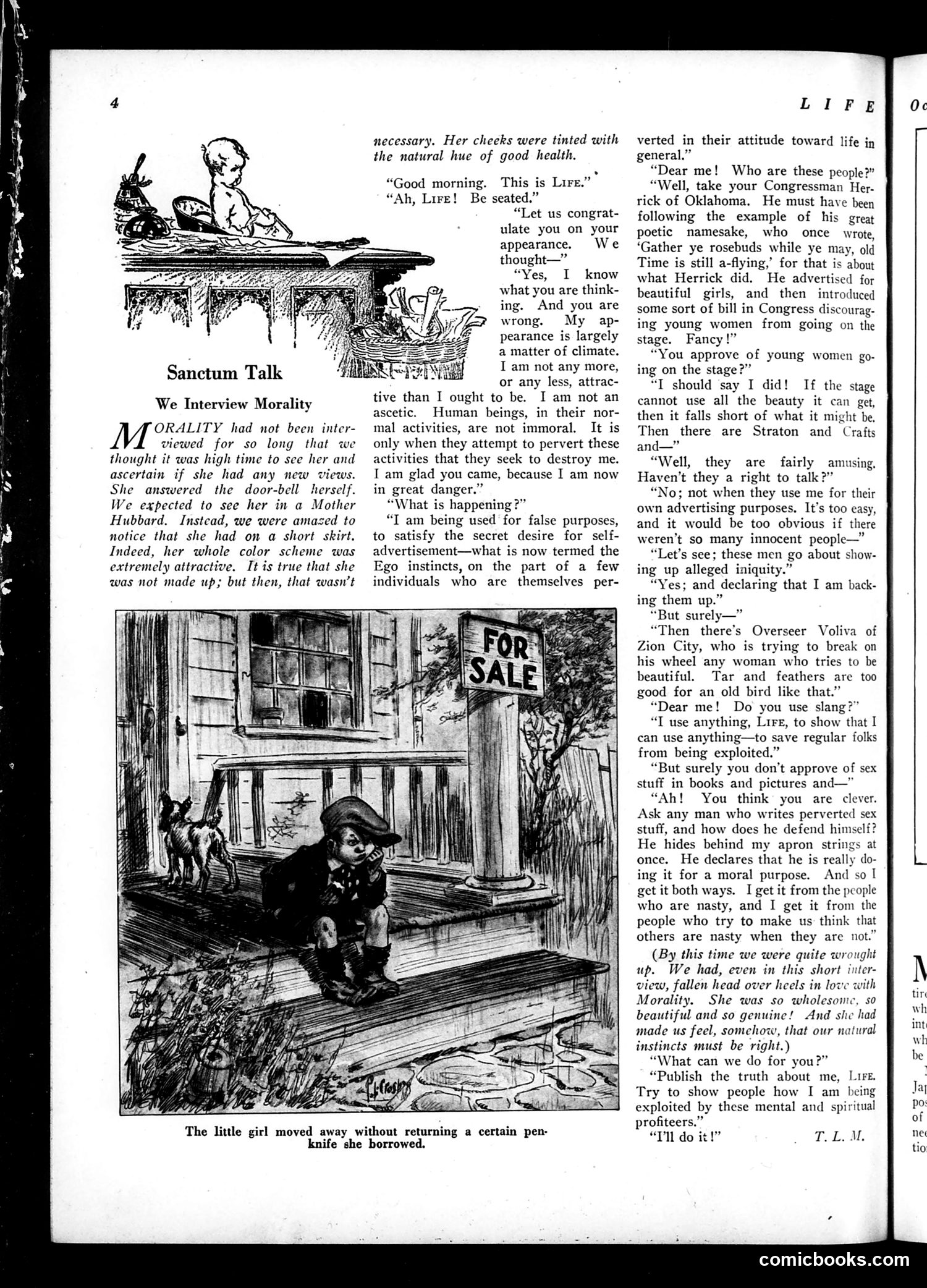
This satirical piece personifies "Morality" as a woman being interviewed. The text reveals the satire's target: she's being exploited for advertising purposes by those claiming moral authority while engaging in the very behaviors they condemn. Key social critiques include: - **Hypocrisy about women**: A Congressman from Oklahoma (likely referencing real political figures) promoted young women for stage work while advertising "poetic" ideals - **Double standards**: Writers defend "perverted sex stuff" in books as morally educational while attacking others as immoral - **Selective outrage**: The wealthy and powerful hide behind morality rhetoric while profiting from exploitation The cartoon shows a poor child outside a "For Sale" house—illustrating economic hardship contrasting with the wealthy's moral posturing. The satire attacks how "Morality" becomes a convenient mask for self-interest and exploitation.
📄 Transcribed text from this page (OCR, searchable)
Machine-transcribed from the original scan — historical spelling and the odd misread are preserved.
Sanctum Talk We Interview Morality ORALITY had not been inter- viewed for so long that we thought it was high time to see her and ascertain if she had any new views. She answered the door-bell herself. We expected to see her in a Mother Hubbard. Instead, we were amazed to notice that she had on a short skirt. Indeed, her whole color scheme was extremely attractive. It is true that she was not made up; but then, that wasn’t necessary. Her cheeks were tinted with the natural hue of good health. “Good morning. This is Lire.” “Ah, Lire! Be seated.” “Let us congrat- ulate you on your appearance. We thought—” “Yes, I know what you are think- ing. And you are wrong. My ap- pearance is largely a matter of climate. I am not any more, or any less, attrac- tive than I ought to be. I am not an ascetic. Human beings, in their nor- mal activities, are not immoral. It is only when they attempt to pervert these activities that they seek to destroy me. I am glad you came, because I am now in great danger.” “What is happening?” “I am being used for false purposes, to satisfy the secret desire for self- advertisement—what is now termed the Ego instincts, on the part of a few individuals who are themselves per- The little girl moved away without returning a certain pen- knife she borrowed. LIFE verted in their attitude toward life in general,” “Dear me! Who are these people?” “Well, take your Congressman Her- rick of Oklahoma. He must have been following the example of his great poetic namesake, who once Wrote, ‘Gather ye rosebuds while ye may, old Time is still a-flying,’ for that is about what Herrick did. He advertised for beautiful girls, and then introduced some sort of bill in Congress discourag- ing young women from going on the stage. Fancy!” “You approve of young women go- ing on the stage?” “I should say I did! If the stage cannot use all the beauty it can get, then it falls short of what it might be, Then there are Straton and Crafts and—” “Well, they are fairly amusing, Haven't they a right to talk?” “No; not when they use me for their own advertising purposes. It’s too easy, and it would be too obvious if there weren't so many innocent people—” “Let’s see; these men go about show- ing up alleged iniquity.” “Yes; and declaring that I am back- ing them up.” “But surely—” “Then there’s Overseer Voliva of Zion City, who is trying to break on his wheel any woman who tries to be beautiful. Tar and feathers are too good for an old bird like that.” “Dear me! Do you use slang?” “I use anything, Lire, to show that I can use anything—to save regular folks from being exploited.” “But surely you don't approve of sex stuff in books and pictures and—" “Ah! You think you are clever. Ask any man who writes perverted sex stuff, and how does he defend himself? He hides behind my apron strings at once. He declares that he is really do- ing it for a moral purpose. And so I get it both ways. I get it from the people who are nasty, and I get it from the people who try to make us think that others are nasty when they are not.” (By this time we were quite wrought up. We had, even in this short inter- view, fallen head over heels in love with Morality. She was so wholesome, so beautiful and so genuine! And she had made us feel, somehow, that our natural instincts must be right.) “What can we do for you?” “Publish the truth about me, Lire. Try to show people how I am being exploited by these mental and spiritual profiteers.” “Tl do it!” T.LLM, comicbooks.com