
Life, 1921-10-27 · page 17 of 34
Life — October 27, 1921 — page 17: what you’re looking at
What you’re looking at
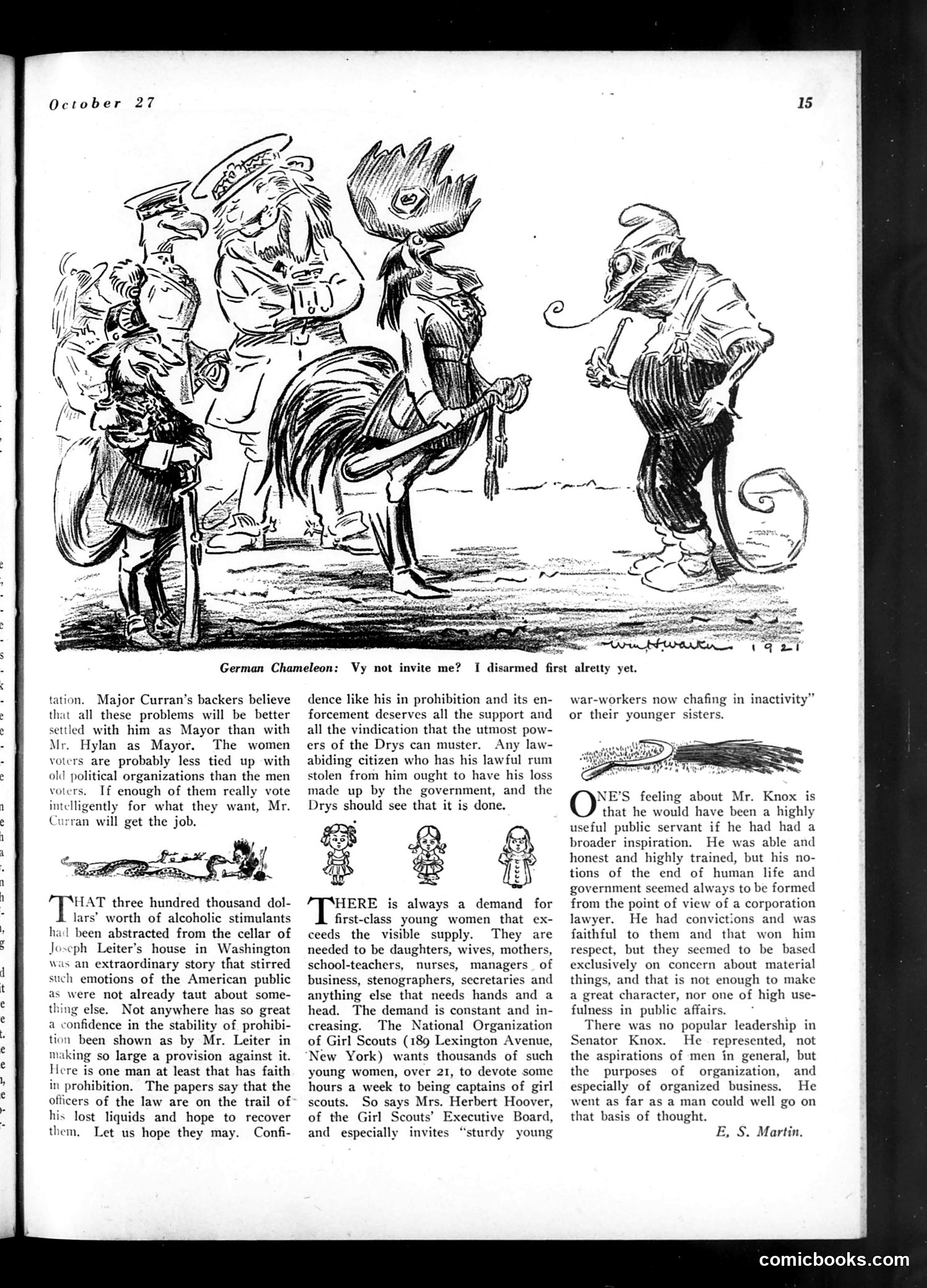
The top cartoon depicts a German military figure (identified as "German Chameleon") being excluded from a gathering of Allied officers, sarcastically asking "Why not invite me? I disarmed first already yet." This post-WWI satire mocks Germany's claimed disarmament and its attempt to rejoin the international community after defeat. The "chameleon" metaphor suggests Germany was being deceptive about its true intentions. The page's text discusses American domestic issues: a NYC mayoral race (Curran vs. Hylan), Prohibition enforcement (Joseph Leiter's stolen liquor), Girl Scouts recruitment, and a retrospective assessment of Senator Knox's public service as overly corporate-focused rather than inspirational. The cartoons and articles collectively reflect 1920s American preoccupations with post-war geopolitics, Progressive Era social reform, and evaluating leadership character versus technical competence.
📄 Transcribed text from this page (OCR, searchable)
Machine-transcribed from the original scan — historical spelling and the odd misread are preserved.
October 27 German Chameleon: Vy not invite me? tation. Major Curran’s backers believe that all these problems will be better settled with him as Mayor than with Mr. Hylan as Mayor. The women voters are probably less tied up with old political organizations than the men If enough of them really vote intelligently for what they want, Mr. Curran will get the job. HAT three hundred thousand dol- lars’ worth of alcoholic stimulants had been abstracted from the cellar of Joseph Leiter's house in Washington Was an extraordinary story that stirred such emotions of the American public as were not already taut about some- thing else. Not anywhere has so great confidence in the stability of prohibi- tion been shown as by Mr. Leiter in making so large a provision against it. Here is one man at least that has faith in prohibition. The papers say that the oflicers of the law are on the trail of his lost liquids and hope to recover them. Let us hope they may. Confi- voters. dence like his in prohibition and its en- forcement deserves all the support and all the vindication that the utmost pow- ers of the Drys can muster. Any law- abiding citizen who has his lawful rum stolen from him ought to have his loss made up by the government, and the Drys should see that it is done. ne’ Ag HERE is always a demand for first-class young women that ex- ceeds the visible supply. They are needed to be daughters, wives, mothers, school-teachers, nurses, managers of business, stenographers, secretaries and anything else that needs hands and a head. The demand is constant and in- creasing. The National Organization of Girl Scouts (189 Lexington Avenue, New York) wants thousands of such young women, over 21, to devote some hours a week to being captains of girl scouts. So says Mrs. Herbert Hoover, of the Girl Scouts’ Executive Board, and especially invites “sturdy young I disarmed first alretty yet. war-workers now chafing in inactivity” or their younger sisters. NE’S feeling about Mr. Knox is that he would have been a highly useful public servant if he had had a broader inspiration. He was able and honest and highly trained, but his no- tions of the end of human life and government seemed always to be formed from the point of view of a corporation lawyer. He had convictions and was faithful to them and that won him respect, but they seemed to be based exclusively on concern about material things, and that is not enough to make a great character, nor one of high use- fulness in public affairs. There was no popular leadership in Senator Knox. He represented, not the aspirations of men in general, but the purposes of organization, and especially of organized business. He went as far as a man could well go on that basis of thought. E, S. Martin. comicbooks.com